
A Position Statement on the Meaning of Christian Baptism
As part of our standard response to the gospel, God appointed baptism for expressing personal identification with Jesus Christ, which involves commitment to his lordship, values, and purposes. In consequence of our identity with him, God forgives our sin, grants fellowship with his Spirit, and numbers us among his children.
Read Essay →A Sketch on Baptism From Acts 2:38
Repent be baptized into the name of Jesus Messiah remission of sins
the Holy Spirit as a gift
Read Essay →Abstract of Distinctions About the Necessity of Baptism
1. A distinction needs to be made between standard situations and special cases. Denying the necessity of baptism applies only to special cases. Special cases include those in which
Read Essay →Baptism as Identification With Christ
Seeing baptism as identification with Christ provides a framework for working through several abnormal situations that arise and helps make sense even of normal situations that may be overlooked in the theory and practice of the ordinance.
Read Essay →Questions About Christian Baptism
Doctrinal Questions
1. What is baptism for (meaning)?
First, in Christian baptism we identify with Jesus Christ. The New Testament means identification when it speaks of (a) being baptized “into Christ,” “into the name of Christ,” and similar expressions (Matthew 28:19; Acts 2:38; 8:16; 10:48; 19:5; Galatians 3:27). We identify with the Messiah instead of with Moses (1 Corinthians 10:1-2) or John the Baptist (Acts l9:1-7) or the apostle Paul (1 Corinthians 1:13-15). As a result, we belong to Christ (1 Corinthians 3:22-23; 1:12). Paul means identification when he says that by baptism we are (b) “united with Christ” (1 Corinthians 6:5). Baptism is a pledge of allegiance to him in which we commit ourselves to his purposes, values, and motivations. We make that commitment to the extent of the death that baptism pictures.
Read Essay →Rebaptism
The wise policy is to let candidates make their own decision about rebaptism; after all, baptism is their obedience to God, not ours. Nevertheless, people usually take their cue from those they have come to trust on religious matters. For these reasons we will not always be able to leave the issue in the hands of candidates.
Read Essay →Rethinking the Description of Baptism
Introduction
Read Essay →Rightly Dividing the Word of Truth in Acts 2:38
Christian baptism is a self-expression of personal identification with Jesus Christ, and God gives consequences on the basis of that identity more than on the basis of the act itself: forgiveness of sin, gift of the Spirit, and fellowship in the body of Christ.
Read Essay →The Purpose of Christian Baptism: A Synopsis
CHRISTIANITY AS AN INTERPERSONAL “SYSTEM”
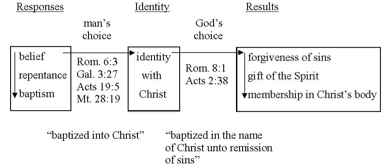
Two Basic Points About Baptism
Two points should be highlighted in presentations about baptism. First, baptism should not be too closely identified with outer response. That lends itself to distinguishing inner and outer, identifying faith with inner and baptism with outer, and then affirming that it is the inner dimension that justifies rather than the outer expressive act as well, thus trying to avoid baptism as a work and bringing it into conformity with the Pauline formula “salvation by faith” vs. works. But “faith” in Romans/Galatians does not mean inner action; that is the usage in James. Paul means action in the context of personal relationship (faith) vs. action in the context of legal process (works). We do well to unite inner and outer response in salvation and to consider baptism itself as comprised of both dimensions inseparably. That unity of aspects applies to all acts of obedience.
Read Essay →Types of Systems
Not all systems are alike. They often operate in respect to different kinds of matters, but the main contrast lies in the kinds of connectors in them that bind actions to results. Below are three types of systems that illustrate this diversity. We outline them here in order to clarify what causes people to differ so intensely about the role of Christian baptism in the salvation process. Basically what happens is that at various points in their total understanding of baptism they are shifting baptism back and forth between different systems without realizing it.
Read Essay →Understanding Christian Ordinances
Introduction
Read Essay →What the Very Existence of Baptism Shows
The very fact that baptism exists shows that salvation is not by works of law, works in a legal sense, works in a legal context, acts that have some legal value. Furthermore, the very existence of baptism shows that salvation is not by human effort relative even to an interpersonal standard of behavior, which, as in law, is also a perfection standard. To make this claim convincing, we must show that baptism is not primarily for bringing about entrance into the institutional church or for communicating to other people that we have decided to follow Jesus. For present purposes, that point is sufficiently shown by the biblical expression “baptism into Christ,” not “baptism into the church” or some wording that indicates testimony to other people.
Read Essay →