
2. Xenoglossia
Glossolalia covers a range of speaking phenomena, including ecstatic utterance and “angelic tongues.” Cases occasionally come up in which someone speaks an actual language—xenoglossia. The following possibilities may be kept in mind when evaluating these cases.
Read Essay →Acts 19 and Receiving the Spirit
“And it-came-to-pass in [the] Apollos’ being in Corinth (that) Paul, having-passed-through the upper parts, came-down into Ephesus and found some disciples, and said to them, “[If] did-you-receive (the) Holy Spirit, having-believed?” But they (said) to him, “But we-did┘ not-even └know whether there-is (a) Holy Spirit.” And he-said, “Into what then were-you-baptized?” And they said, “Into the baptism of-John.” And Paul said, “John baptized (a) baptism of-repentance, saying to-the people that they-should-believe on the-one coming after, that is, on [the] Jesus.” And having-heard, they-were-baptized into the name of-the Lord Jesus. And [the] Paul having-laid┘[the] hands └on them, the Holy Spirit came on them, and they-began-to-speak with-tongues and prophesy. And all the men were about twelve” (Acts 19:1-7).
Read Essay →Alternatives Considered
B. Alternatives to be considered
1. Divine
2. Demonic
Read Essay →Anointing With Oil, James 5
If people get sick, James 5:14-15 urges them to call the elders of the church to pray over them and anoint them with olive oil in the name of the Lord. This text raises two issues: (1) whether the procedure is restrictive or positive (cp. commandment vs. advice), which amounts to precedent vs. example; and (2) whether it is miracle or answered prayer. In the first issue, “restrictive” commandment means that specifying this way eliminates other ways; “positive” commandment means this is a good way to deal with it. If the commandment is non-restrictive, it must be an “example” (one way of approaching God for healing) rather than a “precedent” to be followed always and henceforth. These variables affect the propriety and necessity of using olive oil today for healing, of calling a plurality of church elders, and of accompanying the procedure with prayer.
Read Essay →Applying Tests to Contemporary Claims of Speaking in Languages (“Tongues Speaking”)
D. Applying tests to contemporary claims of speaking in languages (“tongues speaking”)
Read Essay →Baptism in Holy Spirit, Deciding On
Several issues arise with whether baptism in the Spirit occurs today. It is then not a question that can be answered until there is agreement on a New Testament definition of terms and a correct understanding of certain gifts.
Read Essay →Difficulties in Evaluation
C. Difficulties in evaluation
1. Distinguishing divine miracle from other phenomena (epistemology)
Read Essay →Duration of the Charismata, A
II. Duration of the Supernatural Charismata
Read Essay →Duration of the Charismata, B
B. Acts 8 and the duration of miraculous charismata
Read Essay →Ernest of the Spirit
I. Passages (ἀρραβών: “earnest,” “pledge,” “guarantee,” “deposit”)
A. 2 Corinthians 1:22: “who [God] also sealed us and gave us the earnest of the Spirit in our hearts.” (NIV says, “marked with a seal”; NKJV translates ἀρραβών as guarantee and deposit.)
Read Essay →Evaluating Manifestation
Introduction: reasons for testing manifestations of the Spirit (1 John 4:1-4)
Read Essay →Evaluating Speaking in Languages (Tongues)
D. Application of tests to contemporary claims of tongue speaking
Read Essay →
Filled With Holy Spirit G
I. Greek Terminology for Being Filled with the Holy Spirit
A. Several pertinent words not used of being filled with the Holy Spirit are γεμίζω (gemízō), ἐμπιπλάω (empipláō), ἐμπίμπλημι (empímplēmi), κεράννυμι (keránnymi, κεπάω, kepáō], μεστόω (mestóó), πλήρωμα (plērōma), συμπληρόω (symplēróō), ἀναπληρόω (anaplēróō), χορτάζω (chortázō, be filled with food), ἀνταναπληρόω (antanaplēróō), τελέω (teléō, fill by finishing).
Read Essay →Gifts of the Holy Spirit
I. Greek Terminology for Giving
A. δίδωμι: Acts 2:4, 19; 8:18; 14:3; 15:8; Romans 5:5, etc.
B. μεταδίδωμι: Romans 1:11; 12:8
Read Essay →Guidance by the Spirit
B. Guidance: what to do (in Christian living and ministry)
Read Essay →Healing Forgiveness Sickness Sin
Four religious attitudes have been taken toward sickness. Most extreme, (1) sickness is an illusion, an idea associated with quasi-Christian groups and some Eastern thought. (2) Sickness indicates sinfulness. Passages like the following help avoid this mistake: the whole Book of Job; John 9:1-3ff.; Acts 28:1-6. There is not a correlation between a sin and a suffering (the “moralizing view of history”), nor is there a correlation between the degree of sinfulness and the degree of suffering (Psalm 73; Jeremiah 12:1-2; Malachi 3:15; Luke 13:1-5; 2 Corinthians 12:7-9). (3) Sickness is a feature of Satan’s rule that is overcome in Christ; consequently, Christians are freed from what characterizes the devil’s dominion. (4) Sickness is a continuing part of human life, potentially rather always overcome by prayer or miracle; its complete removal comes at the eschaton.
Read Essay →Interpretation, Revelation, and Healing
B. Interpretation
The gift of interpretation corresponds with the gift of language speaking; the understanding of the one corresponds with the understanding of the other, particularly when (δι)ερμηνεύω means “translate” rather than “explain.”
Read Essay →Miracle, Testing by Doctrine & Vice Versa
A problem has been suggested in connection with testing miracle by doctrine. On the one hand, we say miracle confirms revelation (Mark 2:1-12; note 3:2; 20:30-31). On the other hand, we apply the doctrinal test to prophets to judge the divine origin of their message (Deuteronomy 13:1-5). In fact, Moses subjected signs to doctrinal evaluation in this statement. Prophets who gave a sign that came to pass (miracle or coincidence) were nevertheless to be executed if they urged the people on that basis to serve other gods (doctrine; Deuteronomy 13:1-5). Miracle proves doctrine and doctrine tests miracle.
Read Essay →Power From the Spirit
C. Power: means of doing it
The work of Christ (theory) provides the basis for salvation. The work of the Spirit picks up the process at that point and contributes to the functional aspects: conversion, guidance, and Christian growth (sanctification).
Read Essay →Prime Facts About the Holy Spirit
1. The Spirit is a person, not a force, idea, emotional surge.
Read Essay →
Relating to God Through Subjective Experience and Objective Revelation
Introduction
Read Essay →Summary Observations on Biblical MiraclesNotes
I. Types of Occurrences: divine miracle, demonic miracle, answered prayer, psychological,
Read Essay →Supernatural Products of the Holy Spirit: Tongues
II. Supernatural Products of the Relationship Between the Spirit and a Person
Read Essay →Testing Christian Experience
I. Pattern for Testing Christian Experience
Read Essay →The “Indwelling of the Holy Spirit”
Introduction
1. The Father is said to be “in” us: 1 John 4:12, 15 (John 14:23).
Read Essay →The Interaction of Faith and Miracle
The distinctive purpose of New Testament miracles was to enhance faith. That contrasts with doing miracles to entertain, to satisfy curiosity (cp. Herod in Luke 23:8-9), to escape limitations in the natural order, to make money, to get attention, or even to heal everyone. Jesus cursed the fig tree (Matthew 21:18-22 = Mark 11:12-14, 20-26) to teach his disciples a valuable lesson. Miracles were not sheer displays of supernatural power, but manifestations that verified Jesus’ proclamation and claims.
Read Essay →The Nature of Man
I. Three Propositions
A. God’s desire to save everyone
Read Essay →The Nature of the Spirit
Introduction
Holy Spirit studies pick up where Christ’s work ended: preparing the individual for conversion in response to the message about Christ, the sanctification process for the individual in Christ (growth), and evangelism of other people to bring them to Christ (outreach).
Read Essay →The Nature of the Spirit: A Person in the Divine Trinity
III. A Person in the Divine Trinity
Read Essay →The Necessity of 'Tongue Speaking': A Critique
Christian groups have different expectancies about “tongue speaking.” Some think the gift is as available now as in the apostolic age. Others take the more extreme position that it is a sign with all genuine conversions. The following remarks address that latter position. These notes also adopt the New Testament phraseology “speaking in languages” instead of “tongue speaking” because the latter is an undefined expression that allows people to invest it with a special meaning.
Read Essay →The Relation of the Holy Spirit With Man
How God works in us through his Spirit should have (1) a positive basis rather than one we cannot disprove. We should look for (2) what the prediction of the model is in which Christian operations take place. Interpersonal reality implies what is natural to interpersonal process. Feelings, urges, spontaneous ideas, and the like we should understood in an interpersonal sense rather than assigned to the Spirit in a special sense if we have no way of recognizing that the Spirit is their source to the exclusion of other possibilities. Finally, we should try to determine (3) what is left when control tests are applied. If the same experiences occur in other religions or with non-religious circumstances, we should not assign those experiences to the Spirit as directly or specially caused. If we cannot tell the difference, we should not understand them as supernatural, much less claim that they are supernatural.
Read Essay →The Time of Receiving the Spirit
The time of receiving the Spirit naturally belongs with discussing commitment to Christ. The gift of the Spirit as an “indwelling presence” occurs at the time of personal identification with Christ, commitment to him and his values and purposes That understanding is natural if receiving the Spirit means entering a personal relationship with him. Reconciliation follows forgiveness, which removes the guilt of sin that caused the separation. If we identify with Christ (formally in baptism) and God forgives sin on the basis of that identity, then receiving the Spirit correlates with that commitment. Salvation means salvation from alienation; so in regard to the Spirit it means “receiving the gift of the Spirit,” as we say. Not only does that make sense in the nature of things, but Acts 2:38-41 presents baptism as identification with Christ, and therefore with forgiveness of sins, receiving the Spirit, and entering the body of Christ. By the nature of those items, they belong together rather than strung out over time. They are all aspects of one up-front event. We can say they have a logical sequence, but we have no reason to say they have a chronological seqence.
Read Essay →The Work of the Spirit
I. The Relationship of the Spirit’s Natural and Supernatural Operations
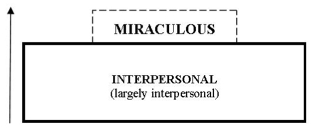
The diagram above pictures at least three truths about the Spirit’s work.
Read Essay →Xenoglossia
2. Xenoglossia
Glossolalia covers a range of speaking phenomena, including ecstatic utterance and “angelic tongues.” Cases occasionally come up in which someone speaks an actual language—xenoglossia. The following possibilities may help evaluate those cases.
Read Essay →Xenoglossia in Corinth
I. METHOD OF RESEARCH
Read Essay →