
Part I: Overview of Christian Apologetics
Part I: OVERVIEW OF CHRISTIAN APOLOGETICS
Virgil Warren, PhD
Apologetics, used in a non-technical sense, deals with three components that unite in the process of coming to faith and continuing in it. The conviction is that the process of apologetics is the same as the process of evangelism. Apologetics and evangelism see it from different viewpoints. Evangelism thinks of it from the viewpoint of the communicator and sees it as communication; apologetics thinks of it from the viewpoint of the hearer and sees it as conversion. What is seen and thought about, however, is the same thing.
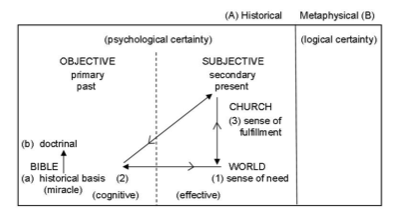
God intends meaning into the event by putting it in connection with a purpose.
There are several advantages to this format as the basis for faith and a framework for presentation.
(a) It helps picture where individuals are coming from as they interact with the presentation of the gospel.
(b) It helps keep a balanced diet of reasons to believe so people do not end up with a deformed faith because of a deformed reason for having it.
(c) It gives a more convincing foundation for a presenter’s own faith.
(d) It gives a variety of approaches so the presenter does not limit himself to a certain type of person that can respond to a particular “canned” approach.
Coming to Christian faith begins with (1) a person’s sense of perceived need, which in turn opens him up to (2) the central defense of Christianity: the death-resurrection of Jesus Christ. The meaning of the “Christ event” was intended into that event and arises from within it. When people begin to live in terms of that meaning, they have (3) a sense of fulfillment: “The proof of the pudding is in the eating.” This process helps refine and redefine perceived needs, bringing them into conformity with the new perspectives that Christian faith offers.
Besides the pattern’s clockwise flow, counterclockwise reciprocation occurs between (3) the experience of Christian living and (2) the objective Christian faith inasmuch as the involvement in the faith helps a person appreciate the faith itself. Reciprocation also occurs between (2) the basis-content and (1) the sense of need because the content of the “good news” adjusts perceived needs to real needs. The three points of the triangle have individual, cumulative, and reciprocal force.
The triangular format can serve to present any religion or philosophy. It outlines what we can call advertising. It pictures the format of scientific endeavor: isolating a problem, hypothesizing a solution, experimenting to verify the hypothesis. There is a difference, though, between philosophical method and scientific method and the format as applied to the Christian faith. Step 2 does not come from step 1 here as it does in philosophy and science. Human need does not generate the answer; it fosters a willingness to hear the answer that comes from another source—the historical events.
Several elements in the above schematic contrast with alternatives often proposed.
(1) The kind of certainty. The certainty implied by Christian evidences is not logical/mathematical certainty as in the equation 2 x 2 = 4. In a mathematical equation each number and function are defined so the equation presents a definitional manipulation. Christian evidence provides for psychological certainty, as in the conviction that we are awake rather than dreaming or watching a football game rather than mowing the lawn. It is the kind of certainty we have that our mothers are their mothers. Christian apologetics occurs (A) in the realm of reality more than (B)in the realm of idea.
In the “taxonomy of certainty” (a subset of epistemology), there is a difference in the degrees and kinds of certainty, as noted above. Mathematical certainty is (a) metaphysical certainty, which differs from (b) real-world certainty. The latter can be direct, personal experience (“sight,” as in 2 Corinthians 5:7) or indirect experience (“faith”) through other people that tell us about things beyond our experience, before our experience (history), and future to our experience(eschatology).
(2) The reason for faith. The reason for religious faith is threefold, not singular. Christianity is not (2b) a philosophy to believe; it is a religion to live (3). It is not (2) a history to know; it is (1) something needed that we sense.
(3) The beginning of Christian evidences. Christian evidences begin in the present subjective viewpoint as far as coming to, and growing in, Christ is concerned. The objective beginning is the past Christ event that created the content of the faith (see below under point 5). We believe not only because (3) the Christian faith works in real life—the pragmatic proving; nor even because (2) the event it came from actually happened—the historical proof; but because (1) our need forces us to believe in something. Practically speaking, something is true to the extent that it works. Historically something is true whether anybody believes it or not. Subjectively Christianity can become true, so a reasonable person should not treat its claims in an academic manner. Before the Christian message came, there was already reason to believe it. Many of us have not accepted Christ and may never do so: we have no conscious sense of need for what the gospel offers. History is the logical beginning point. Need is the chronological beginning point for each person. Need and experience are secondary and confirmatory whereas the Christ event is primary.
(4) The manner of relationship between need, basis, and experience. A manner of relationship between need, basis, and experience is implied by the beginning point. There is continuity between elements, which provides movement from one to the next. Beginning at (1) stands over against beginning at (3) with a “leap of faith” into the experience. Such an approach would adopt a conclusion without knowing the basis for it. Beginning at (3) could mean in effect living, not by principle (2), but by pleasure. Theoretically people could be coaxed into trying a way of life that is sinful, harmful, and false before they find out it has those qualities and effects. Sometimes it is too late then to reverse the consequences. It is better for Christians to have leaped, of course, because they landed somewhere good; but the approach to God does not require such a leap since there is continuity between the position of unbelief and that of belief and commitment. Christian outreach is not limited to “try it, you’ll like it.”
Beginning at (1) also stands over against another kind of discontinuity: the coming of faith implanted directly by the Holy Spirit. In this scenario the Spirit works parallel to the word or any other conditioning factor. He works directly on us, who have no power to leap. But scripture describes conversion as coming to faith through the word. The problem in the previous paragraph was the lack of connection by which we could move to faith. Here the problem is a lack in the us to appreciate the connection between the historical truth (2a + b) and our need (1). The complexity of conversion and the real work of the Spirit in it does not make it miraculous or take away any connection between where we are and where we need to be. The song does speak correctly, “Till by faith I met Him face to face and I felt the wonder of His grace—Then I knew that He was more than just a God who didn’t care . . . ,” but that does not tell the whole story.
Beginning at (1) also contrasts with evangelizing a present person with the recitation of past facts: “Sure, He came to set his people free—What is that to me?” Relevance is involved because caring about people must set the atmosphere for witness, and the ability to be loved is the point of contact for that witness.
The manner of relationship between the primary parts has a second aspect: there is reciprocation between parts rather than only a straight-line series. The schematic moves backwards as well as forward. That fact explains why the pilgrimage is not the same in every conversion. It explains why people believe for originally different “reasons.” It shows why various approaches can be effective though perhaps with varying degrees of “success” and validity. The reciprocal character of needs, basis, and experience also explains why coming to commitment may take a while instead of being immediate. Finally, it illustrates why being a Christian is subject to growth.
As to different pilgrimages, many believe because (3) they never disbelieved. They were raised in Christian homes and began at stage three. In the fellowship of the family, they experienced the love of Christ fulfilling their need to be loved. The reciprocal connection meant that later they became increasingly aware of the reason their family lived that way, which caused them to move from (3) to (2), so their practice took on a reason for itself.
Others come to faith because (2b) they have heard the message proclaimed. “The [subconscious?] secrets of their hearts were made manifest” (to themselves? 1 Corinthians 14:24-25). From the answer they became aware of the problem, moving from (2b) to (1). Again, faith may come because (2a) the historical credentials of Christianity have convinced them. What it claims happened did happen and must have come from a God (John 3:2) “who loves me and gave himself for me” (Galatians 2:20), who must exist, and so on.
Finally, still others accept Christ because (1) they have suffered, suffered loss, or experienced a crisis that swept aside the shackles of academic disbelief, and forced them to gain perspective and seek someone beyond themselves—someone who is “bigger than you and I.” They move from (1) to (2b) and then to (2a).
The chronological sequence of the process does not always correlate with the logical one. All the components must be there, however, or faith is deformed and may not last. Any believer can and does contribute something to winning someone else. Some may help one kind of disbeliever through the decision point; others may help a different kind. The time element means that the witness to unbelievers must never cease, and that the believer himself always has “somewhere to grow.” Understanding the kind of relationship between (1) and (2) is important. The Christian message does not come from the need (1) but through history (1a; cp. point 5 below). The connections between the components are personal, more than metaphysical and logical. They are personal capacities of mind, emotion, will, communication, exhortation, love, and the like.
It might be well to observe at this point that theologically it is not possible to go from (1) to (3). However, (a) people can unconsciously pick up a way of acting without realizing that they are doing it or why. Imitation is a way of learning that does not involve why people do something a certain way, which can create problems if the rest of the picture is not get filled in.
(5) The origin of Christian truth. The idea here has to do with the beginning of truth itself as distinguished from a person’s coming to know it (epistemology; see point 3 above). “Coming to know about it” relates to Christian evidences. The origin of Christian truth and meaning lies in the sovereign God who purposes. The content of the Christian faith is not kicked up by the hearer’s need, as indicated in point 4. Schleiermacher’s notion of “the sense of absolute dependence” (Abhängigkeit) is a stimulating concept, but the “father of modern theology” made a fundamental departure when he tried to develop the content of faith out of the need for it. The fact of dependence does not prove there is something to depend on, nor does a need create the answer out of itself in a kind of self-creation ex nihilo (cp. die Religionsgeschichte Schule).
Historically Schleiermacher was reacting in part to another false starting point prevalent in the attempt of scholastic theology to deduce Christian content from first principles. His, then, was an attempt to develop religious truth from fundamental human experience (empiricism, existentialism) rather than deduce them philosophically from first principles (rationalism). He opted for an empirical starting point rather than a philosophical one. Both approaches, however, end up confusing epistemology with truth in correlation with letting the objective dissolve into the subjective.
The nature of a problem restricts the possibilities for answering it, but it does not establish a specific alternative. Furthermore, a person can misperceive the need. Theology from experience assumes that experience has the character of revelation and that it has sufficient clarity to produce distinctives of the Christian faith. Experience does provide a door for the knowledge of God to enter, but experience is subject to greater ambiguity than propositional revelation.
The alternative proposed here is that God determines meaning, because only an independent (sovereign) being can purpose without fear of frustration from above. And it is from purpose that action arises—an action like the Christ event. Therefore, the meaning of the Christ event is in the event as opposed to being read into it by a viewer or deduced somehow from an original starting point. Subjectively reading meaning into the event occurs in “theology from below,” anthropological theology, eschatological theology, neo-orthodoxy. Deducing meaning from an original starting point occurred in scholasticism. But the meaning of an event is intended into it by its Purposer and actor: “the God and father of our Lord Jesus Christ.”
Truth and meaning are determined in the manner described. Coming to know that meaning is by propositional revelation (explanation) if the revelatory event is not sufficiently clear in itself. For example, Jesus indicated ahead of time the meaning of his death-resurrection: “a ransom for many”; “that you might have life . . . abundantly,” and so on. Inasmuch as that occurrence involved a miraculous element, it confirmed that truth claim; so the beholders could rely on what they came to know. Meaning is determined by the purposer, conveyed by the purposer’s proposition, and authenticated by miracle (Romans 1:3).
The meaning of the Christ event was in the event because it was intended into it. That contrasts with saying that an event means what it “eventuates” into; that it means what it comes to mean. What an event eventuates into may be connected with it all right as in a series of cause-effects in nature, but at best this only comes to recognize that meaning. What an event eventuates into stems from people’s response to it, which rests on their perceptions. The Christ event did not mean what we see as its effect on human civilization afterwards. We even venture to say that the meaning of the Christ event in that sense of “futurum” was not always even good, much less true. The incarnation did not mean what it did because of its effect on the direction of civilization, because such a thing stems from reading meaning into it. It comes from persons’ responses to the historical figure Jesus of Nazareth. What subsequently occurred may tend to show what it meant, but what it meant was determined by the God who brought it about. As predestination teaches, meaning is ultimately intended into history from the outside by God rather than being read into from the inside it by people.
What happened in the Christ event is not as crucial as the meaning of what happened. Meaning is revealed by miracle, prophecy, and the power of a message that correlates with experience and exhibits internal consistency.
(6) The nature of Christian evidences. Apologetics is historical because Christianity itself is historically, rather than philosophically, based. It is unique among world religions in that respect. Because the message is historically based, the event is the message and the fact that it happened “proves” that this truth exists. The occurrence of a resurrection proves that resurrection can happen. The historical basis of Christianity means that theology and apologetics both come through historical event—the same historical event. Christ’s life-death-resurrection forms a fact-meaning composite that by being miraculous also proves it is true. By declaration his death means redemption from death and is proved to have that meaning by resurrection. Because Christianity deals with people in history, it is historical, and its evidences are historical.
Implied in the schematic is that Christian apologetics as history is holistic. It speaks to both the affective and cognitive aspects of the human person. In this way, it is amenable to the ones that Christian evidence addresses. The objective basis (2a + b) addresses the cognitive side while the subjective part (1 + 3) addresses the affective side. In short, love is both contentful and motivational because it bonds social relationships. The Christian message centers on love (2b), was established because of love (2a), is transmitted through the medium of love (3), and answers the need to be loved (1).
Christian evidence combines faith and sight. It is sight in stations (1) and (3); it is faith in station (2) because for us the non-recurring events that establish the foundations for the faith are not directly accessible. Faith contrasts with sight (2 Corinthians 5:7; John 20:27-28), not with knowledge or certainty. The emphasis falls on the way we come to know something.
There is some correlation between this three-point format and the scientific method. Science has problem, hypothesis, experimentation in the need, answer, and use positions. A good hypothesis has predictability; so it explains even more than it was generated to explain. This superadditum compares with honing and refining perceived need in the direction of real need. There is a difference in that the "answer" in Christianity comes to us from beyond us; we who are in need do not generate it. Furthermore, revelation has authority beyond truthfulness, so we are then doubly in no position to take part of it and leave or change the rest.
(7) The purpose of Christian evidences. We maintained above that conversion contains no leaps, which means that the evidence can connect unbelief with belief. An act of the will on that evidence moves the person from one state to the next, decision being the only
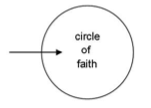
thing loosely comparable to a “leap.” No objective leap inheres in the evidence itself. The “leap” is overcome by (a) previous evidence, by (b) reciprocation between aspects of the process, and (c) by the fact that a person can go back. So, apologetics can have an objective purpose—tracing the process of entering into the circle of faith. Neither is there a subjective leap in the personal conversion. “Leap” sounds like an emotional reaction on the spur of the moment more than a decision, or a “breakover.” So the purpose of apologetics is not limited to pointing out afterwards the continuity a person could not appreciate before.
Not only are evangelism and conversion the same process in identity and kind; conversion and growth are the same in kind. As a result, the purpose of Christian evidences is to convict (John 10:31 in A, C, D, etc.; Mark 2:10) and to confirm conviction (John 20:31 in א*, B, etc.).
The Spirit fits in our original diagram in three ways as far as apologetics is concerned. (a) The Spirit operates through general and special providence, preparing people’s sensitivity to their real need. He does that indirectly through natural processes and through Christians that proclaim and demonstrate the message. He does it through the message to sensitize and convict. He may use miraculous manifestation to demonstrate God’s real existence. (b) The Spirit is involved also in originating the message and in bringing about the events that originated the message: Christ’s conception, the Pentecostal empowerment, and so on. Finally, (c) he operates through sheer presence to impact the believer.
PART II: THE HISTORICAL METHOD
I. Analysis of Components Centered Around the Historical Method
A. Need
The first given in people’s experience is need conveyed by their dependent position in the world. The feeling of need dependence generates has been styled “the sense of absolute dependence,” or the sense of “thrown-ness.” It forces people to reflect on their situation and to reach out for security amidst flux, safety amidst threat, deliverance from limitation, and the like. Scripture declares that God withdrew a more ideal circumstance from humanity evidently to force awareness of dependence since as the withdrawal happened in association with disobedience. Limitations bring mankind back to God, that is, to have apologetic force.
A second given in human nature is a drive for meaningfulness. Out of dependence comes a crisis of meaning subjectively and objectively. Subjectively, meaninglessness is suicidal. We do not ask why; it is just that way. If we become convinced that we do not mean anything to somebody, we cannot bear to live. What ending life has to do with being insignificant is unclear unless suicide assumes reason-to-be. Ecclesiastes implies the necessity of meaningful living for wise people’s true happiness.
Objectively, dependence also establishes a crisis of meaning for people. Dependent persons cannot purpose for themselves and thus determine their own value; their purposes are always subject to contravention by the higher reality. Only independent beings can have independent meaning as well as decide the place and future of all else. Not only do people have or not have a sense of worth, but it is intuitively obvious that they are dependent and have purpose and worth relative to what is sovereign.
It is suicidal for people to be driven for a level of meaning beyond what they have the ability to bring about. There is a significant difference between what people may feel
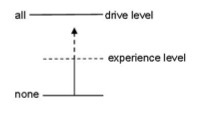
driven to have and the actual experience that they receive from life. By virtue of a sovereign God who gives worth, Christianity has the potential for bringing experience up to the drive level for meaning.
A third given of humanness is the need for a sense of innocence. Guilt is a destructive force in people. As with meaninglessness, so also with conscious sinfulness: it is suicidal. The importance of a “clear conscience” is illustrated by the proliferation of ways for coping with it. Among them are mechanisms like withdrawal, which puts distance between the offender and the knowing eyes of the offended. Hardheartedness refuses to allow affective awareness of anything that is guilt-rendering. Displacement seeks to convince oneself and others that responsibility does not rest on self. Deception tries to cover up guilt so at least other people will not know about it. Self-punishment, including suicide, consciously or unconsciously attempts to balance the books by inflicting oneself with deprivation, emotional stress, or even physical pain to achieve something like self-salvation (autosoterism). Rationalization tries to define sin out of existence. Compensation, as in penance or works, tries to make up for “absence” of the good by doing more good than “normal.” Finally, Christ’s answer comes as forgiveness. The fact of a past deed cannot be eradicated, nor can it be denied its full character as “sin”; but it can be forgiven. Thereafter it no longer affects present relationships, and life can begin again; hence, it is called the “new birth.” Repentance and apology serve as appropriate prerequisites to guilt removal.
A fourth given of human nature is the desire to be loved. The ability to be loved is the best “point of contact” with unbelievers. People may not be good at loving, but they can appreciate being loved.
Alienation is the natural consequence of wrongdoing, of self-centered behavior. Alienation brings psychological “pain.” Even loneliness saps the vitality and radiance from nearly any personality. The sense of acceptance in human relationships makes noticeable changes in a person’s demeanor and behavior. A better self-image resulting from personal acceptance comes about because being loved gives a sense of meaningfulness (1 Corinthians 13:1-3) and because meaning gets its definition from relationship.
For purposes of integration, it is instructive to compare the treatment above with Maslow’s hierarchy of needs as diagrammed below. The Christian message is clearly
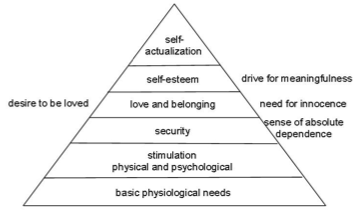
relevant to the needs of modern man. The claim that science replaces religion in the development of cultures may be true of some religions, but science cannot deal with ultimate questions or satisfy people’s psychological requirements. Even in our own culture, the age of materialistic scientism seems to be disintegrating. Sense of dependence, drive for meaningfulness, need for innocence, and desire for love inhere in the very structure of humanness, and serve to sensitize the heart and mind to the Christian answer for the human predicament.
In summary, there are several correlations between the provisions of Christianity and the concerns of man as expressed by modern thinkers.
Tillich’s anxieties about:
1. Meaning Frankl’s “will to meaning” meaninglessness
2. Love Freud’s “will to sex”
3. Security “will to power” death
Schleiermacher’s “Abhängigkeit”
4. Innocence guilt
5. Freedom determinism
The perceived correlation between need and answer is what we mean when we say of the Christian message “it speaks to me,” or “it preaches.”
B. Basis
1. History1
In chronological order, the originating bases for the Christian faith lie prior to the events on which Christianity rests. (1) The “Christ event” comes in the train of a long history of God’s dealings with the Jewish people, among whom the Messiah arose (prophecy). Jewish backgrounds relate to the Christ event as a special line of redemptive history and through prophecy-fulfillment. Inasmuch as Jesus Messiah carries forward that history and fulfills its anticipations, the evidential value attached to that history accrues to Christianity as well.
Those operations of God among the descendants of Abraham were authenticated by miracle. Similarly, (2) various aspects of the Christ event had their own authenticating marks; so the Messiah’s coming can stand independently of the preceding history that enhances it, culminating in the empty-tomb/resurrection. So Gentiles can find in the good news an evidence not predicated on former considerations. Jewish history and prophecy together with the ministry of John the Baptist, Jesus of Nazareth, and his disciples form the positive grounding for Christianity. (For a readable presentation of these matters, see Frank Morison’s traditional treatment in Who Moved the Stone? London: Faber and Faber, Ltd., 1930.)
“Time will tell” has a confirmatory role in validating the Messianic claims of Jesus and his followers. (3) The subsequent course of events in the Christian era tends to show that his original Jewish opponents erred about him (test of time). That the faith has not perished from the earth does not prove it is true; but if it had fallen away like other movements, it would be difficult to believe in was true. Truth may not be the only thing that prevails, but anything from God that is true must prevail.
Recognizing the historical character of Christian evidences is most important in evaluating it. Part A in the diagram of apologetics emphasizes the correlation between the gospel and human. That test applies to all the world’s religions. but Christian evidence has a second aspect somewhat independent of the first. By the fact that it depends on historical events, Christian faith is subject to historical verification and falsification beyond personal experience. Its truth is independent of recurrent human experience. Besides its self-consistency and correlation with experience, Christianity’s historical base affords another class of evidence. That three-dimensional foundation compounds the likelihood that it is true.
The person of Christ is the most inclusive item in slot (2). We do not study historical events as such nor do we study doctrine, ideas, morality as such. We introduce people in need to the Person that can meet their need. We do well to use the expression “Christ event” in this personalized sense.
Jesus himself staked the validity of his ministry on his resurrection as the one great sign, which he called the sign of Jonah because of its analogy to the episode in that Old Testament prophet’s life (Matthew 12:39; Luke 11:29). Paul, the apostle, staked the case for Christianity on the historicity of that same event. Ὑψώσητε [< ὑψόω] means “to exalt, lift up, raise”: “When you have lifted up the Son of man, then you will know that I am and do nothing of myself” (John 8:28). The word surely refers to being lifted up in crucifixion rather than or to praise or to exaltation at the right hand of the Father (Acts 5:31). He means the crucifixion that leads to the resurrection, and no one resurrects himself; so all of Jesus’ previous ministry has the character of “not being from himself” like resurrection does.
The following notes get at significant features of Jeus’ resurrection from the dead. Christianity has a unique relationship to history because its founding cluster of events originate its message. Without Christ being who he was and doing what he did, there would be no Christianity: it is a person-centered system. He was more than a prophet that taught doctrines distinct to himself.
a. The empty tomb
(1) Basic points
(a) Watch of the soldiers (Matthew 27:62-28:15). In anticipation of the disciples’ attempt to remove the body from the grave and claim his resurrection, the chief priests and Pharisees asked Pilate to authorize a guard at the tomb until after the third day, which was when he said he would resurrect.
(b) Large stone across the door (Matthew 27:60; 28:2; Mark 15:46; 16:3-4; cp. John 20:1). The stone was large enough that the women who came that morning to finish burial preparations wondered how they could not roll it away. Whether the Garden Tomb is the Lord’s burial place, it does indicate the type of arrangement used to block the door from view and from scavengers (cp. John 11:38-39). ’Ηρμένον in John 20:1 has been taken to mean “picked up” and moved from the tomb. But (1) the other accounts say ἀποκυλίω, and (2) αἴρω can mean simply “to remove” (1 Corinthians 5:2, e.g.; note John 11:39). It is easier to adjust αἴρω to προσκυλίω than vice versa.
(c) Sealing of the tomb (Matthew 27:66). Sealing does not mean plastering shut, but affixing the mark of a seal on it to indicate any breach of governmental authority in opening it (cp. Daniel 6:16-18). It was much like that of the flimsy little seals put on the doors of train cars and trucks that haul merchandise.
(d) Body wrapped in linen (Matthew 27:59; Mark 15:44; Luke 23:53; John 19:40). This kind of burial cloth and its wrappings appear also in the account of the resurrection of Lazarus (John 11:45). Lazarus could move enough to get out of the tomb. Depending on the condition of the body, it would appear difficult to free oneself from inside the wrapping. The friends of Lazarus assisted him.
(e) Bulk of the burial spices (John 19:39). It is sometimes said there would be from fifty to one hundred pounds of these spices; that such was the case with Lazarus is questionable, but the text says λίτρας ἑκατον (John 19:39): 100 Roman pounds, at 11.5 ounces apiece.
(f) Neat (?) arrangement of the burial clothes (John 20:6-7). Twentieth-century investigations of the relic identified traditionally as the burial shroud of Jesus have revealed some interesting characteristics. The cloth, known as the shroud of Turin, has received special attention in a number of books, including Ian Wilson’s The Shroud of Turin: The Burial Cloth of Jesus? (New York: Doubleday, 1978). These “deflated” grave clothes raise the question of where anyone would get a used burial shroud except in a resurrection. (There are difficulties, however, with identifying the shroud with the burial cloth of Jesus and other explanations of it have been produced.)
(2) Alternative explanations
(a) Jesus was not dead (swoon theory).
This approach does not seem very convincing when we consider the condition of Jesus’ body and other matters.
[1] Even before his crucifixion Jesus’ physical condition was weakened from loss of sleep, mental and emotional strain during the preceding days (Luke 22:44), the crown of thorns and the scourging by the Roman soldiers (Matthew 27:26-30). His condition explains conscripting Simon of Cyrene to bear his cross (John 19:17; Matthew 27:32; Mark 15:21; Luke 23:26). His death so soon after the crucifixion (six hours) may indicate the same (John 19:31-37; Mark 15:44).
[2] The spear thrust in his side by the soldier caused blood and water to drain out of the wound (John 19:34-35; cp. 1 John 5:6, 8?). If he was not dead from the crucifixion, the spear thrust would have killed him since the spear thrust was for making sure he was dead already. The blood and water indicate either that the blood had begun to break down already or that the sack around the heart was punctured by the spear point and drained. These soldiers were sufficiently experienced in such matters to know when someone was dead, and they were responsible for the execution.
[3] A person in such deep shock like Jesus experienced is not revived by a cool tomb. Successful medical treatment from shock requires keeping the body as warm as possible.
[4] Blood poisoning from the nails was commonly the ultimate cause of death in cases where it was not hastened by breaking the leg bones.
[5] In light of his previous condition, had he lived through the scourging and other maltreatment, the crucifixion itself, the spear thrust, the shock, and the blood poisoning, he would hardly have been able, bundled in grave clothes, to remove the large stone and elude the group of soldiers who guarded the tomb (Matthew 27:62-66). A better explanation would be required.
(b) The body was removed (Matthew 27:62-66; 28:11-15).
Revived in Hugh Schonfield’s The Passover Plot: New Light on the History of Jesus (N.Y.: Bernard Geis Associates, 1966), the theory has had several forms. The original one had the disciples stealing the body to claim their master had resurrected (Matthew 27:64).
Another version has it that the gardener took the body elsewhere to save his garden from being trampled (John 20:15; Tertullian, De Spectaculis 30; The Gospel of Peter; The Book of the Resurrection). Schonfield’s version combines the idea with a plot Jesus arranged with secret disciples outside the inner circle. They came to get the body to revive it. The trouble was that Jesus had not counted on the spear thrust and so they could not revive him. Certain considerations make these suggestions implausible as well.
[1] The disciples did not expect him to resurrect. In contemporary Jewish thought, the Messiah would “abide forever” (John 12:36). By the very fact that he could be killed, the leaders felt they had disproved his Messianic claims. Jesus’ disciples shared this understanding about Messiah (Matthew 16:21-16; 24:20-21). Had he been killed, the disciples would have become convinced that he was at most a prophet. The gospel accounts show that this reaction was indeed their response. Their frame of mind militates against having any inclination to steal his body. His death would have disillusioned them, the fear of Roman reprisal would have stayed their hand, and they would have gained nothing from it.
[2] What reason could be given for leaving the napkin and
burial cloth behind?
[3] Schonfield’s rendition falters at this point as well, but more particularly in the person of Jesus. We wonder what would cause someone who honestly thought he was Messiah to make such an elaborate plot to survive, if need be, by deception, and later to encourage another person to perpetuate the fraud. Given the presuppositions Schonfield puts on Jesus, he surely would have known in his dying moments that he was in fact not the Lord’s Messiah (p. 169; note pp. 176-80).
[4] Later, during the preaching of the resurrection, these men had their lives endangered, they were beaten, and most were killed. Had their claims for Jesus’ resurrection been false, they would surely not have died for a (1) known (2) falsehood that was (3) contrary to their convictions.
[5] From an ethical standpoint we finds it difficult to believe that so high a moral standard as the believers advocated—and demonstrated in many other particulars—would allow for perpetrating such a fraud.
[6] The placement of a guard at the tomb decreases considerably the likelihood that disciples would have tried to steal the corpse at all. On the next day after Preparation, the guard was placed and the tomb was sealed—presumably on Saturday. After the guard came, the disciples would not have carried out the plan even if they could have overpowered the guards, because letting the theft be seen would destroy the reason for stealing it. If the corpse had been removed before the guard was set, the chief priests and Pharisees would have known it when they sealed the stone.
About the only thing a disbeliever can do is to deny the truthfulness of the records as a whole. In so doing, he selects what fits with his reconstruction and what does not, automatically deleting anything supernatural.
[7] That the disciples stole the body while the soldiers were asleep does not fit; a guard does not sleep. How would the guards know the disciples stole the body if they were asleep?
[8] If the disciples stole the body, why were they not arrested
and prosecuted for it?
[9] The disciples kept themselves hidden behind locked doors, they so feared the Jews. It is unlikely that such fear would steal a corpse.
[10] The disciples did not begin preaching the resurrection
right away. Why, if they had stolen the body?
(c) Mistaken location of the tomb
Kirsopp Lake in The Resurrection of Jesus Christ gave
classical expression to this theory.
[1] If misidentification occurred, the scribes and Pharisees could have taken people to the correct tomb and assured them that he had not arisen at all. They did not follow this expediency.
[2] Joseph of Arimathea (with Nicodemus) buried him in his own tomb (Matthew 27:57-60; cp. Mark 15:42-46; Luke 23:50-54; John 19:38-42). The women saw where the soldiers laid his body. Mary Magdalene and Mary the mother of Joses/Joseph are singled out specifically (Matthew 27:61; Mark 15:47; Luke 23:55-56). Mary Magdalene and the other Mary were sitting nearby watching (Matthew 27:61), close enough to see “how the body was laid” (Luke 23:55). Even if they had been mistaken on Sunday morning, the ones that buried him would have known where they put him—especially Joseph, since it was his own tomb. Other members of the Sanhedrin knew where to put the guards.
[3] Not a great deal of confusion could have occurred since his tomb was right near Golgotha (John 19:41-42). It was a new tomb as well in a private garden instead of a public cemetery.
[4] Grave clothes were left behind.
[5] Soldiers were at the tomb when an angel descended to
remove the stone from the entrance.
b. Appearances
(1) List of appearances
(a) Appearance to Mary (Mark 16:9-11)
(b) Appearance to the three women (Matthew 28:9-10)
(c) Appearance to the two disciples (Mark 16:12-13; Luke 24:13-
22)
(d) Appearance to Peter (1 Corinthians 15:5)
(e) Appearance to the ten (Mark 16:14; Luke 24:36-43; John
20:19-25)
(f) Appearance to the eleven (John 20:26-31)
(g) Appearance to the seven (John 21:1-23)
(h) Appearance to the five hundred (Matthew 28:16-20;
1 Corinthians 15:6)
(i) Appearance in Jerusalem (Mark 16:15-18)
(j) Appearance to James (1 Corinthians 15:7)
(k) Appearance to the Twelve (Acts 1:3-12; Mark 16:19-20; Luke
24:44-53)
(l) Appearance to Paul (Acts 9, 22, 26)
(m) Appearance to Stephen (Acts 7:55-56, subjective)
(n) Vision of Christ (Revelation 1)
(2) Observations
(a) These were audible appearances in all cases where the
appearance is described at length.
(b) He ate with them (Luke 24:30?; John 20:17, 27), which
implies that they were close to him.
(c) They did not expect him to resurrect.
(d) They were not gullible in believing reports of his resurrection.
[1] The two on way to Emmaus (Luke 24:17 + 21-24)
[2] Mary supposed the gardener had taken the body (John
20:2, 13-15).
[3] The women were going back to anoint the body.
[4] Thomas refused to believe at first (John 20:24-28).
[5] “But some doubted” (Matthew 28:17; cp. John 9:8-9)
[6] The apostles did not believe Mary (Luke 24:11; Mark
16:11).
(e) The disciples were greatly afraid of the Jewish leaders.
(f) He appeared, not just to one person, but to many at the same
time (1 Corinthians 15:6).
(g) There were some disbelievers who saw him afterwards: James,
the soldiers, and Paul.
(h) Did anyone see him arise? The soldiers?
[1] more than one sense was involved,
[2] some appearances were to groups,
[3] they were repeated appearances,
[4] unbelievers were involved, and
[5] his own disciples did not expect him to rise.
(3) Alternative explanations
(a) Hallucination
[1] He appeared to more than one at once. (Note especially
Matthew 28:16-20; 1 Corinthians 15:6.)
[2] They did not expect him to resurrect.
[3] They not only saw but touched and heard him.
[4] More than one person saw him at the same time.
(b) Mistaken identity
[1] All the detailed experiences the Twelve had with him during his ministry and after his resurrection make mistaken identity incredible. There were some occasions when he was not recognized immediately: Paul on the road to Damascus (Acts 9, etc.), the two on the way to Emmaus (Luke 24), Peter and the others by the Sea of Galilee (John 21), Mary Magdalene (John 20). In some appearances perhaps the resurrection altered the looks of the man by making him look younger or different from his previous appearance as a crucified and dying man. This lack of immediate recognition is sufficiently explained by their utter lack of expecting to see him.
[2] The nail scars in his hands and feet along with the spear thrust in his side were decisive marks that resulted from his manner of execution. As he had previously to the other ten disciples, Jesus offered these marks to Thomas, who had previously entertained doubt. Thomas’s response is well-known (John 20:20, 25, 27-28; Luke 24:39-40). The two recognized him in Emmaus during the breaking of bread. Maybe they saw the scars that showed in the light as he passed the food around or perhaps in his manner of taking the loaf and blessing it, which was his custom.
[3] The disciples watched him do things that people do not do—things that Jesus himself had not done during his ministry. He materialized to them inside closed doors (John 20:19, 26). He dematerialized at Emmaus (Luke 24:31). He ascended to heaven bodily in front of them outside Jerusalem (Mark 16:19; Luke 24:51; Acts 1:9-11).
[4] The encounters were near approaches—in a small room, close enough to touch, around a table, Mary clinging to him (John 20:17).
[5] Several appearances were during the daytime.
(c) Epileptic seizure in the case of Paul
[1] Others saw the light and heard the voice.
[2] He was qualified for apostleship by this experience, so it
was objective (Acts 22:14; 26:16; 1 Corinthians 9:1).
[3] He was blinded by the bright light (Acts 22:11).
(d) An apparition
He ate and drank with them (Acts 10:41; Luke 24:42-43; John
21:1?).
(e) Liars
[1] A person will not give his life for what he knows is false
(1 Corinthians 15:30-32).
[2] The apostles championed a high ethical standard.
[3] The accounts have features not readily reconcilable, which tends to show that they were not written with any sense of needing to harmonize apparent discrepancies.
c. Church
The believableness of the resurrection is not wholly dependent on the evidence for one unique event. That event ties into other matters that anticipated it and issued from it. To a significant extent, the acceptableness of Jesus Messiah depended on the Jews’ proper understanding of Old Testament expectations about the Christ. This web of reinforcing evidences increases exponentially the power of the data. A different understanding predisposed most nationalistically minded Jews to reject him on doctrinal grounds. Nevertheless, as Gamaliel’s presentation shows in Acts 5:34-40, the argument from the existence of the church tended to short-circuit that doctrinal objection sufficiently to force a re-evaluation of prophetic interpretation and current policy toward Jesus’ followers.
Arguing from the empty tomb and from the appearances of the resurrected Messiah depends largely on the reliability of New Testament documents. The argument from the existence of the church, however, is more loosely tied to the records, because historical details would not have to be accurate in every case for the argument to hold. Even a cursory reading of the New Testament shows that the church staked its claim on whether Jesus came forth alive from his tomb in Jerusalem (1 Corinthians 15:14; cp. 1 Thessalonians 4:14).
The disciples did not go away to some other place to begin their proclamation, some place where people would have had little possibility of corroborating their story. They proclaimed their message right in the place where they could have been accused of stealing the body or dealing with a misidentified tomb or not having an empty tomb.
A person cannot determine the correctness of a viewpoint by the number of people who accept it. People reject things for emotional reasons, for the practical advantage it implies for them, and for any number of other such reasons.
A person-centered system disintegrates at the death of the central person.
(1) The resurrection of Jesus of Nazareth plausibly explains the
continuation of his movement after his death (Acts 5:34-40).
When Jewish authorities arrested the apostles and were minded to execute them for preaching Jesus as Messiah, Gamaliel restrained the Sanhedrin by observing that this movement was not following the pattern of other, false, Messianic movements. In the cases of Judas and Theudas, their deaths led to the natural consequence: the movements disintegrated. In the case of Jesus of Nazareth, his death not only failed to stop the movement, but it gained impetus. His resurrection could explain that unexpected pattern, and so the council heeded Gamaliel’s advice to “let them alone” and to “put them forth a little while.”
We must enter the contemporary Jewish mindset to see the force of Gamaliel’s argument. Instead of supposing that this doctor of the law used the occasion to score a point against the Sadducees in the council (maybe secondary motivation all right), we propose that his reasoning had enough cogency that it relaxed the persecution of Christ’s disciples sufficiently for disciples to multiply in Jerusalem and a great numbers of priests to believe (Acts 6:7). Only after an indeterminate time, Gamaliel’s disciple, Saul of Tarsus, brought in a wave of persecution beginning with Stephen’s martyrdom that lasted until he himself was converted in Damascus.
(a) The first element is that Messiah is eternal. During the ministry of Jesus that idea surfaced as one “stumbling block” when Jesus publicly intimated that he would die by crucifixion (John 12:34; Matthew 26:35). From the Law the crowd knew that Messiah was to abide forever. Typical passages include Psalm 110:4; Isaiah 9:7; Ezekiel 37:25; and Daniel 7:14. Since there can be only one universal eternal kingdom (as per Psalm 89; Daniel 7:14), any prophetic passage dealing with either a universal or eternal kingdom was speaking of the Messiah and his kingdom. Especially under the pressure of Roman domination, the Jews had fixed on that permanent liberation. For a Messianic claimant to imply that he would die was doubly unthinkable: the prophets had said he would abide forever, and the people needed him to deliver them permanently from political oppression. Jews would not follow a Jewish Messiah they knew was dead.
Not only did the masses subscribe to this understanding, but the inner circle of Jesus’ disciples assumed it. At Jesus’ disclosure that he would have to go to Jerusalem, suffer, and die, Peter promptly took him aside and rebuked him, not seeming to hear the further comments that death would not prevail against establishing the kingdom because he would resurrect on the third day (Matthew 16:13-28). Before the crucifixion the disciples followed the expected pattern of fear (John 20:19) and dispersal that later turned to atypical boldness and power.
For the Jewish leaders there was one practical consequence of the Messiah’s eternality: the very fact they could kill him meant he was not the Christ. The incredible behavior of passersby, the soldiers, the rulers of the people, and even those who died with him takes on at least a modicum of sensibleness with this observation (Matthew 27:29-44; Mark 15:29-32; Luke 23:35-37). Before his crucifixion the two Emmaus residents “had hoped that it was he who would redeem Israel” (Luke 24:21). Now that he was dead the chief priests could confidently call him “that deceiver” (Matthew 27:63). He did not abide forever; therefore, he was not the Christ.
(b) The second element in the picture is that the Messianic kingdom is person-centered. By virtue of eternality, Messiah’s kingdom accentuates the person-centered character of the normal kingdom model; here the same person is king forever. There exists no real parallel to the Messiah and his kingdom. A person-centered system disintegrates when the personal center goes away. It is this point that Gamaliel makes when he contrasts the present case with previous ones that followed the expected pattern natural to Messianism.
[1] What we affirm here differs from an ideology-centered system. Communism did not die with the death of Karl Marx. The movement of a charismatic leader may disintegrate with his death. A case in point is Adolf Hitler and his doctrine of the supremacy of the “Aryan” race. The cause lost a forceful leader and for that and other reasons fell apart, but it did not have to do so. An ideology does not depend on a person for its existence, because someone else can step in to carry it forward. If the ideology somehow proves to be false scientifically or philosophically, the movement centered around it will dissolve. An ideology-centered movement dies when its ideological center “dies” in the same way that a person-centered one dies if its person dies. The Christ was not the dead founder of a religious movement; he is the living Lord of an eternal kingdom.
[2] What is affirmed here also differs from sin’s tendency to self-destruct. Sin does tend to self-destruct since sin is usually sin because it is out of keeping with the nature of the thing or situation involved; consequently, when the organism or the group conducts itself contrary to its nature or purpose, a process of natural selection removes it from the competition. Sin’s self-destruction may involve centuries, whereas the matter under consideration in Gamaliel’s speech is “a little while.”
[3] Later, during the preaching about the resurrection, those men’s lives were endangered, they were beaten, some were killed. Had their claims for Jesus’ resurrection been false, they would surely not have died horrible deaths for a [a] known [b] falsehood that was [c] contrary to their convictions as Jews.
[4] From an ethical standpoint, we find it difficult to believe that so high a moral standard as the believers advocated (and demonstrated in many ways) would allow for perpetrating such a fraud.
When the rabbi affirmed “If this counsel comes from people it will be overthrown,” he did not mean it as a general principle in history, we take it, but as a principle applicable to the matter at hand—the Messiah and his kingdom. That Jesus of Nazareth had resurrected Gamaliel could in principle accept as a Pharisee. Also, Jesus’ resurrection not only (1) explained the peculiarity of this case, but it (2) provided a way to join the suffering and glory motifs in Old Testament prophecy. It (3) tied in with Jesus’ prediction of his resurrection and (4) harmonized with his miraculous ministry, especially the raising of Lazarus (John 11:1-53), a particularly embarrassing sign performed right “under the rulers’ noses.” The resurrection (5) accounted for the disappearance of Jesus’ body and (6) made sense of the disciples’ indomitable spirit. It (7) fit with continued miracles like the healing the well-known impotent man at Gate Beautiful (Acts 3-4). The cumulative force of these considerations made Gamaliel’s caution a wise one.
Summary Analysis of Gamaliel’s Speech
(a) Political. “They came to nothing” means that (1) the Romans will take care of this as they did in the case of Theudas and Judas; we need not get involved. (2) “Minded to execute them” relates to the fact that Rome had withdrawn Jewish right to exercise capital punishment (except where the temple precincts were desecrated). Gamaliel’s suggestion kept them from ill-advised action that could bring worse trouble on the religious leaders than Jesus’ Messianic movement would bring.
(b) Pharisaical. He is willing to use this occasion to score a point
against the Sadducees.
(c) Theological. The resurrection that the disciples were proclaiming would explain the different direction this movement has taken after its leader’s death (vs. “came to nothing”).
(2) People will not give their lives in torture for what they know is false when it is contrary to their convictions (1 Corinthians 15:30-32). Jesus’ resurrection explains the willingness of his disciples to give their lives for their commitment to him as Messiah. Many people would not give their lives for what they know is true, much less for what they know is false.
The point here follows what has been said before about the collapse of a person-centered system after the death of the central person. There may be conceivable situations in which people will give their lives for what they know is false if it might mean protecting loved ones or if they believe they will go down in history as honored persons. In general, though, Satan’s words ring true, “Everything mortals have they will give for their lives” (Job 2:4). Giving one’s life is a person’s last measure of devotion. Going down in history as an honored person does not really apply to the apostles because it was regarding someone else that they suffered martyrdom. Furthermore, as we said repeatedly before, they represented an ethic that opposed the approach to living that they would have employed to pull off such deception. More about the moral considerations later; as for now, Paul’s argument in 1 Corinthians 15 focuses on suffering as a non sequitur if disciples knew Jesus as dead.
Paul begins his evidence with a catalog of appearances by the resurrected Christ, naming last his own experience near Damascus. He places that evidence in opposition to some heretical teaching in Corinth about resurrection. His presentation he weaves into a line of thought as follows:
If there is no resurrection, Christ has not risen (15:13).
If Christ has not risen, we are false witnesses (15:15).
If we are false witnesses, why do we suffer (15:19-34)?
Another direction for the reasoning here comes in 15:14: the apostolic preaching is meaningless and the Corinthians’ faith in it is likewise meaningless. That thrust is set aside in the interest of showing that he did rise; so the kerygma is not meaningless.
(a) One observation about Paul’s argument is that the final basis is behavioral, not logical. Christianity is appropriately defended by historical rather than philosophical arguments because it has the character of event, not idea.
(b) Secondly, Paul does not entertain the possibility that the apostles were deceived. He calls himself a false witness as a reflection of the utter realism of his own witness of the resurrected Christ.
(3) The moral commitments of the Christian system militate against the
apostles’ lying to propagate the system.
d. Old Testament prediction of the (death-)resurrection of Messiah
During the ministry of Jesus, he predicted not only that he would die, but that he would resurrect on the third day: John 2:20-22; Matthew 16:21-28 (= Mark 8:31-9:1; Luke 9:22-27); 27:63; 28:1-8 (Luke 24:5-8); Luke 24:44-48. Beyond his own predictions is the New Testament claim in the mouth of Jesus and his disciples that the Old Testament prophesied Messiah’s resurrection. The unexplained claim appears in Luke 24:25-27, 32; 24:44-48; John 20:9; Acts 26:22-23, and 1 Corinthians 15:4. Other passages specify the prophecy.
(1) Psalm 16:8-11. According to Acts 2:25-31 and 13:34-37 the reference in Psalm 16 is to Messiah’s resurrection when it declares, “Neither will you give your Holy One to see corruption.” Peter argues that the text could not refer to David because his flesh saw corruption and his hearers could still visit his tomb. Psalm 16:10 seems to convey the following conception: “You will not leave my [David’s] soul/life in Sheol/Hades/the grave nor allow your holy one to see corruption.” David’s life/soul would rest in hope (16:9) and not be left in the grave, because the son of David would resurrect; the parallelism of 16:10 suggests a relationship between the two points. In Acts 2:31 Peter speaks of both halves of Psalm 16:10 as referring to Messiah, perhaps not because the first directly relates to him, but because the Messiah’s not being left to corruption implies David’s not being left in the grave and so the latter idea may in scriptural wording apply to him as well.
(2) Isaiah 52:13-53:12. Known as the Suffering Servant poem, Isaiah 52:13-53:12 has been understood by the Christian world as a Messianic reference, although that view may not have prevailed in first-century Judaism. No New Testament writer uses this poem as prophesying the Messiah’s resurrection, though it may have been so used by Philip in unrecorded parts of the presentation to the Ethiopian eunuch (Acts 8:26-36). Isaiah 53:10b says, “When you make his soul/life an offering for sin, he will see his seed—he will prolong his days and the pleasure of Yahveh will prosper in his hand.”
(3) Psalm 2:7-9. In Acts 13:32-33 (cp. Matthew 22:41-45; Hebrews 1:5; 5:5). Paul applies the prediction to the resurrection probably as implied by the enthronement idea in light of the gospel events that have already transpired. Messiah’s resurrection does not seem to be directly and exegetically determinable from this Old Testament text itself.
(4) In Acts 13:34 Paul clusters a reference to Isaiah 55:3 with Psalms 2 and 16 probably because of the eternal covenant made with everyone that thirsts (55:1) among the peoples (55:4-5) who receive the witness of David. By taking “David” as a dynastic designation, Paul must understand the “prince” and “leader” to mean the Messiah, since David was long dead by the time of Isaiah. The eternality of his leadership may imply the resurrection since humanness includes physical death. The point, however, would not be required by this text, which would be problematic only to a pre-Christian reader.
Principally two passages predict the Messiah’s resurrection: Psalm 16:8-10 and Isaiah 52:13-53:12. The event derives exegetically from the texts whereas in others it fits with the texts.
2. Revealed meaning
The death-resurrection of Jesus is one composite event with a meaning made clear through it and in connection with it (cp. John 13:19; 14:29. That the death-resurrection belongs together is clear from the event itself as well as from Romans 4:25. Paul says that Jesus our Lord “was delivered up for our transgressions and was raised for our justification.” The New Testament states many things in connection with it, but the question remains as to how much is clear through it. The meaning of the death of the man on the middle cross would not be visibly different from the deaths of the men on either side of him, but keeping the resurrection in mind broadens the base for direct inference from the event itself as well as for what is made clear by proclamation.
a. Implications of the death-resurrection
(1) The fact of resurrection itself. If Jesus of Nazareth arose from the dead, there is such a thing as resurrection to immortality. When we connect this point with the teaching of Jesus and his apostles, it generalizes to everyone.
(2) Ethical implications. If there is resurrection to immortality, the way a person lives must take into account more than life before the grave. It must not then be limited to the dictates of the flesh (Colossians 3:1-4; Romans 6:1-14; 1 Corinthians 15:31-32; Philippians 3:17-21).
(3) Validation of Jesus’ previous teaching and claims. No man can resurrect from the dead except God is with him. God will not validate a person who is teaching, claiming, or doing contrary to God’s will. He “was declared to be the Son of God . . . by the resurrection” (Romans 1:4). Victory, not defeat, is the verdict.
(4) Interpretation implications. A new hermeneutical programmatic needs to be applied to Old Testament expectations for the Messianic age.
(5) Theological implications: Material existence is not an evil.
b. Old Testament
Among the claims of Jesus was that he was the long-expected Messiah. The resurrection having validated those claims, Old Testament prophecies about the death-resurrection become especially significant, because in connection with those prophecies the New Testament states the significance of his death. The meaning of the death-resurrection is seen to be in it (rather than read into it) by a pre-statement of its meaning. God intended a certain significance into the death-resurrection and vouchsafed it to his servants by prophecy. Jesus claimed to be Messiah; his resurrection authenticated his claims; the Old Testament teaching on Messiah’s death indicates the meaning of the death-resurrection of Jesus.
The main observation about the death of Jesus according to Old Testament prophecy is that the crucifixion is analogous to a sacrifice for sin. It has atonement implications.
c. New Testament reflection
In consequence of Old Testament prophecy about the significance of Messiah’s death, New Testament writers reflect on that event, further elaborating the meaning it contains. For those matters beyond what is directly obvious and what is predictively asserted, miracle serves to confirm the apostolic preaching, and so the place of miracle in the historical basis of Christian faith must receive attention.
3. Miraculous considerations
a. Miracle and the meaning of events
(1) Prediction, by giving access to the knowledge of a future event,
gives access to its meaning as well.
(2) Other miracles, by demonstrating the power to perform them,
demonstrates their meaning as well.
The following are the senses in which the events give rise to the doctrine (meaning) in station two of the triangle: (a) God intends the meaning into the events in contrast to observers reading it into them; (b) we can deduce some meanings from the occurrence itself: since resurrection has occurred, there is such a thing as resurrection, and so on; (c) miracle confirms the claims of the miracle worker (doctrinal matters) (Mark 2:1-12; Romans 1:1-7).
b. Miracle as authentication of revelation
Divine revelation always involves supernatural involvement either as the medium of revelation itself or as an accompanying factor that authenticates the revelation. As Mark 2:9-10 proves the claim that Jesus had the right on earth to forgive sins, John 11:42 uses the resurrection of Lazarus to prove that God had sent Jesus. Miracle is “proof” of truth appears in the following texts: Mark 2:5-12 (= Matthew 9:2-8; Luke 5:18-26); 16:20; John 2:11; 3:2; 5:36; 9:16b, 30-33; 10:25, 37-38; 11:42; 12:37; 14:11 (15:24); 20:30; Acts 10:38; 15:12; 1 Corinthians 14:22. Although miracle authenticates revelation, people do not necessarily believe what is affirmed in connection with miracle. The following considerations also belong in the picture.
c. Miracle as authenticated by previous revelation
Several passages enjoin the faithful to test miraculous events by previous revelation: Deuteronomy 13:1-5; 18:20-22; Mark 2:5-10; 9:39 (cp. 1 Corinthians 12:3); John 9:16a; Galatians 1:8-9; 1 John 4:1-4.
Testing a miracle by doctrine while claiming miracle as proof of doctrine is neither circular nor self-contradictory. The reason both processes can be true is that (a) it is not the same doctrine that is used to test the miracle as is proved by the miracle. The point is that God’s revelation is consistent over time: John 16:13-15 + Jude 3; Galatians 1:8-9; Deuteronomy 13:1-5; 1 Peter 3:18 and Hebrews 9:26-28 (“once for all time”). Furthermore, (b) there is always the possibility that the miraculous display is demonic, a paranormal phenomenon, a falsehood-illusion-magic trick, a psychosomatic result, or sheer chance. Something is wrong somewhere if a “miracle” accompanies a “false teaching.” Either the miracle is not divine, a person’s understanding of previous revelation is wrong, or it is not in fact supernatural. Paramount here is the unmistakable fact that a given phenomenon is indeed a divine miracle. The pattern below outlines its sweep from Moses to Christ.

(1) The original establishment: Moses
(a) Stupendous miracles: Egyptian plagues, crossing the Red Sea, manna, quail, pillar of smoke and fire, manifestations at Sinai, healing from snakebite, earthquakes, consumption by fire, clothes that did not wear out
(b) Triumph over the Egyptian bull-god Apis and the Egyptian
magicians
(c) Pronouncement of “false” on all other alternatives (gods)
(d) Prediction that other prophets would arise and their further revelations would be consistent with the normative prophet Moses (Deuteronomy 18:15-22).
(2) The coming of other prophets that reaffirmed the Mosaic economy and predicted its abrogation nationally speaking (Jeremiah 31:31-34; cp. Hebrews 8-10)
(3) The subsequent establishment: Christ
(a) Stupendous miracles: resurrection, exorcising, and the like. There is some value to the sheer number of miracles Jesus did (John 7:31).
(b) Resurrection of the crucified Messiah
(c) Abrogation of the previous economy as per Jeremiah 31 and the pronouncement of “false” on all other lords (1 Corinthians 8:5)
(d) Affirmation of the finality of the new economy (Jude 3)
Two starting points apologetically and theologically in the Judaeo- Christian religion correspond to the beginning of the two main successive economies. In both there was stupendous display to dispel doubt and authenticate claims. At the same time, there was success in confrontation with alternatives—demonic and otherwise. The circularity between doctrine and miracle is avoided, because it is not the same doctrine that tests miracle that was established by miracle. The original doctrine was accompanied by stupendous display and triumph over demonic power. That doctrine became a restrictive test on all subsequent doctrinal claims. If subsequent claims were miraculously accompanied, they were still rejected because they did not harmonize with previous doctrine. New doctrine is authenticated by miracle that observers can distinguish from demonic miracle, deception, or paranormal occurrences. In the modern setting, beyond such marks we have the understanding that the revelation in Jesus is final (Jude 3), so nothing will supersede the gospel as the gospel superseded the Law.
d. Miracle as challenged by demonic power
Saying above that an apparent miracle could be demonic assumes (a) the existence of demonic power and possession. Some biblical examples of demon possession are Matthew 4:24; 8:16-17 (= Mark 1:32-34; Luke 4:40-41); 8:28-34 (= Mark 5:1-20; Luke 8:26-37); 9:32-24; 12:22-28 (Mark 3:22-30; Luke 11:14-20); 15:21-28 (= Mark 7:24-30). Other references to demonic phenomena include Matthew 7:22; 10:8; 11:18; 17:14-18 (= Luke 9:37-42); Mark 1:39; 3:15; 6:13; 9:38 (= Luke 9:49-50); 16:9 (8:1-2), 17; Luke 4:33-37; 7:33; 9:1; 10:17; 13:22; John 7:20; 8:48-49; Acts 17:18; 19:12; 1 Corinthians 10:20-22; 1 Timothy 4:1; James 2:19; Revelation 9:20.
That an apparent miracle could be demonic assumes also (b) that demonic and divine miracle can be distinguished. They are at least distinguishable: Acts 13:4-12; 19:13- 20; compare 8:1-24. In that connection note the following points.
(1) The divine triumphs over the demonic in confrontation.
(a) Moses and the Egyptian magicians: Exodus 7-11
(b) Paul and Elymas the sorcerer: Acts 13:6-20
(c) Paul and the Ephesian occult: Acts 19:13-29
(d) All examples of exorcism: Matthew 12:28-29, for example
(e) The demonic cannot overcome the believer, at least contrary to his will: Mark 5:1-17 (= Matthew 8:28-43; Luke 8:26-37); John 6:39; 10:28; 17:12; 18:9
(f) Joseph: Genesis 40-41
(g) Daniel and the pagan wise men: Daniel 5
(h) Philip and Simon the sorcerer: Acts 8
(i) 1 John 4:1-4
(2) Divine miracle glorifies God (Matthew 5:16; 9:8 = Mark 2:12 = Luke 5:25-26; Matthew 15:31; Luke 7:16; 13:13; 17:15; Acts 4:21; 21:17-20).
(a) The demonic cannot act in God’s name: Mark 9:39 (Luke 9:49-50); Acts 19:13-16. The use of Jesus’ name does not give automatic results. We may make allowance here for a case like that described by Ben Alexander in Exposing Satan’s Power, XIII:I, p. 3, where a person erroneously thinks he is doing miracles by God’s power, when it is demonic instead. We might make allowance for people erroneously thinking they are doing miracles by God’s power (Matthew 7:22-23?). Kathryn Kuhlman is a case according to William Nolen’s analysis in Healing: Doctor in Search of a Miracle, pp. 72-102. We must also make allowance for a sorcerer’s followers thinking it is divine miracle (Acts 8:9-11).
(b) Divine miracle does not aim to benefit the miracle worker.
[1] There are no biblical examples of miracles worked by a miracle worker on himself. Note Paul’s thorn in the flesh (2 Corinthians 12:7-9 = Galatians 4:13?) and Jesus’ refusal to turn stones into bread during his temptation (Matthew 4:3-4 = Luke 4:3-5).
[2] There are not many clear examples of miracles performed on a fellow Christian. Note Trophimus in 2 Timothy 4:20 that Paul was left behind sick instead of healing him. An exception is the raising of Dorcas in Acts 9:36-43. During Jesus’ ministry he resurrected his disciple Lazarus and healed Peter’s mother-in-law (Matthew 8:14-17). Eutychus also may be an exception in Acts 20:9-12. Having some Christians not delivered from death for their faith seems odd if others are having a shorter leg lengthened by an inch.
[3] There is no example of a divine representative taking money for his service. Contrast Acts 3:6; 8:18-24 with Acts 16:16-19ff.
[4] There is no example of an approved use of miracles that draws attention to the miracle worker. Note 1 Corinthians 14:3-19, 28; Acts 3:11-12ff; 4:9-10; Luke 10:17- 20; John 7:18 in contrast to Acts 8:9-11.
(3) The demonic cannot agree to given doctrines (?): 1 John 4:4. Although a common observation, this idea is evidently not true in all cases (cp. Mark 1:24; note also 2 Thessalonians 2:9; 1 Timothy 4:1-2; “spirit” used here as in Acts 6:10).
(4) In divine miracle the spirit is subject to the person (1 Corinthians 14:32) while in demonic miracle the person is subject to the spirit (Luke 9:37-43, e.g.). The Spirit of God operates through people’s personality, not in place of it. He uses people’s personality, not just their body.
(5) The demonic does not have positive effect as measured in the total situation (Matthew 12:25-26 = Mark 3:23-26 = Luke 11:17-18). The idea here does not necessarily eliminate a small or temporary good accompanied or followed by something proportionately worse. The Gadarene demoniac was indeed made stronger by demonic possession, but his will was overridden in the process.
(6) Divine miracle is purposeful. It is never for display of the supernatural (“paranormal”) for its own sake—like magic shows. The cursing of the fig tree evidently had a didactic significance (Matthew 21:18-22 = Mark 11:12-14, 20-24); the walking on the water was to get to the disciples and to save them from destruction by the sea (Matthew 14:22-23; Mark 6:45-51; John 6:15-21). The floating ax head incident in 2 Kings 6:1-7 is perhaps the least purposive-looking of biblical miracles. In 1 Corinthians 14 Paul seems to be drawing on the purposeful nature of true miracle when he calls for the use of the edification test (14:26).
During his ministry Jesus did not reinforce interest in miracles as such: Luke 23:8-12. Jesus condemned the craving after signs: Matthew 12:38; 16:1 (= Mark 8:11-12; Luke 11:16); John 2:18; 6:30.
(7) Divine miracle always succeeds: Deuteronomy 18:20-22; Acts
19:13-17.
(a) There was a two-stage miracle when Jesus healed the blind
man: Mark 8:22-26.
(b) There were two failures by the disciples during Jesus’ ministry: Peter’s attempt to walk on the water (Matthew 14:28-31) and the disciples’ failure to help the lunatic boy at the foot of the Mount of Transfiguration (Matthew 17:14-20 = Mark 9:14-29). Both failures were due to a lack of faith on the part of the miracle worker; the second involved a lack of prayer (and fasting?).
Regarding uniform success in attempted miracle, we must keep in mind the desire of the person in need of the benefit. This problem might apply to cases of demon possession. Another implication is that one who is really doing supernatural signs like miraculous healing or exorcisms has the guidance from God to know whether a specific miracle should be attempted. If God does not want a person healed, and if miracle always succeeds, then a person who does miracles for God would have to know God did not want a one attempted; otherwise, uniform results would not characterize miracle vs. answered prayer.
Since exorcism is not called a spiritual gift in the New Testament, is it possible that attempting to heal the lunatic boy resulted in failure because it should be conceived of on the analogy of answered prayer rather than miracle? Is it possible that a demoniac might not “want” to be cleansed from demonic possession and that this was the case with the young boy?
(8) Divine miracle is not done by immoral persons: Mark 9:39; John
9:31, 33
(a) Matthew 7:22-23 is not an exception here. Though the passage
could be interpreted to mean:
[1] God’s speaking through an evil person who used his name. Considerations noted above make this approach unacceptable, so another possibility must be sought, such as
[2] God’s speaking through an office held by an evil man (cp. one view of John 11:47-53).
[3] A formerly faithful person with gifts who subsequently apostatized (cp. Hebrews 6:4-6); yet note the word never. One who has fallen away is as good as “never” saved at all.
[4] Someone lacking love while possessing gifts (cp. 1 Corinthians 13:1- 3). Again, we must ask, “Does God endow someone who is not saved?” Though God might endow someone who misuses the gift, the lost condition in the judgment would mean an apostasy situation again. There is the love test, but it seems not to help the understanding of this passage.
[5] Someone lying at the judgment (?)
[6] Someone living within the general will of God, but not within the special will of God for that person, which in effect is a refusal of God commandments
[7] People who thought they were doing miracles by God’s hand, but in fact were doing them by demonic power
*[8] People who thought they were doing miracles
(b) The moral test does not mean moral perfection. Paul was willing to admit his lack of perfection (Philippians 3:12-16; 1 Timothy 1:15). Peter “stood condemned” at his dissimulation in Antioch (Galatians 2:11). Samson was perhaps the most immoral of God’s chosen men.
e. Divine miracle as distinguished from paranormal phenomena
To some people there is no distinction between demonic and paranormal, but for our purposes we separate them. The same tests will “weed out” paranormal phenomena. Examples of paranormal phenomena include the following:
(1) Telekinesis: the movement of objects at a distance by unaided will
power
(2) Precognition: foreseeing the future
(3) Telepathy: the apparent transfer of thought from one person to
another without means
(4) Apports: the transference of objects from place to place even through
material barriers
(5) Materialization: the coming into real presence of persons or objects
(6) Levitation: defiance of the gravitation field
(7) Clairvoyance: the ability to see something mentally
(8) Clairaudience: the ability to hear something mentally
(9) Extra-bodily experiences: separation of the perceiving consciousness
from one’s bodily form
f. Divine miracle as distinguished from psychosomatic “healing”
Divine miracle may call for faith by the requester, but it does not depend
on it:
(1) Jesus required faith in Matthew 8:13 (= Mark 5:36); 9:2 (Mark 2:5); 9:22 (Mark 5:34; 10:52; Luke 7:50; 8:48; 17:19; 18:42; “your faith has made you whole”); 9:28-29; 12:58 (= Mark 6:5); Mark 9:23-24; 11:23-24 (cp. Matthew 17:20; 21:21; 1 Corinthians 13:2); Luke 8:50; cp. Acts 14:9.
(2) The miracle did not depend on faith in the case of Malchus in the Garden of Gethsemane (John 18:10- 11) or the lame man at Gate Beautiful (Acts 3:1-10).
g. Summary of types of miracles and their varying significances
(1) The value of nature miracles is that the result could not involve the psychosomatic element. That question is often raised in connection with healing miracles.
(2) The value of healing miracles is that they were signs with positive value, a doubtful thing to be associated with satanic supernatural power.
(3) The value of predictive miracles is that they cannot involve magic or
delusion.
4. Reasons the Jews rejected Jesus of Nazareth as Messiah
a. Jesus came from the wrong place.
(1) As far as most people knew Jesus came from Nazareth of Galilee, not from Bethlehem Judah as predicted (John 7:41-43, 52). The Jews understood that Messiah was to be born in Bethlehem as predicted in Micah 5:2 (Matthew 2:1-6; John 7:41-43).
Their retort to Nicodemus in John 7:52 was that no prophet arises from Galilee, meaning evidently that no prediction anticipated a prophet from there, because Jonah did come from Gath-hepher in Zebulun (2 Kings 14:25; Joshua 19:13). The comment still bears a curious ring because Isaiah 9:1-2, cited in Matthew 4:15-16, has Messianic import (cp. 9:3-7).
A related observation comes into the discussion with the man born blind. The Pharisees say that they do not know where Jesus came from (John 9:29), evidently meaning something that would naturally contrast with “We know that God spoke to Moses.” We would suppose that they knew where Jesus was from in a geographical sense—Galilee (John 7:52). Presumably they could have discovered from census records and perhaps from local commoners around Bethlehem that he had been born in Judah. In John’s gospel, where he is from appears to have a spiritual sense, meaning who sent him. In an earlier discussion recorded in John 8:12-20, 42, he claims to know where he came from and where he was going, but the Pharisees did not (8:14). Similar comments occur elsewhere in John 13:3; 16:28, 30.
(2) Interestingly a second view of the Messianic origin expected him to appear suddenly in Jerusalem, possibly on the strength of Daniel 7:13 or Malachi 3:1. Knowing where Jesus came from meant he was not the Messiah: John 7:27; cp. 6:42.
In reference to the first view, the gospel records of Matthew 2:1ff. and Luke 2:1-7 indicate that he was indeed born in Bethlehem Judah before his parents took him to Galilee at an early age. As for the second view, it may be said that Jesus came ultimately from the Father and immediately through Bethlehem and Nazareth. Perhaps the two origins could also correspond to his first and second comings.
b. Jesus spoke of his death.
According to John 12:34, the people understood that “Messiah abides forever” (Psalm 110:4; Isaiah 9:7; Daniel 7:14; e.g.) instead of dying as Jesus predicted: John 3:14; 8:28; Matthew 16:21-28 (= Mark 8:31-9:1; Luke 9:22-27); 17:22-23 (= Mark 9:30-32; Luke 9:43b-45); 26:1-5 (= Mark 14:1-2; Luke 22:1-2).
c. Jesus refused to abide by the traditions of the elders and by irrelevant
cultural taboos.
(1) He frequently set aside their Sabbath regulations: Matthew 12:1-4 (= Mark 2:23-3:6; Luke 6:1-11); Luke 13:10-17; John 5:9-18; 7:19-24; 9:1-41.
(2) He often did not observe their ceremonial purifications: Matthew 15:1-20 (= Mark 7:1-23); Luke 11:37-41.
(3) He did not practice apartheid with Gentiles, Samaritans, the multitudes, women, foreigners, or publicans (“sinners,” “people of the land,” the “hoi polloi”): Matthew 9:10-13 (= Mark 2:15-17; Luke 5:29-32); 11:16-19 (= Luke 7:29-33); Luke 4:16-30; 7:29-33; 15:1-2ff; 19:1-10; John 4:9-29.
(4) He did not observe patterns of regularized fasting as did John’s and the Pharisees’ disciples: Matthew 9:14-17 (= Mark 2:18-22; Luke 5:33-39); cp. Luke 18:12.
(5) Jesus criticized the tradition of the elders as such: Matthew 15:1-20 (= Mark 7:1-23); 23 on various points.
The Jews identified the tradition of the elders with the intent of Mosaic legislation. A breach of these regulations was regarded as a failure to understand or obey the law’s intent; that is, from a civil and ceremonial standpoint Jesus was unwilling to submit to “case law,” which by precedent had interpreted the theocratic regulations, or “statutory law.”
Jesus did tell the multitudes to observe what the scribes and Pharisees enjoined because they sat in Moses’ seat. As the Sanhedrin, or supreme court, had civil authority to lead the nation, Jesus did not try to turn the populace against that authority.
Since however, the authority was misused, he opposed the misuse with his life, willing to endure the consequences. There is a loose comparison with Socrates and Athenian law. The misuse of authority in case law sprang from a misunderstanding of divine intent in statutory law as shown by the fact that the tradition of the elders contradicted the Mosaic Law at various points despite the avowed intent to build a hedge around it. Matthew 23 records an indictment of the quantifying mentality (23-24) that goes to seed in a legal mindset on regulatory provisions. Law cannot easily deal with anything but overt behavior (25-26), since inner motivation is difficult to measure; yet mortals who cannot know the heart adequately must render judgment. So time and energy concentrate on externals and neglect weightier, internal matters.
d. Jesus said things that the religious leaders took to be blasphemy.
Despite Isaiah 9:7 the religious leaders did not associate deity with the promised Messiah; consequently, there was no way Jesus could come in that role and nature without being refused by them on the grounds of blasphemy.
(1) He claimed the right to forgive sins: Matthew 9:1-8 (= Mark 2:1-12;
Luke 5:17-26); Luke 7:47-49.
(2) He claimed to be the Son of God: Matthew 26:63-65 (Mark 14:61-
64); John 10:30-39; 19:7.
By referring to himself as “son of God” in reference to himself or calling God “Father,” Jesus in their mind was making himself “equal with God” (John 5:18). The objection lies alongside their attempt to avoid impious use of God’s personal name: they declared it ineffable. So ingrained was this tradition and for so long honored that the pre-Christian Septuagint (LXX) translated the tetragrammaton (יהוה, Yahveh) with κύριος, “Lord”). God’s personal Yahveh never appears in the New Testament, perhaps in deference to these Jewish scruples so as not to cause unnecessary problems, especially since father was the term Jesus taught his disciple to use in referring to God. Jesus was not just dealing with his hearers’ objection to seemingly unwise terminology; he was dealing with the Jewish mentality of overkill seen in the refusal to use God’s name at all.
(3) He spoke against the law: Matthew 5:17; Luke 16:17 (cp. Acts 6:13-
14; 21:28).
(4) He spoke against the temple: Matthew 26:60-61, 65 (Mark 14:57-58, 64; cp. Acts 6:13-14; 21:28); John 2:19-20 (cp. Matthew 27:40; Mark 15:29). His destroying the temple as the Pharisees charged may be somewhat overstated at the trials of Jesus and Stephen, because the statement in John 2:19 is an imperative with a seemingly concessive implication: “If a person destroyed the temple . . .” The rebuilding without hands (Mark 14:58) may have implied divine activity and so was blasphemous to his hearers. (See Old Testament antecedents in Daniel 2:34, 45; 8:25; cp. Job 34:20 and Zechariah 4:6; for New Testament usages see Acts 7:48; 17:24; 2 Corinthians 5:1; Ephesians 2:11; Colossians 2:11; Hebrews 9:11, 24; cp. 11:10.)
Having misunderstood the nature and role of Messiah, the Jewish leaders could hardly do other than condemn him for blasphemy because he claimed things that to them were humanly impossible.
e. Jesus did not unequivocally identify himself as Messiah in front of the masses: Mark 1:34; Luke 4:41; John 10:24. Indeed he could not without the dangers of misunderstanding associated with that claim.
f. Jesus did not lead out in military fashion against foreign oppression of
Israel: John 6:15.
g. Some of his teaching made no sense to them.
(1) Coming down out of heaven: John 6:38, 58
(2) Giving them his flesh to eat and his blood to drink: John 6:51-59
(3) Going where his hearers could not come: John 7:33-36; 8:21-23
(4) Claiming sinlessness: John 8:46-48
(5) Promising that the one who kept Jesus’ word would never die: John
8:51-53; 11:25-26
(6) Abraham’s seeing Jesus’ day: John 8:56-59
At one point anyway, the crowds thought he was crazy or had a demon, because he said they were trying to kill him (John 7:19). The people who spoke that way, however, may not have realized the speaker was Jesus (cp. 7:25-26).
h. Jesus posed a threat to the authority of the religious leaders: John 2:13-22;
Matthew 21:12-16 (= Mark 11:15-18; Luke 19:45-47)
i. He criticized the hypocrisy of Israel’s leaders: Matthew 23:1-39 (= Mark
12:38 = 40; Luke 20:45-47).
j. At least certain sectors of the Jewish leadership (Sadducees?) feared that his popularity could eventuate in the Roman destruction of the Jewish state altogether: John 11:47-53.
Jesus had done outstanding miracles that the leaders could not deny—notably the resurrection of Lazarus (John 12:9-11), but he had shown no interest in military pursuits, nor had he given them a “sign from heaven” like calling down fire to destroy his enemies (Luke 9:51-56).
Most of the Jews’ rejecting Jesus came from their attempt to apply the doctrinal test and the moral test of miracle as commanded in Deuteronomy 13:1-5. That the Pharisees were trying to override miracle with the doctrinal test is evident from John 9:16 (24) on the occasion of Jesus’ healing the man born blind: “This man is not from God; he does not keep Sabbath,” a comment that did not deny the miracle had occurred (24).
They could not deny the miracles, because some of them were astounding: the resurrection of Lazarus, the healing of the man born blind, and so on. (cp. Acts 4:16). The extreme number of signs Jesus performed made denial obscurantist. Their options were either (a) to claim it was demonic miracle or (b) to claim that it was divine miracle without authenticating the miracle worker. At least three problems challenge the way the Pharisees applied the doctrinal test.
(1) Failure to distinguish divine and demonic miracle
On two occasions or more, the Pharisees assigned Jesus’ miracles to Satan’s power: (a) the exorcising of a demon that caused dumbness (Matthew 9:32-34; 10:25); (b) the exorcising of a demon causing blindness and dumbness (Matthew 12:22-37 = Mark 3:19-30; Luke 11:14-26; cp. Mark 3:21). The calumny came under the charge that he did his miracles by the power of Beelzebub (= Baalzebub of 2 Kings 1:2, 3, 6, 16). The clearest attempts to credit his signs to demonic power came with these exorcisms (cp. Matthew 11:18; John 7:20; 8:48-52; 10:20).
Jesus raised two objections: (a) Satan would be working against himself if he cast out his own minions (Matthew 12:25-26; etc.); (b) As an ad hominem argument, Jesus raised a question about the Pharisees’ claims to perform exorcisms. In short, demonic miracle would not be directed against Satan’s destructive purposes in the world.
The persistent call for a “sign from heaven” in the face of Jesus’ constant miracles may have been a request for a kind of miracle that would not only be stupendous, but clearly not demonic (Matthew 12:22-24 + 38; other examples are Matthew 16:1-4 = Mark 8:11-13; Luke 11:16; cp. John 6:30-32 as well as John 2:18 and 1 Corinthians 1:22). The Old Testament background for that request seems to be events like Moses and the manna (John 6:30-31; cp. Exodus 16), Joel’s prophecy in 2:28-32, or Elijah on Mount Carmel (2 Kings 1:10-12; cp. Luke 9:51-56). It may have been in response to that desire for obviously supernatural divine miracle that the disciples asked Jesus whether they should call down fire from heaven to destroy the Samaritans who had not welcomed Jesus (Luke 9:51-56).
(2) Failure to equate divine empowerment with authentication of claims
Upon healing the man born blind, some Pharisees claimed that Jesus was a sinner because he did not keep the Sabbath—a legal and doctrinal test in combination (John 9:16, 24). For this to make sense, we have to assume that God might give his power to someone who was not doctrinally and morally sound. Other Pharisees doubted that a sinner could do such signs (John 9:16). The blind man himself argued that God does not enable those who oppose him because signs authenticate claims.
What the Pharisees had in mind was a case like that of Samson, whose moral level was low; yet he demonstrated supernatural strength. A similar case might be the possibility of misusing gifts as the Corinthians did. While such a thing might be possible, the Samson example shows that God’s Spirit at least eventually leaves a person that is a sinner and grieves the Spirit of God beyond some limit. In keeping with that point, Jesus from the beginning referred to the long haul that would end in his resurrection and the establishment of the church (John 2:18-22; Matthew 12:38-45 = Luke 11:29-32; Matthew 16:4).
(3) Failure to consider the possibility that they misunderstood the Old
Testament
Jesus told the Pharisees they were blind because they said, “We see” (John 9:40-41). Their behavior indicated an unwillingness to be instructed on such matters (John 9:34; 8:37, 43; cp. Matthew 13:13-15). The essential problem was pride.
Applying the doctrinal test assumes a proper understanding of the doctrine. The religious leaders of Jesus’ day had for so long understood the statutory law in the way it was interpreted by the case law (traditions of the elders) that they had lost the distinction between the two. Having lost the distinction, they accused Jesus of heresy when he broke, not the spirit of the statutory law, but the letter of case law.
k. Elijah had not yet come (Malachi 3:1-2).
Several items associated with Elijah come into the gospel accounts. Jesus said of John the Baptist, “This is Elijah who was to come” (Matthew 11:12-19; (cp. Luke 7:18-25). Herod was afraid that John had resurrected (Mark 6:14-16). Peter responded to Jesus’ question about who people were saying he was by saying, “Some say Elijah . . .” (Matthew 16:13-20; Mark 8). On the Mount of Transfiguration, Elijah appeared along with Moses. Peter may have thought that this was the fulfillment of the prediction about Elijah’s coming (Matthew 17:1-13; Mark). Finally, Jesus’ cry of dereliction on the cross was misheard by some of the bystanders as a call for Elijah (Matthew 27:45-50). As far as we can tell, the prophecy meant that someone would come “in the spirit and power of Elijah,” as it is often put, rather than Elijah himself. Another option would be to assign Elijah’s return to yet future events associated with Christ’s second coming.
C. Consequence
1. Individual
The triangular schematic of (1) need, (2) basis, and (3) result pictures apologetics as starting with (1) need. Bibliology (canonicity) is the same set, starting with (2) basis. Evangelism is the same set again but starting at (3) result because the church evangelizes into the need of the world around it.
In its largest dimension we must see Christianity as an interpersonal community rather than at the individual level. Love becomes its characteristic feature in practical effect.
If the church is saved people serving in divine pattern, then love is the moving “force” in that service. Since the church is the aggregate of individuals, each person bears the mark of a loving that gives rise to loving action. Love addresses the point of contact in reaching a world in need. Love creates trust, an object for man’s sense of dependence. It produces a sense of meaning existentially in community and eschatologically in. The point of contact in people is their ability to be loved.
Love provides the mechanisms for conversion. First, love takes the initiative; so reversing the downward spiral of deteriorating relationships comes by an act of unprovoked love. Secondly, love is synoptic, functional, interpersonal, and reciprocal. It addresses interpersonal relationships and touches on everything that comprises persons in community. Love is both rational and emotional, so it combines cognitive and affective with the social dimension through reciprocal behavior. By making love central in the real world of history, Christianity affords a higher self in its relations. Thirdly, love is resistible, so it avoids determinism while fostering positive response. In conversion influential love replaces supernatural miracle and stimulus-response. Love comes close to being self-authenticating experience.
Love provides the mechanism for sanctification. Love motivates, brings self-control, and admits of degrees; so it gives the strength to overcome sin by generating motivational power to conquer habit. With salvation comes the sense of acceptance into fellowship with the Spirit of God and the increased potential for development over pre-Christian possibilities.
2. Church
Love integrates the Christian faith, because Christianity deals with the art of living relationally. Ultimately the only promise in the faith is a better quality of interpersonal relations. Logic provides the bond between ideas; physical laws provide the bonds in nature; love provides the bond between persons; authority connects the steps in legal process. Natural depravity is impersonal, which shows up in misformulated emphasis on divine holiness instead of a balance of holiness and love. In its place, we see a construct that is resistible so as to avoid determinism and yet triumphant over non-Christian systems. It must admit of degrees to be better than the pre-Christian condition and yet not productive of sinlessness. That construct is holy love.
II. Correlation with the Principles of Canonicity
A. General schematic
In keeping with the structure of apologetics, the following sketch, summary, and explanation deal with the principles for determining what materials should be present in the Judaeo-Christian canon.
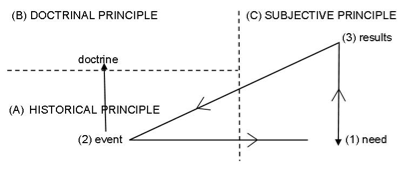
Principle Function Locus Passage
OBJECTIVE A. the historical positive origin of 2 Peter 1:16-21
principle the book
OBJECTIVE B. the doctrinal restrictive content of Mark 2:9-12
principle the book
SUBJECTIVE C. the subjective confirmatory impact on 1 Corinthians
principle the reader 14:24-25
1. The historical principle
Whereas apologetics starts in the present subjective, the principles of canonicity begin in the objective past, “canon” being the body of literature that stands as authoritative, definitive, and normative.
The historical principle is logically first because canonicity has first to do with (5) where the writings came from, which means who wrote them and where authors got their information. Behind this step lies the more basic concern of (4) how a person was recognized as one with a divine message vouchsafed to him and distinguished from false claimants. The question is answered by observing that God’s inbreaking into the world in special revelation always involves (3) miracle. Even (for that matter) the prophet must be able to distinguish between (2) divine miracle as an authenticating occurrence and demonic miracle, parapsychological phenomena, deception, and the like. That distinction is most decisively made by (1) the triumph of the divine in confrontation: the resurrection of Israel from Egypt and the resurrection of Messiah from the grave are the apologetic and theological starting points for the Old and New Testament canons respectively. These are historical considerations, because revelation is a historical matter, rather than a metaphysical construct. The five points inside the historical principle are the same five points in the authentication of a message. That correlation occurs because canonicity has to do with the written form of the same thing a prophet proclaims. The historical principle determines canonicity by identifying the right books in the first place; it is positive.
2. The doctrinal principle
The doctrinal principle determines canonicity by eliminating further books that do not harmonize with previous revelation miraculously authenticated in confrontation. Any writing that contains material contradictory to previous revelation is false and non-canonical, not only in the matter at issue, but as a whole. It is without status among the people of God. The doctrinal principle serves to eliminate new books from falsely coming into the canon; it is restrictive.
3. The subjective principle
The subjective principle confirms in personal experience the objective claims and promises of revelation. That sense of truthfulness means having “the ring of truth.” It speaks to man’s need and finds acceptance there. It is the reality referred to under the expression “the inner witness of the Spirit” (Romans 8:14-16; John 19:4-5, 16). In the present view, this sense of trustworthiness is not a direct act on a man by the Spirit parallel to the proclamation, but as a natural experience a person may have in matters not distinctively religious or Christian. People intuitively perceive the correlation between the answer and their need. “Intuitively” means it is not something reasoned to. “Correlation” is like seeing a bolt and a nut and perceiving that they go together. In the case of an unbeliever, it is the intuitive recognition of the correlation between answer received and need felt. In the case of a believer, it is the intuitive recognition of the correlation between present claims and previous revelation.
Other principles set aside in this treatment have been proposed by writers from a range of theological persuasions: antiquity of the writing, written in a certain language, and the like. The three above, however, are deemed sufficient for explaining the theoretical mechanics of canonization.
The present set of the determining principles differs from some other approaches to canonicity in the number and order of basic principles. It is common to put the doctrinal principle in primary position. Luther is frequently cited in his dictum that those books are authoritative which “preach Christ,” although he may have meant it as a hermeneutical guide rather than a canonical principle. At any rate, three weaknesses inhere in such a suggestion. (a) The doctrinal principle can only be restrictive in that it can only invalidate false doctrines that contradict previous revelation. It cannot deal with false teaching that does not contradict previous revelation. (b) The doctrinal principle cannot determine the original body of literature in terms of which the doctrinal criteria are first established without becoming circular in reasoning. The problem, for example, is insoluble as to why “what preaches Christ” should have any authority. (c) Primacy of the doctrinal principle tends to create a canon within a canon. There is not much preaching about Christ in Job, Haggai, Esther, or the Song of Solomon. By the principle chosen such books must fall into a secondary position of authority, whose contents are negotiable.
Another common tendency, especially among Reformed theologians, is to advance the subjective principle to first position. Because of human depravity, the unbeliever cannot recognize divine truth until a secret, regenerative operation of the Spirit occurs parallel to hearing the message. It stands as an avowed mystery how God implants the conviction of canonicity in the heart of the elect. This kind of subjectivism addresses little that is definitive in canonicity or apologetics, because at best these related matters are post facto as far as becoming a Christian is concerned.
4. Practical providential matters
In the three previous principles, an equation was made between what was written by an inspired man and what was canonical, because canonicity was being considered as to origination. Canonization may also be considered as to formalization. We know from scripture itself, however, that not all original material has been included in the Judaeo-Christian canon. From the Old Testament period there are several cases in point:
a. The Book of the Wars of the Lord (Numbers 21:14)
b. The Book of Jashar (Joshua 10:13; 2 Samuel 1:18)
c. The History of Samuel the Seer (1 Chronicles 29:29)
d. The History of Nathan the Prophet (1 Chronicles 29:29)
e. The History of Gad the Seer (1 Chronicles 29:29)
f. The History of Shemaiah the Prophet (2 Chronicles 12:15)
g. The History of Iddo the Seer (2 Chronicles 12:15)
h. The Visions of Iddo the Seer (2 Chronicles 9:29)
i. The Commentary of Iddo the Prophet (2 Chronicles 13:22)
j. The Vision of Isaiah the Prophet, the Son of Amoz (2 Chronicles 32:22 =
“Isaiah”?)
k. The Prophecy of Ahijah the Shilonite (2 Chronicles 9:29)
l. The Book/History of the Acts/Chronicles of (Various Kings of Israel and
Judah)
m. Elijah the prophet wrote something (2 Chronicles 21:12).
From the New Testament the Epistle to the Laodiceans (Colossians 4:17) comes to mind, although it may be the same as Ephesians. An earlier letter to Corinth is another possibility (1 Corinthians 5:9). About all that can be done in these instances is to suggest such as the following:
(1) They may not have had lasting or universal significance. Several Old Testament items could have been destroyed during the Babylonian capture of Jerusalem.
(2) They may not have had public significance such as for lectionary use. Note the textual problems of Romans 15-16. Philemon, 2 and 3 John were retained, however, and the Laodicean letter was evidently useful for public assembly.
(3) The intention of the writer may be decisive in some New Testament cases if Paul, for example, oversaw the collection of his own letters. New Testament books were all written by an apostle or one who served as an extension of his office.
(4) Perhaps some books could be done without, but others that could be kept or lost God might providentially let go either way.
At any rate, the formalization of the canon operated in terms of principles operative in the origination of the canon, so those principles of the former dictate the results of the latter. As in most cases involving multiple principles, one of these is decisive while the others play important secondary roles. The decision on canonicity is by now a matter of record since we no longer have direct, or even indirect, access to the evidence taken into consideration originally. Nevertheless, as a discipline, understanding the principles has important implications for hermeneutics, for claims of further revelation during the church age, and for evaluating lost books that might come to light. These principles combine to establish what books are canonical, that is, which ones have normative authority for the faith. Canonicity correlates with God-breathedness (2 Timothy 3:16) and equals the concept of apostolicity.
B. Sufficiency of written testimony
1. Vs. personal observation
It is unrealistic to demand personal observation as the only basis for belief. Most of what we come to know is through the written or oral testimony of other people (2 Corinthians 5:7). Jesus pronounced a blessing on those who have not seen and yet believe (John 20:29), presumably because only sufficient evidence is needed to convince someone whose attitude is open to truth that questions self-centeredness.
2. Vs. oral tradition
Written testimony possesses greater stability than does oral tradition. After a generation’s time the reliability of oral information significantly declines. It is eyewitness testimony that the biblical materials purport to preserve in written form.
3. Vs. modern miracle
Generally speaking, miracle authenticates new revelation more than re-authenticating old revelation for each new generation. Elijah on Mount Carmel shows, of course, that continued miracle may occur; but in a significant sense most prophetic miracle did not so much re-authenticate the Mosaic covenant as it did authenticate guidance-revelation delivered through the prophets of Israel or new revelation progressively made known. Christianity has generally taught that progressive revelation did not continue beyond the apostolic era with implication that miracle does not necessarily have to continue. Once new revelation has been authenticated, the reliability of a written record of that authentication is deemed sufficient.
The point here is in regard to sufficiency for apologetic purposes. This does not disallow special guidance or even continued revelation, especially in the form of enablement to understand. The response of Abraham to the rich man in Jesus’ parable sets the expectancy: “They have Moses and the prophets; let them hear them” (Luke 16:29-31). It was not necessary for someone to go back to the rich man’s brothers and make them believe.
christir.org