
Part Iii: The Scientific Method
PART III: THE SCIENTIFIC METHOD
I. Description of General Evolution and Special Creationism
A. General evolution
1. History of the evolutionary model
The concept of evolution originated at least as early as the fifth century B.C. in the person of Greek philosopher Empedocles and may be traced in various forms through Aristotle, Augustine, and others until modern times. Charles Darwin gave classical expression to this much older idea when he published his Origin of the Species in 1859. He highlighted the principle of “natural selection,” which was supplemented by Lamarck’s notion of “the inheritance of acquired characteristics” and de Vries’ “theory of mutations.” Others influential in refining the evolutionary model and background factors include Maupertius, Erasmus, Robert Chambers, Herbert Spencer, Charles Lyell, Thomas Huxley, and Mivart.
2. Definition of evolution
In its distinctive sense, evolution means endogenous complexification through
time, not just modification.
a. Composite in character
In less explicit usage evolution covers two concepts: (1) microevolution and (2) macroevolution. The former means (1) modification observable in nature today; the latter indicates (2) extrapolation of observable change into a “general theory of evolution.” In the general theory there is (1) the fideistic and (2) the scientific, because microevolution is scientific. Macroevolution extrapolates backward to origins in history and forward toward the future, but scientific method applies only to those matters subject to experimental verification—recurrent natural processes in the present; consequently, history (origins) and prophecy (consummation) are beyond the scope of scientific investigation—except as far as the assumption of uniformitarianism can carry investigation. Macroevolution is too slow to be observable; so it cannot come under scientific method though it is methodical in investigating particulars in recurrent processes (microevolution). A process too slow to observe cannot be investigated; so general evolution is composite because it is scientific at the particular level and hypothetical at the general level. The point of contention is macroevolution as far as creationists are concerned.
Scientific method pertains to the natural realm and must be inductive. From data available, it hypothesizes about matters as yet unknown and devises experiments to verify or falsify the hypothesis. At this verification juncture, biological evolution breaks down because of the nature of the subject under consideration: it (1) cannot deal with supernatural agency per se, it (2) cannot deal with non-recurrent processes, and (3) it cannot deal with universals.
b. Universal in scope
Evolution is a principle designed to account for the whole physical realm whether inorganic, organic, and social. As such it is systematically parallel to fiat creation by transcendent deity.
c. Directional in movement
“Complexification” contrasts with “modification” in that evolution seeks to account for the present level of order by going from more simple forms through gradations that lead to more complicated ones. Complexity deals with the relative number of components integrated harmoniously into the whole. Modification and complexification correlate with micro- and macro-evolution.
d. Natural in causation
“Endogenous” contrasts with “exogenous” and refers to principles, powers, or characteristics internal to the system as over against an external source of modification or addition.
The parallel-realm notion for God and the universe would seem to mean that there could be no basis for believing in the other realm. If in fact what we have in nature is fully explainable by principles in nature, then God’s entering in would not be noticeable. It would seem, though, that if he has intervened, we could only know it by the “waves” he left when he came entered. We must say either that we cannot explain the natural order without God or that there is no basis for believing God is. Note the God-of-the-gaps concept and the God-is-dead-for-man-come-of-age doctrine.
Evolution operates by natural causation; so supernatural agency is not involved. This is not to say that all evolutionists are atheists, but that if evolution is true, there is no need for God in explaining the universe. By the law of parsimony (Ockham’s razor, the simplest explanation) God disappears from the picture; consequently, people must believe in God despite evolution, and they must do so for reasons that science cannot address. While God may not be disproved by evolution, he becomes unnecessary as far as nature is concerned; he may still break into history to reveal himself, which becomes a scientific matter. Furthermore, the place that God has is at most before the natural realm (one might postulate his creating mass-energy) or parallel to it (deism). God could be identified with the whole of natural reality as in pantheism, but in that case he would not be super-natural. He could be identified with part of the natural order (panentheism; the law of order, e.g.), but again he would not be transcendent. If evolution were the case rather than creationism, it would not mean that God is eliminated from the picture along the way of life. He would not be necessary for explaining the natural order as we now see it, but he could be involved as an external factor breaking into history for revelation even though he would not be called on to break into history for creation.
3. Mechanisms of evolution
a. Elements (not all currently affirmed)
(1) Randomness. Evolution is carried forward by the random operation of natural law; hence, it is not “pure chance” or a motif of “chaos-to-order” because the randomness, being bounded by natural process, stands distinct from creative and directive intervention by external mind. In fact, a form of determinism operates here, because within the system choice does not exist strictly speaking (at least originally).
(2) Uniformitarianism. “The present is the key to the past.” (a) The maxim (applied especially in geology) means that the processes as to identity that function now are the ones operative in the past. This concept is acceptable to creationism as well except that creationism also allows for divine intervention. (b) In practice there is a tendency to apply the principle of uniformitarianism to processes also as to rate, but less than sensational degrees of catastrophism are compatible with the concept per se. Sometimes creationists, who favor catastrophism, overdo their criticism of this notion, even though uniformitarianism more suitably fits with evolutionary thought.
(3) Naturalism. Reality, insofar as explanation for the universe is concerned, is monistic. Non-material phenomena like life, mind, will, consciousness, altruism are kicked up epiphenomenally by matter.
(4) Timelessness. Evolutionary thought operates in timelessness insofar as it tries to push time toward infinity. Thereby it attempts to overcome the improbability argument. Pushing a factor to infinity effectively eliminates it from the equation.
(5) Mutation. The primary source of the new is mutation, an effect produced by x-ray radiation, neutron radiation, gamma rays, chemicals, heat. Mutation means an alteration in the DNA structure.
(6) Natural selection. Life forms compete in an ecological niche. Those most able to cope with environmental hazards and hardships tend to survive while the weaker, those demanding too much sustenance, too restricted a temperature range, and so on will be eliminated. Natural selection includes sexual selection.
(7) Inheritance of acquired characteristics. Also going under the labels pangenesis and Lamarckism, the inheritance of acquired characteristics was a major proposal in early evolutionary thought as a mechanism for providing the new in evolution. This mechanism is no longer considered possible because DNA, which carries the code for inheritance, is formed in the embryo before experience occurs. The newer field of epigenetics may open up some additional options as the science of it develops further.
(8) Spontaneous generation. Before the modern age of scientific inquiry was in full swing, popular opinion supposed that life arose spontaneously from inorganic material. Now that this concept has been discredited, it no longer affords any assistance in the genesis of life on a regular basis, although it seems not to differ essentially from modern theories of biogenesis.
(9) Polyploidy, amphidiploidy, hybridization. New types arise from an increased chromosome number. It is new only insofar as it puts within one life form the characteristics already present in the individual components of the hybrid.
(10) The exclusion principle (Gause’s). If a hereditary change occurs, either there will be an accompanying alteration of needs and mode of existence or they will exterminate each other. Barriers of various sorts—physical, behavioral, or geographical—would comprise an accompanying feature in the environment.
(11) Revolutionary evolutionism. Catastrophic evolutionism is rapid evolution caused by rapid environmental changes. Punctuated equilibrium refers to relatively short periods of time during which inbreeding within small “founder” populations occurs along with rapid environmental changes, which stimulate these rapid evolutionary changes.
(12) Biological predestination
b. Interoperation
ultimate framework source of the new refinement
mass-energy with mutation natural selection
built-in laws polyploidy (inheritance sexual preference
of acquired charac- competition
teristics environmental
determinism
4. Manner of evolution
a. Progressivism
b. Punctuated equilibrium
c. Emergent evolution
d. Vitalism
e. Orthogenesis means goal-directed evolution independent of environmental
factors.
f. Nomogenesis is evolution according to fixed laws.
5. Application of evolution
a. Constructs of application
(1) Materialistic/naturalistic evolution
Such a position postulates the eternality of mass/energy with no “God” involved in the origin of it or guidance of it. The natural, or material, operates from internal causes.
(2) Theistic evolution
A fundamental question at this point is the way we conceive of God’s relationship to the universe. If God is (a) transcendent to the natural order, his place in the reality is at most on the front end as creator of mass-energy. Evolution is said to be the method God used in bringing basic mass-energy into its present form.
If he is (b) immanent (ontically) in the universe, then he may be equal to the natural order (pantheism), as part of the natural order (panentheism, theistic naturalism), or inclusive of the natural order (a possibility under the concept of process theology). The term “theistic evolution” applies to such an arrangement, but an essentially different kind of concept would be in view. In effect, theistic evolution would not be different from materialistic evolution; so for the sake of distinction, the expression ought to be limited to transcendent deity.
General evolution may also be broken down into polyphyletic and monophyletic schematics. The first pictures parallel developments of the same sequence, or pattern, of development. The latter pictures evolution as occurring only in serial fashion.
b. Areas of application
Evolution, like creation, seeks to provide a motif that has universal application. Every discipline attempts to use the model in an effort to integrate itself into the unified field of knowledge.
(1) Religion. The concept of the spirit world developed from animism, through polytheism and monotheism, to the logical end of atheism for mankind come of age.
(2) Anthropology. In keeping with humans’ essentially animal nature, their growth has progressed at differing paces throughout the world. It would seem that the natural implication of evolutionary thinking is the superiority of some races and the inferiority of others, much like the superiority and inferiority of other animal and plant forms. Note, for example, C. Putnam, Race and Reason: A Yankee View. Washington, D.C.: Public Affairs Press, 1961.
(3) Ethics. The implication of survival of the fittest is a competition model for life in contrast to the love model championed by Christianity. Title IX, for example, is the exact antithesis of the implied ethics of evolution. Mercy killing (euthanasia) and genetic engineering of the super race seem to be most in line with at least atheistic evolution. Keeping less sturdy forms in the reproduction line dilutes the strength of the organism.
(4) Sociology. Social Darwinism produces the kind of behavior
represented by the Third Reich.
(5) Psychology. Behaviorism is an example of working out the logic of evolutionary thought in the area of psychology. People are reduced primarily to stimulus-response beings who may be manipulated as such.
(6) Biology. The organic developed spontaneously from the inorganic and complexification produced higher levels as time passed.
(7) Linguistics. Language came about as animal sounds were multiplied.
(8) Cosmology. The universe began with a big bang and according to nebular theory the planets, and so on, were formed by the accumulation of particles.
(9) Geology. In uniformitarian pattern, the build-up of the layers of the earth’s crust occurred over the millennia.
(10) History
B. Special creationism
1. History of special creationism
Strictly speaking, creation from nothing is unique to the Judaeo-Christian tradition and related religions. The ancient pagan religions either viewed the “universe” as eternal or developed myths in which the world, the stars, and so on, were made out of something or someone that previously existed; consequently, they did not have a pure notion of creatio ex nihilo. In the modern era several forms of creationism have appeared (see below in 4a) that range all the way from flat earth to geocentric and heliocentric universe models, and from a six-day creation a few thousand years ago to the concept of progressive creation over millions of years.
2. Definition of special creationism
“Special creationism” means direct, external causation of kinds with bounded
variation.
a. Composite in character
Creationism allows for evolution of a microevolutionary sort, but the modification potential is bounded so that change is not infinite variation. The concept of “gene pool,” for example, is allowed to operate here in that the common stock contains in it more than one particular expression of the given number of characteristics. “Composite” therefore means that there is (1) direct, external causation as well as (2) principles/laws operative internal to the natural order for carrying forward variation within boundaries. Unlike general evolution, creationism does not limit causation to one sort—internal, but allows for external cause as well. One may say then that creationism is a broader concept that includes bounded “evolution” in it. Neither external nor internal causation is absolutized in that not all variation is assumed to be either by direct supernatural agency or indirect natural law. The proportion of these two components vary between individual creationists.
b. Ultimate in scope
Since creationism subsumes (micro)evolution under it, the view does not
attempt to be so much universal as ultimate.
c. Supernatural in causation
The origin of matter comes from beyond itself. Since a system is characterized by its most ultimate distinctive, creationism is supernatural in causation even though not all the causation in it is supernatural.
3. Mechanics of special creationism
a. Elements
(1) Transcendent deity
(2) Creation from nothing
(3) Built-in laws of operation
b. Interoperation
God God
created mass/energy source of the new refinement
with built-in laws direct creation natural selection
variation within sexual preference
“kinds” competition
polyploidy environmental
determinism
4. Application of creationism
a. Constructs of application
(1) Short-term special creationism
Creation of basic mass-energy occurred in the order of thousands of years ago. Life kinds were formed separately by divine creative acts at essentially the same time in the beginning.
(2) Progressive creationism type (a)
Creation of life kinds occurred over long periods of time, but they were made directly from inorganic materials in a kind of overall “polyphyletic” scheme of parallel beginnings.
(3) Progressive creationism type (b)
Creation of life kinds occurred over long periods of time, and they were formed from previously existing organic forms in a kind of general “monophyletic” scheme of serial beginnings.
b. Areas of application
In general, special creationism provides a higher source of causation in addition to the laws inherent in the natural order of things. As a result the general tendency is not to invoke supernatural causation if natural means is sufficient. In areas like sociology, culture, religion, technology, language the concept of natural modification through time is allowed to account for ongoing change because there is an organizing motor in the form of human reason. In areas like cosmology and biology, supernatural modification through time must be brought to bear. There is, however, a difference even in religion, culture, sociology, and language, because they as such do not have to be generated from natural levels beneath themselves. In fact, devolution may be the case in something like religion. Language can start out as a given and simply modify over time. Creationism provides a greater range of causation possibilities and is a more adequate model for explaining the universe as we know it.
5. Spiritual implications
II. Evidence for General Evolution and Special Creationism
A. General evolution (transformism)
1. Structural similarity: paleontology
What was previously used as an argument for rational deity has been turned into evidence for common origin through evolution. Creation has viewed the raw data more
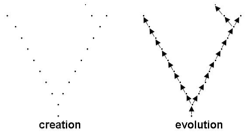
like a dot-to-dot that forms a picture of rational order bespeaking the creator. Evolution has drawn arrows between the points of data as if one came from the other. In the former, the connection between the points lies in a different plane—in the mind of the common creator, while in the latter it lies in the same plane—in the potentialities of nature. Correlation does not equal cause.
2. Vestigial organs
Vestigial organs were originally identified as functionless organs left over from a time when they served a purpose. As scientific investigation has progressed, the originally proposed examples have greatly shrunk. In the modern situation “pseudogenes” have been used in something of the same fashion to argue for evolution. Pseudogenes are genetic material that do not code for any known proteins; consequently, they are regarded as non-function, “nonsense” genes. (See Acts & Facts, March, l988, p. 3, “Gish Debates at U. C., Irvine.”)
3. Nascent organs
The idea is that organs (at least previously) thought to have no function were
in the process of becoming what would later be useful parts of the organism.
4. Embryology
Response: a. The function is not the same between the various animals.
b. Similar animals will have to develop along the same lines
embryologically.
5. Geological stratigraphy
Responses: a. Quick deposition because of ephemeral markings
b. Quick deposition to get fossils, coal, oil, polystrate trees
c. Mostly water-laid strata
6. Fossil remains
The geological column presents a simple-to-complex pattern of fossils.
Responses Counter-responses Surrejoinder
a. Circularity of geological-
column argument
b. Frequent disconformities overthrusts
The disconformities are normally explained as examples of overthrust or as examples of erosion and redeposition. There are, however, no traces of shear marks between the strata to account for the sliding action presumably involved in creating this anomaly.
c. Frequent omissions erosion no weathering
marks
Omissions are normally explained as resulting from erosion of the “missing” sequences. There is an absence of weathering marks, however, between the remaining strata.
d. Fossils require quick covering up.
e. What of those not changed in form throughout the column?
f. What of contemporaneousness of dinosaur and human footprints?
The Paluxy River phenomenon has been identified by some scientists, not as human footprints, but as the single, center toe of theropod dinosaurs: In the Beginning, pp. 107-9. An update on mantrack investigation appeared in Ronnie J. Hastings, “The Rise and Fall of the Paluxy Mantracks,” Journal of the American Scientific Affiliation. (XL:3), September l988, pp. 144-55. In general evangelicals have backed off from putting much weight on this area of investigation.
g. General sorting action of water explains the simple-to-complex pattern.
h. Sudden appearance of advanced forms right on top of the basement
rock
i. Systematic gaps
7. Chronometry
a. Radiocarbon (carbon14)
Nothing older than 40,000 years can be dated using C14.
b. Uranium-thorium-lead (Note In the Beginning, pp. 83-84.)
c. Potassium-argon
d. Rubidium-strontium (For a creationist’s sympathetic presentation see
Davis Young. Creation and the Flood, Appendix.)
Several general objections to radiometric dating schemes have been developed. The objections involve inconsistency, results conflicting with the known, false or unknowable assumptions necessary to make the methods work, and systematic errors caused by intercalibration between various radiometric methods (?).
(1) Different tests on the sample rock may yield different results: Steidl,
The Earth, the Stars, and the Bible, p. 67.
(2) Discrepancies appear between tree-ring dates and radiometric (C14)
dates.
(3) Living mollusks have been radiometrically dated millions of years
old.
(4) Known dates of lava flows (Krakatoa, e.g.) are millions of years
too old.
(5) There have been cases where soil samples were dated older than the rock sources from which they presumably came: Steidl, The Earth, the Stars, and the Bible, p. 68.
(6) The methods have been intercallibrated.
(7) The methods assume uniformity in decay rate, no contaminating or
leaching, and the like.
e. Stalactite-stalagmite formation
f. Light travel from distant stars
(1) Space curvature concept
(2) Light in flight concept (cp. water hose analogy)
(3) Decay in the speed of light (Rise of the Evolution Fraud, pp. 208-10;
Ex Nihilo IV (1 & 3; 1981).
g. Erosion features
h. “Appearance of age at creation” considerations
8. Blood precipitation
9. Chromosome analysis
10. Modern experimentation
a. Peppered moth in England
b. Fruit fly experimentation
c. Sugar beet
11. “Ontogeny recapitulates phylogeny.”
“There are supposed similarities between, for instance, the adult reptile and the mammal embryo, and that these are evidences for evolution.” Taylor, Evolution and the High School Student, p. 21.
12. Obsidian hydration dating technique. See p. 27 of NEAS Bulletin New Series No. 17, 1981.
B. Special creationism
1. Biblical considerations
a. Creation of woman
(1) Basic observations
(a) Both sexes did not develop side by side as in evolutionary
theory, but one was created from the other.
[1] Woman was created “after” man (1 Timothy 2:13).
[2] Woman was created “from” man (1 Corinthians 11:8).
[3] Woman was created “for” man (Genesis 2:18).
(b) Mankind did not develop as a group, but is represented as
descending from a single pair.
[1] Eve was the mother of all living (Genesis 3:20).
[2] Adam was an individual person parallel to Seth (Genesis 5:1-5; Luke 3:38) and Christ (Romans 5:12ff.; 1 Corinthians 15:45-47).
(2) Reasons for understanding the Genesis account historically
Sometimes in an effort to harmonize belief in God with evolutionary theory some have interpreted the account of creation and fall as a loose, extended parable that describes figuratively general truths about the world. Elements of the narration would not then contradict evolutionary theory, but certain observations make this approach unlikely in a complete sense:
(a) The biblical concept of men-women relations
[1] Jesus’ argument against divorce (Matthew 19:3-12)
[2] Paul’s basis for sexual purity (1 Corinthians 6:12-20)
[3] Paul’s argument against women’s exercising authority
over men (1 Timothy 2:8-15)
(b) The obvious purpose of Genesis is to serve as an introduction
to a historical people.
The future of a historical nation is dealt with parabolically in scripture (revelation); therefore, its past could have also been covered parabolically. In point of theory this idea may be true, but the Genesis material does not appear to be interpreted in the rest of scripture as if it is parabolic.
(c) The Christ-Adam parallel (Romans 5:12-21; 1 Corinthians
15:20-23, 45-49)
b. Concept of kind
“Kind” does not necessarily correspond to the modern designation “species,” though perhaps it would originally have designated interbreedable units sharing a common gene pool. Speciation would be possible within boundaries as time progressed. From an evolutionary standpoint the concept of species is limited to the results of change (on the effect end) and does not point to any boundaries of change (on the cause end); that is, cross-breeding may not be able to take place between the end products of different evolutionary lines or between the end of a line and the original stock from which it evolved. But it is foreign to evolutionary thinking to suppose that these are always inherent boundaries beyond which modification can go. “After their kind” is said of all life, both plant and animal (Genesis 1:12, 21, 24, 25). Most importantly it is said of them from their beginning (Genesis 1:11, 20, 24). The creation of man-“kind,” being more detailed an account than the others, seems to depict generally what happened in the origination of the other species: they resulted from separate, parallel, creative activities.
“Create” would not necessarily eliminate creation from previously existing life forms (progressive creationism).
c. Creation from nothing
Evolution in its non-hybrid form (i.e., not theistic evolution) presupposes the eternality of mass-energy. The Bible pictures the universe as having a beginning.
(1) The Hebrew word for “create/make” (בָּרַא, bara’) means to make something new, a new kind of thing. Said with reference to mass-energy itself, the word implies creation from nothing (Genesis 1).
(2) The Greek word for “create” (κτίζω, ktizō) means to create from
nothing (Colossians 1:16).
(3) “All things came-to-be [γίνομαι, ginomai] through him . . .” (John
1:3).
(4) “The things that are did not come from what has phenomenal
existence” (Hebrews 11:3).
(5) “. . . all of them will grow old . . .” (Psalm 102:25-27).
d. Order of creation
e. Abbreviated time
f. Completed creation
Evolution depicts an ever-changing universe in which upward modification from the past is accounted for by processes presently operative. Genesis presents God’s work of creating the material universe as essentially finished by the “seventh day” (Genesis 2:2-3). The changes occurring now, therefore, are not of the sort that caused things to become the way they are.
g. Man-animal distinction
(1) A peculiar divine effect is said to have attended the creation of man: “God breathed into his nostrils the breath of life, and Adam became a living soul” (Genesis 2:7).
(2) No companion was found in the animal world (Genesis 2:18, 20).
(3) People were eventually given permission to kill animals, but not other people (Genesis 9:1-6).
(4) The fear of people was to be on all animals (Genesis 9:2).
(5) Cohabitation between people and animals was prohibited on pain of
death (Exodus 22:19; Leviticus 18:23; 20:15).
(6) Only people are said to have been created in the image of God (Genesis 1:26-27; 5:1; 9:6, etc.).
The most that can be said for the evolutionary hypothesis and the scriptural presentation is that people did not come from an evolutionary process. They are to view themselves as related to God rather than animal, and is to conduct themselves accordingly.
h. Large-scale catastrophism and/or miracle
(1) The Noachian deluge
(2) The confusion of languages (Genesis 11:1-9)
(3) The Egyptian plagues
(4) The great “earthquake” (Amos 1:1; 3:15; 4:11; 5:18-20; 6:11; 8:8-9;
Zechariah 14:5; Jonah 3:4?; Josephus’ Antiquities 9:10:2, 4)
(5) The destruction of Sennacherib’s army (Isaiah 37:36)
(6) The destruction of Sodom and Gomorrah (Genesis 18-19)
(7) Hezekiah’s sundial (2 Kings 20:8-11)
(8) Consummation of all things (2 Peter 3:6-7)
(9) The Deborah debacle (Judges 5:20)
(10) The long day of Joshua
(11) The discomfiture of the Philistines (1 Samuel 7:10)
(12) The death of the Israelites because of David’s numbering the people
(1 Chronicles 21:14-15)
(13) Elijah’s contest on Mount Carmel
(14) Fall of the walls of Jericho
(15) David’s deliverance from Saul (2 Samuel 22:8-19; Psalm 18:7-18)
(16) Job’s catastrophes
(17) The division of the earth (Genesis 10:25)?
i. The concepts of miracle and providence
Miracle refers to a visible entering into the natural realm by supernatural power. Special divine providence refers to an invisible entering into the natural realm by God’s supernatural power. Both equally involve supernatural intervention; they differ in how obviously supernatural the causation is.
j. Ethics
k. Devolution vs. evolution
(1) The garden situation led to a less ideal world for man.
(2) The antediluvian world degenerated into the post-flood system.
(3) Monotheism degenerated into polytheism.
2. Scientific considerations (with references to some of the earlier creationist
materials
a. Thermodynamics generally
(1) First law of thermodynamics (conservation)
(2) Second law of thermodynamics (time’s arrow, entropy,
degeneration). Speak to the Earth, pp. 447-63)
(a) Implications
[1] A beginning for the universe
[2] A beginner for the universe
[3] The transcendence of the Creator
(b) Responses given to the entropy observation
[1] Syntropy: Acts & Facts (VI:12; p. ii) 1977
[2] An alternative principle that negates entropy: enthalpy
Acts & Facts (VI:11, p. 6, 1977)
[3] Energy sources at the center of each universe
[4] Examples of increased order
[5] Probability argument
Entropy can be reduced in a part of the universe at an expense elsewhere (J. A. Cramer. “General Evolution and the Second Law of Thermodynamics.” “Origins and Change: Selected Readings from the Journal of the American Scientific Affiliation,” pp. 32-33.
(c) Counterresponses
[1] Ockham’s razor; law of parsimony
[2] Necessity of an organizing motor: see especially A. E. Wilder Smith, The Creation of Life: A Cybernetic Approach to Evolution. Wheaton, IL: Harold Shaw Publishers, 1970.
[3] Commensurateness of opposing probability
[4] The universe is a closed system.
[5] Entropy was discovered on this planet whether it
represents a closed or open system.
b. Biology
(1) Absence of nascent organs: see The Transformist Illusion, pp.
165-78.
(2) Diminishing number of proposed vestigial organs
(3) Instinct: see The Transformist Illusion, pp. 257-63.
(4) Overdevelopment
(5) Symbiosis
(6) Reserve systems: see Acts & Facts, VI: 8 (Aug., 1977), pp. i-iv.
(7) Oldest living things as of post-flood origin
(8) Mendelian laws of heredity and the operation of DNA
(9) Biogenesis difficulties
(a) Origin of bionomers
(b) Origin of macromolecules
[1] Dehydration-condensation
[2] Directional problems
(c) Chromosomes, genes, DNA: there is a tendency for DNA-
protein reactions to destroy living systems.
(10) Origin of multisexual reproduction
(11) Extinction
c. Geology
(1) Uniformitarianism vs. catastrophism: two models
(2) Particulars
(a) Stratigraphy
[1] Polystrate fossils: Speak to the Earth, pp. 197-201, 60-85
[2] The absence of any physical evidence for chronological
boundaries between rocks of successive “ages”
[3] Uniformly water laid
[4] Near-random deposition of formational sequences
[5] Interbedding (with repeated fossils): Studies in Special
Creation, p. 126
[6] Graded bedding: Studies in Special Creation, p. 125
[7] Intermeshed bedding: Studies in Special Creation,
p. 133
(b) Lithology, or lithography
[1] Occurrence of all lithographic types in all ages
[2] Uniform physical appearance of rocks from different ages
(c) Fossil
[1] Human-ape fossils
[2] Lack of pre-cambrian fossils (see The Transformist Illusion, pp. 19ff.) with sudden appearance of highly developed forms without previous forms in the cambrian. Archaeopteryx can no longer be considered the reptile-bird link because there has now been found an undoubted bird 60,000,000 years older than archaeopteryx (Acts & Facts, VI:12 [December 1977], p. 6).
[3] Systematic gaps without intermediate forms
[a] Gaps correlate with created groups.
[b] The closeness/separateness accountable by
1) Created kinds
2) Stages in metamorphosis and general
development
3) Seasonal change (Mayr, p. 85)
4) Generational cycles (Mayr, pp. 85-86) "
5) Male and female members of the same species
6) Young and adult members of the same species
7) Variability within the same species
Note the concept of punctuated equilibrium.
[4] Breccia
[5] Inverted sequences relative to evolutionary postulations
[6] Worldwide distribution of all types of fossils
(Remarkable Birth of Planet Earth)
[7] Arrangement of fossils implied by the hydraulic processes producing the deposition (Remarkable Birth of Planet Earth, p. 37)
[8] Arrangement of fossils implied by the relative mobility and elevation of the ecological habitat (Remarkable Birth of Planet Earth)
[9] Long-existent specimens without modification
[10] Universal distribution of animal kinds
[11] Notable absences of meteorites in the geological column
[12] Extinction of superior life forms (note natural
selection) (= presence of inferior life forms)
[13] Other phenomena
[a] Human-dinosaur contemporaneity
1) Hoax?
2) Result of time travel backward (Time Travel—
Myth or Reality? by Richard Heffer, p.135)
3) Extraterrestrial visitors
4) Theropod dinosaur tracker (In the Beginning)?
[b] Preservation of ephemeral markings throughout the
geological column
1) Fossil ripple marks
2) Raindrop imprints
[c] Universal occurrence of rivers in valleys too large
for the present stream
[d] Worldwide occurrences of raised shore lines and
river terraces
(d) Coal
The very formation of coal requires catastrophe for quick
burial: Speak to the Earth, pp. 60-85.
(e) Oil
The very formation of oil requires catastrophe for quick
burial.
(f) Continental drift/plate tectonics
(g) Caves
d. Sociology
(1) Universal distribution of flood traditions
(2) Convergence of population statistics on the date of the flood
(3) Language
(a) Uniqueness of human speech
(b) Underlying unity of human language
(c) Origins of the different languages
(d) Origins of language
(4) Creation accounts (cosmogonies)
e. Chronometry (young-earth/universe arguments)
(1) Note the difficulties in radiometric dating methods: Remarkable Birth of Planet Earth, pp. 98-99, and The Creation-Evolution Controversy, pp. 154-56.
(a) Inconsistencies: different tests on the same rock may yield discordant results (Steidl, The Earth, the Stars, and the Bible, p. 67).
(b) Inaccuracies
[1] Discrepancies on tree-ring dating
[2] Error on living mollusks
[3] Krakatoa lava flows
[4] Soil samples older than the rock sources (Steidl, p. 68)
(c) Intercalibration between other methods and K-AR
(d) Assumptions (cp. Chittick, The World and Time)
[1] No contamination or leaching
[2] Uniformity of rate
[3] Beginning at zero
3. Philosophical considerations
a. Probability
(1) “The infinitely improbable becomes necessary by time.”
However, equilibrium forces also grow proportionately: Acts & Facts (I), p. 79. Actually there is more than an equal tendency in the opposite direction because there is entropy.
(2) The infinitely improbable may happen the next minute, as in the way
a pencil may fall on the desk when a person throws it.
b. Design (teleology)
Evolution takes design as indicative of physical origin (matter) rather than
rational origin (person).
c. Circularity
We cannot explain the origin of a system (external) in terms of the
preserving principles of a system (internal).
(1) Example in the geological column argument
(2) Example in chronometry
(3) Example in natural selection
(4) “Too slow to see it”; hence, not science
d. Harmony
(1) Corporate adaptation
(a) Interdependent partials cannot be sequenced chronologically.
(b) Partially developed (nascent) organs would tend to be selected
against because they would be dysfunctional.
(2) Preadaptation: The Transformist Illusion, p. 250
(3) Duplicate adaptation: The Transformist Illusion, p. 251
(4) Co-adaptation: The Transformist Illusion, p. 249
e. Equivocation
(1) Equating mass-energy with mass-energy-organizing motor
(2) Confusing science and religion/philosophy: science cannot deal with
spiritual reality
(3) Confusing science and history: science cannot deal with history
(4) Confusing correlation and causation
f. Theistic implication for either causality or non-causality
The arbitrariness of basic coding of DNA and nature in general implies that it, like speech, is determined by intelligence. If chance would, for example, kick up a certain sequence of amino acids, why would such a sequence provide for making a worm rather than a horse?
g. Diversity: The Transformist Illusion, pp. 253-55
h. Inconsistency
The idea is often expressed that mutations, though generally deleterious, are sometimes beneficial as per a particular setting and that the small number of beneficial ones can carry the day against the general tendency! Strong objection is made, however, to miracle because in our experience it is not statistically probable!
III. Extra-Terrestrial Theories
A kind of mixture of creationism and evolution has been developed on the theory of extra-terrestrial intelligence. The idea popularized by Erick von Däniken in Chariots of the Gods, Return to the Stars [fragment] (= Gods from Outer Space), and Gold of the Gods. Others have joined in the wake of his popularity like Blumfield, The Spaceship of Ezekiel.
Cliff Wilson has some helpful responses in Crash Go the Chariots. Note also War of the Chariots and The Chariots Still Crash, by Cliff Wilson. Under von Däniken’s notion, alien intelligences performed genetic engineering on some humanoid and developed the human race as we now know it. Of course, if such a procedure actually occurred, the question of spontaneous origin of intelligent biological life is simply moved back one step and pushed outside our own solar system. The problem remains as it was before, but only in a new location.
christir.org