
Abbreviated Time
ABBREVIATED TIME
Virgil Warren, PhD
Scripture does not readily adapt itself to the eons of time projected for accomplishing what evolutionary theory postulates, particularly in the biosphere. With varying degrees of likelihood, certain possibilities might push the date A.M. beyond the 4000 + B.C. minimum reading of scripture as in fiat creationism.
I. Possibilities for Elongation
A. Time prior to Genesis 1:2
1. Proposed relationships between Genesis 1:1 and 1:2ff
a. Genesis 1:1 as a caption for the subsequent creation account

Under this view, the account may provide no statement of absolute origin in the “book of beginnings.” That would leave open the eternality of matter and, when taken together with a parabolic understanding of Genesis 1-11, would pose no difficulties for a theistic evolutionary approach.
The answer to that concern, however, is that Day 4 seems to cover the origin of everything beyond earth—sun, moon, and stars; so an absolute beginning does appear in the account if 1:1 serves as a title for everything that follows. Besides, taking 1:1 as a title does not require taking 1-11 as parabolic.
Observations against a title view include the following:
(1) The rest of scripture teaches creation from nothing. We would expect it here in the Genesis statement of origins.
(2) “Bara’” (בָּרַא) means to create something new kind. In reference to the universe, the word implies creation from nothing.
(3) Taking “in the beginning” (בְּרֵשִׁית) as a construct form causes a rather complex syntax for Hebrew grammar, a syntax that seems out of place in the simple style in the rest of Genesis 1-2.
(4) The Masoretic Hebrew text does not point the verse to have it read “In the beginning of God’s creating the heaven . . .”
(5) All the ancient translations understand the Hebrew as an absolute reference, notably the Septuagint Greek version that Jewish scholars prepared a couple centuries before Christ.
b. Gap between Genesis 1:1 and 1:2 (gap theory; ruin-reconstruction; pre-
Adamic cataclysmic theory, creative re-iterations)

After a previous form of existence, the earth “became waste and void” so God started over. The approach removes all difficulty over the geological remains because it assigns virtually all that stratigraphy to pre-Adamic circumstances. The ruin-reconstruction hypothesis makes Adam and Eve comparable to Noah and his family at the end of the flood. Gap theory rests on observations like the following:
(1) The expression “the heavens and the earth” appears elsewhere in
reference to the completed creation: Isaiah 45:18.
(2) Hayah (הָיָה) can mean “became.”
c. Genesis 1:1 is a part of the first day.
Exodus 20:11 and 31:17 speak of God’s creating the heavens and the earth in six days. Were 1:1 to precede Day 1, this later statements would be unlikely. The verses from Exodus, however, may be “loose” statements. (a) Within Genesis 1 itself, all the other days begin with the formula “And God said.” That clause does not appear until verse three, which would lead the reader to make God’s six days of work a matter of adjusting “waste and void” into a situation inhabitable for mankind. (b) The rest of the days do not have amounts of activity comparable to the large-scale creation of the whole universe. Including 1:1-2 in day one would create a disparity in the order of magnitude within the days.
How crucial this last point is depends on whether we feel free to take the “days” of Genesis as topics of divine activity instead of times of activity. If that appears reasonable, the “days” do not deal with duration of time.
d. Genesis 1:1 is antecedent to 1:2ff., yet inclusive of them.
Under this schematic Genesis 1:1 states the completed creation act and then laps back to the point at which the earth was waste and void, and elaborates the account in a six-day arrangement; 2:4-25 becomes another such lapsing back to elaborate the last half of what took place in Day 6.
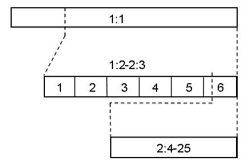
(1) Isaiah 45:18 uses “the heavens and the earth” to indicate the mature
creation; so we may take Genesis 1:1 to mean the same.
(2) Genesis 2:4-25 elaborates the last part of Day 6.
Consequently, the literary pattern of these two chapters can allow for an indefinite period of time prior to the “waste and void” condition. Those stages of cosmological development that preceded 1:2 could be of any length. That period could account for chemical evolution as well as solve the difficulty created by light traveling for millions of years.
B. Periods of time for the “days” of Genesis 1
A summary of constructions for the Genesis days appears below with some of the reasons for them. A helpful study is E. J. Young, Studies in Genesis One (Philadelphia, PA: Presbyterian and Reformed Publishing Co., l964). See also Richard Niessen, Acts & Facts IX:3 (March l980), pp. i-viii.
1. Twenty-four-hour periods. Actually, earth’s rotation has retarded somewhat over the millennia. The original rotation period was somewhat less than at present. If we were to accept Donald Patten’s theory about Martian fly-bys from 701 B.C. back, alteration by 2% or so rotation rate would cause other deviations in day length.
a. The correlation of the normal week with the creation activity: Exodus 20:11. Where does the idea of a seven-day week come from if not from the creation account? Our proposal is that God inspired Moses to set up a seven-day week in contrast to the Egyptian ten-day week. That move was part of a larger reconstruction of life elements to dissociate Israelites from the cultural circumstance they lived under for some centuries. In God’s creating Israel, he provided them with an account of his creative work in a sevenfold breakdown.
b. The plants of the previous day would have died if the sun had not been created soon (Day 4). 1:14-19 may not be the creation of the sun and moon.
c. The “evening and morning” expression. Contrast Psalm 90:4-5, where the typical Jewish view of day starting in the evening is set aside for “morning and evening” when a figure is meant: Acts & Facts, (November 1978), p. 11.
d. With an associated term/ordinal-number, יוֹם (day) always means a period of twenty-four hours. But the difficulty is that Hebrew has no word for a time period that it can put in ordinal series. Using “day” for that unusual purpose would make sense.
e. “Day and night”
f. Genesis 1:14 distinguishes between days, years, and seasons.
g. Symbiosis requires short-term days (?).
h. Survival of plants and animals requires a twenty-four-hour day.
i. Jewish rabbis and early Church Fathers understood the days of Genesis as
twenty-four-hour days.
j. Death came about because of sin: Romans 5:12.
k. Correlation of passion week and creation week (?)
l. Observing the Sabbath means that God’s seventh day could not be millions of years old because mankind was commanded to do as God did—work six days and rest the seventh. Correlation between the week and the creation pattern would be sufficient.
m. Adam was created on the sixth day. If a day is a thousand years, he was far older than the 960 years Genesis 5 indicates for the length of his life (Creation Ex Nihilo, December-February 1996 [18:1], 41; Ken Ham, “The Necessity for Believing in Six Literal Days”).
2. Twenty-four-hour days with indefinite periods intervening
Each day opens the period but does not equal the period. The days are successive, but not consecutive (Eckelmann and Newman, Genesis One, pp. 64-65, 74).
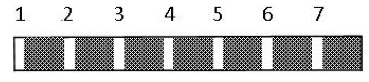
3. Indefinite periods of time (not necessarily geological ages)
a. Rise of the continents and drain off might imply more than a day's time.
b. Formation of the firmament by evaporation from the water (?)
c. Wide series of events on Day 6: creation of animals, creation of man,
Adam's naming the animals, creation of woman
d. The perpetualness of Day 7: Genesis 2:3 + Hebrews 3:11-4:13 (Psalm
95:7-11 (no evening-morning for Day 7)
e. Natural processes were going on prior to Day 3: Genesis 2:5.
f. Usage of “day” for more than twenty-four-hour periods
(1) Genesis 2:4: “in the day that Yahveh God made earth and heaven”
(2) “The day of the Lord”: Isaiah 2:12; 13:6, 9; Jeremiah 46:10; Lamentations 2:22; Ezekiel 13:5; 30:3; 39:13; Joel 1:15; 2:1, 11, 31; 3:14; Amos 5:18, 20; Obadiah 15; Zephaniah 1:7, 14, 18; 2:2, 3; Zechariah 14:1; 2 Corinthians 1:14; Philippians 1:6, 10; 2:16; 2 Thessalonians 2:2
(3) 2 Peter 3:8 (?)
(4) Numbers 7:12 + 18 + 24, and so on, plus 7:84
(5) A generalized word for time; cp. time, times, and half a time as
equal to three days and a half: Revelation 12:14 + 11:9.
g. Genesis 1-11 shows significant compression of time to which two chapters
for seven days would be an exception.
h. Over time, God tends to work through less direct and less miraculous
means. He has plenty of time (2 Peter 3:8) and is long-suffering (3:9).
i. Existence of the sun before its “creation” in Day 4 (?)
4. Geological ages (day-age theory)
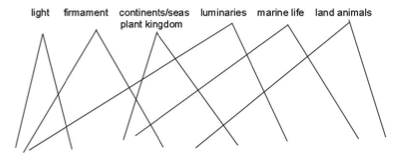
5. “Overlapping” days. A description of this approach may be found in Davis A. Young, Creation and the Flood: An Alternative to Flood Geology and Theistic Evolution, pp. 114-34.
The system depends on the similar sequence in geological stratigraphy and that of the Genesis account of creation. Exceptions to the biblical order are accounted for by saying that the major creative activity for certain segments of creation occurred during a given “day,” not necessarily all.
6. The framework hypothesis
See Meredith G. Kline, “Because It Had Not Rained.” Westminster Theological Journal, XX (l958), pp. 146-57; A. Noordtzij. God‘s Woord in der Eeuwen Getuigenis. Kampen: J. H. Kok, 1924; and N. H. Ridderbos. Beschouwinger over Genesis I. Kampen: J. H. Kok, 1963. The week is a figurative framework within which the events of creation are arranged in other than a straight chronological sequence. The week serves as a literary device.
Considerations
a. Correlation of Day 1 with Day 4, Day 2 with Day 5, Day 3 with Day 6
b. The seven seals and seven trumpets of Revelation 6-11, 16
c. Evenings and mornings prior to Day 4
d. Vegetation before the sun
e. How could there be fertile soil on the exposed land the third day when the drain off on Day 2 would have highly eroded the land masses. How would there had been any topsoil anyway since it comes from the decay of vegetation—which comes later?
f. The different sequence in Genesis 2 and Genesis 1
g. One form of that framework would equal the mythological idea: different order in the two chapters, man before plants and animals, different divine names, a snake that talks, trees that give life and knowledge.
Counter considerations
a. The chronological-historical week comes from the Genesis account of
creation: Exodus 20:11.
b. How can a person argue for creation ex nihilo under this format?
7. “Evolutionary creation”
Howard J. Van Till in “Special Creationism in Designer Clothing: A Response to The Creation Hypothesis” (Perspectives on Science and Christian Faith, 47 [2, June 1995], pp. 123-31) describes a model of God’s relationship to the evolutionary model, which he calls “evolutionary creation.” God created the universe from nothing and endowed it with the capacities to develop into the order of things as we now see them. Though he objects to methodological naturalism, there is no difference in the idea that development can occur given the built-in capacity of base matter to self-complexify. Along the way after the initial mass-energy creation, there is no divine intervention in either format.
8. Revelation days. The seven days refer to seven days on which God successively revealed parts of the whole creation account (or days as topics of God’s creative work, as in #6 above).
C. Time between the creation of Adam-Eve and the events of Genesis 3
D. Time between leaving the Garden and the birth of Cain
E. Expansion of the antediluvian genealogical lists in Genesis 5 and 10
1. Considerations legitimizing expansion
a. Schematizing is suggested by having ten antediluvian generations to Noah and ten more to Abraham (note the schematizing by fourteens in Matthew 1:2-17). This schematizing may be qualified in that only eight generations appear in the Cainite line before the flood. On the other hand, Peleg would have predeceased five generations before him. Noah would also have been a contemporary of Abraham for fifty-eight years, and Shem would have survived Abraham by thirty-five years. Genesis 11:26 is somewhat ambiguous. Some people for this reason identify Shem with Melchizedek.
b. Known examples of genealogical abbreviation show the versatility of the “begot,” “bare,” and “son of” expressions. See William Henry Green, Bibliotheca Sacra XLVII (1890), pp. 285-303, reprinted in Newman and Eckelmann, Genesis One and the Origin of the Earth (InterVarsity, 1977), pp. 105-23.
(1) Matthew 1: (1:8: Joram [Ahaziah, Joash, Amaziah] Ozias), (1:11: Josiah [Jehoiakim] and Jechoniah), (1:1: the whole genealogy of Jesus, David, Abraham)
(2) 1 Chronicles 23:15-16; 26:24: Moses, Gershom [. . .] Shebuel, a contemporary of David
(3) 1 Chronicles 27:31: Levi, Kohath, Hebron [. . .] Jerijah, a contemporary of David
(4) Ezra 8:1-2: (David [. . .] Hattush) (Aaron, Eleazar, Phinehas [. . .] Gershom), Hattush and Gershom being contemporaries of Daniel
(5) 1 Chronicles 6:3-14 + Ezra 7:1-5, where Ezra omits six generations between Meraioth and Azariah
(6) Exodus 6:16-22 has four generations from Jacob to Moses; but 1 Chronicles 2:18-20 gives seven generations from Jacob to Bezaleel, while 1 Chronicles 7:23-27 gives eleven to Joshua, all for the same period.
(7) Numbers 3:19, 27-28: 8,600 males only from Moses’ grandfather to Moses if no abridgment
(8) See Kenneth A. Kitchen, Ancient Orient and Old Testament, p. 55, for extra-biblical examples.
c. Scripture never uses a long date based on its genealogies. Their purpose evidently was for establishing identity, lineage, and inheritance rather than time length. There is no summation from creation to the flood as there is from Egypt to the exodus (Exodus 12:40) or from the exodus to the first temple (1 Kings 6:1).
d. Egyptian chronology (known to Moses, author of the Pentateuch) presumably goes back to 3,000 B.C. and probably more.
2. Limiting considerations
a. Enoch is called "the seventh from Adam": Jude 14 (Genesis 5:18, 21-24). Perhaps that reference is literary only. Luke 3, Genesis 5, and 1 Chronicles 1 all have the same generations from Adam to Noah.
b. As they stand, the antediluvian life spans form a transient decay curve. But that curve does not necessarily prove no gaps exist in the genealogy, because the decay curve would still appear as such.
c. Methuselah dies the year of the flood; that is, no pre-flood person arithmetically succeeds the flood date of A.M. 1656.
d. Long ages of pre-diluvian patriarchs have been considered as transcriptionally erroneous. See Biblical Archaeologist, XLIII:52, pp. 69-70, for example.
e. Recently, studies have been conducted on the Y-chromosome in ethnically distinct humans. The projections backward in time for the antiquity of mankind based on the variety within the gene pool give surprisingly recent dates for the origin of Homo sapiens. See Reasons to Believe (X:1), 4.
F. The best alternative seems to be to take the “days” of Genesis 1 as topics instead of time segments. The rationale for that understanding appears elsewhere on the website under the title “The Rationale for the Structure of Genesis 1” under “Critical Introduction to the Old Testament.”
II. Interpretative Inference
Certain elongations may be possible, but there seems to be no way to expand the time allowed by the biblical framework to accommodate the millions of years posited for the antiquity of the human race in evolutionary thought.
One way to avoid that conclusion is to understand Genesis as talking about Adam and Eve, not as the first pair, but as in effect the first pair. The opening chapters of Genesis pick up the story with a particular man’s clan and trace it on through to its connections to the Israelite nation. It is not dealing with the whole human race nor with the whole history of the race, but with one family at some point along the way, however long it had been since some beginning point. Eve would in effect be “the mother of all living” from the time viewpoint of Moses
Eve is, in effect, “the mother of all living” because those who end up living—from the perspective of the post-diluvian world—were all descendants of her by virtue of being descended from Noah her descendant. Cain’s wife was not a sister or some other relative, but a woman from another clan besides the Adam-Eve clan. The fossil remains of ancient people were ancestors of Adam or one of the other clans contemporary with him.
christir.org