
The Determining Principles for Canonicity
THE DETERMINING PRINCIPLES FOR CANONICITY
Virgil Warren, PhD
In keeping with the structure of apologetics, the following sketch deals with the principles for determining whether a writing belongs in the Judaeo-Christian canon.
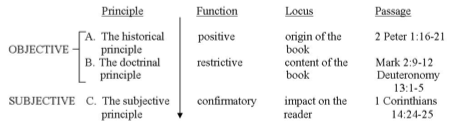
The historical principle comes logically first because canonicity has first to do with (5) where the book came from, which means who wrote it and where he got his information. Behind this step lies the concern about (4) how people recognized divine spokesmen and distinguished them from false claimants. The question rests on the observation that God’s breaking into the world through special revelation always, by definition and the nature of the case, involves (3) miracle. Even the prophets themselves must be able to distinguish divine revelation from their own thoughts. The next step is (2) the distinction between divine miracle that confirms revelation and other phenomena like demonic miracle, deception, parapsychological phenomena, misidentified natural occurrences. This distinction is most decisively made by (1) the triumph of the divine in confrontation with alternatives: the “resurrection” of Israel from Egypt (and attendant events) for the Old Testament and the resurrection of Messiah from the grave in the New Testament serve as prime examples. These are historical considerations because biblical revelation is a historical (vs. metaphysical) construct. The historical principle determines canonicity by giving us the right books in the first place; it is positive.
The doctrinal principle determines canonicity by eliminating additional books that do not harmonize with previous revelation. Any writing that contains material contradictory to previous revelation is false and non-canonical, not only in some matter at issue but as a whole. It has no status among God’s people even if it propounds new teachings that do not contradict previous revelation. The doctrinal principle stops the wrong new books from coming into the Christian canon; it is restrictive.
The subjective principle confirms in personal experience the objective claims and promises of revelation. That sense of truthfulness refers to “the ring of truth.” It speaks to people’s needs and finds acceptance there. The “ring of truth” is probably what many people mean when they speak of “the inner witness of the Spirit” (Romans 8:14). In the present view, the sense of trustworthiness does not come from a direct, supernatural operation on a person by the Spirit parallel to the proclamation of the message. Rather, it is a natural experience anyone may have even in matters not distinctively Christian or even religious. It is the intuitive recognition of the correlation between answer received and need felt.
Other principles, set aside in this treatment, have been put forward by writers from a range of theological persuasions: antiquity of the writing, written in the Hebrew/Aramaic language, and so on. The three above, however, are deemed sufficient for explaining the mechanics of canonization.
The accompanying diagram indicates the relationship between the structure of apologetics and the principles of canonicity.
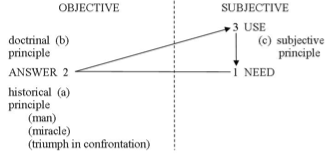
Canonicity focuses on the objective history out of which doctrine arises and then flows to the subjective side, where it strikes a sympathetic chord in the needing heart (cp. 1 Corinthians 14:24-25).
The present set and sequence of canonical principles differ from some approaches to canonicity in number and order. Particularly is it common to (A) put the doctrinal principle in the primary position. Luther may serve as an example in his dictum that those books are authoritative which “preach Christ.” (Luther may have meant this more as a hermeneutical guide than a canonical principle, however.) Three deficiencies lie in such a suggestion. (1) The doctrinal principle cannot deal adequately with new doctrine. It can only be restrictive; it can invalidate only false doctrines that contradict previous revelation. It cannot safeguard against false teachings that do not do so. (2) It cannot identify the original body of literature that determines the doctrinal criteria without becoming circular reasoning. The problem is insoluble as to why, for example, what preaches Christ should have authority. (3) Putting the doctrinal principle in first place creates a canon within a canon. Not much preaching about Christ occurs in Job, Haggai, Esther, or the Song of Solomon. Such books would fall back into secondary position of authority (deutero-canonical), and their contents would become negotiable.
Another view (B) makes the subjective principle primary and decisive. Because of human depravity, unbelievers supposedly cannot recognize truth until a secret operation of the Spirit occurs parallel to the message. For God’s people, it is simply a mystery (unknowable) how God implants the conviction about canonicity in the hearts of the elect. The idea confuses objective with subjective. Canonicity has an objective role, but this subjectivism says little about canonicity. While we would not claim complete awareness of the inner workings of people’s minds and hearts in this matter, we can surely say something true about the process objectively.
As a primary principle, “ring of truth” is inadequate for a couple reasons. What has impact may not be something that should have impact [B], and what does not have impact
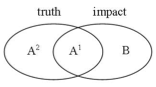
may be something that should [A2]. True religious material—and therefore the written presentation of it—does correlate with people’s real needs and so has impact to some degree and in some respects [A1].
One comment is useful regarding canonicity and a hearer’s conviction about Christian truth. The need-answer-use triangle shown above applies to all matters on which a person comes to belief (apologetics). So, it is appropriate to say that the convincing process can begin anywhere in the triangle, and the movement from one to the other can go in either direction. People who hear the message may come to believe it in other than the best way; but as time goes on, their “growth” in the faith will strengthen as the other parts of the triangle come into play. See articles in these cite form about “Apologetics.”
Before leaving this subject, we should deal with two assumptions that underlie critical introduction and canonicity in this presentation. With miracle in decisive position, (a) miracle by a false prophet would be confusing. The assumption is that false teachers cannot do real miracles by divine power. They cannot do supernatural things unless the Supernatural enables them (cp. John 3:2). God does not enable false teachers to do miracles, as Jesus implies when he says that no one can do a mighty work in his name and soon speak evil of him (Mark 9:39).
Likewise, (b) if demonic power can produce miracle among false prophets, then divine and demonic miracle must be distinguishable. We suggest that demonic miracle itself does not have positive value and that in the case of negative (destructive) value, the divine triumphs over the demonic in confrontation. Elijah over the Baal prophets illustrates the principle.
Finally, (c) the present scheme suggests a problem. On the one hand, we have said that miracle confirms revelation about doctrine (Mark 2:1-12; note John 3:2; 20:30-31). On the other hand, we have applied the doctrinal test to judge the canonicity of a prophet’s writing (Deuteronomy 13:1-5). Moses subordinated signs to doctrine in the Deuteronomy passage. A prophet who gave a sign that came to pass (miracle, chance occurrence, “lying wonders”) was nevertheless executed if he urged people on that basis to serve other gods (doctrine; Deuteronomy 13:1-5). Miracle proves doctrine and doctrine tests miracle.
The problem poses a false dilemma because the doctrine proved by stupendous miracle is not the same doctrine that judges miracle. (1) Miracle authenticates doctrine. (2) That doctrine, in turn, tests any miracles used to authenticate further doctrine that contradicts
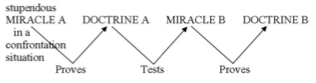
previous teaching. In the beginning, God attested the message of Moses by stupendous demonstration of miracle in the triumph of divine over demonic and human in confrontation. As revelation progressively unveiled further truth, it was miraculously attested; but any prophet was cut off who sought to contradict previous revelation by displaying lying wonders (demonic, deceptive, or otherwise); no message from God stands at odds with previous messages from him. The “miracle” was not divine miracle.
Miracle and doctrine are not individually absolute tests because a miracle may not always be obviously a divine miracle rather than something else. Furthermore, doctrine is not always decisive because observants may not correctly understand the doctrine.
Besides the false-dilemma, signs may have varying degrees of obviousness that they are divinely supernatural. Even though it is not the same miracle that tests doctrine that is tested by doctrine, there is a question about the relative ambiguity of miracle as such. At this more general level, we can appeal to (a) stupendous miracle (greater degree) and (b) divine miracle (c) in confrontation. We may be inclined to consider the case in Deuteronomy 13 as the same doctrinal point, that is, “Who is God?” In this case, a more stupendous display of divine supernatural manifestation had earlier occurred in confrontation with some of the very gods that a “dreamer of dreams” or “prophet” would propose to serve. These gods were the ones that Yahveh had overwhelmingly defeated in the exodus; and the gods of Canaan were likewise going to be overwhelmingly defeated in the conquest. Those previous and future confrontations were significantly more obvious than any sign some “dreamer” could offer.
The original stupendous divine miracle in confrontation was the exodus-conquest, reaffirmed in lesser displays throughout Israel’s history. The next stupendous miracle in confrontation was the resurrection plus Gentile mission. Jesus’ ministry multiplied preliminary miracles that culminated in his bodily resurrection and was perpetuated in the Pentecostal display and in the miraculous confirmation demonstrated through the apostolic witnesses.
There is also the issue of relative certainty. People take positions on what makes the best case more than on what offers absolute certainty, has no ambiguity, or presents no difficulties.
As with most considerations, more than one principle operates in canonicity, and one is decisive while others play important secondary roles. The original decision on canonicity is by now a matter of record; students today no longer have access to much of the historical information used then. Nevertheless, as a discipline, the principles involved in canonization are historical, doctrinal, and subjective in that descending order. They combine to establish what books comprise the canon, that is, which ones have authority and are normative for faith. Canonicity and normativeness correlate with God-breathedness.
In summary, two theoretical problems are involved in the interaction of doctrine and miracle. The first is how we avoid circularity. The answer is that it is not the same doctrine that checks miracle that is proved by miracle. The second is how we get the original body of literature to check miracle by. The answer is to look for stupendous triumph in confrontation with opponents of God when God promised success in that confrontation.
There are also two practical problems in applying the doctrinal test. The first is what to do when no previous revelation exists on a given doctrine. The answer is that we must supplement the doctrinal test with the success test, the moral test, the definitional test, and the kind-of-miracle test. The second is how to avoid missing the truth on something that erroneously strikes us as false. The answer lies in a willingness to listen. The doctrinal test assumes correct doctrinal understanding by the “tester.” The miracle test assumes the correct identification of an event as divinely supernatural.
Additions to the Basic Canonical Principles
The previous schematic does not deal with books written by authenticated men that did not become part of the canon. Paul, David, Isaiah may have written some things not in the canon. Unless we assume that everything a prophet wrote became canonized, we must consider how it was decided which ones belonged. The principles on the previous pages apply to canonicity in the first sense—in the theoretical sense (inspiration). Other factors apply to canonicity in this historical sense, the later formal sense (providence).
Perhaps some books were not preserved because they did not have lasting, universal significance. Such a point does not account for 2 and 3 John, although it might account for the preservation of Philemon because it addressed a prevalent problem for Christians in the ancient world: the slavery issue. Though short and relatively private, Philemon dealt with a recurring issue of general interest and importance. An example of a localized problem might be some understandings of “baptism for the dead” (1 Corinthians 15:29). Such a parochial matter might confuse later readers in different situations who have no access to the original circumstance.
The apostle or prophet may not have conceived of certain writings as having canonical value and so did not encourage their use and circulation. If Luke, for example, collected the Pauline corpus, the apostle could oversee the selection process. Perhaps Luke was responsible for the whole canonical collection because he knew there were “many who [had] taken in hand to draw up a narrative” about the ministry of Jesus (Luke 1:1-4).
We may invoke a restrictive notion here since some New Testament books could be omitted without loss. In the case of those that could be kept or not, God would let it go either way historically. In the case of any that should not be kept as scripture, he saw to it that they were not kept.
Paul took care of the churches’ needs by (1) establishing resident leadership, (2) gifting them with spiritual gifts, and (3) sending various assistants to deal with practical matters. These lesser means could meet the needs of the congregations. Consequently, there may have been less need for (4) more private, parochial correspondence that would then have been preserved as canonical. Preserving such literature would magnify the problem of implied cultural limitation, which modern readers already face regarding meat offered to idols, veil wearing, female deference, slavery, eating blood, table fellowship, dress code. It would also multiply instances of ambiguity on parochial issues not understandable to generations no longer privy to such situations.
As to the historical impact on canonicity, we could identify (a) the lack of permanent or universal importance (limited province) and (b) the lack of additional information (duplicate content) as contributing to the failure to preserve items that otherwise met the requirements for canonicity.
Irrelevant Factors in Canonicity
For completeness sake, we mention some matters that do not have anything to do with establishing canonicity. (1) Being quoted. Citing of books by Old or New Testament authors does not in itself mean the biblical authors regarded the books cited as inspired. How they use them must determine canonicity. On the one hand, the New Testament writers cite non-Christian sources on occasion including the apocrypha, pseudepigrapha, Greek authors, and early Christian sayings. (See “Sources of the Pauline Materials.”) Some Old Testament writings refer to sources no longer extant that would probably not qualify as inspired: “The Acts of Solomon,” “The Chronicles of the Kings of Judah,” “The Chronicles of the Kings of Israel,” and the like. (See notes for Critical Introduction to the Old Testament.) On the other hand, some Old Testament canonical writings are not cited in the New Testament. Citations can be for illustration (of the current point in other people’s thinking) instead of authoritative confirmation.
(2) Inclusion in manuscripts. What books a manuscript included may have been determined more by space considerations than anything else, especially if they appear at the end of the scroll or codex. Manuscripts of New Testament books may include early Christian writings from outside the canon. Old Testament manuscripts do the same thing, which some have considered evidence for the canonicity of the Apocrypha.
(3) Language used. The biblical message is concerned with content, not with the language chosen for inscripturation. There is no reason to suppose that canonical literature for the Jews had to be written in Hebrew rather than in Aramaic or Greek.
christir.org