
Wisdom Literature
WISDOM LITERATURE
Virgil Warren, PhD
Introduction
The New Testament contains several literary genres:
gospels (Matthew, Mark, Luke, John)
history (Acts)
epistles (Romans-Hebrews, 1 Peter-3 John)
apocalyptic (Revelation)
wisdom literature (Sermon on the Mount, James, Jude).
I. Content
Wisdom literature has some affinities with law. They both deal with human behavior and so use the imperative mood extensively. Wisdom, however, is a larger category than law even as advice is larger than commandment. The accompanying diagram shows their relationship. Advice vs. commandment, opinion vs. faith and fact, procedure vs. fundamental morality represent distinctions between the two types of material. Advice and commandment differ as to intent and scope. The advice in wisdom literature is not interested just in what
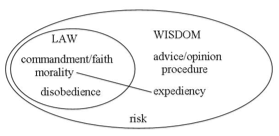
people “must do,” but in what they “best do.” It goes beyond sheer moral living to smart living. In the areas where it goes beyond sheer morality, advice is not necessarily consistent for everyone in all cases, places, and times. It is not something that “has” to be done. When people do not take advice, they do not commit a sin; they take a risk. Advice is not concerned just with behavior relative to a standard, but also with behavior relative to result—what is effective and expedient. It deals with application in real situations.
II. Structure
As to structure, wisdom literature especially has a pattern that characterizes biblical writing in contrast to the ideal pattern of presentation in Western culture. The goal in Western rhetoric is to have parallel major headings with two or more parallel supporting points under them with the overall presentation moving toward the desired conclusion. As anyone can see
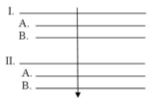
from trying to “outline” biblical materials, this kind of analysis does not easily impress itself on most biblical writings—except perhaps in broad sections. It is artificial to their structure because they were not constructed with that format in mind. What was not put into them cannot be extracted from them.
Biblical materials—as well as most “Western” rhetoric, frankly—adopt something more like a daisy pattern. A central theme or purpose of writing acts as the principle of selectivity for what is put into the document. Individual items become petals around the
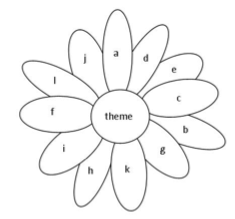
central concern. The format is more flexible, capable of rather loose to more highly structured format. So to speak, the petals may not be sequenced in any particular order, but then again in some cases the author might use a deliberate sequence within the pattern. Not all the petals have to be the same size; that is, some points may be treated more briefly than others.
christir.org