
The Seven Days of Consummation
THE SEVEN DAYS OF CONSUMMATION
Virgil Warren, PhD
Part I: Recurring Elements
Recurring elements give clues to the common identity of elements that appear separately in the Book of Revelation.
I. Earthquake (seven references)
A. Passages
1. 6:12 (seal 6)
a. The sun became as black as burlap made out of hair.
b. The whole moon became blood.
c. The stars in the sky fell to the earth.
d. The sky was removed.
e. Every mountain and island moved out of their place.
f. People cried out for the rocks and mountains to fall on them because the day of God’s wrath had come.
2. 8:5 (seal 7?)
3. 11:132 (trumpet 6)
a. A tenth part of the city fell (Jerusalem; cp. 11:2).
b. Seven thousand people were killed.
c. The rest were frightened and gave glory to the God of heaven.
4. 11:19 (trumpet 7)
5. 16:182 (bowl 7)
a. The great city was divided into three parts. Was this Jerusalem since the same expression occurs in 11:8; or was it Babylon, called “the great” in 14:8; 16:19; 17:5; 18:2, 21? Are there two cities or one mentioned in 16:192?
b. The cities of the nations fell.
c. Babylon was remembered in the sight of God.
d. Every island fled away, and the mountains disappeared.
e. Exceedingly large hail stones came down from the sky on people.
B. Observations
1. 6:12 and 11:132 mention only an earthquake.
2. 11:132 and 16:182 are both associated with Jerusalem.
3. 6:12 and 16:182 both affect mountains. Islands and mountains are mentioned
only here in combination.
4. In 8:5; 11:19; and 16:18 an earthquake is listed among lightning flashes,
voices, and thunders (add “large hail stones” in 11:19).
5. 6:12 and 11:132 are in the sixth of their series. The rest are in the seventh (?);
yet these others have close affinities with the single earthquake.
C. Comparison of earthquake passages
1. Passages 6:12 8:5 11:13 11:19 16:18
2. Elements mountains mountains and
and islands islands
large hail large hail stones
stones
glorify God blaspheme God
1/10 of city divided into
city fell three parts
fear God frightened
7,000 killed
alone combined alone combined combined
with with with
thunders, thunders, thunders,
lightnings, lightnings, lightnings,
voices voices voices
II. “Here is the patience (and faith) of the saints.”
A. Passages: 13:10 (in connection with the sea beast); 14:12 (in Interlude I)
B. Observations
1. Both refer to the destruction of the beast (add “and its image” in 14:9), which “overcame” (13:7; “killed,” 13:10) the saints.
2. Both are on the background of a lex talionis concept of retributive justice. For similar sentiments, see 16:4-7; 18:4-7 (cp. 6:10; 11:5).
III. Burlap
A. Passages
1. 6:12 (seal 6): “the sun became black like burlap made out of hair.”
2. 11:3 (trumpet 6 = woe 2): the two prophets prophesy 1260 days clothed in
burlap.
B. Observation: Both burlap instances occur on a background of calamity, the first on a cosmological basis, the other on a spiritual one; the one on physical light, the other on spiritual light.
IV. Mark (seven passages)
A. Passages
1. 13:16 (earth beast): on the right hand or forehead of people from every class
2. 13:17 (earth beast)
a. Having the mark was necessary for commerce.
b. The mark was the name of the beast.
c. The letters of the beast’s name totaled 666 (13:18).
3. 14:9 (sea beast)
a. People received the mark on the forehead or hand.
b. Those bearing the mark are tormented eternally (14:10-11).
4. 14:11 (sea beast): The mark was the name of the beast.
5. 16:2 (bowl 1): A severe sore came on those who had the mark.
6. 19:20: Those who received the mark were deceived people.
7. 20:4 (millennium)
a. Those who had not received the mark lived and reigned with Christ a
thousand years.
b. The second death had no power over those who did not have this mark.
c. They will be priests of God and Christ.
B. Observations
1. Mankind is divided by whether they had the mark of the beast on them.
2. The mark always has a bad connotation because it always refers to the distinguishing name of those who oppose God (14:11).
3. It occurs continuously in Revelation from the time of the rise of the earth beast until the eternal destruction of the beast and its image.
V. Birds
A. Passages
1. 18:2: After its fall, Babylon became the hold of every unclean, hateful bird.
2. 19:7: Birds are called to devour the flesh of the horses and riders slain by the sword that came out of Christ’s mouth.
3. 19:21: The birds ate the flesh of those killed by that sword.
B. Observations: Birds always seem to be mentioned with Babylon, including the passages in Revelation 19; because it is the (sea) beast (= scarlet beast) that loses the battle with Christ. That beast is leading “the kings of the earth,” comparable to the ten kings represented by the horns of the scarlet beast. Furthermore, the King of kings was to overcome the scarlet beast (cp. 19:16, “King of kings”).
VI. Abyss
A. Passages
1. 9:1-2 (trumpet 5)
a. An angel opens the pit of the abyss with a key.
b. Smoke went up out of the abyss and darkened the sun and air.
c. Locusts came out of the smoke to torment people for five months.
2. 9:11 (trumpet 5)
The angel of the abyss is Abaddon and Apollyon (Hebrew and Greek words for “destruction"), king over the locusts.
3. 11:7 (trumpet 6)
The beast comes out of the abyss wars against the saints, and overcomes them.
4. 17:8 (Interlude 2)
The beast is about to come out of the abyss.
5. 20:1, 3
Satan is cast into the abyss, bound for a thousand years, and released (20:7). An angel uses a key and a great chain.
B. Observations
1. In 9:1, 2, 11 and 20:1, 3 a key opens (note 20:7) or closes the abyss.
2. 11:7 and 17:8 does not mention a key, as if whatever the abyss represents was such that the beast could come up from it on its own initiative to accomplish its purposes against God, whereas in 9:1, 2, 11 and 20:1, 3 God releases the imprisoned beast to accomplish his own purposes.
VII. “Peoples, Nations, Languages (Kings), Tribes (and Multitudes)”
A. Passages
1. 7:9 (seal 6): a great multitude in addition to the 144,000, from every nation,
tribe, people, and language
2. 10:11 (trumpet 6): peoples, nations, languages, and kings about whom John
must prophesy again
3. 11:9 (trumpet 6)
a. For three days peoples, tribes, languages, and nations look at the two prophets’ unburied bodies.
b. They refuse to bury the dead prophets.
c. They watch the prophets ascend to God.
4. (12:9: The dragon deceived “the whole world.”)
5. 13:7 (sea beast): The sea beast is allowed to exercise authority over every tribe, people, language, and nation.
6. 14:6: An angel tells the good news to every nation, tribe, language, and
people.
7. 17:15 (sea beast): The water that the harlot sits on is peoples, multitudes, nations, and languages.
B. Observations
1. 10:11 specifies “kings” in an otherwise general listing.
2. The terminology occurs in seal 6, in the trumpets, and in the interludes.
VIII. Blasphemy
A. Passages
1. 2:9: the blasphemy by false Jews in Smyrna
2. 13:1, 5, 62: the blasphemy by the sea beast
3. 16:9, 11, 21: people’s blasphemy because of the seven last bowls of plagues
4. 17:3: the blasphemy by the scarlet beast
B. Observations
1. The only beasts that blaspheme are the sea beast and the scarlet beast.
2. Apparently, the blasphemy in each of these passages is in the context of that full, final rejection of God that we identify with the blasphemy of the Holy Spirit.
IX. “King of kings and Lord of lords”
A. Passages
1. 17:14: the names of the ones the kings of the scarlet beast fight and overcome
2. 19:16: the name written on the thigh of the rider on the white horse
B. Observations
1. The phraseology always refers to a final conquest.
2. The rider is apparently Christ.
X. Kings of the Earth
A. Passages: 1:5 (introduction); 6:15 (seal 6); 16:14 (bowl 6); 17:2, 18; 18:3, 9 (scarlet beast); 19:19 (sea beast = scarlet beast); 21:24 (vision of the New Jerusalem)
B. Observations
1. The phrase keeps in front of the reader the universal aspect of these apocalyptic events.
2. Except for the first and last references, “the kings of the earth” are among those who oppose God by taking sides with the beasts (cp. “not many mighty, not many noble are called”).
XI. References to a Great Conflict When God Consummately Triumphs over Evil
A. Passages
1. 19:11-16: in connection with the rider on the white horse
2. 17:14: in the war against the kings of the scarlet beast
3. 16:12-16: at Harmagedon the dragon, beast, and false prophet gather the kings of the whole world.
4. 20:7-8: Satan is released from the abyss to gather the nations for a final war.
B. The great day of (war of) God
1. 6:17 (seal 6): the day of God’s great wrath has come.
2. 16:14 (bowl 6): the great day is the great day of God Almighty
C. Observations
1. 6:17 seems to equal 16:14.
2. 16:14 is connected to the battle of Harmagedon, so 6:17; 6:12-16; 17:1-4; and
19:11-16 may all be associated with the same event.
3. 20:7-8 must be a separate battle because
a. Only Satan gathers the nations. The beast and false prophet have been cast into the burning lake (19:19-21; 20:10).
b. The narrative from 19:11 to 20:10 seems to be a continuous narrative; so the conflict in 9:11-21 could hardly be the same as 20:7-11. Furthermore, the battles are on different sides of the millennium.
XII. Terminal Language: “finished” (The only word meaning “finished” in Revelation is τελέω; γίνομαι has a comparable meaning in 16:17 and 21:6.)
A. Passages
1. 10:7: Then the mystery of God is finished that he declared to his prophets. It occurs when the seventh trumpet is about to blow, that is, after the sixth trumpet.
2. 11:7: The two witnesses finished their prophecy.
3. 15:1: In the seven last plagues, the wrath of God is finished.
4. 15:8: No one could enter the temple till the plagues were finished.
5. 15:10: bowls
6. 16:17 (bowl 7): “It is done.”
7. 17:17 (scarlet beast): God’s words would be accomplished. Until that time,
the ten kings give their kingdom to the scarlet beast.
8. 20:3 (millennium): The devil no longer deceives the nations till after the 1,000
years.
9. 20:5 (millennium): The rest of the dead do not resurrect till after the 1,000
years.
10. 20:7 (millennium): Satan is released for a while after the 1,000 years.
11. 21:6 (Things) have come to pass.
B. Observations
1. The usages fall in two, three, or four categories, depending on the equations
the interpreter makes.
a. The millennium is finished (20:3, 5, 7).
b. The plagues are finished (= the wrath of God; 15:1, 8).
c. The mystery of God is finished.
d. The prophets’ prophecy is finished (11:7).
2. Identification
a. The wrath of God (15:1) is possibly part of the mystery of God (10:7) if
mystery stands for the whole of God’s eternal plan (cp. Romans 16:25, etc.).
b. “The words of God” (17:17) may also refer to “the mystery of God” (10:7), because that mystery was the good news declared to his prophets. “Good news” equals “God’s words.”
c. “His prophets” (10:7) may refer to the two witnesses of 11:3-12. The witnesses “prophesy.” If they prophesy, they may be called prophets as well as witnesses (but this is not certain; see entry XIII).
XIII. Prophets
A. Passages
1. “Prophesy” (προφητεύω)
a. 10:11: John must prophesy again before many kings, and so forth.
b. 11:3: The two witnesses will prophesy.
2. “Prophecy” (προφητεία): 1:3; 11:6; 19:10; 22:7, 10, 18, 19
3. “Prophet” (προφητής): 10:7; 11:10, 18; 16:6; 18:20, 24; 22:6, 9
B. Observations
1. The two witnesses: 11:3, 6, 10, 18
2. Reference to the Book of Revelation: 1:3; 10:11; 22:7, 10, 18, 19
3. Prophecy in general: 19:10
4. Prophets in general: 10:7; 16:6; 18:20, 24; 22:6, 9
XIV. “Going into Perdition” (ἀπώλειαν)
A. Passages: 17:8, 11 (scarlet beast)
B. Observations
1. The expression appears only twice in Revelation, both times referring to the
scarlet beast.
2. In 17:8 the beast arises from the abyss and goes into perdition; so this
expression combines with the beast coming out of the abyss.
XV. Notes of Time in Revelation
A. Hour (ὧρα): 3:3, 10; 9:15; 11:13; 14:7; 17:12; 18:10, 17, 19 (said of the harlot—
in “one hour” her destruction has come)
1. 3:10: keep you from the hour of tribulation
2. 9:15: prepared for an hour, day, month, and year
3. 17:12: They receive authority as kings with the beast for one hour.
B. Half-hour (ἡμιώριον): 8:1: After the opening of the seventh seal, silence prevailed in heaven for about a half hour.
C. Month (μήν): 9:5, 10, 15; 11:2; 13:5; 22:2
1. 9:5: Those without the seal of God on their foreheads are tormented for five
months.
2. 9:10: With their tails the locusts can hurt people for five months.
3. 9:15: hour, day, month, year being the time for which the four angels of the
Euphrates are freed to destroy a third of the people
4. 11:2: The nations tread the Holy City underfoot for forty-two months.
5. 13:5: The sea beast can continue forty-two months.
D. Days (ἡμέραι)
1. 11:9, 11: For three and a half days, the dead bodies of the two witnesses lie
unburied.
2. 18:8: The destruction of mighty Babylon comes in one day.
3. 11:3 + 12:6: the time of the two witnesses’ prophecies and the time God nourish the woman who fled into the wilderness
E. Years (ἔτη): Year appears six times in consecutive verses about the millennium
(20:2-7).
F. Time (καιρός): time, times, and half a time (12:14)
XVI. “Wiping Tears from the Eyes,” and so on. (7:13-17; cp. 21:1-7)
XVII. “Wine (of the Wrath of Her Fornication/His Wrath)”
A. 14:8: Babylon the Great makes all nations drink the wine of the wrath of her fornication.
B. 14:10: The one that worships the beast and its image will drink the wine of God’s wrath.
C. 16:19: God makes Babylon the Great drink the cup of the wine of God’s fierce wrath.
D. 17:2: The kings of the earth are drunk with the wine of the fornication of Babylon
the Great.
E. 18:3: All the nations are felled by the wine of the wrath of the fornication of
Babylon.
F. 18:13: Wine appears in the list of products with “people’s souls.”
G. 19:15: The rider on the white horse treads the winepress of God’s fierce wrath.
XVIII. “Blood of the Saints”
A. 6:10: the martyrs’ call for vindication of the blood
B. 16:6: Blood is given to the evil to drink.
C. 17:6: The harlot is drunk with the blood of the saints.
D. 18:24: The blood of the saints is found in Babylon.
E. 19:2: In the fourfold Hallelujah, God avenges the blood of his servants.
Part II: Inter-Identification of the Beasts of Revelation
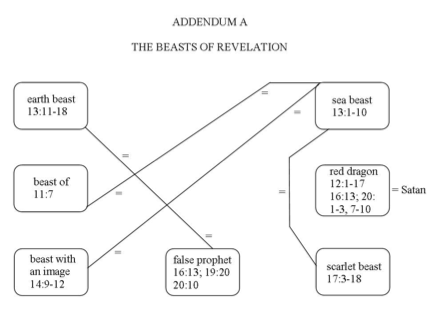
I. Basic proposition: there are only three “beasts” in Revelation.
A. 16:13 (the source of three frog-like, unclean spirits): the dragon, the beast, and the
false prophet
B. 19:19-20:3: the beast (19:19-20), the false prophet (19:20); and the dragon, the old serpent, the devil, Satan (20:2)
C. 20:10: the devil that deceived them, the beast, and the false prophet
II. Beasts mentioned in Revelation
A. The (great red) dragon: 12:1-17; 16:13; 20:1-3, 7-10
B. The sea beast: 13:1-10
C. The earth beast: 13:11-18
D. The beast in 11:7
E. The beast with the image: 14:9-12
F. The false prophet: 16:13; 19:20; 20:10
G. The scarlet-colored beast: 17:3-18
III. The identification of the beasts
A. The “earth beast” (13:11-18) equals the false prophet (16:13; 19:20).
1. Both worked signs in the sight of the beast (13:13-15; 19:20).
2. Prophet is an appropriate term for a beast that spoke on behalf of another (13:11-12, 14b, 15b-17; 19:20; 20:10).
3. Three satanic creatures are mentioned in Interlude I (12:1-14:20) before the listing in 16:13, the first being a definite reference and the others most naturally in the same order as they appeared in the previous text. The only other single beast prior to chapter 12 is in 11:7, the one coming up out of the abyss. Abyss is a word not previously used in Revelation except with reference to the hordes of locusts in 9:1, 2, 11; hence, it looks forward to the beasts introduced in Interlude I.
B. The earth beast (13:11-18) does not equal the sea beast (13:1-10).
1. “Another beast” (13:11); “first beast” (13:12)
2. The earth beast performs signs in the sight of the sea beast (13:12).
3. The earth beast causes people to worship the image of the sea beast (13:15)
C. The dragon (12:1-17; 16:13; 20:1-3, 7-10) does not equal the sea beast (13:1-10);
the dragon gives it its power, throne, and great authority (13:2).
D. The scarlet-colored beast (17:3-18) does not equal the dragon (12:1-17; 16:13;
20:1-3, 7-10).
1. The dragon is Satan (12:9), a person; but the scarlet-colored beast is a composite of person, place, and thing; that is, the “beast” itself (20:11), seven hills (20:9), and an evil political system (20:10-11a). The heads are both mountains and kings (20:9, 10).
2. One is called a dragon (δράκων); the other is called a beast (θηρίον). Δράκων seems to mean reptile (12:9; 20:2-3), while θηρίον is a more general word for undomesticated animals (mammal in 13:2, snake in Acts 28:4-5).
E. The sea beast (13:1-10) equals the scarlet-colored beast (17:3-18).
1. The sea beast emerged from the sea (13:1); and the harlot, sitting on the beast
(17:3), was sitting on many waters (17:2).
2. Both had seven heads and ten horns (13:1; cp. 17:3).
3. The sea beast had blasphemous names on its heads (13:1, 6). The scarlet-colored beast was “full of blasphemous names” (17:3). Blasphemy is mentioned only with these two beasts.
4. The sea beast had one head smitten, but its death stroke had healed (13:3); the scarlet-colored beast was, is not, and is about to come out of the abyss.
5. Only in the sea-beast section (13:8) and the scarlet-beast section (17:8) is the phrase not written in the [Lamb’s] book of life used, except for references near the beginning of Revelation and at the actual judgment scenes near the end.
6. After mentioning the healed death-stroke, the text says that “the whole earth” marveled at the beast (13:3). After saying that the scarlet beast was, is not, and is about to come, the angel states that “people on the earth” will marvel at the beast (17:8).
F. The sea beast (13:1-10) equals the beast with an image (14:9-12) because both
have an image made of them (13:14-15; 14:9).
“Here is the patience and faith of the saints” is used only in connection with these two beasts (13:10; 14:12).
G. The sea beast (13:1-10) equals the beast in 11:7.
1. They are both overcome the saints (11:7; 13:7), the only two places in
Revelation where saints are overcome.
2. The sea beast equals the scarlet beast. The three beasts arise on their own initiative; that is, it is not a matter of freeing them from confinement as with a key (11:7; 17:8, 10).
3. Both exercise control over peoples, tribes, languages, and nations (11:9; 13:7).
4. The first difficulty in this identification is that no other single θηρίον ascends from the abyss, but the θηρίον of 11:7 cannot be a separate beast. That would make at least four beasts in Revelation, but the book seems to allow for only three when all identifications are made. The δράκων does come out of the abyss after the millennium because it is released from its prison, the abyss. But the dragon’s release from the abyss does not seem to fit the 11:7 statement:
a. A θηρίον (undomesticated animal), rather than a δράκων, is to come up.
b. The θηρίον that comes out of the sea seems to triumph over the saints after its coming up, whereas the dragon does not succeed against God after the millennium.
c. The θηρίον of 11:7 seems to arise on its own from its “abyss,” whereas Satan is released from the abyss after the millennium.
d. The beast and the false prophet are thrown directly into the lake of fire and
sulfur immediately after the King of kings defeats them.
e. The δράκων is distinguished from the sea beast that equals the presumed scarlet beast, and the scarlet beast also comes up from the abyss (17:8).
5. We suggest that the difficulty here may be overcome by making the abyss of 11:7 equal to the sea of 13:1, from which the sea beast arises.
a. The Septuagint (LXX) used ἄβυσσος to translate תּהוֹם (“the deep”) in Genesis 1:2. The deep there was the ocean since dry land had not yet appeared. That helps because considerable parallels connect the creation account in Genesis and consummation account in Revelation.
b. In Romans 10:7 Paul calls Christ’s grave an abyss as a parallel to Deuteronomy 30:11-14, where the sea is mentioned. Ἄβυσσος occurs elsewhere in the New Testament only in Luke 8:31, where Legion requests Jesus not to send them into the abyss; yet they run into the lake.
6. The second difficulty in this identification is that “coming out of the abyss” refers to the future in 17:8, four chapters after the rising of the sea beast. Since, however, the scarlet beast is the same as the sea beast, the events signified in 17:1ff. probably amplify 13:1ff.
In summary, there is one beast called a dragon; a second called the earth beast and the false prophet; and a third called the sea beast, the beast (11:7), the beast with an image, and the scarlet-colored beast.
IV. Identifying the Woman and Her Child
A. The woman’s child equals Christ (Revelation 12).
Woman’s Child Characteristics of Christ
1. He will rule all nations with an iron He will rule nations with an iron
rod (12:5). (This expression occurs rod (19:15).
in Revelation elsewhere only in
2:27, as a description of over-
coming Christians.)
2. Immediately after the account of the I saw Satan fall from the sky. The war in heaven, Satan and his angels text continues, saying to rejoice that
are cast out. your names are written in heaven—
a phrase used elsewhere in
Revelation.
3. The crown of twelve stars equals the Christ was born of the Jews.
twelve tribes of Israel (?).
4. The devil was ready to devour him. The temptation scene, or Herod’s
killing the infants in Bethlehem.
5. He was caught up to God (12:5). The ascension (?)
6. The dragon made war with the rest of Christians are all descendants of
her seed who keep God’s command- faithful Abraham (Romans 11).
ments and the testimony of Jesus.
7. Testimony of Jesus (12:17) In 19:10 the testimony of Jesus is the
spirit of prophecy.
B. The woman is the Jewish nation.
Part III: The Seals, Trumpets, and Bowls
I. The Seals
A. The seals group into four plus three.
1. The first four are horsemen, and are thus separate from the rest by a common
figure.
2. More material is given for the last three than for the first four—one or two verses for the first four, three verses for the fifth, and twenty-three verses for the sixth.
3. The first four are in a secular setting while the others have a religious and
spiritual emphasis.
4. The four horsemen form a natural sequence.
B. Few, if any, parallels exist between the first four seals and the remainder of
Revelation, while some later parallels occur with seal five and very many with seal six.
II. The Trumpets
A. The trumpets are divided into four plus three.
1. The first four are cosmological disturbances. The next two involve punishment on people. Note the commandment in 9:4 not to hurt the things hurt in the first four trumpets.
2. The last three are also called woes.
3. Much more material appears for the last three than for the first four—one or two verses for the first four, eleven verses for the fifth (9:1-11), and thirty-three for the sixth trumpet (9:13-11:13).
B. The first six trumpets deal with the earth, but the seventh pictures a scene in
heaven.
III. The Bowls
A. Outline
Destination Consequences
1. First bowl earth “a noisome, grievous sore on people that 16:2 had the mark of the beast and worshipped
it”
2. Second bowl sea It became like dead people’s blood;
16:3 every living soul died, even the things that
were in the sea.
3. Third bowl rivers and foun- They became blood.
16:4-7 tains of water
4. Fourth bowl sun It was allowed to scorch people with fire.
16:8-9
5. Fifth bowl throne of the His kingdom was darkened.
16:10-11 beast They gnawed their tongues for pain.
6. Sixth bowl Euphrates River Its water was dried up.
16:12-16 Unclean spirits come out of the mouth of
the dragon, beast, and false prophet.
7. Seventh bowl air “It is done.”
16:17-21
B. Parallels to the ten plagues
1. Facts
a. Plague (15:1, 6, 8; 16:9, 21) Πληγή is one of the words used for the Egyptian plagues (Exodus 11:1).
b. First plague (Revelation 16:2) plague of sores (sixth plague; Exodus 9:8-
12)
c. Second plague (Revelation plague of water turned to blood (first
16:3) “sea became like dead plague; Exodus 7:20-25)
people’s blood”
d. Third plague (Revelation plague of water turned to blood (first 16:4-7) “rivers and fountains plague; Exodus 7:20-25)
of waters became blood”
e. Fourth plague (Revelation loosely parallels the hail “mixed with
16:8-9); “scorching heat” fire” (? seventh plague; Exodus 9:22-26)
f. Fifth plague (Revelation The darkness aspect parallels the dense
16:10-11) darkness, pain, darkness (ninth plague; Exodus 10:21-
sores 29). There was no darkness in the
Israelites’ camp. The darkness in
Revelation is in the kingdom of the
beast (sixth plague; Exodus 10:23).
g. Sixth plague (Revelation Parallels the hail plague (seventh plague;
16:12-16) earthquake and Exodus 9:22-26)
hail
2. Observations on the relationship of the ten plagues of Egypt and the seven
plagues of Revelation
a. Differences: the order is different, some Egyptian plagues are omitted, some plagues are added, some Egyptian plagues are combined, and subdivisions of one are made wholes of the other and vice versa
b. Likenesses
(1) The individual plagues of Revelation do not accomplish God’s purpose of causing people to repent (16:9, 11). The individual Egyptian plagues also fail to accomplish God’s purpose of obtaining Israel’s freedom (Exodus 7:22; 8:15, 19, 32; 9:7, 12, 35; 10:20, 27).
(2) There is bondage associated with both plagues. In Exodus there is political bondage to Egypt; in Revelation there is religious bondage to sin.
(3) Great rivers are involved in both accounts—the Euphrates and the Nile. The Euphrates, however, may conjure up the Assyrian treatment of the Old Testament people of God.
(4) A battle concludes both series, the land battle of Harmagedon in the last and the sea conquest in the former. God fought for Israel there according to Exodus 15 in the Song of Moses.
(5) The Song of Moses in Exodus 15 parallels the Song of Moses and the Lamb in Revelation 15.
(6) Tabernacle occurs in both accounts—Revelation 15:5 and many
passages in Exodus. Note Hebrews 9, which speaks of the tabernacle rather than the temple.
(7) Several of the same or similar plagues occur. Death of the firstborn compares to the death of one-third of the people in the plague of Revelation 10.
c. The plagues probably serve as vehicles of expression, not intended to be understood as more than typical of the end-times judgments. The idea here is not that the end-time judgments will repeat the Egyptian plagues.
IV. Comparing the Seals and Trumpets
A. Both are divided into four plus three.
B. Both have less material for the first four than for the last three.
V. Comparing the trumpets and bowls
A. The bowls are more intense than the trumpets.
B. There is not in the bowls as much implication of sequence as in the trumpets.
VI. Comparing the Sixth Seal and the Seven Trumpets
A. Four angels are bound at the Euphrates (trumpet 6 = 9:14-15); cp. four angels
bound holding winds (seal 6 = 7:1).
B. An earthquake occurs (besides the one mentioned with voices, etc.) in seal 6 (= 6:12); cp. 11:132, where one-seventh of the city fell.
VII. Comparing the Sixth Trumpet and Seven Bowls
A. Islands moving (6:14); compare 16:20 (bowl 7); island (νῆσος) occurs elsewhere
only in 1:9; it occurs in combination with mountains in both places.
B. Euphrates River (9:14); compare 16:12 (bowl 6)
C. Fire (and smoke) and sulfur (9:17-18); compare 16:8; scorch with fire (bowl 4)
D. The word plagues: 9:20; 11:6; compare 15:1, 6; 16:9, 21; (18:4, 8, the harlot);
21:9 (22:18 indefinite?)
E. Repentance occurs only in 9:20-21; compare 16:9 (bowl 4), 11 (bowl 5)
VIII. Comparing the Interlude I (12:1-14:20) and the Sixth Trumpet
A. 9:17-18; cp. 14:10-11: fire, sulfur, and smoke
B. “Fallen, fallen” (two fallen’s = second woe = sixth trumpet) 14:9; woe, woe, woe announces the three woes; consequently, there is evidence for such a subtlety.
IX. Comparing the Fifth Seal (6:9-11) and the Third Bowl (16:4-7)
A. “How long do you not avenge our “They poured out the blood of the saints
blood on them that are on the earth?” and prophets, and you have given them
to drink.”
B. “O Master, the holy and true.” “Holy One,” “your judgments” are true
and righteous”
C. “I saw under the altar” “I heard the altar say”
X. Comparing the Sixth Seal and Trumpets 1-4
A. Earth-sea-trees (7:1); earth-sea (7:2); earth-sea-trees (7:3)
B. Hurting the earth (8:7), sea (8-9), and trees (8:7)
XI. Comparing All Seals, Trumpets, and Bowls Together
A. The seals, trumpets, and bowls are progressively more severe.
B. In all three, the seventh is a conclusion.
1. After the seventh seal is broken, there is silence (8:1-2).
2. After the seventh trumpet sounds, there is worship in heaven and a victory
hymn (11:15ff).
3. After the seventh bowl is poured out, “it is done” (16:16).
C. The sevens seem to have a common terminus in time as well as literary form.
1. In 10:7 John already says that when the seventh angel is about to sound, the
mystery of God is finished.
2. The seventh of each series seems to have no definite end; so the seventh seal,
sounding of the trumpet, and outpouring of the bowls may be simultaneous.
D. In all three, the seventh of the series indicates lightnings, voices, thunders, and an
earthquake (8:5; 11:19; 16:18).
E. The sevens always return to the throne-room scene.
1. 8:1-5 (actually a continuation of the throne-room scene): “in heaven” (8:1),
throne (3), and altar (32, 5)
2. 11:15-19: temple (11:19), “in heaven” (11:19)
3. 16:17: throne (16:19), temple (16:17)
F. All three series deal with cataclysmic evil.
XII. Summary of Conditions for an Eschatological Scheme
A. The seven bowls (15:1-16:21) must succeed the beast and its image (13:1-18).
B. The beast and its image (13:1-18) must succeed the dragon (12:1-17) mentioned
earlier.
C. Trumpets 1-5 (8:2-9:12) must follow the sealing of the 144,000 (7:1-17).
D. The sixth seal (6:12-7:17) succeeds the fifth seal (6:9-11). The sealing of those in white robes seems to be the final reward of the ones in the fifth seal. (6:11; cp. 7:9, 14).
E. Passages about evil people being killed must succeed the fifth trumpet.
F. The third bowl (16:4-7) must follow the fifth seal (6:9-11), because the third bowl is at least part of God’s answer to the saints’ prayer for avenging their blood.
G. 11:7 ties the material of the interlude (chapters 11-14) into the sequence of the seven trumpets, so the dragon-sea beast-earth sequence forms part of the sixth trumpet.
H. If the scarlet beast equals the sea beast, then 17:1-18 precedes 13:1. Since 13:1 is
part of the sixth trumpet, 17:1-18 is part of the sixth trumpet.
I. Chapters 15-17 must precede 14:8.
J. The scarlet beast must come near the end (17:17).
“Babylon is fallen” (14:8) occurs for the first time, talking of Babylon’s destruction; hence, much of chapter 17b is before 14:8 because chapter 17 pictures the unfallen city. Chapters 15-16 introduce and recount the seven bowls of the seven last plagues. The angel who showed John the great harlot was one of the angels that had the seven bowls (17:1). Consequently, 15-16 as well as 17 precedes 14:8.
K. The angel invites John to the judgment of the great harlot, an event presumably at the very end of things (cp. 15:1). However, 17:9-14 speaks of another king yet to come as if the picture itself is not at the very end (when all the kings would fall). The solution is probably that 17:1-2 directly anticipates the message of 18:1-24, where the fallen state (judged state?) of Babylon is portrayed, 17:3-18 being a necessary flashback to describe the unfallen Babylon, because no picture of Babylon has yet been presented in Revelation. (Note, however, that chapter 18 has some future tenses as well.)
XIII. Conclusion
From the phenomena enumerated, we conclude that the sixth day is the setting for the trumpets, the bowls, and the beasts of the succeeding chapters. The literary form is an expansion of the seventh, however.
Part IV: Comparing Creation and Consummation
I. Parallel Elements Between Revelation and Genesis
A. The direct mention of creation: 4:11; 10:6; 14:7
B. The seven pattern: The Hebrew concept of perfection indicated by the number seven correlates with a creation completed in seven days.
C. Significant common imagery
D. Significant common terminology
1. ἄβυσσος: Genesis 1:1 (Septuagint—LXX), “the deep.” “The beast that comes up out of the abyss” (11:7) seems to be the sea beast of 13:1-10. If so, then at least once in Revelation (11:7) ἄβυσσος means the sea, as it does in Genesis 1:1.
2. “Earth and sky” in combination: Genesis 1:1 (15, 17); 2:1; (7:2); compare. Revelation (20:11) 21:12 (10:2, 5, 8)
3. “Serpent”: Genesis 3; cp. Revelation 12:9, 14, 15; 20:2; δράκων is an animal of the reptile class. The term Deceiver appears in Revelation 12:8 (cp. 1 Timothy 2:14 + Genesis 3).
4. “Grass, herbs, trees”: Genesis 1:11, 12; cp. Revelation 9:4 (although different
words are used)
5. “Grass and herbs”: Genesis 1:11, 12; cp. Revelation 8:7
6. The correlation between sky, earth, and sea, on one hand, and sky, land, and water animals, on the other hand: Genesis 1:28; cp. Revelation 4:11; 10:6; 12:12; 14:7; 21:1
a. The three beasts come from sky, earth, and sea (12:1-12; 13:1-10;
13:11-18).
b. The seven bowls are poured out on sky, earth, and sea.
c. There was a new sky and a new earth, but no new sea (21:1).
E. The major emphasis is on the sixth day in Genesis and Revelation.
F. Nothing happens on the seventh day.
G. Recapitulation of the sixth day in Genesis 2 is like the pattern of recapitulation with added emphasis of the sixth day in Revelation. 10:7 thinks of the seventh trumpet as a close to the sixth trumpet as well as an opening of the seventh.
H. The seventh day of creation is a consummation—never ending.
I. Sabbath rest in Hebrews 3-4 is comparable to divine rest (cp. Genesis 14:13).
J. Revelation’s seventh day is not divided up. It is the sixth in the series that is divided up in the seals (8:1-2), trumpets (11:15ff), and bowls (16:17).
K. The seven-day pattern of Revelation, then, presumably builds on Old Testament backgrounds rather than on Greek sources, as the drama motif presupposes.
II. Conclusions
A. The creation motif is superior to the drama motif because it comes from an Old Testament biblical background.
B. It seems impossible to take Revelation as strictly chronological because the end is near already in 10:7.
christir.org