
Recensions of Romans
RECENSIONS OF ROMANS
Virgil Warren, PhD
1. Placements of the doxology (16:25-27 in the standard English text)
a. At end
b. After 15:33
c. After 14:23 (some also at end); see Greek apparatus for the New Testament in loco.
d. Omitted altogether
2. Placements of the benediction (16:20b in the standard English text)
a. At 16:20; then Tertius adds a note and Paul closes the letter.
b. At 16:24
c. In both places
d. After 16:27
e. Omitted altogether
f. After 15:33 (Chester Beatty Papyrus [p46])
3. Omission of chapters (15-)16
a. Liturgical purposes originated texts without chapter 16 and perhaps 15 as well. (See below “The long list of greetings.”)
b. Marcion omitted them because 15:8 calls Christ a “minister to the circumcision.” Other places in Romans would apparently be as unacceptable to him as this phrase, notably the Olive Tree Parable in chapter 11. He would have needed to reject the book altogether if this were a significant point and if he were consistent in his mutilation of canonical writings. Nevertheless, there is evidence from Origen and Tertullian that Marcion used or originated a text that omitted these chapters.
c. Paul (via Tertius?) wrote the letter in more than one form (without the greetings so it could also serve as an encyclical).
d. Recopied during circulation without these chapters
e. Defective archetype (An early copy could have lost its last sheet or two, especially if it was a codex; cp. the similar possibility in the Gospel of Mark)
Codices Amiatinus and Fuldensis, whose chapter headings can be traced to a text before the time of Jerome (fl. A.D. 400), seem to indicate that these chapters were missing. Although Paul’s argument does not properly end until 15:13, there is a fairly definite break after chapter 14, as illustrated by the decision to make a chapter division here. Some critics have said that the language beginning at chapter 15 is more personal, although previously Paul has been speaking in the first and second person singular and plural in 14:7-22.
4. The long list of greetings
a. Paul added the long list of greetings as justification for writing a letter to a church he did not found. He wrote from Corinth before he had been to Rome. But he had met, worked with, and even converted a number of those who had founded or furthered the church in Rome. The long list showed that he had some basis for doing what on his own principles may have appeared presumptuous—teaching them despite not having converted them.
b. He added the list because he knew fewer in Rome than in other churches he addressed. In most other churches, it would have been impractical to greet everyone he knew. His acquaintances in Rome were limited; so rather than naming just the closest two or three, he names them all. The letter to the Colossians also has a longer-than-normal list of salutations (from individuals with the writer rather than to individuals at the destination as in Romans), and Colossians was another church Paul addressed but evidently did not found directly (Colossians 2:1-5)—although he may have founded it in the sense that members of his circle did the evangelizing there.
c. Similar salutation lists may normally have been sent in a cover letter that the epistle itself was wrapped in. With Romans, that cover letter could have been copied into the main manuscript at an early date. Under this reconstruction, the long list would not have been abnormal; copying that list onto the end of the letter would have been what was unusual.
d. A long list of greetings may have been in order since there were at least three congregations (16:4-5, 14, 15). But this was probably true as well for other churches in larger metropolitan areas.
Sketch of Manuscript Variants for the End of Romans
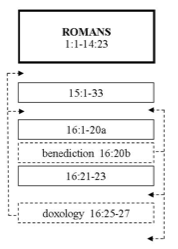
5. Reasons for displacements
a. The list of greetings may have been the originating factor that occasioned all this textual instability. Leaving out the greetings could have allowed the doxology or benediction to collapse onto the end of chapter 15.
b. If Marcion had qualms about the final two chapters, his influence may have additionally complicated the textual condition of Romans manuscripts.
c. Scribal error may have been a third element.
christir.org