
Faith and Sight/Science
FAITH AND SIGHT/SCIENCE
Virgil Warren, PhD
Science deals with the experience of recurrent natural processes in the present. The technology science uses enhances the degree and kinds of sense perception in the natural realm.
Limitations of Science
A. Science cannot deal with universals or absolutes. It is subject to “the plague of particularity.” Science must take an inductive approach although it can form hypotheses, which are proposed universals suggested by observed particulars. The scientific method cannot deal with the absolutes of universal space or eternal time; hence, strictly speaking, it cannot see the big picture and cannot produce a worldview, because it is based on human experience, which is limited.
B. Science cannot deal with history in the strict sense whether past or future. It has access only to recurring processes. At best, it can only extrapolate backwards into the past (including origins) and forward into the future (eschatology) by assuming uniformitarianism from current processes at least as to kind. It assumes that the same processes have always and everywhere operated although it is uncertain whether the rate of these processes has been the same.
C. Science cannot deal with the supernatural as such, that is, directly. It cannot affirm or deny realities beyond the space-time “material” universe. Whether some event comes about naturally or supernaturally we infer from what previous experience tells us is naturally possible. Science relies on physical perception extended and intensified by technology.
In summary, science can deal with recurring processes in the present natural realm.
Christianity is not about the metaphysical realm or even the real spiritual realm itself. We can come to know what lies beyond the nature realm we experience only if the supernatural intervenes into the natural. Intervention into the natural realm can occur in a way that is visible, which is what we mean by miracle. We recognize a supernatural process as one that produces a result in a way that natural processes do not produce them. The issue here is how the effect is produced, not what effect is produced.
Science is more particular than mere systematic investigation. History and literary research are also systematic, but they lack the precision that direct observation makes possible.
Trust/faith/belief always involves a second person that stands in the gap between the first person in ignorance and the thing to be known (epistemology), even as a second person stands in the gap between a first person in need and a result needed.
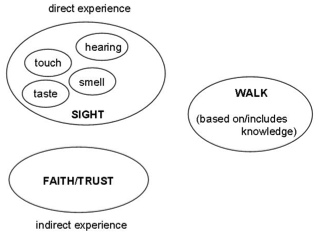
Some things we can know by faith or sight, but the limitations of time and space mean that we know even most of them by trust in testimony rather than by direct experience. We cannot know some things by direct sight: (1) the supernatural, (2) the universals of time and space, and (3) the specifics that occur outside our direct experience.
Paul's Science-Faith Relationship as per
2 Corinthians 5:7
KNOWLEDGE
christir.org