
Jesus and the Law
JESUS AND THE LAW
Virgil Warren, PhD
Our study of the Sermon on the Mount brings us to Matthew 5:17-20, the second “petal” on the daisy. We have entitled it “Jesus and the Law” because it shows how his ministry and teaching relate to God’s earlier revelation. This paragraph introduces Jesus’ objection to the Pharisees. He contrasts his teaching more with theirs than with the Old Testament Law itself. The verses deal with his concern that people not misunderstand what he is teaching.
Do not think that I came to destroy the law of the prophets. I did not come to destroy them but to fulfill them. For truly I tell you, till heaven and earth passes away not one jot or tittle will pass away from the law until everything is accomplished. Whoever then breaks one of these least commandments and teaches men so will be called least in the kingdom of heaven. But whoever does them and teaches them will be called great in the kingdom of heaven. Because I tell you that unless your righteousness exceeds the righteousness of the scribes and Pharisees you will certainly not enter the kingdom of heaven.
The first question is why Jesus says, “Do not suppose that I came to destroy the law or the prophets.” In the next paragraphs, he contrasts his ideas with those the Jews had heard connected with Old Testament passages. He does not want them to think he is contradicting the Law instead of correcting popular misunderstandings of it. In fact, he came to accomplish its purpose: “I did not come to destroy it but to fulfill it.” Jesus claims to be within the framework of previous revelation through Moses and the prophets. More than that, he claims to fulfill its anticipations. He fulfilled it first by correcting typical misconceptions about its meaning, secondly by calling attention to underlying principles of the law as distinguished from some specifics in it, and thirdly by fulfilling its predictions. In this context he is mainly concerned to explain fundamental, permanent truths in contrast to temporary civil aspects occasioned by the national dimension of the Mosaic covenant and in contrast to ceremonial provisions that anticipated Messiah’s real redemptive work. In general, he wants to avoid misunderstandings about his ministry.
He did not come to “destroy” the law or the prophets. Destroy means different things to different people, depending on how they understand the relationship between the Law of Moses and the ministry of Jesus. The accompanying chart summarizes the ways Christians have related the New Covenant to the Mosaic Law. In light of texts like Hebrews 8-10, we know there is a contrast of identity and kind between the Mosaic and Messianic covenants even though Matthew 5:17 teaches that Messiah came in continuity with Moses and the prophets.
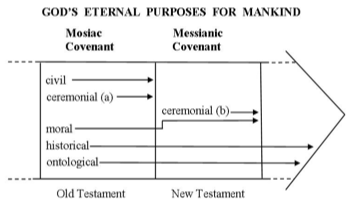
“Destroy” suggests doing something negative with the Law—throwing it away as if it were false, as if it were not from God, as if it should not have been governing Israel. There have been those in the Christian era who wanted to “destroy” the law in this sense. In the early centuries, Marcion represented this attitude. He saw such a difference between the God of the Old Covenant and the God of the new that both covenants could not both be from him—could not both be good and true. Consequently, what had been done in God’s name before was to be repudiated, and the revelation through Christ put in its place. This is the very attitude Jesus denies: “I did not come to repudiate the law as if it were not genuine revelation from the one true God.”
Another approach adds the gospel to the law. The Judaizing teachers that Paul confronted in the Book of Acts and elsewhere represented one form of this idea. During his missionary endeavors, these Jewish believers were following him around the Gentile territories, “correcting” his teaching and adding to what he said. According to them, to be saved, Gentiles who became Christians also had to be circumcised and become Jews, thereby putting themselves under the Mosaic Law. This idea had a combined effect called “Galatianism” because particularly in the Book of Galatians Paul addresses this heresy. The notion seemed to be that we are saved by Christ; and after being reconciled to God, we continue in that relationship by obeying the Law. Paul objected because in effect such a scheme would bring back the same problem we had before—that none of us can succeed at living up to the perfection the Law required. In principle, circumcision would bring us back under the very thing that was the source of death to us in the first place, because death is the consequence of sin. The gospel is not something simply added to the Law so we end up keeping them both or basing continued salvation on continued observance of everything God commanded in the Old Testament.
A more frequent approach today amends the Law in terms of the gospel. Constitutions usually have a provision that allows for changing items within the constitution itself. Under this conception Christians are under the Mosaic law as amended by Messianic revelation. Things that God no longer intends for us to keep have been removed by amendment. For instance, we no longer need to keep dietary laws, because Mark 7:19 says Jesus “cleansed all meats.” The same can be done with the observance of Sabbath days and new moons because of Paul’s comments in Galatians 4:8-11 and Colossians 2:16-17. Paul’s comments on circumcision removes it as the identifying mark for the people of God now. Since Christ fulfilled the sacrificial system, we do not offer sacrifices. The priesthood and accompanying features have been removed by the change of priesthoods implicitly predicted by Psalm 110:4: “The Lord swore and will not repent himself. You are a priest forever after the order of Melchizedek [not Aaron].” That verse is the backbone for the middle section in Hebrews as it contrasts the first and second covenants. In this way of thinking, we do not follow Mosaic civil legislation, because the people of God are no longer organized into a national system. We do not observe dietary laws, the festival cycle, circumcision, sacrificial codes, and other regulations because they have been amended out of the law one by one. Failure to do them now does not break God’s Law. This approach requires going through the lists of Old Testament ordinances and removing each one that the New Testament annuls. We are really under the Mosaic Law minus all commandments specifically withdrawn—civil and ceremonial regulations, generally speaking.
There are difficulties with this approach although it has fewer problems than the previous two. The Mosaic Law came from God, but the gospel does not simply add to it or amend it. Those saved by Christ do not then maintain salvation by living perfectly. As Deuteronomy 27:26 says, we would have to continue to do all the things that are required of the law or we would be under a curse (cp. Galatians 3:10). Not only are we under a different covenant, we are also under a different kind of system from what Mosaism was (Jeremiah 31:31-34). It is based on personal relationship factors rather than on legal processes. Another difficulty is that we would have to obey every Mosaic commandment not specifically removed by direct statement or indirect implication. It is hard to remove every specific requirement that does not seem applicable to Christians. The New Testament does not clearly make statements that take care of them all one at a time.
The New Testament does not specifically cancel “the law of jealously,” for example, a procedure for testing whether a wife has been unfaithful (Numbers 5:11-31). Perhaps we could argue that this item falls under “civil regulations,” which as a class are removed because there is no national aspect to the kingdom now. That there is no national aspect to the kingdom now, however, has, in fact, been denied implicitly by every attempt to establish a theocracy during the Christian dispensation. Some experiments in colonial America serve as examples. Besides, it does not have to be regarded as a civil regulation. At any rate, nothing in the New Testament specifically annuls the law of jealousy.
Some early Christians tried another approach, one that spiritualized the Old Testament in terms of the gospel. Going through the Old Testament, they took its episodes and teachings and plugged Christian meaning into them. Even in historical sections like Genesis, they would find references to the Christian gospel. They made literal, historical material say something spiritual that was in the gospel. That way they could still regard the law as true without observing the particulars it contained.
The proper approach, we believe, abrogates the law. “Abrogate” means to take out of jurisdiction, to annul, to cancel, to repeal. The law as a code is not now the relevant expression of God’s will for human life. It did express his will for Jews, but the New Testament is the new “code” that expresses his will for Christians. There is a code-context distinction here. Changing the code does not change all the contents to other things. Abrogating the law means taking it away only as far as commandments are concerned. The issue here is what we should do, not what we should believe. It is not a question about the truth of the Old Testament, but about its role. The law is not “destroyed,” but annulled.
The broad arrow given earlier represents the flow of holy history. The left part pictures God’s will for his people during the Mosaic age. At that time, Israel was the people of God in a national sense. The right part of the arrow stands for God’s will during the Christian age, “spiritual Israel” in an interpersonal sense. At this time, the church is the people of God. In the shift from the previous “dispensation” to the present, many things do not change, some things drop out altogether, a few things are adjusted, and some things are added.
A constitution specifies what its subjects should do. Canceling it does not affect items that are not done. The contrast between the Law of Moses and the New Testament, then, does not bring into question Old Testament descriptive teaching about historical, natural, and geographical matters. Historical matters include the origin of the universe, what has happened since creation like the origin of Israel and prophecies about the future. Descriptive statements about the nature of things—ontological matters—include all teaching about the nature of God, the nature of history, the nature of humankind, the purposes of God, and so on. Geographical location of events does not change; consequently, the record of them does not change. History, nature, and geography are not things to do, but things to understand. The Old Testament provides accurate information on all these categories—of all things whereof it speaks; so these elements “continue.”
Civil regulations comprise one category that drops out. Civil regulations directed national and political affairs in Israel. Besides their religious duties, the priests had administrative powers. They were the health officers of the nation, for instance. The Levites were the financial officers of Israel. There were laws that governed property rights. The New Testament says some things about how Christians should organize themselves; so there are functional equivalents of national structure. But the church does not have the political aspect included in Old Testament civil legislation.
In the Torah there were also ceremonial regulations. These include the sacrificial system and other tabernacle/temple observances. Some ceremonial observances appear in the New Testament as well, although significantly fewer. The Lord’s Supper and baptism are the examples we observe. Christians observe these ordinances, not the Old Testament ones. The code we are under is a different code from the Old Testament. Not being under the former covenant does not deny the former code’s truthfulness or divine origin; it simply means that it no longer regulates human behavior in regard to matters not of permanent import. God has moved into a new stage of his overall plan for history. We operate now according to the values and ceremonies God instituted for this era, which the old covenant prepared for and looked forward to as shadows of later realities (Hebrews 8:5; 10:1). Civil and ceremonial regulations have dropped out altogether, and a few new ceremonial observances have been added in.
Generally speaking, moral matters continue, or perhaps we can say are “reinstituted.” The Mosaic moral structure is the same with a few alterations that stem from progressive revelation. One example of adjustment is the provision for divorce for any cause (Deuteronomy 24:1-4). Anything unacceptable in the spouse was grounds for divorce, and only men could initiate divorce. Legally, divorce had no moral stigma attached to it. Jesus alters the divorce issue into one that does have moral connections. If divorce occurs now, sin is involved somewhere in the situation. This complex issue occupies our attention in chapters 4 and 5 dealing with 5:31-32.
In a sense, the shift on divorce was not a change in moral principles. In Matthew 19:3-12 Jesus shows that from the beginning divorce was contrary to God’s intentions. The legislation in Deuteronomy was civil regulation. Genesis 1-2 implies God’s moral intent. As part of God’s progressive revelation, Moses allowed a less exact requirement because contemporary Israelites were not ready for the full expectancy. There are not many moral considerations that have changed in the shift from first to second covenant.
This last approach to law-gospel relationship works from zero up. Such a format means that only New Testament directives apply to Christian practice. We do not have to find a way to eliminate each item of Mosaic legislation that does not relate to us. Annulment is not item-by-item, but covenant wide. There does not have to be a specific annulment for each withdrawn observance or class of observances. Neither do we have to prove that a commandment belongs to some withdrawn class of observances before we can disregard it.
That is an important gain because it reduces the likelihood of mistakes. Even if we agree, for example, that civil and ceremonial commandments have been annulled, we still must decide whether a given provision belongs in one of these categories—as the Mosaic civil divorce law illustrates. That sets us up to make mistakes. Another difficulty is that some commandments combine temporary and permanent features. Civil or ceremonial matters may have moral facets, which we might agree do continue. Are Christians supposed to keep Sabbath, for example? Was Sabbath-keeping a moral commandment, simply a civil/national observance, or a combination of the two? Did it have a moral aspect, as its presence among the ten commandments might suggest? If so, what was that moral aspect? Was eating blood forbidden because it was immoral, because it was physically or psychologically unhealthy, or because cultural associations made it unwise at the time? A third difficulty is that even though we may agree that moral commandments tend to carry over, certain exceptions are conceivable. These problems only complicate interpretation and therefore increase the likelihood of theological errors.
When Jesus said, “I did not come to destroy the law,” he was not repudiating it as false or denying that Jews should have been keeping it. He came in the tradition of that very Law to fulfill what it anticipated. In fact, not one jot or tittle of it would pass away without accomplishing its purpose.
Verse 20 is a splice between Jesus’ relationship to the law (5:17-19) and objections he raises against the way Pharisees were misusing the Law (5:21-6:18). Jesus proceeds to talk about exceeding the righteousness of the Pharisees, not so much by doing more than they did, but by following a more mature kind of righteousness. For that reason, he does not contrast his teaching with the Law itself, but with the misuse of it that undergirded Pharisaical righteousness in places like the ones he cites.
By scanning this material, we infer his point by observing how Jesus quotes the Old Testament and then comments on it. “Do not commit murder” he heightens to “Do not get angry.” “Do not commit adultery” becomes “Do not lust.” “Give a certificate of divorcement if you divorce” is adjusted to “Do not divorce.” The Pharisees say, “Do not swear falsely”; but Jesus says, “Do not swear at all.” A quotation found several times in the Pentateuch (the first five books of the Old Testament), “An eye for an eye and a tooth for a tooth,” Jesus rephrases to mean, “Do not react to evil,” or “Do not have a retaliating mentality.” (The saying was not originally intended anyway as a principle for social relations, but as a principle for measuring out punishment for crimes; that is, the punishment should be commensurate with the crime.) The second great commandment, “love your neighbor,” plus “and hate your enemy” (not found in the Old Testament), Jesus increases to “love your enemy.” In chapter 6 we see the religious leaders—whom he elsewhere calls hypocrites—involved in displayed giving. Jesus says, “Give in secret.” In place of “pompous praying” Jesus calls for “praying privately.” They practiced conspicuous fasting; he says, “Fast in secret.” The question is, “How do these two sets differ in the way they look at God’s will for life?”
In subsequent chapters we work out these contrasts more closely. The main point for now is that Jesus did not destroy what God had commanded before. He did not set it aside as irrelevant or false. On the contrary, he came in the train of that history—including the Mosaic Law—to fulfill it by bringing about its predictions and by bringing to full conclusion what it had begun: the restoration of righteousness among people and the restoration of relationship between them and God on the basis of that righteousness. Jesus embodies the intent of what God set up through Moses and the prophets, who prepared the Israelites for the coming of their Messiah.
christir.org