
The Sermon as a Whole
THE SERMON AS A WHOLE
Virgil Warren, PhD
Matthew 5-7 records the Sermon on the Mount. This study presents thirteen lessons on that material. First, we look at the structure of the whole presentation. It is “wisdom literature,” an especially appropriate expression in this case because Jesus closes with an illustration about a wise man who built his house on ledge rock. “Wisdom” lies not only in knowing what to do, but in doing it. It is application in addition to information. Wisdom is living life among men according to the will of God. It means more than avoiding evil and doing good; it means aiming at doing best. That is always the wise way to live.
Several examples of wisdom literature appear in the Old and New Testaments. The Book of James is one example. James, almost as long as the Sermon on the Mount, covers several of the same topics. There are parallels between these two scriptures and Old Testament books like Job, Ecclesiastes, Proverbs, and even the Song of Solomon. Classifying them as wisdom literature draws attention to structure as well as content. The format for biblical presentation, especially for wisdom writings, differs from what we expect in a Western structure. The diagram below illustrates the pattern we idealize in oral and particularly written communication. We like to have a major idea supported by at least two parallel points under it. The main heading together with its subpoints lead to the next idea, which parallels the first main point and has its own supporting materials. This series of major points plus subpoints progresses to the end of the presentation.
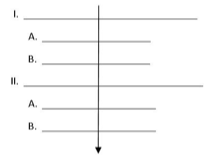
Wisdom literature, however, follows a different structure. In fact, scripture as a whole usually does. It has what might be called an Eastern rhetorical style. That is why it is often hard to outline scripture—in very much detail at least. What is not written from an outline cannot have an outline extracted from it. Outlines presuppose the Western layout. In the Eastern style the presentation has a theme, which we have represented by the center of a daisy. The theme of this sermon is living life among men under God—an interpersonal matter. Particular applications of that theme and more specific ideas within it are like petals arranged around the center of the daisy.
Picturing the whole sermon requires putting several petals on the daisy. Some petals are smaller and some larger because the statements vary in length. In cases like the Sermon on the Mount, the petals do not have to occur in a particular sequence; they simply appear in this order in this sermon. The daisy format gives more flexibility to the manner of

presentation, but it could be relatively rigid if the subject matter so dictated. One idea would necessarily lead to the next one and so on around the circle. In most examples the structure is rather loose as in the Sermon on the Mount, Ecclesiastes, James, and elsewhere. From the way Matthew 5-7 is blocked out, we can see the space Jesus assigns to his subjects. A separate chart could picture the proportioning.
The sermon begins with a series of statements called “beatitudes,” because many earlier translations use the word “blessed” here. Newer versions often say “happy” or “fortunate.” The beatitudes and the salt-light paragraph form a unit that combines the blessings—which God gives when we follow his will—and responsibilities—being a light to the world about his will.
In a transition statement, Jesus says, “Except your righteousness exceed the righteousness of the scribes and Pharisees, you will certainly not enter the kingdom of heaven.” The section 5:21-48 grows out of this principle. It is a series of correctives on popular and rabbinic beliefs of the day. Jesus quotes something from the Old Testament and then qualifies it, not so much from what the Old Testament actually says, but from way people were misusing it.
In chapter 6 Jesus addresses almsgiving, fasting, and prayer. Hypocrisy is a good label for this portion, because right motives are important in what we do in these matters. Our heart needs to be in it, and our behavior should demonstrate what we are inside. This section contains another set of correctives on current religious teaching and practice in Judaism.
The last half of chapter 6 together with the first part of chapter 7 calls for trusting God for inner strength to deal with daily life and to relate to other people without being critical. We use the word judge for criticize because that is the way most translations read.
Next 7:7-11 deals with asking God for what we need and with our confidence that he provides what we need—vs. what we want. Chapter 6:19-7:11 speaks about strength to deal with life and the capacity to relate to other persons—including God—in a trusting way throughout all of our years.
Matthew 7:12 gives the Golden Rule, which calls for treating other people the way we want to be treated. We call this “love” because love is what the Golden Rule implements, as we will show later. The sermon closes with a warning about false prophets. Jesus describes some ways false prophets operate and commends those who heed his teachings and apply them as they should. He compares them to a builder who puts his house on a firm foundation instead of sand.
This is the general breakdown of the sermon itself. Our analysis further subdivides it into thirteen parts for purposes of presentation. Our first segment has taken an overview of the sermon. The general ideas pictured on the daisy give the breakdown of the next twelve segments. The first one is “Blessings and Responsibilities,” covering the first half of chapter 5, followed by “Jesus and the Law,” about six verses that comfort Jesus’ listeners: “Don't worry that I am advocating throwing the law away as if it is false; rather, I am here to fulfill the law.” The third segment talks about hate, murder, and relating to people positively to replace that attitude and behavior. Another paragraph warns against adultery and divorce. Because those issues are so complex we are devoting two studies to them, one to Jesus’ teaching relative to kingdom ideals and another that integrates his teaching with other biblical testimony, including the redemptive process.
The fifth chapter ends with comments about taking oaths and relating to adversaries. The sixth chapter speaks first about prayer, almsgiving, and fasting, which lead into the “model prayer.” Then we look at the model prayer itself, together with some statements elsewhere in the sermon that deal with prayer. We consider the last half of chapter 6 from the standpoint of living with strength and coping with the problems. The first five or six verses of chapter 7 warn against “judging,” which we take to mean not being critical. Two studies look at the Golden Rule (7:12), one dealing with what Jesus says directly and the other dealing with its values in everyday relationships. The sermon concludes with the Parable of the Builders.
Besides the structure of the sermon, there is the matter of its emphases. One emphasis is that people must not overlook the inner attitude and motives behind outer behavior. Righteousness does not consist only of external actions that people can see or words they can hear; God knows our hearts as well. Commenting on Old Testament prohibitions against murder and adultery, Jesus adds prohibitions against anger and lust. Retaliation and hypocrisy arise from bad attitudes. Intentions and motivations are as important to God as the actions people see.
Another emphasis is the need to unite everyday life and religious observance. If someone goes to offer a gift and remembers that things are not right with some neighbor, he may as well lay the sacrifice down beside the altar and go correct that relationship first. In chapter 6 almsgiving, fasting, and prayer have that feature as well. We cannot do religious observances and spiritual exercises just any old way and forget about the other dimensions of life—the inner dimension and the horizontal dimension. Particularly in 5:21 and following, Jesus talks about some incorrect ideas. Although he might appear to be setting himself up in contrast or contradiction to the law, Jesus is really objecting to its misuse in contemporary Jewish teaching. The law is quoted, but even Satan can quote scripture (Matthew 4:6). Jesus is correcting the manner in which Old Testament teachings are being brought to bear on everyday existence. That is most obviously the case in the “eye for eye” statement and the statement about loving a neighbor, which was getting diluted by an unbiblical addition about hating an enemy.
The sermon also stresses the horizontal more than the vertical. “Horizontal” relationship with people contrasts with vertical relationship with God. We live the horizontal in light of the vertical, of course, but in this sermon Jesus is most concerned that we interact with fellowmen in ways that strengthen relationships instead of fragmenting them.
The sermon focuses on the here and now rather than the hereafter. It includes nothing about the next life or the nature of man’s eternal state. Jesus says little about the nature of God, man, creation, or even redemption. He talks about everyday things—going to work, coming home from work, relating to family and friends all the time. There are some allusions to rewards in the beatitudes, but the stress is on this world and how to live in it now.
Jesus addresses ideals rather than redemption from a failure to live up to ideals. Wise living rather than salvation is the topic of the sermon. He describes the ethic we should commit ourselves to. “What happens if I fail?” is another issue. Redemption as the distinctive Christian message comes into the picture later.
Another emphasis is on personal relationships rather than on legal concepts. Although Jesus quotes the Old Testament and sets forth ideals for living, his interest is on how their behavioral correlates affect life between people. The issue is not just what God wants us to do, but how we do it. When we understand Christianity in an interpersonal framework, artificial things fall out. Christianity does not deal so much with ideas as with ways of relating.
This observation relates to another emphasis: some behaviors weaken relationships. They “depersonalize” associations by treating persons as if they were not persons—as if they were objects or animals. The distinctive characteristics of human persons need to be kept in mind in studying this sermon. It provides a lot of material that helps us personalize ourselves to other people. Jesus is warning against ruining relationships by treating people like things.
Legalizing is one way of depersonalizing people. This problem comes up in part because we religious people are concerned about how we ought to live and how others ought to live. It is easy to have foremost in mind what we should be doing and what other people should be doing. We become judgmental because they are not doing what they should, and we get down on ourselves because we are not doing everything right either. Legalizing relationships means that we keep calling each other into question because none of us fully live up to our standards. Jesus warns against being legalistic.
The last half of chapter 5 illustrates this point well. Swearing was legally okay in the Old Testament, but it hinders relationships. In Matthew 23 Jesus criticized the tricky system evidently practiced in current Judaism. Certain oaths were not necessarily binding in court while others were. Jesus shoves such things aside and says, “You may be able to work out legal justifications to keep yourselves out of trouble or to get other people in trouble. But if you really want to live, you have to concentrate on more positive, interpersonal ways of acting. If you are going to do something, you do not have to take an oath to make people believe you.”
Externalizing is another way of depersonalizing. Since persons have an inner as well as an outer dimension, these aspects are necessarily bound together in social relationships. Involvement with other people cannot be simply surface associations that consider only what we say and the movements we make. If we externalize, we cause other people to distrust us. They know good and well we do not really mean what we are doing and saying. Almsgiving, prayer, and fasting can become external motions that lead to surface relationships instead of real actions by one whole person to another whole person.
Competing is a third form of depersonalizing. Instead of omitting the internal or emphasizing concepts more than people, the problem here consists of setting ourselves in contrast to other people. Chapter 5 talks about an eye for an eye and a tooth for a tooth, loving neighbors and hating enemies. Jesus turns us away from a competition mentality. When we compete with someone we often treat him as something we are working against or showing ourselves better than. That is not the way to build a positive feel for life with another person. Love is the way to interpersonalize life (7:12).
This chapter has looked at the structure of the Sermon on the Mount and noted its main concepts. They are pegs on which the sermon hangs; they are the concepts that hold it together. One major statement is 5:16, which speaks about letting our light shine and doing good works that other people can see. That is our mission. Another statement is in 7:12: living in love is the way we do it (method). A final statement indicates the standard to which this sermon commits us: “Be perfect, even as your heavenly Father is perfect” (5:48).
christir.org