
The Value of the Golden Rule
THE VALUE OF THE GOLDEN RULE
Virgil Warren, PhD
The previous study on Matthew 7:12 dealt with the meaning of the Golden Rule. This study looks at the impact of the Golden Rule on individuals and on their relationships. In the parallel between “[Do] [to others] [as you would have others do to you]” and “[Love] [your neighbor] [as yourself],” we made two primary observations. (1) Do replaces love; so love is an action that can be commanded. That doing is a giving of ourselves for the joy of others. Often love means giving of ourselves for the needs of others, but we can also love God, who “is not served by men’s hands as though he needed anything” (Acts 17:25). It is better, then, to define love broadly enough to include loving him. When we meet people’s needs, we are increasing their happiness; so love becomes self-giving for the joy of others.
Comparing the Golden Rule and the Second Great Commandment shows that (2) neighbor means others without restriction. The Golden Rule principle applies to all relationships, not only to Christians and friends, but to people outside the faith, people we do not know, and people who work against us—our “enemies.” Looking for the values of the Golden Rule means looking for the ways it makes life meaningful for us and joyful for everyone.
For the individual, the first value of practicing the Golden Rule is that it enhances ability to relate effectively to other people. In this respect there is healing value in treating people the way we want to be treated. “Healing” in this case means improving conditions to more nearly what they ought to be. That healing value affects the individual who does the Golden Rule because doing it requires “projecting consciousness” over behind the eyes of someone else. We all see the world from behind our own eyes, but we can transfer our perspective over behind the eyes of someone else. We use imagination to see what things look like from over there. Treating others the way we want to be treated requires “being in their shoes” or “putting ourselves in their place.” Otherwise, we do not take into consideration the difference between their situation and ours. Fulfilling the Golden Rule involves taking into consideration the differences between us and them and between our situation and theirs.
Learning to project consciousness is the first step in the socialization process. Human beings are social beings, not just unrelated individuals. We have the capacity not just to deal with our own environment, but to relate to others who can in turn relate to us. To do that, both of us must think about what it is like to be in each other’s place. Society can exist only to the extent that each person looks at the situation from other than his own viewpoint alone. If we do not consider other people’s needs, we are treating them like things and acting self-centeredly. We are forcing them to fit our agendas, which is individualism. By projecting our consciousness over behind the eyes of others, we enter the socialization process.
As we grow up, we develop the ability to see the other person’s point of view. Young kids cannot do this as well as teenagers and adults. My wife and I have four children. One time somebody asked one of them, “How old are you?” He held up three fingers inside of a mitten. In another episode one evening my wife put the kids to bed, turned the lights off, and went in the other room. Then she thought of something she needed to ask one of them; so she went back in and asked him. There was no answer. She asked him again. Silence. As she asked a third time, she happened to reach down and touch his head. He was nodding his head in the dark.
In about the same way, we adults do not always stop to think that the other person cannot, so to speak, see inside our mittens. A socialized person would take off the mitten. We have all probably seen someone talking in a phone booth pointing around as if he were describing his surroundings or giving directions.
Sometimes we catch ourselves doing about the same thing. Late one Sunday night after preaching at an evening service two hours away, I was driving home with the family through hilly countryside on a narrow two-lane road with lots of curves. I was getting exasperated with people not dimming their lights. It was hard to see with bright lights shining in my eyes. Pretty soon the car ahead of me started slowing down and kept slowing down till we were only going twenty miles an hour. A little way up the road we came to a group of houses where there was room enough for him to pull off. I thought, “Well, great. Now I can get on home.” After I passed him, I looked in the rear-view mirror and watched as he pulled back on the road and came up close behind me. He turned his lights on bright and let them glare off my rear-view and side-view mirrors. While I was holding my head down to keep the glare out of my eyes, I noticed the little red light on my dash. I had had my own bright lights on all that time! I suppose we have all done things like that. Usually they are unintentional, but these lapses show that we do not always think about what is necessary to take into consideration in social settings.
We have been talking about getting to the place where we can put ourselves in the other person’s position. Developing this skill is one reason play is so important for young children. When kids play, they are doing the very thing we are talking about. They are projecting themselves into imaginary situations. They are playing mothers or doctors or policemen—roles they do not really have. Play uses this projection mechanism, and it is important for kids to use it. Adults might be tempted to think that little kids should work more, but playing is important for shaping their personalities. It enables them to become social beings.
Developing the ability to look at things from other people’s viewpoints is a “side effect” of practicing the Golden Rule. We become more perceptive of human nature in general as well as in the particular people we are relating to. It is terribly important to understand people as well as possible so we limit mistakes in choosing what to say and how to act toward them. This is a “healing value” of the Golden Rule because it changes us from less effective interaction by requiring us to project consciousness. Treating other people the way we would want to be treated in their shoes not only keeps us from ruining personalities that are already good; it can turn around patterns of relating that are less effective.
For the individual, the second value of practicing the Golden Rule is that it establishes the habit of taking initiative. To be treating people the way we want to be treated, we do not wait for them to make the first move. We naturally make the first move when the situation calls for it. Doing the Golden Rule creates a different kind of a personality in us. Without realizing it, we can get into the habit of letting someone else take the initiative. I have had friends who expected their wives to make the phone calls about fixing the car or making appointments regarding things that were their own responsibilities. Taking initiative in turn fosters a positive attitude toward life, because we find out that other people do not usually reject us, which increases self-confidence. We do not want to be followers who let other people take the brunt of the action up front.
This is one reason the Golden Rule is a positive statement in scripture. Outside the Bible we find the Golden Rule stated in negative form: “Do not treat other people in ways you would not want to be treated.” A lot of good comes from this principle even in negative form, because it reduces the number of evil things people would otherwise do to each other. But the negative principle does not keep us from being passive. It does not prod us into taking initiative in doing good things for other people. Jesus states his life principle in positive terms.
For the individual the third value of practicing the Golden Rule is that it eliminates the distrust complex. If we are taking the initiative, we have to override the tendency to distrust. We have probably had experiences where we tried to do someone a good turn, and instead of appreciating it he took advantage of us. A few such experiences and we get afraid that other people in general respond this way. We have to stand up for our rights, or people will run over us. Frankly, with some people there is some truth in that, but practicing the Golden Rule sets that aside as a reason to distrust them. It urges us to trust them first, to take the initiative and relate to them as we ought to, regardless of whether they have acted that way toward us first or regardless of whether they respond to our goodness the way they should.
Besides healing values for the individual, the Golden Rule has interpersonal healing values. Following the Golden Rule strengthens personalities by encouraging us to take initiative, to think positively, and to progress through the socialization process. The most basic mechanism in all of this is the projecting of consciousness to the other person’s vantage point. It raises the quality of the individual person. Interpersonal healing values raise the quality of relationships. The first set of benefits lies within the individual. A second set of benefits lies in relationships between individuals.
The first interpersonal value of practicing the Golden Rule is that it negates the law of retaliation. It sets aside the principle of hitting back, getting revenge, getting back at people. This point about the Golden Rule is extremely important. Sometimes we would be perfectly happy if we could just figure out how to keep situations from going bad in the first place or at least getting any worse. Many of us would be happy if we could just keep from making the mistakes that turn people off and drive them away. But obeying the Golden Rule accomplishes even more than that. If we just keep situations from getting worse, then bad situations do not get corrected. The Golden Rule can do more than keep a bad situation from escalating; it can take a bad situation and turn it around. The accompanying diagram pictures the idea. The spiral represents the give-and-take between people. We can go on indefinitely, not doing anything particularly good or particularly bad—just maintaining the relationship.
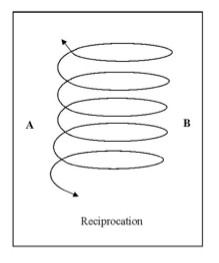
In many situations, however, rather than being neutral, an act on one side is noticeably positive or negative, and the quality of the relationship starts moving up or down accordingly. People typically respond in kind. We treat others the way they have treated us. If we do something other people dislike, they tend to react toward us the same way. They react negatively if we act negatively. Soon we are in a “downward spiral of deteriorating relationships”—a “vicious cycle.” One person’s poor attitude feeds the other person’s poor attitude, which makes the first attitude worse, and so on.
The Golden Rule turns this element of human nature into a mechanism for good. If we do good to someone, they tend at least to respond less negatively, possibly in the neutral way, sometimes in a positive manner. Consequently, we can stop the downward spiral of deteriorating relationships by taking the initiative, which calls for returning good for evil at some point along the way. That slows up the deterioration, stops the downward spiral, or turns it around. In other words, what keeps relationships healthy and causes them to grow is the very thing that turns deteriorating relationships around and heads them in the opposite direction.
As Jesus says earlier in this sermon, “Blessed are the peacemakers.” The Golden Rule provides the means for making peace. In an inspiring devotional passage, Paul says, “Let love be without hypocrisy. Abhor what is evil. Hold onto what is good. In love for the brothers, be tenderly affectionate toward one another in honor, preferring one another” (Romans 12:9). Verse 14 continues, “Bless them that persecute you. Bless and do not curse.” That sounds familiar. The chapter closes with another classic statement:
Do not be not wise in your own conceits. Do not render to any man evil for evil. Take thought of things honorable in the sight of all men. If it is possible as much as lies in you, be at peace with all men. Do not avenge yourselves, beloved, but give place to wrath for it is written, “Vengeance belongs to me. I will repay,” says the Lord.” If your enemy is hungry, feed him. If he is thirsty, give him to something to drink. In so doing, you will heap coals of fire on his head. Do not be not overcome with evil but overcome evil with good (12:16b-21).
If a bad relationship is ever going to be changed, one side or the other has to do good back to the one who did evil. That requires more than doing good in a neutral situation; it calls for doing good in a negative one. We overcome evil with good by practicing the Golden Rule. It reverses the spiral by responding to evil with good.
A second interpersonal value of practicing the Golden Rule is that it eliminates the competition mentality. We often base our sense of worth on being better than other people—at succeeding in competition against them. We have to feel above them to feel secure and significant. But success in competition is not a very good basis for feeling good about ourselves. It cannot work for very many people, and even for them it works only in certain areas and only for a while—till someone even better comes along or till they weaken with age.
Living the Golden Rule builds self-esteem by self-giving for the joy of others. We feel good about making people happy. They make us feel good by appreciating us for what we have done. We do not compete with them; that pits us against them. We do for them; that unites us with love. The Golden Rule puts us in true horizontal relationship to people so we do not have to put them down to raise ourselves up. We do not have to make them feel bad to make ourselves feel good. That brings something good to both of us. We both “win.”
This highly respected principle deserves the attention we have given it. It is the basic social mechanism by which all people everywhere relate to each other in positive ways. It is Jesus’ primary principle for social existence: “Do to others as you would have others do to you.” It restates the ancient principle God revealed through Moses when he organized the Israelite nation: “Love your neighbor as yourself.” Jesus defines love as “doing” and neighbor as “others.” He explains “as yourself” by saying “as you would have them do to you.” We relate to all people by this principle. It socializes us, gives us initiative, and removes distrust. It gets rid of revenge and eliminates competition as a mechanism for achieving self-worth.
christir.org