
Interchanging Nature, State, and Action Terms
B. Interchange of Nature, State, and Action Terms Virgil Warren, PhD
A series of examples may be found in Virgil Warren’s doctoral dissertation The Implication of Divine Self-Consistency for the Doctrine of Natural Depravity, pp. 157-66.
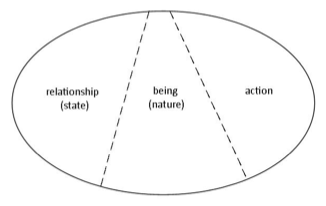
As to words, people shift categories without shifting them as to concepts, because the categories are interconnected in actual experience. Being, action, and relationship are equally present in any real event, but with the mind we can differentiate between them. So language, which reflects the subjective activity of sensory perception and mental conception, differentiates between the aspects of an event even though they are objectively interrelated. If we do not distinguish language and reality, we take a point stated about one aspect and slide it onto another. Furthermore, language itself may use a nature term to refer to an action or to state reality. If readers do not keep in mind the nature of the issue, they can make all kinds of false inferences.
Over the centuries a recurring general problem for interpretation has been the ontologizing character of Greek philosophy. It has shown itself in the doctrine of real presence (communion), natural depravity (anthropology), and miracle for influence (causality), to indicate a few. This kind of “reification” confuses the medium with the message.
1. Nature-state/circumstance substitution
**the doctrine of real presence in the Lord’s Supper (impanation, transubstantiation, consubstantiation)
**The doctrine of natural depravity comes mainly from reading statements about stative and functional reality as if they were talking about the ontic nature of man. In this place belongs a whole series of “cannot” statements. See examples under “Mechanics: Nature of the Case—Inability.”
**Scripture uses “death” as a state-of-being term for broken relationship, because when people die, they no longer exist to their spouses and others. Ephesians 2:3 speaks of “deadness” as the kind of thing that comes from sinning (cp. Luke 15:32).
**Romans 11:24 says that the Gentiles were by nature a wild olive tree. The verse is not talking about their created nature, but about their relational circumstance. They were apart from special revelation, which led to their acting in wrong ways.
2. State-action substitution
Language makes process static and actions substantive. It fosters the notion of static being, because static being is the closest analogy to language.
3. Nature-action substitution (concretized speech)
Biblical writers frequently use substantive imagery for spiritual realities. Over the centuries interpreters have misread Semitic idiom to create their substantive and legal theological systems. Semitic idiom, however, is more characterized by graphic pictures, which lends itself to being read hypostatically. The body-parts expressions are typical: “by the hand of,” said even of God.
**The “image of God” in Old Testament used by Paul for behavioral quality and functional pattern (Romans 8:28-29-39).
**Even we speak of “halfhearted attempt,” “backbiting,” “I can’t stomach the idea,” “shoulder the responsibility”; cp. biblical expressions like “heart was hardened,” “bowels of compassion,” and other body-part language. Such speech assigns psychological values to substantive words.
**Note the ambiguity even in the term god as to whether it is functional or ontological deity. Psalm 82:6 calls “gods” those who served as representatives of God, or as extensions of God’s activity. An age-old controversy continues over this distinction in the use of “God” as a reference to Jesus of Nazareth. Was he ontological or functional deity? Was he homoiousia (similar being) or homoousia (same being)? What of Hebrews 1:3 (the “very image of his substance”)?
**Philippians 2:7 says, “. . . [Christ Jesus] emptied himself, taking the form of a servant. . . .” We say that Jesus gave up the free exercise of his rights as deity, not his status or deity or abilities. Nature terms are used here for functional reality (“slave”), and action terms are used figuratively (“emptied”).
**1 Timothy 4:2 speaks of a “conscience seared as by a hot iron.”
**2 Peter 1:4 speaks about partaking of the “divine nature,” not meaning ontological deification, but coming to approximate the character of God. Peter is talking about characteristic action. In their book The Seduction of Christianity, Hunt and McMahon referred to groups that want to take passages like this one to promise the ontological deification of people through the supposed Christian message (p. 219). When he used the term nature, however, Peter was talking about behavioral likeness (action) rather than substantive being or divine status (relationship), as is clear from the succeeding context, which talks about developing various virtues. The English term nature is unclear because it can refer to substance or behavioral pattern, as in the statement, “It’s just his nature to be grumpy,” or ‘“She is good natured.” Grumpiness and being good natured, however, are patterns of behavior, not types of substance. Ephesians 2:3 says that “by nature” Paul’s readers were previously children of wrath. They were dead through their trespasses and sins, not through birth. See also above under “Nature-State Substitution.”
**The expressions “born in” (something) and “from the womb” mean to be totally characterized by something, as when we say, “He is a born leader, a born liar, a born loser.” He is an “inveterate” sinner. Many characteristics and activities involved would not be present in the beginning months and years. (a) People are said to be wicked from the womb. Psalm 58:3 says, “The wicked are estranged from the womb; they go astray as soon as they are born, speaking lies.” In light of that clear case of exaggeration for emphasis, we should read Psalm 51:5, “I was brought forth in iniquity, and in sin my mother conceived” (cp. Job 11:11-12; 15:10, 14-16; 25:4). Because of his birth defect, the Pharisees said that the man in John 9:34 was born in sin (9:2). This terminology provides the background for Isaiah’s saying of Israel that they were called transgressors from the womb (Isaiah 48:8). God said of the antediluvian people that the imagination of their heart was evil from their youth (Genesis 8:21).
It should be clear that born in wickedness does not mean biologically inherited racial depravity. There are (b) statements about goodness from the womb. John the Baptist was filled with the Holy Spirit from his mother’s womb (Luke 1:15; cp. Nazirite statements below). Job says that he guided the widow from his mother’s womb (31:18). A child was a Nazirite from birth (Judges 13:5, 7; 16:17; cp. Numbers 6:1-21). None of the Nazirite regulations would be relevant in the earliest years—shaving, drinking liquor, or eating grapes. Likewise, David says in Psalm 22:9-10 that God made him trust him when he was on his mother’s breasts, that he was cast on the Lord from the womb, and that Yahveh was his God from the time that his mother bore him.
(c) People are said to be separated and called to divine tasks from the mother’s womb. Jeremiah was sanctified before he came from the womb (1:5; cp. Galatians 1:15).
(d) Timothy knew the sacred writings from the time he was a baby (2 Timothy 3:15, βρέφος [brephos]).
(e) The foreigners in Acts 2:8 were born in the language they spoke.
Other, non-controversial usages of these expressions occur in Job 10:18-19; 31:18; Isaiah 46:3-4; 49:1, Matthew 19:12; Acts 3:2; 14:8; Romans 9:11 (< Genesis 25:23; Malachi 1:2-3). God forms people and nations in the womb (Job 31:15) and from the womb (Isaiah 44:2; 44:24; 49:5).
**The word flesh indicates ethical behavior based on the drives of the flesh. It serves as a word for self-centered living. Translating σάρξ (sarx) as “sinful nature” is a misleading rendering in the New International Version in its earlier edition, because it can set up a foreign set of contrasts.
**Leaven serves as a symbol for influence.
**In scripture, sin is used for action and state but not for being (although it is used in this latter sense in historical theology). In historical theology, “original sin” does not mean the original act of sin, but the supposed inheritable fallen nature incurred by our first parents when they sinned.
**“If you don’t quit that, I’m going to beat it out of you.”
Among other things the issue here is the intended meanings of the linking verb: “is, are, was, were.” Is can mean
(1) Present time (the English progressive present); “is” of time (“He is here.”) Is Jesus assuming present-time “is” rather than “is” of timeless identification in the Exodus 3:6 text he quotes to the effect that at the time of Moses God says, “I am the God of Abraham” (Matthew 22:32 = Mark 12:26-27 = Luke 20:37-38)?
(2) Timeless description (the English simple present); ‘“is” of predication (1 Timothy 6:10, “The love of money is the root of all evil.”)
(3) Identification (“He is John.”); “Is” of co-extensiveness.
(4) Appointment (Psalm 110:4, “You are a priest forever after the
order of Melchizedek.”)
(5) Correlation; “is” of analogy (When things correlate with
something, people sometimes say they are that thing.)
**Matthew 26:26, 28, and the like, say, “This is my body/blood,” meaning that the bread and grape juice represent his body and blood. (cp. “That is my grandfather,” said of a portrait.)
**Matthew 13:37-39 interprets the Parable of the Tares by saying that the field is the world, the angels are reapers, and so on.
**John 12:48: “I know that his commandment is life eternal.”
**“The rock was Christ” (1 Corinthians 10:4).
**Galatians 4:24: “The women are two covenants.”
**Galatians 4:25 says, “Hagar is Mount Sinai,” meaning that in the illustration she represents, or corresponds to, Mount Sinai.
**In the adage “A penny saved is a penny earned” the word is means “amounts to,” “is tantamount to,” or “is as good as.”
(6) Means
**John 10:6: “They did not understand what-the-things were” (ῥήματα, rhēmata implied); another translation might be “that he was saying to-them”).
**Luke 1:29: “She cast in her mind what manner of salutation this
might be.”
**Luke 8:12: “This is the parable.”
**Luke 15:26: “He asked what these things would be.”
**Acts 10:17: “Peter was perplexed what the dream would be.”
(7) Exists
Hebrews 11:6: “. . . must believe that he is.”
(8) Phenomenological existence
Rachel would not be comforted because the children were not. The passage does not teach that children do not exist in heaven. Since they were no longer visible, they did not exist in her mind; they did not seem to be there. They did not exist for practical purposes of relationship.
(9) Amounts to, is tantamount to
All the “I am” statements in John. “I am the resurrection” (John 11:25). He amounts to the resurrection because it is only through him that resurrection comes.
A related problem is reification, assuming that a label means there is a thing it refers to (“the word guarantees the thing”)—there is a thing because there is a noun. Often, however, a noun does not refer just to a person, place, or thing, but also to an abstraction (idea) or to a pattern of action. Reification occurs in situations where phenomenological language is used.
Reification becomes an important issue in discussing the nature of man, for example. Does each person have a soul in distinction from a spirit, a will, a mind? This approach postulates a faculty psychology, which means that there is a corresponding component in a person for each functional phenomenon experienced—which is then labeled by a word. These terms, however, may simply represent phenomena and say little or nothing “scientific” about the substantive makeup of the human person or the relationship of mind and brain. There is a current expression, “A part of me” (wants to do one thing) but “another part of me” (wants to do something else). People really mean that they have opposing inclinations, but they picture these inclinations as different parts of themselves.
The nature of God can too easily be modeled after the nature of a statement or the statement of a law. The unchangeableness of the will of God, for example, may be modeled after the unchangeableness of statements about the will of God. The kind of unchangeableness that a statement has once it is made is transferred to the idea the statement is made about. So to speak, the legalistic view of God and history may end up having the characteristics of the medium used to communicate it. There is a connection here with one idea that the Bible is the word of God.
All the attempts to equate the number of concepts with the number of words run the risk of another form of reification. See the treatment of lists later in these notes.
Because of reification, people can get into the idea that you cannot think without words. Educationally, they may suppose that if they can name it, they know it. It relates to the belief that if you can say it, you can control it, as well as the assumption that if you can say it, it can be done. “Honesty compels you to do this” may represent reification. It is interesting that aphasic people cannot say something they cannot do. The loss of language functioning in the brain can come from some kind of cerebro-vascular accident.
C. Implicit limitation (general rule and absolute uniformity)
Implied limitation to instances like the following:
These cases show that an expression in their place does not mean everything it could be used to mean, but what the author intends it to mean. There may be an implicit limitation that is not given in the statement itself. Jeremiah 18:7-8: “If at any time I announce that a nation or kingdom is to be uprooted, torn down, and destroyed, and if that nation I warned repents of its evil, then I will relent and not inflict on it the disaster I had planned.” The Book of Jonah is another example of thi point. This concept can be called “frame of reference.” There may be universal and absolute words in the statement, but they are intended within an implied area of concern, within a limited category, like the topic at hand, the time period in view, the circumstance envisioned. Generality vs. absolute is another form of this same phenomenon. The meaning is iterative vs. continuous or characteristic vs. uniform.
The issue here is the difference between the absolute form of a statement and the general nature of the observation it makes. Statements of general principle can be made without going ahead to specify exceptions or additional considerations in the practical situation. Actual situations bring together factors that qualify each other; so no one factor in a set can be treated as an absolute if it can be impacted by the other factors in the set.
The issue here is also the intended meaning of universal and absolute words: all, every, each, no, none, as many as, whatever, whoever, entirely/wholly (that is, quantity and number words); never, always (that is, frequency words), forever (that is, extent-of-time words), greatest/highest/easiest, perfect (that is, degree words). Superlative forms are not normally to be understood absolutely; they often have an elative force: very great/high/easy. A Christian praise song says in the first verse, ‘“The greatest thing in all my life is knowing you.’” But the next verse says, “The greatest thing in all my life is loving/praising you.”
כָּל in Hebrew, hence, πᾶς among Hebrew writers in Greek, is a reference to the category. It therefore approaches the value of the Greek (definite) article, which thinks of the noun as an identity (as when set in contrast to a parallel alternative) vs. quality. Often this amounts to potential “all,” characteristic “all,” phenomenological “all.”
In a way, we should distinguish between universal and absolute words. Absolute words refer to matters of degree, while universal words refer to matters of number. Perfect, holy, good are examples of the former; all, never, forever are examples of the latter. Universal and absolute words, however, are alike in that they are often meant in a relative sense.
Universal words may be
(a) actually all, that is, an absolute statement.
actually all within an implied limitation that can be discovered from the context or by the nature of the case.
Forever is used within the implied limitation of the Mosaic dispensation.
(b) generally all vs. absolutely, characteristically vs. uniformly. All may simply observe a significant generalization or even a noticeable pattern, one that is important to the subject at hand. Note the rhetorical device called “glittering generalities.” Note in this connection Paul’s statement in 1 Timothy 6:10, “The love of money is the root of all [kinds of] evil.”
(c) potentially all vs. actually all (John 1:9; see What the Bible Says About Salvation, p. 120).
(d) phenomenologically all, that is, that is the way it looks (Romans 7:15).
(e) psychologically all; that is the way it feels.
(f) all as to kind (Perhaps this is the point of passages like Mark 6:23, which promise that Christians will receive whatever they ask in Christ’s name believing. See below under “limited universals”). See What the Bible Says About Salvation, pp. 141-46, for the way some use these options to deal with the biblical promise about the availability of salvation to every human person.
(g) emphatically all. Universal, or absolute, words also appear in statements that exaggerate for emphasis. (See also below under “Category vs. Continuum.”) Universal words are often used for emphasis: “We have tried everything.”
(h) All may mean final or ultimate. When Jesus says that all authority has been given to him (Matthew 28:28), it does not mean that no one else has any. It means that he has ultimate authority in heaven and earth. Having authority over all means that whatever other authority there is falls under his.
1. Limited universals
**Genesis 3:20 says that Eve was the mother of all living, yet she was not
the mother of Adam (or the mother of all the animals that lived).
**Genesis 7:7-8 tells of God’s promise to Abraham that the land of Canaan would be an everlasting possession. The whole dispensational theology is based on reading everlasting as meaning as long as the earth will last.
**Exodus 9:6 says that all the livestock of Egypt died, but later there is
mention of livestock.
**“Smaller than all the seeds” (Matthew 13:32) may be a generalized reference, especially if in contemporary lore a mustard seed had come to stand for a small element with large results. (See also Matthew 17:20; Luke 17:6; 21:21 = Mark 11:23; 1 Corinthians 13:3; as well as James 1:6.)
**Universal words like “all” and “whatever” may be understood as universals of frequency or of kind. Matthew 21:22 says, “Whatever you ask in faith believing you will receive.” The sentence could mean either that believers get everything (in number) they ask for, or that they can get all kinds of things through prayer though not every one of them every time.
**Luke 3:21 says, “When all the people were baptized,” Jesus also came, was baptized, and received the Spirit.
**Luke 21:32: Jesus told his disciples that all things written in the prophets would be fulfilled in this last trip to Jerusalem. He obviously meant all prophecies pertaining to that period in his ministry; everything that was supposed to be fulfilled would be fulfilled, but there was still the Pentecost application of Joel 2. Much of what the prophets predicted had already been fulfilled.
**John 1:11 + 12 says, “His own (people) did not receive him, but as many as did receive him . . .” (In John 3:32 + 33-34 the same thing happens.)
**John 8:35: “A servant/son does/does not abide in a house ‘forever.’”
**John 14:26 promises the apostles that the Comforter would teach them all things. The Spirit did not make the apostles authorities on all subjects, only those matters related to the gospel and to their mission.
**In Luke 2:30-31 Simeon says in the Nunc Dimittis, “My eyes have seen your salvation, which you have prepared before the face of all peoples.”
**Luke 18:31 says, “We are going up to Jerusalem and everything written by the prophets will be accomplished to the Son of man.” Does this mean that the Old Testament does not contain any predictions that look forward to a time after the Messiah’s first advent or anything prior to the final week?
**Acts 1:1 says of the Gospel of Luke that it gave an account of all that Jesus began to do and to teach (cp. Luke 1:3), but John 20:30-31; 21:24-25 says that the world could not hold all the books if everything Jesus did and taught were written down.
**Acts 2:47 says that all the people held the Christians in favor, yet the religious leaders did not (4:1 ff.).
**In Acts 4:32-34 (cp. 2:44-45) Luke says that as many as owned possessions, land, or houses sold them and put the resources in a common store; yet not everyone did since in 12:12 John Mark’s mother had a house where Christians assembled.
**After the persecution surrounding Stephen, Acts 8:1 says, “[The Christians] were all scattered abroad.”
**Romans 3:23 says that all have sinned, but Jesus did not sin.
**Romans 11:26 says all Israel will be saved, yet those that reject Messiah are not saved. “Israel” probably means spiritual Israel here.
**1 Corinthians 1:4: “I thank my God always for you” (cp. 1 Thessalonians 5:17; characteristic behavior).
**Is 1 Corinthians 2:14 a general rule or an absolute uniformity when it says, “A natural person does not receive the things of the Spirit of God . . .” (cp. 1:26-27; What the Bible Says About Salvation, pp. 51-52)?
**1 Corinthians 6:12 says, “All things are lawful,” perhaps meaning all things may be used, rather than that all acts may be done. The statement applies to dietary regulations and matters like meat offered to idols. All such things are good in principle, but using them is not expedient if they are detrimental to the kingdom. Paul refused to let desire for such things override more important considerations.
**1 Corinthians 15:27 observes regarding Psalm 8:6 (“He put all things in subjection under his feet”), “He is excepted who put all things in subjection to him.” **Ephesians 5:20 says, “. . . giving thanks always for all things.” This passage goes beyond 1 Thessalonians 5:18, which says, “Give thanks in everything.”
**Ephesians 5:29 claims, “No one ever hated their own flesh.” (The reference could be for all “people” [ὑπὲρ πάντων, hyper pantōn].)
**Paul, the prisoner in Rome, wrote to the Philippians that he “had all things” (4:18), meaning that he had received from Epaphroditus the supplies they had sent him and that he had everything he felt he needed.
**Colossians 1:16 does not mean “the firstborn of all creation” created God and the Holy Spirit just because the text says he created all things.
**Colossians 3:20, 22 says for children and servants to obey their parents and masters in all things. Are there not some things wherein it would be appropriate to disobey?
**Paul tells Timothy (2 Timothy 1:15) that everyone in Asia turned away from him, but goes on to say that the house of Onesiphorus stood by him (1:16-18).
**Hebrews 9:27 claims that it is appointed to man to die once, but Enoch and Elijah did not die; neither will they die who are alive at Christ’s coming.
**1 Peter 2:13 tells people to submit to every ordinance of man, but Peter himself told the authorities in Jerusalem that he had to obey God rather than people.
**Forever often stands within an implied limitation, particularly an implied dispensational limitation. For a list of examples, see What the Bible Says About Salvation, pp. 125-28; add Leviticus 23:21 regarding the observance of Pentecost; Psalm 111:7-8; 119:152, 160, though the law has been nailed to the cross (Colossians 2:14); Luke 16:9; and John 14:16. This word gets very much involved in the issue of whether the damned have eternal conscious existence. 2 Chronicles 7:16 says that God was to reside in his temple “forever.”
**The scope of the atonement—both as to universalism and particularism—involves the force of universal terms that appear in passages addressing this issue (What the Bible Says About Salvation, pp. 119-23). Regarding the scope of the atonement, universalists take the universal terms as actual, conditionalists take them as potential, and particularists take them within implied limitations.
Universal words are often associated with prayers: Matthew 7:7 (= Luke 11:9); 17:19-20; 18:19; 21:21-22; Mark 11:24; John 14:13; (15:7); 15:16b; 16:23-24; 1 John 3:22; 5:14.
From another angle, we wonder whether the universal expressions that speak of the lostness of the unevangelized may compare with the universal expressions that speak of the lostness of Israel. “He came to his own but his own did not receive him” is meant as a generality rather than an absolute, as can be told from the succeeding statement, “but to as many as did receive him he gave the right to become sons of God” (John 1:11 + 12). Similarly, Paul speaks of Israel: “What Israel is seeking he did not obtain, but election obtained it” (Romans 11:7). In the surrounding context, the apostle speaks of the remnant doctrine in that it is a hardening “in part” (11:25, etc.). By and large, Israel was lost; by and large the unevangelized are lost—an even higher proportion presumably.
2. Limited negative (See examples under “Law of Contrast.”)
3. Characteristic action (vs. continuous)
One recurring translation problem comes from the fact that Greek uses the same form for characteristic and iterative action as it does for progressive action in the present, imperfect, and future tenses.
**Acts 8: “When Simon saw that the Holy Spirit was-given/was-being-given.” Either translation is possible, but the ideas are quite different. Does the text mean that the Holy Spirit was characteristically given this way? More likely it means the Spirit was being given this way in this case; Simon would not likely have been in a position to conclude such was the characteristic pattern (unless the characteristic aspect came more from Luke’s knowledge of the process than from the viewpoint of Simon).
**Romans 11:29 says, “The gifts and the calling of God are not repented of,” making it a generality statement. The verse could be translated, “The gifts and the calling of God are not being repented of,” a progressive present applicable to the specific issue Paul is discussing regarding the relation of God to Israel. The gifts and calling of Israel as not being repented of in opening up the gospel to Gentiles as Gentiles.
There are cases where gifts and calling were withdrawn: Saul’s dynasty was removed from being the royal house in Israel, Eli’s lineage was removed from serving as the priests, Judas was removed from being an apostle, Samson’s supernatural strength was taken away; note Luke 20:16, “He will come and destroy these husbandmen and will give the vineyard to others” (cp. Matthew 21:41); and especially Matthew 21:43 in relation to Romans 11:29, “The kingdom of God will be taken away from you and given to a nation bringing forth the fruits thereof.”
**Hebrews 7:7 makes the observation, “Without any dispute, the less is blessed by the greater.” Or should the verse be translated, “The less is being blessed by the greater [in this instance]” since people are said to bless God (Luke 2:28 + 34; 24:53? James 3:9)? The claim that Melchizedek was greater than Abraham (as indicated by his blessing the latter) comes from the nature of the situation recounted in Genesis.
4. Generality statements (principles vs. rules/laws/regulations)
Statements are often cast in the form of absolutes when they are meant as generalities. They assume all things being equal. This kind of expression is particularly prominent in wisdom literature like proverbs, because such literature deals with generalities and notable tendencies.
**Proverbs 22:7 says that if you train up children in the way they should go, they will not depart from it when they are grown up. Solomon is stating a general principle, not making a promise.
**The generalized anti-divorce statement in Mark 10:2-12 does not contradict Matthew 5:31-32; 19:3-12 (= Mark 10:2-12), which contain an exception clause about adultery, or 1 Corinthians 7, which brings up desertion. Perhaps it is legitimate to envision other circumstances like the one Jesus specifies. The Lord, for example, evidently infers from the prohibition against murder that it is wrong also to hate. What the commandment prohibited also prohibits what leads to it or has the same character.
**John 1:11-12: “His own people did not receive him, but as many as did
receive him . . .”
**Acts and the epistles recount some household baptisms that obviously do not include infants. The term household occurs a number of times in the Old Testament as well. (See What the Bible Says About Salvation, pp. 285-87, 290, ¶2.)
**1 Timothy 5:11-15: Paul tells Timothy not to enroll younger widows in the church’s benevolence program because they would be troublemakers, grow wanton against Christ, desire to remarry, and reject their first pledge. He states as a fact what is more likely a risk.
**The theological statement in Galatians 3:28, which says that soteriologically there are no distinctions between classes of persons, does not contradict the practical injunctions Paul lays down in Ephesians 5 and Colossians 3 about husband-wife relationship in the home or in 1 Timothy 2-3 about male-female role relationship in the church.
**Righteousness leads to long life (Ephesians 6:2-3 < Exodus 20:12; Deuteronomy 5:16, 33; 6:1-2; 11:8-9).
D. Category vs. continuum (degree for kind, and vice versa)
Degree matters may be stated in categorical form (note “relative negation” above) and vice versa. Matters of process are expressed as matters of state; degree terminology substitutes for categorical difference.
“That’s all you ever think about.”
**Paul tells Timothy, “Be no more a drinker of water, but take a little wine for your stomach’s sake” (1 Timothy 5:23).
**Shifting from one kind of music to another, a person might say, “Now we are going to have a ‘change of pace.” Then a section of jazz follows a section of country western. Actually, of course, “change of pace” is degree imagery, but it is being applied to a difference in kind.
**Running down a country road, a jogger may meet an on-coming car stirring up dust that the wind is carrying somewhat at an angle with the direction of the road. Does the runner speak of the dust as blowing fast toward him or slowly crosswise? For the purpose of communication, he might word it “one way or the other,” but there are an infinite number of possibilities between crosswise and head-on.
**Much of Calvinistic theology is built on treating categorical terminology as categorical reality. It has an absolutizing hermeneutic; sovereignty, for example, is absolutized to the elimination of freedom—in soteriological matters at least. Ethically such an approach becomes legalistic.
**The doctrine of entire sanctification takes categorical language and reads it as absolute reality. Miraculous operation also has a categorical character; so miraculous operation gets brought into the picture as the agent of instantaneous change between opposing categories.
Exaggeration for emphasis (hyperbole) belongs to the subject of degrees as well. Exaggeration reflects how something seems. It tells how a person feels about it. In examples below, added degree is put for better kind.
**At the time of the flood, God saw that “every imagination of the thoughts of [man’s] heart was only evil continually” (Genesis 6:5).
“You changed my wages ten times” (Genesis 31:7, 41).
“Offered sacrifices under every green tree”: Deuteronomy 12:2; 2 Kings 16:4. 2 Kings 17:10 says that during the reign of Hoshea, king of Israel, the children of Israel set up obelisks and asherah poles on every high hill and under every green tree.
Judges 20:16 speaks of seven hundred men who could sling stones at a hair’s
breadth.
Numbers 13:3: the people of Israel felt like grasshoppers in comparison to the inhabitants of Canaan.
**Psalm 51:5: “I was born in sin” (or is this best taken as phenomenological
language?).
**Psalm 58:3: “They go forth from the womb speaking lies.”
**Israel was a “rebel/transgressor from birth” (Isaiah 48:8).
**Jesus tells his hearers in Matthew 5:20 that their righteousness would have to exceed that of the scribes and Pharisees, or they would not enter the kingdom of heaven. A person could hardly be more meticulous in legal observances than the Pharisees were (degree). Christ’s kingdom called for a higher kind of righteousness as needed for salvation.
**Matthew 7:3: “And behold a plank/beam is in your own eye.”
**Will it indeed be more tolerable in the day of judgment for Sodom and Gomorrah than for those who reject the mission of the twelve (Matthew 10:15)?
**Matthew 11:11 (= Luke 7:28) says that John the Baptist was the greatest man ever born but that everyone in the kingdom would be greater than he.
**Matthew 17:20; 21:21; Mark 11:23; 1 Corinthians 13:2: “Faith that will move mountains.”
**Matthew 23:15: “You compass land and sea to make one proselyte and when he is made you make him twofold the child of hell more than yourselves.”
**Matthew 18:22: “I say to you to forgive seventy-seven times.”
**Matthew 24:4: “There will not be left one stone on top of another.”
**John 4:29: “He told me everything I ever did.”
**John 12:19: “Behold, the whole world has gone after him.”
**In John 14:12 Jesus tells his disciples that they will do greater things than he has done, a text often used to argue for continued miraculous manifestation at a stupendous level during the whole church age. However, a person could hardly do something more stupendous than resurrecting the dead. More likely, Jesus means that their actions would be of a greater kind—savings souls, which is greater than saving bodies. “Resurrecting” people from debauchery is more important than resurrecting them from the dead. The “greater-ness” does not consist of more extreme degree, but of more important kind.
**John 19:40: “The very stones would cry out.”
**John 21:25: “There are many other things that Jesus did which if they were written every one, the world itself would not contain the books that should be written.”
**Acts 17:21: “. . . the Athenians . . . spent their time in nothing else but to tell or hear something new.”
**Acts 27:43: “Not a hair of your head will perish from any of you.”
**There are no righteous people (Romans 3:9-23 < Psalm 14:1-3; 53:1-3;
5:9; 140:3; 10:7; Isaiah 59:7-8; Psalm 36:1).
**Romans 7:18: “In me lies no good thing.”
**1 Corinthians 1:12: “Each one of you is saying, ‘I am of Paul . . .’”
**1 Corinthians 13:1-3 has several apparent exaggerations in close proximity: speaking with the tongues of men and angels, giving one’s body to be burned, knowing all mysteries and all knowledge.
**2 Corinthians 11:20: “If a person slaps you in the face . . . you bear with
him.”
Paul says that he wished the Jews would mutilate themselves.
**It is good psychological advice for each person to adopt the saying, “Christ Jesus came into the world to save sinners of whom I am chief” (1 Timothy 1:15; cp. 1 Corinthians 15:9; Ephesians 3:8).
**Moses accounted the sufferings of Christ greater riches than the treasures of Egypt (Hebrews 11:26; cp. Ephesians 2:7).
**“Everybody is doing it.”
Note the application of exaggeration for emphasis also under “General Rule and Absolute Uniformity.”
E. Semitic Tendency to Use Concrete for the Non-Concrete (abstract and spiritual)
Hebrew thought not only personalizes, historicizes, and ritualizes; it also concretizes abstract reference. Planting becomes the picture for getting something started; growing is scripture’s image for increase by degrees; fruit and harvest are its images for cause and result. One function of figurative speech is to make abstract things tangible and concrete; consequently, this Semitic characteristic further illustrates the tendency to speak figuratively rather than literally or scientifically.
**We can illustrate the difference between concrete and abstract this way. If parents owe a daughter three allowances of $5 each and she owes them $11.95 for phone bills and they owe her $14 for housecleaning and she owes them $7.50 that she had borrowed, they could abstractly figure out on paper the final result ($9.55), or they could concretely exchange money back and forth till they had paid each other everything they owed.
**Scripture uses body-part word pictures with God (anthropomorphisms).
**The “presence” of the Lord with someone uses a locational figure for a non-locational (interpersonal, “spiritual”) reality. Presence is put for relationship (cp. the indwelling idea).
F. Amount and Number for Degree
**The statement “I learned a lot” means “I learned something important,” because there have not been a large number of things taught.
**Compare the Hebrew idiom called majestic plural, where plural number is put for high degree.
G. Effect for Process (purpose-result)
**English has the expressions “amounts to,” “in effect,” “is tantamount to,’” and “is as good as (done)” (“He is as good as elected”; “She is as good as dead” [1 Timothy 5:6; Romans 4:19; Hebrews 11:12]). It is a “done deal.” Hebrew has a comparable idiom called “prophetic perfect,” where the perfect tense—completed action—refers to something yet future that is sure to happen.
**Effective proleptic usage may explain the variance in the Lamb’s-Book-of-life imagery in Revelation (see What the Bible Says About Salvation, pp. 456-60).
**Psalm 16:10: “You will not allow your Holy One to see corruption.”
**In Matthew 5:32 Jesus says that when a man divorces his wife, he causes her to commit adultery, but he does not explain how this is the case. One explanation has been that divorcing her in effect puts her back in a condition of singleness despite her having lived with a man. Being divorced is, in effect, like not having meantime been married. Another effective proleptic approach has been to say that divorcing her puts her in a practical situation where she about has to remarry to live, which in terms of God’s ideals is not what he wants, which amounts to “adultery.” A better understanding is that, by divorcing her, the husband makes her out to be an adulteress—since adultery is the reason Jesus just gave for divorce; he ruins her reputation. An even more likely meaning is that he treats her like an adulteress (cp. “you make God a liar”; 1 John 1:10; 5:10).
**“I never knew you” in Matthew 7:22-23 may illustrate this use of speech.
**In John 11:4 Jesus says that Lazarus’ sickness is not unto death but for the glory of God, even though Lazarus later dies, and Jesus knows he will (11-14). In the final effect, Lazarus did not end up dead but was resurrected by Jesus to the glory of the Father.
**John 17:4: “I have finished the work you gave me to do.” But he had not yet died; he had not yet said, “It is finished” (John 19:30).
**The curious wording in Hebrews 3:14 may be effective use of terms: ‘“We have become partakers if we hold fast our original confidence firm to the end.’”
**Perhaps this is the point behind Jesus’ statement about Jairus’ daughter that had died: “She is not dead; she is sleeping” (Matthew 9:2 = Mark 5:39 = Luke 8:52). Inasmuch as Jesus was going to resurrect her from the dead, her temporary death “amounted to” being asleep—was like being asleep.
H. Primary and Confirmatory Evidence
1 John 4:2: “Every spirit is of God that confesses that Jesus Christ has come in the flesh.”
I. Commandment for Inference
Acts 13:47: “The Lord commanded us, ‘I have set you as a light for the Gentiles
that you should be for salvation to the uttermost parts of the earth.”
christir.org