
Interpreting Various Genre
IV. INTERPRETING VARIOUS CLASSES OF LITERATURE Virgil Warren, PhD
Examples of biblical literary genres: apocalyptic, benedictions, covenant, diatribe, didactic, drama, epistles, fable, history, lament, law, myth, parables, poetry, prophecy (predictive), proverbs, psalms, riddles, speeches (sermons, prayer, dialog), wisdom literature
A. Prime concerns
1. The degree of figurativeness expected in various genres
Figurativeness and literalness are matters of degree. The degree of figurativeness depends on the purpose of communication. If the purpose is to inform, the writing less figurative; if it is to motivate, it may be more figurative. Poetry and prophecy foster figurative expression; history and law have less figurativeness. Didactic material lies between the extremes. High levels of figurativeness do not occur so often in passages that seek to inform, because figurativeness works against clarity. Figurative language is used more for confirming truths already understood, exhortation, and impression.
The meaning of words develops out of experience. Consequently, words cannot communicate what is beyond experience. In didactic material, then, if a figure is used to refer to something unknown or unknowable, the reader will not always know that the thing to be known is other than the literal meaning associated with the figure. The referent will therefore not be revealed to him. If something is unknown and also unlike anything known or imaginable to the reader, the speaker has to communicate through analogy, or figuratively, using the known to communicate the unknown as well as possible. Explaining a car to someone in l750 might mean calling it a “horseless carriage,” which exemplifies the cultural conditioning of terminology.
Speaking about the unknown presents one difficulty with revelation about the realm of spirit and deity. Though we are led to believe that God is not wholly different from us (because we is created in God’s image), nevertheless he is revealed by comparisons with us, by negations of what he is not, and by absolutizing characteristics found in the natural realm (cp. Cicero, Orator 21; Augustine, De doctrina Christiana 4:11:26).
There is no virtue to literal over figurative. Figurative has nothing to do with unreal or false; it means that for the sake of communication one reality has been represented by another that has comparable aspects. It is a more affective way of speaking because of its motivational and emotional impact. The author’s intent, the nature of the case, and contextual considerations determine whether something is literal. The statistical predominance of literal over figurative does not help with deciding a case that could fall in either category. Taking something figuratively only if it cannot be taken literally sets the reader up for literalizing what the author meant figuratively. It also puts the burden of proof on the negative by requiring the figurative position to disprove the literal before offering its own analysis.
Sometimes people want to advocate literal interpretation because they confuse intentional meaning (“what it meant”) with (a) theological interpretation (“what it means,” i.e., contemporary application by extracting underlying principles). Their impulse also comes from confusing it with (b) literary interpretation, where the literary product is treated as a form readers use to create their own viewpoint; the writer or artist’s goal here is not so much an intended meaning as a meaning evoked from the reader.
2. The amount of material intended to be believed (cp. “Misidentifying the Genre” and “Introductory Considerations on Jonah”)
3. The tendency to speak in a restrictive vs. non-restrictive manner
B. General concepts for interpreting predictive prophecy
1. The nearest adequate fulfillment
The perfect (1 Corinthians 13) refers to the face-to-face relationship that begins immediately at death rather than the second coming
2. Assuming one adequate fulfillment
The notion of double fulfillment runs counter to the nature of language. “The meaning of scripture is one”; that is, when a statement is made, one meaning is intended, not several parallel ones. Supposing that God’s use of human language does not follow normal p usage puts little boundary on what a statement can mean. Instead of double fulfillment, the following concepts should be preferred.
a. Class prediction: the reference is to a class or group, not to a specific within it. An example appears in Hebrews 1:5b when it appeals to 2 Samuel 7:14.
b. Specific but recurring event: the prediction has recurring fulfillment; that is, it is a form of the generalized prediction illustrated above.

c. Conflated prediction: two or more discrete events are mixed together or dealt with in the same general context because they are related in nature or are analogous in some way. The Olivet Discourse is a case in point (Matthew 24-25; Mark 13; Luke 21:5-36).

d. Type-antitype: the original event was intended by God to anticipate a
later one.

e. Application: sermonizing often applies a passage to other things than what was originally meant (theological interpretation) on the basis of principles involved there. The process is all right, but it is not interpretation per se. It is application, whose correctness rests on the perception of the interpreter rather than on the intention of the original

writer. A New Testament writer may do this with an Old Testament event or statement. The correctness of the idea claimed lies in the inspiration of the writer in such cases (Galatians 3—Hagar and Sarah; this specific case could be a type-antitype in which case the only difference is that God originally intended this situation to be prophetic).
The rationale for limiting prophetic interpretation to the above considerations is to place restraints on interpretation that are congruent with the range of possibilities for human language as such. No limitation is put on God particularly except that limitation necessarily implicit in God's choosing human language as a medium of revelation. If the method of communication is adopted, its built-in limitations are necessarily adopted along with it. One must carefully distinguish this point about (1) limitation in the medium of communication from any notion of (2) limitation in the communicator and from any claim of (3) limitation about the New Testament interpreter who read the Old Testament with inspiration.
The following two possibilities are then regarded as illegitimate.
a. Two unrelated events: the problem here is that language cannot mean
parallel and unrelated things at the same time.
b. Accommodation: accommodation applies a passage to a matter not in the mind of the author.

3. The telescoping tendency of predictive prophecy
The length of time is not the primary concern. God’s prophet warns and gives hope to those in need. The ultimate triumph of good over evil is the real need God’s people have. It is not always for men to know the times and the seasons that God keeps within his own authority (Acts 1:7). It is the nature of the relationship between events that causes them to be laid side by side, even though, in fact, they form a series spread over a long period of time.
The sequence of events is also not the primary concern; their character is the more pressing matter. Telescoping prophecy allows for uniting events separated in time as long as they are conceived of as parts of one thrust of divine activity. The fact that history has an overall direction sets up the possibility that those prophets to whom God reveals his purpose may set it forth in telescoped fashion. Telescoping prophecy is natural in that as a people look back over time or forward into the future, they lose their sense of elongation and lets it all “run together.” In this kind of phenomenological outlook, prophecy is written not so much for indicating sequence or length, but topic—hope.
**Jeremiah 31 predicts the return from the Babylonian captivity and the coming of the covenant in one sequence, but five hundred years lay between them.
**In Matthew 10 Jesus’ commission to the twelve lapses into principles and expectations that go beyond the immediate mission. He tells them to go only to Israel (10:6), yet he brings up their testimony to Gentiles (10:18). He mentions scourgings in synagogues, which is doubtful in this mission. It appears that he is mixing the immediate mission with elements of their later permanent mission and conflates the two because they are related. This pattern of mixing characterizes Hebrew prophetic discourse, and therefore is not something explained by literary conflation by confusing two separate predictions.
**In the Olivet Discourse (Matthew 24-25; Mark 13; Luke 19), Jesus combines predictions about the fall of Jerusalem, the second coming, and the end of the age (Matthew 24:1-3), which involve events separated by at least two thousand years.
4. The analogy of scripture
“Analogy of scripture” means the same thing as “letting scripture interpret scripture.” How scripture handles Old Testament predictions should dictate how we handle them. We do not have a reason to believe that a more adequate fulfillment will come for what the New Testament already identifies as the fulfillment. Dispensationalism particularly posits literal, political, earthly fulfillment of kingdom predictions even though New Testament writers treat such prophecies as accomplished in the interpersonal church. The double fulfillment mechanism allows them to maintain theories about the end times even though New Testament writers analogically apply these texts to the Messiah and his kingdom. No New Testament writer ever applies an Old Testament prediction to an event yet future to his own viewpoint. Perhaps this means that Old Testament predictions have been fulfilled in the New Testament dispensation as already constituted.
5. Prediction and the full range of literary genres
As there is parable, apocalyptic, myth, and narrative elsewhere, so there can
be such in predictive prophecy.
6. Prophecy and fulfillment and their full range of biblical usage
Prophecy and fulfillment are correlative terms; the range of usage in the first
corresponds to the range of meaning in the second.
a. Prophesy and fulfill can involve time and thus refer to a future event. In
this case the idea is prediction and coming to pass.
b. The word fulfill can mean something like “this course fulfills the requirement for theology.” The idea is more like “corresponds to” than fulfills a prediction of. The corresponding term prophesy means more than predict. A prophet speaks for another; what a “prophet” says for God can have the full range of what God might say to his people.
**Hosea 11:1 (< Matthew 2:15)
**James 2:23: Genesis 15:6 was fulfilled in that faith found its
exemplification in what Abraham did.
**John 18:9 says that not getting any of the apostles arrested in the garden was a fulfillment of 17:12, yet 17:12 was not even a statement about the future.
7. The possibility of conditional prophecy
All promises have the form of predictions, but promises can be conditional. They are predictions about what the predictor will do rather than what someone else may do.
**1 Samuel promised that Eli’s family would have the priesthood permanently, but it was taken from them and given to another because of the unfaithfulness of Eli’s sons.
In the promise to Abraham about the land of Israel—that it would be an everlasting covenant—might be a conditional covenant (Genesis 17:17-18). Note Exodus 19:5-6; Deuteronomy 4:25-31; Joshua 21:43-45; 23:14-16. (A more likely meaning is that “everlasting” means permanent within an implied limitation—as long as God was using a national kingdom to serve as a light to the Gentiles.)
**Elijah’s prediction against Ahab in 1 Kings 21:20-24 was delayed because of Ahab’s repentance (1 Kings 21:27-29). Later, however, the prediction was fulfilled (2 Kings 9).
**Isaiah 38:1-8 records that the prophet Isaiah came to King Hezekiah and told him he was going to die. Because Hezekiah prayed to God and wept, the Lord sent Isaiah back to the king with the news that he was adding fifteen years to his life (2 Kings 20:1 + 6).
**When Jonah predicted the fall of Nineveh, he was really delivering a conditional prophecy. Its destruction was contingent on the Ninevites’ lack of repentance.
God promised to drive out the Canaanites from before the people of Israel. But the Israelites did not carry through on the condition that they were to initiate the warfare.
Incidents of conditional prophecy show the distinction between the prophets and the Spirit who spoke through them (cp. 1 Peter 1:10-12). These incidents also show the objectivity of the prophetic experience. Jonah’s message was opposite to, rather than reflective of, Jonah’s inclination—as shown by his fleeing toward Tarshish.
8. Dispensational interpretation of predictive prophecy and its rationale for
preferring literal prediction
Dispensational hermeneutics of predictive material appears to begin with the
following syllogism:
a. The future is as historical as the past.
b. The past in scripture is literal, not mythological.
c. Therefore predictions of the future are to be understood literally in
scripture.
The syllogism confuses the nature of the future with the nature of the reason for writing about the future. It is true that (1) the future and the past are equally capable of being set forth in historical and mythological form. It is also true that (2) scripture usually treats the past in the historical, more than the mythological, genre (even the earliest chapters of Genesis seem to have parabolic material wrapped around historical anchors; cp. the Book of Job and the Book of Jonah). But it does not follow that by taking a mythological, figurative, or parabolic approach to eschatological and apocalyptic material, interpreters leave themselves open to the charge of inconsistency if they understand history in typically literal fashion. This is the case for two reasons.
(1) The reason for writing history differs from the reason for writing eschatology. History shows the basis for truths to be believed and lived (conviction). Eschatology gives hope that the commandments lived by now should not be abandoned because they will win out in the end (exhortation). Good will triumph over evil.
(2) History could be written in myth form and eschatology can be written in historical form. However, the reasons for not writing the future in historical form may be (a) to help avoid the impression of determinism, not because there is any denial that God knows or can tell the future. Furthermore, (b) people do not need to know the future in vivid detail. In a literal historical sense, people need only to be assured that good conquers, especially during predominantly evil times.
The reason interpreters take the past historically, if they do, and the future mythologically, if they do, is not because both past and future are historical, but because of the analogy of scripture. The rest of scripture—particularly the New Testament—treats Genesis in at least quasi- historical fashion and the kingdom predictions in spiritual fashion. The Old Testament prophesied that Elijah would return before the coming of Messiah (Malachi 4:5; Matthew 11:14), but the “preferred” literal interpretation was not the case and there is no cue in the Old Testament that it would be figurative. Literal does not take precedence over figurative in prophecy any more than it does elsewhere.
Dispensational interpretation does not apply the analogy of scripture as final in this area because of the questionable idea that prediction will be as literal as history or because taking a statement figuratively takes it less seriously. The reason for the predisposition toward literalism in prediction is the assumption that New Testament writers spiritualize Old Testament kingdom prophecies because the church age forms a parenthesis before the resumption of the earthly political kingdom of Israel. The dynamic aspect of the kingdom is in operation now, but that supposedly does not exhaust the Old Testament meaning. In dispensationalism there are two levels in Old Testament predictions: the spiritual (applicable to church and kingdom) and the spiritual plus literal (applicable to the yet future kingdom only). In actual practice, the highly figurative, apocalyptic material in Daniel, Ezekiel, and Revelation simply must be taken in a mythological rather than historical sense.
There is a difference between mythological and historical. (a) In history there is one-for-one correlation between the parts of the account and the reality recounted, even when individual figurative expressions occur in the historical settings.
(b) In myth, however, there is no correlation between specifics of the story and elements of the reality do not necessarily correlate. The correlation lies in the general principles illustrated in story form. Very often myth takes recurring timeless truths and casts them into historical form (story) as a way of speaking of them. It concretizes and historicizes ongoing processes into one-time events. It tends to deal with things in black-and-white fashion. In a historical account the reader is given precise events from which the truth arises and by which it is guaranteed. The truth base in history is the event itself; the truth base in myth is the inspiration of the writer.
9. Type-antitype as a form of prophecy
Typology studies historical events, persons, or things that are analogous to later ones. There is a before-after, time element in type-antitype that is not present in other comparisons. Typology is like predictive prophecy in this regard, but differs from prediction because types are not statements but events. A type is a predictive event rather than a predictive word or timeless comparison.
In the history of interpretation, students of scripture have abused typology. Supposed types are nothing more than perceived likenesses that are overdone in the interest of apologetics or a doctrine like eschatology. The question is how to know that some Old Testament event was a type of something later.
“Typology” must have at least two restrictions for identifying examples of it. (a) Typology is limited to divinely intended likeness between previous persons, events, or things and later ones. The idea must be that God “planted” in certain events he intended to correlate with later ones (as the Hebrew writer indicates in 8:3 < Exodus 25:40 re the structure of the tabernacle). Sheer likenesses between some ancient person (Solomon) and a later one (Messiah) does not make these persons anything more than comparable in certain respects. In real types, the meanings intentionally existed in the previous events as distinguished from being read into them by later interpreters. If the meanings are read into the compared persons/things, the interpreters’ ideas originate elsewhere than in what they are drawing attention to. They might be true without having God shape a past event into a likeness of a future one.
(b) Typology should be limited to those former events scripturally identified later as types; otherwise, there is little control placed on the interpretation process, and typology degenerates into allegorizing comparisons. Whether things are comparable and the degree to which they are comparable are matters that can too easily be “in the eye of the beholder.” As with parables, similes, or metaphors, typology compares two things. With comparisons the interpreter runs the risk of overdoing the number of like elements. Comparisons illustrate; they do not prove. They make matters concrete and memorable. Whether they are true is based on other considerations like the correctness of the speaker’s perception or conceivably revelation the speaker received. Correlations need to be based on other factors than the similarities anyone can see. The points made in typology need to be based on scriptural identification or on scriptural teaching aside from such allegories so that the ideas themselves are taught through some other medium than sheer events; events can be ambiguous unless authoritatively interpreted. The truths proposed need to be conveyed to us through didactic material instead of inferred from historical material alone.
Typology may be a “suspect category.” Proposed examples of it in New Testament presentations are examples of something else. The connection between 2 Samuel 7:14 and Hebrews 1:5b, for example, is not type-antitype but a common larger class that includes both Solomon and Messiah (See “Interpretation in Hebrews Contrasted to the Allegorical Method of Philo.”). Paul’s use of events connected with Sarah and Hagar probably does not illustrate type-antitype (Galatians 4:21-31). Instead, he appeals to these events to picture what the Galatians should understand about the gospel. He does similarly in Romans 5:12ff. with Adam and Christ and in Romans 9 with events surrounding the lives of the patriarchs and Moses. These are event-vehicles for conveying Paul’s message; it cannot be shown that they are the basis for his message. The basis and origin lay in Paul’s Spirit-guided understanding of the purposes of God and in the gospel.
God’s intervening hand could have adjusted Old Testament events from what they would have been and given them features they would not have had, but we need to know that before we identify an episode as a type of something later. Particularly we want to avoid the supposition that there is a systematic code for interpreting figures so that the same figure always conveys the same idea. Such thinking causes people to suppose they can decode eschatological literature and thereby unravel the mysteries of the future. But we do not need to know by typology or straightforward verbal prediction the “when’s” and “what’s” of the end times except to the extent necessary for serving the interpersonal purposes of God in our present fellowship and responsibilities toward him. Having that, we should be satisfied.
Type-antitype often reflects the Semitic tendency to personalize truth (as well as to personify it—Wisdom, e.g.). God could have planted an event or person in the Old Testament to parallel something later. A biblical writer could draw parallels between events, in which the correlation lies in his inspired perception. If we make the parallel, we are doing it on the basis of our own perception. A number of personalized type-antitypes occur in scripture. The question with many of them is whether up ahead of the original Old Testament person, event, or thing God intentionally shaped him or it to parallel a later person or event. More likely the New Testament writer later saw certain parallels and used them simply to illustrate rather than prove; it was for description, understanding, and memory. The purpose was didactic rather than interpretative; hence, these cases differ from allegory because they depend on a use of unintended analogy.
**the arms of Abraham as a designation for paradise (Luke 16:22-23)
**“Moses is read in every city” (Acts 15:21).
**the Christ-Adam parallel in Romans 5:12-21 and 1 Corinthians 15:20-23,
45-49
**Jacob and Esau (Romans 9:10-13; Malachi 1:2-3)
?**“That rock was Christ” (1 Corinthians 10:4).
**Hagar-Sarah in Galatians 4:21-31
**the Melchizedek-Messiah parallel in Hebrews 7 (but based on Psalm
110:4)
**the temple-church parallel
As a teaching device type-antitype is related to post facto interpretation. In his praise of wasteful love, Jesus said that Mary anointed him in preparation for his burial (Mark 14:8). One wonders whether that was the purpose in her mind or whether that was what Jesus made out of it for teaching purposes.
C. Apocalyptic
D. Parables
1. Generally true to life
In this respect parable differs from myth, fable, apocalyptic, and any other genre that appeal to anthropomorphism and other unreal devices. Being true to life, they can illustrate how people act and what makes them tick.
2. Teaching general spiritual lessons
Parables are stories that teach spiritual lessons. Parables differ from allegories, which intentionally make parallels between the picture and the point in as many ways as possible. Parables speak more generally so that details serve as realistic scenery instead of being parts of the lesson. Paul’s armor figure in Ephesians 6:11-18 represents more closely what an allegory is.
The meaning of a parable is best explained by the person who devised the story, and the reason for using it lies in the circumstance of teaching through them. Jesus told his disciples that they were to know the mysteries of the kingdom, but the general populace received the message in parables that they would not understand (Matthew 13:10-15; Luke 8:10; cp. Isaiah 6:9-10). The lack of understanding comes from the lack of obvious correspondence between stories and meaning. He gave audiences memorable pictures to which later they could attach meaning made clear by subsequent events. His teaching method derived from readiness considerations: their expectations about the Messiah and the Messianic kingdom had to change before compliance could occur. By miracle, power of personality, and righteous character he could more easily change the former en route to changing the latter. But that change would take time; meantime there were parables with general lessons that typical people could remember and later understand.
a. We can look for cues in the parables themselves that slant them in the direction of their interpretation. One cue that we are dealing with a parable is the elements exaggerated in the story from what they would be in real life. These touches of unrealism qualify somewhat the true-to-life character that parables usually have.
**Matthew 13:42 for 13:36-43
**Matthew 13:50 for 13:47-50
**Matthew 22:13 for 22:1-14; binding someone hand and foot and throwing him outside in the dark might happen, but “weeping and gnashing of teeth” takes the story off in the direction of its lesson about the condition of the wicked (unless “gnashing of teeth” does not indicate extreme pain but “chattering of teeth,” as when someone is really cold).
**Matthew 24:31 for 24:45-51
**Matthew 25:30 for 25:14-30
**Luke 18:4 for 18:1-8; what is the likelihood that a judge would say even to himself that he feared neither people nor God?
**John’s “parable” about laying down his life for his sheep (10:1-11-15-17-18). A shepherd might risk his life for his sheep, but would he “die” for them? How typical would it even be for such a need to arise?
b. Stylized repetition is another mark of parable vs. an account.
**This phenomenon occurs in Job. (See B. “Misidentifying the Genre.”)
**The Parable of the Prodigal Son (Luke 15:11-32) has some stylized repetition in the prodigal’s speech (15:18-19 + 21) and in the father’s “dead-alive, lost-found” statement regarding his younger son (15:24 + 32).
**Luke 18:4 + 2 repeats the descriptive phrase about fearing neither God
nor man.
c. Statements of purpose appear in the contexts of parables.
**Matthew 7:24 for 7:25-27
**Matthew 13:18-23 for 13:3-9
**Matthew 13:36-43 for 13:24-30
**Matthew 16:12 for 16:5
**Matthew 18:10, 14 for l8:10-13
**Matthew 18:35 for 18:23-34
**Matthew 19:30 + 20:16 for 20:1-15
**Matthew 21:32 for 21:28-31
**Matthew 21:45 for 21:33-44
**Luke 14:7 (12-14) for 14:8-11
**Luke 15:1-2 for 15:3-32
**Luke 17:20 for 17:21-37
**Luke 18:1 for 18:2-8
**Luke 18:9 for 10-14
**Luke 19:11 for 19:12-27
**Luke 20:1-8, 9 for 20:9-18
**John 10:7-18 for 10:1-6
E. History
The historical genre is distinguished by its greater concern with historical matters. History stresses time-related features like when something happened, how long a time was involved, prophecy-fulfillment. Place-related items include where things happen and the direction of movement. People-related matters involve who did what, how they were related to other people, genealogies. There is an absence of the fantastic and the unreal, as found in apocalyptic. The interpreter can note the way New Testament writers deal with Old Testament narratives.
Reading the Bible as literature makes quite a difference in the way people handle it. If they use literary interpretation, they assume a special significance for each part of the text. When author create a literary piece, they are in control of its contents. They can choose to “plant” in it whatever they please, because they are not bound by the constraints of what actually happened. In historical materials, authors do not control what happened. At best they select what they will tell out of all that actually transpired. It may not be, then, that some detail conveys a significant point. Historians may include them by happenstance, because it was interesting to them, because it was unusual, because it tied the narrative together.
Interpreted accounts are different because (a) not everything is told and because (b) some bits and pieces may be thrown in that are not germane to the purpose.
**An example of seemingly undesigned information is the note in Genesis 10:25 that in the days of Peleg the earth was divided.
**Similar may be the note in Genesis 2:6 that a mist went up from the ground and watered the land (a note given in anticipation of the flood account later on?).
History, including biblical history, is interpreted history. It has gone through the process of selection (John 21:25) and recombination—recombination because dropping out most events leaves the rest juxtaposed differently from what happened. Historical records are microcosms of the time period they cover. The gospels and Acts, then, are theological history; they are written to show certain things about the origin and growth of the Christian church. The Judges and Kings-Chronicles materials especially are evaluated history inasmuch as they record whether the judges, the people, the kings, and their countries were good or evil in God’s eyes (Judges 2:11; 3:7, 12; 4:1; 6:1; 10:6; 13:1; 1 Kings 11:6; 14:22; 15:26, 34; 16:25, 30; 22:52; 2 Kings 3:2; 8:18, 27; 13:2, 11; 14:24; 15:3, 9, 18, 24, 28; 17:2; 21:2, 16, 20; 23:32, 37; 24:9, 19; 1 Chronicles 2:3; 21:6; 22:4; 29:6; 32:2, 22; 33:6; 36:5, 9, 12).
F. Wisdom literature
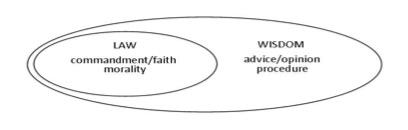
Wisdom is a larger category than law even as advice is larger than commandment. The accompanying diagram shows how the two classes compare. Advice vs. commandment, opinion vs. faith and fact, procedure vs. fundamental morality represent distinctions between the two types of material. Biblical examples of wisdom include Proverbs, Ecclesiastes, Song of Solomon, the Sermon on the Mount, James, and Jude. Wisdom literature often deals with degree matters and complex matters; that is, it deals with matters that are not always categorical or simple. Wisdom applies more to tendencies, patterns, and generalities.
For a fuller description of wisdom literature, see “Pitfalls in Interpretation: Confusing Advice and Commandment.”
As to structure, wisdom literature exemplifies a structure that contrasts with the ideal pattern of Western presentation. Western rhetoric wants to have parallel major headings with two or more supporting points and an overall presentation that moves to the
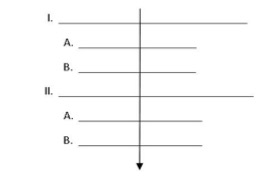
conclusion. As anyone can see from trying to “outline” biblical materials, this kind of system does not fit easily on most biblical writings—except perhaps in broad sweeps. It is artificial to their structure. What was not put in cannot be pulled out. Biblical materials—as well as most “Western” rhetoric—follows something more like a daisy pattern. A central theme acts as the principle of selectivity, and individual items become petals around the central purpose. The format is rather flexible, capable of loose or tighter arrangement.

The petals may or may not be in any order. They may not all deal with the same kind of material (history, doctrine, and practical—as in Galatians 1-2, 3-4, 5-6 respectively); there may be digressions. Not all the petals have to be the same size; some points may be treated more briefly or elaborated as desired. There may be cycles back and forth between doctrine and exhortation and doctrine again (Hebrews has this structure). The daisy format is more sermonic than didactic.
The difference between these two formats has implications for interpretation. For one thing, the daisy pattern reduces the decisiveness of near context; conclusions do not rest as firmly on what appears before and after. In the Book of Proverbs, for example, the individual nuggets of wisdom came about independently—out of a cohesive worldview, to be sure, but independently nevertheless. The sequence in which these aphorisms appear in the book does not reflect the author’s intentions as much as the compiler’s. They do not form a series of reasonings that lead toward a conclusion. The order of the beatitudes in Matthew 5 is probably not highly significant as judged by the different order and precise wording of the loose parallels in Luke 6:20-26.
**The reduced force of immediate context in wisdom literature affects the paragraphing of Matthew 5:31-32 in the Sermon on the Mount. Are Jesus’ divorce statements a separate entry, or do they fall within the context of his comments on adultery? The difference affects the Lord’s intent in divorce prohibition. Does he mean that spouses cannot use divorce as a technical way of avoiding adultery? They could divorce their spouse and marry the other person and be legally within bounds of Mosaic legislation in Deuteronomy 24:1-4; but Jesus said it was immoral even if it was legal (cp. Matthew 19:3-9). That puts divorcing someone for other reasons—verbal, physical, psychological abuse—outside the purview of his proscription. It leaves unaddressed such divorces followed a few years later by meeting someone and deciding to remarry.
G. Law
In its statements, law is more (1) restrictive than non-restrictive and more (2) literal more than figurative. (3) Silence has a greater relevance. (4) Law is more rigid than interpersonal and is distinct from the One/ones who speak through it.
H. Proverbs
Proverbs are free-standing statements. For that reason, they do not have much context by which to shape their meaning. Consequently, they state generalities or significant observations rather than absolutes.
I. Myth
History is an interpreted account; myth is a made-up account. Unrealistic elements are brought into the picture. It might be built up around a key event or person, but it is elaborated with unreal material. Myth states timeless, placeless truths; hence, it says little about people, places, actual events, dates, and other features of real occurrence.
christir.org