
Pitfalls in Interpretation: Allegorizing the Comparison
V. PITFALLS IN INTERPRETATION Virgil Warren, PhD
A. Allegorizing the comparison
The allegorizing problem applies to all expressions that make comparisons: similes, metaphors, parables, illustrations (vs. examples). Comparison does not mean likeness in every respect, but in the respects the speaker indicates. All comparisons relate figure and fact as overlapping circles. Some things about the figure do not apply to the fact. When hearers press the comparison to aspects outside the purpose of the illustration,
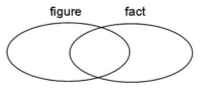
they abandon the speaker’s authority for claiming those likeness. They commit the equivalent of what in logic is called “the fallacy of four terms”; that is, the middle term does not refer to the same thing in both statements.
To avoid allegorizing, (a) a reader must understand the likeness only in respect to the speaker's point, and (b) not parallel an element that would contradict the flow of thought, the distant context, or the nature of the case.
Comparisons are used (a) for affective purposes, (b) for highlighting the aspect under discussion, (c) for working from the known to the unknown, (d) for aiding memory. Comparisons draw on the power of imagination. They illustrate rather than prove. In popular parlance, allegorizing the comparison is called “overdoing the comparison” and “making it walk on all fours.”
Melchizedek and Christ in Hebrews 7 and Hagar and Sarah in Galatians 4:21-31 are two biblical instances of illustration. The Hebrews 7 passage has been allegorized to say that since Melchizedek received tithes and Christ is after the order of Melchizedek, Christ also receives tithes!
**The Parable of the Unjust Judge (Luke 18:6) shows that not everything correlates between the story and the lesson; it would teach that God does not care about the plight of the poor and helpless.
**Jesus calls his disciples “friends” rather than “slaves” because a slave does not know what his master is doing (John 15:15); yet elsewhere his disciples freely call themselves “slaves of Jesus Christ” (Romans 1:1; Philippians 1:1; Titus 1:1; James 1:1; 2 Peter 1:1; Jude 1; Revelation 1:1; etc.). “You call me ‘Lord,’ and indeed I am” (John 13:13).
**A vessel cannot clean itself; yet after comparing honorable vessels and vessels for menial tasks (2 Timothy 2:20), Paul tells people to cleanse themselves. He appeals to the vessel figure so he can talk about cleaning containers, which Christians are comparable to as containers of the word. It would carry things too far to say that since a vessel cannot clean itself, a person has to be cleansed by another—perhaps by supernatural operation. But Paul does go ahead to talk about people cleansing themselves; he shows he did not have that feature of vessels in mind when he made the comparison.
**In the Parable of the Tares (Matthew 13:24-30, 36-43), the foreman tells the workers to gather up the tares first and burn them. Some have used the command as an argument against premillennialism, which pictures Christ’s coming to deliver his saints from the wicked, who are left in the world.
**Matthew 20:6 in the Parable of the Laborers in the Vineyard does not necessarily mean equal eternal reward for everyone. Jesus is showing that rank in earthly affairs does not correspond to status in eternity (see 20:16, 25-26; 21:16).
**Parable of the Prodigal Son (Luke 15:11-32) is used by those who believe in eternal security to say that the prodigal was his father’s son even in the far country. The allegorizing in this instance occurs between physical and spiritual sonship. Since physical sonship cannot be reversed, the inference is that spiritual sonship cannot be undone either. But while the prodigal was in the foreign country, he was “lost” (15:32). Besides, the parable pictures first-time lostness, not lostness after being “saved.”
**One traditional argument for paedobaptism comes from what Jesus says in Luke 18:15-17—that unless people accept the kingdom of God like little children, they cannot enter it.
**On the basis of the new-birth imagery in John 3, some have argued that a real, ontological change occurs in the person himself. They do not take the figure simply as a statement of new beginning with a continuity of identity despite new values, goals, relationships.
**“Only begotten” as a translation of John 1:14 does not argue for the createdness of Jesus and to deny his preexistence.
**The vine-branches imagery of John 15:1ff. should not be carried as far as observing that a vine is not always bearing fruit! That comment was actually made by a family that had left full-time service in ministry for a while. They needed no such justification for that hiatus.
**In Acts 1:18 the baptism in the Spirit is called an “outpouring.” Some, therefore, have argued that the baptism in water can be by pouring—affusion. A figure for one thing does not determine the form of another.
**Theologians use Paul’s four comparisons in Romans 9 to argue for unconditional election because some of the illustrations involve unconditionality. A person is as passive in salvation as clay is in a potter’s hand. Paul’s point is that people’s actions do not cause salvation, that is, reconciliation to God. It is not that a person can do nothing as a condition for God’s giving that result. (See What the Bible Says About Salvation, pp. 133-40.)
**It has been argued that church organization is adiaphoric because the body figure in 1 Corinthians 12 and other places does not include structure and authority flow. The body figure also should not be used to argue that God has chosen which job he wants each Christian to do—even though in designing the body he did specify, so to speak, the job of each organ. Paul’s point is that each part has a part to play, not that God has specified what part each person should play.
**In Paul’s Olive Tree Parable Paul speaks of grafting back into the tree what has already been trimmed out (Romans 11:23). That does not happen in grafting. Paul’s bringing such an idea into the presentation shows that an illustration can be “bent” to the point a speaker is making.
**Ephesians 2:1 (“death in trespasses and sins”) is often used to argue for the doctrine of natural depravity (What the Bible Says About Salvation, p. 51). The apostle’s point is that sinners are insensitive, not that they are insensible (minimum affirmation).
**Philippians 2:10-11 does not mean that heavenly beings and those of the nether world have knees (anthropomorphism).
**“The firstborn of all creation” (Colossians 1:15, cp. 1:18; Revelation 3:14) is allegorized to argue that Jesus Christ was a created being. The comparison is that the Christ is in charge of reality like an oldest son in Judaism was in charge of the family.
**The Hebrew writer in chapter 12 uses Proverbs 3:11-12 as a basis for encouraging his readers to treat suffering like parental discipline. That does not mean, however, that they should take a moralizing view of history, where every calamity indicates that God has intentionally sent it because of a sin the person has committed. Nevertheless, deliberate punishment on the basis of disobedience does characterize parental discipline in some respects.
**Theologians have argued for universalism because hell is called “punishment.” Since punishment can have remedial intent and is temporary, punishment in hell does not mean endless torment with no prospect for restoration. However, “capital punishment” does not imply remediation. The reason for calling hell punishment may be to speak of its suffering relative to sin. Other matters fall out of the picture.
**“Filling with the Spirit” should not be conceptualized as something that happens so as to get the human person out of himself. “Filling” is an impersonal figure for an interpersonal reality; so interpreters should not depersonalize what Paul means by it.
**The concept of double-fulfillment in interpreting prophecy is a form of allegorical interpretation; the “second” fulfillment is simply a comparison between the original meaning and something similar to the “first.”
**A non-substitutionary theory of the atonement regards substitution language as a model rather than a reality; consequently, it is a comparison like conquest terminology, of ransom imagery for the atonement work of Christ.. With this in mind, an interpreter is not denying that substitution language occurs, but is observing that certain aspects of substitution do not correspond with the reality; they are like scenery in a parable.
**One argument for infant baptism allegorizes the comparison between Old Covenant circumcision and New Covenant baptism without taking into account the differences between the natures of the covenants. (See What the Bible Says About Salvation, pp. 297-306.)
**The doctrine of soul sleeping is based largely on sleep as a euphemism for death. As someone asleep is unaware of the passage of time, so the dead are unconscious until the resurrection.
**The canon is like the wall around a city, so there can be suburbs!
**Are Paul’s appeals to the sequence of creation and fall with Adam and Eve used for illustrative purposes or proof purposes (1 Timothy 2:12-15)?
God is compared to certain persons like nurses who are female. That does not justify praying to him as she.
In order to associate female with the God of the Bible, readers have noted that he is compared to a nurse, etc., and inferred that female identity applies to him. The dozen or so cases in scri0pture where such comparisons occur, readers are carrying the comparison beyond the author’s intent in so doing and therefore lose his authority for any such claim about deity. We would not argue that there can be female apostles because Paul says to the Galatians that he is having birth pangs till Christ is formed in them (Galatians 4:19). A group of men originally evangelized the Thessalonians even though Paul says, “We were gentle among you like a nurse cherishes her children” (1 Thessalonians 1:8). God does not have feathers just because Jesus says he would have gathered the people of Jerusalem under his wings, but they would not do it (Matthew 23:37).
Allegory has been repeatedly used to “save the day” when someone’s beliefs need some authoritative basis. The Greeks used allegory to make ancient religious thought compatible with new historical and philosophical traditions. Philo used it to make the Old Testament compatible with the Greek philosophy. Ancient Christians used it to make the Old Testament compatible with their new faith in Jesus as the Messiah. Gnostics used allegory to bend biblical revelation in the direction of their philosophical speculations. Modern Christians use it to harmonize biblical teaching with the current views of the scientific community. Modern Muslims use it to harmonize the Koran with modern scientific knowledge. People try to substantiate many false and doubtful views in this fashion.
There is little boundary on what people can get out of the scripture this way. Allegorizing comparisons is not exegesis, but a kind of eisegesis; they read their own ideas into the scripture’s wording.
christir.org