
Hermeneutics and Life
VII. HERMENEUTICS AND LIFE Virgil Warren, PhD
A. The process of hermeneutics and life [understanding the biblical message]
1. Goal: to find out what the scripture means by experiencing what it says; do it to understand it.
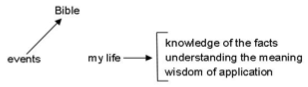
Passages take on a liveliness and relevance because of experiences we face. Meaning is not just objective significance, but subjective impact. The two correspond as to content, but the impact comes from the doing. Understanding through interpretation (validity) leads to belief (truth) and obedience (commitment), which turns around and clarifies the understanding. As reciprocation occurs between parts and whole in biblical-systematic interpretation, so also reciprocation occurs between text and experience.
Sometimes the brazen reality of experience is what forces us to reread the Bible in light of that experience. An interesting comment on this phenomenon appeared in Verdict, p. 14, Essay 26 in l987:
“. . . it is a foolish myth to think that theologians make progress simply by acquiring new insights from the Bible. They, as well as the entire church, cling to their ridiculous traditions until the force of circumstances forces them to modify or relinquish their theology. They then take another look at the Bible and begin to see things they had never seen before.”
Experience forces us to understand one truth in connection with other truths. The complexity of life turns understanding into an art through application. It is art because relative importance and combined interaction enter the picture.
2. Method of study
We carry out what we already know to get a “feel” for the knowledge (Colossians 1:9b-10; 2 Peter 1:5-9). We carry out what we hear in scripture as a way to understand better what it reveals; scripture is real rather than ideal, historical rather than metaphysical, experiential more than conceptual. The idea is to read scripture for self-application rather than for information, teaching other people, or for measuring other people. “Knowledge un-used is ‘useless.’”
Another aspect of this method of study is to hide the word in our heart and mind, to refresh our minds and hearts from time to time so the impact of passages can resurrect in us when experience returns them to the surface and “exegetes” them for us. We hide God’s word in our hearts that we may not sin against him (Psalm 119:10).
3. Cautions
a. Not all aspects of Christian truth can profit from this approach because
they are not all experiential.
b. We must take care not to make experience rather than scripture the basis
of belief instead of an avenue to understanding it.
B. The structure of the Bible and the nature of Christianity (recognizing truth in it)
1. Structure of the Bible
The Bible is organized around history rather than ideas. Its doctrinal elements are presented in the service of practical needs. Scripture is a problem-solution presentation; specific situations called forth its content. It is not arranged topically with all its material about one subject in one place. We may discover in several places information about each subject, so we have to combine from various events the contributions to every subject.
2. Method of study
We can ask a question and then read for answers to it. We can use a problem-solution method to study a problem-solution book. When we study the Bible in connection with its practical use, our method determines our results, establishes its center, and shows us how to approach the subject in our life and ministry. Studying the Bible is more real than studying a text on logic, geometry, mathematics, or philosophy.
An example of what we might ask and read to answer is, “How can I handle suffering?” We find material in 1 Peter, 2 Corinthians, and Hebrews 11-12 especially helpful. We might ask what the criteria are for good leadership and profit from seeing how Paul dealt with challenges to his leadership among the Corinthians (2 Corinthians 10-13). “What are the criteria for greatness?” finds answer in Matthew 18.
3. Cautions
a. Scripture may not deal with every question we might ask; so we do not force it to speak to our concerns.
b. Asking a question and reading for answers can supply a context that skews words and statements in ways the author did not intend. For example, Romans 8:26 says, “We do not know how to pray as we ought, but the Spirit makes intercession for us with groanings that cannot be uttered.” If we ask, “How can I know what to ask for?” we get one answer: “What is taken care of by the Spirit.” If we ask, “How does God understand when I do not know how to say what I am feeling?” we get another answer: “How is taken care of by the Spirit.”
C. The structure of truth
1. Wholeness
In reality, parts do not precede the whole or the whole precede the parts. In logical analysis, we come to understand the whole as parts lead to the whole.
2. Method of study
We should study large portions of the Bible at a time and “live with the text” by reading it over and over. Memorizing it allows us to “meditate on it day and night” (Psalm 1:2). By so doing, we analyze and synthesize at the same time, because we move broadly enough to expose ourselves to the whole while passing through the parts. The process is akin to the way we learned our language. We heard the total expression and got pieces here and there that we continually adjusted from previous approximation to more refined understanding.
christir.org