
Greek Helps in New Testament Interpretation
GREEK HELPS IN NEW TESTAMENT INTERPRETATION
Virgil Warren, PhD
In general, Greek raises possibilities of interpretation we would not think from the English wording. Sometimes the Greek eliminates ideas the English wording might suggest. The Greek helps us understand why translations differ at certain points, and alerts us to ambiguities in the original text so we do not get dogmatic about a certain idea in the passage. Greek awareness enables us to use study tools like Greek concordance, lexicons, and commentaries that discuss the original text.
Typical Sources of Difficulty in the Greek New Testament
1. Second person plural indicative vs. imperative. These two Greek forms are always the same in any given voice and tense. (a) You cannot always tell whether the speaker is telling them something or telling them to do something. Likewise, (b) you cannot always tell whether the speaker is asking a question that anticipates a negative response (μὴ δοκεῖτε, “you are not supposing, are you”) or giving a prohibition (μὴ δοκεῖτε, “do not suppose”).
2. Punctuation differences. The oldest Greek uncial manuscripts were written in all capitals and did not indicate punctuation; consequently, (a) situations arise where full stops could be placed at different points in the statement or where comma and semi-colon could suggest different thought associations between parts of the sentence.
(b) Paragraphing problems come up where editors must decide whether to insert a paragraph break or where such a break should occur.
(c) Without punctuation, readers cannot always distinguish questions from statements. (See below a list of such passages.) They cannot tell a statement from a question unless there are (a) interrogative words preceding, or (b) the question involves a negative with the indicative, in which case μὴ shows there is a question anticipating a negative response. An indirect question can usually be identified by the interrogative character of the main clause.
Another typical problem is where direct quotations end because no quotation marks appear in the original, unedited text.
On some occasions, editors must decide whether the text should read ὅτι or ὅ τι. Ὅτι can also be an issue as to whether it introduces indirect discourse or means “because.”
3. Participles. Circumstantial participles can cover for such a wide variety of adverbial ideas, and Greek writers loved to use them. Participles can cover for time, means, manner, cause, condition, concession, attendant circumstance, purpose, result, co-ordinate circumstance. It is sometimes unclear also whether nominative participles that appear near same-number linking verbs are periphrastics or separate entries in the sentence. Periphrastic participle constructions can be unclear as to whether the elements should be taken as separate items.
4. Genitive case. The genitive case in Greek serves to tie one noun grammatically to another noun. How their referents really relate must be determined from the nature of the case, which may leave two or more options in some cases. If the phrase-head noun refers to an action, a typical problem is whether the associated genitive noun is the subject of that action (subjective genitive) or the object of it (objective genitive).
5. Manuscript variants. A number of textual variants occur in the text of the New Testament. Often, they cause significant differences in the content of the statement. Ἡμῶν (our) and ὑμῶν (your) are often confused.
6. Article. The rules that govern the Greek article are sufficiently different from the rules for the English articles that translators and students end up making different judgments about their presence or absence in given cases.
7. Vocabulary. In many instances interpreters have different opinions as to the meaning of individual vocabulary words. This both leads to, and derives from, overall theological stances, which form a context for judgments. (a) Whether ὅτι means “because” or “that” is sometimes unclear because it can introduce an indirect discourse segment or an adverbial clause (combines with lack of punctuation and lack of lower/higher case letters). (b) Ἐν can mean “in,” “among,” “in the manner of,” and conceivably “by.” (c) Ἑαυτῶν can be a reciprocal or reflexive pronoun.
8. Middle and passive voice. In the present, imperfect, present perfect, and pluperfect tenses, the middle and passive voices are the same for a given person and number.
9. Verb aspects. The present and imperfect tenses can cover characteristic, iterative, tendential/conative, progressive, continuous, timeless, and simple action. The future can be progressive, characteristic, or simple action. The imperfect can be ingressive action. The aorist can be simple, gnomic, ingressive for statives, etc.
10. Gender. Declensions cross each other as to what ending signals feminine or masculine at times, which can make it unclear with names, for example, whether a man or woman is indicated.
11. Capitalization. Greek uncial manuscripts were written in all capital letters. Consequently, there are occasions when the editor does not know whether the writer meant a proper noun or common one. The word is frequently unclear as to whether it should be capitalized in reference to the Holy Spirit, the human spirit, or one of the other several applications of the term.
12. First person singular indicative vs. subjunctive. The form of the first singular indicative and subjunctive are the same in the present, and they are the same for the future indicative and aorist subjunctive with regular verbs.
In addition to these brief notations on specific passages, we recommend consulting herein The Conversational Version: Translation Notes for the New Testament as well as The Conversational Version: Translation Notes for the Old Testament and the essays under Hermeneutics: Getting the Point.
Question/Statement Passages
Matthew
16:2-3
22:17a
23:37
24:3
25:26
26:45, 50, 55, 62a, 64a
27:11b, 42
Mark
2:16
4:21b?, 28
(7:18-19)
9:11, 28
13:4
14:41, 48, 64a, 68
15:2c, 31
Luke
4:34, 36
11:13
12:49-50
13:34
17:18
19:22
20:2
22:52, 70
23:3
John
4:48
7:28
8:25
12:19, 27
14:2
16:32
18:37
20:29
Acts
2:11?
5:4?
9:21b?, 22-23
10:29?
23:9?
Romans
2:23
8:33, 34
11:2-3, 12, 24
1 Corinthians
1:13a
5:2, 12b, 13a
6:4
12:15, 16
2 Corinthians
10:7
11:8
12:19
Galatians
4:10
Hebrews
9:14, 17
10:2, 29
James
2:1, 18, 19, 22
4:5 ± quotation; 4:15?
5:6b
2 Peter
3:11-12
MAJOR TEXTUAL VARIANTS
Matthew 6:13 omit: The Conclusion to The Lord’s Prayer
ὅτι σοῦ ἐστιν ἡ βασιλεία καὶ ἡ δύναμις καἰ ἡ δόξα εἰς τοὐς αἰῶνας. ἀμήν.
“ . . . because your is the kingdom and the power and the glory forever. Amen.”
Matthew 17:21 omit: Formula for Exorcism
Τοῦτο δὲ τὸ γένος οὐκ ἐκπορεύεται εἰ μὴ ἐν προσευχῇ καὶ νηστείᾳ.
“This kind does not come out except by prayer and fasting.”
Matthew 21:44 omit: Καὶ ὁ πεσὸν ἐπὶ τὸν λίθον τοῦτον συνθλασθήσεται. ἐφ’ ὃν δ’ ἄν πέσῃ λικμήσει αὐτόν.
“And the one that falls on this rock will be bruised, but on whom it falls he will be crushed.”
Matthew 27:49b omit: ἄλλος δὲ λαβὼν λόγχην ἔνυξεν αὐτοῦ τὴν πλευράν, καὶ ἐξῆλθεν ὕδωρ καὶ αἷμα. < John 19:34
“But another, taking a lance, pierced his side, and water and blood came out.”
Mark 15:28 omit: καὶ ἐπληρώθη ἡ γραφὴ ἡ λέγουσα, Καὶ μετὰ ἀνόμων ἐλογίσθη.
“And the scripture was fulfilled that said, ‘And he was numbered with transgressors.’”
Mark 16:9-20 omit: The Longer Ending
Luke 9:55b-56 omit: . . . καὶ εἶπεν, Οὐκ οἴδατε ποίου πνεύματός ἐστε ὑμεῖς. 56ὁ γὰρ υἱὸς τοῦ ἀνθρώπου οὐκ ἦλθεν ψυχὰς ἀνθρώπων ἀπολέσαι ἀλλὰ σῶσαι.
“ . . . and he said, ‘You do not know what spirit you are of. For the Son of man did not come to destroy lives but to save (them.’”
Luke 23:34a omit: ὁ δὲ Ἰησοῦς ἔλεγεν, Πάτερ. ἄφες αὐτοῖς, οὐ γὰρ οἴδασιν τί ποιοῦσιν.
“And Jesus said, ‘Father, forgive them because they do not know what they are doing.’”
John 5:3b-4 omit: ξηρῶν ἐκδεχομένων τὴν τοῦ ὕδατος κίνης. ἄγγέλοςγὰρ κυρίου κατὰ καιρὸν ἐλουετο ἐν τῇ κολθμβήθρα καὶ ἐτάρσσε τὸ ὕδωρ. ὁ οὖν πρῶτος ἐμβὰς μετὰ τὴν ταραχὴν τοῦ ὕδατος ὑγιὴς ἐγίνετο οἵῳ δήποτ’ οὖν κατείχετο νοσήματι.
“Waiting for the moving of the water, because an angel of the Lord came down at certain times into the pool and stirred the water; whoever then first after the stirring of the water stepped in was cured from whatever disease he has.”
John 7:53-8:11 omit: The Woman Taken in Adultery
Acts 8:37 omit: εἶπεν δἐ αὐτῷ, Εἰ πιστεύεις έξ ὅλης καρδίας σου, ἔξιστιν. ἀποκριθεἰς δἐ εἶπε, Πιστεύω τὀν υἱὀν τοῦ εἶναι Ίησοῦν Χριστὀν.
“‘And he said, ‘If you believe with all you heart, it can happen.’ And he, answering, said, ‘I believe that Jesus Christ is the Son of God.’”
1 John 5:7-8: The Three Witnesses Passage
THE GREEK IN INDIVIDUAL PASSAGES
Matthew 1:16 syntax
“Jacob was father of Joseph, the husband of Mary of whom Jesus, who is called Christ, was born.”
Is the antecedent of whom supposed to be Mary or Joseph? The antecedent is Mary because the Greek reads ἐξ ᾗς. Consequently, Matthew is not claiming that Joseph was the father of Jesus. The rest of this context and the account in Luke’s gospel make that clear.
Matthew 1:25
To counter belief in the perpetual virginity of Mary, interpreters often appeal to “until” (ἕως οὗ) in this verse to show by implication that the couple subsequently had sexual relations and that the four brothers and at least three sisters were the result (Matthew 13:55-56). Till, however, may appear in the text only to reinforce the fact that Jesus was virgin born without necessarily implying that sexual relations began thereafter. Isaiah 42:4 says, “He will not fail or be discouraged till he has set justice in the earth.” Luke 27:8 says, “Wherefore it is called the Field of Blood [Aceldama] to today” διὸ ἐκλήθη ὁ Ἀγρὸς Αἵματος ἕως τῆς σήμερον. Till could be influenced by the possible meanings of עד in Hebrew. עד does not necessarily imply that the action not occurring before it does then occur after it. That may follow English idiom, but not necessarily Greek idiom under Hebrew influence.
The evidence for the perpetual virginity of Mary needs to be shown because nothing in the biblical record suggests it. It arises instead from Greek philosophical influence on the subapostolic church. According to Greek dualism, the material world and its desires were to be depreciated (rather than managed). The seven children referenced in Matthew 13 have become Joseph’s by a previous marriage to a wife who had died. If that were the case, how does that sizable group of siblings figure into the trip to Bethlehem, where Jesus was born, and the following couple years perhaps before the holy family returned from Egypt and eventually made it back to Nazareth?
Matthew 2:18 idiom
“[Rachel] would not be comforted because they were not.”
This English wording might suggest adding “comforted,” but the linking verb in Greek does not serve as a pro-verb, as in “they were not [comforted].” The import rather is “they were not [alive]” any longer.
Matthew 3:3 genitive value
Φωνὴ βοῶντος means “voice of-one-crying,” not “voice of-crying.” The latter would be an infinitive. Compare John 10:21, “These are not the words of one-demon-possessed [δαιμονιζομένου].”
Matthew 3:11 force of ὲν
Is there a difference between baptizing ὲν plus dative vs plain dative? See notes on Mark 1:8.
Matthew 3:16 vocabulary
What does μακάριοι mean? Does it mean “blessed,” “fortunate,” or “happy”?
Matthew 5:3 syntax
Μακάριοι οἰ πτωχοὶ τῷ πνεύματι.
(1) “Blessed are the poor in spirit.”
(2) “Blessed in the spirit [spiritually] are the poor.”
The location of the phrase is after “poor,” not “blessed.”
The parallel construction in 5:8 is μακάριοι οἱ καθαροὶ τῇ καρδίᾳ: “Blessed (are) the pure in heart.” “Blessed in [the] heart (are) the pure” may not make a likely statement. But “poor in heart” sounds too close to “meek,” or “gentle” in 5:5. In the other direction, note that “Blessed spiritually are the poor” matches Luke 6:20 rather well, “Blessed are you that are poor.”
Matthew 5:22 textual problem
The presence or absence of εὶκῇ (“without cause,” “for no reason”). The difference may affect the understanding of the acceptable range for anger sense and expression. Compare “not letting the sun go down on your anger” (Ephesians 4:26).
Matthew 5:32 aorist tense
Ποιεῖ αὐτὴν μοιχευθῆναι
Sometimes it is argued that the aorist infinitive means adultery is the case the first time but not thereafter because an aorist infinitive is used (See “Divorce” study in the Matthew 5-7 materials on the Sermon on the Mount). But aorist does not mean the real action is not a process; it means simply that the speaker is referring to the action as a fact and is not following it along with his mind’s eye (as with the imperfect tense).
Matthew 5:32 vocabulary
What is the reason for the passive form μοιχάομαι?
Does ποιέω mean “treat” or “cause”? In combination does the statement mean
(1) that the divorcing husband treats her like an adulteress by divorcing her, or
(2) that the divorcing husband causes her to be an adulteress by forcing her for practical reasons (a to adopt a life of prostitution, or (b) to remarry to support herself, and remarrying is tantamount to adultery in the theory of things?
It is difficult to see how one person can make another immoral. That she would have to become a prostitute to survive does not seem to be her only option. Returning to her parents’ house might be another option depending on the situation.
The import of the clause is best seen as his “treating her like an adulteress” because that is the reason Jesus just gave for divorce. Compare “he makes God a liar” (1 John 1:10), as “treat him like a liar.”
Matthew 5:37 article/gender
Does ὲκ τοῦ πονηροῦ mean “from the evil one” or “from evil”? The text here can be taken in the abstract. Other passages containing the expression are Matthew 5:39; 6:13; 13:19; John 17:15; Ephesians 6:16; 2 Thessalonians 3:3; 1 John 2:13-14; 3:12; 5:18-19.
Matthew 5:39 sounds like a general reference to anyone that is evil.
Matthew 6:13 is ambiguous.
The underlined passages seem better taken as references to the devil and his influence.
This first alternative takes it as a masculine substantive on the analogy of Matthew 13:19, “the evil one comes and snatches it away”; note also the evil one in Matthew 5:37; 13:38; John 17:15; Ephesians 6:16 (“the flaming arrows from the evil one”), 2 Thessalonians 3:3.
1 John 5:18-20 makes it clear that the phrase means “the evil one” rather the “evil,” because the text goes on to say that the whole world lies in “the evil one.” We would not expect the text to say that the whole world lies in “evil.” Besides, the passage goes on to contrast the world with us who lie in “the true one.”
Matthew 5:48
Could “be perfect” be a tendential future: “Let being perfect be your goal”?
Matthew 6:11 vocabulary
“Give us today our daily [ὲπούσιον] bread/food.” Could it mean necessary bread as in the food we need for today? The Greek term does not occur outside the New Testament. Cp. Luke 11:13.
Matthew 6:13 textual issue
Does the conclusion belong on the model prayer: “For yours is the kingdom and the power and the glory forever. Amen”?
The difference lies in the manuscripts behind the Latin Vulgate vs. the Textus Receptus from which they translated the King James Version. The difference does not come from some doctrinal difference.
Matthew 6:27 vocabulary
“. . . to add one measure [πῆχυν] to his life span/height [ἡλικία].”
Luke 19:3 uses the word to mean small in stature. Zacchaeus got up in a tree because he was short, not because he was young.
Matthew 11:12 voice
“From the days of John the Baptist until now, the kingdom of heaven
(1) is suffering violence and violent people are seizing it (middle)”;
(2) is being forced” (passive).
Jesus means that people who are expecting an earthly, political kingdom are straining to bring it in by military means. They anticipate a Messianic enterprise that brings about that very thing, and they are ready to join in to free the country from Roman control.
Matthew 13:32 comparative
degree adjective
A mustard seed is “smaller” than all the seeds. In the New Testament, the comparative degree is frequently used in place of the superlative degree on adjectives. There may be seeds that are smaller than a mustard seed, but Jesus evidently has in mind seeds that are planted in a garden. Besides, the adjective can carry an elative value, that is, quite small or very small. The main point is a comparison between the size of the seed and the plant it produces.
Matthew 13:56 syntax
“ . . . and his sisters, are they not all [feminine] with us?”
(1) Is all feminine because Jesus had at least three sisters in addition to the four brothers that are named?
(2) Is all feminine because the nearest antecedent is feminine, and all as an adjective cannot be both masculine and feminine so as to cover both brothers and sisters?
So two principles are at odds with each other here: (1) the use of masculine for mixed reference and (2) forming an adjective according to the nearest antecedent. But that issue can be set aside because we doubt that a feminine adjective would cover a mixed group even if it were the nearest antecedent; masculine takes preference.
Matthew 16:18 syntax
“You are Peter [Πέτρος], and on this rock [πέτρα] I will build my church.”
Is the antecedent of “this rock” (1) the content of the confession, (2) Peter, or (3) Jesus?
Taking the
antecedent as the content of the confession (grammatically) is best
because it stands in third person reference—vs. “I” (Jesus) or “you”
(Peter). If we maintain our
CIR custom of using “that” for aforesaid demonstrative in English (rather than
“this” for to-be-said), the statement becomes, “I’ll build my church on that
rock.”
Obviously, there is a play on Peter’s name, something like, “As sure as you are Peter, I will build my church on the fact that I am the Messiah.” Adding in the difference between πέτρος and πέτρα when distinguished, we gain the feature ledge rock (πέτρα) over and above detached rock (πέτρος), Peter. The ledge-rock value recalls 1 Corinthians 10:4, where Christ/Messiah is the rock. Matthew 7:24 has the wise builder putting his house on ledge rock.
Aside from syntactical considerations, Jesus as the antecedent would make the point something like 1 Corinthians 3:11 (theologically): “No other foundation can be laid than what is laid.”
Peter as antecedent would make a point similar to Ephesians 2:20, where Paul speaks of the church as built on the apostles and prophets (historically). Peter was the most prominent personality among the original twelve (primus inter pares), although it is questionable whether he would eclipse Paul, who was added later, “I labored more abundantly than all of them” (1 Corinthians 15:10). Paul’s comment references Peter/Cephas, the twelve, the Lord’s brother, as well as all those to whom Jesus appeared after his resurrection. Besides, Paul comes off as the more articulate apostle on theological matters. He corrects Peter in Antioch (Galatians 2:11-21). In 2 Peter 3:15-16, Peter seems to acknowledge Paul’s greater acumen in theological understanding. Historically speaking, Paul has left more written testimony on doctrinal matters, and he worked more abundantly in regions that had a more enduring witness to Christ, especially after A.D. 70, when the Romans destroyed Palestine.
In this reconstruction we may also note that καί simply joins two things, which for conceptual reasons are viewed as facing each other (καί) rather than facing forward together (δέ) or standing back-to-back (ἀλλά). Καί can even join realities that are by nature adversative, in effect covering “but.” Examples include Matthew 1:19; 11:19; Mark 12:12; Luke 2:51; 4:26; 9:40; 10:24; 11:29, 42, 46; 12:21, 40, 47; 13:6, 27, 35; 15:29; 17:22; 18:2, 19:40; 20:19; 21:19; John 7:30; 16:32; 17:11; 20:14; Acts 7:5, 9, 53; 9:26; 10:28; 16:7; 22:22; 1 Corinthians 12:5; Revelation 1:3; 3:1; 9:21; 12:14, 16. So, and does not say anything about the degree of close association or likeness between items before it and after it, that is, here between “Peter” and “this rock.”
Readers might note “Did Jesus Speak Greek?” Biblical Archaeological Review (XIX:3); May 1993, pp. 18ff.
Matthew 16:19 future perfect passive
What is bound and loosed? Is the meaning “will have been bound/loosed” or “will stand bound/loosed”?
Under the first option, Peter should bind and loose on earth what has already been bound or loosed in heaven. He is to be faithful in preaching what he has received. Jesus would give Peter the keys (Matthew 16:19) he was to use; he was not commissioned to make up his own keys.
Under the second option, the point is that God will stand by Peter’s proclamation, with the understanding, of course, that his message did come from heaven in the first place. God sticks by his people when they stick by his will. The idea that Peter could originate matters of faith and practice is not involved here even under the first option.
The apostles’ work was to have the opposite effect of what the Pharisees had been doing: “shutting up the kingdom of heaven” by what they taught and enjoined (Matthew 23:13).
Does the binding and loosing mean authoritative enactment on his own or gospel proclamation of what he received? God has never turned over to men the constructing of doctrines or setting up rules and regulations. Jesus cites Isaiah 29:13 as a rebuff of those who teach as doctrines the commandments of men (Mark 7:7). Paul made a point of telling the Galatians that what he preached he did not figure out on his own or get from other people; it came to him as revelation from Jesus Christ (Galatians 1:12). No prophecy in the scriptural sense came about from men’s deciding to say this or that; instead, they spoke from God as moved by the Holy Spirit (2 Peter 1:21). The church did not originate the New Covenant; its leaders and people are caretakers of what they received.
The binding (δέω) as locking comes from proclamation, and the loosing (λύω) as unblocking comes from preaching the gospel. By rejecting the message, people have sins bound on them. By accepting it, they have their sins loosed. Those who do the proclaiming set up that situation.
Kindred passages are Matthew 16:18-19; 18:18; and John 20:23.
Matthew 17:21 textual question
“This kind does not go out except by prayer [and fasting].”
The preferred reading in the UBS 5th rev ed omits the whole verse.
The bracketed element is omitted from newer translation because it does not have the best manuscript support.
Several cases in the New Testament involve the combination “prayer and fasting”: Matthew 12:21* = Mark 9:29; Luke 2:37; Acts 13:3; 14:23; and 1 Corinthians 7:5*. Asterisks indicate passages with textual issues.
Matthew 18:22 translation
Does the wording mean 70 x 7 (= 490) or 77 times?
Obviously, Jesus meant not to put a set number on the times for forgiving someone. Either rendering would get that across. In contrasting with Peter’s number seven times, Jesus is playing on the numbers in Genesis 4:24 (note 4:15). There Lamech contrasts Cain’s being avenged sevenfold with his own seventy-sevenfold.
The frequentative suffix -άκις attaches to the seventy, and the seven appears as a separate word. It takes two words to say seventy-seven in Greek. Presumably 490 would call for attaching -άκις to both Greek words, so to speak, seventy times seven times rather than the first multiplied by the second as English wording seventy times seven would suggest.
Matthew 21:7 pronoun reference
ἤγαγον τὴν ὄνον καὶ τὸν πῶλον καὶ ἐπέθησαν ἐπ’ αὐτῶν τὰ ἱμάτια, καὶ ἐπεκάθισεν ἐπάνω αὐτῶν
“They brought the donkey and colt, and put their garments on them, and he sat on them.”
Did Jesus sit on the two donkeys or on the garments?
The genitive plural form for all three genders is the same: αὐτῶν. So as respects grammar, “they” could refer to the two donkeys (one feminine, the other masculine) or to the garments (neuter plural).
(a) The nearest antecedent is “garments.”
(b) There would be no reason for Jesus to ride both donkeys at the same time even if that was possible. The mother and colt may have been different sizes, which would make it hard to do even as a circus act.
(c) “And” in 21:5 (< Zechariah 9:9) can mean “even.” The same goes for וin the Hebrew that Matthew quotes.
Matthew 21:42 antecedent
“This [αὕτη] is from the Lord.”
The English reading can sound like the rejecting by the builders is from the Lord, that is, it’s okay with the Lord. “This,” however, is feminine gender, which links it to the phrase-head feminine antecedent: “the head of the corner” [κεφαλὴν γωνίας]. It is the “head of the corner” that is marvelous to see.
Matthew 23:35 textual variant
The quotation comes from 2 Chronicles 24:20-22. A textual corruption has occurred in Matthew’s account since Zechariah “son of Barachiah” would indicate one of the minor prophets (Zechariah 1:1), whose manner of death is not recorded. Luke’s parallel account of the statement (11:50) omits the words son of Barachiah. The text of Matthew in Codex Sinaiticus firsthand omits the phrase, as also do some ancient evangelisteria and Eusebius (twice). Originally, Matthew probably read, “ . . . from the blood of Abel the righteous to the blood of Zachariah, whom you killed between the sanctuary and altar.” Jesus’ comment covers the first to last murder in the Hebrew Old Testament, which puts Genesis first and 2 Chronicles in final position.
Matthew 24:5 direct vs. indirect discourse
Πολλοὶ γὰρ ἐλεὐσονται ἐπἰ τῷ ὀνόματί μου λέγοντες, Ἐγώ εἰμι ὁ χριστός, καὶ πολλοὺς πλανήσουσιν.
(1) The standard reading of the text considers “I am the Christ” as something individuals will be claiming—that they were the Messiah. As such, it is a statement of direct discourse, the quotation of purported words.
(2) Herbert Armstrong read the text as if the clause in question was indirect discourse, inferring that those who come will indeed be agreeing that Jesus of Nazareth is the Messiah, but will deceive many people in their message about him. This interpretation would be possible from an English translation that omits quotation marks because English can omit the sign of indirect discourse (“that”). Greek, however, does not omit the sign of indirect discourse if followed by a finite-verb construction like here (rather than an infinitive or participle construction). Consequently, the proposed interpretation is not possible, whatever may be said about the idea itself.
Matthew 24:14 reference
Readers often understand this verse to mean that the gospel will be proclaimed all over the world before the Lord’s return. So, as that program nears completion, we can have greater anticipation of his coming soon.
The immediate context, however, is talking about the fall of Jerusalem and the end of the Jewish state in A.D. 70. The word refers to the then-known world, or more particularly the territory around the Mediterranean Sea, the Roman empire: οἰκουμένη. By the time Jerusalem fell, the gospel had already circulated over that area enough for Colossians 1:5-6 to say, “the truth of the gospel that has come to you like it has in all the world [κόσμος]”; likewise, Colossians 1:23, “the gospel, which was preached in all creation under heaven” [κτίσις]. Those words came from Paul during his Roman imprisonment, which would have been in the early 60’s.
The reason the prediction about preaching the gospel all over the empire is significant, is that Jesus’ Messianic movement would not be just another fly-by-night movement. It relates to Gamaliel’s observation that what was happening with Jesus’ followers was not following the pattern of movements led previously by Theudas and Judas (Acts 5:33-39), who were evidently Messianic claimants. With the death of those leaders, the movements disintegrated. That is what we would expect with a person-centered system like Messianism: remove the person, and the system falls apart. But with the crucifixion of Jesus, his movement was spreading even more, a difference conceivably explained by his resurrection.
Matthew 24:15 capitalization
ἑστὸς ἐν τόπῳ ἁγίῳ
Does it mean (1) “standing in (the) holy place,” as in Palestine or in the city of Jerusalem, or does it mean more specifically “standing in (the) Holy Place,” the sanctuary (Holy of Holies) either before or after the Romans demolished it?
The text goes on to tell the people in Judaea to flee to the mountains (24:16). It would be too late to flee anywhere if they waited till the Romans were standing in the Holy of Holies after advancing into the city. The same could be said about the beginning of the siege of the city. So understanding the “holy place” as a reference to the land may be the best option. When the Romans entered the Holy Land in A.D. 66, the forewarned disciples would have opportunity to flee.
Matthew 24:33 implied subject
Γινώσκετε ὅτι ἐγγύς ἐστιν ἐπὶ θύραις
(1) “(you) know that he is near at the doors” [the Son of man, 24:30]
(2) “(you) know that it [24:14, the end, the coming of the Son of man, the kingdom] is near, at the doors.”
The first option connects Jesus’ prediction with his personal return.
The second option connects his prediction with what will happen within their own generation (24:34). The it would be the end of the Jewish state historically with the spiritual kingdom of the Messiah being near to replace it.
Matthew 24:33 imperative/indicative
“When you see these things, (you) know that he/it-is near, at the doors.”
First, is the verb indicative or imperative? The forms for both moods are the same. The fact that Jesus does not use the future tense may favor the imperative, although a futuristic present might also be possible.
(1) His return was not during their lifetime.
(2) Jesus is speaking to his disciples as if they would see that he/it was at the doors, though the reference could be taken advisedly to mean whoever is alive at the time involved.
(3) The fall of Jerusalem forty years later would be something they could live to see; they would be about sixty or seventy by then. They could at least see the preceding developments that Jesus was pointing out as leading up to the fall of Jerusalem: “all these things,” matters that would happen in “this generation.”
(4) The preceding verse uses the spring sprouting of a fig tree before summer for comparison to Jesus’ reference. So the emphasis seems to fall on what would happen more than on who was involved in it.
Matthew 24:36 textual variant
extra phrase: “not even the son” or “neither the son”
The phrase does not appear in a number of textual witnesses.
Matthew 24:36 vocabulary/reading
Περὶ τῆς ἡμέρας ἐκείνης καὶ ὥρας
(1) “ . . . but concerning that day and hour no one knows.”
(2) “ . . . but concerning that day and hour no one knows.”
Stressing “that” connects the present statement with the more distant reference (24:29-31), a reference to the second coming rather than to the subject addressed in the immediate verses (24:32-35). The similarity of Messianic claimants arising ties the two events together and leads to the warning not to be deceived by them. Claims are false just before the destruction of the city because God was not going to deliver it. The claims would be false before Christ’s actual return because it will be visible to everyone (24:30; Revelation 1:7). Liddle & Scott, Greek-English Lexicon, p. 447 under ΕΚΕΙΝΟΣ indicates that in Attic usage, distant time does not reside in the meaning of the word itself.
Matthew 26:22, 25 syntax
Μή with a question anticipates a negative response, “I’m not the one, am I?” So the words do not ask an informational question as in, “Am I the one?” Cp. Mark 14:19.
Matthew 26:27 antecedent
“All of you drink from it.” The cup (ποτήριον) is indicated in the previous part of the verse; so we assume “it” (αὐτοῦ) is neuter to connect up with ποτήριον. Less likely is that “it” indicates by metonymy the contents of the cup, the “wine” (οῖνος), which is masculine, making “it” masculine also. The form of the pronoun would be the same in either gender. They drank from the same cup, however uninviting that seems to modern sensitivities. Using actual wine would have tended to allay concerns about germs.
The accounts of institution have Jesus taking a cup; so it should be clear that it was circulated among the apostles assembled. In 1 Corinthians 1:17 Paul ties a symbolic significance to the one loaf. Most naturally that symbolism would apply to the cup as well.
Matthew 26:41 grammar
Προσεύχεσθε ἵνα μὴ εἰσέλθητε εἰς πειρασμόν.
(1) “Pray as a safeguard against temptation [why pray].”
“Pray lest you fall into temptation.” fear clause
“Pray in order that you not fall into temptation.” negative purpose clause
(2) “Pray for temptation not to come” [what to pray]. indirect discourse
Pray (in order) that you do not fall into temptation seems the best option because it covers or implies the others.
Matthew 26:45 statement/question
(1) “Sleep a little and rest. Behold, the hour has come for the Son of man . . . .”
(2) “Are you sleeping a little and resting? The hour has come for the Son of man . . . .”
The next comment does not seem to fit a command to go on and sleep some more unless it was said in irony, or an unnoted period of time passed between the two statements.
Matthew 27:11 meaning of an idiom
“Thou sayest.”
(1) “You have said that; (I didn’t).” NASB translates: “It is as you say.”
(2) “Yes.”
The second alternative is the correct one.
(a) John 18:37 continues by saying, “To this end I have come into the world.”
(b) In Luke’s account (22:70), the response follows, “Why do we still need testimony? We have heard him say it ourselves.”
*(3) Mark parallels this statement with “I am” (14:62).
(4) Matthew 26:25 seems clear that Jesus means to tell Judas that, yes, he is the one, because he was the one that would betray Jesus.
answer in Greek passage addressee question
“You say” occurs in Mt. 26:25 (to Judas)
Σὺ λέγεις 26:64 before Caiphas
27:11 before Pilate
Mk. 15:2 before Pilate “Are you king of the Jews?”
Lk. 23:3 before Pilate` “Are you king of the Jews?”
*“I am.” Ὲγώ εἰμι Mk. 14:62 before the high priest
“You say that I am.” Lk. 22:70 before the Sanhedrin “Are you the son of God?”
because
Ὑμεῖς λέγετε ὅτι ὲγώ εἰμι
The rest of the examples indicate that this sentence should take ὅτι as an introduction to indirect discourse.
Matthew 27:42 statement/question
Ἄλλους ἔσωσεν, ἑαυτὸν οὐ δύναται σῶσαι.
“He saved others; he is able to save himself, isn’t he?”
“He saved others; he is not able to save himself.”
If a question, the words imply a positive response, which is a little surprising unless it is a taunt.
Matthew 27:49-50 textual issue
After other bystanders said to leave him alone to see whether Elijah would come, four uncials (אBCL and a few other testimonies) add, “And another, having taken a lance, speared his side, and water and blood came out.” In John 19:34 the spear thrust appears after the statement that he died (19:30).
Matthew 27:65 indicative/imperative
Ἔχετε κουστωδίαν.
(1) “Have/take a guard” would mean that Roman soldiers were at the tomb.
(2) “You have a guard” would mean that Jewish soldiers guarded the tomb.
(a) On the Jewish side, Pilate would be referring to the temple guard that the Jews could use to guard the tomb, perhaps implying he did not think it important for him to involve himself in this thing. That was their problem.
(b) After the resurrection the κουστωδία went to the Jews, who assembled the Sanhedrin. Perhaps a Roman guard could have gone to the Jews because that was their only hope of survival. But a reader may wonder about the statement, “If this comes to the governor’s ears.” If this was a Roman guard, Pilate would surely have had enough connections with his soldiers to know what spread among them (28:15).
(c) “Have a guard” sounds sensible in English as in, “Have a cookie,” but that value for ἔχω seems remote. “You have a guard” is more natural. “Take care of it yourselves” would fit Pilate’s attitude on the matter.
(d) We wonder what influence the Jews would have had over Pilate to protect Roman guards from whatever disciplinary measures Romans customarily took in such cases. If they were Roman guards, why would they have gone to the Jewish leaders when the angel opened the tomb and Jesus came out? Maybe that would have been their only hope of getting some credible help against the Roman procurator in this awkward situation. The fact that the Jewish leaders would vouch for them under such a lame excuse may have increased its likelihood, especially since they could have pictured this as a really large contingent of Jesus’ followers to overwhelm a guard of sixteen. Under the circumstances, the tendency would have been to bill this as an insurrectionist Messianic movement. Generally, saying that the disciples stole the body while they were asleep would have cut no ice with Pilate and Roman law; and obviously that claim was not intended to (28:14). It was supposedly made to Jews for popular Jews’ benefit. The text does not explain how the religious leaders would “persuade” Pilate if this matter ever reached his ears.
(e) It is doubtful whether Pilate would have put a group of Roman soldiers under the Jews’ direction rather than under his own authority.
(f) A consideration toward the Roman explanation is the meaning of κουστωδία. If it has the flavor of “custodians,” it might fit well with the temple-guard proposal. However, since it is a Latin loan word and not the more normal word for guard (φυλακή), the argument accommodates a Roman designation. Κουστωδία appears only in this context in the New Testament. (Matthew 28:11; 27:65, 66).
(g) Also in favor of a Roman guard is the fact that the Jews offered them money to keep this matter quiet whereas they may not have needed to bribe their own employees. (But this last consideration may be countered by the Jews’ concern to stamp out this messianic heretical movement.) One question for the Jewish-guard theory is why the concern that Pilate would do something punitive to them for having lost the body of Jesus. The Jewish religious leaders, not the soldiers, raised this point (Matthew 28:14); after all, the leaders were the ones that involved Pilate in the matter.
The weight, though, of these considerations favors a Jewish guard.
Matthew 28:1 vocabulary
ὀψὲ σαββάτων (1) “in the end of the sabbath” (King James Version)
(2) “late on the sabbath”
(3) “after the sabbath”
The root of ὀψὲ is associated with “lateness,” but according to lexicographers, when followed by the genitive it should be translated “after.” That should be obvious from comparisons with the parallel gospel accounts, where the corresponding activities took place early in the morning. “In the end of the Sabbath” would be late in the afternoon because Sabbath ended at sundown.
Cp Mark 8:31: “it was necessary for . . . . him to resurrect after three days.”
Matthew 28:17 the article/vocabulary
Οἱ δὲ ἐδίστασαν could be translated (1) “but some doubted” or “but they doubted.”
Oἱ and other forms of the article can serve as equivalent of a pronoun; so “they” is a possible rendering. “Some” (ASV) is also possible for a free-standing, plural article. The New Living Translation notes the surprise element in this note by inserting an exclamation mark at the end.
Does “doubt” mean they doubted it was Jesus or that they were not sure what all this meant?
Did some of them doubt because they were too far away to see well, as was the case with the seven in Christ’s appearance in John 21:4-12. They may not all have been close to him, because the text says in next verse that Jesus “came to them.” Was he hovering in the air on this occasion when he delivered the Great Commission? Is the appearance to the five hundred (1 Corinthians 15:6) conflated with this appearance to the eleven? At any rate, they had enough faith in him to travel more than a hundred miles to Galilee to meet him as he had promised.
Matthew 28:19 participle
Πορευθέντες μαθητεύσατε
Occasionally someone will say that we should translate this passage “as you go, make disciples.” The interest in this rendering comes from wanting to go on and say that “as you go” about your daily life, include outreach to the unconverted.
(a) If that were the idea, a present participle would appear here as it does in The Mission of the Twelve, “As you go, cleanse lepers,” etc. (Matthew 10:5; cp. 10:7; Luke 13:14). A present-tense participle in the commission would convey the desired characteristic action. Whether the participle is taken as aspect or time, it does not come out meaning “as you go.” In a temporal sense, the aorist participle means “having gone, make disciples.”
(b) Even if the proposed wording were appropriate for Matthew 28, it would not mean lifestyle evangelism. It would mean that, as you go about your evangelistic calling, this is what you are to be doing. Jesus is talking to the apostles he had chosen specifically for the missionary enterprise; he is not talking to the general church about lifestyle evangelism as typical members carry on their regular mode of livelihood.
(c) An aorist participle attached to an imperative verb picks up the imperatival value of that verb. Luke 7:22 says, “Go, report to John what you have seen and heard.” It could not mean “as you go, announce to John . . . . .” See elsewhere the aorist participle + imperative in Matthew 2:1, 8, 13, 19, 20, 21; 9:18; 11:4; 17:14, 27; 18:15; 19:21; 28:7; Luke 16:6; 17:14; 19:5, 30; 22:8; Acts 5:20; 15:36; 16:36; 22:16; cp. Mark 6:37 (aorist participle + hortatory subjunctive); cp. 16:5 (aorist participle + aorist indicative).
(d) “Send” in the New Testament program means commission (John 13:16). Consequently, it is not a matter particularly of traveling over a distance when the commission says “go.” It means to take the initiative in carrying out the commission.
(e) The construction serves as an alternate way of saying, Ὕπαγε + imperative, which reproduces the Hebrew idiom “ . . . קום .” It amounts to a formula for ingressive action.
In closing, Christians do not need a passage of scripture to tell them to do what is obviously good to do. A text does not have to mean such and such just because such and such is true.
Matthew 28:19 finite verb
Μαθητεύσατε πάντα τὰ ἔθνη, βαπτίζοντες αὐτοὺς . . . διδάσκοντες αὐτοὺς τηρεῖν
(1) “Make disciples” is the only finite verb; therefore, it is the most important idea in the Commission.
(2) “Make disciples” is in a sequence after “go” and before two participles. All four verb forms make a series of actions that correspond with the order of the verbals: go, make disciples, baptize, teach.
As to (1), grammatical independence does not necessarily indicate greater real importance or independence. Instead, grammatical levels show the speaker’s arrangement as affected by his flow of thought, what comes to mind first, the purpose of the present communication, etc. A better tack would be to think of “make disciples” as the general activity that involves the other actions.
(2) A sequential reading of the last three verbals fits with the belief that basic teaching precedes baptism, which would tell against infant baptism. But whatever may be true about that point, the three activities at best fit with it rather than show it. That conclusion about the candidate for baptism comes first from other considerations. Interpretation theory says that lists are not necessarily sequential, parallel, exhaustive, or homogeneous.
Taking “make disciples” as the large concept of which the other actions are aspects makes a better connection with the meaning of the cognate noun μαθητεύς, a disciple. Jesus’ disciples were more than a retinue of learners who had not yet come to the point of commitment to him as Lord and Savior. This latter meaning is the one μαθητεύω becomes if the verb is in real sequence with the preceding and succeeding verb forms. Admittedly, sequence is involved in that “going” will precede the rest, and “teaching them everything” will follow commitment to Christ in baptism, but reducing μαθητεύω to gathering hearers goes beyond the requirements of the situation and the meaning of the word.
If we suppose a meaning correlation between the verb μαθητεύω and cognate noun μαθητεύς, then μαθητεύω does not mean preliminary teaching prior to commitment. Not only is μαθητής not limited to preliminary learning, but one is hard pressed to find any case of its meaning “auditor” rather than “adherent.” With the verb, note Matthew 13:52 (“scribe, who has also become a disciple of the kingdom of heaven”); 27:57 (“Joseph of Arimathea, who had become a disciple of Jesus”); Acts 14:21 (“having evangelized that city and made many disciples, they returned . . . ”). Matthew 28:19 is the only other example of this verb.
Since μαθητεύω occurs so infrequently (only four times), it is more likely to share the meaning of the cognate noun (μαθητεύς) than if the verb occurred hundreds of times, thus able to slant itself in directions more specific than its cognate noun. It is also likely that the verb and noun are close in meaning because parallel passages in Matthew and John switch with each other. John 19:38 says, Ἰωσὴφ [ὁ] ἀπὸ Ἀριμαθαίας, ὢν μαθητὴς τοῦ Ἰησοῦ. Matthew 27:57, however, says, Ἰωσήφ, ὃς καὶ αὐτὸς ἐμαθητεύθη τοῦ Ἰησοῦ. Furthermore, in short scope the verb and noun interchange in Acts 14:21-22: “having made many disciples, they returned to . . . Antioch [of Pisidia], strengthening the souls of the disciples.” In 14:28 Luke mentions again that when Paul and Barnabas got back to Antioch (of Syria), “they were spending no little time with τhe disciples.” In this same context, 14:21 precedes “making disciples” with “having preached the gospel” (εὐαγγελισάμενοι); so, “making disciples” does not mean gathering a retinue of learners and giving them preliminary instruction. If “making disciple” as an item of vocabulary does not mean preliminary exposure, then an interpreter would have to appeal to context within this sentence to limit the meaning. But context cannot suffice here because another contextually legitimate construction of thought applies.
Matthew 28:19 present-tense participle
Βαπτίζοντες is a present participle; hence,
(1) it refers to trine immersion because present participles (linear action) include iterative action as one its patterns;
(2) it is looking at the ongoing process of baptizing person after person over the scope of time envisioned by the Great Commission, and is therefore iterative across different examples.
(a) Εἰς is not repeated with Father, Son, and Holy Spirit each. Neither is the whole phrase “in the name of the” repeated with each member of the Godhead. We would expect the latter format if the statement refers to three baptizing actions.
(b) Luke 9:23 shows that present (linear) vs. aorist do not refer to the length of the real action, but to how the speaker is viewing the action: “If anyone wants to come after me . . . let him take up [aorist imperative] his cross daily and follow me.” “Daily” might suggest iterative action, but the verb is aorist.
Matthew 28:19 -ίζω verbs
(1) -ίζω verbs are frequentative; therefore, baptism is triune.
(2) -ίζω verbs in Hellenistic Greek have tended to drop their frequentative force. So we cannot conclude anything about trine vs. single-action baptism from the verb form itself.
The frequentative value of this -ίζω verb itself cannot obtain and therefore indicate triune action. That is clear from the other objects of baptism witnessed in the New Testament.
(a) John the Baptist did not practice trine baptism because at the time of his ministry the concept of trinity was not part of the understanding of God among the Jews. Besides, his baptism was for identification with a single, indicated object: repentance, as in contrast to descent from Abraham. Nevertheless, βαπτίζω describes his baptism.
(b) Paul speaks of the Israelites’ being baptized to Moses in the cloud and the sea (1 Corinthians 10:2), a single object of identification after baptism.
(c) Paul says in 1 Corinthians 1:15 that he was glad that he did not baptize any more of the converts at Corinth than he did, lest they might claim he was baptizing into his own name—a single object of identification again.
So, both the context of this usage and the value of the word itself look away from the inference that baptism has triune form.
Matthew 28:19 vocabulary
Ἔθνος deals with racial groups, especially cultural identities rather than political entities, language units, or geographical territories.
Matthew 28:20 futuristic present
“Lo, I am with you always . . . ” contains a futuristic present (or timeless present?). The force of the promise is, “I’ll always be with you.”
Matthew 28:20 vocabulary
(1) “I will always be with you till the end of the world.”
(2) “I will always be with you till the end of the age.”
It is conceivable that “age” could be less than “world” unless age means the world age, the Messianic age, this form of our existence vs. the next. Hebrews 1:2 speaks of God as making “the worlds” through the Son, more of a spatial reference because they can be made.
MARK
Mark 1:2 textual issue
(1) “As it is written in Isaiah the prophet”: א Β D L Δ Θ (ASV, NIV, NASV)
(2) “As it is written in the prophets”: A K P W Π (KJV)
The variant may have arisen because the succeeding quotation begins with Malachi 3:1 and concludes with Isaiah 40:3. Mark may have referred to the more prominent prophet or because he considered Isaiah’s part the more important part of the quotation for his purposes—what the ἄγγελος was to do.
Mark 1:8 vocabulary/textual issue
(1) “I am baptizing you in water” ἐν ὕδατι location?
(2) “I am baptizing you with water” ὕδατι means?
(a) The problem is complicated by the Hebrew background of the events Mark describes. In Hebrew, the prefixed preposition ב can cover location, manner, means, and entrance. Consequently, במיםcould mean respectively “in water,” (“in a ‘water-ly’ way”!), “with water,” or “into water.” Traditionally Greek grammarians have said that means (and manner) is expressed by the plain instrumental case without the use of a preposition while location uses the preposition ahead of the noun. Under the influence of the Hebrew background of all the New Testament writers as well as the Jewish setting of the gospel accounts, there is a tendency to proliferate the use of the preposition ἐν. That tends to broaden the word beyond its earlier Greek usage to cover the range of meanings in the roughly corresponding item in Hebrew.
(b) There is a lack of uniformity in the gospels and Acts in wording the report of John’s statement and prediction. The list below shows the variation in use of ἐν before ὕδατι and πνεύματι both separately and individually.
Matthew 3:11: Ἐγὼ μὲν ὑμᾶς βαπτίζω ἐν ὕδατι αὐτὸς ὑμᾶς βαπτίσει ἐν πνεύματι ἁγίῳ
Mark 1:8: ἐγὼ ἐβάπτισα ὑμᾶς ὕδατι [ἐν ὕδατι], αὐτὸς δὲ βαπτίσει ὑμᾶς ἐν πνεύματι ἁγίῳ
Luke 3:16: Ἐγὼ μὲν ὕδατι βαπτίζω ὑμᾶς. . . . δὲ . . . αὐτὸς ὑμᾶς βαπτίσει ἐν πνεύματι
ἁγίῳ καὶ πυρί.
John 1:33: ὁ πέμψας με βαπτίζειν ἐν ὕδατι ἐκεῖνος μοι εῖπεν, Ἐφ’ ὅν ἄν ἴδῃς τὸ πνεῦμα
καταβαῖνον καὶ μένον ἐπ’αὐτόν, οὗτός ἐστιν ὁ βαπτίζειν ἐν πνεύματι ἁγίῳ
John 1:31: ἦλθον ἐγὼ ἐν ὕδατι βαπτίζων
Acts 1:5: Ἰωάννης μὲν ἐβάπτισεν ὕδατι, ὑμεῖς δὲ ἐν πνεύματι βαπτισθήσεσθε ἁγίῳ οὐ μετὰ πολλὰς ταύτας ἡμέρας.
Acts 11:16: Ἰωάννης μὲν ἐβάπτισεν ὕδατι, ὑμεῖς δὲ βαπτισθήσεσθε ἐν πνεύματι ἁγίῳ
1 Corinthians 12:13: καὶ γὰρ ἐν ἑνὶ πνεύματι ἡμεῖς πάντες εἰς ἒν σῶμα ἐβαπτίσθημεν
In Acts 1:5; 11:16 ὕδατι has no ἐν while πνεύματι does. This is a restatement of John’s original promise, hence, it means the same thing. There is variation in the ± presence of ἐν between parallel accounts of the same statement (Matthew and John vs. Mark and Luke) and even between the two aspects of the one statement.
(c) Means does not somehow argue against immersion because the element can be considered the “means” of submerging.
See the treatment in Wha the Bible Says About Salvation, pp. 360ff.
Mark 1:9
(1) baptized into (εὶς) the Jordan
(2) baptized in the Jordan
(3) baptized at the Jordan
Compare Matthew 3:13-17; Luke 3:21-22
Mark 1:10 vocabulary
(1) “He came up out of (ἐκ) the water.”
(2) “He came up away from the water.”
Both could supposedly translate the same Hebrew preposition מן. The parallel account in Matthew 3:16 uses ἀπό (cp. Luke 4:1). John 1:44 says Philip was from (ἀπό) Bethsaida, out of (ἐκ) the city of Andrew and Peter.
“Out of” and “away from” could be thought of as in sequence. Note when ἐξέρχομαι is followed by ἀπό: 1 Corinthians 14;36 (ἀφ’ ὑμῶν ὁ λόγος τοῦ θεοῦ ἐξῆλθεν).
See What the Bible Says About Salvation, pp. 362-64.
Μark 1:14 English reading
μετὰ δὲ τὸ παραδοθῆναι τὸν Ἰωάννην
“After that” (KJV) John was imprisoned should be read as after John was imprisoned because it does not mean that John rather than someone else or after that-time all were filled (Acts 2:4). It is an old English pleonastic expression meaning simply “after”: “after John was imprisoned,” “after John’s being imprisoned.”
Mark 2:15 solecism
Καὶ γίνεται κατακεῖσθαι αὐτὸν ἐν τῇ οἰκίᾳ, καὶ πολλοὶ τελῶναι
“and it came to pass, him to be reclining in his house, that many tax collectors . . . ”
A solecism is a literal translation into a second language where it does not make sense literally. Here is an example of a solecism on the word καί. This Greek conjunction has been used in the New Testament as the all-purpose equivalent of the Hebrew ו. One idiomatic use of the prefixed particle in Hebrew is usually translated “that,” as in the expression “it came to pass that [היה . . . ו].” The equivalency with καί is carried so far that it appears in the word-for-word Greek re-expression of the Hebrew idiom.
Compare Matthew 9:10; Mark 3:23; Luke 18:2; 19:15; 20:19; 21:28; John 20:14; Acts 5:7; 7:5, 9.
Mark 2:16 vocabulary
ὄτι means (1) introduction to direct discourse (perhaps an exclamation).
(2) introduction to an indirect question.
(3) ὅτι = τί (why) or a short for τί ὅτι.
(4) introduction to an indirect statement.
Mark 2:26 vocabulary
“David and his men entered the sanctuary and ate the shewbread ἐπὶ Ἀβιαθὰρ ἀρχιερεύς.”
(1) Ἐπί “at the time of” Abiathar the high priest.
(2) The statement means at the time when Abiathar was high priest.
Abiathar was not yet high priest when this Old Testament incident occurred. Instead of saying that this is a mistake in Mark’s record, we ought to understand the preposition in reference to the time of Abiathar, not at the time of Abiathar’s priesthood. Acts 11:28 speaks of Agabus’s predicting a famine that occurred “at the time of Claudius [ἐπὶ Κλαυδίου].” See also Matthew 1:11: ἐπὶ τῆς μετοικεσίας Βαβυλῶνος, “at the time of the carrying away to Babylon.”
Mark 6:56 gender
“Touched him/it [αὐτοῦ]” could be neuter in reference to κρασπέδου or ἱματίου, or masculine in reference to him (αὐτοῦ). It makes little difference because earlier we find a mix of garment and person in Mark 5:27 (ἱματίου), 28 (ἱματίων), 30 (ἱματίων), 31 (“touched me”)
Mark 7:4 vocabulary
Βαπτισμός refers to Jewish ablutions. Their ablutions, washings, are covered by this root because washing often involves dipping. Dining couches also appear in this list according to four uncials and several minuscules.
Μark 8:16 vocabulary
(1) introduction to indirect discourse: they reasoned with one another that they did not have bread.”
(2) causal (+ historic present): they reasoned with one another because they did not have bread.”
Mark 8:24 syntax
“I see men like trees walking.” Does walking refer to trees or men?
The Greek participle for “walking” is accusative masculine plural; hence, it refers to men rather than “trees,” which is accusative neuter plural.
Mark 8:31 idiom
“After three days” he will rise again.”
Actually, three whole days were not complete. Compare Matthew 28:1. Mark 9:31 says he will rise on the third day. There is looseness of expression here because “after” and “on” do not mean the same thing.
A similar looseness of expression occurs between Genesis 42:17 and 18. Joseph put his brothers in prison “three days,” but in the next verse the text says that he released them “on the third day.”
According to 1 Kings 12:5, 12 Rehoboam told the people to leave “for three days: and then come back.” They left and then returned “the third day.”
In Matthew 27:63-64 the Pharisees cite Jesus as saying that “after three days” he would rise again. Then they turn around and ask Pilate to make the tomb sure “till the third day.”
Μark 9:1 direct/indirect discourse
“Truly I tell you that that there are some standing here who . . . ”
“Truly I tell you, ‘There are some standing here who . . . ”
The situation is indeterminate because ὅτι can stand ahead of direct discourse as well as indirect discourse in the New Testament.
Mark 9:11 vocabulary
The first ὅτι means “why” as it does in Mark 2:16 and 9:28. With questions ὅτι has this force. It is possibly a short for τί ὄτι (Arndt and Gingrich).
Mark 9:29 textual variance
There is a manuscript difference on whether “and fasting” follows Jesus’ comments about exorcisms.
Compare Matthew 17:21; Acts 10:30; and 1 Corinthians 7:5. See the issue as treated under Matthew 17:21 above.
Mark 9:50 command/statement
“Have salt in/among yourselves.”
“You have salt in/among yourselves.”
The verb forms for second plural indicative and imperative are the same. The subsequent comment, “and have peace in/among yourselves” may impact a reader’s preference.
Mark 10:11-12 meaning of the present tense
“If he divorces his wife and marries someone else, he commits adultery against her.”
It has been claimed that the tense of the Greek verb “commits adultery” can indicate continuous action (present tense) or one-time action, a so-called aoristic present.
Grammar does not settle this and like cases. The verb form is what it is, and a reader cannot tell which is meant except by context or the nature of the case. Furthermore, the present tense can indicate iterative, progressive, or characteristic action. The verb tense does not particularly have anything to do with how long the real action lasts or whether it happens more than once. It should be clear from the kind of thing that is happening here that Jesus is describing what a husband is doing. He is not distinguishing between a first-time adultery that is no longer adultery thereafter! Jesus is saying that a husband cannot avoid the guilt of adultery by divorcing his wife i to marry someone else. In the spirit of things, doing that amounts to the same thing as adultery.
Mark 10:14 meaning of the present tense
(1) “of such is [present time] the kingdom of heaven.”
(2) “of such is [description] the kingdom of heaven.”
Description is the more natural reading: the kingdom of heaven is made up of people like these children. The time idea is aside from considerations here. That can be decided on conceptual grounds.
It is seldom wise to decide large ideas based on a single word, especially when that word can be taken in more than one way, as with a present-tense Greek verb. At best, the present tense provides five or more options to choose from, depending on doctrinal matters decided by clear grounds from elsewhere.
Compare Matthew 19:14; Luke 18:16; Acts 2:39.
Mark 11:24 meaning of the aorist tense
“Everything you ask for in prayer, believe that you received (them), and they will be to you.”
Textual variants here say (1) “you received/have-received [aorist indicative],” (2) “you receive/are-receiving/do receive [present indicative],” (3) “you will receive [future indicative].”
Since the aorist indicative seems to have the best support, it makes sense to take this statement as a timeless aorist. Such an aorist usage is reminiscent of the Hebrew perfect used for something future viewed as certain, as good as having occurred. The force of the promise is akin to the future perfect passive in Matthew 16:19 understood as emphatic certainty.
Mark 14:51-52 vocabulary
“Naked” probably means wearing only undergarments; cp. John 21:7, where Peter dived into the sea “naked.” Presumably he would not have arrived before Jesus without any clothes on.
Mark 15:2 idiom
Does σὺ λέγεις mean “yes” or “you say that; I don’t.” See the treatment at Matthew 26:25.
Mark 15:2 question/statement
Could this be a question rather than a statement? It would have the force of saying, “Are you saying this or is this at the instigation of someone else?”
In this case, the form of written words would be the same. It remains a judgment call by the reader.
Mark 15:28 textual variant
Some manuscripts add, “And the scripture was fulfilled that said, ‘He was counted with lawless ones.’” The addition is in Luke 22:37 < Isaiah 53:12.
Mark 15:39 article
Ἀληθῶς οὗτος ὁ ἄνθρωπος υἱὸς θεοῦ ἦν.
(1) “This man was (a) son of God.”
(2) “Truly this man was (the) son of God.”
(3) “Truly this man was God’s son.”
The first option might be appealing on the assumption that the centurion was a pagan with no conviction regarding the deity of Jesus, an unknowable point. This phraseology could carry a “kind of” value: that is the kind of man he was. John 10:36 fosters this reading because Jesus connects it with the kind of person he claims to be.
The second option could represent the evangelist’s wording as affected by Hebrew idiom. “The son of God” would be covered by son in the construct followed by God in the absolute state: בן⁻אלהים. A noun in the construct cannot carry the Hebrew article; so option (2) would be a possible value. Hebrew is involved because a presumably Hebrew writer is telling what happened. Even in Greek, “the son of God” could be understood as the format for a name.
The third option may be the best English expression because it avoids the the/a distinction. Cp. Matthew 27:54. Besides, it allows the anarthrous Greek noun son to imply “kind-of”/quality vs. identity as in the first option. In John 10:36 Jesus says, “I am God’s son [υἱὸς τοῦ θεοῦ εἰμι].” He would not likely mean that he is a son of God among others, although that possibility is not entirely eliminated, since he has just quoted Psalm 82:6, “You are gods [θεοί ἐστε],” a reference to judges in Israel.
Mark 16:7 vocabulary
“Tell his disciples, and/especially Peter.”
Since Peter was in fact one of Jesus’ disciples—even the most prominent one, the text would not be referring to him as someone besides the disciples. The emphasis could come as a reassurance to the one who had denied Jesus three times. It could also anticipate Peter’s role in bringing the rest of the disciples back into confidence about Jesus after his crucifixion: “Once you have returned [to confidence], establish your brothers” (Luke 22:32).
Mark 16:9-20 textual issue
There is no doctrinal issue involved in the pericope except the fear that it promotes snake handling. But the meaning of that promise need not be more than what happened with Paul on the island of Malta or what Jesus had promised the disciples after the Mission of the Seventy (Like 10:19).
Virtually everything in this questioned section already appears in the other gospels.
Mark 16:18 future tense
The future tense need not be made more than a prediction of what can happen. To take it as an imperatival future conjures up tempting the Lord your God because there is no value in the act itself and borders on exhibitionism. An ambiguous statement cannot serve as the basis for a belief.
LUKE
Luke 1:3 clarification
“to write to you in order, most excellent Theophilus, that you . . . [ASV].”
So stated, the verse sounds as if “in order” combines with “that” to say “in order that.” But they stand separate in the original, “to write to you in an orderly fashion, most excellent Theophilus, in order that you . . . .”
Luke 1:4 vocabulary
“in order that you might know the certainty about the things in which you were instructed.”
The word for “instructed” means “orally instructed.” It is the word from which English gets the term “catechism/catechetical” (κατηχήθης). The verse emphasizes the value of a written account.
Luke 1:36 vocabulary
Elizabeth, the mother of John the Baptist, is called a συγγενίς of Mary the mother of Jesus. The two genealogical lists of Matthew and Luke are usually reconciled by saying that they are the genealogies of Joseph and Mary respectively. If so, then Mary was a descendant of David, hence, of the tribe of Judah; whereas Elizabeth was of the “daughters of Aaron” (Luke 1:5), hence, the tribe of Levi. Since John’s father Zechariah was also a Levite, both of John’s parents descended from Levi and Jesus’ “parents” were both descended from Judah. Mary and Elizabeth could not be “cousins,” as the King James Version reads in Luke 1:36. Furthermore, the significant age difference between Mary and Elizabeth does not fit particularly well with their being cousins. Finally, the word does not specifically mean “cousin” (at least in English today) but kinsman. When cousin is meant, Paul uses the expression ἀνέψιος (Colossians 4:10). Συγγενίς ιs a cognate of συγγενής, which is also less specific than “cousin.” Elizabeth could be related to Mary more distantly if either one of their mothers was from the other person’s tribe. A man did not have to marry within his tribe.
Luke 2:2 vocabulary
Strictly speaking, Luke does not call Quirinius a “legatus,” or governor. He calls him a “leading one” (ἡγεμονεύοντος). He does not carry a title but is described as someone responsible for a function.
Luke 2:7 translation
Ἔτεκεν τὸν υἱὸν αὐτῆς τὸν πρωτότοκον: “She brought forth her firstborn son.” An alternate translation has been, “She brought forth her firstborn, a son.” That is true, as we know from the record, because Mary did not have any daughters before Jesus. The grammar, however, has two modifiers joined to τὸν υἱὸν: αὐτῆς and τὸν πρωτότοκον, one genitive and the other a second-attributive adjective. The genitive modifier more usually follows its noun, hence, “her son” rather than “her firstborn,” which leaves “the firstborn” as a substantive adjective: “her son, the firstborn.” If the writer is going to say both “her” and “firstborn” as modifiers, “her” can come before “the firstborn.”
Cp. τὸν ἄρτον ἡμῶν τὸν ἐπιούσιον δὸς ἡμῖν σήμερον: “give us today our daily bread” (Matthew 6:1); cp. 2 John 13.
Luke 2:14 translation/textual problem
“and on earth peace among men of good pleasure/will.”
(his) good will.”
(1) The first issue is whether the good will (εὐδοκία) characterizes God or men.
(2) The second issue is the variant textual readings:
(a) ἐν ἀνθρώποις εὐδοκίας: “among men of [his?] good will.”
(b) ἐν ἀνθρώποις εὐδοκία: “good will among men.”
(c) καὶ εὐδοκία ἀνθρώποις: “and good will to men.”
(d) καὶ ἐν ἀνθρώποις εὐδοκία: “and among men good will.”
Textual critics have judged (a) as the preferred reading. There will be peace among men of good will.
Luke 2:16 clarification
“Mary and Joseph and the baby lying in a manger” [καὶ τὸ βρέφος κείμενον ἐν τῇ φάτνῃ]
So worded, the English sounds like all three were lying in the manger. But the Greek indicates that the participle lying modifies baby—neuter accusative singular.
Luke 3:22 vocabulary
Did the dove descend like a dove or as a dove: ὡς περίστεραν? Matthew 3:16, Mark 1:10, and John 1:32 are less clear because Luke adds “bodily [σωματικῷ].” Did the Spirit cοme down like a dove would descend or did the Spirit come down in the shape of a dove. John knew the descending object was the Spirit because the next verse (1:33) says, “The One that sent me to baptize in water, told me, ‘The one you see the Spirit descending on and abiding, is the one that baptizes in the Holy Spirit.’” “In the shape of a dove” fits better with the fact that what descended is called a dove rather than some other bird—or some specter of light, or whatever. Any audience that was present would not have known the descending object was the Spirit with or without the added “bodily.” “And remaining on him” would help John be more certain that it was the Spirit. Αt any rate, the dove was a visual representation of the Spirit, something John could see.
Luke 4:3 A-class conditional clause
The issue here is whether Satan is agreeing that Jesus is the Son of God when he offers this temptation: “If you are the son of God, say to this tone to become bread”: εἰ υἱὸς εἶ τοῦ θεοῦ, εἰπὲ τῷ λίθῳ τουτῷ ἵνα γένηται ἄρος. Sometimes people mis-explain the point of a “real” condition by saying here, “If you are the Son of God [and you are], tell this stone to become bread.” The point of “real” is that it is treated as real for communication purposes, “for the sake of argument.” If you are an American citizen, prove it. A speaker would not be implying “and you are”; he would not be asking for proof if he was admitting that the other person was an American citizen.
Language is always from the subjective side, that is, from the way the speaker is viewing things as he speaks.
Luke 5:4 clarification
The King James Version reads at this point, “Let down your net.” Reading that translation, people have claimed that Peter did not fully trust the Lord, so he put down only one net and thus did not have α good enough net for the catch. The original reads τὰ δίκτυα, the nets. No such claim can be made here.
It is wise not to handle accounts negatively in scripture unless the text makes that clear.
Luke 9:55b-56a textual problem
(1) “he rebuked them.”
(2) “he rebuked them and said, ‘You do not know what kind of spirit you are of.’”
(3) “he rebuked them and said, ‘You do not know what kind of spirit you are of, 56for the son of man did not come to destroy people’s souls/lives but to save (them).”
The best manuscript evidence favors the shortest reading, which complies with one of the principles that textual criticism brings to bear on variant readings.
Luke 11:8 future indicative
(1) “Although he will not give to him, having arisen because of being his friend . . .”
(2) “Although he will not want to give to him, having arisen because of being his friend.”
It should be clear that the homeowner does not want to get up, but he does it anyway. Using the future indicative may seem surprising unless the reader supposes this is a case of tendential future indicative.
Luke 12:39 imperative/indicative
Τοῦτο δὲ γινώσκετε ὅτι εἰ ᾔδει ὁ οἰκοδεσπότης
(1) “but know this: if the house master had known”
(2) “but you know this: if the house master had known”
The form of the Greek verb would be the same for either statement; consequently, the decision restσ on what would the Lord be more likely say.
Luke 16:8 vocabulary
“The sons of this age are wiser than the sons of light in their own generation.” In εἰς τὴν γενεὰν τὴν ἑαυτῶν, could γενεά have the idea of kind? The force of the statement would become, “The sons of this age are wiser among their own kind than the sons of light are.” The NIV says, “in dealing with their own kind”; the NASB says, “shrewder in relation to their own kind.”
Luke 16:9 vocabulary
“Make friends for yourselves out of unrighteous mammon.”
non-righteous
Perhaps the word ἀδικίας here means non-righteous rather than unrighteous because Greek seems not to have a way to distinguish between neutral and negative, “non” and “un.” We would not expect Jesus to command doing something associated with unrighteousness. Instead, his point seems to be that a person can use non-righteous resources for long-lasting things. Anyway, things (mammon/resources) are not righteous or unrighteous, which describe behaviors and people that do them.
Luke 16:24 vocabulary
Βάπτω refers to a man’s “dipping” the tip of his finger in water.
The other New Testament instances of this shortened βάπτ– root occur in John 13:262 and Revelation 19:13 (cp. ἐμβάπτω in Matthew 26:23; Mark 14:20).
Luke 17:3 vocabulary
(1) “Pay close attention to one another [ἑαυτοῖς].”
(2) “Pay close attention to yourselves.”
In Hellenistic Greek the plural of ἑαυτοῦ covers the third-person reflexive pronoun and the second- and first-person ones; so it could be translated “to yourselves.”
Another development in Hellenistic Greek is using ἑαυτοῦ in the plural as a reciprocal pronoun. This last idea fits here because the context concerns rebuking a brother for his sin.
Compare Mark 1:27; 9:10; Romans 12:16, 18; 1 Corinthians 6:7; Ephesians 4:32; 5:19; Hebrews 3:13.
Luke 17:21 vocabulary
ἡ βασιλεία τοῦ θεοῦ ἐντὸς ὑμῶν ἐστιν
(1) “The kingdom of God is inside youpl.”
(2) “The kingdom of God is among youpl.”
(3) “The kingdom of God is interpersonal.”
We wonder whether Luke uses this unusual word to express an unusual idea. The preposition occurs elsewhere only in Matthew 23:26, “Clean first the inside of the cup,” where it must mean the “inside.” Interpersonal would be “in/among you” in a specialized manner: “ín between” persons vs. in a territory, defined by persons rather than territory, race, political definition. It is in the realm of persons, not place or power. A person might wonder what it means to say the kingdom is “inside” you—subjective, in your heart (?), “in your head.” Maybe it could imply that the kingdom of God is rooted in the characteristics of persons, which are internal and expressed in connection with others who have those attitudes and motives. But the “kingdom” itself does not consist of those features; it is rooted in them.
Luke 18:8 the article
“When the Son of man comes, will he find faith/the-faith [τὴν πίστιν] on the earth?”
In the interests of pure Christianity, interpreters have taken the question as an implied warning that “the faith” will need to be restored because it will be perverted over the years before Christ’s return. In English vernacular, the expression gets applied to relatively minor differences that exist between Christian movements or denominations. This approach could include later variations between people equally committed to Christ and the scriptures. But the Greek article marks contrast/identity, not necessarily definiteness—as one set of individuals vs. another, that is, here one faith/denomination vs. another.
The first understanding contrasts “faith” with unfaithfulness on the earth, faith rather than the Jewish Messianic expectancy of a political entity, with Judaism, gnosticism, Gentile religions, or various kinds of syncretism, including Judaizing efforts. It would be faith in him as Messiah vs. a contrast of any sort. The New Living Translation renders, “How many will he find on the earth who are faithful to him.” The rendering marks a concern for turning off from Christ in any direction.
The choice between the two renderings does well to consider how Jesus’ question relates to the Parable of the Unjust Judge, which he has just told. The connection may well be that Jesus wonders whether, when he returns, he will find people will trust/rely on God (through Messiah?) to give them justice and pray to him for it (cp. 19:1). Other considerations may be real concerns, but Jesus’ question here deals with a basic, behavioral matter among people and their relationship to God.
Luke 18:16 clarification
“But Jesus called them [αὐτά] to him . . . .” “Them,” being neuter, means the children [παιδία], not to the disciples [μαθητάς], being masculine. Jesus was countering the interference of the disciples, who were trying to keep the kids away from him.
Luke 19:8 present tense
“If I have wronged anyone, I restore (it) fourfold.” Is this a characteristic present—what his practice has been, or a futuristic present—his pledge for the future. This had probably not been his (known) practice, or he would have had a better reputation among the people. He seems to have been so enthused over his encounter with Jesus that with abandon he makes a pledge about the future. Something of this usage can occur in English: “If he’s done that for my daughter, I’m giving them my blessing in marriage.”
Luke 22:15 Hebrew idiom in Greek
“With desire I have desired” means I have especially desired . . .”
This construction is the wooden Greek equivalent (a solecism) of the Hebrew infinitive absolute construction used to express intensity. The Hebrew construction consists of the same root used twice (or a similar-meaning term), first as an infinitive absolute followed by the finite form of that root.
The Greek rendering is handled in a couple ways:
(a) dative-case noun + finite (cognate) verb
Luke 22:15: έπιθυμίᾳ ἐπεθύμησα [“I have really wanted to eat.”]
John 3:29: χαρᾷ χαίρει [“He rejoices greatly.”]
Acts 2:30: ὅρκῳ ὥμοσεν αὐτῷ ὀ θεός [“God swore to him with an oath.”]
Acts 5:28: παραγγελίᾳ παρηγγείλαμεν [“We strictly charged you . . .”]
Acts 23:14: άναθέματι ἀνεθεματίσαμεν [“We have taken a binding oath/we
have sworn ourselves . . .”]
James 5:17: προσευχῇ προσηύξατο [“Elijah prayed fervently.”]
(b) nominative-case participle + finite (cognate) verb
Mark 4:12: βλέποντες βλέπωσι . . . καὶ ἀκούοντες ἀκούωσιν (OT quote)
Hebrews 6:14: εὐλογῶν εὐλογήσω . . . πληθύνων πληθυνῶ σε (OT quote)
Ephesians 5:5: ἴστε γινώσκοντες . . . [know assuredly]
Luke 22:31 clarification
“Simon, Satan asked to sift youpl like wheat, but I prayed for yousg that your faith might not waver; and when you get turned around, strengthen your brothers.”
Luke 22:40 clarification
Προσεύχεσθε μὴ εἰσελθεῖν εἰς πειρασμόν
(1) “Pray lest (you) enter into temptation.” (fear clause)
(2) “Pray that (you) not enter into temptation.” Indirect discourse
Fear clauses have finite verbs. Indirect discourse would carry a different force. Indirect discourse could mean that you request God not to let temptation come or not let you succumb. Fear clause would imply that the praying itself would help them cope with temptation. But the restatement in 22:46 is in the form of a purpose clause (to offset the fear?).
Luke 22:43-44 textual problem
The statement about an angel appearing to Jesus in the Garden of Gethsemane is not in some major uncial manuscripts: א, A, B, N, T, W. The parallels in Matthew 26:39 and Mark 14:36 do not include it.
Luke 22:70 syntax(ὅτι)
question-statement
(1) See notations with Matthew 27:11.
(2) The interrogative option is not likely because the members of the Sanhedrin respond by saying that they have no more need of witnesses because they heard from his own mouth.
Luke 23:43 placement of quotation
marks
(1) Ἀμήν σοι λέγω, Σήμερον μετ’ ἐμοῦ ἔσῃ ἐν τῷ παραδείσῳ: “Truly I tell you, ‘Today you will be with me in paradise.’”
(2) Ἀμήν σοι λέγω σήμερον, Μετ’ ἐμοῦ ἔσῃ ἐν τῷ παραδείσῳ: “Truly I tell you today, ‘You will be with me in paradise.’”
The issue at stake is the doctrine of soul sleeping, which understands the time between death and resurrection as an unconscious state.
Σήμερον occurs in the following texts: Matthew 6:11, 30; [11:23]; 16:3, 21:28; 27:8, 19; 28:15; Mark 14:30; Luke 2:11; 4:21; 5:26; 12:28; 13:32, 33; 19:5, 9; 23:34; 23:43; 24;21; Acts 4:9; 13:33; [19:40]; 20:26; 22:3; 24:21; 26:2, 29; 27:33; [Romans 11:8; 2 Corinthians 3:14, 15]; Hebrews 1:5; 3:7, 13, [15; 4:72]; 5:5; [13:8]; James 4:13. Of these, the following texts seem relevant to the question here. Βracketed references above are deemed irrelevant because σήμερον appears in a prepositional phrase or is otherwise significantly unlike the Luke 23:43 passage.
Matthew 6:11: τὸν ἄρτον ἡμῶν τὸν ἐπιούσιον δὸς ἡμῖν σήμερον.
6:30: εἰ δὲ τὸν χόρτον τοῦ ἀγροῦ σήμερον ὄντα καὶ αὔριον εἰς κλίβανον βαλλόμενον ὁ
θεὸς ὅυτως ἀμφιέννυσιν . . .
16:3: καὶ πρωΐ, Σήμερον χειμών, πυρράζει γὰρ . . .
21:28: Τέκνον, ὕπαγε σήμερον ἐργάζου ἐν τῷ ἀμπελῶνι.
27:8: διὸ ἐκλήθη ὁ Ἀγρὸς Αἵματος ἕως τῆς σήμερον
27:19: πολλὰ γὰρ ἔπαθον σήμερον κατ’ ὄναρ δι’ αὐτόν
28:15b: καὶ διεφημίσθη ὁ λόγος οὖτος παρὰ Ἰουδαίοις μέχρι τῆς σήμερον
Mark 14:30: Ἀμὴν λέγω σοι ὅτι σήμερον ταύτῃ τῇ νυκτὶ πρὶν ἣ δὶς ἀλέκτορα φωνῆσαι τρίς
με ἀπαρνήσῃ.
Luke 2:11: ὅτι ἐτέζθη ὑμῖν σήμερον σωτὴρ ὅς ἐστιν χριστὸς κύριος ἐν πόλει Δαυίδ.
4:21: ἤρξατο δὲ λέγειν πρὸς αὐτοὺς ὅτι Σήμερον πεπλήρωται ἡ γραφὴ αὔτη ἐν τοῖς ὠσὶ
ὑμῶν.
5:26: Εἴδομεν παράδοξα σήμερον.
12:28: εἰ δὲ ἐν ἀγρῷ τὸν χόρτον ὄντα σήμερον καὶ αὔριον εἰς κλίβανον βαλλόμενον ὁ θεὸς
οὕτως ἀμφιέζει.
13:32: Ἰδοὺ ἐκβάλλω δαιμόνια καὶ ἰάσεις ἀποτελῶ σήμερον καὶ αὔριον καὶ τῇ τριτῃ
τελειοῦμαι.
13:33: πλὴν δεῖ με σήμερον καὶ αὔριον καὶ τῇ ἐχομένῇ πορεύεσθαι
19:5: σήμερον γὰρ ἐν τῷ οἴκῷ σου δεῖ με μεῖναι.
19:9: Σήμερον σωτηρία τῷ οἴκῳ τούτῳ ἐγένετο
23:34: Πέτρε, οὐ φωνήσει σήμερον ἀλέκτωρ ἕως τρίς με ἀπαρνήσῃ
Acts 4:9: εἰ ἡμεῖς σήμερον ἀνακρινόμεθα ἐπὶ εὐεργεσίᾳ ἀνθρώπου ἀσθενοῦς . . .
20:26: διότι μαρτύρομαι ὑμῖν ἐν τῇ σήμερον ἡμέρᾳ ὅτι . . .
22:3: ζηλωτὴς ὑπάρζων τοῦ θεοῦ καθὼς πάντες ὑμεῖς ἐστε σήμερον.
24:21: περὶ ἀναστάσεως νεκρῶν ἐγὼ κρίνομαι σήμερον ἐφ’ ὑμῶν
26:2: ἥγημαι ἐμαυτὸν μακάριον ἐπὶ σοῦ μέλλων σήμερον ἀπολογεῖσθαι . . .
26:29: Εὐξαίμην ἂν τῷ θεῷ καὶ ἐν ὀλίγῳ καὶ ἐν μεγάλῳ οὐ μόνον σὲ ἀλλὰ καὶ πάντες τοὺς
ἀκούοντάς μου σήμερον γενέσθαι τοιούτους ὁποῖος καὶ ἐγώ εἰμι.
27:33: Τεσσαρεσκαιδεκάτην σήμερον ἡμέραν προσδοκῶντες ἄσιτοι διατελεῖτε
Hebrews 1:5: ἐγὼ σήμερον γεγέννηκά σε (cp. 5:5; Acts 13:33)
3:7: Σήμερον ἐὰν τῆς φωνῆς αὐτοῦ ἀκούσητε (cp. 3:15; 4:7)
James 4:13: Ἅγε νῦν οἰ λέγοντες, Σήμερον ἢ αὔριον πορευσόμεθα εἰς τήνδε τὴν πόλιν
It appears from the placement of σήμερον relative to the verb that the idea of soul sleeping cannot be disproved from the passage, although there is no example of “I say to you today” as there is with “I say to you,” the present tense in the verb already covering the fact that the saying is going on “today.” In general, σήμερον tends to appear near the front of the sentence, seldom does it appear after the verb as the alternative translation requires.
The appropriate question can still be why Jesus would add “today” to his comment. That would be obvious.
The issue needs to be studied from the positive side, that is, what is the reason for the soul-sleeping idea?
Luke 24:33-34 clarification
“They got up that very hour and returned to Jerusalem, and found the eleven gathered together and them that were with them, sayingpl, ‘The Lord is risen indeed, and hath appeared to Simon.’” ASV
How “saying” connects to the previous wording seems unclear at first as to whether it was the two from Emmaus or the ones they met in Jerusalem who said the Lord had appeared to Simon. The reader can probably figure out that the eleven and others in Jerusalem were telling the Emmaus travelers, not vice versa, because Peter himself was in the eleven. The participle is accusative masculine plural, modifying the ones they met in Jerusalem, not nominative masculine plural, as would make saying modify the two who rose up, returned, and found. A less literal translation could clarify, “with them, who said . . . .”
Luke 24:47-48 syntax
Does “beginning in Jerusalem” connect with the following or preceding words? The UBS 5th rev ed and the Westcott and Hort text choose the nominative masculine plural for the participle “beginning,” which connects it with the upcoming “you are witnesses of these things” in verse 48. The accusative masculine/neuter singular reading could perhaps connect with the abstract idea in the infinitive “to be preached” (κηρυθῆναι) or as a masculine accusative singular connect loosely with the Messiah (τὸν χριστὸν) in verse 46.
JOHN
John 1:1 article
ἐν ἀρχῇ
(1) “in the beginning”
(2) “in a beginning’
καὶ θεὸς ἦν ὁ λόγος
(1) “and the Word was God”
(2) “and the Word was a God”
(3) “and God the Word was; the Word was deity”
The absence of the article in Greek does not mean the noun in indefinite particularly. It means that attention is drawn to the nature of what the noun refers to in contrast to the identity of it as such. The force of the verse is really caught better in writing by translation #3. The Word was deity—that is the “kind of thing” he was. Cp. John 1:49 does not mean “You are one-of-the-kings of Israel”: σὺ βασιλεὺς εἶ τοὺ Ἰσραέλ.
John 1:3-4 punctuation
Καὶ χωρὶς αὐτοῦ ἐγένετο οὐδὲ ἕν [.] ὅ γέγονεν [.] ἐν αὐτῷ ζωὴ ἦν . . .
(1) “and without him not one thing has come to be that has come to be. In him
was life . . . .”
(2) “and without him not one thing has come to be. What has come to be in him
was life . . . .”
In the second punctuation the tense sequence does not seem to follow as well. The reader wants to hear “What came to be in him is life.” Besides, since the writer already said that everything came to be through him, why need to say, as if a fresh observation, that life came to be through him.
John 1:9 present tense/syntax
Ἧν τὸ φῶς τὸ ἀληθινόν, ὃ φωτίζει πάντα ἄνθρωπον, ἐρχόμενον εἰς τὸν κόσμον.
(1) “He was the true light that tends-to-enlighten every man coming into the world.”
(2) “He was the true light that enlightens every man coming into the world.”
Translated the first way, the present-tense verb is an example of tendential/conative present, has the capability of. It reinforces the idea that the gospel is for every person. The second way can more easily be read to harmonize with the doctrine of universalism, the belief that everyone will be saved. Even the second way, of course, could describe the potential that is in the system without addressing the issue of what actually happens in the system. Since the rest of scripture is clear that not all people are saved, we read this verse in light of that clear teaching elsewhere.
The second issue in this verse is the grammatical connection for “coming.”
(1) “Coming into the world” modifies “light”: “He was the true light . . . coming into the world.”
(2) “Coming into the world” modifies “every man”: “ . . . the true light that enlightens every man coming into the world.”
There is no article on the participle. Its absence could be explained two ways. In keeping with the first translation, “coming” (taken as neuter) could be construed adverbially: “He was the true light that enlightens every by coming into the world.” In keeping with the second translation, “coming” (taken as masculine) could be anarthrous because the noun it modifies has no article, that is, person.
“Person” is the nearer antecedent. We would think that an author would realize that he was creating an ambiguity by word arrangement that called for a modifying phrase to jump over the nearer possible antecedent to modify a more distant one.
John 1:11 clarification
“He came into his own (things), and his own (people) did not accept him.”
The first use of ἴδιος is neuter while the second is masculine in the Greek.
John 1:12 vocabulary
“He gave them power (ἐξουσία) to become children of God.”
This typical English translation is ambiguous because “power” sounds like ability. The force of the word ἐξουσία, however, is authority. God through Christ gave people the “right” to be his children.
In contrast stands Acts 1:8, where Jesus promised the apostles “power” (δύναμις), that is, they were to be endowed with the abilities they received on Pentecost to serve as special witnesses of the Messiah. Compare the enigmatic statement in John 20:22 regarding the Spirit. It takes “right” to be saved; it takes “power/enablement” to be a special witness like the apostles.
John 1:13 textual variant
Οἲ . . . ἐγeννήθην: “who . . . were born by God”: a reference to Christians
ὃς . . . ἐγeννήθη: “who . . . was born by God”: a reference to Christ
John 1:13 vocabulary
Οὐδὲ ἐκ θελήματος ἀνδρὸς
Does this mean “will of man” (vs. angels, God, animals) or “will of a husband”? Ἀνήρ is more likely to mean man as male vs. female, hence, husband, than it is to mean mankind vs. other orders of being. The combined idea is that those (or he) who are begotten are not the fruit of physical drives nor a husband’s decision to beget a child. Neither are they physically involuntary nor mentally planned.
John 1:14b vocabulary
μονογενοῦς παρὰ πατρός
The term can mean “the only one of its kind.” Jesus was the “unique” son of God. The word applies only to Jesus in Johannine literature: John 1:14, 18; 3:16; 1 John 4:9. Luke otherwise uses the word three times: 7:12; 8:42; 9:38. Once it appears in Hebrews (11:17) to refer to Isaac as Abraham’s “only son,” even though Ishmael was also his son biologically, hence, the only one in his category, unique. “Only son” plays on a derivation from the root γέν-.
The root γεννάω, carrying a double νν, may also have a background in μονογενής in application to Jesus. It may be questionable whether a single-double ν (or λ) requires a meaning difference. Τεκνογονία means childbirth (< γεννάω); cp. also γενετή, birth; and γένεσις, birth/lineage; and γενεσία, birthday celebration. So cognate terms may vary on this point as well perhaps across principal parts in the same verb.
Under this second influence, Jesus is the only one directly begotten in the flesh by God (Luke 1:34-35), or begotten son “from the Father,” as here.
John 2:25 article
“for he himself knew what was in [the] man [ἐν τῷ ἀνθρώπῳ].”
“Jesus knew what was in man” takes the article to indicate one class (mankind) vs. other classes.
“Jesus knew what was in a man” takes the article to indicate a noun typical of its class: “In America the president needs to be thirty-five years old.” In current usage, American English is more likely to use the indefinite article: “A president needs . . . .” So in this verse, Jesus “knew what was in a person.” The English wording with or without “a” for Greek the article ends up meaning about the same thing. English would not say “the man” because he was not addressing a specific/definite man.
John 3:3, 7 vocabulary
Δεῖ ὑμᾶς γεννηθῆναι ἄνωθεν.
(1) “You must be born again.”
(2) “You must be born from above.”
In favor of “born again” is 3:4, where Nicodemus says, “born a second time” (δεύτερον).
In favor of the second is the meaning of the suffix, which appears on directional adverbs. Furthermore, it fits so nicely the character of the kingdom that Jesus was bringing, because it was not a political kingdom like the Jews expected; it was not “from below.” Paul says to put our minds on things above where Christ dwells at the right hand of the Father (Colossians 3:1-4), and life and ascended lifestyle. Our citizenship is in heaven (Philippians 3:20). It is to be a resurrected lifestyle (Romans 6; 1 Corinthians 15). The eternal beyond the grave leads to the transcendent above the grave. It is an omniscient viewpoint in contrast either to Jewish political nationalism or Gentile fleshliness. While in the flesh, we live in terms of what transcends flesh and guides the use of it; we live a spiritual lifestyle based on spiritual values.
Perhaps the ideas of transcendent kingdom and new beginning could be joined by saying that we are to be born again—from above, this time. It is a starting over from a transcendent orientation.
John 3:5 syntax/article/vocabulary
ἐξ ὕδατος καὶ πνεύματος
(1) one, twofold act
(2) two acts in series
(a) in favor of the first arrangement is the fact that “of” (ἐκ) is expressed only once instead of before each noun. This statement repeats the ones in 3:3 and 7; consequently, both “water” and “spirit” combine to replace “from above.” They express two ways that fit with a more “fluid” system of things, one not characterized by quantification, more analog than digital, one we can call interpersonal (vs. political and temporal). See comments on 3:3, 7.
(c) In 3:6 and 8 “born of spirit” contrasts with “born of flesh” (cp. 1:13).
In the second arrangement, occasionally readers connect “water” with male semen for physical birth plus be born of S/spirit. There would hardly be a need to teach people to be born physically before they can enter the kingdom of God. People have to exist to do anything, no commandment needed. It is a proposal sometimes raised to offset another connection brought into this text regarding Christian baptism (“water”) followed by the gift of the Holy Spirit. This last idea seems more relevant than the previous one, but it also seems like too much of a concretization to fit in a discussion about principles of operation. There is also no contextual cue for that point. Baptism as commitment to the Messiah and forgiveness in consequence of that commitment (Acts 2:38), is some three years off from this conversation near the start of Jesus’ ministry. A closer link might be to John’s baptism unto repentance for remission of sins, also a spiritual consideration vs. racial descent (Matthew 3:8-9).
John 3:6 S/spirit
Does Jesus mean that what is born of Spirit—or of spirit—is spirit?
(1) No article accompanies πνεῦμα, so it more naturally refers to a kind of thing, something non-material.
(2) The rule seems to be that πνεῦμα means “spirit” when set in contrast to flesh (σάρξ). That judgment appeals to the law of opposition in interpretation: a word tends to mean what it most naturally contrasts with. That is because talking is for clarifying what would otherwise be uncertain. Compare this point with Galatians 5:16-24 and What the Bible Says About Salvation, p. 28. See also Romans 8:1-17
John 3:16 vocabulary
Οὕτως γὰρ ἡγάπησεν ὁ θεὸς τὸν κόσμον, ὥστε
(1) “For God loved the world so much that . . . “
(2) “For God loved the world in such a way that . . . “
Matthew 26:40: “You are not strong enough to watch with me for one hour, are you?”
Ὅυτως οὐκ ἰσχύσατε μίαν ὥραν γρηγορῆσαι μετ’ ἐμοῦ;
1 John 4:11: “If God so loved us [or loved u8s so much]; we ought to love one another,”
said again in reference to the incarnation-crucifixion.
εἰ οὔτως ὁ θεὸς ἠγάπησεν ἡμᾶς . . .
Hebrews 12:21: “So fearful was the appearance.”
Οὕτως φοβερὸν ἦν τὸ φανταζώμενον
Revelation 16:18: “There was a great earthquake . . . so great an earthquake, so mighty.”
Σεισμὸς ἐγένετο μέγας . . . τηλικοῦτος σεισμὸς οὕτως μέγας.
Galatians 1:6: “I marvel that you are so quickly moving away from him who called you.”
Θαυμάζων ὅτι οὕτως ταχέως μετατίθεσθε ἀπὸ τοῦ καλέσαντος ὑμᾶς
Galatians 3:3: “Are you so ignorant that, having begun in the spirit, you are now perfected in the flesh?”
οὕτως ἀνόητοί ἐστε
It appears from these cases that when οὕτως can be taken of degree, it should be so taken.
John 3:16 article
ὧστε τὸν υἱὸν τὸν μονογενῃ ἔδωκεν
“So that he gave the/his only son.”
It is not so much that the Greek article sometimes means possession as it is that Greek is often satisfied to indicate identity in places where English idiom calls for indicating the possessor.
John 3:23 idiom
ὅτι ὕδατὰ πολλὰ ἧν ἐκεῖ
“because there was much water there”
many springs
The Greek plural replaces the Hebrew dual form regularly used for water. New Testament Greek does not use any dual Greek forms, so dual Hebrew words like water (מים, waters) and heaven (שּמים, heavens) regularly show up as plurals in Greek. “Many springs” still amounts to “much water,” whether so noted because John’s big crowds needed lots of water to drink or because immersion calls for more than a little water. The form of baptism as immersion, appealed to in this passage, has been the motivating influence for finding some other explanation for the supply of water noted here. See What the Bible Says About Salvation, pp. 364-65.
John 4:9 vocabulary
(1) “have no dealings with Samaritans”
(2) “do not use (utensils) in common with Samaritans”
The verse is the author’s explanatory note on the Samaritan woman’s response to Jesus’ request for a drink. Her initial comment was a more general one regarding Jesus’ request, not how she could honor the request without using a shared utensil. There is a water pot in the episode and the woman’s comment that Jesus has nothing to draw water with. “Common utensils” would make a particular reference in place of a general one (“no dealings”) with Samaritans. There was a strained relationship between Samaritans and Jews; yet they evidently carried on business dealings together, so their lack of relationship was not absolute; note the Parable of the Good Samaritan (Luke 10:30-37). The woman’s comment addresses his request, not how she could fulfill it without using a “defiled” bucket. Jesus’ returning comment is likewise a general one instead of setting aside the smaller issue as perhaps unimportant to him. The New Testament makes clear the general antagonism, so taking the author’s interpolation as general makes sense. In addition, we wonder how likely the author would be to inject an explanation for Gentiles about a small matter about utensils when a bigger issue was at stake: the generalized antagonism existed between the two populations. Of note as well is the absence of any reference to utensils in the Greek itself, and that is what would carry the dative case in a statement about not sharing “utensils.”
We call 3:9 the author’s interpolation rather than part of the woman’s statements. She would have had no call to remind Jesus of such a fact.
The verb here (συγχράομαι) is a once-used word (ἅπαξ λεγόμενον) in the New Testament. Lexicons for classical and Hellenistic Greek cite references for both ranges of meaning in the word, the wider one perhaps developing from the more narrow one.
John 4:24 article
Πνεῦμα ὁ θεός
(1) God is (a) spirit.
(2) God is spirit.
The absence of the article emphasizes the nature of God as spirit, which in this instance means that he is not limited geographically to Mt. Gerizim or Mt. Moriah. In English, we could say “a spirit” and mean that is the kind of being he is. The absence of the English article seems preferred here because God’s individuality is not so much the issue as his not being limited to one place or another—spiritual, transcendent.
John 5:3b-4 textual variant
The Textus Receptus adds, “ . . . waiting for the moving of the water: for an angel of the Lord went down at certain seasons and troubled the water; whoever then first after the troubling of the water stepped in was made whole, with whatever disease he was held.” The “Received Text” was the edited text available to the translators of the King James Version. It did not include a number of important manuscripts discovered after that time.
If the passage had integrity, we wonder whether God would set up such a situation for receiving a blessing. Where also would people learn about such a pattern? It would not be a question of fairness exactly, since in our own day the believers in one part of the world may be starving while those elsewhere are enjoying the finest cuisine. The difference is that this arrangement would have been established by God, not brought about by man.
John 5:39 imperative/indicative
question/statement
ἐραυνᾶτε τὰς γραφὰς ὅτι ὑμεῖς δοκεῖτε ἐν αὐταῖς ζωὴν αἰώιον ἔχειν [./;]
(1) “Search the scriptures because you think you have eternal life in them”
(2a) “You search the scriptures because you think you have eternal life in them.”
(2b) “Do you search the scriptures because you think you have eternal life in them?”
Probably (2a) would be the most likely thing for Jesus to say to the religious leaders. A question does not seem to ring right in this flow of thought. A command (1) may not seem likely for Jesus to tell them; they were already doing that—searching the scriptures.
John 5:45 imperative/indicative
question/statement
μὴ δοκεῖτε ὅτι ἐγὼ κατηγορήσω ὑμῶν πρὸς τὸν πατέρα
(1) “You do not think, do you, that I will accuse you to the Father?”
(2) “Do not think that I will accuse you to the Father.”
The comment may be a relative negative. “It’s not so much that I will accuse you to the Father. Moses, that you rely on, does that.”
John 6:49 syntax
(1) “This is the work of God: that you believe.”
(2) “This is the work of God in-order-that you might believe.”
This is a grammatical format limited almost exclusively to John’s writings as an appositive format: John 6:39, 40; 15:12, 13, 17; 17:3; 1 John [1:5; 2:25]; 3:8; 4:[9], 21; 5:3; [4:9b, 11, 14]; 2 John 6a, 6b. There are similar constructions in 1 Corinthians 9:18; John 15:8; Luke 1:43. Ὅτι is also used this way in John 3:19; 2 Corinthians 1:12, 18, 23; 5:14; 10:7, 11. There is an infinitive construction in Ephesians 3:6, 8; 4:17; James 1:27 that is similar as well. John 3:16 may be regarded as using οὕτως in place of ἵνα.
See the treatment of this passage in What the Bible Says About Salvation, pp. 194-95, 197-98; and Dana & Mantey’s grammar, p. 295. (1) is the preferred translation since nothing previous makes a natural reference for “this.”
John 6:67 question anticipating a
negative response
“You do not want to go away too, do you?”
The Greek negative is μὴ, not οὐ. The μὴ negative in questions anticipates a negative response.
John 7:8 futuristic present
present time
ἐγὼ οὐκ [οὔπω] εἰς τὴν ἑορτἠν ταύτην
(1) “I am not going up to this feast.”
(2) “I will not go up to this feast.”
Since Jesus does go up to the feast later, the easiest take on the statement made it as ambiguous to the original hearers; Jesus’ brothers could have been understood it as present progressive or futuristic reference. The addition of “not yet” is an understandable addition. The editors of the UBS 5th rev ed have opted for the harder reading, a standard principle textual critics use in sorting between readings.
John 7:52 futuristic/characteristic
present
(1) “No prophet arises from there.”
(2) “No prophet is-to-arise from there.”
In favor of regarding the verb as a futuristic present is that Jonah did come from Galilee. The Jewish leaders evidently mean that no prophet is predicted to arrive from that area. It could mean that prophets typically do not come from Galilee (characteristic present), but that meaning would not have much value for delegitimizing Jesus as a prophet from there. His “credentials” were what they were. The real issue was that Messiah was not to come from Galilee, a point reinforced by saying that no prophetic—an even wider observation—was to come from there.
John 7:53-8:11 textual variant
The pericope about the woman taken in adultery is missing from major manuscripts. The counter-concern is imagined to be that it was left out for fear that it would send the wrong message, especially in a gospel intended more for Gentile audiences.
John 8:25 ὅτι/ὅ τι editorial variant
John 9:3-4 syntax
“But that the works of God should be manifest in him, we must work the work of him that sent me while it is day . . . .”
John 11:49 case
ἀρχιερεὺς ὢν τοῦ ἐνιαυτοῦ ἐκείνου
The claim has been made that the statement reflects a later time than Jesus’ ministry when the high priest had to be bought each year because the Romans had made that the case. But the time words are in the genitive, which means time during, not in the accusative, which means extent of time. “Being high priest during that year” says nothing about his term of office. If the claim were true, we would perhaps expect accusative-case time words here.
John 12:27 question/statement
(1) “and what shall I say, ‘Save me from this hour’?” [“Is that what I should say?”]
(2) “and what shall I say? Father, save from this hour?”
Since ‘this hour’ is the reason for his coming into the world, we would not expect Jesus to say wholeheartedly, “Deliver me from this hour.” We would expect the meaning to be as (1) states it. We do have the Lord’s threefold prayer in the Garden for the Father to deliver him from this time. That frankly reveals the reality of the foreboding our Lord felt at the prospect of crucifixion. So with his feelings he did not want to undergo this agony; but with his will, he chose to let the Father’s will override his own preference. So the prayer serves as a realistic model for us all to override our similar feelings of foreboding by willing to carry out our commitment to the Father in such a dire circumstance. In principle, God could perhaps have decided to structure the basis for salvation some other way; but inasmuch as he calls on us to undergo even agonizing death to maintain our righteous relationship to him, it was only appropriate that the Savior we commit to—for being considered righteous like him—to carry his out obedient righteousness to that same level. If the Father was going to let Peter be crucified, how would it look for the perfectly righteous One we are to commit to to be delivered from that fate? We can say it was an interpersonal necessity for the Father to let Christ’s crucifixion take place, given the rest of his will for mankind’s obedience.
John 12:48 referent
ὁ ἀθετῶν ἐμὲ καὶ μὴ λαμβάνων τὰ ῥήματά μου ἔχει τὸν κρίνοντα αὐτόν. ὁ λόγος ὂν ἐλάλησα ἐκεῖνος κρινεῖ αὐτὸν ἐν τῇ ἐσχάτῃ ἡμέρᾳ.
(1) τὸν κρίνοντα refers to God: “ . . . has the One who judges him.”
(2) τὸν κρίνοντα refers to the word: “ . . . has the-thing-that/what judges him: the word that I have spoken—that will judge him in the last day.”
John 13:2 translation/textual variant
(1) δείπνου γινομένου: “and supper becoming,”
(2) δείπνου γενομένου: “and supper having-come,”
The present vs. past participle for “being/becoming” may have some connection with establishing the series of events in the upper room, particularly whether Judas was present at the institution of the Lord’s Supper.
John 14:1 imperative/indicative
(1) “You believe in God; believe in me too.”
(2) “Believe in God; believe in me too.”
(3) “You believe in God, and you believe in me.”
The first option seems most likely. We would not expect Jesus to be telling his disciples to believe in God” (option 2). We wonder as well why Jesus would say the disciples believe in him (option #3).
John 14:2 vocabulary2/ὅτι,
μοναὶ πολλαί,
question/statement
“In my Father’s house there are many rooms” [RSV, NIV, TEV].”
Mansions” [KJV, Douay, NKJV].”
Causal: “If not, I would have told you because I am going to prepare a place for you.”
Indirect discourse: “ . . . I would have told you that I am going to prepare . . . .”
It is difficult to see how taking the sentence as indirect discourse makes a natural connection. Having no rooms in his Father’s house does not seem like a reason to say Christ would have told his disciples that he was going to prepare rooms for them.
“If not, would I have told you that I am going to prepare a place for you?” He had not already told them such a thing. The question reading does not seem to fit the circumstance either.
John 14:16 vocabulary (ἕτερος/ἄλλος)
In classical Greek ἄλλος meant “another in number” while ἕτερος meant “another in kind.” That distinction disappears in the New Testament.
Interest in maintaining that distinction here comes from wanting to argue for the deity of the Holy Spirit. (Note this same interest in Acts 2:4 about the nature of languages.)
Parallel accounts substitute ἄλλος/for ἕτερος.
In a series in Matthew 16:14, “some say Elijah [ἄλλοι]”, “others [ἕτεροι] say one of the prophets).”
We wonder how there could be enough different “kinds” of people to justify using ἕτερος (cp. Luke 9:57-61 with ἄλλος each time.
Luke 14:18-20 uses ἕτερος both times with no apparent difference.
Several contexts provide no basis for bringing in a difference in kind for ἕτερος: Romans 13:8, for example. There are cases where ἅλλος applies to another of a different kind.
The better analysis of the difference is to say that ἄλλος means another relatedly while ἕτερος means another non-relatedly.
(a) “Some . . . other . . . other . . . other,” said of the four seeds (Luke 8:5-8). The sower is not switching “kinds” of seed from instance to instance.
(b) Compare Mark 13:33 and Matthew 8:21 (another parable and another disciple).
(c) Compare Mark 4:7 (ἄλλο seed) and Luke 8:7 (ἕτερον seed).
(d) Note also Galatians 1:6-7.
John 14:26 grammatical gender
(1) Ἐκεῖνος is masculine in reference to πνεῦμα, neuter. So John supposedly breaks a rule of Greek grammar [concord of gender] because the personality of the Spirit overrides his concern for “correct” grammar. But
(2) the antecedent of ἐκεῖνος is not πνεῦμα but παράκλητος, Comforter.
The same thing occurs in John 16:7-8, 13, 14. In each case, παράκλητος is in the immediate context. It is simpler to see the pronoun reference to the masculine title than to the neuter πνεῦμα.
If we are interested in finding an argument for the personality of the Holy Spirit in this context, we do better to note that “Comforter” indicates a personal role—that of serving as an advocate. The alternate reading in Ephesians 1:14 would be a more likely example of a masculine pronoun reference to the Holy Spirit; “who is an earnest of our inheritance.” See under that reference below.
John 16:7-8, 13, 14 grammatical gender
Is the point of ἐν τῇ ἀληθείᾳ πάσῃ that of quality, i.e., he will guide you only in the truth (inerrancy); or is it quantity, i.e., he will guide you in all the truth (that concerns the Christian calling), hence, no more revelation after the apostolic era? We do well not to adopt an unclear reading because it would be useful to making some point, in this case the end of new revelation with the original apostles.
John 16:13 textual variant
The ἐν + dative vs. εἰς + accusative reading has been decided by adopting the former, the “harder” or less expected, reading. The difference is that in the former the Spirit would guide the apostles in the truth (divine guidance) whereas the latter would have him guiding them into the truth (revelation). In Hebrew, the same prefixed preposition (ב) would have appeared in the preposition slot whether Jesus meant ἐν or εἰς. Both “in” and “into” make sense, so doctrinally the issue is indeterminate.
John 16:31 question/statement
“Do you believe now?” That is questionable because you will forsake me during the trial.
“You believe now.” That is true, but you will nonetheless forsake me during the trial. Belief has a functional component within it.
John 18:36 ἐκ + genitive
ἡ βασιλεία ἡ ἐμὴ οὐκ ἔστιν ἐκ τοῦ κόσμου τούτου.
The Greek carries a preposition here, which strengthens the idea of source more than description that the English “of” is covering. Where something comes from determines the character that it has. Matthew uses “kingdom of heaven” to replace “kingdom of God” in the other synoptics, where the latter term appears and the former never does. Matthew’s terminological adjustment contrasts with the kind of kingdom the Jews were expecting with the kind of kingdom the Messiah actually came to establish.
Premillennialists take this as a confirmation of their view of the millennial kingdom. Inasmuch the millennium is not part of the gospels’ witness, we take it as a switch-out term for “kingdom of God” and refers to the “kingdom” Christ is going to set up at Pentecost, the church. Christ comments to Pilate that his “kingdom is not of this world,” indicate that he is not working to establish the kind of “kingdom” that Pilate would need to worry about. Jesus was not an insurrectionist against the Roman empire for establishing an independent Jewish kingdom.
John 18:37 ὅτι indirect discourse
idiom for “yes”
See notes under Matthew 27:11
John 19:14 genitive case
ἦν δὲ παρασκεύῃ τοῦ πάσχα.
(1) “It was preparation of the Passover (lamb/meal).”
(2) “It was Preparation of the Passover (week).”
“Of” is a better translation because “Preparation” evidently became the term for Friday rather than “the act of preparing,” and Passover refers to the week-long feast of unleavened bread.
John 19:14 textual problem
John says that it was about the sixth hour when the trial of Jesus was still going on, whereas Matthew 27:45; Mark 15:33; and Luke 23:44 say that the was crucified at the third hour. Some ancients suggested that a copyist misread the digamma ϝ, meaning six, for gamma Γ, meaning three. The explanation seems inadequate. In general, John uses Roman, while the synoptics use Jewish, notations of time. So Jesus got to Sychar about noon. See e.g., Gleason Archer, Bible Difficulties, pp. 363-64.
John 19:35 present/aorist subjunctive
See notes under John 20:31.
John 20:1 vocabulary
Ἠρμένου, participle from αἴρω often means “to pick up”; so it has been suggested that the stone was picked up and “carried” away from the tomb. But in this instance αἴρω could not mean “carried away” because the other accounts say “rolled away,” ἀποκυλίω. “Roll away” and “carry away” are parallel kinds of actions Consequently, one term is broad enough to include the other, which we know from elsewhere with αἴρω. It can simply mean remove: “in order that the one who had done this deed might be removed from your midst” (1 Corinthians 5:2). Compare “Away with him! Crucify him!” (John 19:15 = Luke 23:18 = Acts 21:36; 22:22). Jesus told the ordinary men with him to αἴρω the stone from Lazarus’ tomb (John 11:39), so supernatural strength need not be involved.
John 20:17 vocabulary
Μή ἅπτου.
(1) “Do not touch me.”
(2) “Do not cling to me.”
In 1 Corinthians 7:1 Paul uses ἅπτομαι when he says that it is good for a man not to “touch” a woman, evidently a euphemism for sexual intercourse in keeping with the statement in Genesis 2:24, “cleave to his wife, and the two will become one flesh.” The present imperative may have the force of “don’t keep clinging to me.” He was not yet leaving for the Father.
John 20:22 vocabulary
Does ἐμφοσάω mean “breathe on” or “blow on”? Does this “insufflation” have air coming through the nose, as in the first definition, or through the mouth, as in the second. Genesis 2:7 says, “God breathed into his nostrils the breath of life”; Ezekiel 37:5 (“I will cause breath to enter you.”). “Blow on” seems like a more obvious act; “breathing through the nose at” would not be strong enough to be felt.
John 20:29 question/statement
Ὅτι ἑώρακάς με πεπίστευκας [;/.]
(1) “Because you have seen me, do you believe?”
(2) “Because you have seen me you believe; blessed are the ones not having seen and having believed [that is, the other apostles?].”
Both renderings seem natural enough.
John 20:31 textual variant vs.
aorist tense
ταῦτα δὲ γέγραπται ἵνα πιστεύ[σ]ητε ὅτι Ἰησοῦς ἐστιν ὁ χριστὀς
(1) “But these-things have-been-written in-order-that you-may-believe” [present tense].
(2) “But these-things have-been-written in-order-that you-may-come-to-believe” [aorist used ingressively].
In the first instance the purpose of the gospel would be to strengthen faith in much the same way Luke tells Theophilus that his own gospel was to help that believer know the certainty of the things in which he was orally instructed.
We doubt whether the distinction has much to do with the tenses of the subjunctive verb here. Choosing the aorist reading is one thing, and then choosing which aorist connotation to choose has no clear way to be decided. Compare the implications of 20:2ff. and 21:24.
John 21:17 vocabulary
Peter jumped in the lake “naked” (γυμνός). Naked does not have to mean completely without clothes. It can mean lightly clothed (Matthew 25:36, 38, 43, 44; James 2:15; cp. Isaiah 58:7; Ezekiel 18:7?, 16?) or just in whatever underwear he had on (Mark 14:51-52).
John 21:15-19 vocabulary
In this series of interactions, there is shifting between words for “love”: ἀγαπάω and φιλέω as follows:
Jesus Peter Commission
ἀγαπᾷς με σὺ οἶδας ὅτι φιλῶ σε βόσκε τὰ ἀρνία μου
ἀγαπᾷς με σὺ οἶδας ὅτι φιλῶ σε ποίμαινε τὰ πρόβατά μου
φιλεῖς με σὺ γινώσκεις ὅτι φιλῶ σε βόσκε τὰ πρόβατά μου
In these questions Jesus asks ἀγαπάω the first two times and φιλέω the last time, while Peter uses φιλέω in all three answers. There is this same shift of “love terms” in the descriptions of “the disciples whom Jesus loved”: 13:23; 19:26; 21:7, 20 use ἀγαπάω while 20:2 uses φιλέω.
The question really stems from whether we regard ἀγαπάω or φιλέω as a more prized action. “Do you love me” (altruistic love) may have been answered “I am you friend” because Peter thought of it as better, more intense, more intimate, something that would include the other.
Jesus’ request could be said to be regarding his welfare because of being kindly disposed toward him (ἀγαπάω) whereas Peter’s answer could reflect more the sense of attitude based on emotion. Thayer, p. 653 under ἀγαπάω, says that ἀγαπάω rather than φιλέω is used in reference to loving God. Is there an element of deity involved in Jesus’ request?
Another reconstruction has it that Jesus switched to φιλέω as if to say, “Do you love me even in that sense?” Peter accordingly does not feel he can measure up to the high level of love in ἀγαπάω and persisted with φιλέω.
It grieved Peter that Jesus had asked him “the third time whether he loved him,” implying that the third question (φιλέω) really did not differ from the first two (ἀγαπάω). Maybe the switching was for variety or rounding out the general sense of relationship between the two men. The same goes for the βὸσκε-ποίμαινe shift and the ἄρνιον-πρόβατον shift.
Would the variations in the first two sets of terms have been expressed—or somehow implied—in the Aramaic?
Probably the best take is not to make too much out of the shifts. Peter does not change his answer, so he may not have sensed any significant difference. These musings do not take into consideration what tone of voice and kinesics may have contributed to the incident. So much conjecture points up the lack of contextual considerations in analyzing these terms here.
If anything, the triple question provides a rectifying opportunity for Peter’s triple denial. There need be no more significance to the shift here than there is between the two Greek forms of the set designation “the disciple that Jesus loved” (φιλέω/ἀγαπάω).
John 21:15 syntax
ἀγαπᾷς με πλέον τούτων;
(1) “Do you love me more than these [do]?”
(2) “Do you love me more than [you love] these?”
(3) “Do you love me more than [these things]?” (the fishing business)
The first option has the advantage of giving a rationale for the directives to feed Jesus’ sheep, especially if “my sheep” include—or is—the disciples present. It sounds like Luke 22:32, “Once you get turned around, strengthen you brothers.” Feeding the other lambs and sheep would call for having greater love than the others had.
The second option raises a seemingly unlikely point. Peter does not strike us as someone who would be swayed by what the other apostles would think or do
The third option might have some relevance since Peter had prompted the others to go fishing while they waited for the Lord to show up as promised. The point of the question would be something like, “Do you love me more than you love the fishing business?” It would recall Jesus’ original calling in which he would have them “fish” for people. But the fishing business has not been part of the conversation here; it is only an earlier part of the circumstance.
John 21:24 ± editorial we
There seems to be no need to take these as an editorial insertion by the “Johannine community.” No manuscript evidence suggests it was an addition. The most natural inference is that this is an editorial “we” used by the author since the next verse says, “I suppose.” As far as Greek is concerned, the question is how typical editorial “we” was in writers from that era.
ACTS
Acts 1:8 idiom
The King James Version reads, “You will receive power after that the Holy Spirit is come upon you.” The Greek reads, Ἀλλὰ λήμψεσθε δύναμιν ἐπελθόντος τοῦ ἁγίου πνεύματος ἐφ’ ὑμᾶς καὶ ἔσεσθε . . . “But you-will-receive power, the Holy Spirit having-come on you, and you-will-be . . . .” The tautology of the KJV, “after-that” has a longer form of “after,” has been taken by modern readers to mean, “You will receive power; after that-time, you-will-receive the Holy Spiri” [as in Acts 2:38, taken as non-miraculous]. Such a meaning would require an added Greek word for that [probably ἔτερον] The argument was used against pentecostalism by saying, “You will receive power and after that [receiving of power] the Holy Spirit will come on you”; the inference was that the Holy Spirit was not the source of the power; it was directly given by God in this instance. The case serves as an example of the kind of thing English readers might imagine without guidance from the Greek original.
Acts 1:8 future tense
Καὶ ἔσεσθέ μου ἔν τε . . .
(1) “You will be my witnesses.” [statement of a future fact]
(2) “You shall be my witnesses.” [command, imperatival future]
This is not necessarily an imperatival future because it connects with a promise that they would receive the Holy Spirit. It also parallels the first verb in the verse, which is not an imperatival future.
Compare Matthew 5:23-24.
Acts 1:13 idiom
Ἰούδας Ἰακώβου
(1) “Judas (son of) James”
(2) “Judas (brother of) James”
English readers will find both “James, the brother of James” (KJV) and “James, the son of James” (ASV, etc.). The difference is a translation matter, not a manuscript variant. The Greek text simply reads “Judas of James.” The word “son” or “brother” are added to clarify the shorthand expression in the original.
The expression “X of Y” is used almost always for “son of,” when able to be checked, although if context could clarify it, a writer might use the format to indicate “wife of,” “father of,” “brother of,” or some other relationship. The standard relationship, however, is son-to-father when this idiom appears.
The reason translators like those of the King James Version (the New King James reads “son of”) have thought it might mean “brother of” here is that there were two prominent brothers in the Jerusalem church named Judas and James. They authored the two New Testament letters by those names. But those brothers were half-brothers of Jesus, as most New Testament scholars agree. The Judas and James of Acts 1:13 would surely not refer to these men since the next verse mentions Jesus’ brothers separately as present in the upper room. There would be no reason for mentioning them in 1:14 after naming them in 1:13. Since James (Jacob) was a common Hebrew name, it is not surprising to find it connected yet another time with people within, and related to, the apostolic circle.
Acts 2:4 idiom
See notations “after-that” at Mark 1:14.
Acts 2:4 vocabulary
Καὶ ἤρξαντο λαλεῖν ἑτέραις γλώσσαις.
(1) “They began to speak in other languages” [identity].
(2) “They began to speak in other-kinds-of language” [quality].
The distinction between other in number and other in kind is a difference in classical Greek lost in Hellenistic Greek. Ἅλλος vs. ἕτερος does not mean there is a distinction based on the nature of the referents but on the speaker’s present conceptualization of their relationship. Ἄλλος conceives of the two as conjoined within α larger whole. Ἕτερος conceives of them as disjoined.
Acts 2:40 says that Peter testified to his audience with many other words [ἑτέροις λόγοις]. “Other kinds of words” is foreign to his statement.
A similar misargument grows out of John 14:16 regarding the deity of the Holy Spirit. See notes accompanying that text herein.
When a text can be taken in more than one way, it cannot serve as the basis for either of them.
Acts 2:23 vocabulary
διὰ χειρὸς ἀνόμων
(1) “through (the) hand of-lawless-(men)”
(2) “through (the) hand of-men-without-law”
The first option means kind of men, lawless ones.
The second option notes that these were men not under the Law.
While the second take on the phrase fits with the fact that the Romans crucified Jesus, we would expect an article to appear with “Law” if that were the point.
Compare Romans 2:12.
Acts 2:32 gender
Τοῦτον τὸν Ἰσοῦν ἀνέστησεν ὁ Θεός, οὗ πάντες ἡμεῖς έσμεν μάρτυρες.
(1) Does οὗ mean “of whom” [Jesus]?
(2) Does οὗ mean “of which” [resurrection]?
Both ideas make sense, but the words for “resurrection” are feminine, which would call for ἧς in order to match an implied antecedent ἀνάστασις, ἔγερσις, or ἐξανάστασις. Perhaps οὗ, analyzed as a neuter (instead of a masculine), could work if the idea “whom God resurrected” was meant as the antecedent.
In the final analysis, it probably does not affect the point about whether the apostles were witnesses of Jesus’ resurrection. The witness role is stated within the context of resurrection; consequently, the only issue is whether Peter means to specify witnessing to Christ’s resurrection particularly or to bear general witness for him, which includes his resurrection.
Acts 2:38 prepositions
The meaning of the difference between the various sequential prepositions after βαπτίζω.
(1) βαπτίζω ἐπὶ τῷ ὀνόματι: Acts 2:38
(2) βαπτίζω εἰς τὸ ὄνομα: Matthew 28:19; Acts 8:16; 19:5; Romans 6:3; Galatians 3:27 (cp. Acts 19:32; 1 Corinthians 1:13, 15; 10:2; 12:13)
(3) βαπτίζω ἐν τῷ ὀνόματι: Acts 10:48 (cp. Matthew 21:9; Mark 16:17; Luke 10:17; John 14:26; Acts 3:6; 9:27)
These three formulae are probably variant Greek renderings of the same Hebrews expression לשם.
Acts 2:38 grammatical/logical
subordination
Μετανοήσατε, [φησίν,] καὶ βαπτισθήτω ἕκαστος ὑμῶν ἐπὶ τῷ ὀνόματι Ἰησοῦ χριστοῦ εἰς ἄφεσιν τῶν ἁμαρτιῶν ὑμῶν . . .
(1) “Repent—and be baptized—unto remission of sins.”
(2) “Repent, and be baptized unto remission of sins.”
There is a change of person and number from “repent” to “be baptized.” Literally it is translated, “Repent [pl], and let each-one of-you be-baptized in the name of Jesus Christ unto remission of your sins.” Consequently, the stress grammatically falls more directly on the connection between baptizing and remission than it does on repenting and remission.
See What the Bible Says About Salvation, pp. 245-56.
Acts 2:38 vocabulary/εἰς
Βαπτισθήτω . . . εἰς ἄφεσιν τῶν ἁμαρτιῶν
(1) unto remission of sins
(2) in remission of sins
The difference is that baptism under the second alternative takes place after a person is saved, that is, has remission of sins.
The phrase with είς occurs with John’s repentance unto remission of sins (Mark 1:4). It occurs as well with the blood of Jesus Christ that was poured out unto remission of sin (Matthew 26:28). So the expected value of εἰς is something before that leads to something after. The reason for balking at that value for baptism is a fear of works. So the idea has been to find some other value for the act, a value like a subsequent outward act for a previous inward grace, or baptism into the visible church, or as a testimony to other people, or baptism at the time of (but not unto) remission of sins.
That fear proves to be unnecessary because “works” as contrary to salvation by faith is not doing something but producing something. Baptism is not a cause of salvation but part of a condition cluster for God’s giving salvation. Besides, it is an interpersonal act, not a legal one. Its meaning is the point that we must grasp. As Acts 2:38 puts it, in baptism we identify ourselves with Jesus—commit ourselves to him, his purposes, and values, which are the same as the Father’s. On the basis of our willingness to commit ourselves to Christ, God forgives sin, that is, considers us righteous like the righteous One we commit ourselves to. The saving takes place in the mind and will of God, not produced by the human act or as the result of an external legal operation.
For practical purposes it is important here not to use the common shorthand expression in place of the full statement that Peter makes. “Baptized . . . for remission” lends itself too easily to leaving out the most crucial part of the statement: “be baptized in the name of Jesus unto remission of sins.” The act of baptism commits us to Jesus Christ, and it is on the basis of our willingness to the-identity-with-him/commit-ourselves-to-him that God “considers us righteous like him,” which is the positive side of the negative side “remission of sins.”
Acts 2:38b genitive case
λήμψεσθε τἠν δωρεὰν τοῦ ἁγίου πνεύματος
“ . . . and you will receive the gift of the Holy Spirit.”
Is the gift “from” or “by” the Holy Spirit, as in speaking in languages that the audience has just seen? (genitive of source or agent)
Is the gift the Holy Spirit [“of” as in “the state of Texas”]? (appositive genitive)
The grammar itself does not answer the question, but it raises possibilities that might not occur to an English speaker reading “of.”
Acts 2:40 middle/passive voice
Σώθητε ἀπὸ τῆς γενεᾶς τῆς σκολιπᾶς ταύτης
(1) “Save yourselves from this crooked generation.” (KJV, ASV)
(2) “Be saved from this crooked generation.”
Though the verb is imperative, it is passive. The statement does not address the connection between what a person does and the result that comes. What “you do” (active) is connected with being saved (passive); but beyond that, the passage does not lend itself to whether salvation is active or passive or some kind of combination in sequence. People do what God commands as conditions for God’s doing the saving, but people’s doing those things does not save them in whole or in part. The decisive juncture is divine pronouncement in an interpersonal circumstance. Cp. looking at the brazen serpent as a condition for curing snakebite (John 3:14-15). The act on the part of the offending party only meets a condition for the other person to give the result. The “condition” is what logic calls an “occasional cause,” but it does not itself contribute to producing the result: looking on brazen serpents is not the way to cure snakebite; it was only a condition God laid down to the Israelites for his curing the snakebite.
Acts 2:47 clarification
ὁ δὲ κύριος προσετίθει τοὺς σωζομένους
(1) “And the Lord was adding to their number such as should be saved.” (KJV)
(2) “And the Lord was adding to their number the ones being saved.”
The statement does not refer to a future situation or to what ought (“should”) be done. It is a present ongoing process. So it has nothing to do with passive salvation wholly by the Other.
Acts 3:21 gender/punctuation
ὃν δεῖ οὐρανοῦ μὲν δέζασθαι ἄχρι χρόνων ἀποκαταστασεως πάντων ὧν [,] ἐλάλησεν ὁ θεὸς διὰ . . .
(1) “Whom it is necessary for the heavens to receive until (the) times of (the) restoration of all-things, which God spoke through his prophets of old.”
(2) “Whom it is necessary for the heavens to receive until (the) times of (the) restoration of all-(people) [,] which God spoke through his prophets of old.”
If the second option is a non-restrictive clause—adding in the comma, then the statement means all people will be restored. But no Old Testament passage predicts the salvation of all people. Scripture is clear that not all will be saved; so we must understand the ambiguous in light of the clear. So again, the unclear is interpreted in light of the clear.
See What the Bible Says About Salvation, p. 120.
Acts 4:27 vocabulary
. . . ἐπὶ τὸν ἅγιον παῖδά σου Ἰησοῦν, ὅν ἔχρισας . . .
(1) “against your holy child Jesus, whom you anointed”
(2) “against your holy servant Jesus, whom you anointed”
Παῖς can mean either “servant” or “child.” “Child” here probably makes better sense as being in keeping with the terminology “son” used elsewhere.
Acts 4:28 vocabulary
ποιῆσαι ὅσα ἡ χείρ σου καὶ ἡ βουλή σου προώρισεν γενέσθαι.
“to do as many things as your hand and your plan foreordained to occur”
The word picture in the word translated “foreordain/predestine” is that of a horizon: pro-horizo. The concept enables us to combine determinism and freedom; there is determinism as a surrounding boundary within which freedom of movement taken place.
Acts 4:34 imperfect vs. aorist
πωλοῦντες ἔφερον τὰς τιμᾶς τῶν πιπρασκομένων
“ . . . selling, they were bringing the proceeds of the things sold . . .”
They were bringing their goods and distributing them as people had need. The verb is imperfect rather than aorist. The imperfect implies that they were selling things as need arose instead of getting rid of everything. This is not a communistic situation where private property did not exist; it was an ongoing program by which private property that did exist was dispensed with because of the higher need of those who could not support themselves. This was a practical process, not a theoretical system.
Acts 8:16 clarification
μόνον δὲ βεβαπτισμένοι ὑπῆρχον εἰς τὸ ὄνομα τοῦ κυρίου Ἰησοῦ
(1) “They were baptized in the name of Jesus only.”
(2) “They were only baptized in the name of Jesus.”
The “Jesus-only” reading is an English example of a misplaced “only.” In the original, “only” appears at the front of the sentence, indicating that they had just been baptized into the name of Jesus, evidently in contrast to also receiving gifts of the Holy Spirit through the laying on of hands. The passage is not in tension with the wording of the Great Commission, where baptism was “into the name of the Father, the Son, and the Holy Spirit.” The trinity issue lies behind recasting the wording in Acts 8:16 as “Jesus” vs. “Father, Son, and Spirit.” Whatever we do with that issue, it does not find support in this verse. The law of opposition puts baptism in contrast to receiving gifts of the Spirit by the hands of Peter and John, not in contrast to being baptized into the name of Father-Son-Spirit. Receiving the Spirit by the laying on of the apostles’ hands was the reason the church in Jerusalem sent Peter and John down to Samaria. So, what the apostles did is what stands in contrast to “only” what had happened before: they had been baptized.
See What the Bible Says About Salvation, pp. 389-95.
Acts 8:18 verb tense
ἰδὼν δὲ ὁ Σίμων ὅτι διὰ τῆς ἐπιθέσεως τῶν χειρῶν τῶν ἀποστόλων δίδοται τὸ πνεῦμα
The tense here can be construed as progressive rather than characteristic. It is a present tense inside an indirect discourse construction; in indirect discourse Greek uses present to mean simultaneous with the main verb (or the same tense as would have been used in the direct quotation). Using the passage to argue that only the apostles could pass on miraculous take the verb as characteristic action, meaning that this was the way the passing on of gifts always occurred. But not only is that reconstruction unnecessary, it does not fit the context very well: Simon was watching only what was happening in front of him at Samaria.
The interest in having only the apostles able to pass on gifts is for creating a scenario that works against having supernatural gifts in the church throughout the church age and today. When the apostles passed off the scene, there would be no more passing on miraculous gifts, which eliminates modern manifestation. But, it is better to test claims than to rely on unnecessary reconstructions of texts to promote. The modern church is not at a disadvantage in this matter if supernatural manifestation because we are called to exercise the same discernment that first-century Christians had to exercise—as with evaluating men like Simon the sorcerer from the city of Samaria (Acts 8:9-13) and the seven sons of Sceva (Acts 19:14-17). If only apostles could pass on miraculous gifts to third parties, how do we explain Ananias healing Saul’s blindness in Antioch (Acts 9:11-12; 22:13). Besides, the proposed scenario creates a mechanical process for equipping process and Holy Spirit operations. Not having a lineage of impartation by manual imposition also eliminates pride in tracing back one’s roots to one apostle rather than another—something like what the Corinthians were doing in choosing between leaders (1 Corinthians 1-4).
It is appropriate to ask why Philip himself did not pass on gifts if he could, instead of the Jerusalem church’s sending down two apostles for that purpose. An appropriate explanation is that sending apostles to Samaria showed that the ages-old Jewish animosity toward Samaritans was no longer relevant to the divine economy: the (a) leaders (apostles) of the new economy demonstrated the full divine acceptance of Samaritans into Messiah’s kingdom by coming from (b) Jerusalem, the center of the Jewish system (John 4:20-26), and giving (c) supernatural gifts to the Samaritans themselves to exercise. That made their acceptance even more undeniable than just preaching to them and baptizing them would have; the forthcoming supernatural manifestations were something everyone could see as on Pentecost (Acts 2) and later at Caesarea (Acts 10).
So, (1) as supernatural gifting showed the divine approval of the apostles among the Jews, and (2) having the supernatural manifestations later come on the Gentiles of Cornelius’ household (Acts 10:44-48), so also (3) providing supernatural manifestation through the Samaritans showed divine approval of their entering into the Kingdom of God. Acts is tracing the expansion of the gospel from (1) Jerusalem (2:1-47), to (2) Samaria (8:4-25), to (3) the uttermost parts of the earth (10:1-48)—as per 1:8. That pattern shows the essential steps in the full witness of Acts to the expansion of Christianity from Jerusalem to Rome.
Acts 8:37 textual variant
“If you believe, you may” does not appear in the better uncial manuscripts.
Acts 8:38-39 prepositions
Both Philip and the eunuch went into (εἰς) the water; after Philip baptized him there, they both came up (ἀναβαίνω) out of (ἐκ) the water. Both men’s going down into the water would not have been necessary for sprinkling or pouring as the form of baptism.
Acts 9:7 vocabulary
(1) Acts 9:7: ἄκούοντες μὲν τῆς φωνῆς δὲ μηδένα δὲ θεωροῦντες
(2) Acts 22:7: ἤκουσα φωνῆς λεγούσης μοι
22:9: οἱ δὲ σὺν ἐμοὶ ὄντες τὸ μὲν φῶς ἐθεάσαντο τὴν δὲ φωνὴν οὐκ ἤκουσαν τοῦ λαλοῦντος μοι
(3) Acts 26:14: ἤκουσα φωνὴν λέγουσαν πρός με τῇ Ἑβραΐδι διαλέκτῳ
(a) Ἀκούω + genitive means to hear with the ear (physical): those with Paul heard the sound. Genitive is used on the person heard.
(b) Ἁκούω + accusative means το hear with the mind, to understand (mental): those with Paul did not understand the speaking. Accusative is used on the thing heard.
In the case where they did not ἀκούω, the text says that the voice was speaking in the Hebrew dialect (26:14). “Hebrew” could mean classical Hebrew instead of the Aramaic the populace of Palestine used at the time. Perhaps Paul’s traveling companions did not know classical Hebrew. They may have been from the Greek-speaking synagogue in Jerusalem that Paul and Stephen were from (Acts 6:9). However, in Jerusalem the word is used evidently to refer to Aramaic, which is what Paul used in addressing the temple mob (either that or the populace would have understood classical Hebrew—if they listened carefully). There was enough difference between Aramaic and Hebrew that Ezra and Nehemiah read the law to the returning exiles and interpreted it to the masses (Nehemiah 8).
Though interpreters sometimes disagree with the difference cited here between ἀκούω plus genitive or accusative, 1 Corinthians 14:2 offers a clear case where ἀκούω by itself means “understand”: “because no one is understanding it.”
Acts 10:30 textual variant
Some manuscripts add “and fasting.”
Cp. similar additions in Matthew 17:21; Mark 9:29; 1 Corinthians 7:5.
Acts 10:46 Hebraism/hendiadys
Is speaking in languages and magnifying God a composite act or two acts? Did they magnify God by speaking in languages, or did they speak in languages as a separate act? The latter could allow for non-linguistic utterance for “tongue speaking.” See also Acts 19:6; 1 Timothy 2:12 for other cases in question.
Acts 10:48 ± indirect discourse
προσέταξεν δὲ αὐτοὺς ἐν τῷ ὀνόματι Ἰησοῦ χριστοῦ βαπτισθῆναι.
(1) “He commanded them to be baptized.”
(2) “He commanded that they be baptized.”
The second option could allow the comment to be addressed more to the six Jewish brothers that had come with Peter from Joppa. Is προστάσσω typically an indirect discourse verb?
Acts 11:26 verb voice
χρηματίσαι τε πρώτως ἐν Ἀντιοχείᾳ τοὺς μαθητὰς χριστιανούς
(1) “And the disciples were called Christians first at Antioch” [passive idea].
(2) “And they [Paul and Barnabas] called the disciples Christians first at Antioch” [active idea].
In favor of the passive idea is Romans 7:3, where a woman “will be called” [χρηματίσει] an adulteress. Lexicons list “be called” among the meanings of the active form of this verb. See also its usages in Matthew 2:12, 22; Luke 2:26; Acts 10:22; Hebrews 8:5; 11:7; 12:25.
The term “Christian” appears also in Acts 26:28 and 1 Peter 4:16.
Iτ seems to push a point to say that χρηματίζω is always used for divine activity. Romans 7:3 appears to be too general to mean that God will call her an adulteress. On the other hand, in Romans 11:4 χρηματίζω is connected with God in the context by a quotation of 1 Kings 19:10, “What is (God’s) answer” to him? But nothing in the stem of the word itself suggests divine activity.
Acts 14:19 syntax
The Jews from Lystra and Iconium were the ones that stoned Paul at Lystra. Ἰουδαῖοι . . . καὶ πείσαντες τοὺς ὄχλους λιθάσαντες τὸν Παῦλον. The English can sound like the Lystrans were the stoners, but the participles are masculine nominatives, not accusative plurals, and refer particularly to the Jews (nominative) from Antioch and Iconium.
Acts 16:6 participle
Διῆλθον δὲ τὴν Φρυγίαν καὶ Γαλατικὴν χώραν, κωλυθέντες ὑπὸ τοῦ ἁγίου πνεύματος λαλῆσαι τὸν λόγον ἐν τῇ Ἀσίᾳ
“They went through Phrygia and Galatia country, having been prevented by the Holy Spirit from speaking the word in Asia.”
(1) The participle indicates that Paul did not go through Galatia (?).
(2) The aorist passive participle refers to a prohibition after passing through Phrygia and Galatians country.
As Donald Guthrie comments,
“The sweeping claim that Greek grammar wrecks the southern theory cannot be maintained as Askwith effectively proved by citing other examples from Acts to show that the participle would more naturally refer to a prohibition subsequent to the journey through Phrygia and Galatia” (New Testament Introduction, p. 455).
Askwith, The Epistle to the Galatians: An Essay on Its Destination and Date (1899), pp. 7ff.
Acts 16:34 clarification
“And he . . . . rejoiced greatly with all his house, having believed in God” (ASV). The believing refers to him, not house”: καὶ ἠγαλλιάσατο πανοικεὶ πεπιστευκὼς τῷ θεῷ. It is nominative masculine singular.
Acts 19:2 ingressive aorist
“Did you receive the Holy Spirit when you (1) came to believe?”
(2) believed?
(3) became a believer.
The text should not be used to show that people receive the Spirit when they believe vs. when they are baptized. The believing and being baptized occur together when a person accepts Jesus as the Messiah. There should be no fear that baptism is, somehow, a work and must be separated from salvation; it is an expression of faith and is therefore an act of faith by “the law of the harvest.” A result has the character of what produces it. It is an act of identification with Christ; the forgiveness of sins arises out of that identity with him: (a) baptized into Christ and (b) receiving forgiveness of sins (Acts 2:38).
Acts 19:6 Hebraism/hendiadys
Was the speaking in languages and prophesying a composite act or two separate acts? See comments on 10:46 and 1 Timothy 2:11 for the other examples in question.
Acts 22:16 aorist participle
ἀναστὰς βάπτισαι καὶ ἀπόλουσαι τὰς ἁμαρτίας σου ἐπικαλεσάμενος τὸ ὄνομα αὐτοῦ.
(1) “calling on his came”
(2) “having called on his name”
(3) “by calling on his name.”
The aorist participle is basically non-temporal; consequently, “having called on his name” is not a natural rendering. See A. T. Robertson, Grammar of the Greek New Testament, 1112-13; Dana & Mantey, Manual Grammar, 178; Blass/Debrunner, A Greek Grammar of the New Testament and Other Early Christian Literature, pp. 174-75.
As so often in these texts that involve baptism, the driving force behind discussions is the fear of works in salvation by faith as if baptism were a work. It is an act of faith for formally identifying with Christ; it does not produce the result (forgiveness), which is what a work is.
Acts 26:28 question/statement
(1) “With little would you persuade me to be a Christian?”
(2) “With little you would persuade me to be a Christian.”
Another variable is whether the comment was made seriously or in jest, a meaning that would be carried by voice modulation and kinesics rather than different words.
The verb could be understood as a tendential/conative present: “ . . . would you-try-to-persuade me . . . ?”
ROMANS
Romans 2:12 article
ὅσοι γὰρ ἀνόμως ἥμαρτον, ἀνόμως καὶ ἀπολοῦνται. καὶ ὅσοι ἐν νόμῳ ἥμαρτον, διὰ νόμου κριθήσονται.
(1) “For as many as have sinned without the Law . . . ”
(2) “For as many as have sinned with law . . . ”
Is Paul’s point that these Gentiles did not have the Law of Moses, or that they did not have law as distinguished from grace, for example? “Not having law” is a broader idea; it is the kind of thing of which the Law is an example
Cp. ἄνευ λόγου in 1 Peter 3:1.
Romans 2:14 vocabulary
φύσει τὰ τοῦ νόμου ποιῶσιν
Does “do by nature” mean “do naturally” as learned from culture? Compare 1 Corinthians 11:14.
Romans 3:21 genitive case
δικαιοσύνη θεοῦ
“righteousness of God”
(1) “righteousness that comes from God” (genitive of source)
(2) “righteousness that God has” (possessive genitive)
(3) “God’s kind of righteousness” (descriptive genitive)
The first option does not fit the context well. Does “righteousness of God” contrast with righteousness of the Law, righteousness of one’s own, self-righteousness? The latter would be a righteousness that comes from the law system vs. the former, where the righteousness derives from an interpersonal system and comes from having it reckoned on us by another Person.
Evidently, “righteousness of God” could come both in a law context and outside a law context. Descriptive or possessive genitive could fit this requirement.
Compare Romans 1:17.
Romans 3:22 genitive/vocabulary
διακαιοσύνη δὲ θεοῦ διὰ πίστεως Ἰησοῦ χριστοῦ
“the faith of Jesus Christ”
Compare Hebrews 2:17-3:2; 12:2. Other important verses are Romans 3:3, 10, 21-26; 4:16; 5:1, 9, 18, 19; 8:1, 31-39; Galatians 2:20.
Similar examples of objective genitives appear elsewhere. A like statement occurs in Mark 11:22: “You have faith of God [Ἕχετε πίστιν θεοῦ].” Also in Revelation 2:30 the text says, “You did not deny faith in me [οὐκ ἠνήσω τὴν πίστιν μου].”
Ephesians 3:12 say, “We have . . . . access through faith in him” [ἔχομεν . . . προσαγωγὴν διὰ τῆς πίστεως αὐτοῦ]. In a related construction 2 Timothy 3:15 says, “through faith that is in Christ Jesus [διὰ πίστεως τῆς ἐν χριστῷ Ἰησοῦ].” All these have objective genitives on the phrase in question. The decision on objective vs. subjective genitive must be decided on contextual considerations. See elsewhere in these notes for that determination. The principal points are (1) the Habakkuk 2:4 context for Romans and Galatians. (2) In 10:38 the Hebrew writer uses the Habakkuk reference in a way that makes the faith/trust something the “righteous one” has, the typical follower of God. (3) The line of thought traces from Habakkuk on back to Genesis 15:6, which cites the faith/trust Abraham had as a basis for God’s reckoning him righteous. (4) That assemblage of points in Romans and Galatians pertains to salvation by the faith of people vs. works, not the faithfulness of the Messiah. Note the law of opposition.
Romans 3:23 clarification
Πάντες γὰρ ἥμαρτον καὶ ὑστεροῦνται τῆς δόξης τοῦ θεοῦ.
(1) “For all have sinned and come short of the kingdom of God.” (KJV)
(2) “For all have sinned and fall short of the glory of God.”
The King James wording leaves the meaning unclear since come is both the present and past participle of the verb “to come,” as if it means “have sinned” and “have come.” A reader does not know whether to take come as parallel to have sinned or as parallel to sinned with have serving as the auxiliary to both verbs. The second verb is present tense in the Greek, so the passage means that everyone has sinned, and they do so now as well.
(3) A third way is to take the first verb as a gnomic aorist: “For all sin and fall short . . . .” When combined with another verb in the present, we would not expect an aorist to have a gnomic force.
Romans 5:2, 3 indicative/subjunctive
(1) “and we boast”
(2) “and let us boast”
Kαυχώμεθα is an alpha-contract verb, which means that the two mood forms end up the same in the first plural: α + ο = ω (indicative); α + ω = ω (subjunctive).
Romans 5:12 translation
ἐφ’ ᾧ
(1) “in whom all sinned” (Latin reads “in quo”)
(2) “because-of whom all sinned”
“In whom” is then taken to mean in Adam, and from that derives the notion of federal guilt: the whole race is guilty because Adam, who sinned, was the race; so the guilt adheres to all people.
See What the Bible Says About Salvation, pp. 26ff.
Romans 5:12 translation
Does ἥμαρτον mean “all sinned” or “all have sinned”? In Romans 3:23 this same form must be understood as referring to all men over a long period of time. Aorist does not mean one-time act vs. ongoing process. An aorist can refer to what has been a recurring reality as a matter of fact because the aorist refers to any action as a fact contemplated in the mind rather than as a process contemplated in the mind. The distinction between aorist and imperfect or perfect is the way the speaker is thinking about it, not the way the action objectively is (note 16:2: ἐγενήθην). The point of the ἥμαρτον in 5:12 is not that as an aorist it refers to Adam’s one-time act of sin—in which all men are legally implicated by being his physical descendants. So far in Romans, Paul’s whole point has been that soteriology is not figured in legal terms—it is not driven by legal principles; it is figured in terms of the person who is acting. Anyway, to show God’s manner of viewing guilt, even the Law forbade punishing children for parents’ sins (Deuteronomy 24:6). The righteousness of the righteous is on themselves (Ezekiel 18:20). The all sinned of 3:23 is the same as the “all sinned” in 5:12.
1 Timothy 6:16 says “whom no-one of-men saw/has-seen [εῖδεν] or can see.” The long historical process of not seeing God is referred to as a fact; that is, the linear reality is referred to as a punctiliar fact. 1 Timothy 6:21 illustrates the same idiom: “erred concerning the faith.” This is not some specific occasion or act but an ongoing occurrence of false conviction.
Finally, it is possible to take the verb here as a gnomic aorist, which provides another way of hearing the verb as not referring to Adam’s original sin act.
Romans 6:5 vocabulary
(1) “likeness” in meaning (functional equivalent)
(2) “likeness” in form
Strictly speaking, the form of baptism cannot be settled from this text, but ὁμοίωμα—as distinguished from ἀντίτυπος—seems to carry the idea of likeness in shape. See What the Bible Says About Salvation, pp. 336-37.
Romans 7:7, 11 sequence of syntax
Does “through the commandment” modify “taking occasion” or “worked in me”? The complete statement is, “But sin, taking occasion (,) through the command (,) worked in me all lust.”
See Dr. Warren’s PhD dissertation, pp. 207-8.
Romans 7:24 genitive
“body of death”: ἐκ τοῦ σώματος τοῦ θανάτου τούτου
Is this a possessive genitive (“death’s body”?) or descriptive genitive (“death-filled body/dying body”)?
Descriptive genitive seems more likely though it does not match English usage exactly. See other cases like “body of sin” (sinful body) in Romans 6:6 and “body of flesh” (“fleshly/physical body’) in Colossians 2:11.
Romans 8:9 spirit/Spirit
“You are not in the flesh, but in the spirit/Spirit.” In places that contrast πνεῦμα with flesh, “spirit” makes the more natural contrast. See Galatians 5:16-26 and John 3:3-8.
Romans 8:20-21 ὅτι = that/because?
Οὐχ ἀκοῦσα ἀλλὰ διὰ τὸν ὑποτάξαντα ἐφ’ ἑλπίδι ὅτι καὶ αὐτὴ ἡ κτίσις ἐλευθερωθήσεται ἀπὸ τῆς δουλείας
(1) “not of its own will but on account of the One who subjected it in hope that even the creation itself will be freed from the bondage . . .”
(2) “not of its own will but on account of the One who subjected it in hope, because even the creation itself will be freed from the bondage . . . ”
There is an alternate minority reading that has διότι rather than ὅτι.
NOTE: ἐφ’ ἑλπίδι should be ἐπ’ ἐλπίδι < ἐλπίς 5th rev ed
Romans 8:24a` aorist
τῇ γὰρ ἐλπίδι ἐσώθημεν.
(1) “for by hope you were saved” (regular past-tense aorist)
(2) “for by hope you are saved” (gnomic aorist)
Romans 8:28 syntax/textual variant
Τοῖς ἀγαπῶσιν τὸν θεὸν πάντα [ὁ θεὸς] συνεργεῖ εἰς ἀγαθόν
(1) “For those who love God all-things work-out for good.”
(2) “For those who love God, [God] works-out all-things for good.”
Nominative and accusative neuter forms are the same, so πάντα can be subject or direct object of the verb “work out.” Also, neuter plural forms can take a singular verb. So the grammar can work either way. Besides, a fairly good textual basis exists for adding “God” as the subject of “works out.”
The idea that taking “all-things” as subject would be pantheistic, is unwarranted. We do not imply pantheism when we say, “Things will work out okay.”
Romans 8:29 vocabulary
ὅτι οὓς προέγνω . . .
(1) “because whom he knew ahead-of-time” (foreknew)
(2) “because whom he set his regard on ahead-of-time”
(3) “because whom he set his regard on before-the-person-knew-it”
The interpretative question is whether Paul is tracing a logical or chronological sequence.
See What the Bible Says About Salvation, pp. 157-70.
Romans 8:29 vocabulary
On προoρίζω, see notations herein on Acts 4:28. Compare also Acts 2:38; 17:26; 1 Corinthians 2:7; Ephesians 1:5, 11.
Romans 8:35 gender
Τίς ἡμᾶς χωρίσει ἀπὸ τῆς ἀγάπης τοῦ χριστοῦ
(1) “Who will separate us from the love of Christ?”
(2) “What will separate us from the love of Christ?”
Who plus objective genitive “of Christ” looks backward and keeps the parallel with the two occurrences of τίς at the beginning of 8:33 and 34. Will any accuser be able to separate us from Christ’s love for us? Compare “no one will snatch you out of my hand.”
What plus subjective genitive “of Christ” looks forward to the words after χριστοῦ. (a) Will persecution separate us from loving Christ? (b) Are these experiences we are going through any indication that God does not love us?
We can combine the ideas and say, “Who will be able (by these things) to snatch us out of Christ’s protective love and treat us as he wants with Christ unable to do anything about it?”
Τίς is masculine/feminine gender (in contrast to τί, which is neuter). An English reader is inclined to read it as “who” but τίς is feminine because of the feminine nouns that Paul is getting ready to list, nouns that refer to impersonal things, so in English τίς should be rendered as “what.”
Romans 8:35 objective/subjective
genitive
(1) separate us from the love Christ has for us: promise
(2) separate us from loving Christ: pledge
The first alternative is evidently correct here because in 8:37 he says, “through the-one-having-loved us” (διὰ τοῦ ἀγαπήσαντος ἡμᾶς). Furthermore, Paul goes on to say, “will not be able to separate us from the love of God that is in Jesus Christ our Lord” (8:39).
Romans 9:22 aspect/voice
σκεύ ὀργῆς κατηρτισμένα εἰς ἀπώλειαν
(1) vessels of wrath fitted for destruction (passive)
(2) vessels of wrath having-fitted-themselves for destruction (middle)
(3) vessels of wrath fit for destruction (stative, perfect); cp. Romans 4:20
“Fitted for destruction” would be “by God,” but no one makes something to destroy it. The text makes best sense as referring to their condition without regard to how they got that way.
Romans 9:22 participle
(1) concessive: “What if God, though desiring to show his wrath and make his power known, endured with great patience . . . “
(2) causal: “What if God, because-he-wanted to show his wrath and make his power known, . . . endured . . .”
(3) temporal: “What if God, while desiring to show his wrath and make his power known, . . . endured . . .”
Participles can cover for time, means, manner, cause, condition, concession, attendant circumstance, purpose, result, co-ordinate circumstance. So they do not specify by form how the author means them; but they are valuable for raising possibilities a reader might not otherwise think of. Strictly speaking, the author does not “mean” any of the possibilities list here; his speaking vaguely except insofar as the nature of the case and context shape his comment.
Romans 11:26 vocabulary
(1) “and so” as a statement of inference
(2) “and so” as a statement of manner
“In this way all Israel will be saved,” that is, by faith vs. works. The passage does not mean all Jews will be saved, because salvation is interpersonal, not based on race, nationality, etc. Besides, Paul is talking about spiritual Israel, which is a remnant of the physical nation.
Romans 11:29 translation
ἀμεταμέλητα γὰρ τὰ χαρίσματα καὶ ἡ κλῆσις τοῦ θεοῦ
(1) “For the gifts and the calling of God (are) not repented of.” (general principle, characteristic participle)
(2) “For the gifts and the calling of God (are) not-being-repented-of.” (in this matter, progressive participle)
Paul is not talking about a universal principle of history, but about the subject at hand: the calling of Israel. There are cases where God does withdraw gifts and calling: Saul as king over Israel, Judas as an apostle of Jesus Christ, Samson’s supernatural strength. That happens when there is an implied condition for continued fulfillment. Note Jesus’ parable in Luke 20:16.
Acts 8:18 provides another case where interpreters have made a generality out of a specific: the laying on of the hands of apostles for passing on supernatural gifts.
Romans 12:1 vocabulary
“Presenting our bodies as a living sacrifice is our spiritual/reasonable service/worship [τὴν λογικὴν λατρείαν ὑμῶν].”
The text has been used for viewing worship as I-Thou acts. The word here, however, is λατρεία, which is broader than προσκυνέω, the one that provides the cue for I-Thou situations as worship. The NIV translates 12:1 as “spiritual worship’; the ASV renders it “reasonable service.” The term appears elsewhere only in the following texts:
John 16:2: “They think that they are doing God service [by killing you]”;
Romans 9:4: “The advantage of the Jews is having the Law, service, and promise”;
Hebrews 9:1: speaks of the ordinances of divine service;
Hebrews 9:6: priests go into the tabernacle to accomplish the service.
The cognate verb appears in Matthew 4:10 (“Him only will you serve).
Romans 12:20 genitive
Coals of fire [ἄνθρακας πυρὸς] equals “burning coals,” an example of descriptive genitive. It is a Greek construction that parallels the Hebrew construct noun tied to another noun: cp. Luke 16:8, 9; 18:6; Galatians 6:1; Jude 18d.
Romans 14:14 vocabulary
πέπεισμαι ἐν κυρίῳ Ἰησοῦ ὅτι οὐδὲν κοινὸν δι’ ἑαυτοῦ
(1) “I am persuaded in the Lord Jesus that nothing (is) unclean of itself.”
(2) “I am persuaded in the Lord Jesus that no thing (is) unclean of itself.”
If ὀυδέν were to include acts as well as things, we might wonder whether Paul had in mind basic acts, that is, acts aside from contextual considerations: intercourse as distinguished from fornication, taking life (execution for capital offence) as distinguished from murder. But what about lying, stealing, coveting? It seems best, then, to suppose that he is talking about dietary laws (14:14-15). The statement should not be applied beyond Paul’s frame of reference. John 15:5 includes fruit-bearing under οὐδέν.
Romans 15:16 passive/middle
“sanctified in the Holy Spirit” (ἡγιασμένη)
“sanctified themselves in the Holy Spirit” (ἡγιασμένη)
Romans 16:1 vocabulary
Was Phoebe (1) a “deaconess” in Cenchrea,
(2) a servant in a non-technical sense (a church worker), or
(3) a widow-servant who performed certain duties in return for support from the church (cp. 1 Timothy 5:9, etc.)? The term could be “technical,” but it cannot be pressed from the standpoint of vocabulary.
Compare notes below under 1 Timothy 3:11.
Romans 16:2 vocabulary
Does προστάτις mean “presider” or “helper”?
Taking the term to mean presider plays on the word picture in the root, “stand before,” but that could mean “one who stand at the ready, at hand.” In this case, however, it cannot mean a presider or leader because Paul says Phoebe was a προστάτις, not only “of many,” but also “of himself [Paul].” She would not have been Paul’s leader. Besides, she is a προστάτις in a way that includes doing it with one person at a time. A presider/leader would not do that for one person; presiding and leading are done with groups.
Romans 16:7 declension
Is Ίουνίαν from Ἰουνίας (mas) or from Ἰουνία (fem)?
Andronicus and Junia could be husband and wife like Aquila and Priscilla. The issue is cannot be settled from available information.
Romans 16:12 declension
In the Greek, Tryphaina (Τρύφαινα) and Tryphosa (Τρυφῶσα) are clearly women, not men (Tryphanas and Tryphosas) because a feminine plural participle (τὰς κοπιώσας) modifies the names.
1 CORINTHIANS
1 Corinthians 1:17 relative negative
Οὐ γὰρ ἀπέστειλέν με χριστὸς βαπτίζειν ἀλλὰ εὐαγγελίζεσθαι
(1) “For Christ did not send me to-baptize but to-evangelize.”
(2) “For Christ did not send me so-much to baptize as to evangelize.”
(3) “For Christ did not send me so much to perform baptisms as to evangelize.”
The third option is best because the Great Commission includes the very activity Paul would be denying.
1 Corinthians 2:7 clarification
ἀλλὰ λαλοῦμεν θεοῦ σοφίαν ἐν μυστηρίῳ, τὴν ἀποκεκρυμμένην, ἣν προώρισεν ὁ θεὸς πρὸ τῶν αἰώνων εἰς δόξαν ἡμῶν.
“But we speak God’s hidden wisdom in a mystery, which God foreordained before the ages unto our glory.”
The English is unclear because we cannot tell whether it is the wisdom or the mystery that was hidden. Greek makes clear that wisdom was what was hidden.
1 Corinthians 2:13 translation
πνευματικοῖς πνευματικὰ συγκρίνοντες
(1) combining spiritual-things with spiritual-(words)
(2) explaining spiritual-things to-spiritual-(men)
1 Corinthians 2:14 vocabulary
ψυχικὸς δὲ ἄνθρωπος οὐ δέχεται τὰ τοῦ πνεύματος τοῦ θεοῦ, μερία γὰρ αὐτῷ ἐστιν, καὶ οὐ δύναται γνῶναι, ὅτι πνευματικῶς ἀνακρίνεται.
The verb δέχομαι has the feel of “welcome.” The physical person does not eagerly latch onto the things of the Spirit of God. That is a different thing from whether he is able to receive them. The point is receptivity, not ability.
Another approach says that materialistic-minded people do not characteristically receive them, just as John says Jesus’ own people “did not receive (λαμβάνω) him, but to as many as did receive him . . . .”
1 Corinthians 2:14 aorist
What is the force of the aorist infinitive γνῶναι in the last part of the verse? If we take it in an ingressive sense, Paul’s remark means that the materialistic person cannot “come to know” the things of the Spirit of God, starting out as they do from the wrong perspective. Revelation rather than wisdom/philosophy for discovery is necessary for the knowledge of spiritual things.
1 Corinthians 3:15 antecedent
Εἴ τινος τὸ ἔργον κατακαήθήσεται, αὐτὸς δὲ σωθήσεται, οὕτως δὲ ὡς διὰ πυρός.
(1) “If anyone’s work will be burned up, he will suffer loss, but he himself will be saved, but so as through fire.”
(2) “If anyone’s work will be burned up, it will suffer loss, but he himself will be saved, but so as through fire.”
The verb is
third person singular, but it can be masculine (he), feminine, or neuter
(work).
1 Corinthians 3:16 in/among
τὸ πνεῦμα τοῦ θεοῦ οἰκεῖ ἐν ὑμῖν
(1) the Spirit of God dwells in you (pl) distributively
(2) the Spirit of God dwells among you (pl) collectively
The accompanying imagery is that of a temple. The question, then, is whether the temple as a whole is compared to a collection of individuals—like the columns or individual stones of the temple—or the temple corresponds to the body of the individual Christian. Many interpreters see the building up of the temple as the improving life quality of the individual believer, yet Paul began this section with the notion of laying a foundation in the missionary enterprise. The building up of the building seems, therefore, more appropriately to be the adding of lives to the foundation. Each person becomes “a living stone” in the building (cp. 1 Peter 2:5).
1 Corinthians 5:9 aorist
(1) “I wrote to you in the epistle.”
(2) “I am writing to you in the epistle now.” “I have written here”
List of views
A. There was no previous letter (epistolary aorist)
B. There was a previous letter now lost or included in 2 Corinthians 6:14-7:1
I. There was a previous letter: 1 Corinthians 5:9-13
A. Ἔγραψα is a normal past tense aorist in 5:9
B. “My letter” (5:9) sounds like a distant reference in contrast to “this letter”
C. Ἔγραψα is 5:9 is a normal past tense, but in 5:11 it may be epistolary.
II. There was no previous letter before 1 Corinthians.
A. 1 Corinthians 5:9 is an epistolary aorist.
1. New Testament examples of epistolary aorists (obvious example ___)
a. “wrote”: 1 Corinthians 5:9, 11; 9:15; 2 Corinthians 2:3, 4, 9; 7:12;
Galatians 6:11; Philemon 19, 21; 1 Peter 5:12; 1 John 2:14, 21, 26; 5:13;
3 John 9
b. ἀνέπεμψα “sent”: Philemon 11?
c. προέπεμψα “sent”: Ephesians 3:3
d. ἔπεμψα “sent”: Acts 23:30; Ephesians 6:22; Philippians 2:28; Colossians
4:8
Possible examples
e. ἐχάρην “rejoiced”: 2 John 4; 3 John 3
f. ἔπεμψα “sent”: Philippians 4:10; 1 Corinthians 4:17
Epistolary imperfects: Galatians 4:20; 3 John 13 (or unattainable wish?)
Epistolary aorist participles: Romans 16:22; Colossians 4:16; 1 Thessalonians
5:27; 2 Thessalonians 3:14
2. ἐπιστολή referring to the letter in which it is used: Romans 16:22; Colossians
4:16; 1 Thessalonians 5:27; 3:14
3. Epistolary aorists were certainly a phenomenon in Greek, the New Testament,
and Paul, especially natural since the ancient postal system was slow.
4. Somes usages of write do not render aorists. The authors of the New Testament
letters do use present tense write, as in 1 Timothy 3:14.
Using epistolary aorist rather than present tense might reflect differences in
the occasions where a longer or shorter time intervenes between the writing
time and the reading time. Using epistolary aorists may be a function of
distance from the readers or efficiency of the delivery system in certain cases.
B. The meaning of the comment
1. The fornicator statement is precipitated by the example of the incestuous man
and the church discipline Paul recommends.
2. Paul clarifies the matter relative to non-Christians to avoid being
misunderstood.
3. In 5:13 Paul reverts to the incestuous man of 5:1-8 so that verses 9-12 most
naturally relate to the matter at hand instead of some other occasion.
1 Corinthians 6:19 ambiguous antecedent
“Don’t you know that your body is a temple of the Holy Spirit in you, that [temple/body/ Spirit] you have from God?” The Greek clearly refers to the Spirit because of the genitive-case attracted relative pronoun: τὸ σῶμα ὑμῶν ναὸς τοὺ ἐν ὑμῖν ἁγίου πνεύματός ἐστιν οὗ ἔχετε ἀπὸ θεοῦ. The other possible antecedents are in nominative case, so the relative pronoun would be accusative as required by the clause in which it stands.
1 Corinthians 7:1 question/statement
καλὸν ἀνθρώπῳ γυναικὸς μὴ ἅπτεσθαι [,/;]
(1) “Is it good for a man not to touch a woman?”
(2) “It is good for a man not to touch a woman.”
See the argument presented by Julia Staton, What the Bible Says About Women, p.123.
1 Corinthians 7:2 ± continued action
Ἐχέτω is present tense. On the principle that present imperative means continuing to do what is already being done, the very opposite would be said for correcting some who were wanting to move away from sexual relations because of bringing into their Christian conversion certain assumptions from pagan dualistic sources. Otherwise, the import would be more that marriage provides for natural sexual desires and so avoids fornication. If the previous idea were Paul’s intent, the matter of providing against fornication would be foreign, because the same sensitivities that would direct against sexual relations in marriage would direct against fornication too.
1 Corinthians 7:5 textual variant
See similar additions in Matthew 17:21; Mark 9:29; Acts 10:30.
1 Corinthians 7:11
ἐὰν δὲ καὶ χωρισθῇ, μενέτω ἄγαμος ἢ τῷ ἀνδρὶ καραλλαγήτω,--καὶ ἄνδρα γυναῖικα μὴ ἀφιέναι.
“The innocent party” is “not bound” by the previous marriage contract—not “under obligation” to it (1 Corinthians 7:10-11). If the Christian departs—presumably for other than the other’s immorality—the Christian should remain unmarried—at least till as long as reconciliation is possible. If that other person remarries, presumably the initiator of the leaving is free to remarry—in the Lord
1 Corinthians 7:14 vocabulary
ἡγίασται γὰρ ὁ ἀνὴρ ὁ ἄπιστος ἐν τῇ γυναικί, καὶ ἡγίασται ἡ γυνὴ ἡ ἄπιστος ἐν τῷ ἀδελφῷ. ἐπεὶ ἄρα τὰ τέκνα ὑμῶν ἀκάθαρτά ἐστιν, νῦν δὲ ἅγιά ἐστιν.
(1) “The unbelieving husband/wife is-sanctified by the wife/husband; otherwise, your children would be unclean/illegitimate, but now they are clean/legitimate.”
(2) “The unbelieving husband/wife is-set-apart in the wife/husband, otherwise your children would be illegitimate, but now they are legitimate.”
The sanctification is not a tendential notion because the verb is not a present (or imperfect) tense; that is, it does not mean that the husband or wife tends to make the spouse holy by his/her influence, an otherwise conceivable notion. The perfect tense means “sanctification” is already the case while the spouse is an unbeliever.
The “un/clean-ness” of the children evidently has to do with their being considered “legitimate.” Marriage is a feature of humanity, not a feature of the church; marriage exists outside the church. The partners are “set apart” to each other in the eyes of society. A comparable use of the ἁγ- root occurs in the Annunciation when the angel tells Mary that “the begotten ‘holy-(thing/child/baby) will be called the Son of God.” The implied τέκνον or βρέφος is neuter.
1 Corinthians 7:15 “permissive imperative”
Εἰ δὲ ὁ ἄπιστος χωρίζεται, χωριζέσθω. οὐ δεδούλωται ὁ ἀδελφὸς ἤ ἡ ἀδελφὴ ἐν τοῖς τοιούτοις.
(1) “Let him depart” means allow him to depart as a permissive imperative.
(2) “Let him depart” is a third-person command; “tell him to leave.”
Other cases of permissive imperative include Matthew 6:3; 9:30; 19:12; 26:39, 42; John 14:1; 1 Corinthians 7:21, 36; 14:38; Ephesians 4:26; 1 Timothy (3:10?); 4:12.
1 Corinthians 7:16
“How do you know, wife/husband, whether you will save the husband/wife?”
(1) Therefore, hang in there.
(2) Take a realistic stance. Ther is no point in the risks associated with “toughing it out.”
1 Corinthians 7:21 vocabulary
ἀλλ’ εἰ καὶ δὐνασαι ἐλεύθερος γενέσθαι, μᾶλλον χρῆσαι.
Does ἀλλὰ mean “but” or “nay.”
“Nay” would mean “even-though (εἰ καὶ) you are able to be free, use [slavery/freedom/ calling] rather/more/all-the-more.”
1 Corinthians 7:27 perfect tense
Does “loosed from a wife” imply being previously “bound”? If so, Paul straightforwardly says a person does not sin by remarrying (7:28).
Paul uses the perfect passive here. Especially in the perfect passive participle, stress falls on the resultant condition more than on the originating act, whether a person was put into that condition by another or by himself. Cp. “fit for destruction” in Romans and filled/full of the fruit of righteousness in Philippians 1:11. Occasionally a motorist sees a “closed” sign at the beginning of a new road; similarly, “loosed” can mean an “unattached” person who has never been attached in marriage.
More to the point, Paul is talking about needing to be married or needing to be single in the Lord. He is not talking about divorce and remarriage. That could be a different issue. It is not wise to apply an author’s wording to matters he is not addressing.
1 Corinthians 7:28 gender
Παρθένος has the same ending whether referring to a male or female. The difference is indicated by the accompanying article. The word virgin in 7:28 refers to a female virgin as is shown by its article. So, a contrast of female with male in the earlier part of the verse is possible—instead of virgin and divorcee.
1 Corinthians 7:32, 34 present tense
ὁ ἄγαμος μεριμνᾷ τὰ τοῦ κυρίου.
ὁ γαμήσασα μεριμνᾷ τὰ τοῦ κόσμου.
ἡ γυνὴ ἡ ἄγαμος καὶ ἡ παρθένος μεριμνᾷ τὰ τοῦ κθρίου.
“Cares about” can be taken either as characteristic or tendential present tense. We would not expect Paul to be disparaging marriage; he is observing how life is when we are concerned about people we are close to—concerns we should have. That sentiment applies especially in times of persecution (1 Corinthians 7:26, 28b-32).
1 Corinthians 7:36, 38 translation
Does “his virgin” refer to his daughter or his fiancé?
This decision needs to consider the marriage customs of the day, where fathers finalized arrangements for their daughters. 7:36 indicates that a father should be sensitive to his daughter’s feelings in making his decision.
1 Corinthians 7:40 expressed pronoun subject
Δοκῶ δὲ κἀγὼ πνεῦμα θεοῦ ἔχειν
(1) “And I think that I also have the Spirit of God. “
(2) “And I think that I also have the Spirit of God.”
Since the Greek finite verb itself indicates person and number, there is no need for a pronoun subject, as in English. Expressing a pronoun usually emphasizes the pronoun as when we underline it in writing.
In the second translation, there could be an emphasis on Paul’s conviction that he has the Spirit of God or perhaps that he seems to have the Spirit in contrast to others in Corinth who were claiming to have the Spirit. Yet another take assumes that the apostle believes he has grasped the spirit of divine intent in making this judgment on a matter concerning which he has not received definitive revelation (7:25). This last take also adopts spirit spelled with a small “s.”
1 Corinthians 9:9 present tense
relative negative
Μὴ τῶν βοῶν μέλει τῷ θεῷ
(1) characteristic action: “God doesn’t care about oxen, does he?”
(2) progressive action: “God isn’t expressing caring about the oxen here, is he?”
The second wording removes a point of tension with Matthew 6 and other places, where Jesus pictures God as concerned about even the fowl of the air and the grass in the field. As worded the second way, Paul’s idea would be that in this passage Moses was not expressing concern for the oxen so much as he was illustrating a principle for human observation. The second translation has said “the oxen” in place of “oxen.” That way it sounds less like he is dealing with a generalized concept in the negative.
1 Corinthians 9:27 vocabulary
μή πως ἄλλοις κηρύξας αὐτὸς ἀδόκιμος γένωμαι
(1) “lest somehow, having preached to others, I myself should be rejected.” (apostasy)
(2) “lest somehow, having preached to others, I myself should be disapproved.” (chastisement)
A person might be disapproved on a specific matter without being disapproved as a state of relationship. The second avoids the question of whether apostasy can happen, a matter that needs to be settled by considerations from elsewhere.
1 Corinthians 11:14 translation
“Does not nature (φύσις) teach you that long hair is a dishonor to a man?”
Can φύσις be stretched to cover for what might come from environment—from culture?
1 Corinthians 11:16 translation
ἡμεῖς τοιαύτην συνήθειαν οὐκ ἔχομεν, οὐδὲ αἰ ἐκκληςίαι τοῦ θεοῦ
(1) “We have no such custom neither the church of God.”
(2) “We have no other practice nor do the churches of God.” (NIV)
Does “such custom” mean the custom of wearing a veil, which would mean “we” nor God’s churches as churches have this custom; so do not content with someone who wants to argue; it is not that sort of thing. This would perhaps reflect synagogue practice as over against Gentile social and religious practice.
Does “such custom” mean not wearing a veil, which is the position being argued against by a contentious person.
1 Corinthians 11:24 textual variant
Τοῦτό μού ἐστιν τὸ σῶμα τὸ ὑπὲρ ὑμῶν [κλώμενον/θρυπτόμενον/διδόμενον/x].
“This is my body, which (is) [broken/broken-in-pieces/given/x] for you.”
The reading “broken-in-pieces” has little support (D*). “Given for you” shows up in some translations; it probably represents a carry-over from Luke 22:19. “Broken for you” has rather good support, but the UBS editors preferred the omission of any passive participle here on the basis of the strong combination of p46, א, A, B, and C*.
“Broken for you” is sometimes thought to contradict the statement, “Not a bone of him will be broken” (John 19:36 < Psalm 22:7; Exodus 12:46; Numbers 9:12; Psalm 34:20). There can be a difference, however, between having one’s bones broken and having one’s body broken.
1 Corinthians 11:26 indicative/imperative
(1) “As often as you eat . . . you-are-proclaiming.” (indicative)
(2) “As often as you eat . . . proclaim.” (imperative)
The choice boils down to what would be the more likely thing for Paul to tell his readers. They have been observing inappropriately (1 Corinthians 11:17-22).
1 Corinthians 12:13 vocabulary
ἐν ἐνὶ πνεύματι ἡμεῖς πάντες εἰς ἓν σῶμα
Does ἐν mean location or agent or manner?
“In one Spirit” or “by one Spirit?”
1 Corinthians 13:3 textual variant
καὶ ἐὰν παραδῶ τὸ σῶμά μου ἵνα καυχήσωμαι
κα(υ)θήσομαι
(1) “If I give my body in-order-that I-might-boast . . . ”
(2) “If I give my body in-order-that I-might-be-burned . . . ”
In favor of “giving my body that I might boast” is that “giving my body to be burned” would not leave me alive to profit anything. But, if this means martyrdom—as by burning under Nero’s persecution in Rome later, it could conceivably mean that such an act of martyrdom would not lead to salvation if Paul was not a loving person. Exaggeration for emphasis has a place in this context by any approach.
1 Corinthians 13:10 gender
ὅταν δὲ ἔλθῃ τὸ τέλειον, τὸ ἐκ μέρους καταργηθήσεται.
Supposedly the neuter article with a substantive adjective refers to an abstraction rather than to something concrete. Therefore, the statement could not be a reference to a particular thing like the canon or an event like the second coming.
However, Paul is speaking in a vivid future condition about a set of abstractions. When “the perfect” comes, what is partial will be done away. Partialness is an abstraction okay, but Paul may have in mind a concrete thing that exemplifies the abstraction: something like the event of the second coming or the situation of this life vs. the next.
An anti-pentecostal argument is also attempted by saying that since “the perfect” is neuter it cannot refer to Christ at his second coming. It would not, of course, refer to Christ, but to the situation involved at his coming. It would not refer to him but to the event or situation.
Instead of referring to the canon or the second coming, τὀ τέλειον refers to something Paul can be in both conditions of; hence, the next life 13:12). Love abides now and in eternity, but speaking in languages is a secondary matter associated with this life only.
1 Corinthians 13:12 vocabulary
ἄρτι γινώσκω ἐκ μέρους, τό τε δὲ ἐπιγνώσομαι καθὼς καὶ ἐπεγνώσθην.
Is there a difference between the prefixed and un-prefixed forms of this root?
When set in contrast, as here, γινώσκω vs. ἐπιγινώσκω evidently means knowing by direct experience in contrast to knowing through a glass darkly. Τhe parallels in chapter 13, line up with “then” and “seeing face to face.” At that time, “I know” will equal “being known” both before as well as at that time, not particularly to know fully, but to know directly or certainly. The τέλειον above is that kind of end-time fulness/completeness that comes with direct knowledge vs. communicated knowledge—not a matter of omniscience, but a relatively clear, or complete, knowledge of the actual thing. Cp. in Romans 2:1.
1 Corinthians 14:5a vocabulary
Θέλω δὲ πάντας ὑμᾶς λαλεῖν γλώσσαις, μᾶλλον δὲ ἵνα προφητεύητε.
(1) “Now I-want you all to speak in languages, but more that you may prophesy.”
(2) “Now I-am-willing-for you all to speak in languages, but more that you may prophesy.”
The second translation does not have Paul urging or pushing for every one of the Corinthians to speak in languages. That fits with 12:30, which implies that by design not all in fact speak in languages.
Θέλω can refer to wanting or desiring to do what originates in the person himself. It can also refer to being willing to do what originates in someone else. In the Corinthians’ situation, Paul means that he is willing even for every one of them to speak in languages as long as it becomes prophecy in the process, that is, as long as it is translated. He said earlier (12:30) that not all speak in languages. His comment then is hyperbole for emphasis or as a concession for argument’s sake, which he makes so they do not misunderstand him as forbidding speaking in languages itself rather than forbidding the misuse of it. Paul was passively willing to let even all of them speak in languages; he was not positively urging them to do so.
1 Corinthians 14:5b antecedent
μείζων δὲ ὁ προφητεύων ᾒ ὁ λαλῶν γλώσσαις, ἐκτὸς εἰ μὴ διερμηνεύῃ
(1) “And greater is the one prophesying than the one speaking in languages, except he interprets.”
(2) “And greater is the one prophesying than the one speaking in languages, except (someone) interpret.”
The question here is whether the one who speaks in languages also does the prophesying. “Except he interprets” may mean, not that he has also the gift of interpretation, but that he is explaining the concepts, which he knows at the general level. The gift of interpretation would be for interpreting some else’s speaking in languages. Praying to interpret one’s own speaking in languages (14:1-3) would presumably be so he could express cogently in his own language the presentation he just spoke in a language. In 14:2 the apostle must mean that the one who speaks in a language does not understand at the word-for-word level. See on this site Notes for Gifts of the Spirit.
As far as grammar goes, the question may be asked whether Greek uses the third singular or plural verb without the indefinite pronoun in cases of unspecified subject, which is what the second translation above assumes. Luke 12:20 has a third person plural verb without an expressed subject, but it is evidently in reference to angels that he is speaking. Note also Matthew 9:173; Mark 1:45; 6:12; Luke 14:35; 12:20; 16:4, 9; 17:18, 21, 23; 18:15; Romans 10:10; 2 Corinthians 3:15; 8:12; 12:20; 21:12.
1 Corinthians 14:7 clarification
ὅμως τὰ ἄψυχα φωνὴν διδόντα
“things without life giving voice” (not life-giving, but life, giving voice)
1 Corinthians 14:17 pronoun
The pronoun you is separately expressed, which implies emphasis because the verb ending already expresses person and number. “You are truly giving thanks.” The added emphasis highlights the fact that the one speaking in a language here understands what he is saying and that he is giving thanks. If he had no idea what the Spirit was using his tongue to say, he would not know that he was thanking rather than praising.
1 Corinthians 14:19 vocabulary
“in church” (ἐν ἐκκλησίᾳ) means “in church services”
Note 1 Corinthians 11:8; 14:28, 34, 35.
1 Corinthians 14:22 translation
(1) for a “sign” in the sense of miracle
(2) for a “sign” in the sense of significant
1 Corinthians 14:34-35 vocabulary
“Let the women be silent in the churches because it is a shame for them to speak.” See notations on 1 Timothy 2:12.
1 Corinthians 14:36 vocabulary
Does “or” have a negative force?
“Or” is the opposite of the preceding material, which is imagined to be a quotation from the Corinthians’ letter to Paul or from a statement in rabbinic law (neither of which we have). The contrariness to the preceding context can lie in the shamefulness of the women to speaking up in church.
1 Corinthians 14:36 pronoun gender
The gender of μόνους shows that ὑμᾶς, hence ὑμῶν earlier, is masculine (ἢ ἀφ’ ὑμῶν ὁ λόγος τοῦ θεοῦ ἐξῆλθεν, ἢ εἰς ὑμᾶς κατήντησεν). The problem is that μόνους may as easily be masculine because customary usage calls for using masculine in mixed, ambiguous, or unknown cases. Μόνους does not have to be set in contrast to the women in the preceding verses.
1 Corinthians 15:29 voice
The claim is that “βαπτιζόμενοι is also middle voice. Thατ meanσ someone can take action regarding something belonging to him—in this case the beloved one’s body. He can wash the body, the equivalent of baptism (or cleansing in a mikvah) in preparation for the resurrection” (a comment made in Αssociates for Biblical Research Newsletter, cir. December 1984).
1 Corinthians 15:29 verb aspect
ἐπεὶ τί ποιήσουσιν οἱ βαπτιζόμενοι ὑπὲρ τῶν νεκρῶν;
(1) “Otherwise, what will the ones being baptized for the dead do?”
(2) “Otherwise, what will the ones being baptized for the dead be-doing?”
The “baptism of suffering” usually comes into the interpretation of these verses: Mark 10:38; Luke 12:50. That usage plays on the overwhelming aspect of immersion. That factor plays into this comment because Paul goes on to speak about dying daily, fighting with beasts at Ephesus, and the like (15:31-34). It cannot be speaking about being baptized for people’s salvation who have already died. Salvation is interpersonal and therefore personal.
See the discussion in What the Bible Says About Salvation, pp. 317-21.
1 Corinthians 15:29 vocabulary
Does ὑπέρ mean “on behalf of,” “in place of,” “with a view to” [the resurrection] of the dead, “above” [the graves of the dead, “out of respect” for the dead.”
The interpretation must come from systematic considerations more than vocabulary. Salvation is personal/interpersonal; hence, it and its behaviors cannot be accomplished by third parties, whether by a priest or a proxy.
1 Corinthians 16:2 vocabulary
κατὰ μίαν σαββάτου ἔκαστος ὑμῶν παρ’
(1) “according-to/every first (day) of-(the)-week . . . “
(2) “according-to/every first (part) of-(the)-sabbath
The second translation is offered in defense of sabbatarianism. The difficulty is that the word first in that rendering is a different usage of μία because it is in the wrong gender. “One” would have to be neuter to modify the implied word μέρος (“part”)—the first part of the sabbath day.
Furthermore, we would expect to find the word πρῶτον as the modifying element in circumstances that means the first of some set. The “first” part of the sabbath would have to be after dark on Friday evening because Jewish days began a sundown in Jewish reckoning. As to the facts, Acts 20:7-12 did happen in the evening because Paul discoursed to the Christians in Troas till the next morning. Since Paul and his fellow travelers left the next day, they either did not observe the Sabbath, or Luke is using Roman time reckoning in this event; otherwise, the next morning would have been on the Sabbath, as would their subsequent traveling. Since Acts 2:15—and probably 3:1—is Jewish time, Paul and his companions disregarded the Sabbath laws, being in a Gentile territory (?). All the other hour references in Acts fit with Jewish timing: 10:3, 9, 30; 23:23.
Σάββατον is a case of metonymy where the seventh day of the week comes to serve as the label for the week.
See the similar expression in
Matthew 28:1 (τῇ ἐπιφωσκούσῃ εἰς μίαν σαββάτων);
Mark 16:2 (τῇ μιᾷ τῶν σαββάτων);
Luke 24:1 (τῇ μιᾷ τῶν σαββάτων);
Acts 20:7 (ἐν τῇ μιᾷ τῶν σαββάτων);
John 20:19 (Οὔσης οὖν ὀψίας τῇ ἡμέρᾳ ἐκείνᾳ τῇ μίᾳ σαββάτων . . . ἧλθεν Ἰησοῦς καὶ ἔστη . . . ).
In all these cases, ἡμέρα is the obviously implied noun after μία. Besides, σαββάτων is plural, the first of the days of the week.
1 Corinthians 16:12 omitted possessive pronoun
πάνως οὐκ ῆν θέλημα ἵνα νῦν ἐλθῇ. “It was not at all [his/Gods] will to come now.” Paul means Apollos’ will, but the Greek text does not specify whose will. Apollos is the last-mentioned person; God is not in the context.
2 CORINTHIANS
2 Corinthians 5:19 periphrastic participle
Θεὸς ἦν ἐν χριστῷ κοσμὸν καταλλάσσων ἑαυτῷ.
(1) “God was in Christ reconciling the world to himself.”
(2) “In Christ God was reconciling the world to himself.”
In question here is whether ἦν and καταλλάσσων are two parts of one periphrastic participial construction or are two separate entries.
Mark 2:18 is a case where εἰμί and the participle are clearly to be taken together rather than separately: καὶ ἦσαν οἱ μαθηταὶ Ἰωάννου καὶ οἱ φαρισαῖοι νηστεύοντες.
Later in Mark 3:1, however, the two elements do not form a whole: καὶ ἦν ἐκεῖ ἄνθρωπος ἐξηραμμένην ἔχων τὴν χεῖρα.
Mark 13:25 contains a periphrastic construction: οἱ ἀστέρες ἔσονται ἐκ τοῦ οὐρανοῦ πίποντεες.
Mark 14:40 is periphrastic: ἦσαν γὰρ αὐτῶν οἱ ὀφθαλμοὶ καταβαρυνόμενοι.
Luke 19:17 has separated elements that comprise an imperative statement: ἴσθι ἐξουσίαν ἔχων ἐπάνω δέκα πόλεων.
John 3:23 is periphrastic: ἦν δὲ καὶ Ἰωάννης βαπτίζων.
In Acts 9:9 this pattern appears: ἦν ἡμέρας τρεῖς μὴ βλέπων. Evidently Luke is not conceiving of ἦν and βλέπων as forming a combination. He uses μὴ ahead of the participle rather than οὐκ ahead of ἦν. Furthermore, there are two other negatives somewhat in parallel on two other verbs that immediately follow in parallel.
Other examples of separated linking verbs plus nominative participles are Matthew 8:30; 9:36; 10:25, 30; 12:4; 18:20; 19:22; 24:9, 38; 26:43.
In the target verse above, we may say that “was reconciling the world” makes clear sense. “God was in Christ” may not present as clear an idea unless it is a statement of means.
2 Corinthians vocabulary
Should we translate χαίρετε “goodbye” or “rejoice”? Is it a command, an indicative, or a parting saltation? At this point in the narrative, it is probably an imperative since the other words in the list are imperatives; a parting salutation would surely come later. Furthermore, χαίρετε is virtually never used as a farewell at the end of a letter (Journal of Biblical Literature, 1996, p. 81). Usually it appears at the beginning to mean “greetings.” Its singularity at the beginning (χαῖρε) may be due to the fact that most letters are written to individuals. At the end of sepulchral inscriptions, χαίρετε sometimes appears: “Goodbye.”
GALATIANS
Galatians 1:6 vocabulary
Θαυμάζω ὅτι οὕτως τάχεως μετατίθεσθε ἀπὸ καλέσαντoς ὑμᾶς . . .
“I am amazed that ‘so soon/quickly’ you removed from the One who called you.”
Is the point that Paul was amazed that they turned away from Christ so soon after he evangelized them or so quickly after being exposed to another gospel? The difference bears on the possibilities for dating Galatians. “Soon” relative to their conversion would put the writing of Galatians earlier.
Galatians 1:18 vocabulary
ἱστορῆσαι Κηφᾶν is not just to meet Peter or meet with Peter, but to inquire of him (F. F. Bruce, Paul, p. 267, ¶ 3). Since Paul made a point of being independent of other workers, we wonder what Paul would have inquired about in such a meeting.
Galatians 1:19 genitive case
Does ἕτερον τῶν ἀποστόλων mean genitive of content (“other of the apostles”) or genitive of comparison (“other than the apostles”)?
Galatians 2:20 objective/subjective genitive
ἐν πίστει ζῶ τῇ τοῦ υἱοῦ τοῦ θεοῦ Ἀβραάμ.
(1) “faith (I have) in the Son of God.” (objective genitive)
(2) “I live by the faithfulness the Son of God has.” (subjective genitive)
See comments under Romans 3:22 above.
Galatians 3:7 imperative/indicative
Γινώσκετε ἄρα ὅτι οἱ ἐκ πίστεως—οὗτοι υἱοί εἰσιν Ἀβρφαάμ.
“Know then that the-ones of faith—these are sons of Abraham.”
“You-know that the-ones of faith are the sons of Abraham.”
Galatians 5:4 aorist
κατηργήθητε ἀπὸ χριστοῦ οἵτινες ἐν νόμῳ δικαιοῦσθε, τῆς χάριτος ἐξεπέσατε.
(1) Paul is declaring the lostness of those who have been influenced by the Judaizing teachers: “You-have-been-cut-off from Christ . . . you-have-fallen from grace.”
(2) This is a gnomic aorist: “You are cut off from Christ . . . you have fallen from grace.” You cannot add Christ to the law like the Judaizers are attempting to do; you fall from grace when you do that.
A gnomic aorist would state the principle that law and Christ are mutually exclusive systems. A person must leave the one in adopting the other as total systems. These people’s actual condition in the eyes of God can be a separate matter from a statement about the nature of the law and grace systems in theory. James, the brother of the Lord, tells Paul that thousands of Jews in the homeland are zealous for the Law, and he does so without hinting that they are all lost (Acts 21:20). And, Paul goes along with James’ suggestion that he take a vow with four Jewish Christians, an agreement that ended up getting him arrested for two years in Caesarea, sailing the treacherous trip to Rome, and spending two more years there in house arrest.
Galatians 5:4 progressive/tendential
present
(1) “you who are being justified by the Law” (progressive present)
(2) “you who are trying to be justified by law” (tendential/conative present)
We would expect Paul to mean the second idea because a person cannot be justified by law (Galatians 3:11).
Galatians 5:16 progressive/simple
future
πνεύματι περιπατεῖτε καὶ ἐπιθυμίαν σαρκὸς οὐ μῆ τελέσητε.
(1) “Walk by the s/Spirit and you will certainly not fulfill the desire of the flesh.”
(2) “Walk by the s/Spirit and you will certainly not be fulfilling the desire of the flesh.”
By virtue of walking one way, you will not be walking in a way antithetical to it. In addition, walking in the s/Spirit will cause not walking according to the flesh because there will be empowerment to overcome fleshly drives. Antithetical systems that they are, doing the one means not fulfilling the other.
Galatians 5:16-26 s/Spirit
Does πνεῦμα refer to the Holy Spirit or to the transcendent vs. the fleshly?
Taking πνεῦμα to mean the non-fleshly, the transcendent, the spiritual makes the clearest sense in cases where it contrasts with σάρξ. Other contexts that involve that contrast are John 3:3-8; Romans 8:1-17, and 1 Timothy 3:16. The preferred interpretation appeals to the law of opposition in hermeneutics; statements mean most clearly what they are set in contrast to.
Galatians 6:11 epistolary aorist?
Ἰδετε πηλίκοις ὑμῖν γράμμασιν ἔγραψα τῇ ἐμῇ χειρί.
(1) “See with what large letters I am writing to you with my own hand.”
(2) “See with what large letters I have written to you with my own hand.”
In the first instance, the translation assumes an epistolary aorist and Paul has in mind the present sentence, not necessarily the previous part of the book (cp. 1 Corinthians 16:21; Colossians 4:8; 2 Thessalonians 3:17).
The second option regards it, not as an epistolary aorist, but as past tense in reference to the previous part of the letter. The difference is a contrast between the readers’ time viewpoint vs. the writer’s time viewpoint or a contrast between the time of writing 6:11 and the time of writing the previous part of the letter.
Galatians 6:11 vocabulary
Πηλίκος means large as to size, not as to number. Paul is not talking about how many letters (of the alphabet) he has written, hence, how long a letter he has written; but the size of the letters he used as he wrote. That fact has suggested that Paul’s eyesight was bad, something associated with 2 Corinthians 12:7-9 under the expression “thorn in the flesh.”
EPHESIANS
Ephesians 1:4 syntax
εῖναι ἡμᾶς ἁγίους καὶ ἀμώμους κατενώπιον αὐτοῦ [,] ἐν ἀγάπῃ [,] προορίσας ἡμᾶς εἰς υἱοθεσίαν
Does ἐν ἀγάπῃ belong to the preceding infinitive phrase or tο the succeeding participial phrase? Does “in love” describe an accompanying feature of our being holy and blameless before “him,” or is it “the manner in which God foreordained us to sonship.” Since the prepositional phrase can stand at the end or at the beginning, it requires us to consider the question from a conceptual standpoint more than a grammatical one. Grammatically it seems to be a toss-up.
There may be a stronger tendency for Paul to tack a prepositional phrase on ends of statements than to precede a participle with a prepositional clause. In so, love is something in us, not God in this statement—unless we connect it with ἐξελέξατο earlier in the verse (“having chosen us . . . in love”).
Ephesians 1:14 textual variant
ὅ/ὅς ἐστιν ἀρραβὼν τῆς κληρονομίας ἡμῶν
(1) “that [πνεῦμα] is an earnest of our inheritance”
(2) “who [χριστός/πνεῦμα?] is an earnest of our inheritance”
The neuter reading grammatically fits with the antecedent “spirit.” The masculine reading could also be taken as a reference to the “spirit” as an example of modification by sense, a personalizing of the Spirit. Taking the masculine reading as a reference to Christ is a more difficult idea because it is harder to see how he would be a downpayment.
Ephesians 1:20 clarification
The Greek relative pronoun ἥν is feminine accusative in reference to the “working” (ἐνέργειαν), not the “strength” (ἰσχύος).
Ephesians 2:8 gender/clarification
τῇ γὰρ χάριτί ἐστε σεσωσμένοι διὰ πίστεως, καὶ τοῦτο οὐκ ἐξ ὑμῶν, θεοῦ τὸ δῶρον.
(1) “ . . . and that [faith] (is) not of yourselves”
(2) “ . . . and that [grace] (is) not of yourselves”
(3) “ . . . and that [salvation] (is) not of yourselves”
Since the previous part of the sentence contains three ideas, the English is ambiguous as to the antecedent of “that.” In the Greek, however, two of those antecedents are eliminated because they are the wrong gender. “That” is neuter, and so cannot refer specifically to grace or faith because they are feminine gender. So “that” refers to salvation as the abstract idea in the verb. It would not likely be the whole thing—salvation by faith—because to say “it is not of you” would be a truism inasmuch as grace is obviously God’s act.
An acquaintance of mine wanted to argue that faith is not an act here and so he wanted to understand it on the analogy of Romans 1:5; Ephesians 4:13; Colossians 1:23; Titus 1:4; Jude 3. That makes “the faith” a system of understanding (the gospel) rather than a principle of relationship (kind of thing). The idea hangs on whether faith is an act. It is the name of an act, though.
Ephesians 3:12 objective/subjective genitive
ἐν ᾧ ἔχομεν τὴν παρρασίαν καὶ προσαγωγὴν ἐν πεποίθησει διὰ τῆς πίστεως αὐτοῦ [through the faith of-him].
(1) “We have boldness . . . through [our] faith in him.” (objective genitive)
(2) “We have boldness . . . through his [Christ’s] faithfulness [to God].” (subjective
genitive)
See notations at Romans 3:22.
Ephesians 4:8 NT/OT
The LXX reads: ἔλαβες δόματα ἐν ἀνθρώπῳ: “received in/among man(kind)”
Ephesians reads: ἔδωκεν δόματα τοῖς ἀνθρώποις: “gave gifts to men”
MT reads: לָקַחְתָָּּּ מַתָּנוֹם בָּאָדָם: “received gifts in/among man(kind)”
Neither the LXX Greek nor the MT Hebrew substantiate the statement Paul makes as a quotation of Psalm 68:18. Perhaps his is an interpretative paraphrase conceived of as a truth necessitated by the original verbiage. If Christ received gifts “as one among mankind,” he would have received them “for men” because he ascended on high presumably to “get” them.
Ephesians 4:9 partitive/appositive genitive
kαὶ κατέβη εἰς τὰ κατώτερα [μέρη] τῆς γῆς
(1) “into the lower parts of the earth” (the grave/Hades) [partitive genitive]
(2) “into the lower parts, the earth” [appositive genitive]
The descent relates to giving gifts to men, so “the lower parts” should designate where men live—on the earth down from where Christ got the gifts, not the nether world noted in 1 Peter 3:18-21; 4:6.
Ephesians 4:11 καί
Τοὺς δὲ ποιμένας καὶ διδασκάλους
(1) “and some pastors and teachers”
(2) “and some pastor-teachers”
One article covers both nouns, which implies that the two are being thought of as connected. That they are two terms for aspects of this “slot of service” could explain why only one article appears. Compare Ephesians 3:5: “(The mystery) was revealed to his holy apostles and prophets in the spirit/[by the Spirit].” The fuller treatment on Dr. Warren’s The New Testament Basis for the Non-Denominational Church (original edition; in the computerized edition, it is on pages 32-34).
Other examples of one article governing two or more nouns are Matthew 17:1; 24:3; Luke 14:21; John 7:45; Acts 17:18; 23:7; Romans 1:20; 2 Corinthians 1:6; Ephesians 3:18; Philippians 1:7, 19, 20, 25; 2:17; Colossians 2:8; 1 Thessalonians 2:12; 3:7; 1 Peter 2:25; 1 Peter 1:10. Pastor and teacher are two names for the same office under different word pictures: shepherding and instructing.
Ephesians 4:26 unusual imperative
(Hebraistic solecism)
ὀργίζεσθε καὶ μὴ ἁμαρτάνετε
(1) “Be angry and/but do not sin.”
(2) “If/when you get angry, do not sin.”
Both statements distinguish between being angry and sinning. The first translation leaves a stronger impression about the acceptableness of getting angry.
This idiomatic use of the imperative appears in John 2:19 also: “Destroy [λύσατε] this temple, and I will rebuild it in three days.” Compare also Luke 7:7, “Speak the word, and my servant will be healed.” (This rendering follows the reading ἰαθήσεται; ἰαθήτω is an alternative reading, “Let him be healed.” Neither variant affects the question here.) An Old Testament instance of conditional imperative in the Hebrew text occurs in Proverbs 22:6: “Train up a child in the way he should go; and when he is older, he will not depart from it.”
Using two imperatives where the second action depends on the first could also be considered conditional imperative:
(a) Luke 6:38, “Give and it will be given”;
(b) Galatians 6:2, “Bear one another’s burdens and thus fulfill/you-will-be fulfilling the
law of Christ”;
(c) 1 Corinthians 12:31, “But desire earnestly the greater gifts, and moreover I show you
a more excellent way.”
(d) Job 1:11, “But stretch out your hand now and touch everything he has, and he will renounce you to your face.”
Ephesians 5:5 vocabulary
Does “idolater” go with the immediately preceding noun or with all three taken as described in a threefold way?
Ephesians 5:21 editorial question
Does “submit yourselves to one another out of respect for Christ” belong with the preceding or succeeding context?
The UBS Greek text of the New Testament puts it with the preceding material in the third edition, but with the succeeding context in the third edition (corrected)—likewise the 5th ed rev. Grammatically the participle “submitting” parallels earlier participles in the preceding two verses—participles that modify the subject of the finite verb in 5:18. Conceivably a free-standing participle can give a command; but clear cases of that usage are infrequent in the New Testament: Mark 5:23; Romans 12:92, 10?, 11?, 123?, 132?, 172?, 18, 19; 13:11; 1 Corinthians 8:24; Ephesians 5:21?; Titus 2:7; 1 Peter 2:18; 3:1. Even so, there is no grammatical call for invoking that usage in Ephesians 5:21 because of the parallel between “submitting” and the preceding participles of 5:19-20. Grammatically, then, “submitting” connects with the preceding material.
Conceptually, of course, 5:18-21 forms a natural context for the household instruction in 5:22-6:9; but it forms a conceptual setting for the whole unit of household instruction, not just for the marriage section (21-33). Those who are particularly interested in getting away from a hierarchical element in marriage want to connect the sentence with what follows and with only the marriage part of it. That seems to them to establish an egalitarian arrangement for the home since they understand “one another” as full individual reciprocation (see below).
However, making that connection grammatically and conceptually does not de-structure the home. First, (a) structure and interpersonalism are compatible. Structure adds to specialized interpersonal situations like marriage, the church, parenting without pre-empting it or setting it aside. Christ’s being head of the church does not conflict with his love for the church; structure does not conflict with interpersonalism; so we do not have to get rid of order to maintain interpersonalism. This same issue Paul and other writers speak of elsewhere, encouraging people in congregations to obey them that have the rule over them in the church (Hebrews 13:17, etc.).
Second, (b) in this passage Paul’s obvious point is the very opposite of de-structuralism—that is, anarchy in the technical sense. That should be clear from his admonition to children to obey their parents, and the parenting section is part of this same unit on household operation. Paul makes a concerted effort to compare his teaching on marriage with Christ’s relationship to the church.
Not only does 5:21 serve to introduce the whole household teaching section, it comes out of a much broader context. The household teaching provides prime examples of a more orderly applicable principle.
Ephesians 5:21 vocabulary
ὑποτασσόμενοι ἀλλήλοις ἐν φόβῳ χριστοῦ
(1) “Submit yourselves to one another.” [reciprocal between individuals]
Submission in this sense could cover two sub-formats, one format in which (a) each does the same thing to the other and another format in which (b) one submits to the other in respect to some things while the other submits to the first in other things.
I You
(2) “Submit yourselves to one another.” [one-directional within a group]
Christ
X
X X
Interpreters have been trying to handle Ephesians 5:21 in the first format ever since the women’s rights issue became part of American cultural concern in the 1970s. In so doing, their goal has been to remove any essential distinctiveness of the husband-to-wife vs. wife-to-husband relationship. We can sympathize with Christians’ desire not to create more differences between the general culture (“the world”) and the church than is necessary so as not to create unnecessary hurdles for accepting the Christian faith and the truthfulness of the Bible. We also sympathize with the concern to find a way of counteracting the abuse of male domination, chauvinism, and the attitude of condescension toward wives and women. In fact, Paul seems to have that very concern in this section of Ephesians because his commands to husbands and wives address the faults that each most often has. He commands husbands to love their wives (but not vice versa here) because husbands’ most frequent sin is running over their wives. He commands wives to respect their husbands (but not vice versa here or anywhere) because wives’ most frequent sin is trying to compete with their husbands.
The first understanding of the reciprocal pronoun ends up meaning a purely interpersonal manner of operation between (a) husbands and wives, (b parents and children, and (c) masters and slaves. There is a sense in which parents can “submit” to their children—by not discouraging them (Colossians 3:21). Masters can “submit” to slaves—by not being hard on them (Ephesians 6:9). Husbands can “submit” to their wives—in giving themselves for their spouses (Ephesians 5:25). Christ “submitted” to the church by giving himself for it (Ephesians 5:25). In all three cases, we could say that attitudinally both sides of the relationship submit to one another. “Let each person consider the other better than himself.” While this last idea is true and should be stressed, it should be derived from Philippians 2:3-4 or perhaps Galatians 6:1-5, not from Ephesians 5:21. Obviously, the first format is appropriate in any circumstance, but in this context a person would not expect Paul to be referring to such an arrangement. In fact, his point seems to be the very opposite. He is concerned to prevent the disorder that comes when no one has final responsibility and when others do not respect the appointed person’s responsibility.
(a) If the reader is to consider 5:21 an introduction to the succeeding context, then it should be interpreted as applying to the whole section on household teaching. If so, the second arrangement would have parents submitting to their children (6:1-4), masters submitting to their slaves (6:5-9), and Christ submitting to his church (5:25-32) in the same sense that children, slaves, and Christians are to submit parents, masters, and Christ. While it is possible for masters, husband, and Christ to “submit,” they do not do so in the same sense that slaves, wives, and children submit.
Furthermore, (b) the mutual submission mentality does not negate one-directional submission in order. One has to do with attitude while the other has to do with authority as a reinforcement of responsibility. There is nothing about authority that means proper attitude is forfeit. Authority derives from responsibility, which in turn derives from purpose. In the final analysis, the point of authority here is the very opposite of the fears that people have of it. The concern is to assign responsibility for the home, which puts the onus on the husband rather than make him someone who can act as he pleases without recourse from the other person. As Paul tells masters to remember that they have a Master in heaven (Ephesians 6:9; Colossians 4:1), so also husbands are under the headship of Christ, whom they are to respect (Ephesians 5:21; 1 Corinthians 11:3).

(c) There are texts where ἀλλήλων does not mean the kind of reciprocality that is in format #1 above. The clearest example is Revelation 6:4, “ . . . that they should kill one another.”
Galatians 5:15 speaks of “devouring one another.”
In Acts 19:34 the mayor of Ephesus tells the mob that if Demetrius and his craftsmen have a case against some, “Let them accuse one another.”
Matthew 24:10 talks about betraying one another.
In 1 Corinthians 6:7; Paul complains that the Corinthians are having lawsuits with one another.
In 1 Thessalonians 4:18 Paul tells his readers to comfort one another. In most circumstances, one person is hurting, and another comforts him; they are not usually both hurting and in need of comfort.
Luke 12:1 speaks of the multitudes treading on one another. The situation does not picture people stepping on one another’s feet in a strictly reciprocal way.
There are some occasions like Luke 8:25 where people in a crowd ask one another, “Who then is this, that even the wind and water obey him is commands?” Other cases of speaking to one another are Luke 7:32; 24:32; John 4:32; 19:24; (Acts 2:7ms).
Acts 7:26-27 may be another example depending on the particulars in the event: “Sirs, you are brothers. Why do you wrong one to another” (cp. Luke 7:32). Stephen notes in his speech before the Sanhedrin, “Why do you mistreat one another.” “And the one who was mistreating the neighbor thrust him aside.” The mistreating was actually one-directional, but ἀλλήλων is used because two sides were involved (Acts 7:26-27 < Exodus 2:13). (Two other reciprocal expression in Greek are εἶς τὸν ἕνα and ἑαυτοῦ.)
James 5:16 may be another example of “one-directional” use of ἀλλήλων because the text has been talking about a situation where people are to call the elders to heal a man. The healed man’s confession rather than the elders’ confession also may be the intended point, although in parallel to confession is prayer for one another. Of course, the prayer for one another may be the prayer of the elders for the sick man as the sick man’s confession is to the elders.
1 Corinthians 7:5 is a one-another passage that deals with marriage: “defraud one another.” Defrauding could happen in both directions.
Whether to take the first or second format of reciprocation depends on the situation. In the case of domestic relations, order is not set aside.
For additional notes on “one another,” see notes on James 5:16 below.
Ephesians 5:21 middle voice
“Submit” [ὑποτασσόμενοι] is middle voice; so this is not male domination, it is said.
Such a comment misses the point about the middle voice. By the nature of the case, in an intransitive usage, submitting is something the person does who has lower “rank.” It is significant that Paul addresses the submitting one, not that having decided to address the submitting one, he uses the middle voice. The verb is deponent in the New Testament; hence, it is not used with a active-voice value.
Ephesians 6:17 antecedent/gender attraction
on relative pronouns
καὶ τὴν μάχαιραν τοῦ πνεύματος, ὅ εστιν ῥῆμα θεοῦ
(1) “the sword of the Spirit, which [sword] is the word of God/”
(2) “the sword of the Spirit, which [Spirit] is the word of God.”
The second option is advocated as a way of equating the Spirit and the Bible so as to turn attention away from desire for miraculous gifts of the Spirit.
Three grammatical issues pertain to the understanding of this short comment.
(1) Why is ὅ neuter?
(a) because its antecedent is πνεύματος
(b) because its gender is attracted to the predicate nominative ῥῆμα
(c) because it is part of a set expression: ὅ εστιν
This question can relate to antecedents of different gender and number and predicate nouns of various genders as well. Examples include Matthew 1:23; (12:4); 27:33; Mark 3:17;:41; 7:11, 36; 12:42; 15:16, 22, 34, 42; John 1:41, 42; 9:7; Acts 4:36; Ephesians 5:5; Colossians 1:24; 3:14; 2 Thessalonians 3:17; Hebrews 7:2; Revelation 20:2, 12; 21:17. See Moulton & Geden. Concordance of the Greek New Testament (5th ed), pp. 707-8.
Colossians 3:14 has a feminine antecedent, so the force is not “that is,” and
the predicate is not neuter: “Above all these things, put on love, which is the
perfect bond.” Mark 15:42 has a feminine antecedent, but a neuter predicate
nominative
(2) What is the antecedent of ὅ?
(a) Spirit (πνεύματος): nearest preceding noun: Matthew 21:7 [cp. Mark 11:7 for
sequences], but there is no phrase head in this construction.
(b) sword (μάχαιραν): phrase head (note Revelation 2:7; 14:10; James 1:12b)
(3) Why is πνεύματος genitive?
(a) possessive genitive: the sword that belongs to the Spirit
(b) appositive genitive: the sword is the Spirit (functional equivalent)
(c) genitive of source: the sword that comes from the Spirit
(d) descriptive genitive: spiritual sword = God’s sword
These variables create the following three sets of syntactical relationships
The third translation does not strike us as natural in one way of reading it since the Spirit is a person, not a message. To say that the Spirit is the word of God would have to mean that the Spirit corresponds to the word; the word is the functional equivalent of the Spirit. In that sense the statement is used in the service of claiming that the only contemporary operation of the Spirit is “through the word.”
If the genitive on πνεύματος is appositive (format #1), the final meaning becomes the same as format #3, where there is no attraction of gender on “which.”
Attraction of gender means that the relative pronoun takes the gender of the predicate nominative within its own clause rather than the gender of the antecedent. (Such attraction, of course, can only occur in clauses with linking verbs.) There are some examples of attraction of gender in the New Testament—most with the “that is” kind of expression: Mark 15:16; Galatians 3:16; Ephesians [1:14]; 6:17?; 1 Timothy 3:15; 1 John 2:8; Revelation 4:5. “That is” (ὅ ἐστιν) occurs several times as a set expression aside from gender or number: Acts 16:12; 1 Corinthians 3:17; Ephesians [1:14]; 3:13; 5:5; Philippians 1:28.
We do not have to invoke attraction of gender as a way to avoid making “Spirit” the antecedent or predicate nominative. Note especially Matthew 27:33 and Ephesians 5:5. The notion of operating only through the word amounts to operating conceptually. It raises the question about how a person can stop arguing likewise against answered prayer. Besides, Paul is addressing the situation in his own day. If his comments eliminate miraculous manifestation, they eliminate miraculous manifestation in his own day. We know from the New Testament records that such was not the case; so the interpretation needs to be set aside. See likewise below.
The question about appositive genitive vs. genitive of source, description, or possession is somewhat unclear. If we go on the basis of parallelism, “of the Spirit” could be appositional genitive. “Spiritual sword” makes sense as well.
loins gird with truth
breastplate of righteousness
feet shod with the preparation of the gospel of
peace
shield of faith
helmet of salvation
sword of the S/spirit
The breastplate is righteousness; the shield is faith; the helmet is salvation; so sword is the word of God. A person could, however, conceive of the conceptual parallelism as being with “word” rather than “Spirit.” The parallelism with previous entries lies with word (ῥῆμα), not spirit anyway. Consequently, the appositional genitives in the previous armor parts do not dictate appositional genitive on Spirit.
Paul makes a balanced construction between “sword of the Spirit” and “word of God” as these two phrases stand on each side of “which is.” It makes best sense because of this parallelism within the entry (rather than between entries) to take both “of’s” in the same sense. Since “word of God” is not appositional, neither is “sword of the Spirit.” Rather, they both are possessive, descriptive, or source genitives.
If this is genitive of source, possession, or description, then the idea is that the word of God is a sword we can use much as Jesus did in the temptation accounts (Matthew 4:1-11; Luke 4:1-13). See also Hebrews 4:12 and 2 Timothy 3:16-17. It may be observed that “sword of the Spirit” is the first offensive piece of warfare equipment in this text. The previous pieces of armor serve defensive roles. If it is offensive, then we do not expect “of” to be appositive genitive, but possessive, source, or descriptive genitive because a sword is something someone uses. Therefore, what a sword is affects how Spirit connects with it. It is something offensively used by an agent; therefore, it is not appositive genitive.
Aside from grammatical considerations, it is not likely that Paul would mean by this text that the Holy Spirit operates only through the word. The reason for wanting to make that claim is so that in the modern setting, Christians can automatically discount claims of supernatural manifestation or special revelation. But (a) there is no denying that such experiences were occurring when Paul wrote. He would not then be saying that the Holy Spirit operates only through the message because that was not the case at the time. The Spirit was operating in miraculous manifestation, and not much of the written message existed yet. If “word” is broadened beyond written word to mean conceptual statement, then the argument is lost against current revelation and special divine guidance.
(b) Even if we were to say that the Spirit is the sword, it would hardly prove that there is a one-for-one correlation with the written word. The Spirit is now God’s means of communicating with his people.
Furthermore, (c) to say that the Spirit “is/correlates with” the word does not necessarily prove that the Spirit “is/correlates” only with the word.
Finally, (d) we must ask again how a person can be consistent in using this text to argue against modern-day miraculous manifestation without arguing against answered prayer as well and against miraculous manifestation in the first century. What proves too much does not prove what it seems to prove.
PHILIPPIANS
Philippians 2:9-11 clarification
Strictly speaking, the passage does not say every knee will bow, etc. The subjunctive mood appears in a purpose clause; apparently Paul’s point is that God exalted Christ with the intent that every knee would bow, etc. So the reference does not necessarily address universalism. The second verb after ἵνα varies between subjunctive and future indicative with about equal manuscript support. If the future indicative is correct, then it predicts that everyone will confess that he is Lord at least under duress—when it is too late to make a difference (?).
Philadelphia 3:1 vocabulary
What transitional role does τὸ λοιπόν play? Does it mean “finally” or “in the future, the remaining time”? Does χαίρετε mean “rejoice” or farewell, assuming the end of the letter? Does ἀσφαλές mean “safe” or “specific” or “steadfast/firm/trustworthy”? Does βλέπετε mean “consider/observe” or “beware of”? Βλέπετε means “beware of” followed by a fear clause or by ἀπό; so not “beware”, but “consider their opponents.” Is ὀκνηρόν part of a hesitation formula, or does it mean “irksome/troublesome”? Is it part of a threefold hesitation formula: ὀκνηρόν . . . οὐκ . . . infinitive γραφεῖν? Consult Journal of Biblical Literature, 1996.
COLOSSIANS
Colossians 1:14 textual variant
The King James Version, based on the Textus Receptus, adds the phrase “through his blood” (διὰ τοῦ αἵματος αὐτοῦ. This phrase has been omitted in later textual editions including The Greek New Testament According to the Majority Text, which tends to follow the later Byzantine text.
Colossians 1:15 genitive
πρωτότοκος πάσης κτίσεως
(1) Partitive genitive would mean that Jesus was part of all creation.
(2) Descriptive genitive would have the force of firstborn over all creatin.
The passage is appealed to for arguing that Jesus was the first created being, hence, partitive genitive. If partitive genitive, then it is more natural also to translate the whole phrase “firstborn of every creature/created-thing.”
On the other hand, the presence of “all” with “creation” would not be so likely, it would seem, as it would be if the meaning were firstborn over all creation. In general, the genitive case ties one noun to another grammatically. About all it shows is that the referents of the nouns belong together. How they are associated depends on context and the nature of the referents. The partitive genitive “firstborn from the dead” in 1:18 has ἐκ, but this may also be “out-of.”
Preferences for a particular interpretation comes from matters external to the text under consideration. In this case the preference for partitive genitive is driven by the desire to promote a particular view of the trinity.
Colossians 1:15 vocabulary
ὅς ἐστιν εἰκὼν τοῦ ἀοράτου, πρωτότοκος πάης κτίσεως
(1) “Who is the image of the invisible God, the firstborn of all creation.” (ASV, NIV, RSV, NKJV, NEB)
(2) “Who is the image of the invisible God, the firstborn of every creature.” (KJV)
Colossians 1:19 gnostic vocabulary
Beginning in the middle of the first chapter, Paul uses some vocabulary that was associated with gnosticism: πλήρωμα (1:19; 2:9), πληρόω (1:9, 25; 2:9; 4:12, 17), αἰών (1:26?), (2:8), (ἐπί)γνωσις (2:2, 3). Below is a sketch of the gnostic system, at least as it became more fully organized. It assumed a dualism that considered matter evil and spirit good. Salvation consisted of moving from where people are through levels with decreasing proportions of matter to spirit until they reached the realm of pure spirit. Gnostics syncretized Christianity into their system by making Jesus the ruler (ἄρχων) of one of the realms; consequently, Paul emphasizes that Jesus is the head of the whole system that is, so to speak, the “fulness.” He uses the terminology from gnosticism to describe the Christian system to clarify the difference between
the two systems.
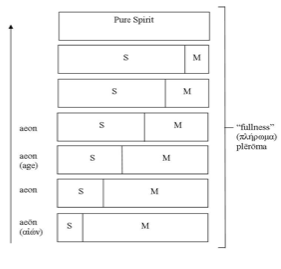
Colossians 2:12 textual variant
Συνταφέντες αὐτῷ ἐν τῷ βαπτισμῷ/βαπτίισματι
“having been buried with him in baptism”
This variant affects the question of whether βαπτισμός is ever used for Christian baptism. Βάπτισμα is the normal form of the root for indicating Christian baptism.
Colossians 2:13 textual variant
“made us/you alive with him” (ὑμᾶς/ἡμᾶς)
The textual evidence for ἡμᾶς is rather weak.
Colossians 2:18 textual variant
ἃ [μὴ] ἑόρακεν ἐμβατεύων
“dwelling on/in what-things he-has-[not]-seen”
“Dwelling in/on what he has seen” could be a stab at the physical orientation of the dietary laws and other “fleshly” Jewish customs Paul apparently refers to in the context. “Dwelling in/on what he has not seen” could fit with the immediate mentioning of angels, which people do not normally see.
Colossians 3:18 punctuation
(1) submitting to their husbands, as is fitting in the Lord (non-restrictive)
(2) submitting to their husbands as is fitting in the Lord (restrictive)
The second wording would address occasions where a husband might want the wife to do what her commitment to Christ would not allow. There are limitations to the deference principle.
Colossians 4:15 textual variant/editorial work
Is Νύμφαν a man or a woman?
Νύμφαν [or Νυμφᾶν] could be the accusative singular for either (m) or (f). It could be comparable to Λουκᾶς and Δημᾶς in 4:14. Uncertainty on this point has generated the textual variant later in 4:15 between αὐτῆς and αὐτοῦ. The problem resembles the one with Ἰουνίαν in Romans 16:7
1 THESSALONIANS
1 Thessalonians 2:13 antecedent
. . . λόγον Θεοῦ ὃς καὶ ἐνεργεῖται ἐν ὑμῖν τοῖς πιστεύουσιν
(1) “the word of God, which also works in you who believe”
(2) “the word of God who also works in you who believe”
The question is whether the antecedent of ὃς is the phrase head “word” (“which”) or the nearest antecedent (“who”).
1 Thessalonians 4:3-8 vocabulary
This text shows that πορνεία includes adultery: a brother is wronged when this πορνεία occurs. So it is a broader term than adultery, not one parallel to it.
Compare 1 Corinthians 6:18; Galatians 5:19; Ephesians 5:3-5; Colossians 3:5; Revelation 21:8.
1 Thessalonians 5:17 present tense
ἀδιαλείπτως προσεύχεσθε: “pray without ceasing”
(1) iterative action: do not leave off the “practice” of prayer, the habit of praying.
(2) continuous action
(a) always be in an “attitude” of prayer; be in a frame of mind that makes prayer
always appropriate
(b) exaggeration for emphasis
(c) all life is to be lived toward God; all things are to be done to his glory.
The familiar wording has created the last three takes on the commandment as people try to find some way to talk about praying all the time. Iterative and characteristic actions may not suggest themselves in English, but they are more natural meanings of the present tense command form in Greek, which has a less specific verb system than English.
(a) Continuous action is, of course, impossible; people have to sleep. So all the suggested ways of understanding the expression end up “fudging” what prayer is. Prayer is not merely a humble attitude or a vertically directed life, both of which are admittedly good; prayer is I-You communication with God.
(b) Note the different kinds of activity that ἀδιαλείπτως modifies in the New Testament:
Romans 1:9: “without ceasing, making mention of you in my prayers”
Romans 9:2: “great heaviness and continual sorrow”
1 Thessalonians 1:3: “remembering without ceasing”
1 Thessalonians 2:13: “that God without ceasing”
2 Timothy 1:3: “unceasing in my remembrance of you in my prayers”
(c) Note the similar expression in Colossians 1:9: “We do not cease praying for you” (οὐ
παθόμεθα ὑπὲρ ὑμῶν προσευχόμενοι καὶ αἰτούμονοι . . . ).
2 THESSALONIANS
2 Thessalonians 1:8 vocabulary
Διδόντος ἐκδίκησιν τοῖς μὴ εἰδόσιν θεὸν καὶ τοῖς μὴ ὑπακούουσιν τῷ εὐαγγελίῳ τοῦ κυρίου ἡμῶν Ἰησοῦ
(1) two groups: those who do not know God and those who do not obey the gospel
(2) one group described in two ways: those who do not know God and do not obey the gospel; καὶ might be construed as “even”
A related consideration is what “know” means. Does it mean “know about” or “be in relationship to”? “Not knowing” may amount to “not being obedient.”
There are articles on the front of both descriptions, a fact that tends to picture them as two groups. If we combine that with “know,” we might get to the belief that the unevangelized are lost. A counter consideration can be that they are not in relationship to him although they have heard the gospel. But there is no way to tell which option makes sense, given the rest of the Christian system. The fate of the unevangelized cannot be determined by this verse because it may be an example of synonymous parallelism. So any conclusion regarding the state of the unevangelized must come from systematic theological considerations derived from elsewhere. Options people have proposed include (a) sliding-scale judgment based on conscience wherein it has properly led each person (cp. Romans 2:11-16); (b) annihilation of the unevangelized, (c) salvation option after death (2 Peter 3:18-20; 4:1-6?). It is best to leave the matter unresolved, and to be satisfied with using “sanctified imagination” for constructing options that justify God without committing to any of them.
The question comes mainly from a general concern for consistency in Christian teaching: would a loving God send people to hell for not doing or believing what they had no way to know to do? An alternate way of judging the 99% of humanity over all the time in history makes the best sense.
Compare the problem in John 3:5.
2 Thessalonians 1:12 syntax
κατὰ τὴν χάριν τοῦ θεοῦ ἡμῶν καὶ κυρίου Ἰησοῦ χριστοῦ
(1) “according-to the grace of our [God and Lord Jesus Christ]”
(2) “according-to the grace of our God and of the Lord Jesus Christ”
The one article that could fit over “God” and “Lord” according to Sharp’s rule. The “our” in this circumstance probably modifies both nouns though expressed just once. Sharp’s rule does not have to mean that two nouns under the same article are two ways of referring to the same thing; they may be combined this way because, though different, they form a unit. The situation can be like an English statement, “The father and mother came into the hospital.”
A different construction with parallelism occurs in 1 Timothy 1:1, where “God our savior and Jesus our hope” separates the God and Jesus equation that would otherwise be implied by Sharp’s rule as in this 2 Thessalonians text.
1 TIMOTHY
1 Timothy 1:5 syntax
Τὸ δὲ τέλος τῆς παραγγελίας ἐστὶν ἀγάπη ἐκ καθαρᾶς καρδίας καὶ συνειδήσεως ἀγαθῆς καῖ πίστεως ἀνυποκρίτου
“And the end of the charge is love out of a pure heart and a good conscience and unfeigned faith.”
(1) Are heart, conscience, and faith parallel to love as a series of predicate nominatives?
(2) Are heart, conscience, and faith common objects of “out-of”?
Since heart, conscience, and faith are genitive rather than nominative, they are three objects of “out-of.” Love comes out of these three: “the end of the charge is out of a pure heart, good conscience, and unfeigned faith.”
1 Timothy 1:13 vocabulary
Did Paul do what he did ignorantly in unbelief or disbelief (ἀπιστίᾳ)? Alpha-privative words can be either negative or neutral.
The answer cannot come from grammar or vocabulary, but from the record in Acts, it seems that Paul did it in disbelief.
1 Timothy 2:12 vocabulary
It has been argued that διδάσκω underscores the content imparted in teaching, while διδασκαλία refers to the teaching role. Supposedly relevant texts are 1 Corinthians 4:17; Ephesians 4:21; Colossians 1:28; 2:7; and 1 Timothy 6:2. Consequently, Paul did not want them teaching “what they were teaching”; they were not learning first before they taught, and so they were teaching heresies. That sounds like an awful lot to get out of one word.
1 Timothy 2:12 vocabulary
διδάσκειν δὲ γυναικὶ οὐκ ἐπιτρέπω, οὐδὲ αὐθεντεῖν ἀνδρός, ἀλλ’ εἶναι ἐν ἡσυχίᾳ.
(1) Does αὐθεντεῖν mean “to usurp,” so that it is okay if men let her?
(2) Does αὐθεντεῖν mean “to domineer,” so that she might exercise authority as long as she does not do it in a domineering manner?
(3) Does αὐθεντεῖν mean “to exercise authority,” so that it is not appropriate for a woman to be positioned above a man in the home or in the church?
For a discussion of these points, see Scot Bartchy in “Power, Submission, and Sexual Identity Among the Early Christians,” Essays on New Testament Christianity, pp. 71-74.
1 Timothy 2:12 vocabulary
Does ἀνδρός mean “husband” or “man”? “Husband” would fit with the Adam-Eve example Paul cites next, but it could also fit the larger church context beyond the home.
The associations with upcoming directives about elders put these closing verses of chapter 2 in connection with the larger church setting. Paul would not have any “say” in how a husband and wife related on day-by-day items in the home; of what point, then, would it be for him to say, “I do not allow a woman . . . .”? The preceding verse likewise pictures a public setting (2:8-11), and 2:8 uses “men” in a generic sense parallel to “women” in 2:9. One claim is that when there is a shift from plural to singular, the meaning normally becomes “husband” and “wife” (as in German?). Another point here is that if a woman should not do something like exercise authority over her own husband, she should all the more not do it over someone else’s husband as would be the case in a public, mixed setting, especially if such teaching was perceived as authoritative. Another claim is that αὐτόδικος means “to act with independent jurisdiction” as a close synonym. Could the meaning here then be that Paul did not allow women to act with jurisdiction independent of their husbands? So there are cultural considerations involved that reinforce Paul’s comment “I do not allow.” Which could be adjusted if some cultural components do not apply everywhere for or at later times.
As regards “teach and exercise authority,” we may ask whether it is a feature of Semitic idiom to use two verbs for indicating one composite action made up of two parts conjointly (hendiadys) as in an adverb-adjective composite. Exodus 33:20 says, “No one can see me and live.” Does that mean “no one can see me while alive.” Can the same question apply to Acts 10:46; 19:6; Revelation 2:20 (teach and seduce)”? So even from a grammatical, syntactical standpoint, does “teach and exercise authority” mean “teach authoritatively” like an elder.
1 Timothy 2:12 syntax
(1) Is ἀνδρός the implied common object of διδάσκειν and αὐθεντεῖν?
(2) Is ἀνδρός the object of αὐθεντεῖν only?
Greek uses case endings to indicate grammatical functions in a sentence. (a) We would not expect a noun to be the common object of a compound-verb construction if the verbs govern different cases. The bail out might be to use the case required by the nearer verb. In 1 Timothy 2:12, διδάσκειν governs the accusative while αὐθεντεῖν governs the genitive. (b) “To teach” and “to exercise authority” have five words between them, which may separate them. A counter-consideration is that οὐκ ἐπιτρεπω (“I do not allow”) stands between the infinitives “to teach” and “to exercise authority.” (c) The two infinitives are connected by οὐδὲ, meaning “neither,” rather than “and.” But οὐδὲ should probably not be considered any more disjunctive than καὶ is; it is its parallel negative.
These three things might imply that “teach” means “I do not allow women to teach—period” But Paul is describing a public setting, so custom may still create an cultural expectancy that women not teach in such a situation; it would be perceived as authoritative— regardless of the grammatical aspects of this sentence. In addition, the comments in 2:12 feed off into qualifications for elders, the highest office in the local church, one of whose main roles is teaching. So Paul is likely speaking about official teaching; that is, as elders would do. Teaching younger women how to love their husbands (Titus 2:4), teaching children (2 Timothy 1:5), or teaching anyone informally (Acts 18:26?) does not fall under his perview.
1 Timothy 2:12 vocabulary
What does ἡσυχία mean: “silence,” “peacefulness,” “quietness”?
The second alternative is argued for by Joseph M. Webb in “Where Is the Command to Silence?” Christian Standard, May 21, 1989, p 4. Cyril of Jerusalem in Prochetechesis 14¸ cited by Michael Slusser in Society of Biblical Literature, III:3 (Fall, 1992), p. 499, says the women were to read silently during the pre-baptismal exorcisms. The most natural meaning refers to what contrasts with what Paul says should not happen. He does not particularize it to a certain setting like the pre-baptismal observation just noted.
1 Timothy 2:13 vocabulary
Ἀδὰμ γὰρ πρῶτος ἐπλάσθη, ειῖτα Εὕα.
(1) “Adam was formed first, then Eve.”
(2) “Adam was informed first, then Eve.”
Walt Kaiser offered the second translation in “Shared Leadership,” Christianity Today, October 3, 1986. We know from the Genesis account that the first rendering is true, so we can accept that and let the other idea be a matter of interest.
1 Timothy 3:2 article
μιᾶς γυναικὸς ἄνηρ
“Husband of one wife” lacks the article, which draws attention to the kind of person he is; hence, it sets up the possibility for other morally acceptable statuses besides married men were possible: that a previously divorced man, a man who had never found a mate (bachelor), most obviously a man whose wife had died (widower), or one that had then remarried (deuterogamist).
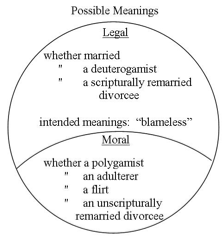
The same comments apply to 3:12, where Paul mentions this characteristic for deacons, and to Titus 1:6, where the phrase appears again in reference to elders. Titus 1:6-7 makes this clear by putting the word “blameless” before and after “husband of one wife.” He has character in mind, not societal status. This idea is what “one-woman man” intends to address.
1 Timothy 3:11 vocabulary
Does γυναῖκας refer to the “wives” (of deacons) or to “women” (deaconesses)?
Relevant passages include Titus 1:6 and 1 Timothy 5:9. See also the following excerpt from Virgil Warren’s M.A. thesis.
From Romans 16:1; 1 Timothy 3:11; 5:3-16 some exegetes have defended the existence of “deaconesses” in the early church. As respects the larger question of the positive New Testament pattern for church unity, this problem need not be solved. If 1 Timothy 3:11 speaks of deaconesses under the word γυναῖκες, mentioning them amid statements about deacons makes deaconess not so much a separate function, as a sub-category on the same function: “service” to the Christian community. Certain services to female members could more properly be fulfilled by women or by husbands (διάκονοι) and wives (γυναῖκες) together. The relationship between deacon and deaconess could be as follows.
The qualifications for deacons in 1 Timothy 3:8-10 + 12-13 inserts the material in question between two sections about deacons. In 3:12 we do not find “men” but ‘deacons,” which implies that Paul has not left his description of deacons in 3:11. It suggests that he is thinking of γυναῖκες as the wives of the deacons described in the surrounding verses.
In Romans 16:1, however, Phoebe is called a διάκανος of the church in Cenchrea. She was going to Rome in some kind of service work. That sounds like she was not a deaconess in combination with her husband, but as someone on her own who would be doing for Roman Christians what she was doing in Cenchrea. Of note, however, is that she was going to Rome to do this service; she was not going there to be part of the organization of the church there. We would not think she would have been going to Rome without her husband if she had one. So her efforts there were not “official” because she was not part of the organization of any congregation in Rome. Phoebe’s case may be a crossover with older widows envisioned in contrast to younger ones in 1 Timothy 5:9-16. Older widows supported by the church evidently had responsibilities they could perform in return for their support. There seems to be no sure exegetical base on which to build a case for the presence of official deaconesses in the first-century church, though nothing critical is at stake in the matter.
οί διάκονοι
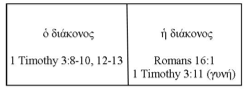
1 Timothy 3:16 S/spirit
The NIV translates this verse “body . . . Spirit” whereas the text has “flesh” (σάρξ) and (πνεῦμα) “spirit.” When πνεῦμα stands in contrast to flesh, we take it as most likely not the Holy Spirit, but lower-case “spirit.” The choice comes from the law of opposition in interpretation theory.
1 Timothy 3:16 textual variant
(1) “Who was manifest in the flesh,” with the implication that Jesus is the antecedent or referent/antecedent. Even here the antecedent could be God in 3:15.
(2) “God was manifest in the flesh,” etc.
The UBS 5th ed rev editors have chosen the first reading as a confident choice.
1 Timothy 4:8 vocabulary
ἡ γὰρ γυμνασία πρὸς ὀλίγον ἐστὶν ὠφέλιμος
(1) “Bodily exercise profits little.”
(2) “Bodily exercise profits a little.”
There is no way to tell whether it is a positive or negative comment. We would probably judge it more likely for him to say the positive because bodily exercise does profit some, depending on what “profit” refers to.
1 Timothy 4:14 vocabulary
μὴ ἀμέλει τοῦ ἐν σοὶ χαρίσματος ὃ ἐδόθη σοι διὰ προφητείας μετὰ ἐπιθέσεως τῶν χειρῶν τοῦ πρεσβυτερίου.
The text says not to neglect the gift that . . . was given . . . with the laying on of the hands of the presbytery. It does not say “given by the laying on of the hands of the presbytery.”
The passage relates to the question of whether anyone except an apostle could pass on miraculous gifts. 1 Timothy 1:6 says that Timothy’s gift was received from the laying on of Paul’s hands. “Laying on” here must refer to Timothy’s ordination/commissioning; anything more is uncertain because we do not see him working any miracles in the biblical record. The gift, then, that Paul is referring to is Timothy’s slot of service.
1 Timothy 5:2 vocabulary
Does πρεσβυτέρας refer to older women or women elders?
Since the contrast is between πρεσβυτέρας and younger women, the term means older vs. younger rather than officers of the church.
1 Timothy 5:8 gender
εἰ δέ τις τῶν ἰδίων καὶ μάλιστα οἰκείων οὐ προνοεῖ, τὴν πίστιν ἤρνηται καὶ ἔστιν ἀπίστου χείρων.
Τις can be masculine or feminine, as can ἀπίστου. Consequently, from this verse we cannot conclude that God holds the man primarily responsible for providing for the family. Taking this statement in application to women could fit 5:16, “If any woman that believes has widows, let her relieve them.” In a standard household setting, we would infer from the husband’s primary responsibility for the family that he is primarily responsibility for providing for the family.
1 Timothy 5:11 vocabulary
When Paul says to “refuse” younger widows, does he mean it in a neutral or negative sense? (cp. Hebrews 12:2, despising the shame”).
We would not expect the apostle to have a negative attitude toward younger widows. After all, they are widows. He means not to include them in the list of possible recipients of church support.
1 Timothy 5:17 vocabulary
μάλιστα οἱ κοπιῶντες ἐν λόγῳ καὶ διδασκαλίᾳ
(1) especially the ones laboring in word and teaching
(2) especially the ones laboring in word even teaching
The issue may affect the question of whether all elders should teach or whether some teach while some rule (note the ruling elder idea). The word “especially” may already sufficiently slant the issue toward saying that some teach while all rule if a division of labor can connect with that variation.
2 TIMOTHY
2 Timothy 1:12 genitive case
Δυνατός ἐστιν τὴν παραθήκην μου φυλάξαι εἰς ἐκείνων τὴν ἡμέραν
(1) “He is able to keep my deposit.” [what I have deposited with him;
possessive/subjective genitive]
(2) “He is able to keep the deposit of me.” [what he deposited is me; objective genitive]
The difference relates to the perseverance of the saints. The second translation could be understood to mean the effectual regenerative operation of the Spirit. His keeping it, however, does not have to be unconditional.
2 Timothy 2:15 vocabulary
Σπούδασον σεαυτὸν δόκιμον παραστῆσαι τῷ θεῷ
“Study” in the KJV does not mean “study” the Bible but “give diligence,” the import of the verb.
2 Timothy 2:26 vocabulary
Does ἀνανήφω [“recover”] imply the possibility of salvation a second time, that is, after apostasy? The question has to do with the force of the ἀνα- prefix; cp. “re-” on Latin-based English words.
The idea in itself does not offend the interpersonal nature of salvation and the Christian life. Often Hebrews 6:6 has created the impression that “re-salvation” is not possible: “impossible to renew to repentance.” See entries there.
2 Timothy 3:14 clarification/textual variant
εἰδὼς παρὰ τίνων ἔμαθες
“knowing from whom you learned them”
“Whom” is plural; so, in the preferred reading, Paul is not referring to himself as if to say that Timothy should be confident about what he knows because he learned it from Paul. He may mean he learned it from Timothy’s mother and grandmother, Eunice and Lois (2 Timothy 1:5) because in the next verse he mentions “from a child,” which brings up the ones who raised him. “From the scriptures” (3:15-16) might be possible, but that would eliminate the translation “whom.” Paul could be included, but in a later role.
2 Timothy 3:16 linking verb/καὶ/γραφή/πᾶς
vocabulary/article
πᾶσα γραφὴ θεόπνευστος καὶ ὠφέλιμος πρὸς διδασκαλίαν
(1) “All/every scripture/writing (is) God-breathed and profitable for teaching.”
(2) “All/every scripture/writing, God-breathed, (is) also profitable for teaching.”
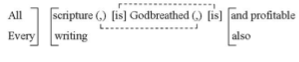
Variables in the English wording of this verse
all vs every
scripture vs. writing
commas vs. no commas [restrictive vs. non-restrictive “God-breathed]
placement of is
and vs. also
Two wordings seem to fit the context, which shows Paul’s concern to encourage Timothy in a good thing:
(1) “All/every scripture (is) God-breathed and profitable.”
(2) “All/every scripture, God-breathed, (is) also profitable.”
(being) God-breathed,
(because it is) God-breathed [NON-RESTRICTIVE]
As to the placement of the linking verb, it might be noted that there is no other New Testament instance where an attributive adjective is connected with a predicate adjective by the word καί; that is, καί is used to connect equal and parallel grammatical features unless it is adverbial. Compare 1 Timothy 4:4, “Every created-thing is good and nothing to be rejected.” Also Hebrews 4:12, “The word of God is living and active and sharper than any two-edged sword.” If the copulative verb is placeδ after “God-breathed,” the interpreter needs to understand God-breathed as a non-restrictive element set off in commas “Scripture, being God-breathed, is profitable”; “all scripture, because it is God-breathed¨, (is) also profitable” (except for the observation made above about the awkwardness of combining attributive and predicate adjectives with καί.
Γραφή is never used of a non-authoritative scripture in the New Testament. Consequently, its meaning a “writing” would be to do something we would not expect. Since Paul is speaking about what Lois, Eunice, and Timothy would have considered normative, it is doubtful whether “writing” in a general sense could have any relevance. Besides, the apostle has just used the word in a technical sense in the preceding verse.
In choosing between “all” and “every,” we might observe that the plural ἱερὰ γράμματα occurs in 3:15, thus individuating the whole into its parts. On the other hand, Paul says scripture is profitable for several things. He links them by καί rather than ἤ (“or”), which he might have used if he were thinking of individuated scriptures. Not every scripture would be profitable for each of these things. It might be possible to speak this way because he was individuating them and using and to connect the many possibilities a scripture might have.
The translation “God-breathed” is better than “inspired” because its word picture is that of exhaling the scripture. Inspired creates the picture of something already in existence from some other source and then God breathed into it (as into Adam), and it became something more, something that has an added character (authoritative, approved, etc.).
A series of
words has been used traditionally to state from various angles the character of
scripture in positive and negative terms. The list begins with the biblical
expression in 2
Timothy 3:16, which translates literally as “God-breathed.” The rather
unhappy term in popular vogue for this passage is “inspired” so that
“inspiration” becomes the noun employed to get at the Pauline concept expressed
in the text. “Inspire,” however, does not properly picture the idea intended
because it (a) creates the image of breathing into something already existent
an added character, as noted above. The word-picture in “God-breathed” is that
of exhaling the thing itself so that the scripture is viewed as issuing from
the mouth of God directly; consequently, scripture is by definition set apart
from all other examples of writing in that it may be viewed as God’s speaking.
A second weakness in “inspire” for “theopneustos” is that it (b) leaves less clear that the quality in mind characterizes the writing rather than the writer. So it does not sufficiently contrast revelation with illumination, the heightened power of perception or understanding that might be generated in/by a man’s mind as he views the Old Testament. Men are illuminated; the message is revealed. Illumination is limited to what is theoretically possible to see so that it does not eliminate error necessarily in all whereof one might speak. “Inspiration” does not offset the subtle change in modern theology of the Bible that shifts the quality from the scripture to the scribe, and then proceeds to view the nature of inspiration as something analogous to the “inspiration” of an artist, poet, musician. God-breathedness draws attention to the relationship between scripture and God and then to the implicit qualities of that association.

As a word, inspire could be an inspired man, who is really grabbed by a situation and writes a book that is inspired because it reflects the author’s really being grabbed by that situation so that the reader is inspired as well. The book is inspired because it is inspiring.
The lack of an article on “scripture” tends to emphasize the character of scripture rather than scripture as an identity.
2 Timothy 4:3 clarification
ἀλλὰ κατὰ τὰς ἰδίας ἐπιθυμίας ἑαυτοῖς ἐπισωπεύσουσιν διδασκάλους κνηθόμενοι τὴν ἀκοὴν
“Having itching ears” modifies the ones who heap unto themselves teachers; it does not describe the teachers, as the King James suggest.
TITUS
Titus 1:3 vocabulary
“but was manifested in his-own times” καιροῖς ἰδίοις
our-own times
In New Testament Greek the plural intensive pronoun is the same form for all three persons. We note as well that ἴδιος is an adjective, so its being plural does not favor an “our” translation. It is plural because it modifies a plural noun.
Titus 1:6 article
μιᾶς γυναικὸς ἀνήρ
See comments under 1 Timothy 3:2 and 5:9.
Titus 1:6 clarification
ἀνήρ, τέκνα ἔχων πιστά, μὴ ἐν καρηγορίᾳ ἀσωτίας ᾒ ἀνυπότακτα
“not accused of riot or unruly” applies to the children, not the man. “Accused” is accusative neuter plural.
Titus 2:13 article
ἐπιφάνειαν τῆς δόξης τοῦ μεγάλου θεοῦ καὶ σωτῆρος ἡμῶν Ἰησοῦ χριστοῦ
(1) “appearance of the glory of our great God and Savior Jesus Christ”
(2) “appearance of the great God and of our Savior Jesus Christ”
One article stands ahead of θεοῦ and σωτῆρος, which implies that the two are to be combined in the mind.
PHILEMON
Philemon 25 number
“Your spirit” is plural; so it is not a comment directed privately to Philemon, but to those also named in Philemon 2.
HEBREWS
Hebrews 1:2 article
ἐν υἱῷ
The anarthrous noun stresses the character of the new revelation in contrast to the ways God spoke before to the fathers. This time he spoke “in a son,” “son-wise” (Rotherham).
Hebrews 1:3 vocabulary
The Son is called the “effulgence” [ἀπαύγασμα] of God’s glory. He is the direct shining rather than a reflected light.
Hebrews 1:8 linking verb
vocative-nominative
Ὁ θρόνος σου [,] ὁ θεὸς [,] εἰς τὸν αἰῶνα τοῦ αἰῶνος
(1) “Your throne, O God, (is) forever and ever.”
(2) “Your throne (is) God forever and ever.”
The nominative and vocative singular forms are often the same in Greek. Τhis quotation from Psalms 45:6-7 also lacks the copulative verb both in the MT Hebrew and the LXX Greek translation. The combination of features makes it theoretically possible to translate the statement either way. Those who deny Messiah’s deity take it the second way so avoid ascribing deity to the Son. That translation does not make a likely comment, however; how would God be someone’s throne?
Hebrews 2:6 vocabulary
Διεμαρτύρατο δέ πού τις λέγων
(1) “Somewhere someone witnessed . . . .” [The writer does not know who said it or
where the quotation came from.]
(2) “In-a-certain-(place) a-certain-one testified saying . . . .”
[no implication one way or the other as to
whether the author knew the source of the
quoted comment]
Note the expression “a certain man named ___________.” The point is either that the hearer would not know where it is or that the author is not concerned to make a point of place. He knows where it is (or at least can find it because he can quote the passage). Indefinite relatives have nothing to say about the speaker’s knowledge. Indefinites may be used because the hearer does not know the specific case the speaker has in mind or because the speaker does not consider it important to the hearer to specify the place (note Luke 7:2). Τις plus a proper noun shows that τις does not imply uncertainty of reference.
Hebrews 2:7 vocabulary
ἠλάττωσας αὐτὸν βραχύ τι παρ’ ἀγγέλους
(1) “a little lower than the angels”
(2) “a little while lower than the angels”
In favor of the second translation is that degree difference is expressed often by the dative case, literally lower by a little.
Hebrews 2:11 ellipsis
ὅ τε γὰρ ἀγιάζχων καὶ οἱ ἁγιαζόμενοι ἐξ ἐνὸς πάντες
(1) “The sanctifier and the sanctified (are) all of one [nature].”
(2) “The sanctifier and the sanctified (are) all of one [father].”
In 2:9-18 the writer speaks of the need to become a physical man to participate in the full range of human experience—including suffering unto death—in order to “qualify” himself in full righteousness to be appointed as savior of humankind. Consequently, we are inclined to understand 2:11 as an anticipation of those comments; that means opting for “all of one nature.”
See What the Bible Says About Salvation, p. 59.
Hebrews 4:4 vocabulary
Does the indefinite adverb imply that the writer does not know.? It says, “Somewhere it says thus about the seventh day.” Another translation is “In a certain place it says . . . . .” Luke 12:20; 16:4, 9 shows that indefinites do not imply lack of knowledge. In this passage then που does not imply that the Hebrew writer did not know the source of his quotation.
Sometimes references are given: (1) “in the second Psalm (Acts 13:33); (2) “in the place of the bush” (Mark 12:26), as well as references to authors like Isaiah, Jeremiah, etc.
Hebrews 4:8 vocabulary
Εἰ γὰρ αὐτοὺς Ἰησοῦς κατέπαυσεν
(1) “If Jesus had given them rest . . . .”
(2) “If Joshua had given them rest . . . .”
Joshua and Jesus are the same name, but obviously the writer of Hebrews is talking about the time of conquering of Canaan. So he is talking about the successor to Moses, not about Jesus the Messiah. Another appearance of Ἰησοῦς as Joshua is in the variant readings for Jude 5.
Hebrews 4:15 vocabulary
The meaning of tempt ranges from being presented with a test—something God even invites his people to do in Malachi 3:1)—to trying to get people to depart from their ethical standards. In another set of variables, tempt runs from being presented with a temptation that holds no lure for the one tempted all the way to successful temptation. The Holy Spirit could be tempted (Acts 5:9) in the sense of tested. Elsewhere God is said to be tempted even within Hebrews itself: 3:9 < Psalm 95:9.
God’s not being able to be tempted with evil (James 1:13) has nothing to do with denying the deity of Christ, who was tempted. He was tempted in the flesh because incarnation made him susceptible to physical drives and pain like the people have that he came to save, yet without sin (4:15). The point lies in the fact that Christ was in the flesh and could be tempted through the it.
Hebrews 4:13 vocabulary
πρὸς ὃν ἡμῖν ὁ λόγος
(1) “with whom the matter (is) to us” [= ASV “with whom we have to do”]
(2) “to whom the word is to us” (Westcott commentary on Hebrews in loco)
This passage is an example of a word’s shifting meaning within a short scope (cp. 4:12).
Hebrews 4:15 vocabulary
πεπειρασμένον δὲ κατὰ πάντα καθ’ ὁμοιότητα χωρὶς ἁμαρτίας
(1) “tempted in all things the same way we are, without sin”
(2) “tempted in all things the same way we are, apart-from sin”
In the first translation Jesus was tempted in all the ways we are, yet he did not sin. In the second he was tempted in all the ways we are with one exception that he never experienced the drag of past failure on present resolve.
Hebrews 5:8 participle
καίπερ ὣν υἱὸς ἔμαθεν ἀφ’ ὧν ἔπαθεν τὴν ὑπακοήν
(1) “Although, being a son, he learned obedience from the things he suffered.”
(2) “Although, because he was a son, he learned obedience from the things he suffered.”
Hebrews 6:4 vocabulary
ἀδύνατον
Can this word cover both impossible and improbable? Can it cover impossible in different senses: not possible from a practical standpoint, as a behavioral observation about people;
not possible from a theoretical standpoint; God will not accept them back?
Greek may not have as wide a vocabulary for gradations of possibility as English has. Maybe a particularly hard experience later can bring a person to his senses. God’s not being willing to accept him back does not sound like what would happen in an interpersonal process with a loving God. So we are inclined to take the verse as a comment on a sad tendency that still leaves open unlikely possibilities. It allows for James 5:19-20 to carry its natural import: “If any among you err from the truth and one convert him, let him know that he who converts a sinner will save a soul from death and cover a multitude of sins.” Similarly, Jude 22-23 comments, “On some have mercy who are in doubt; some, save, snatching them out of the fire; and on some have mercy with apprehension.”
Hebrews 6:4 vocabulary
γευσάμενος/γεύομαι
(1) to nibble at vs. consume
(2) to experience something in a perceptive way
The second wording is more likely here. The author uses the same figure earlier when he says that Jesus “tasted” of death for every person (2:9). The import of the passage would hardly mean a light exposure (from which the person could fall away) vs. a full intake (from which God would keep him from falling away as in the doctrine of perseverance of the saints). Besides tasting the heavenly gift, the good word of God, and the powers of the coming age (6:4-5), the person envisioned has been enlightened and partaken of the Holy Spirit. That is a strong line-up of Christian experiences to which it would be difficult to add anything relevant.
Other passages on tasting as perceptive are Matthew 16:28; Mark 9:1; Luke 9:27; 14:24; John 2:9; 8:52; Colossians 2:21; Psalms 34:8; 1 Peter 2:3. In fact, only Matthew 27:34 appears to use “taste” without stressing the acute perception of the experience.
Hebrews 6:6 participle
ἀνασταυποῦντας ἑαυτοῖς τὸν υἱὸν τοῦ θεοῦ
(1) “crucifying to themselves the Son of God all over again” [attendant circumstance]
(2) “seeing that they are crucifying the Son of God all over again” [causal]
(3) “while they are crucifying the Son of God all over again” [temporal]
The first option is best because it leaves the statement as ambiguous in English as the participle does in Greek. The third option does not make a lot of sense: if we could get a person to stop crucifying the Son of God all over again, we would be getting him to repent. It sounds like Mom telling her little boy how to catch a bird: put salt on its tail. If you could get close enough to put salt on its tail, you would not need to put salt on its tail. The reason for various options here, comes from interacting with the doctrine of perseverance of the saints. See What the Bible Says About Salvation, pp. 451-53, 486-95.
Hebrews 7:7 present tense
“The lesser is-blessed by the greater.”
“The lesser is-being-blessed by the greater.”
The first wording sounds like a principle the writer is affirming. We wonder whether it would be true in that sense. There are cases that speak of people blessing God. The second wording addresses the specific occasion the writer cites: Melchizedek.
Hebrews 7:25 vocabulary
Does εἰς τὸ παντελὲς mean “utterly” (ASV) or “forever” (NASB)? The former is a bigger idea. At any rate, the verse should not be used in the service of eternal security or even perseverance of the saints. The author’s comment is about the system, not the individual. It contrasts utterly with partially either in the sense of yearly renewal or of specific sins (vs. sin).
Hebrews 7:27 vocabulary
The expression “Christ died . . . once” does not mean “once for everybody,” but “once-for-all-time, once-and-for-all.” Compare 10:10; Jude 5.
Hebrews 10:10 vocabulary
“The offering of the body of Jesus Christ once for all” does not mean “once for everybody,” but “once and for all.” Similar notations apply to Hebrews 7:27 and Jude 5.
Hebrews 10:26 participle
ἑκουσίως γὰρ ἁμαρτανόντων ἡμῶν μετὰ τὸ λαβεῖν τὴν ἐπίγνωσιν τῆς ἀληθείας
The NASB translates this verse to say, “For if we go on sinning willfully after we have received a knowledge of the truth . . . .” That rendering could imply that the type of people pictured here are uncommitted Christians who have heard the message but did not commit themselves to it. The present participle does not particularly mean continue to do what you are already doing; it views the action progressively rather than as a fact. It could be translated here, “If we sin characteristically after we . . . .”
Hebrews 10:29 indicative/optative
“Of how much more severe punishment do you think a person will be judged worthy [ἀξιωθήσεται],” not “ought to be judged worthy” (KJV).
The verb is a future passive indicative. Compare notes on Hebrews 6:4-6.
Hebrews 11:4 pronoun antecedent
πίστει πλείονα θυσίαν . . . δι’ ἧς
Evidently the antecedent is πίστει, faith, because that is the main subject in the sentence and in the context. The writer goes on to say ‘καὶ δι’ αὐτῆς he still speaks.’ Surely it is through his faith that he still speaks, not the sacrifice (θυσίαν).
Hebrews 11:11 note different translation
textual variant
(1) πίστει καὶ αὐτὴ Σάρρα [στεῖρα] δύναμιν εἰς καταβολὴν σπέρματας ἔλαβεν
(2) πίστει καὶ αὐτὴ Σάρρα δύναμιν εἰς καταβολὴν σπέρματας ἔλαβεν
The question is who received power unto the foundation of seed—Sarah or Abraham. If taken regarding Abraham as subject, an implied or actual nominative absolute is created by καὶ αὐτὴ Σάρρα [οὖσα] στεῖρα. If taken regarding Sarah as subject, the [οὖσα] στεῖρα—if it appears—remains an appositive with the subject, which is less problematic, or unusual. From an information standpoint, it seems better to make Sarah the one who received power since we know she was barren. Abraham, however, had begotten Ishmael, only fourteen years before and later had six sons by a second wife—Keturah.
As counters to these considerations, we do note that the Hebrews text goes on to say in 11:12 that Abraham was “as good as dead.” Maybe that point could be in light of his aged wife’s barrenness. Similarly, counting him faithful who had promised is more easily connected with Abraham since God dealt primarily with him. Nevertheless, the angel did talk directly to Sarah. When the angel talked to her, she laughed, which may look away from counting God faithful; yet her laughing was not a permanent attitude.
Hebrews 11:32 masculine particle
ἐπιλείψει με γὰρ διηγούμενον ὁ χρόνος περὶ Γεδ θέλω
The masculine participle modifying shows that a woman could not have written Hebrews even though Harnack suggested that Priscilla wrote the book.
Hebrews 12:2 objective genitive
“author and perfecter of [our/his] faith”
Is this objective genitive (the faithfulness that Jesus perfected) or (the faith/trust that he perfects in us)? We would think that the author and perfecter would both lead into “faith” the same way. If so, then he is the author of our faith and therefore the perfecter the writer is talking about is our faith as well.
Hebrews 12:2 vocabulary
When the writer says that on the cross Jesus “despised the shame,” does he mean it in a negative or neutral sense? Does he mean hated the shamefulness (negative) or disregarded (neutral) it because of “the glory that was set before him.” The second option sounds like Paul’s observation, “The sufferings of this present time are not worth comparing with the glory that will be revealed to us.”
Hebrews 12:17 ellipsis
“he found no place for a change of heart [in his father]”
[in himself]”
The former is surely the meaning because the text goes on to say, “though [Esau] sought it diligently with tears.” The description sounds like there was some kind of change in himself. The other idea is that he could not bring himself to repent, an interesting idea in itself, but not one that comes through clearly in the flow of thought.
Hebrews 13:4 indicative/imperative
(1) “(Let) the bed not (be) defiled.”
(2) “The bed (is) not defiled.”
The verb the reader is to supply is surely the imperative, because the wording continues with reminders about what God will do to those who disobey his directives on the matter.
Hebrews 13:24 vocabulary
ἀσπάζονται ὑμᾶς οἱ ἀπὸ τῆς Ἰταλίας [“The ones from Italy salute you.”]
It cannot mean “they salute you from Italy” because the prepositional phrase stands in an adjective slot after the article.
A comparable case appears in Acts 17:13, however: “When the Jews from Thessalonia knew that the word of God was preached by Paul in Berea . . . .” The text reads, ὡς δὲ ἔγνωσαν οἱ ἀπὸ τῆς Θεσσαλονίκῆς Ἰουδαίοι. They were not “away from” Thessalonica when they heard but were “from/of Thessalonica.”
A fourfold example shows up with Joseph of Arimathea in Matthew 27:57; Mark 15:43; Luke 23:51; and John 19:38. All four writers say ἀπὸ Ἀριμαθαίας. Their point is not that Joseph was away from Arimathea, but that he originated from that town. It is obvious from the narrative that Joseph was in Jerusalem, so he was “from” Arimathea; the writer would not, in reporting events in Jerusalem, be telling their readers Joseph was away from Arimathea by being in Jerusalem.
John 1:44 reports that Philip was from Bethsaida (ἀπὸ Βηθσαϊδά), Andrew and Peter’s city. Surely again, the point is not that Philip was “away from” Bethsaida; that was clear from the narrative.
There are three options then:
(1) Italians with Paul in Italy as he writes to elsewhere,
(2) Italians with Paul sending greeting back home to wherever, or
(3) Italians with Paul sending greetings to a third place.
The third option seems unlikely. Why would the writer single out people from Rome in writing from where he was in some second place while sending greetings to people in some third place.
The second option does not seem likely either because in early Christian tradition, Hebrews is not witnessed as being sent to Rome.
The first option makes the best sense. Telling his readership that those beside him were sending them greetings would be natural. It indicates then that the author is writing from Rome.
JAMES
James 1:19 imperative/indicative
(1) “Know this.”
(2) “You know this.”
The imperative seems more likely; there would be little reason to tell his readers that they know what they know they know, “You must be swift to listen.”
James 2:10 translation
Γέγονεν πάντων ἔνοχος, “He has become guilty of all.” The comment sounds like the author means the offender is considered guilty of breaking every one of the other commandments when he breaks just one. The plural “all” tends to sound that way too, admittedly. If it were singular, it would more easily fit with the notion that offenders have become guilty of the Law as such, as a whole. Our inclination is to fall back on that composite idea even though “all” is plural. The thought would be that the offender has become guilty of them all clustered. It is too difficult to imagine someone being guilty of the many other things he has not done. As it is, perhaps the point could be taken as meaning that he in principle would break the other commandments too since disrespect for God in breaking one applies equally to them all.
James 2:14 question
μἠ δύναται ἡ πίστις σῶσαι αὐτόν;
Μὴ implies a negative answer; οὐ would have implied a positive answer.
“Can belief save him?” would have been an informational question, but that translation does not account for the negative in the Greek sentence, “Belief cannot save him, can it?”
James 2:14 demonstrative?
(1) “Faith cannot save him, can it?”
(2) “(That) faith cannot save him, can it?”
The first translation is the correct one because (a) “that” does not appear in the Greek. (b) James’ subsequent contrast is between faith and works, not between one kind of faith and another—between a faith that works and a faith that does not. Interpreters may want to add the demonstrative in an effort to harmonize James’ teaching on faith and works with Paul’s teaching about faith and works. And that may seem to fit the immediate context (2:14) because it refers to someone that wants to say he has faith (that is, without works) while the one he is talking to has works—two alternatives, right? “We’re both good. I believe the right stuff; that is what being a Christian can mean. You do the right stuff; that is another thing being a Christian can mean. We’re both safe/saved.”
As an idea, these interpreters’ proposal at the beginning of the last paragraph will fit in, but it is not exactly what James is teaching. (a) First, James is talking about “faith” as something demons have (2:19). The faith they have does not relate to saving them; so it does not equal the speaker’s claim in 2:14, where he proposes that some saved people have one thing going for them (“faith”) while others have something else going for them (“works”). All’s good here. But James says, “No.”
(b) Second, James goes on to say that Abraham was justified by “works” when he offered up Isaac (2:21) and Rahab by sending the spies out another way (2:25). He was justified, not by his act, but by God as conditioned on his act.
(c) Thirdly, in talking about justification, James does not talk about a faith/belief that works, but about faith/belief and works. Salvation comes from God’s reckoning the combination, not from one (“faith/belief”) that produces the other (“works”). For James’ purposes, he conceptualizes them as two things (2:20, 21, 22, 23, 24, 26). He conceptualizes the process as one plus the other that leads to God’s doing the justifying (by “reckoning: 2:23).
That prepares the way for an important point: for saying that both faith and works—believing something and doing something—have a relationship to the resulting salvation/reckoning/justifying. A person cannot take “credit” for believing any more than he can take “create” for doing. Both faith/belief and works/doing in James 2 are conditions, not causes. The cause of justification occurs in the mind and will of God, who acts by giving the salvation result: God reckons people like Abraham as righteous on the basis of faith/trust/believing and works/doing-something. James’ attention to the human side of the salvation process corresponds with the Book of James as wisdom literature.
As another note in this segment on James 2, we note our decision The Conversational Version to translate πίστις in James as “belief” rather than “faith.” Doing so uses the “that πίστις” proposal above, but in a specific way: James is talking about belief, which is different from the faith/trust that appears in Paul. That kind of πίστις, translated “belief,” cannot save anybody; just remember that Paul does not use the word that way. The difference between our proposal and the previous one above is that proposal speaks of a kind of faith whereas ours speaks of a different meaning of the word πιστις.
Plugging that construction into the larger picture, we see the full reality as an interpersonal one: what the human person does (believing and doing) and what the divine person does (justifying).
Aspect One (James)
Final note regarding James’ construction of (the human side of) the interpersonal salvation process that takes place within a conditionality framework.
A condition can be called an occasional cause vs. an efficient cause or even a contributory cause. An occasional cause does not produce anything; it only provides a circumstance in which the efficient cause appropriately produces it. The efficient cause is divine forgiveness; the occasional is human believing-and-doing. That is the part James lays out in the salvation process: essentially the human side of the larger interpersonal process. It has the character Jesus illustrates with looking on a brazen serpent for the cure of snakebite (John 3:14-15). Looking at anything does not cure snakebite. James’ believing is an interpersonal believing, and his doing is an interpersonal doing; it is not just any believing or any doing. It morphs into trusting.
Aspect Two (Paul)
The rest of the full interpersonal process is that by our believing-doing combination we connect ourselves to Christ-the-righteous-One’s atonement as the way of identifying-with-him/commitment-to-him. On that condition, God has willed to reckon us as righteous like him (forgive sins)—on our commitment to him who is righteous. Aspect Two transforms Aspect One by a contextualizing clarification.
**We need to make one adjustment to this broad comparison to Paul in Romans and Galatians. In James πίστις means “belief” whereas it means belief-trust in Paul. Note the wording in The Conversational Version in the respective scripture portions.
When the rest of the picture gets placed in the hologram, it clarifies James’ teaching by interpersonalizing the believing and doing. James’ believing is an interpersonal believing, and his doing is an interpersonal doing. It is not just any kind of believing, but a believing within a personal relationship; and it is not just any kind of doing, but a doing within a personal relationship. Contextualizing Aspect One by putting it in Aspect Two not only adds the rest of the picture; it transforms the first part of the picture into an interpersonal kind of process (Jeremiah 31’s “new kind of covenant” written on the heart).
See also What the Bible Says About Salvation, pp. 218-19.
James 4:5 translation
ἢ δοκεῖτε ὅτι κενῶς ἡ γραφὴ λέγει, Πρὸς φθόνον ἐπιποθεῖ τὸ πνεῦμα ὃ καῴκισεν ἐν ἡμῖν
(1) “Do you think the scripture speaks in vain? Does the Spirit he made to live in us long unto envying?” (two parallel questions)
(2) “Do you think the scripture says in vain, Does the Spirit he made to live in us long unto envying?’” (one question within another)
James 5:16 translation
ἐξομολογεῖσθε οῦν ἀλλήλοις τὰς ἁμαρτίας καὶ εὔχεσθε ὑπὲρ ἀλλήλων, ὅπως ἰαθῆτε.
The KJV translates this “faults,” which serves as a basis then for a distinction in The Good News of the World Tomorrow (May-June, 1988, p. 23) between faults and sins. The writer of the article is trying to argue against sacerdotalism on the basis of this word slip.
James 5:16 clarification
“Confess . . . and pray that [ὅπως] you may be healed.” This is not indirect discourse, but purpose because it flows from a purpose clause.
James 5:16 reciprocality
“Confess your sins to one another.”
(1) one-directional, thus leaving the door open for
(a) sacerdotalism: an idea eliminated by the nature of interpersonal relationships; guilt cannot be forgiven by third parties
(b) the ones who sinned confessing to the ones they sinned against
(c) counseling-type situation
(2) two-directional between peers
James puts this directive inside a set of examples that show what he means: pray for one another that you may be healed, a remedying process between persons. The interpretation of this directive’s meaning must derive from systematic grounds—from the whole picture. An unclear passage cannot serve as the basis for a doctrine or practice. If the passage by itself can be taken in more than one way, its meaning must derive from the full picture in which it stands. Eliminating legalism eliminates distinctive ideas rooted in it—ideas like authoritarian, legal operation. The ones that fit with interpersonal considerations are the only ones left standing.
1 PETER
1 Peter 3:19 vocabulary
ἐν ὧ καὶ τοῖς ἐν φυλακῇ πνεύμασιν πορευθεὶς ἐκήρυξεν
(1) “preached” to the spirits in prison (implications for salvation?)
(2) “announced” to the spirits (no implications for salvation?)
The argument has been made that this passage uses κηρύσσω, “to announce,” not εὐαγγελίζομαι, “to preach the gospel.” Therefore, it means to announce to the spirits the accomplishment of the salvation program, which amounts to sealing their doom. It did not invite them to accept salvation. The conclusion is agreeable, but this observation does not serve as a satisfactory basis for it. See below.
But 1 Peter 4:6 speaks of this same incident evidently, yet the text uses εὐαγγελίζομαι in speaking about “preaching the gospel” to the dead. Furthermore, using κηρύσσω does not mean it was not for invitation purposes; in 2 Peter 2:5 Noah is called “a preacher [κήρυκα] of righteousness.”
The observation about κηρύσσω and εὐαγγελίζομαι may have relevance, however, to the fact that in 1 Peter 3 the former is used when discussing the disobedient souls in prison from the days of Noah—evidently a presentative group—while the latter is used when discussing the dead to be judged like the living. But terminology-based arguments are often tenuous. Mark 16:15, for example, says κηρύξατε τὸ εὐαγγέλιον parallels μαθητεύσατε. It can be used in connection with the preaching enterprise.
The second reference may have to do with those, say, Israelites already regarded by God as saved on the basis of the previous revelation he had given them through Moses and the prophets (Luke 16:29). They were now being apprised of the historical accomplishment of the real basis on which their salvation rested. Such a thing reminds us of Jesus’ discussion with Moses and Elijah on the Mount of Transfiguration in which they were talking about “his exodus.” Hebrews 9:15 indicates that the salvation of people during the Mosaic dispensation really rests in Jesus Christ. By the same principle of operation, we assume God figures salvation and lostness for those in the patriarchal dispensation before Moses.
Scripture does make clear that people’s final condition becomes their eternal state. Ezekiel 18:18, 24; John 8:21, 24, 28 use the expression “die in your sins.” That factor from elsewhere guides the choice for interpreting here about preaching to the spirits in prison.
1 Peter 3:21 vocabulary
συνειδήσεως ἀγαθῆς ἐπερώτημα εἰς θεόν
(1) “the appeal of a good conscience toward God”
(2) “the answer of a good conscience toward God”
1 Peter 3:21 objective/subjective
genitive
(1) “the appeal by a good conscience toward God” [subjective genitive]
(2) “the appeal for a good conscience toward God” [objective genitive]
2 PETER
2 Peter 1:1 article/syntax
τοῦ θεοῦ ἡμῶν καὶ σωτῆρος Ἰησοῦ χριστοῦ
(1) “of our God and (the) savior Jesus Christ”
(2) “of our God and savior Jesus Christ”
The one article covers both “God” and “Jesus,” which means the two are being conceived of as a unit. In this case the text apparently affirms the deity of Jesus. Similar formats involving his nature occur in Ephesians 2:20 and Titus 2:13.
2 Peter 1:20 vocabulary
πᾶσα προφητεία γραφῆς ἰδίας ἐπιλύσεως οὐ γίνεται.
(1) “No prophecy of scripture is of private interpretation.”
(2) “No prophecy of scripture comes to be of private interpretation.”
(1) “No prophecy of scripture comes out of one’s own interpretation.”
(2) “No prophecy of scripture comes of personal prognostication.”
2 Peter 1:20, 21a. The American Standard and King James versions read: “No prophecy of scripture is of (any) ‘private interpretation.” The marginal reading is “special” interpretation. Peter is not saying that people have no right to read the Bible for themselves, because
(1) he is talking about the origination of a prophecy. [(a) cp. 1:21, (b) ἰδίας ἐπιλύσεως = genitive of source, (c) γίνεται ≠ ἐστίν], not the attempt to understand one already in existence. That Peter is talking about the origination of a prophecy is made clear by the word came in the next verse: “for no prophecy ever came . . . .” No prophesy in scripture ever came that way.
(2) The word for indicates why it is not of “private interpretation”: it did not originate by man’s will; hence, not of private interpretation equals not by man’s will, and both expressions refer to originating prophecy.
(3) What is “interpreted” is not the prophecy in scripture, but the trends in history, whose uncertain implications are the only source to which men unaided supernaturally can look in order to predict the future. Men’s vague guesswork Peter denies is the nature of “prophecy of scripture,” i.e., “prophecies in the scripture” or “scriptural prophecies.” People cannot predictively prophesy in the “scriptural” sense by merely deciding (“came by will of man”) to do so; they have no way of knowing what the future holds. They can do only the closest thing to prophesy—prognosticate, the other member in the class of prediction.
2 Peter 3:18 vocabulary/textual variant
καὶ γῆ καὶ τὰ ἐν αὐτῇ ἔργα [οὐχ] εὐρεθήσεται.
(1) “Found” could mean being destroyed or purified; cp. the Εnglish word foundery.
(2) If the negative reading is adopted, it means they will not be found because they do not exist. Cp. instances elsewhere.
(3) Another, minor reading uses ἀφανισθήσονται, they-will-be-destroyed, will perish, disappear, vanish.
2 Peter 3:11 question/statement
(1) “What-kind-of-people ought we/you to be?”
(2) “What-kind-of-people ought we/you to be!
2 Peter 3:11 you/we textual variant
(1) “What-kind-of-people ought we to be?”
(2) “What-kind-of-people ought you to be?”
1 JOHN
1 John 1:1 vocabulary
Ὃ shows that John is not referring to Jesus specifically. It is not whom we have seen, etc. the point is more general: the revelation was personal revelation in contrast to a conceptual revelation. God revealed himself in tangible terms rather than in verbal-conceptual ones. His comments are calculated to contrast with gnostic notions about idea revelation. Cp. John 1 and Hebrews 1.
1 John 1:1 genitive case
λόγου τῆς ζωῆς: “word of life”
(1) appositive genitive (see “life” = Christ in the next verse)
(2) source (life-giving word)
1 John 1:4 your/our textual variant
1 John 3:6 present tense
πᾶς ὁ ἐν αὐτῷ μένων οὐχ ἁμαρτάνει
(1) “Everyone who remains in him does not sin (at all).”
(2) “Everyone who remains in him does not sin (characteristically).”
Compare 1 John 1:8-10; 3:9; 5:18, and Romans 3:23b. See the treatment of “entire sanctification” in What the Bible Says About Salvation, pp. 439, 464-65, 572-73. Since the present tense can be iterative or characteristic action as well, the point does not have to be that truly sanctified Christians never commit a sin. Again, what is only a grammatical possibility among others, cannot serve as the basis for faith or practice
1 John 3:19-20 punctuation
The question here is whether because if our heart condemns us, God is greater than our heart goes with and we will assure our heart or whether it is a separate entry that goes with both parts of 3:19.
1 John 5:3 objective/subjective genitive
Is the love of God something (a) we have for him as demonstrated by keeping his commandments without feeling grieved (“put upon”) by doing so, or is the love of God something (b) he has for us that enables us to keep his commandments without feeling grieved in doing so?
The preceding context sets the direction presumably because “we” are the ones acting in those earlier verses; yet it is an engaging thought that God’s loving us does not particularly have a miraculous implication to it.
1 John 5:16-17 vocabulary
Does “sin unto death” (πρὸς θάνατον) mean (1) degree, (2) duration, or (3) consequence? Is the emphasis on how long it lasts—and therefore characteristic action, action going on till the end of life (which determines eternal destiny), or is the emphasis on the result? In the last case, we would not pray for the forgiveness of someone whose sin is obviously not to be forgiven either because he is characteristically doing it or because it is so obvious not going to be forgiven.
There is a similar format used about Lazarus, when Jesus says that his sickness was not unto death (πρὸς θάνατον): John 11:4; it was not going to result in death.
1 John 5:18 textual variant
πᾶς ὁ γεγεννημένος ἐκ τοῦ θεοῦ οὐχ ἁμαρτάνει, ἀλλ’ ὁ γεννηθεὶς ἐκ τοῦ θεοῦ τηρεῖ αὐτόν [ἑαυτόν]
(1) “ . . . the One begotten by God [Jesus] keeps him” [the Christian].
(2) “ . . . the one begotten by God [the Christian] keeps himself.”
The UBS 5th ed rev considers the second variant to have the strongest textual backing, though its editors rate it as a difficult choice.
1 John 5:18-20 vocabulary
ὁ πονωρός
Does it mean “the evil one” or “evil”?
The first alternative takes it as a masculine substantive on the analogy of Matthew 13:19, “the evil one comes and snatches it away”; note also the evil one in Matthew 5:37; 13:38; John 17:15; Ephesians 6:16 (“the flaming arrows from the evil one”), 2 Thessalonians 3:3.
This passage makes it clear that the expression means “the evil one,” because the texts goes on to say that the whole world lies in “the evil one.” We would not expect the text to say that the whole world lies in “evil.” Besides, the passage contrasts the world with us who lie in “the true one.”
2 JOHN
2 John 1 noun/proper noun
“Elect lady,” i.e., the church and its members (“children”)
“Elect Cyria,” i.e., a woman John knew and her children
JUDE
Jude 3 vocabulary
ἐπαγωνίζεσθαι τῇ ἅπαξ παραδοθείσῃ τοῖς ἁγίοις πίστει.
“The faith once-for-all-time delivered to the saints,” not the faith delivered to everybody.”
Compare the other significant usages of this adverb in Hebrews 7:27; 9:28; 10:10.
Jude 5 textual variant
Besides the readings κύριος/θεός “once saved a people out of Egypt,” some manuscripts read Ἰησοῦς/θεός (A B 33 81 2344 itar dem div vg eth Jerome Cyril, 88 915 322 323 665 1241 1739 1881 2298 itc cop(sa bo) and one that reads θεὸς χριστός (p72). Ἰησοῦς probably refers to Joshua, not Jesus, although “the God/divine Messiah” looks in that direction. The Μessiah is elsewhere associated with the Exodus (Hebrew 11:26).
Jude 20 vocabulary
ἐπικοδομοῦντες ἑαυτούς
(1) “building one another up” [reciprocal]
(2) “building yourselves up” [reflexive]
Sanctification occurs in the arena of love (reciprocal) and by means of love (agency)
REVELATION
Revelation 13:8 textual variant
οὗ/ὧν οὐ γέγρπται τὀ ὄνομα αὐτοῦ/αὐτῶν
(1) “whose [sg] name is not written . . . ”
(2) “whose [pl] name is not written . . . ”
The antecedent of “whose” is the plural “all the ones dwelling,” but Revelation sometimes has grammatical anomalies like the plural form here.
Revelation 13:8 syntax
οὗ οὐ γέγραπται τὸ ὄνομα αὐτοῦ ἐν τῷ βιβλίῳ τῆς ζωῆς τοῦ ἀρνίῳ τοῦ ἐσφαγμένου ἀπὸ καταβολῆς κόσμου.
(1) “not written . . . from the foundation of the world.”
(2) “ . . . slain from the foundation of the world.”
The most natural connection would seem to be with “slain.” However, Revelation 17:8 connects “from the foundation of the world” with being written in the book of life. Consequently, both ideas are expressed in the Book of Revelation. See What the Bible Says About Salvation, pp. 425, 457-60. “From/before the foundation of the world” also occurs Matthew 13:35; 25:34; Luke 11:50; John 17:24; Ephesians 1:4; Hebrews 4:3; 9:26; 1 Peter 1:20.
Revelation 18:8 ὅτι/ὅ τι editorial variant
(1) conjunction for indirect discourse
(2) relative pronoun
Revelation 19:13 textual variant
περιβεβλημένος ἰμάτιον βεβαμμένον/ἐρραντισμένον αἵματι
(1) dipped in blood
(2) sprinkled with blood
The text gets involved in discussions about the form of baptism. Some ancient versions read “sprinkled” at this point. The claim has been made by affusionists that this text affords an example of a place where a βαπτ– root was translated by “sprinkle.” The case, however, is an example of those translations’ being made from an edition of the text that in the Greek itself read “sprinkled” instead of “dipped.”
christirt.org