
The Christ
THE CHRIST
Virgil Warren, PhD
I. Pre-Existence
A. Pre-existence
1. John 1:1-4
2. John 6:33, 38, 51
3. John 8:56-58
4. John 17:5, 24
5. Philippians 2:5-7
6. Colossians 1:13-17
7. Hebrews 1:1-4
B. Eternal pre-existence
The eternal pre-existence of Christ is difficult to prove. It is an inference from having first shown that he is personal deity. It is difficult to disprove the idea that the Father, Son, and Spirit were originally one person, but that for a time the Son and then the Spirit became a second and third person somehow set off from the original one. The nature of personhood would seem to exclude the separating idea; but it is possible that we make that inference because our personal nature is like that. The following information, however, relates to the eternal pre-existence of the Son.
1. Christ-Son-Word-Jesus is never said to be created, especially interesting since scripture says he created all things material and spiritual (John 1:3; 1 Corinthians 8:6; Colossians 1:16).
2. “Firstborn” [πρωτότοκος, prōtotokos]
a. “Firstborn of all creation,” or “firstborn of every creature”: Colossians 1:15-18; cp. Psalm 8:3-6 (Hebrews 2:6-18)
“Firstborn” means that Christ has position over the whole creation just as a firstborn (1) had position over the whole family in ancient Semitic culture. As the firstborn, he presides over the creation, not just over one of the realms that the Gnostics imagined and made him the ruler over. (See “Gnosticism and the Book of Colossians.”) Firstborn could parallel Christ’s role also because he (2) preceded the creation he made even as the firstborn preceded the rest of the siblings he oversaw as head of the family. Being created is not the same thing as incarnation. Christ became a man in the incarnation, but he did not come into existence then. Carrying the meaning of firstborn beyond these two points allegorizes the comparison between him and the firstborn son of the family. (3) In Old Testament practice, the firstborn was dedicated to God. Christ as firstborn was that kind of person. Perhaps that element as well pertains to the firstborn terminology of Colossians (Luke 2:23-24 < Exodus 13:2, 12, 15).
Paul means that during the incarnation Jesus was “fully deity” in contrast to partially so, as with the Gnostic notion of a mixture of spirit (a la deity) and flesh like the archons that ruled the hierarchy of aeons in the pleroma. In the Christian system, Jesus was the functional equivalent of the whole pleroma (fullness) in Gnostic thought.
“The beginning of the creation of God” (Revelation 3:14) means the “source” of the creation and presider over it rather than the first or most important part of it. In other texts, the Christ is called “the beginning and the end” (Revelation 2:6; 22:13). In the Old Testament, Reuben, Israel’s firstborn, was “the beginning of my virility” (cp. Deuteronomy 21:17; Psalm 78:51; 105:36).
b. Compare Romans 8:29 (“firstborn among many brothers”); Colossians 1:18 (“firstborn from the dead”) as well as Luke 2:7; Hebrews 11:28; 12:23. So “firstborn” is associated with incarnation and resurrection (Colossians 1:18; Revelation 1:5).
3. “Only (begotten)” [μονογενής]: monogenēs is a Johannine term for Messiah: John 1:14, 18; 3:16, 18; 1 John 4:9. (Note Luke 7:12; 8:42; 9:38 and especially Hebrews 11:17 [Genesis 22:2].) The import of the word is “unique.” He is the only one of his kind (γένος [genos]) rather than only one begotten (γεννάω [gennaō])—unless we mean that he is the only One begotten in the flesh the way he was engendered by the Holy Spirit (Luke 1:35).
II. Deity
The question here is what order of being Christ is. Strong Christology appears in the New Testament books of John, Philippians, Hebrews, and Revelation.
A. Terminology
1. Associated with God in “trinitarian” texts (Matthew 3:16-17 = Mark 1:10-11 = Luke 3:21-22; John 14:16-17, 25-26; 15:26-27; 16:7-15; Matthew 28:19; Acts 2:29-36; 7:55; 1 Corinthians 12:4-6; 2 Corinthians 1:21-22; 13:13 [14]; Ephesians 4:4-6; 1 Peter 1:2; 1 John 5:4-8)
2. “God” is used in reference to him:
a. John 1:1: “The Word was God,” or “The Word was deity.”
b. John 20:28: “My Lord and my God!
c. Titus 2:13: “and the appearing of the glory of our great God and Savior
Jesus Christ” (cp. Isaiah 9:6 Masoretic Text)
d. Hebrews 1:8 (Psalm 45:6): “To the Son (he said), ‘Your Throne, O God, is
forever and ever.’”
e. 1 John 5:20: “. . . in his Son Jesus Christ. This is the true God and eternal
life.”
f. Isaiah 9:6 (MT אֶל גִּבּוֹר [not Septuagint])
g. Revelation 1:8: “Lord God” here refer to Christ (cp. 1:7, 17-18) or the Father (cp. 1:4 vs. 1:5)?
h. 2 Thessalonians 1:12?: “the grace of our God and Lord Jesus Christ”
i. Romans 9:5?: “Christ . . . God blessed forever.”
j. 2 Thessalonians 2:4: unclear use of theos (θεός): “all that is called God.”
k. Acts 20:28: “the church of God/Lordms that he purchased with his own
blood.”
3. Titus 2:13 affords another possible case: ἐπιφανάνειαν τῆς δόξης τοῦ μεγάλου θεοῦ καὶ σωτῆρος ἠμῶν Ἰησοῦ Χριστοῦ: “the appearance of the glory of our great God and savior Jesus Christ.” The phrase could be translated, “the glory of the great God and of our Savior Jesus Christ.”
One case where “God” is used of an angel (and even a man) is the case of Jacob who fought with a man (Genesis 32:24-32). In 32:24 calls the being a “man,” but Jacob’s name is Israel, contender with “God.” Jacob also named the place Peniel, “face of God” (32:32).
4. “Only/unique son” of God: John 1:14, 18; 3:16, 18; 1 John 4:9 (See monogenēs above.)
5. Jesus is kyrios, which in the New Testament equals the Adonai that Jews substitute for the tetragrammaton (Yahveh, יהוה) when they read the Old Testament. As a term, it (lord) need not imply deity as shown by cases where a wife uses the term for her husband (1 Peter 3:6 < Genesis 18:12). When the general populace addressed Jesus as kyrios, they may have been using the Hebrew/Aramaic term Adonai, which comes into the Greek records as kyrios, “lord.” (See old International Standard Bible Encyclopaedia, IV, 2704.) The force would either be polite address (“sir”), an honorific, or a word meaning “teacher.”
B. Relationship
1. Equality with God
a. John 5:18: “The One that was born/begotten by God keeps him.”
b. Philippians 2:5-11: “the form of God”; “equal with God.” The ambiguity here lies in whether the contrast is between spiritual nature and physical nature or between deific nature and human nature. If it is the former, it does not indicate the deity of Christ, at least in a way that would offset the view that the Christ was the first thing God created.
c. Hebrews 1:1-4: “the very image of his substance”; “effulgence of God’s
glory,” “effulgence” being a direct shining vs. a reflection.
d. “Seeing me is [as good as] seeing the Father”: John 14:9
2. “Superiority” to the Spirit (even more than to angels: Hebrews 1:4-14)
The Son promised to send the Spirit (John 15:26; 16:7; Acts 2:33); the Spirit
would glorify the Son, not himself (John 16:13).
3. Superiority to angels: Hebrews 1:4-14
4. “Name above every name”: Philippians 2:9-11
5. Superiority to humankind
C. Nature
1. Ontological nature: “the very image of [God’s] substance” (Hebrews 1:1-4)
2. Ethical nature: sinlessness (John 8:29, 46; 14:20?; 2 Corinthians 5:21); Hebrews 4:15; 7:26-27. Who can forgive sin but the sinless? The one sinned against is the one that forgives the sin; he is not guilty of what he forgives. A generalized comment about forgiving someone’s sins implies that the forgiver is not guilty of sin. Since all sin is against God, when Jesus forgave sin, he implied that he was deity.
3. Omniscience: “He knew all men” (John 2:24); “Lord, you know everything”
(21:17)
D. Activities
1. Accepted worship and special honor
a. Worship from people: Matthew 8:2; 14:33; 15:25; 19:18; 20:20; 28:8, 9,
17; Mark 5:6
b. Worship from angels: Hebrews 1:6
c. In contrast to apostles (Acts 10:25-26; 14:11-18) and angels (Revelation
19:10; 22:8-9), who refused to receive it.
d. To be honored like the Father: John 5:23
2. Creator/sustainer of the universe
a. John 1:3
b. 1 Corinthians 8:6
c. Colossians 1:16
3. Judge: John 5:22, 26-27; Acts 17:31
4. Forgave sin: Mark 2:1-12 (= Matthew 9:1-8; Luke 5:17-26); Luke 7:44-50;
23:39-4
5. Claimed to be the basis for redemption: Matthew 20:28; Luke 19:10
6. Called for absolute allegiance: Mark 10:21; Luke 9:59-62
III. Incarnation
A. “Kenosis,” the emptying: Philippians 2:5-11
“Fullness of the godhead bodily” (Colossians 2:19) shows that in becoming a man Jesus gave up nothing in the way of deity; he was “fully” deity. Jesus himself makes a comparable statement when he tells Philip that seeing him is (as good as) seeing the Father (John 14:9). The “emptying” was not an emptying of deity, but the giving up of the free exercise of his prerogatives as deity. The image of God in people means that incarnation can take place without compromising deity or prostituting humanity. The “overlap” between divine and human means that incarnation adds the physical (which does not pervert or take away from the divine) and ceases to exercise the prerogatives and distinctive abilities or degree of them in the divine. Note the diagrams under VI below.
B. Virgin Birth
1. Matthew 1:18-25
2. Luke 1:25-38
3. (Minority reading of John 1:13: [“. . . to the ones believing on his name,] who was not born of blood or the will of flesh or man’s/a man’s/husband’s will/desire but of God”; [cp. “seeing I know not a man” (Luke 1:34); “the Holy Spirit will come upon you” (Luke 1:35)]).
4. Isaiah 7:14 (in the Septuagint especially): “a virgin will conceive and bear a son.”
IV. Resurrection (empty-tomb resurrection, bodily resurrection)
Besides the gospel accounts of the resurrection, note Romans 1:3-4; 1 Corinthians 15:4, 12-34. Jesus’ resurrection is not a synonym for immortality of the soul (Acts 17:31-32; 1 Corinthians 1:23) or a parable for continuing influence. It is not a parable; it left behind an empty tomb.
The nature of the resurrection body has been the subject of some discussion. Some call for seeing Jesus’ resurrected body as something exactly like the pre-crucifixion body. Thomas was challenged to touch Jesus, Mary Magdalene was able to hold onto him in the garden, and he told his disciples in a resurrection appearance in Galilee that he had flesh and bones; he ate with them.
On the other hand, he “materialized” before them inside the locked upper room, and vanished just as quickly. Both movements do not occur in the pre-crucifixion existence. Was the resurrection the resuscitation of a dead corpse?
The fact that they were not demonstrated does not prove they could not have been, however. Philip may have “disappeared” from the Ethiopian eunuch (Acts 8:39). Jesus’ resurrection appearances may have had a different form than the state his body had between appearances. He walked on water during his ministry and ascended to heaven bodily after the resurrection. Did he just not do these things before or was his body different afterward? Could he have gone through the wall in the condition he was in during the upper-room appearance?
V. Ascension (bodily ascension): Mark 16:19; Luke 24:51; Acts 1:9-11
VI. Doctrine of the “two natures” (dyophysitism vs. monophysitism)
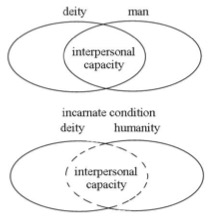
If we get rid of the idea of omnipresence as immensity, we know of nothing the Son had to give up to become incarnate. Immensity would have to be given up in favor of location in a physical body. Omnipresence may be an extension of omniscience (Psalm 139).
On the one extreme, overemphasizing Christ’s deity detracts from the value of the incarnation for us. It changes the normal human experience into something not so extreme as what we endure in our physical situation. That tendency found its ancient expression in Docetic Gnosticism, where Jesus was only a phantom; that would hardly enable him to be tempted in all points such as we are (Hebrews 4:15). On the other extreme, overemphasizing Christ’s humanity detracts from the strong testimony in the New Testament regarding his hypostatic deity (Hebrews 1:1-4).
christir.org