
Husband of One Wife
HUSBAND OF ONE WIFE
Virgil Warren, PhD
Paul gives “husband of one wife” as a characteristic of elders and deacons in 1 Timothy 3:2, 12 and Titus 1:6. The following diagram traces the pattern of thought for determining what he meant by this phrase.
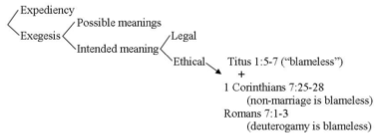
STEP I. We must distinguish between what to do because it is best under the circumstances (“expediency”) and what a passage requires (“exegesis”). For instance, in the case of married versus not married, it is one thing to say that there are advantages to having a married eldership; it is another thing to say that Paul is requiring a married eldership. This treatment of the problem addresses primarily what the passage means as to whether elders and deacons must be married.
STEP II. In any example of language, a second distinction exists between what an expression can mean in differing contexts and what it is intended to mean in this context. Husband of one wife might require marriage in the right context, but giving it that meaning here is a different matter. It could likewise eliminate from the eldership and deaconship someone who had remarried after the death of his wife (deuterogamy), but whether Paul means to eliminate such men here is another question.
The meaning of husband of one wife probably cannot be settled from 1 Timothy 3. Titus 1:5-7 provides the key to Paul’s intent:
“If any man is blameless, a husband of one wife, having children that believe, who are not accused of riot or unruly—because the bishop must be blameless as God’s steward.”
“Blameless” appears on both sides of the target expression, and the word because links the characteristic to that blamelessness. The kind of reason Paul gives for the characteristic shows what kind of characteristic he has in mind. A moral/ethical reason anticipates a moral/ethical conclusion. Paul requires an elders and deacons to be husbands of one wife because they should be blameless. Furthermore, blameless must have a biblical, rather than cultural, frame of reference; otherwise, this characteristic would not be constant from place to place or time to time. We must consult the rest of the New Testament to determine what blameless marital statuses there are.
STEP III. From 1 Corinthians 7:25-28, it is obvious that whether a man is married is an “amoral” matter. Being married is a legal status, not a moral one. So, “husband of one wife” does not necessitate marriage here regardless of what the expression could mean under different circumstances. Romans 7:1-3 and 1 Corinthians 7:39 indicate that a similar line of reasoning applies to remarriage after the death of a former mate: it is blameless.
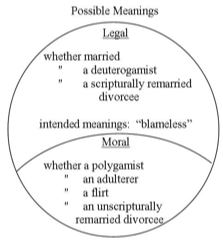
The figure below represents the author’s understanding of Paul’s intent based on the observation from Titus 1:5-7 that he has a moral matter in mind. The larger circle represents the possible applications of husband of one wife; the more restricted circle represents moral matters biblically defined. Whether a man is married or a deuterogamist falls outside the moral category. The decision about a scripturally remarried divorcé depends on a person’s understanding of that issue as a separate concern under specific circumstances.
Husband of one wife, ethically speaking, would most naturally eliminate polygamists and some divorcees. Since the lists of characteristics do not mention fornication and adultery separately, they are probably included here by implication. Since “flirting” is a behavioral expression of the same weakness, it should belong under this qualification too.
Other Observations
In addition to the line of thought above, additional observations confirm the conclusion it yields.
1. Wife of one husband is a comparable expression in 1 Timothy 5:9 used of widows enrolled in support by the church. (a) It is hard to see that the expression could possibly be requiring marriage. If a woman had never married, it would likely make her a more legitimate object of benevolence since she would have no family to support her in her old age (cp. 1 Timothy 5:4). (b) We also find it hard to see why a woman widowed the second time would be eliminated from the church’s benevolence program, because she remarried after the death of her first husband (note especially 1 Timothy 5:14).
2. Husband of one wife does not have an article on “man/husband” in the Greek, which puts emphasis on character: he must be “husband of one wife,” a “one-woman-kind-of man,” “a one-woman man,” as commentators sometimes say.
3. Since church leaders always come from the local membership, we would not expect to have a required characteristic that Paul advises the general membership is against because it might hinder their service under “distress” conditions (1 Corinthians 7:28-38).
4. It seems unlikely that a man like Paul would be unqualified for a position lower than the one he held because of a qualification not germane to Christian concerns. Paul may have been an elder in Antioch (Acts 13:1-3) since teacher can be an alternate term for elder (Ephesians 4:11), and the New Testament never mentions elders in Antioch. Paul may have been married at one time and his wife had subsequently died or deserted him after his conversion (Philippians 3:8?). He may have been a member of the Sanhedrin, which presumably required marriage.
5. If Paul wanted to require marriage, he could have said it more clearly: “It is necessary for an elder to be married.”
6. To be consistent, those who think that “husband of one wife” requires being married should require that an elder or deacon have more than one child (which would eliminate any sterile man or anyone with a barren wife), that the children be old enough to believe in Christ, and perhaps that they be living at home.
Arguments Used for the Necessity of Married Elders and Deacons
1. A man cannot be the husband of one wife without having a wife. It is true as regards reality that a man cannot have one wife without having at least one, but with the mind a speaker may distinguish between one vs. more than one without intending also to require one vs. none. In the case at hand, the intended contrast is between one and more than one (further restricted to not more than one in a morally blameful sense). It is true that one cannot drive 45 mph unless he is driving, but a government that requires us to drive 45 mph does not require us to drive. A characteristic that regulates man-woman relationships does not require a man-woman relationship. The intended contrast to the words is the concern; a reader must not confuse language and reality (reification).
2. 1 Timothy 3:5 asks how a man can take care of the church if he cannot manage his own home. The verse does not signify that a man must have the experience of managing the home before managing the church. It offers a negative test. If he does not know how to manage his house, we surmise that he cannot accomplish the harder task of managing the church. Certain results are required in the domestic testing area; that does not require the testing area itself. Having the experience of exercising authority is evidently not the point of the husband-of-one-wife requirement, because Paul repeats it with deacons, who do not hold an authoritative position.
Related to experience in exercising authority is the question of how people are to know whether someone can manage well unless he has demonstrated such ability in the home. (a) Ability to lead can be developed and demonstrated in other places like business and education or in “unofficial” natural leadership in the church. (b) The deacon’s position is a natural place to develop and demonstrate the ability to carry responsibility and perhaps exercise delegated authority (1 Timothy 3:13). (c) We can usually tell responsible leaders by the way they move among people.
Stability of personality might be enhanced by marriage, but not being married does not necessarily involve instability. Sometimes the reason a man is not married may be the reason he is not qualified to be an elder, but his not being married does not in itself disqualify him.
3. An elder can better meet the needs of married people if he has been married. While that is true, it does not necessitate a married elder any more than it necessitates a married minister. People do not argue that to be biblically qualified, a minister has to be married. That consideration has practical value, but expediency is different from necessity and from what a text means. There would normally be other, married elders who could assist in areas where the lack of domestic experience might make it hard for married people to come to a celibate elder for counsel. In the Roman Catholic church, the unmarried priests take part in marital counseling work.
4. To be an elder in a synagogue, a man had to be married. The weight of this consideration has questionable relevance since the church is a different kind of institution.
“Having Children That Believe”
The characteristic that a man have faithful children is like the requirement that he be a husband. To require faithful children is not to require children. The concern is faithful versus unfaithful (modifier) rather than children versus no children (phrase head) or more than one child versus one child.
What constitutes a faithful child does not necessarily involve someone of the age of accountability. Children raised in a Christian home may believe (Titus 1:6) for some time before their parents consider it appropriate for them to be baptized, “formally” becoming a member of the body of Christ.
Throughout this document we have used “characteristics” instead of “qualifications.” The choice reflects a desire to reduce the matter from something akin to the qualifications for a public office like the presidency. The choice of “characteristic” stems from our conviction that Paul has in mind moral matters, matters of character, as Titus 1:6-9ff shows Especially of note is his framing this item with the word “blameless” before and after “husband of one wife.” Of note as well is the apostle’s listing “husband of one wife” with deacons (1 Timothy 3:8-13), where the teaching-ruling function does not come up (3:12?). Above reproach, blameless, behavior saturates the descriptions of elders and deacons.
Additionally, there is the matter of “competence” that derives from the teaching and overseeing roles bishops/elders perform for the local believers. In these last respects, “qualification” does more naturally apply because a man can be a Christian without having a “skill” like leading or teaching.
christir.org