
Chapter I
CHAPTER I
NON-DENOMINATIONAL UNITY IN PERSPECTIVE AND PREVIEW
General Framework in Diagram
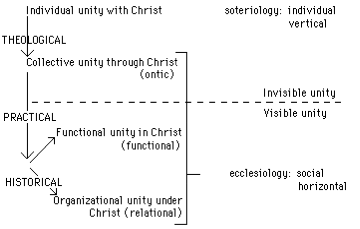
The framework of thought for this entire presentation is previewed in the following diagram. The diagram delineates four aspects of Christian unity as it relates to salvation, and shows their general correspondence to proposed divisions of the whole topic of unity.
Fig. 1. Four Aspects of Christian Unity
Soteriological Context: Being
Salvation and Unity
“Individual unity with Christ” refers to the interpersonal relationship with Christ made possible by his moral perfection. Individual salvation both precedes and pervades the subsequent horizontal group aspects of Christian unity.
Gestalt psychology has popularized a helpful concept that brings into focus the place and necessity of unity: “the whole is more that the sum of its parts.”1 Collective unity as expressed in structure-function is one corporate quality that lies beyond the sheer sum of parts. “Collective unity through Christ” moves back far enough from “individual unity with Christ” to see all as one in the state of salvation. Collective unity combines with functional and organizational unity to form the dynamic composite of being, action, and relationship that stands distinct from, and parallel to, “the world” and is called “the church”: saved people (collective unity) cooperating (functional unity) in divine pattern (organizational unity). As the whole is more than the sum of its parts, the church is more than the sum of the saved.
While church unity is within the context of salvation, the purpose of this study is not to deal with soteriology as such, except to draw out its restrictive implications for the form of the church–implications that negatively preclude denominationalism without in themselves positively determining the precise pattern for non-denominationalism.
Salvation and Denominations
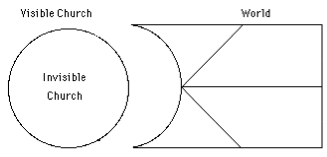
The intent is not to question whether people in denominations are saved, but to argue that saved people should not be denominated. A person’s very desire to affirm the individual salvation of all believers only further impresses him with the inappropriateness of divisions among them. The following diagram illustrates the author’s view of the relationship between the invisible body of Christ and the denominations of the visible church seen by the world. Unity under Christ has as its goal the purging of the church from foreign elements and
Fig. 2. Denominations and the Invisible Church
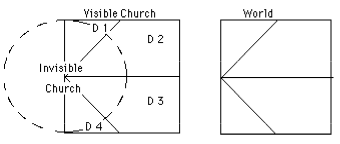
the elimination of distinctions among the saved so that the united invisible church is visibly distinct only from a divided world.
Fig. 3. The Church and the World
General Structure-Function Characteristics: Being
Historical
Various combinations of denominational characteristics are often reflected in, and reinforced by, an accompanying separate organization. This study outlines the original pattern of the church as the normative apostolic precedent recorded authoritatively in New Testament history. The positive presentation for non-denominational unity is rooted in the realm of historical origins, whereas the negative presentation against denominationalism would be argued on the principle of consistency from theological and practical considerations. In consequence of these three approaches, the New Testament impresses on the modern church a need for present unity on earth in conformity with the fact of a common origin in history and a common destiny in eternity.
Visible
Visible unity is more at issue than the invisible oneness into which studies of Christian unity sometimes retreat leaving the visible church divided without blame.2 The distinction, valid in itself, offers no avenue either for making indifferent, or for justifying, division in the visible church. The saved are of course one in their being saved, but such essential unity is only the basis-in-being on which the New Testament boldly builds an additional unity of function-in-form. Though the church is people, it is pattern as well. Though it is first invisible, it is also to manifest itself.
Universal
The kind of organizational oneness in the visible, universal church is the full and proper subject of this thesis. It goes beyond the question of local autonomy and structure to the larger question of whether there can be any present earthly headquarters, one or several, in the united church of Christ catholic.
Functional Unity in Christ: Action
Common Approaches to Christian Unity3
Doctrinal Reductionism
Erasmus gave classical expression to the concept that the ultimate basis for Christian unity lies in the most elemental articles of the Christian faith. Aside from them there is nothing required for Christian fellowship and church unity.
Organizational Union
Richard Hooker may be cited as a prominent exponent of the view that the church is primary over the individual believer. Unity, therefore, results from the church rather than in the church. Roman Catholicism has been an advocate of this approach along with individual leaders in other denominations.
Personal Conversion
In addition to the doctrinal and the institutional, there is the experiential basis for unity that arose among the pietists of England and Holland. The common salvation of the saved is viewed as the decisive factor that provides for, establishes, and seeks to express itself in, the unity of the church.
The Approach Herein Presupposed
Formal Approach
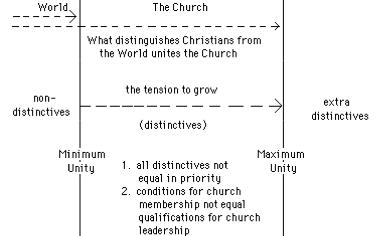
The formal approach to the visible unity of the church may be expressed in one general principle: “What distinguishes Christians form the world is what unites them together.” What takes individuals out of the world in the first place becomes the minimum basis for uniting them together in the church. Everything that distinguishes Christians from the world becomes the maximum requirement for uniting them together.
Within this broad framework lie four sets of distinctions that guide the church in its growth from minimum toward maximum unity. (1) All distinctives are important, but all are not equally central to the Christian system.
(2) The conditions for church membership are not the same as the qualifications for church leadership. To become a Christian, a person does not have to be full-grown; but after he has been born in justification, he must be growing in sanctification toward naturally leading in the church.
(3) Ignorance differs from rejection and unbelief differs from disbelief. Some Christians may need to know the way of the Lord more perfectly. This is the work of Christian education in its broadest and most practical sense: perfecting Christian unity. Others may reject added truths or may apostatize from previous beliefs or righteousness. This is the work of church discipline discreetly exercised in connection with “first and second admonitions”: preserving Christian unity. So nothing is perfected or preserved by denominations that could not be effectively accomplished without them.
(4) Earnest uncertainty about a truth is different from blatant opposition to it.
Beyond the minimum basis for unity there is the tension to move toward perfect oneness. Failure to come to agreement must be viewed as temporary lack of progress in a context of mutual respect of persons and common submission to the will of God.
What distinguishes Christians from the world is what unites them together. Therefore, only Christian distinctives are necessary for Christian unity, and no additional ones may be required. All are necessary so that an emphasis on some cannot be the basis for a division of the church. No denomination can be founded on less or more than all Christ teaches and commands his one church. Founding a new denomination is not an orthodox means of maintaining orthodoxy.
Material Application
Certain material elements of these formal guidelines will be implicit in the assertions of the thesis. Conversion takes place in response to doctrinal matters, and on the conditions of responsive faith God saves. He saves from sin, adds to the church, and gives minimum church unity on the same conditions and at the same time. Doctrine, experience, and organization are therefore temporally simultaneous as well as logically sequential in that order. The outworking of Christian unity comes in (1) the common acceptance of the Bible as authority, (2) doctrinal agreement4, (3) practical cooperation, and (4) organizational oneness.
Fig. 4. Formal Framework of Church Unity

Organizational Unity Under Christ: Relationship
Summary of Corporate Ecclesiastical Patterns
From an organizational standpoint the forms of the universal church are divisible into three general groups according to the presence or absence of earthly “headquarters” and local congregations: (1) local congregations and earthly headquarters; (2) no local congregations and no earthly headquarters; (3) local congregations and no earthly headquarters.
Local Congregations and
Earthly Headquarters
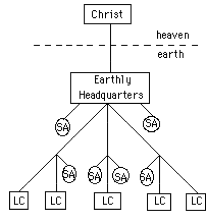
“World-Churchism.” Two variations exist in the category characterized by local congregations and earthly headquarters. The first of these may be called “world-churchism” because there is numerically one ecclesiastical organization on earth. Very generally this concept of the church is represented by the next diagram. The Earthly Headquarters may represent a continuation of the original “apostolic college.” Under this central person or group of officials are different levels of jurisdiction with Service Agencies and degrees of responsibility over the Local Congregations. To this pattern belongs notably the Roman Catholic Church (in its doctrinal position on the church) as well as the goal of some ecumenicists for the “Coming Great Church.”5 The unity here is organizational and is expressed in organized action.
Fig. 5. Pattern of “World-Churchism”
Denominationalism. A second variation in this same category is denominationalism, or pluralism. “Denominationalism” means here “world-churchism” multiplied into a number of parallel systems whose polity may be episcopal or presbyterian.6
Fig. 6. Pattern of Denominationalism
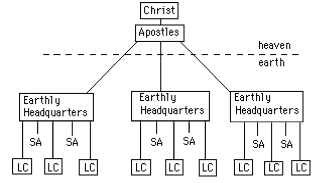
These denominations do not necessarily view themselves individually as the only saved people. Either their differences are considered sufficient to keep them from being organically united, or are insufficient to impress them with the need for it. Unity in such cases is invisible, and is expressed visibly through different degrees of interdenominational co-operation on areas of common ground.
No local congregations and
no earthly headquarters
Emil Brunner sets forth a view that seems to be gaining momentum in modern attitudes toward the church: the Ecclesia itself is aside from, other than, and without reference to,
Fig. 7. Pattern of “No-Churchism”

organization.7e.g. Ecclesia is indeed people (ἐκκλησία) in vertical communion and horizontal fellowship (κοινωνία), in service (διακονία), and the like; but it does not include form in the organizational sense. Unity is, therefore, not formal, as in world-churchism. It is more than invisible, as in interdenominationalism; it is simply and significantly dynamic.
Local Congregations and
No Earthly Headquarters
The following schematic shows the relationship of Christ, the Apostles, Local Congregations, and Service Agencies in an organizational pattern that has no earthly headquarters.
Fig. 8. Pattern of Non-Denominationalism
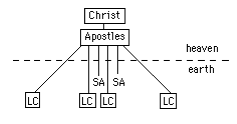
The dynamic nature of non-
denominational authority. There are various forms of interpersonal control: physical force, personal influence, and legal authority. Of these three, the pattern for the flow of authority is the peculiar emphasis in the organizational aspect of unity. Non-denominationalism has a system of authority that flows in such a way that the universal church is one in it while relying as little as possible on it.
Describing as a corporate “organization” a series of autonomous congregations with no earthly headquarters, does not accommodate the term as long as Christ and the apostles are in the pattern. Nevertheless, a person’s historical context of denominational complexity may cause him to misconstrue the simplicity of that original pattern as no real pattern at all. The church is a high-trust, low-fear system that relies more on personalized power than on legal authority,8 but that does not mean it has no pattern of authority.
Misconstruing simplicity and overemphasizing trust use their common conclusion in opposite ways. The former moves church organization into the realm of spontaneous generation and social evolution, automatically changing authoritative precedent to mere example so that a search for the divine pattern of the church and its unity ceases.9 Modern Christianity is thus made responsible for developing its own expression of unity according to its perception of what is appropriate to the nature of the body of Christ. Overemphasizing trust, on the other hand, reacts unduly against organization and seeks to express unity only in the exercise of interpersonal love. A New Testament picture of the church combines a strong reliance on inner motivation with a recognition of simple authority.
Local autonomy and responsibility. Non-denominationalism involves a universal organizational pattern in which each congregation is autonomous under Christ. Congregations and agencies on earth are under the apostles in heaven by virtue of their submission to the New Testament, which preserves all the apostolic truth the church needs to know. The local church stands legally independent of all outside controls even while it is responsibly sensitive to outside concerns. From within, the churches regulate their own personnel, programs, and properties. In principle any group of congregations that fully practice local autonomy is organizationally non- denominational.
Local autonomy is here viewed in light of the total cause of Christ.
The autonomy is not absolute. The authority of Christ as solitary Head of the church must be recognized; and the Scriptures, rightly divided, accepted as the all-sufficient rule of faith and practice.
The principles of autonomy must be applied to the relationship that exists between the local church and other churches.
The principles of autonomy must be applied to the relationship that exists between one or a number of local churches to an extra-congregational ministry or organization.
Decisions in that realm where Christ has left the congregations free are to be made in the light of the relevant law of love and expediency. We are not to think of freedom here as being absolute.
Local autonomy does not relieve the brethren of like precious faith in various sections of the world of the obligation of mutual concern in the Lord.10
The congregations, then, are both legally free and morally responsible.11
Extra-congregational service agencies are not part of the church’s visible organization except in the non-legal sense that they exist as non-prescriptive entities under biblical jurisdiction. Individual Christians incorporate under the state to form non-profit publishing houses, educational institutions, benevolent services, and missions agencies voluntarily supported by individuals and congregations.
World-churchism is correct in its contention that the church should be one even organizationally, the position taken by ecumenical and Catholic writers. On the other hand, full weight must be given to Brunner’s emphasis on the dynamic aspect of the Ecclesia, the position evangelicals tend to take. Non-denominationalism includes both an organizational and dynamic unity. This combination is made possible by the simplicity of its organizational pattern.
Qualifying Distinctions
Attitude and Status
Denominational attitude and status have no necessary correlation. Parochial exclusivism ingrains itself in groups natural as well as formal and tends toward fragmentation in either. Freedom is not the cause; structure is not the cure. The heart of the problem lies in the hearts of the people. The “mark of the Christian” is an outward behavior springing from an inner disposition regardless of the environment in which it grows.
Division and Separateness
Separateness differs from division as working privately differs from working competitively. But it does not seem correct to consider the denominations in America, for instance,12 as merely separate groups while they have among them mutually exclusive formative principles. The total state of affairs in denominational Christendom does not measure up to the New Testament standard for oneness either in kind or in degree.
Unity and Union
Unity is not synonymous with union. “Union” emphasizes organizational form without sufficiently stressing that general oneness of quality-in-form which grows out of personal and doctrinal matters. Unity must begin from within and will appear outwardly.
Unity and Uniformity
Unity views synthetically the harmonious inter-relationship that characterizes a whole comprised of even diverse, interdependent parts. Uniformity views analytically the formal, parallel likeness of independent parts. There are parallel features in the autonomous congregations of the New Testament, but the unity of the universal church is more than the sum of certain formal likenesses discoverable in these largest of its constituent parts. Non-denominationalism describes the whole of the church, focusing not on the uniformity of parts, but on the form and character of its total unity in history.
Causing and Curing
People are not guilty for what they inherit, but they are responsible for what they perpetuate. Christians must be concerned about division, and must make every effort to cure what predecessors have caused. Although guiding principles inhere in the apostles’ handling of incipient division, most New Testament injunctions address causal factors and their inappropriateness among God’s people. This examination of the basis and nature of New Testament unity seeks to increase sensitivity to the problem of division, but does not suggest a program for unifying today’s divided Christendom.13
Summary
The essential basis of Christian unity lies in the gift of fellowship with God by virtue of salvation from sin and separation. From a functional standpoint unity progresses from the point of the common salvation to the full extent of the Christian distinctives.
In the question of organizational church unity, the proper antitheses are not (1) organizational unity vs. functional unity (Catholicism vs. Emil Brunner’s concept), or (2) visible unity vs. invisible unity (Catholicism vs. denominationalism), but (3) hierarchical unity vs. non-hierarchical unity. It is a question of the form of organizational unity per se.
Non-denominationalism refers to a kind of Christian oneness: an essential, functional, historical, universal, visible, organizational oneness without such denominational characteristics as exclusivistic attitude, private doctrinal emphases, restrictive Christian fellowship, distinguishing names, or hierarchical structure.
The church, then, is saved people serving together in divine pattern.
ENDNOTES
1An introduction to Gestalt psychology may be found in Wolfgang Kohler, Gestalt Psychology.
2See G. W. Bromiley’s commendations and objections to this concept in The Unity and Disunity of the Church, pp. 32-38; cp. endnote 8 in “Introduction.”
3The following summary uses the convenient categories enumerated by W. A. Visser’t Hooft, “Our Ecumenical Task in the Light of History,” ER, Vol. VII (July, 1955), pp. 309-20.
4Hence, this approach repudiates the view of some ecumenical writers who have argued that doctrinal agreement is not essential to Christian unity; note C. C. Morrison, The Unfinished Reformation, pp. 82, 199.
5The present blueprint of the World Council, however, makes it a confederation of churches, which retain individual sovereignty, rather than a federation, where individual sovereignty is not retained. W. A. Visser’t Hooft affirms the confederate goal of the Council in “The Significance of the World Council of Churches,” pp. 177-95. Others view the present confederate character of the “Council” as a provisional instrument for a full organic unification. See Walter Marshall Horton, Toward a Reborn Church, pp. 91-92; or Lesslie Newbigin, The Household of God, p. 14.
6Even free church fellowships with congregational autonomy may be denominational for all practical purposes. So contends Paul M. Harrison, Authority and Power in the Free Church Tradition: A Social Case Study of the American Baptist Convention, pp. 60, 79, 86-87, 92, 117, 183. The civil courts of North Carolina have even ruled in the case of Southern Baptist churches that congregations with the Southern Baptist Convention, at least under certain conditions, forfeit property rights on withdrawal from the Convention. See attorney Luther Doniphan Burrus’ article, “Judicial Recognition of the Unique Congregational Polity of New Testament Churches of the Restoration Movement,” SR, Vol. II, No. 2 (1956), pp. 7-8. Similarly, on December 3, 1953, the Court of Appeals of New York reversed Kings County Court, giving the General Council of Congregational Churches properties of all its affiliated congregations. As a result, the General Council merged with the Evangelical and Reformed Church and was eventually carried into the United Church of Christ in July, 1961. For a useful sketch of the major denominational patterns, see J. Paul Williams, What Americans Believe and How They Worship.
7The Misunderstanding of the Church, trans. by Harold Knight. See pp. 99-100 for one statement of the idea that the Ecclesia is not associated essentially with organization. This concept as expressed by Brunner does not eliminate congregations as functioning groups of believers, but it is a “no-local-congregation” system in the organizational sense.
8Jack R. Gibb delineates the differences between the high-trust, low-fear system and the low-trust, high-fear system in “Fear and Facade Defensive Management,” in Science and Human Affairs, ed. by Richard E. Farson, pp. 197-214.
9See Chapter V, endnote 23, for a description of normative precedent.
10[George Mark Elliott], “Biblical Theology” (unpublished course syllabus), p. 198.
11Note this concern expressed by R. Pierce Beaver in his book From Missions to Mission, pp. 104-5.
12A general idea of the current extent of pluralism in America may be gained from perusing the Yearbook of American Churches: 1972, ed. by Constant H. Jacquet, Jr. The Yearbook reports data on 236 religious bodies. America’s contribution to world-wide denominationalism is evident in North American Protestant Ministries Overseas, published by Missions Advanced Research Communication Center. See also World Christian Handbook: 1968, ed. by H. Wakelin Coxill and Kenneth Grubb; or Handbook of Denominations in the United States, by Frank S. Mead.
That the denominations of Christendom are not only separate, but divided, seems obvious from practical matters such as their mutually exclusive polities, closed communion; disagreement on the action, design, candidate, and administrator of baptism; the inability of ministers to be approved for service as readily in one denomination as in the next. Were the denominations merely separate, these problems would not exist.
Baptism, communion, and polity are also singled out by Matthew Spinka, The Quest for Church Unity, pp. 55-57. As a result of mutually exclusive views on these matters, Spinka is rather cautious about the full success of Christian unity (pp. 83-85).
13Beginning with local autonomy does imply a consequent pattern of organizational unification–a unification through dissolution of super-congregational authority and a strengthening of extra-congregational communication and cooperation, congregations being the common element throughout Christendom. Practical and doctrinal unification are realized together in a pattern of reciprocal reinforcement: progressive growth of fellowship and functioning is proportionate to an increasing doctrinal agreement centered around salvation by faith only through Christ alone. Strictly speaking, then, non-denominationalism involves an unusual form of the unification Earle E. Cairns styles “organic reunion” as distinguished from, and more than, “confederation” and “co-operation”; see Christianity Through the Centuries: A History of the Christian Church, pp. 485-92, or Christianity in the United States, pp. 168-74.
christir.org