
Chapter Iv
CHAPTER IV
THE NORMATIVENESS OF THE NEW TESTAMENT STRUCTURE
Divine Origination
Prescriptive Divine Origin
The normativeness of the first-century pattern may be conveniently discussed under three headings progressively arranged: divine origin, intended permanence, and inherent exclusive-ness.
Formal application
Christ’s lordship. Jesus Christ is an appointed King of a granted kingdom (Luke 19:12). The givenness of that entity includes its form—“kingdom”—as well as the principles of kingdom government–formal authority prescriptively applied. The organization of the church did not result from a natural process of crystallization among the disciples of Jesus, for Jesus was not a teacher like Socrates, who wrote nothing, founded nothing, and died, only to leave behind a group of followers that evolved a tradition of thought and practice. As to essential nature the church is kingdom as well as brotherhood. As regards government, the church may be called a Christocratic monarchy.
Jesus Christ is formal Head of the church. “All authority was given to me . . .” (Matthew 28:18; cp. Daniel 7:13-14; John 17:2). It was given because of his qualifications and did not arise directly out of his person so that Jesus Christ leads not only by power and influence in interpersonal love, but also by divine grant in impersonal law. His lordship, then, like his priesthood was by power as well as commandment (Hebrews 5:1-10; 7:16); for the Messiah was to be an eternal High-Priest King (Psalms 110:1-4). In that the church (1) has a Head who (2) received the headship (3) even before the church existed through whose ranks he might naturally rise (John 13:13), the whole church–or the church per se–is placed in the category of formal organization.
General statements re lower ranks. He to whom all authority was given in heaven and on earth ascended from earth to heaven and gave gifts to men. He gave some to be apostles; and some, prophets; and some, evangelists; and some, pastor-teachers” (Ephesians 4:11). Similarly, Paul says again in connection with Psalm 68:18, “God set some in the church, first apostles, secondly prophets, thirdly teachers” (1 Corinthians 12:28).
Particular statements re lower ranks. Besides statements about the givenness of church positions in general, passages dealing with individual offices and functions are frequent. As the Lord said, “Authority was given to me” so also the apostle Paul speaks of the “authority that the Lord gave” (2 Corinthians 13:10; cp. 10:8; 1 Timothy 2:7). In the headings of nine epistles he mentions this fact.1 Perhaps he does so because of the Judaizing teachers who were taking it on themselves to “correct” the apostle’s teaching and leadership, and thus were false leaders who fashioned themselves into apostles of Christ (2 Corinthians 11:13-15). A man can no more make himself an apostle than he can make himself a saint (cp. Romans 1:5; 1 Corinthians 1:1 + 2) or a worker of miracles (1 Corinthians12:28-30).2 That the origin of the apostolate was formal rather than spontaneous is evident from the fact that the apostles were chosen even before the church was established. That they did not simply gravitate to the top among their peers is particularly obvious in the case of Paul the persecutor.
Eldership is an office “set in the church” by God (1 Corinthians 12:28), “given” by Christ (Ephesians 4:11), “made” by the Holy Spirit (Acts 20: 28), “allotted” to certain qualified men (1 Peter 5:3). The office, its qualifications, and first incumbents were established by God. In leadership, givenness means formalness.
As to evangelist, in the particular case of Timothy the gift is said to have been given by Paul (2 Timothy 1:6, διά), with the presbytery (1 Timothy 4:14, μετά), and by prophecy (2 Timothy 1:6; 4:14, διά). Acts 16:1-3 is evidently the occasion to which these passages refer.3
Enumerating qualifications accompanies formal office so that deaconship is a formal function even though Paul does not mention it in 1 Corinthians 12:28 or Ephesians 4:11. It is significant that newly converted groups of believers were not left to organize themselves as they might have seen fit (Acts 14:23; cp. Titus 1:5ff.).
Establishing persons in a position is distinguished, of course, from establishing the position itself, or establishing the responsibilities resident in it. If only the former were expressed in scripture, one might reason that God did not prescribe the form of the church, but only permissively appointed certain personnel, such as the elders of Ephesus, Matthias, and Timothy.4 First, appointment of persons necessarily implies ratification of positions. God does not positively assist or credential what is contrary to his will.5 Secondly, in 1 Corinthians 12 and Ephesians 4 Paul is not talking about, or to, particular persons; so he must mean particular kinds of interdependent ministries designed to help the church mature. He speaks particularly of ministries, rather than the ministering persons, because he does not have definite individuals in mind and because he draws attention to the purpose of the responsibilities they have and the tasks they perform: the growth of the church. The gifts of the Spirit are more particularly in view in 1 Corinthians 12:1, “now concerning spiritual gifts . . . .” Thirdly, Paul is speaking of slots as well as the slots’ responsibilities because he lists things that involve clusters of responsibilities. If only functions were in mind he would speak of them individually as he does in 1 Corinthians 12:28b, 29b-30. Positions of responsibility are also in view in 1 Corinthians 12 and Ephesians 4.
Consequents. The givenness of Christ’s headship places the whole church in a system of formal leadership. Whether viewed collectively or individually, the offices and functions of the Christian church were formally bestowed from the outside instead of spontaneously generated from the inside. Formal application shows that (1) the church has organizational form in the strict sense instead of being simply a community of persons drawn together by love alone. (2) Furthermore, organization is not a matter of indifference in the body of Christ visible, and all the more so when taken in connection with the considerations yet to be developed. The church has a givenness in it regarding organization; its form is the result of formal application.
Divine application
Many passages that indicate the giveness of church positions also directly indicate their divine givenness. Not only did “God set in the church . . . ,” but “God set in the church apostles,” etc. (1 Corinthians 12:28); “Christ gave apostles,” etc. (Ephesians 4:11); “the Holy Spirit made” men elders (Acts 20:28).6 Divine application shows that the positions of service are ultimately and essentially divine, being bestowed from above rather than from beside. Different levels coming directly and indirectly from God, the form of the church is the result of divine application. As Christ was the proper starting point for placing the church in a formal framework,7 so he is the proper starting point in the official manner of placing the church in it. (1) According to Colossians 1:15-19 together with Matthew 28:18, God the father was pleased with respect to the church to give Christ all pre-eminence in heaven and on earth.
(2) Christ prophetically promised to build his church on the living truth of the great confession.8 “I will build my church” has a historical thrust. It involves a crisis and a process. The Christ the Son of the living God was going to establish his kingdom and build his church, and the grave (“Hades”) was not going to stop him (16:18 + 21) nor overpower it (16:18).
(3) Christ chose his primary messengers.9 He equipped them with his Spirit (Acts 1:8), who was to guide them into all truth by speaking the same thing as Jesus spoke.10 He sent them out to preach the gospel to every creature.11 He directed them through the Spirit to the places where he wanted them to evangelize.12
(4) He aggregated their converts to form the church (Acts 2:41, 47). He organized the congregations, appointing elders by the Holy Spirit through the apostles.13 He chose, equipped, sent, and directed the apostles adding together their converts under elders–all this in addition dying for them. If the Lord ever did anything, he certainly built his church.
An inspired interpreter of gospel prediction, the book of Acts shows that Christ’s building of the church (Matthew 16:18-19) was fulfilled indirectly through apostolic agency guided by the Holy Spirit. Conversely, the gospel prediction shows that what his apostles were doing was his doing.14 Official application refers to the manner in which the pattern of the church unfolded from the Father, through Christ, through the apostles, to the elders. The form of the church then is a result of official application.
Christ’s prediction that he would build his church (Matthew 16:18) is followed by an explanation of how he intended to do it: indirectly through the agency of the apostles (Matthew 16:19; 18:18): “I will give you the keys of the kingdom of heaven, and whatever you bind on earth will certainly be bound in heaven, and whatever you loose on earth will certainly be loosed in heaven.”15 What he intended to do can only be determined from what the apostles did and taught in his name. Everything they did and taught as representatives was presumably his will, and organizational matters were included in their activity and teaching.16
Matthew 16:18-19 (and 18:18) is the prediction of which Matthew 28:19-20 is the command and Acts is the account. The “keys” Christ gave are “whatever I commanded you.”17 The “bind/loose on earth”18 is the “make disciples, baptizing, and teaching.” The “bind/loose in heaven” is the “Lo, I am with you.”19 In view is a three-step process that begins with the decretive will of Christ for the church he wanted to build, followed
Fig. 14. Commission, Obedience, and Ratification
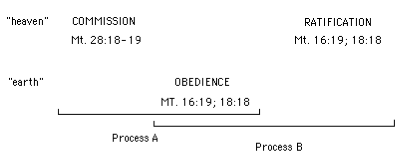
by the carrying out of that will by his representatives, and his “backing them up” and “sticking to his promises” when they fulfilled his will. They were not given free rein to do as they saw fit, but were to do and teach “whatever I commanded you.”20
Authoritative application
The official manner of application in church organization has been traced from Christ’s prediction to build the church to the inspired apostolic fulfillment. The authoritative mode of application also runs through this same process. “All authority was given to me in heaven and on earth; Go . . . .” By virtue of the fact that Christ is an authoritative Head, the whole church is put in the category of authority. In an earlier section it was argued that the apostles he thus commissioned had supervisory authority.21 Evidence offered there dovetails with the process predicted in Matthew 16:18-19. Since the apostles were authoritative as well as official representatives, what they did as representatives had the authority dimension in it as truly as what they said as representatives.22 Since they functioned with regard to organization the form of the church is a result of authoritative application.23
Building is a total process that necessarily involves both substance and form, design and materials–in this case divine pattern as well as saved people.24 As a consequence of Christ’s general prediction that he would build his church and the over-all promise to guide his representatives by whom he built it, the precise question becomes whether pattern should be exempt. From the promise and the prediction there seems to be no theoretical reason that organization be exempt. Moreover, there is positive historical evidence that it was included. In organization God did guide. The record of the apostles’ acts generally is a record of God’s doing indirectly, and the particular acts of appointing positions lower than their own is expressly called God’s doing (Acts 20:28; 1 Corinthians 12:28; Ephesians 4:11). Evidence for the prescriptive origin of the church is as strong in kind as the prescriptive origin of the gospel; there is as much justification for supposing that the apostles were permitted to determine the form of the church as for supposing that they were permitted to decide the terms of admission into it.25, 26
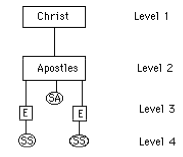
The process of prescriptively originating the form of the church may be summarized in a diagram read top to bottom and left to right. Three levels represent successive levels of official
Fig. 15. Manner of Divine Origination
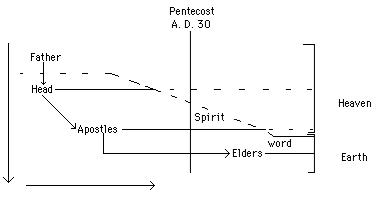
and authoritative application. The left-to-right direction depicts the progression of time during which the three offices were historically realized. The Father gave (a) headship to the Son, who delegated (b) apostleship to the Twelve-plus-Paul, and they in turn appointed (c) elders. As in any formal system, the lower levels operate under the jurisdiction of the higher ones. Moreover, in the church an omniscient God has not only negatively limited the lower ranks within the higher ones, but positively guided the lower ranks through his Spirit and eventually through a written revelation as well.
The formal, divine, official, authoritative application of church form establishes its prescriptive origin.
Not Permissive Divine Origin
New application
Prescriptiveness is compatible with previousness. The prevalence of ancient monarchies does not detract from divine right in the Davidic dynasty or the lordship of Christ. Elders in the Jewish synagogue harmonize with their necessity in the church. Constitutionally the church is a new entity;27 its government is therefore a new application. Its prescriptiveness inheres in the newness of application not in the uniqueness of kind; so previousness does not detract from normativeness. Prescriptive origin does not necessarily mean complete originality.
Church polity is essentially divine in origin. In the last analysis it was not produced by an unguided social evolution even if certain elements appeared before. Such may not be immediately obvious, however, from a cursory comparison of operations in the Christian congregation and the Jewish synagogue. Evolutionary theory may indeed fit with a significant part of the functioning of the whole biblical religion. Progressive revelation is easy to misidentify as progressive evolution. In the operation of something, its distinctive nature and significance may not be observable and so must be revealed. The crucifixion scene, for example, may not itself be such that a person can distinguish a peculiar objective significance in the death of the man on the middle cross. Nevertheless, divine revelation declares that the salvation of all mankind hangs on it. The operation of the church and synagogue may have had parallels,28 but the New Testament reveals that God set elders in the church.
Whole application
Normativeness deals with wholes more than parts. Whereas certain church offices may have had pre-Christian counterparts, the organization of the church as a totality was new both in identity and shape. Apostleship notably was without parallel as an office. The holistic consideration applies not only to the newness of the whole, but also to the normativeness of the whole. At the very least, the question is not whether church polity is normative, but how much of it is normative; because Christ is the permanent head of the church. But, more than that, organization being a holistic matter, normativeness as a characteristic of one is as normative as another. If the apostles, for example, had been responsible for church form, they would have been responsible for it only below themselves; but the givenness of apostleship is indicated in the same breath with the divine givenness of other lower positions appointed through them.29 Church polity as a whole is an authoritative series in which there is no way to distinguish the givenness of one level from that of another.
Intended Permanence
General Indication of Permanence
Not only did God prescriptively design the pattern of the church; he intended for it to remain in that form until such time as he should change it. After listing positions given to the church (Ephesians 4:8-11), the apostle Paul gives their positive purpose: “for the perfecting of the saints, for the work of ministering, for the building of the body of Christ” (4:12). Next, he indicates the time and degree of intended operation and efficiency: “till we all attain to the unity of the faith and to the knowledge of the Son of God, to a full-grown man, to the measure of the fullness of Christ” (4:13). Finally, he gives the negative reason–protection from false teaching (4:14) and a general summary of purpose: growth in an interdependent, self-perpetuating unity of love and truth. The ministries Christ gave are placed immediately in a purpose connection with a permanent need. One concludes that these ministries were to be permanent as long as the King should deem it necessary to give them or until such time as he should change them.
Permanence of Individual Positions
Permanence of Christ’s lordship
“Lo, I am with you all the time, until the end of the age.” Christ’s headship of the church is permanent at least until the time when he delivers up the kingdom to the Father (1 Corinthians 15:24-28); he therefore has no successor. By resurrection Jesus is a living Lord, not a dead founder.
Because Jesus Christ continues as administrator of his kingdom, at least this primary position of organization is permanent. Immediately, then, the question of permanence in organization is not whether, but how much.
Moreover, since the church continues to be a kingdom, it continues to possess the characteristic of administration from the “top.” Any change anywhere in its polity must take place essentially through the permanent Head of its affairs, because it is axiomatic that the place of essential origination is the place of amendment.30 The original pattern of the church was given through Christ; so any change in the pattern must proceed from him. Authority coming from above, the New Testament naturally has no amendment clause by which the subjects of the kingdom may alter its form, and gives no indication that the Lord intended to do so.
Finally, there seems to be no sufficient reason for changing the church’s basic structure since its simplicity makes it a manageable, adequate, and appropriate pattern for cross-cultural identification and unification.
Permanence of the apostleship
Fact of permanence. The apostleship is a second permanent position in the church. Those who originally filled this slot filled it permanently, being without successors when they passed beyond the veil. (1) By the nature of their eyewitness qualification and function, these who were apostles in the strict sense could have no successors. (2) Historically, one may observe that Judas was replaced by Matthias when he fell from his ministry and apostleship (Acts 1:15-26), but James was not replaced when Herod Agrippa I killed him with the sword (Acts 12:1-2).
(3) Jesus’ enigmatic statements on the two occasions in Matthew 19:28 and Luke 22:30 seem to indicate that the apostles had permanent responsibility that projected forward to the culmination of history. They were to sit on twelve thrones judging the twelve tribes of Israel (cp. Revelation 4:4; 11:16; 20:4). Christ appointed to them a kingdom as the Father had appointed to him (Luke 22:29). After the great white throne judgment (Revelation 20:11-15), there is the coming of the new heaven, the new earth, and the new Jerusalem (Revelation 21). The twelve foundations of the holy city (21:12) seem to be a combination of the foundation figure in Ephesians 2:20 (origin) and the city figure in Hebrews 11:10 (14), 16; 12:22 (28); 13:14 (consummation). From Christ’s ministry in the gospels to the consummation in the apocalypse, there are never more than the twelve apostles; so the progress of time does not increase their number.
(4) The foundation figure in Ephesians 2:20 seems to imply that apostles belong to the initiating stage of church history. Apostleship is therefore permanent, but not permanent in the flesh.
Mode of permanence. The written New Testament continues the apostles’ eyewitness testimony and preserves their authority. It is comprised only of books written (a) during the apostolic era and (b) by men in the apostolic circle, i.e., by apostles and men who served as extensions of their office. Apostolicity in these two senses taken together defines and delimits the canon. Therefore, apostleship even on earth is permanent by virtue of the written word.
Instead of naming successors, the apostles prepared for their departure in two ways; (1) they wrote the message (2 Peter 1:13-15; 3:1-4) and (2) appointed elders.31 When Christ was ready to leave he gave the apostles the Holy Spirit to guide them into the truth (Acts 2) and commanded them to tend his sheep (John 21:15-17). When the apostles were ready to depart, they wrote the truth and commanded the elders to tend the sheep (Acts 20:18-35; 1 Peter 5:1ff.; cp. 1 Timothy 3:1-4:5; Titus 1:5-11). The written message provided the general authoritative norm. The eldership provided its local authoritative application.32, 33
Permanence of the eldership
The permanence of the eldership is implicit in the fact of written qualifications for that office. Eldership is as permanent as the scripture that contains those qualifications.
In recording the qualifications for this office in 1 Timothy 3, Paul anticipates the last times, in which the Spirit said expressly that some would fall away from the faith (4:1ff.). He does the same thing in Titus 1:5-11. In the elders he placed his hope of preserving the truth and conducting the church in an orderly fashion (1 Timothy 3:14-15). In Acts 20 Paul warns the elders about false teachers after his departure and lays on them the responsibility for doctrinal purity. Peter has this same forward projection when he tells his fellow elders to guard the flock in anticipation of the appearance of the Chief Shepherd (1 Peter 5:1-4).
All the offices analyzed as authoritative are seen to be permanent. Christ and the apostles no longer function personally on earth; so after the first century the visible form of the church is adjusted in these respects. Elders remain as the only authoritative office. Since authority flow is essentially what is meant by organizational form, the three-office pattern of the church is permanent.
Permanence of the deaconship
The presence of written qualifications in the permanent New Testament makes it evident that deacons were also intended to be permanent even though Paul does not catalog them in Ephesians 4. They along with elders are associated with the orderly operation of the Ephesian church during Paul’s absence (1 Timothy 3:1-13 + 14ff.).
Permanence of the evangelist
In addition to the general indication of permanence in Ephesians 4, the pastoral epistles were first instructions to the evangelists Timothy and Titus. Paul’s admonitions to these men are set in the framework of his own approaching exodus. 2 Timothy 2:24-26 is among the scattered statements of qualifications directed to Timothy. Immediately the apostle’s mind moves to the last days (3:1ff.), thus indicating the permanence of the position of service (2:24) in coping with the false teachings that were already beginning to arise.
The function of prophet
Inasmuch as the first-century prophet seems to have been miraculously endowed with direct revelation, the question of permanence is tied up with the larger question of whether miraculous manifestations have continued. Benjamin Warfield gives classic expression to the view that they ceased in the second century.34 In the present day his thesis is being denied by many.35 (1) Miracle in scripture served as the authentication of revelation. The finality of the gospel would lead one to expect the cessation of miracle. The gospel does not need to be validated continuously after it has been proved to be of divine origin. (2) More particularly as respects prophet, the completion of the written revelation would relieve the necessity for an office distinguished by revelation directly from God. (3) History seems to confirm this expectation.36 (4) Whether prophets continue is not a matter of human obedience, but of divine gift; hence, the church must simply wait to see whether God continues to act in this endowment. (5) Prophet is not an authoritative office and so is not strictly essential to the permanence of church organization.37 As a generality then the extraordinary offices have not remained, their functions being continued by the office and ministry of the word.38
Conclusion re Local Autonomy
From the contemporary perspective the churches possess local autonomy in that no general offices continue to operate in flesh, general authority being perpetuated in the word. Local expressions of the church are therefore parallel entities in the Lord and under the word, legally independent and functionally interdependent.39
Inherent Exclusiveness
Exclusive of Denominationalism
What was of divine origin and intended permanence is necessarily exclusive of all other possibilities. (1) By the definition of “universal” there can be at a given time only one universal organization of any united entity. Denominationalism, or pluralism, involves a series of parallel patterns of polity. It is therefore excluded by the fact that the first-century church possessed a universal oneness whose form was of prescriptively divine origin and of intended permanence. Catholicism and organic-reunion ecumenism are therefore correct in the view that the church must be organizationally one, not many. (2) By the nature of history what has a single origin must have a single end. As all Christians have in common a continuing theological and practical center in the person of Jesus Christ, they also have a common historical origin in the foundation of Christ, the apostles, and the prophets.
Exclusive of Hierarchism
There is excluded not only the presence of the many, but also essential change within the one. (1) By the fact of intended permanence there cannot be a series of different, universal patterns; the contemporary must match the original. (2) By the nature of kingdom principle whatever change may occur in the one church must be initiated essentially from the “top.” The subjects are not free to generate change.
(3) By the nature of organization itself one prescriptive pattern is exclusive of all other possibilities.40 This principle is obviously true in the sense that (a) monarchy is exclusive of democracy, but even more can be said. (b) Even within one general form like monarchy, addition of new offices means reorganization–hence, a different organization. In the church the presence of other positions between the apostles and elders might not necessarily contradict the statements to/about elders, but it contradicts church form as such. Elders, for example, are described as responsible for the local congregation. That description would not preclude some general position superior to them. But once the church’s pattern in determined as a whole, the addition of such an office would require a reshuffling of duties and jurisdiction–that is, reorganization. Reorganization affects another organization so that one pattern is exclusive of all others. Therefore, in organization injunction is restriction, silence is prohibition, addition is contradiction; and history is norm.41
Fig. 16. Inappropriate Model for Organization

A proper understanding of the nature of organization requires an appropriate model. Organization is not the kind of thing pictured by Fig. 16, where the solid lines represent the givens, and the dashed lines represent additions. Strictly speaking, one should not say that the New Testament lays down the “broad outlines” for church polity or establishes only “basic principles” of its government. Some kinds of things are such that their broad outline may be elaborated without altering what is original, as one may add the dashed lines without changing the placement of the original ones. If this inappropriate model is used, one may derive false conclusions about the reality it represents. The error may not lie in the reasoning, but in the choice of model by which to reason. A true conclusion as regards the model may be false as regards the reality.
Organization refers to the flow of authority together with the responsibilities of the offices through which it flows. It is appropriately represented by Fig. 17. Anything that
Fig. 17. Appropriate Model for Organization
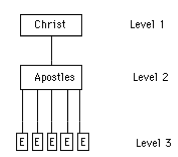
Fig. 18. Incompatible Additions to Organization
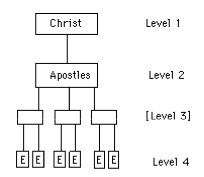
interrupts this flow of authority from top to bottom is contradictory to it, although anything that extends it is compatible with it. Medial additions are therefore contradictions while additions “outside” or “below” are extensions.42 Service Agencies added outside the flow do not interrupt or re-channel from top to bottom. Service agencies
Fig. 19. Compatible Additions to Organization
stand in the same relationship to the local eldership as the evangelist function does. Addition of Sunday school Superintendent, for example, even if the position were considered an office with authority, is below the local elders and therefore compatible with the jurisdiction exercised by them. It is not merely a matter of retaining the positions originally given, but retaining them with their original jurisdiction. The normative character of church organization is twofold: it does not enjoin a uniformity that eliminates variety and diversity from place to place; (2) it sets the authority-flow pattern that must be kept intact without interruption or rechanneling from top to bottom.43
Summary
Church organization is prescriptively divine because God established the church after the manner and form of a kingdom. Jesus Christ was (1) given (2) lordship (3) by God. (3) Divine rather than human locates the origin; official rather than spontaneous sets the direction; (1) formal rather than natural and (2) authoritative rather than personal determines the nature of the whole pattern so that one asks simply (a) the areas in which official authority operates, (b) the degree to which it predominates, and (c) the number of levels through which it passes from top to bottom.
Christ’s lordship is important here because (1) his example of ability before office sets the pattern for all other places of service in the church. (2) In that his authority was given to him, the organization of the church is formal as well as natural. (3) In that he has supervisory authority, the whole church is in the category of authoritative operation. (4) In that his authority was given from above, it was not spontaneously generated from below by men. (5) In that Christ is a living Lord rather than a dead founder, any change in the church’s pattern has to come from him. The fact, origin, and nature of Christ’s lordship is therefore the key to church organization.
Church organization is prescriptively divine because a divine Head built it. The Lord predicted that he would build his church and promised to guide his representatives through whom he indirectly fulfilled the prediction. The general scope of the promise includes particulars like doctrine and organization unless some reason can be given for their being individually exempt. Form and substance are equally present in any reality (prediction to build: the nature of the case). No theoretical reason can be found for negatively exempting organization from the general promise to guide into all truth prescriptively defined. Instead, positive evidence shows that he did guide in organizational matters (promise to guide: the historical record). The prediction about building (Matthew 16) amounts to the commission to go (Matthew 28). The binding-loosing in heaven and the promise to guide (John 16) are the promise to be with (Matthew 28). The keys to be used (Matthew 16) were all things he commanded (Matthew 28). The book of Acts records the historical fulfillment of these interrelated predictions, promises, and commandments.
The organizational aspect of church unity is divine in origin. (1) It has a givenness in it; its form is the result of formal application. (2) Different levels of organization came directly and indirectly from God; the form of the church is the result of divine application. (3) In that God chose particular persons through whom he dispensed church form, it is a result of official application. (4) Since Christ and the apostles functioned authoritatively, organization is a result of authoritative application.
Intended permanence of original polity is evident in (1) those offices that were never vacated: lordship and apostleship. Christ’s lordship is a key point both in the manner of divine origination and intended permanence, and provides a second indication of permanent polity; (2) the level of origination is the level of amendment, and in a kingdom the level of both is at the “top.” The members of the church are not therefore able to change the form of the church. (3) The permanent prospective needs of the church are set in connection with the original offices and functions. Ephesians 4:8-16 sets the general forward thrust; other passages set the forward thrust for individual offices. (4) The presence of written qualifications in a permanent guide imply the permanence of positions prescribed and described. (5) There seems to be no reason to change a pattern that is universally adequate and appropriate for its purpose.
In the forward progress of time certain adjustments were made in the visible functioning of polity: (1) Christ passed into heaven; (2) the apostles beginning with James also passed from the scene; (3) the prophetic gift was not necessarily continued. These three positions, however, still operate in absentia through the written word. Elders, deacons, and evangelists are the permanent gifts by which “all the body is fitly framed together . . . to the building up of itself in love.” Intended permanence eliminates successive variation in the essential pattern of the church. The manner and form of this kingdom’s administration was not going to be altered by the Lord.
At any one time there can be only one universal organization of any united entity. This fact is true by the definition of universal and by the nature of organization. Over a period of time no change can take place in the pattern of authority flow without making it a different pattern as respects the whole. In organization, therefore, injunction is restriction, silence is prohibition, addition is contradiction, and history is norm. Necessary exclusiveness eliminates simultaneous multiplicity in the essential pattern of the church by the very nature of organization itself.
Thus, the pattern of the church is normative by virtue of its divine origin, intended permanence, and inherent exclusiveness.
ENDNOTES
1In all the epistles except Philippians, 1 and 2 Thessalonians, and Philemon.
2Note also John 17:2 and all passages like John 1:12 that speak of the givenness of salvation, life, sonship, etc., or the givenness of authority.
3An assumption here is that χάρισμα of 1 Timothy 4:14 and 2 Timothy 1:6 refers to the same thing as χωρίς, δωρεά, and δόμα indicate in Ephesians 4:11. In the letters to Timothy Paul may mean a special spiritual endowment, as in Romans 1:11; 12:6; 1 Corinthians 1:7; 12:4, 31; 1 Peter 4:10 (?); yet contrast 1 Corinthians 7:7. The case for spiritual gifts is not certain since Timothy gives no clear indication of possessing spiritual gifts. Δωρεά indicates miraculous manifestation of the Spirit in Acts 11:17. At any rate, Timothy is set aside to the work formally.
4Acts 20:28; 1:23-26; 1 Timothy 4:14 (“by prophecy”).
5This truth evidently lies behind Paul and Barnabas’ rehearsing in Acts 15:17-18 the signs and wonders that God worked through them among the Gentiles. The assumption must be that he would not have done so had their gospel to the Gentiles been deficient; otherwise, these attestations have no place in the discussion of the conference.
6Cp. also Psalms 68:18; 110:1-4; Daniel 2:31-35, 43-44 (“without hands”); 7:13-14; Matthew 11:27; 28:18; Luke 19:12; Ephesians 1:20-22; Philippians 2:9-11; 1 Peter 3:22 (Christ); 1 Corinthians 13:10; 10:8; 1 Timothy 2:7 (Paul the apostle); Acts 14:23; 1 Peter 5:3 (elders); 2 Timothy 4:14 (Timothy the evangelist).
7See the opening pages of this chapter.
8Three things are true of the building of the church: (a) theologically it is built on Jesus Christ (1 Corinthians 3:10-15); (b) historically it is built on the apostles and prophets among whom Peter (and Paul) was especially prominent (Ephesians 2:19-22; cp. Revelation 21:14); (c) logically it is built on the facts included in Peter’s confession (Matthew 16:16-18). “This rock” in Matthew 16:18 is taken here as a reference to the content of Peter’s confession for two reasons: (1) the confession is the only appropriate contextual element standing in third person to both Jesus and Peter. Jesus does not say,” On you/myself I will build my church,” though by either statement something true could be meant (argument from grammatical person). (2) Both Jesus and Peter are elsewhere in the building figure respectively as builder and turnkey (argument from rhetorical figure). Furthermore, as respects Peter, (3) the word change from Πέτρος to πέτρα (“this rock”) in Matthew’s Greek history evidently reflects an distinction meant originally by Jesus in Aramaic. In confirmation see Kepha treated as a Hellenized Kephas in R. C. Foster’s Studies in the Life of Christ, pp. 714-15. For other explanations rejected here, see in loco Alfred Plummer, An Exegetical Commentary on the Gospel According to S. Matthew; and Sherman E. Johnson, “The Gospel According to Matthew,” in Vol. VII of The Interpreter’s Bible, ed. by Nolan B. Harmon, p. 451.
9Matthew 10:1-4; cp. Acts 1:2, 24-26; 13:2-3; 26:16.
10The promise in John 16:13 that the Spirit would lead into all truth was directed to the apostles. It appears in those chapters (13-17) that record the upper-room events on the night before the crucifixion; only the apostles were present. It is this promise that the resurrected Christ reiterates in Acts 1 when he tells the apostles to wait in Jerusalem for “the promise of the Father” (1:4). Thus enabled, then, they would become the special resurrection eyewitnesses they were chosen to be (1:8). At Pentecost the Spirit descended on the apostles (not the 120) in fulfillment of this promise, and in consequence they established the church historically (cp. Ephesians 3:19-22), theologically (cp. 1 Corinthians 3:10-11), and organizationally (cp. Acts 20:28) under his guidance. The indwelling presence of the Holy Spirit is promised to all Christians (Acts 2:39), but his special guidance is in particular Christians.
11Matthew 28:18; cp. Acts 13:4; 26:17.
12Acts 9:15; 14:27; 16:6; 22:21; 10:20; cp. 8:26, 39-40.
13Acts 20:28; 14:23.
14The building figure for the church has varying applications in scripture. They who are turnkeys in Matthew 16 (and 18) are pictured as builders in 1 Corinthians 3:10 (and Acts) and as part of the foundation in Ephesians 2:20-22 and Revelation 21:14.
15The Greek future perfect passives are rendered here as emphatic futures so as to express the idea diagrammed as “Process B” in the accompanying figure. Translating into an English future perfect passive would express the idea diagrammed as “Process A.” Both concepts are true, but the Greek idiom does not necessarily support the second possibility even though the translation committee of the New American Standard Version has recently adopted this rendering. See Robertson, Grammar, pp. 906-7; W. W. Goodwin, A Greek Grammar, p. 271; Moule, Idiom Book, p. 18. The emphatic future expressed by a future perfect tense is a linguistic mechanism related in basic nature to the prophetic perfect in Hebrew; see E. Kautzsch and A. E. Cowley, Gesenius’ Hebrew Grammar, pp. 312-13. If one were to take the alternate rendering, it would only add more weight to the point being made at this juncture.
16Organization is mentioned not only in accounts of the apostles’ ministry, but also in their teaching. Later in the section on “Intended Permanence” this fact will be emphasized. Suffice it to note that Paul writes to Timothy speaking of qualifications for positions in the church for the express purpose of showing how men ought to conduct themselves (ἀναστρέφεσθαι) in the church (1 Timothy 3:1-5).
17 Ἐνετειλάμην is probably to be taken here as past with respect to their future discipling. (1) Jesus had not yet taught them everything, but the Spirit would later reveal the rest (John 16:12-16). (2) Μαθητεύσατε is the grammatical peg for Matthew 28:19-20a. Being imperative mood, it has a future time reference, so that the contemporary participles βαπτίζοντες and διδάσκοντες are future as to time. The aorist indicative ’ενετειλάμην is then previous to that future action, but still subsequent to the Great Commission.
These observations affect the question of guidance in matters of organization because as yet Jesus seems not to have taught the apostles much about it. The disciples, expecting a restoration of the kingdom to Israel (Acts 1:6), were not ready for something so radically different as the church (John 16:12). The Spirit’s ministry to the apostles was not simply that of bringing to their memory the teaching of Jesus (John 14:26). It was a guidance into new matters as well that the Spirit would take from Christ and declare to them (John 16:12-15).
18The words for “bind” and “loose” (δέω and λύω) are fairly strong words for questions of duty, obligation, and law. See δέω in Acts 20:22; Romans 7:2; 1 Corinthians 7:27 and λύω in Matthew 5:19; John 7:18, 23; 10:35. They may carry an intended ring of authority in them.
19“Lo, I am with you” probably includes the positive guidance and comfort of John 16:13 as well as this confidence that Christ will stand by his word.
20The position advocated here relative to church organization is not to be confused with the Roman Catholic view of the passage: (1) Peter is not viewed as vocationally peculiar to his fellow apostles. (2) Apostolic succession is not advocated (see pp. 81-82, fnt. 3). (3) The permanent pattern for the church was given by God, the apostles acting only as the agents of establishment. The two views are alike only as to the general manner of origination with greater stress placed on “Process A” in Fig. 13. For a presentation and criticism of the Roman usage of “the three texts” (Matthew 16:13-20; Luke 22:31-32; John 21:15-23), see George Salmon, The Infallibility of the Church: Lectures Delivered in the Divinity School of the University of Dublin, pp. 327-46.
21See Chapter III.
22Even if one were to suppose that divine origin were permissively through the apostles, God simply ratifying, it would seem evident that the point of ratification is the place of amendment. The discussion would then move to the matter of intended permanence, a topic discussed below.
23A distinction exists between example and precedent: example is merely what was done; precedent is what was to be followed. Eight considerations are suggested for determining whether what was done is precedent: (1) persons giving the example, (2) presence of accompanying propositions, (3) consistency of practice, (4) amount of example, (5) nature of the case, (6) test of consistency in the argument pattern, (7) reason for seeking an alternative, (8) dispensational distinctions (discontinuity between synagogue and church).
24Since 1 Corinthians12:28-30 lists together special positions of service and special gifts for service, a person might even contend that the positions were as prescriptively divine as the gifts: “God set in the church.”
25Two classes of presumptive evidence may be noted in passing. (a) Normally one expects the “purpose” to be the “patterner” as a consequence of right and qualification. The nature and purpose of the church was a mystery until it was revealed (Ephesians 2:11-3:13). Because of their typical human ethnocentrism, the apostles unaided were not appropriate designers of a universal, cross-cultural, and spiritual kingdom (cp. Acts 1:6-7; 10:1-11:18). The form of anything must be amenable to its nature and purpose. The simplicity of the church’s organization enables it to operate manageably in any culture and to have the cross-cultural continuity characteristic of a united universal community. (b) On the analogy of Israel, one would not expect God in the institution of his economies to be indifferent to the form of his people. The divine origin of Israel’s national government becomes apparent in Israel’s demand for a king. They were not free apart from his directive to change from a system of charismatic judges to a hereditary monarchy (1 Samuel 8). Divine prerogative is apparent also in the change of dynasty from Saul to David. Even Jethro’s advice about a judiciary system was conditioned with “if . . . God command you” (Exodus 18:23). God gave the Israelites judges, he gave them Saul, and he raised up for them David (Acts 13:20-22 + corresponding “raised-up” passages in the Old Testament).
26Not having authoritative patterns would still be a “form.” The church in such case would be purely interpersonal in nature and operation.
27The Christian church is not constitutionally a continuation of national Israel or a sect of Judaism. On the basis of Psalms 110:4; Jeremiah 31:31-35; and Psalms 40:6-8, Hebrews sets forth the “anotherness” of the new covenant. Israel’s constitution was changed (7:12), disannulled (7:18), taken away (10:9); and vanished (8:9). The Christian system was the second of which Mosaism was the first (8:7; 9:1; 10:9). It was the new that came after the old (8:8, 13). There is covenantal continuity of purpose from Abraham forward but dispensational discontinuity of orders.
28For warning against overdrawn parallels between church and synagogue, see Lightfoot’s comments on deacon vs. chazan in Philippians, pp. 189-90.
29Ephesians 4:11; 1 Corinthians 12:28; cp. Acts 20:28; 1 Timothy 3:10-13; Titus 1:5-9.
30By the word “essential” it is being recognized that at least in theory change may be initiated elsewhere; but such change is not operative unless, or until, it is ratified and implemented at the place of essential authority.
31The functional association between the apostleship and the eldership appears in “the apostles and elders” at Jerusalem (Acts 15:2, 4, 6, 22, 23; 16:4) and in Peter and John’s calling themselves elders (1 Peter 5:1; 2 John 1; 3 John 1).
32In a non-authoritative sense the apostles prepared for their departure by setting the church in order generally, as by training evangelists. Paul exhorts Timothy, e.g., to preach the word and fulfill his ministry, because Paul was ready to be offered, and the time of his departure had come (2 Timothy 4:1-8).
33The perpetuation of the church and its ministry depended on conformity to the written truth and was provided for in the personal dimension by a series mentioned in 2 Timothy 2:2. Paul taught Timothy, who was to teach faithful men, who would be able to teach others. There is no hint that the validity of ministry depended on successional connections with the apostles, a concept made unnecessary by the fact that salvation flows through the word to the individual, not through the church. The church results from salvation, not salvation from the church. Conformity to the apostolic word is therefore the measure of orthodoxy, not connection with apostolic persons. The validity of ministry lies in conformity to the apostolic pattern, not in apostolic succession.
34See Miracles: Yesterday and Today, True and False, pp. 1-31.
35See various publications from Logos International, Gospel Publishing House, and Christian Literature Crusade.
36In addition to Warfield’s book on Miracles, consult Henry Barclay Swete’s two works The Holy Spirit in the New Testament: A Study of Primitive Christian Teaching and The Holy Spirit in the Ancient Church: A Study of Christian Teaching in the Age of the Fathers. On pp. 401-2 of the latter volume he summarizes by saying,
“It was believed by contemporary writers that the charismatic gifts of the Holy Spirit were still exercised in the second and third centuries. Not only in the remote church or churches from which the Didache sprang, but at Rome in the days of Hermas, and in South Gaul within the memory of Irenaeus, prophets delivered their message in Christian assemblies. Even in the middle of the fourth century Cyril of Jerusalem thought it possible that some of his catechumens might receive prophetic powers at their baptism. Nor were the miraculous operations of the Spirit altogether withdrawn from the ancient Church, if we may trust the testimony of Irenaeus and Origen, and the half reluctant witness of Theodore. “But upon the whole the references in post-apostolic writings to ‘workings of miracles’ and prophecy are relatively few, while on the other hand there is a growing insistence on the spiritual and ethical effects of the Spirit’s indwelling in the hearts of men.”
37It may be possible to infer from the foundation figure in Ephesians 2:20 that the ministry of prophets was like that of Christ and the apostles in being limited to the beginning. Those who later became members of the “house of God” were historically the outgrowth of their ministries and were thus “built” on them. If this inference is correct, it speaks to the temporary nature of the prophetic function. That New Testament prophets are meant is obvious from Ephesians 3:4-5, where the previous mystery of Christ is said to have been revealed to his holy apostles and prophets.
38In The Church and Christian Union: The Bampton Lectures for 1964, p. 119, Stephen Neill connects the changeableness in church form with changeableness in revelation. This view is not dealt with here because of the New Testament limitation.
39See the end of Chapter I.
40Implicit in the argument of Hebrews 7:12-14 (cp. 8:4) is the principle that injunction is restriction, and silence is prohibition in organizational matters. The writer argues that Jesus son of Judah is prohibited from the priesthood under the Mosaic law because it enjoins priesthood to sons of Levi: “It is evident that our Lord has descended from Judah as to which tribe Moses spoke nothing about priests.” From the subsequent oath-appointment of a priest in Psalm 110:4, he infers that the law would have to be changed in order for this new priesthood to function legitimately. All organizational matters, whether qualifications for offices, the presence of offices themselves, or the total pattern, are subject to the principle of injunction-restriction. The New Testament would have to be changed for another system of government to function legitimately.
41An affirmation that other did exist does not derive from the inability to disprove it from the silence of the biblical sources or from the possibility of its not contradicting statements about the offices that are mentioned; nor is there any change in the amount of appropriate evidence needed to reach that conclusion as if, for example, subapostolic practices could create presumptive evidence for similar unrecorded procedures existing earlier with apostolic approval.
Since this study is confined to New Testament sources, arguments from patristic teaching and practice have not been treated. Suffice it to say that the method of determining orthodoxy on patristic evidence alone or primarily, relies too heavily on possible association with apostles and nearness to the apostolic age as bases for purity. At best, the testimony of early Christian literature is confirmatory evidence for matters already founded on the positive teaching of the New Testament taken alone, not the other way around.
The following reasons seem to justify a healthy skepticism of innovations in subapostolic times. (1) Widespread errors were creeping into the church even while the apostles were still actively on the scene: incipient gnosticism (cp. John Rutherfurd, “Gnosticism,” ISBE, Vol. II, pp. 1240-48), which in turn led to antinomianism (cp. William Young, “Antinomianism,” EC, Vol., IV, pp. 270-79). Paul warned about later heresies springing up even among leaders who knew him (Acts 20:29-30; 1 Timothy 4:1-5; 2 Timothy 3:1-9; 4:3. See also 2 Corinthians 11:13; Galatians 1:7; 2:4). Jude writes that already in his day false teachers were rising up as the apostles had predicted (17-18, probably in reference to 2 Peter 2:1; 3:2-3 and the above references in Paul; note 2 Peter 3:14-18). John speaks of these false leaders also (Revelation 2:12-29). In less than twenty years a goodly number of Judaizing teachers were already leading the early Christians into heresy under the opposition of the apostles. What would happen when the apostles were gone? It hardly seems advisable to rest a case on second-century leaders who might have been able to count some of the apostles among their acquaintances or whose lives reached back into the apostolic era, when in the apostolic age itself error was already reaching significant proportions.
Furthermore, (2) the early Christian writers were in error on some points immediately associated with organization. The New Testament uses bishop and elder interchangeably, knowing nothing of the subsequent practice that separated the terms and created an office superior to the local elder (see Chapter III). The extravagant affirmations of Ignatius and Irenaeus, who advocated respectively the patristic-type bishop as center of Christian unity and depository of apostolic tradition, seem to stand in contradiction to the implications of Acts 11:23, where the groups of Christians are called “churches” before such leadership was ever appointed in that area. The New Testament views the church first as people and then as pattern, the order being reversed by later tendencies. For a collection of strong statements re bishops in early Christian literature, see Lightfoot, Philippians, pp. 234ff.
(3) Historical allusions into the apostolic age may not be independent witness to the facts. In certain instances, patristic writers may only have read back into the inspired documents the practices of their own day, and on that basis may have failed to distinguish between the power of superior personal influence and the authority of superior office as in the case of James the Lord’s brother (Acts 12:17; 15:13-29; 21:18; Galatians 1:19; 2:9-12). It is safer to depend on the inspired writings of eyewitnesses than on oral tradition that is later recorded.
(4) It is only natural that as Greek philosophy infiltrated Christian theology, Roman government should affect church polity. As doctrine was subject to perversion, organization was subject to a crystallizing, authoritarian change, especially in the face of potential division caused by the Gnostic, Marcionite, and Montanist movements against, and from within, the church (cp. Kenneth Scott Latourette, A History of Christianity, pp. 119-33).
(5) Social evolution, led by lesser lights and left unchecked by the apostles’ correcting influence, is sufficient to account for the state of affairs in a “second-generation” church that felt a need to fill the perceived vacuum left by the absence of the “first-generation” apostles. The drift from influence to authority and general function to general authority are two particular components of the patristic alteration in polity. One does not need to suppose that there had been sanction of these practices in unrecorded apostolic history in order to account for their widespread appearance later in the church.
The evaluation, then, of patristic teaching and New Testament teaching must follow three principles: (a) where they agree patristic evidence confirms; (b) where they disagree the New Testament takes preference; (c) where the New Testament is indecisive patristic practice is indeterminate. The question of church polity falls in the second category because the New Testament is sufficiently clear and patristic practice is different, a difference which by the nature of church polity is not only contrary, but incompatible.
42The possibility of having functions “outside” and “below” the prescribed pattern is sometimes not recognized perhaps because of a failure to perceive the exact nature of what organization is; see, e.g., “The Divine Organization Is Complete,” Apostolic Review, January 19, 1937, p. 1.
43The New Testament pattern of unity is exclusive of (a) pluralism and (b) hierarchism. It is also exclusive of (c) free-church confederacy, but for different reasons. Since those reasons derive from theological and functional, rather than organizational, considerations, a discussion of them falls outside the precise scope of this thesis. Nevertheless some observations may be made in passing.
In connection with (1) hierarchism, the doctrine of local autonomy in the free-church and baptistic tradition may not be precluded by delegated conventions in that the downward flow of jurisdictional authority is not interrupted in principle. The decisions and policies made by delegates may be repudiated by the local churches without legal recourse by the convention. One questions from an expediency viewpoint, however, the advisability of having such strong influence over the whole church concentrated in so relatively few persons. The International Convention of the Disciples of Christ is a case in point; see James DeForest Murch, Christians Only.
Secondly, though corporate decision making may enhance the functional efficiency of the total cause, what is gained in efficiency may be lost in interest due to less direct connection between the local source of funds and the place of their ultimate use. The point is not so much efficiency as it is effectiveness. Furthermore, in some cases a tendency toward bureaucracy may end up less efficient than the direct-support approach. For other areas of evaluating direct- support missions, see Sam E. Stone, “The Advantages and Disadvantages for Direct-Support Missions to the Local Church,” Christian Standard, September 14, 1968, pp. 5-7. Even if there were only one confederate system of congregations, these problems would demand careful consideration.
In connection with (2) the phenomenon of pluralism, one may say that the generating causes of parallel free-church systems are the same as the generating causes for parallel hierarchical systems–doctrinal peculiarities, etc. A series of free-church confederacies presents the same problem as a series of hierarchical denominations. As regards the total picture seen by the world, a series of separate free-church fellowships is still less than a unified whole.