
The New Testament Structure
THE NEW TESTAMENT STRUCTURE
Virgil Warren, PhD
Basic Structure
This chapter sketches the original organization of the church in the New Testament. It determines what positions exercised authority and which were functions, all being places of service. The procedure works because it addresses an either-or matter and because authority includes function. We cannot suppose that a function seemed to be such only because the records happen to be insufficient to show that it was really an office. That would argue from silence and shift the burden of proof onto the negative. The negative burden would be impossible since the only available evidence would pertain to function, which is part of the larger concept: office.
Authoritative Offices
Lord
Authoritative
The first place of service in the church is Lord (κύριος, kyrios); Jesus Christ alone possesses this office. “All authority has been given to me . . . go, therefore . . .”1 His authority is supervisory because as head of the church he oversees others. Because he accomplished his appointed service, the Father gave him his exalted authority; the order in the types of activity conforms to a principle of church leadership: ability and service before rank and authority. Jesus Christ is both Savior and Lord (Ephesians 5:23; Titus. 1:4; 2 Peter 2:20; 3:2, 18) in that order (Ephesians 1:20 + 21-23; Philippians 2:5-8 + 9-11).
General
“All authority has been given to me in heaven and on earth.” Because Christ died to be Savior of all, the Father appointed him to be Lord of all, that every knee should bow and every tongue confess that he is Lord to the Father’s glory (Philippians 2:10-11). Lordship is a general office.
Apostle
Terminology
The second place of service in the church is apostle [ἀπόστολος, apostolos]. In the New Testament, more than twenty-five men bear the label apostle in sense of missionary, “one sent.”2 Of these, fourteen may be singled out as apostles in an added special sense, (a) having in common certain distinguishing marks and (b) being perceived as peculiar from the rest.3 The distinguishing mark of the original Twelve, Matthias, and Paul was (1) their being personally chosen by Christ as (2) special eyewitnesses of his resurrection.4 The combination of these two elements is important: over five hundred could bear witness to the fact itself; but they were not all officially chosen, appointed, endowed, commissioned, and guided; many preached the resurrection who had not seen it. If there had been no difference between the apostleship of “the Twelve” and that of others called “apostles,” there would have been no more reason formally to replace Judas than any one of the others,5 who are not known ever to have been replaced in this manner. Paul’s manner of sending and calling the others who are called apostles indicates a difference between himself and them (Colossians 4:7-11; 2 Timothy 4:9-13, 20-21; Titus 3:12-13; Philemon 8-9). Finally, no one except the Twelve plus Paul ever refers to himself as an apostle.
That the Twelve were perceived as a special group comes in the very references to them as “the Twelve” (Matthew 10:1-2; John 6:67, 70, 71; 20:24), then “the eleven” after Judas Iscariot committed suicide (Matthew 28:16; Mark 16:14; Luke 24:9, 33; Acts 1:26), and then “the Twelve” again after the selection of Matthias (Acts 6:2). John 20:24 is significant in that “the Twelve” occurs in a passage where the number had been reduced by the death of Judas. Paul conceived of himself as equal with the most important apostles (Galatians 1-2) and was accepted by them in this capacity (Galatians 2:8-9). Since Paul was also accounted an apostle in the technical sense, there were “twelve” apostles in the same sense as there were “twelve” tribes of Israel.
Characteristics
Authoritative—As we view the reason for, and the nature of, supervisory authority, it is obvious that the highest rank in an authoritative system is authoritative, at least as long as the ultimate authority is away. This axiom is true because, if authority is needed at all, it is needed for the orderly and efficient operation where the system is functioning. The church partakes of authority by virtue of its head, who has authority. His appointment of the apostles gave them the final earthly leadership during his absence.6 So what they did he “authorized” them to do, and what they were authorized to do involved supervising the activities of others. In addition to making converts, they disciplined and set them in order. Christ’s authority not only passed down to them as functionaries, but down through them as officers. Since his authority was always passing through them, and since he himself was absent during their whole ministry, we may say that authority inhered in the apostleship itself.
As we view the functioning of authority, the right to lead based on service performed (1 Corinthians 9:7) is sometimes difficult to distinguish from the right to lead based on authority given (Matthew 28:18-19). Particularly this is the case with church leadership, where authoritative right always includes service right. Moreover, certain passages describe church authority as exclusive of “lordship,” as when Jesus says that his apostles are not to exercise lordship the way the kings of the Gentiles do—lording it over their subjects.7 Such statements, however, involve a pejorative use of “lordship”; because Jesus who had the authority of Lord (John 13:13) conducted himself in the attitude of Servant (Luke 22:25). They strike at the motives of the person rather than the fact of his authority, the manner of using rather than the right to use. Even when authority is present, the operation of the office moves forward as much as possible by interpersonal factors. If rightful authority includes able service, no one minds being subject to it. The question is not so much what is done, but the basis on which it is done.
Certain statements in Paul’s writings seem to presuppose a right to lead on the basis of authority given. In connection with disciplining the Corinthians, he uses language that would seem presumptuous outside the context of a recognized formal authority. Among these instances is 1 Corinthians 4:21, where he asks whether they would have him come “with a rod, or in love and a spirit of gentleness.” Note the otherwise idle and boastful threat in 2 Corinthians 13:2, “If I come again, I will not spare” (cp. 2 Corinthians 1:23; 10:8-11; 13:10). The right to discipline has legal implications, but Paul wanted to handle problems in personal love.
One commanding situation in Paul also brings up the distinction between his right in Christ and his preference for beseeching in love. He says regarding his desire to keep another man’s slave, “Though I have all boldness in Christ to enjoin what is appropriate; yet for the sake of love I beseech instead . . . that your goodness be not of necessity, but of free will” (Philemon 8-14); Paul had confidence in Philemon’s “obedience” (21). He used the strong verb διατάσσω (diatassō) in 1 Corinthians 16:1 in reference to his “instructing” the churches of Galatia about the offering. The case for formal right should not be pushed too far in connection with commanding statements, because the commanding idea itself says nothing about official right over someone else, as is obvious in Gamaliel’s “command” to fellow members of the Sanhedrin (Acts 5:34-40). The same may be said of “setting in order” (1 Corinthians 11:34; cf. Titus 1:5). Even Paul’s foregone right to command support (1 Thessalonians 2:6-9; 2 Thessalonians 3:8-9) does not rest on more than the right of service (1 Corinthians 9:7-19); yet in the case of Onesimus, the slave of Philemon, right by grant may be intended.
The apostles’ appointment of the seven in Acts 6:1-7 indicates supervisory authority, especially since they took the initiative in this new matter (cp. Acts 14:23; contrast Titus 1:5). These observations on the functioning of the apostleship confirm the fact that the Lord himself appointed them as authoritative leaders with responsibility for establishing the church during his absence.
General––In commissioning the apostles, Jesus sent them to the whole world, to every nation, to every classification of mankind (Matthew 28:19; Mark 16:15, 20; Luke 24:47; Acts 1:8). Recounting their triumphant establishment of the universal church in a hostile world, the Book of Acts traces the spread of the gospel from Jerusalem to Rome, emphasizing the apostle to the circumcision and the apostle to the Gentiles (cp. Galatians 2:8). According to Galatians 2:7-10, Peter and Paul concentrated respectively on the circumcision and the uncircumcision, a complete listing from the Jewish viewpoint (cp. Ephesians 2:11ff, etc.). Paul speaks of his anxiety for all the churches (2 Corinthians 11:28; cp. 1 Corinthians 4:17; 7:17; 16:1). In the New Testament canon, the apostles directed their letters to individuals, churches, and territories in broad range throughout the northern Mediterranean: Syria, Asia Minor, Greece, and Italy. The scope of the apostolic ministry was as wide as the scope of the Christian gospel. Apostleship is therefore a general office.
Elder
Terminology
Usage of the word elder––A third place of service in the church is elder, or presbyter. Of the seventy-five times πρεσβύτερος (presbyteros) and its cognates occur in the New Testament, sixteen are clear references to an office in the church. Other usages refer to apostles (3), Jewish elders (33), men of old (1), old men (10), and the twenty-four elders of the Apocalypse (12).8 The word has a general and a technical denotation. In technical references to the office of elder, the word retains something of its meaning “older.” In 1 Peter 5:1-5, Peter urges the younger to defer to the elder, who had responsibility for, and over, the flock; hence, the eldership is an office of personal Christian maturity.
Equation of elder and bishop––Bishop (ἐπίσκοπος, episkopos) is another term the New Testament uses for the office of elder. The primary evidence for equating them is the interchangeable use of elder and bishop in common reference. Two contexts provide the evidence for equating them. In Acts 20 the Ephesian elders (20:17) are to watch out for the flock in which the Holy Spirit has made them bishops (20:28). Luke calls them elders; Paul calls them bishops. In Titus 1, Paul explains that he left Titus in Crete to appoint elders (1:5), men blameless in their domestic relations because bishops (1:7) must be blameless as God’s stewards.
The two terms are not used in a way that puts one within the other, as if bishop were a narrower category than elder. In Acts 20:17 and 28, the historian and the apostle refer to the same group of people; in Titus 1:5-9 Paul lists qualifications for one office. Bishop and elder do not just appear in the same context; they appear interchangeably in the same context with reference to the same predicate.
In conformity with Paul’s interchange of “bishop” and “elder” in Acts 20 and Titus 1, Paul gives a common description of elder and bishop. He says in 1 Timothy 3:4-59 concerning a bishop that he must be “a person who rules [προΐστημι, proistēmi] his household well, having children in subjection [ὑποταγή, hypotagē] with all respectfulness; if a man does not know how to rule [προΐστημι] his own house, how will he take care of [ἐπιμελέομαι, epimeleomai] the church of God?” (a) The qualifications laid down in Titus 1 under the double label “elder-bishop” parallel the ones here under the single label “bishop.” (b) 1 Timothy 3 speaks of the “ruling-caring for” idea in connection with the work of “bishops” and later associates it with that of “elders” in 5:17, “Let the elders that rule [προΐστημι] well be counted worthy of double honor, especially those who work in word and teaching.” Working “in word and teaching” (5:17) also parallels 3:2, which stipulates that a candidate be “able to teach.” While requiring high personal and domestic characteristics for deacons in 3:8-13, Paul does not require of them the ability to teach or the responsibility of “ruling” the church as he does of bishops (3:2, 4-5), and these are the two elements joined together in 5:17. (c) Finally, Paul combines bishops and deacons in Philippians 1:1 as in 1 Timothy 3, where “bishop” in turn equals the “bishop-elder” of Titus 1. He seems to have had the same position in mind in Titus 1:5-9 (bishop-elder), 1 Timothy 3 (bishop), 1 Timothy 5:17ff. (elder), and Philippians 1:1 (bishop).10
In further confirmation of the identity of eldership and bishopric, there is no New Testament unit of immediate context that ever mentions bishops and elders together to imply distinctness.11
Primary evidence for equation lies in (1) the interchangeableness of terms in common reference, confirmed by (2) common description and (3) absence of distinguishing reference in combination. We conclude from this evidence that ἐπίσκοπος and πρεσβύτερος are interchangeable in the New Testament.12, 13
Equation of elder-bishop and pastor—Perhaps on the background of Zechariah 13:7, “I will strike the Shepherd and the sheep will scatter” (cp. Matthew 26:3 = Mark 14:27), Jesus pictures his disciples as a flock, especially in John (also in Matthew 9:36 = Mark 6:34; Matthew 25:32). Paul mentions pastors in Ephesians 4:11 among the ministries Christ gave after his ascension. Pastor, or shepherd (ποιμήν, poimēn), appears only twice more outside the gospels, both times in reference to Christ (Hebrews 13:20; 1 Peter 2:25). The question arises then as to what a pastor is in Paul’s list of ministries.
Two contexts shed light on the ministry indicated in Ephesians 4:11: Acts 20:17-35 and 1 Peter 5:1ff. In both places the shepherding metaphor combines with the elder-bishop terminology discussed above. The elders of Ephesus (Acts 20:17) were to fulfill the ministry of bishops (20:28) in the “flock” that they were to “feed” (ποιμαίνω, poimainō) and protect (20:28-29). This same set of figures (elder, bishop, pastor) appears in the 1 Peter passage, where elders (5:1) are exhorted to pastor the flock (ποιμαίνω, 5:2) as bishops (ἐπίσκοποι, 5:2) anticipating the return of the Chief Shepherd (ἀρχιποιμήν, archipoimēn, 5:4). Pastor evidently means the same thing as elder and bishop because pastoring is incorporated at least twice in a series of interwoven metaphors dealing with the work of elder-bishops.
Ποιμαίνω, the cognate verb of ποιμήν, depicts the work of elder-bishop, because it carries the two elements of ruling and providing for the flock. Ruling is especially prominent in Matthew 2:6, “For out of you a governor will come that will shepherd-rule [ποιμενεῖ] my people Israel.” This quotation from Micah 5:2 uses ποιμαίνω where the LXX (Micah 5:1) has τοῦ εἶναι εἰς ἀρχοντα (tou einai eis archonta) as the translation of the Hebrew (Micah 5:1), משֵּׁל (moshēl) and ἄρχων being words in the respective languages for the ruling idea. Three passages in Revelation speak of the Son as ruling (ποιμαίνω) all nations with a rod of iron: 2:27; 12:5; 19:15.
Feeding is a common English translation of the other work in ποιμαίνω. Jude 12 is one example, “. . . shepherds that feed themselves [ἑαυτοὺς ποιμαίνοντες].” Similar usages appear in Luke 17:7; John 21:16; Acts 20:28; 1 Corinthians 9:7; 1 Peter 5:2; and Revelation 7:17. Feeding a flock of sheep corresponds to teaching a group of people. A pastor has the same two responsibilities that describe elder-bishops: ruling and teaching.
Three considerations taken together equate pastors in Ephesians 4:11 with elder-bishops: (1) pastor is an expressive figure for leadership responsibilities that emphasize ruling and teaching; (2) the shepherding metaphor elsewhere describes the elder-bishop’s work; (3) Paul omits elder-bishops in this list of ministries where pastor appears.
Occasional equation of elder-
bishop-pastor and teachers—Teaching is a prominent part of the elder-bishop’s work in Acts 20:28-32; 1 Timothy 3:1-7; 5:17; Titus 1:5-9. It is natural that on occasion “teacher” should be used by metonymy for it. In Ephesians 4:11 the hyphenated expression “pastor-teacher” brings this point into view. In a serial balanced construction, Paul says, καὶ αὐτὸς ἒδωκεν τοὺς μὲν ἀποστόλους, τοὺς δὲ προφήτας, τοὺς δὲ εὐαγγελιστάς, τοὺς δὲ ποιμένας καὶ διδασκάλους. Sharp’s Rule says that the article is not repeated when καὶ connects epithets applied to the same referent.14 The conclusion in this passage is somewhat obscured by the possibility that a writer may for certain purposes view two different groups as one in terms of a common larger category that in turn sits in parallel to another category in his mind. In light of the example in question, Ephesians 2:20 and 3:5 are instructive, because apostles and prophets is there governed by one article while in 4:11 it is not.15 So the rule about definite synonyms in series must be taken in conjunction with the writer’s present intent of category contrast determined only by context.
That τοὺς δὲ ποιμένας καὶ διδασκάλους is part of a balanced construction seems to be as important to the matter of identification as the omission of a second article, because by the grammatical construction we gain insight into the way Paul conceptualizes the set of parallel categories. In Ephesians 4:11 he balances apostles against prophets, then against evangelists, and then against pastors and teachers. These are grammatically parallel examples of positions that are Christ’s parallel gifts to his church for maturation.
The last position in 4:11 is twofold in nature, being a work of oversight and education. Authority and teaching correspond to the aspects united in elder-bishops in 1 Timothy 3:1-7; 5:17; Titus 1:5-9; and possibly Acts 20:28 (feeding = teaching) plus 1 Peter 5:2 (overseeing = authority).16 The composite nature of Ephesians 4:11d inheres in the combination of (a) appropriate syntactical parallelism and (b) descriptive characteristics identified elsewhere in elder-bishops.17(c) Finally, we observe in 1 Corinthians 12:28-29 that God set in the church apostles, prophets, and teachers. Neither 1 Corinthians nor Ephesians uses the words elder or bishop presumably because pastor and teacher refer to the same office.
Summary—In summary, the New Testament uses four terms to refer to one role: elder, bishop, pastor, and sometimes teacher. Equating elder and bishop rests primarily on (a) full interchange of terminology with the same reference in Acts 20:17-35 and Titus 1:5-6, confirmed by (b) common description (didactic, authoritative, and local) and (c) lack of distinguishing reference in combination. Elder-bishop then equates with pastor in that (a) pastoring is an expressive figure for the prominent responsibilities of elder-bishop (ruling and teaching); (b) the pastoring metaphor describes the elder-bishop’s work; and (c) Paul omits elder-bishop in the one place where pastor describes a church office. Elder-bishop-pastor evidently equals teacher in Ephesians 4:11 and 1 Corinthians 12:28, 29 since in the first passage teacher forms with pastor a hyphenated expression that parallels teacher standing alone in the second.
Characteristics
Local—Every example of elder (= bishop-pastor-teacher) is local; every local church whose organization is mentioned had elders. As respects the distribution of examples, elders existed in every area whose evangelization the New Testament records: Jerusalem, cities of southern Asia Minor, cities of northern Asia Minor, Ephesus, Philippi, cities of Crete, as well as perhaps Rome, Antioch, and Thessalonica.18 Bishop is local in contrast to subapostolic usage and practice; no evidence exists for a general office by that name in the usage of ἐπίσκοπος or its cognates.19 There is uniformity in the localness of the office and in the local churches’ having the office.
Authoritative A. One strand of evidence that eldership is an authoritative office comes in four of the words for its activity. Προΐστημι, “to stand before,” roughly corresponds to the English word preside, a mild authority word. It designates church leadership in Romans 12:8; 1 Thessalonians 5:12; and 1 Timothy 5:17. Always local in reference, the word clearly designates elders only in 1 Timothy 5:17. The first two passages show there was authority at the local level; the last shows it was resident in the elders.
Ἡγέομαι, “to lead,” indicates church leaders in Acts 15:22; Hebrews 13:7, 17, 24. The references in Hebrews are unclear, but Acts 15:22 refers to Judas Barsabas and Silas, who were perhaps elders in the Jerusalem church.20 The word can indicate authority as Luke 22:26 demonstrates, where it contrasts to διακονέω and compares with κυριεύω.
Ποιμαίνω, “to shepherd,” carries two meanings that correspond to a shepherd’s work: feeding and ruling.21 The word refers to church offices only in Acts 20:28 and I Peter 5:2: “feed the flock/church.” Ἐπισκοπέω (episkopeō), “to oversee,” appears only in Hebrews 12:15 (indefinite) and 1 Peter 5:2, the latter speaking of elders.
Strong verbs for authority like (κατα)κυριεύω (katakyrieuō) do not describe elders in the New Testament; these words do not preserve the proper balance between authority and service. All the verbs that are used for elders can include authority, but none of them necessarily do so.
B. Another strand of evidence occurs in the comparisons used with eldership. In 1 Timothy 3:5 Paul draws a parallel between the home and the church when he says, “If a man does not know how to rule his own home, how will he take care of God’s church?”22 A man’s responsibility as head of the home is more than a comparison with his work as church leader. The one is an example of the other because real elements are common to both. (1) Authority is involved in being head of the home, an authority like Christ’s as head of the church (Ephesians 5:22-23). More importantly, (2) connecting father and elder establishes a model by which to think of the eldership and gives a feel for the way an elder is to carry his authority in the church: as a loving father does in the home and as Christ does in the church. Finally, (3) it puts the headship in the context of service. As Christ is both Savior and Lord, so a husband is helper and head, and an elder is servant and ruler.23
C. A third strand of evidence for the eldership as an authoritative office comes in certain examples of operation. The relief offering from Antioch was sent to the elders (Acts 11:30) even though men had been chosen to distribute relief goods (Acts 6:1-6). This is similar to the previous practice in Jerusalem of laying offerings at the apostles’ feet (Acts 4:35, 37; 5:2) though they did not distribute them (Acts 6:2). That procedure pictures the apostles and later the elders as men responsible for work they did not themselves perform: supervisory authority. The Conference on Circumcision in Acts 15 shows the elders gathering with the apostles to consider the problem raised by certain men who had gone out from Jerusalem preaching to Gentiles the necessity of circumcision and allegiance to the Law of Moses. They deliberated the problem with the apostles and joined in an official statement on behalf of the Jerusalem church that these Judaizing teachers had gone out on their own. Paul’s summons to the Ephesian elders in Acts 20 likewise implies that these men were the responsible leaders of the church there.
In summary, evidence for authority in the eldership comes from appropriate word associations confirmed by example. These related strands of data are particularly close in 1 Timothy. Speaking of elders’ qualifications in 3:5, the apostle parallels the home and the church. This parallel involves προΐστημι, a potential authority word applied to husbands in 3:4, 5 and to elders in 5:17. Having made the parallel between home and church as regards leadership, Paul applies the same potential authority term to both husband and elder in close context. Under such circumstances we expect continuity of meaning. Authority is an ingredient in being head of the home; hence, it is in the church. The ability to use authority in combination with other, dynamic factors is common to both institutions, and success at using it in one is presumptive evidence for the ability to use it in the other. (1) Potential authority words are applied to elders and to (2) certain illustrative comparisons like shepherding and being a husband; (3) elders in their operation demonstrate authoritative leadership.24
Non-Authoritative Functions
Evangelist
Terminology
A fourth place of service in the church is evangelist. Εὐαγγελιστής (euangelistēs) οccurs three times in the New Testament: Acts 21:8 of Philip; 1 Timothy 4:5 of Timothy; and Ephesians 4:11 of a gift to men. This slim evidence appreciably increases with another consideration. Timothy is called both apostle (1 Thessalonians 1:1 + 2:6) and evangelist (2 Timothy 4:5); in some sense they are alike. Apostles and evangelists are parallel in Ephesians 4:11; in some way they are different. The proposed solution is that apostle in the strict sense is distinct from evangelist; apostle in the general sense equals evangelist. This solution accomplishes two things: (1) it assigns a category to those men who were not among the Twelve-plus-Paul; (2) it gives a greater range of data from which to develop an understanding of the evangelist’s position.25
Characteristics
General—If Philip were the only example of evangelist-apostle, we might suppose that evangelist was a local position, since several years passed between his coming to Caesarea in Acts 8:40 and Paul’s visit with him there in Acts 21:8. General ministry takes place in a series of locations so that the time in any one city is relative and not essential to the question of local versus general.26 Caesarea may have been a headquarters for the movements of Philip, where he maintained a house for his family (cp. Acts 8:40). Εὐαγγελιστής (and ἀγγέλλω in Revelation 1-3) implies mobility and so is suitable for a general ministry. Since Barnabas, Apollos, Silas, and Timothy went from city to city in their ministry, the work of evangelist-apostle is general ministry.
Non-authoritative—The description of evangelists’ work does not carry it beyond a function. The authority words applied to elders never describe evangelist, prophet, or deacon. No activity of an apostle-evangelist illustrates an authority resident in his position.
The work of Timothy and Titus in Crete forms no clear exception to the non-authoritative nature of the evangelist’s work. Titus’ “appointing” elders (Titus 1:5) can be construed as the exercise of supervisory authority.27 Timothy and Titus did not initiate the idea that there should be elders (as the apostles initiated the idea that seven should be chosen to serve tables in Jerusalem), nor did they initiate their appointment in the cities where they were working. (1) In both cases, Paul had left them behind to finish what he had begun (Titus 1:5; 1 Timothy 1:3). (2) He addressed detailed instructions to them in the event that he should not soon return (1 Timothy 3:14-15). If authority was operating in these cases, it was an apostolic authority mediated through the evangelist.28 Timothy and Titus served as as extensions of the apostolic office, sent by Paul’s authority, and laboring under his written authority. These men did not walk onto the scene and begin setting the churches in order.29
Prophet
Terminology
In the New Testament, προφήτης, prophet, occurs mostly in the historical books and mainly with Old Testament prophets,30 John the Baptist,31 and Jesus.32 In addition, however, about a dozen passages refer to prophets in the church.33 1 Corinthians 12:28-29 and Ephesians 4:11 are clear technical usages of prophet as parallel to apostle, evangelist, and pastor. The twofold expression apostles and prophets evidently refers to two classes of persons,34 as does prophets and teachers in Acts 13:1. Three men are called prophets: Agabus (Acts 13:27-28; 21:10), Silas, and Judas (Acts 15:32). Philip had four daughters who prophesied (Acts 21:9). In the group of Barnabas, Symeon, Lucius, Manaen, and Saul some were prophets (Acts 13:1). In places like Jerusalem, Antioch, and Corinth, men did the work of prophet. Whereas elders and others might also be called “prophets” for having the prophetic gift, some seem to have been prophets in parallel to elders, apostles, and evangelists.
Characteristics
Non-authoritative—Among the examples of prophets in the New Testament, nothing they do seems to indicate that they exercised supervisory authority over their hearers. This picture accords well with that of the Old Testament prophets who stood as charismatic leaders among the people rather than in the government. Authority resided not in a position in the nation’s political structure, but in the prophet’s message from God. Likewise, church prophets ministered, not from a position of authority, but from a gift of revelation. With no example of supervisory authority and no appropriate principle for invoking it, prophet falls in the category of function, not in the church’s pattern of authority flow, or organization.
Extraordinary—Prophets appear as communicators of messages from God. Sometimes their prophecy was predictive, as with Agabus concerning the famine (Acts 11:27-28) and the bondage of Paul (Acts 21:10-11). More often it was communication. Paul’s admonitions to prophets in 1 Corinthians 14 focus on the importance of prophesying as distinguished from speaking in languages without communicating a message. This prophesying, however, has a different emphasis from teaching because prophets and teachers are listed side by side.35 The difference between them seems to lie in the reference to divine endowment, or revelation: “But if something is revealed to one who is seated, let the first be silent” (1 Corinthians 14:30). Whether special prediction or general communication, prophesying looks at the origin of the divine message more than at the dispensing of the divine message itself.
General—Like their Old Testament counterparts, New Testament prophets as prophets were potential for general function. Their ministry had general application because neither predicting nor revealing is local perforce. Accordingly, prophets went down from Jerusalem to Antioch (Acts 11:27; 15:22, 27, 32) and to Caesarea (Acts 21:10) as prophets. Judas and Silas were either elders or general members at Jerusalem (Acts 15:22), but they went to Antioch and functioned there as prophets. Indeed, there were prophets “in the church” at Antioch (Acts 13:1). Furthermore, Agabus lived in Judaea from the time of Acts 11:27 to 21:10—over fifteen years; but these men could, and did, move outside their normal area of service from time to time. Prophets were potential for general function.
At the local level, prophet differed from elder by being non-authoritative and from deacon by being extraordinary (though a deacon might have the gift of prophecy).36 Likewise, at the general level, prophet differed from apostle by being non-authoritative and from evangelist by being extraordinary. Authoritative vs. non-authoritative, ordinary vs. extraordinary, and general vs. local are the three pairs of variables by which positions in the church find definition.
Deacon
Terminology
The last place of service is deacon. In almost every case διακονέω, διάκονος, and διακονία refer to ministry in a non-technical sense. Some passages are aside from the church altogether, as in Matthew 8:15 (= Mark 1:31; Luke 4:39), where Peter’s mother-in-law “ministers” to the disciples. Others describe activities by the general membership, as in Acts 11:29, where διακονία is the “relief” sent to Jerusalem from Antioch in anticipation of a famine. Sometimes those words describe other positions in the church besides “deacon,” as in Romans 11:13, where the apostle Paul emphasizes the importance of his “ministry” to Gentiles.
The only clear technical references to deacons come in the salutation of the Philippian letter and in 1 Timothy 3:8-13. In the first case, διάκονοι pairs with ἐπίσκοποι, and the second case lists qualifications for deacons. To these examples we can probably add the seven who were chosen “to serve tables” in Jerusalem (Acts 6:1-7), but διάκονος does not describe them.
From Romans 16:1; 1 Timothy 3:11; 5:3-16, some exegetes have concluded that there were “deaconesses” were in the early church.37 The group could have included the widows the church supported, and this service could have been their way of “repaying” the church for their support in return. As respects the larger question about the New Testament pattern for church unity, we need not solve this question. If 1 Timothy 3:11 speaks of deaconesses under the word γυναῖκες, mentioning them amid statements about deacons makes them not so much a separate function as a part of the same function: “service” to the local Christian community. Certain services to female members could with more propriety be fulfilled by women or by husbands (διάκονοι, diakonoi) and wives (γυναῖκες, gynaikes) together. The relationship between deacon and deaconess could be as follows:38
Fig. 12.—Diaconate: Deacons and Deaconesses
οἱ διάκονοι
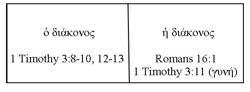
Deaconesses could have included wives of deacons, widows supported by the church, and individual women with service roles the congregation needed. In some way, Phoebe ranges beyond that arena b y working at Paul’s behest as an unspecified endeavor. There seems to be, however, no way to build a clear case for deaconesses as a separate function from deacon in the first-century church. It seems to be a moot point with no significance riding on the matter. Since they operated within the local church, congregation could differ without consequence in the church at large.
Characteristics
Local—In the above texts, deacons appear in local situations: at Philippi (Philippians 1:1), Ephesus (1 Timothy 3:8-13), Jerusalem (? Acts 6:1-7), and even Cenchrea (Romans 16:1). 1 Timothy, like Titus, does not deal with one city, but is particularizing for that city how people ought to conduct himself in the house of God anywhere.
Non-authoritative—Nothing indicates that the work of deacons involved supervisory authority in the position itself. 1 Timothy 3 leaves the impression that these men worked under the elders in whatever capacity they were needed. Whereas in 3:1-7, elders are responsible for “taking care of” (and later for “ruling”) the church, such language does not describe deacons. Instead, by serving as deacons, they could “gain good standing” (3:13), an expression more appropriate to reputation than office. The seven in Jerusalem show in their serving tables the kind of service to the Christian community that deacons might perform. Primary evidence can carry the description of deacon only as far as formal function.
Arguments for Further General Organization
The Jerusalem Conference
Nature of the conference
Upon cursory examination, the Conference on Circumcision recorded in Acts 15 might compare with the councils of Nicea, Constantinople, Chalcedon, and so on.39 It would be an intermediate level of organization above the local churches, a fact that would change significantly the organization outlined above because it would affect the role of local leadership. Important dissimilarities exist, however, between this gathering and the councils in later centuries, so we term it here a “conference.”40
The Jerusalem conference was a meeting of two churches, not a general assembly of delegates from all over Syria. It was comprised of Paul, Barnabas, and others from Antioch (Acts 15:2); the apostles and elders in Jerusalem (15:3, 4, 6, 22, 23; 16:4), and apparently unofficial persons from the Jerusalem church.41 The procedure was orderly, but not necessarily formal; whether anyone presided we cannot determine from the record. There was no formal decision as such, only a course of action for correcting the difficulty, and that was done by consensus. Although Paul and Barnabas took part in the discussion, the final action was taken, not by the group conjointly, but by Jerusalem only because it was from Jerusalem that the Judaizing teachers had tried to spread their understanding of how Gentiles should incorporate among the followers of Jesus Messiah (15:22-29, 33). It was not a council.
Purpose of the conference
The men in Antioch went up to Jerusalem (1) to deal with a problem at the source of the problem, not at the “source” of the church. They conferred with Jerusalem rather than Caesarea or Samaria because the Judaizing teachers had come from Jerusalem (15:2, 24). Going to the source in this instance was especially expedient. What Jerusalem taught would be highly influential since the other apostles labored there. Disagreement among the apostles or between these two churches would be disquieting to Gentile converts everywhere because Antioch was a center of Gentile missions (13:1ff.). What affected them would have repercussions beyond them (15:23; 16:4).
Paul and the others went to Jerusalem (2) to clear up a misunderstanding, not to decide on a doctrine. The Christians in Antioch had no way of knowing whether Jerusalem had approvingly sent the Judaizing teachers. Dealing with the problem openly (a) exonerated Jerusalem in the eyes of Antioch, (b) dispelled the fear that the two churches disagreed on basic doctrine; and (c) provided a public occasion for the Jerusalem church generally to hear the discussion and dissuade others of them from similar deviations. (d) The conference made the Jerusalem leadership aware that men had gone out from them with this doctrine: “. . . we have heard . . .” (15:24).
Paul and Barnabas had no uncertainty about their message. Antioch had always taken that position (Acts 11:19-26). God had confirmed their ministry by miraculous credentials (15:12). They were joyfully announcing the conversion of the Gentiles (15:3) even on the way to the Conference. The issue was not new or unsettled from the precedent in Cornelius’ conversion (15:7-11; 10:1-11:18). Amos prophesied that the Gentiles (as Gentiles) would seek God and be called by his name (15:13-18; Amos 9:11-12). The Judaizers were subverting souls (15:24); scripture and precedent had settled the matter.42 The purpose of the meeting was to take public action on a settled issue, rather than take official action on a new one.
Results of the conference
The meeting resulted in a course of action, a delegation to Antioch, and a “decree” to Syria and Cilicia. The decree was confirmed, explained, and exhorted rather than issued an edict.43 It confirmed Gentile freedom from the Mosaic Law (15:29; cp. 20); it explained that Jerusalem had not sent the Judaizers (15:23-27); it exhorted general morality not to throw stumbling blocks before Jews by indulging in typical Gentile sins (15:28-29; cp. 20-21; 16:31-32).44
The Jerusalem leadership prepared a statement to provide something multiple. They sent a delegation to add personal authentication. Judas and Silas went along as credible representatives from Jerusalem. To Antioch they were exhorters confirming especially the Gentiles in faith vs. law
The conference in Jerusalem openly clarified the position of the Jerusalem church on the question of circumcision for Gentiles, and showed that Jerusalem had not sent these men to Antioch with the message they were preaching. They sent a letter and two prophets to Antioch to make that fact as clear as possible.
The “Church of Judaea”
The “church of Judaea, Galilee, and Samaria” speaks generically rather than organizationally since the expression “churches of Judaea” occurs elsewhere.45 In all other cases, territorial references have “church” in the plural. No known organizational office corresponds to this territory or any like it.
Summary
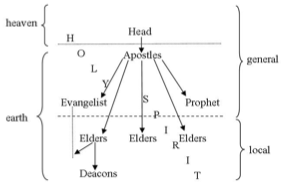
The following diagram pictures the original pattern of the church according to the evidence outlined in the preceding pages. The lines represent the flow of authority from Christ through the other levels of organization. Evangelist and prophet are general functions under the apostles. When they work locally, they are under the local leadership and are not themselves authoritative offices. All the general offices are universal offices. The structure of the church universal in the first century was not elaborate.
Fig. 13.—The Pattern of the Church
ENDNOTES
1Matthew 28:18-19; cp. 26:64; John 13:13; 17:2; Romans 14:9; 1 Corinthians 15:24-28; Ephesians 1:20-23; Philippians 2:5-11; Colossians 1:13-18; 1 Timothy 6:13-16; Hebrews 1:1-4; 1 Peter 3:22; see also Luke 1:32-33; 19:11-27; Revelation 11:15; 20:4-6; 22:1-5.
2Besides the Twelve apostles Peter, Andrew, James, John, Philip, Bartholomew, Thomas, Thaddaeus, James the son of Alphaeus, Matthew, Simon Zelotes, and Judas Iscariot in Matthew 10:2-4, and so on, apostle applies to Matthias (Acts 1:26), Paul (Romans 1:1, etc.), Barnabas (Acts 14:4, 14; cp. 13:2; 1 Corinthians 9:5-6; Galatians 2:9), Apollos (1 Corinthians 4:6-9), Epaphroditus (Philippians 2:25), Andronicus and Junias (Romans 16:7?), Silvanus and Timothy (1 Thessalonians 1:1 + 2:6), two unnamed men in 2 Corinthians 8:16-23; James the Lord’s brother (? Galatians 1:19); certain false apostles (2 Corinthians 11:13), and Christ himself (Hebrews 3:1).
3For the opposite view that all the apostles fulfilled their missionary calling by non-authoritative charisma, see J. C. Lambert, “Apostle,” International Standard Bible Encyclopedia, Vol. I, pp. 202-4. He seems to forget that apostle in the special sense includes all the general meaning as well. There are two reasons that more than fourteen men are called apostles. (1) The first is the missionary concept the term. The activity to which it refers is the same as that of evangelist, the two words arising from different aspects of the whole activity: the “being sent” and the “good news” the men declared. (2) Several of these men as members of the Pauline circle were extensions of the apostolic office and so bore the name of the office they were representing.
4(1) Christ’s personal choice of the Twelve is recorded in Matthew 10:1-4; Mark 3:13-19; Luke 6:12-16; John 6:70; 13:18 (15:16-17); Acts 1:2 + 13; 10:41; of Matthias in Acts 1:23-26 (“Lord . . . whom you [σὺ] chose”); and of Paul in Acts 9:15; 13:2; 20:24; 26:16; Galatians 1:1, 16; 1 Timothy 1:1 (cp. Titus 1:3).
(2) Seeing the resurrected Christ is mentioned as a qualification in Acts 1:22 (“witness with us of the resurrection”; cp. Luke 24:44-48; Acts 1:1-8; 2:32; 3:15; 4:19-20, 33 “their witness”; 5:32; 9:17; 10:39, 41; 13:31; 22:14-15; 23:11; 26:16; also John 1:14 + 1 John 1:1; 1 Peter 5:1 + 2 Peter 1:16-21). In 1 Corinthians 9:1, Paul associates his apostleship with seeing the Lord (probably meaning the resurrected Lord, though he may have seen Christ before). The Damascus experience was an objective event because Paul’s companions heard Christ’s voice (Acts 22:9; ἀκούω [akouō] + acc.) without understanding it (Acts 9:7 ἀκούω + gen.) and saw the light (Acts 22:9). Paul himself was physically blinded by the brightness of the light (22:6, 11). It was the kind of seeing and hearing that enabled Paul to be a witness of what he had seen and heard (Acts 22:14-15), witness being a peculiar word for the apostolic mission. Furthermore, in a table of post-resurrection appearances, Paul lists himself last in parallel to the incidents in the gospels (1 Corinthians 15:1-8). Galatians 2:7-8 makes evident that Paul was an apostle in the same sense as the Twelve.
Other distinguishing marks of the apostles were (3) receiving their message directly from Christ through the Holy Spirit rather than through other men (John 16:13-15; Acts 1:8; Galatians 1:11-12; Ephesians 3:1-13; 1 Timothy 1:11);
(4) being endowed directly with miraculous power (Acts 2) rather than through the laying on of hands (Acts 8:14-19) or perhaps prayer (1 Corinthians 14:14?);
(5) being each one supernaturally endowed with the whole range of miraculous manifestation rather than with different gifts (1 Corinthians 12:28-31). The apostles were direct witnesses, directly chosen, informed, and endowed.
(6) A secondary element mentioned in Acts 1:22-23––companying with Christ during his ministry (cp. Mark 3:4)––probably has the force of not being a novice (cp. 1 Timothy 3:6). Paul fits even this stipulation, at least in spirit. He was not a novice when he began his apostolic work, because ten to fourteen years had intervened before his first missionary journey.
5The selection of Matthias accorded with divine sanction. Luke gives no reason to question it, recounting the use of scripture (Psalm 69:25 and 109:8) without demur, and indicating implicit ratification by God in the miraculous endowment of chapter 2 as well as the choice by the Lord in 1:23-26.
6The Great Commission was given directly and particularly to the apostles: Matthew 28:16; Mark 16:14; Acts 1:1-13 (cp. Luke 24:44-53), though of course by extension the work involves all who labored under them from that day till this.
7Luke 22:25 (= Matthew 20:25; Mark 10:42); cp. 2 Corinthians 1:24; see 1 Peter 5:3 re elders.
8(a) Church office: Acts 11:30; 14:23; 15:2, 4, 6, 22, 23; 16:4; 20:17; 21:18; 1 Timothy 4:14 (πρεσβυτέριον); 5:17, 19; Titus 1:5; James 5:14; 1 Peter 5:1;
(b) the references to apostles (possibly to be included in the first listing): 1 Peter 5:1 (συμπρεσβύτερος, sympresbyteros); 2 John 1; 3 John 1;
(c) Jewish elders: Matthew 16:21; 21:23; 26:3, 47, 57, 59; 27:1, 3, 12, 20, 41; 28:12; Mark 8:31; 11:27; 14:43, 53; 15:1; Luke 7:3; 9:22; 20:1; 22:52, 66 (πρεσβυτέριον); Acts 4:5, 8, 23; 6:12; 22:5 (πρεσβυτέριον); 23:14; 24:1; 25:15; (elders, tradition of: Matthew 15:2; Mark 7:3, 5);
(d) men of old: Hebrews 11:2 (see in loco F. F. Bruce, The Epistle to the Hebrews: The English Text with Introduction, Exposition and Notes in The New International Commentary on the New Testament, ed. by F. F. Bruce);
(e) old (wo)men: Luke 15:25; John 8:9; Acts 2:17; 1 Timothy 5:1, 2 (fem.); 1 Peter 5:5; πρεσβύτης Luke 1:18; Titus 2:2; Philemon 9; πρεσβῦτις (presbytis): Titus 2:3;
(f) twenty-four elders of the Apocalypse: 4:4, 10; 5:5, 6, 8, 11, 14; 7:11, 13; 11:16; 14:3; 19:4.
9The following comments issue from a Pauline authorship framework despite frequent rejection of the pastorals as genuine products of the apostle himself. Among the writers on this question, Donald Guthrie represents those who favor Pauline authorship; see The Pastoral Epistles: An Introduction and Commentary in The Tyndale New Testament Commentaries, Vol. II: New Testament Introduction, pp. 198-236. Introductions by R. K. Harrison, Theodor Zahn, H. C. Thiessen, and others take the same side of the issue. P. N. Harrison, in The Problem of the Pastoral Epistles, presents the case for denial of Pauline authorship, especially from linguistic data.
A decision against Pauline authorship does not materially affect the point we are making; it may add weight to the argument because non-Pauline authorship corresponds with a later date of writing. The synonyms “elder” and “bishop” in the pastorals would then stand in more direct opposition to the later tendency to distinguish them by the same generations that were involved in formally delimiting the canon.
101 Peter 5:2 uses the cognate verb ἐπισκοπέω to speak of the elders’ “overseeing” (ἐπισκοποῦντες, epikopountes, UBS 5th rev ed), though Westcott and Hort in their text characteristically omit the word because of a preference for the joint reading of Codex Sinaiticus (firsthand) and Codex Vaticanus, which omit it; the Nestle text also omits it.
11The New Testament combines in distinguishing reference apostles and prophets (Ephesians 2:20; 3:5), apostles and elders (Acts 15:1-29); apostles, prophets, and teachers (1 Corinthians 12:28, 29); elders and deacons (1 Timothy 3:1-13), bishops and deacons (Philippians 1:1); apostles, prophets, evangelists, pastor-teachers (Ephesians 4:11); but never elders and bishops.
12As regards the origin of the term ἐπίσκοπος to alternate with πρεσβύτερος, we observe (1) that all the usages are in primarily Gentile circumstances (Ephesus in Acts 20:18; 1 Timothy 3:2; Philippi in Philippians 1:1; Crete in Titus 1:7; Northern Asia Minor in 1 Peter 2:25. See J. B. Lightfoot, Saint Paul’s Epistle to the Philippians: A Revised Text with Introduction, Notes and Dissertations, pp. 95-99, 193-94);
and (2) that all these occurrences are after A.D. 60, by which time the church had become predominantly Gentile in composition. Πρεσβύτερος among the Gentiles was not so prominent a word for leaders; hence, a new term tended to develop among them. For further evidence identifying elder and bishop, see the sections “local” and “authoritative.”
13There is only one case that could be made to fit the idea of a bishop over the other elders: James, the Lord’s brother, who figured prominently at the Conference on Circumcision (Acts 15). Peter tells those gathered at Mary’s house to tell “James and the brothers” about his release (Acts 12:17). Paul went up to Jerusalem and visited “James, and all the elders” were present (Acts 21:18). He was a pillar of the Jerusalem church (Galatians 1:18-19; 2:9). This evidence would fit, but does not require, a bishop superior to his elders.
14See H. E. Dana and J. R. Mantey, A Manual Grammar of the Greek New Testament, p. 147; A. T. Robertson, A Grammar of the Greek New Testament, p. 785ff.; C. F. D. Moule, An Idiom Book of New Testament Greek, pp. 109-110. The New Testament examples of this idiom include the following: Mark 6:3; 12:33; Luke 6:49; 14:23; Acts 3:14; 1 Corinthians 4:9; 2 Corinthians 1:3; Galatians 1:7; Ephesians 1:3; 5:5; 6:21; Philippians 3:3; 4:20; Colossians 2:22; 1 Thessalonians 3:11; 2 Thessalonians 1:12; 1 Timothy 4:3; 6:15; Titus 2:13; Hebrews 3:1; James 3:9; 1 Peter 1:3; 2 Peter 1:1, 11; 2:20; 3:2, 18; Jude 4; Revelation 1:9; 3:17.
15Other instances of an article governing two or more nouns are τὸν Πέτρον καὶ Ἰάκωβον καὶ Ἰωάννην (Matthew 17:1); τῆς σῆς παρουσίας καὶ συντελείας τοῦ αἰωνίας (Matthew 24:3); τῶν πρεσβυτέρων καὶ γραμματέων (Mark 15:1); τὰς πλατείας καὶ ῥύμας (Luke 14:21); τὰς φίλας καὶ γείτονας (Luke 15:9); τῶν Ἐπικουρείων καὶ Στοικῶν (Acts 17:18); τῶν Φαρισαίων καὶ Σαδδουκαίων (Acts 23:7); ἡ τὲ ἀΐδιος αὐτοῦ δύναμις καὶ θειότης (Romans 1:20); τῆς ὑμῶν παρακλήσεως καὶ σωτηρίας (2 Corinthians 1:6); τὸ πλάτος καὶ μῆκος καὶ ὕψος καὶ βάθος (Ephesians 3:18); Philippians 1:7, 19, 20, 25; 2:17; Colossians 2:8; 1 Thessalonians 2:12; 3:7; 1 Peter 2:25; 2 Peter 1:10.
16The ruling idea is probably included in Acts 20:28, but the teaching element seems more basic there since Paul is concerned about false leaders drawing away disciples by saying perverse things.
17Teaching is an activity involving most of the offices and functions so that elder-bishop-pastors teach, but they are not the only ones who teach (cp. 1 Timothy 2:7; 2 Timothy 1:11). Additional possibilities where elders may be in view are Acts 13:1; Romans 12:7; 1 Timothy 1:7; Hebrews 13:7, 17, 24. The other references for διδάσκαλος are general (Romans 2:20; Hebrews 5:12; Titus. 2:3; 2 Peter 2:1).
18(a) Jerusalem: Acts 11:30; 15:2, 4, 6, 22, 23; 16:4; 21:18; Hebrews 13:7, 17, 24 (ἡγούμενοι; assuming a Jerusalem destination for Hebrews); (b) cities of southern Asia Minor established during Paul’s first missionary journey: Acts 14:23; Lystra or Iconium may be inferred from Acts 16:1-3 + 1 Timothy 4:14; (c) cities of northern Asia Minor: 1 Peter 5:1-4; (d) Ephesus: Acts 20:17, 28 (ἐπίσκοποι); 1 Timothy 1:7 (? teacher); 3:1-7 (ἐπίσκοποι); 5:17, 19; (e) Philippi: Philippians 1:1 (ἐπίσκοποι); (f) cities of Crete: Titus 1:5-9 (ἐπίσκοποι); (g) Rome: Romans 12:7-8 (ἱστάμενοι διδάσκαλοι, istamenoi didaskaloi); (h) Antioch: Acts 13:1 (διδάσκαλοι); (i) Thessalonica: 1 Thessalonians 5:12.
19Of the five times ἐπίσκοπος occurs (Acts 20:28; Philippians 1:1; 1 Timothy 3:2; Titus 1:7; 1 Peter 2:25), the first two are plural and refer to bishops in Ephesus and Philippi respectively. The next two are articular generic references: “the bishop” (cp. Dana and Mantey, Manual Grammar, p. 144; see also Titus 1:5), the local range of references being Ephesus in 1 Timothy and “in every city” of Crete in Titus. The last occurrence of ἐπίσκοπος describes Christ rather than labels an office. Ἐπισκοπέω appears in Hebrews 12:15 and 1 Peter 5:2; ἐπισκοπή is used of this church office only in 1 Timothy 3:1. Luke 19:44; Acts 1:20; and 1 Peter 2:12 are the other references.
20They are later called prophets (15:32); perhaps they were prophets-elders as the six in Acts 13:1 were prophets-teachers.
21The ruling emphasis comes in Revelation 2:27; 12:5; and 19:15. Micah 5:2 (5:1 in Hebrew) predicts that out of Bethlehem will come one who would משֵּׁל Israel. משֵּׁל, the regular word for “ruler,” is rendered ἄρχων (“ruler”) in the LXX and brought into Matthew 2:6 periphrastically under ἡγεμών (ēgemōn) and ποιμαίνω. The feeding emphasis comes in Luke 17:7; 1 Corinthians 9:7; Jude 12; and probably John 21:16 and Revelation 7:17.
22No particular significance attaches to the fact that in this verse Paul says “rule” (προΐστημι) with home and “take care of” (ἐπιμελέομαι) with church. In 5:17 of the same book, he uses προΐστημι to refer to elders. Paul can switch terms in 3:5 because both terms can apply to either subject.
23While the four words handled here do not always carry authority in their meaning reference, they are never used for any non-authoritative function in the church.
24A fourth element especially important in determining the authoritative nature of the eldership lies in the theoretical premise that the highest present position in an authoritative system is itself authoritative. The premise is not invoked in the text at this point because it presupposes two propositions not demonstrated yet: that an evangelist is non-authoritative and that apostles have no successors.
25The present writer is also inclined to consider the ἄγγελοι of the seven churches of Asia as evangelists (Revelation 1:20; 2:1, 8, 12, 18; 3:1, 5, 7, 14). (1) Ἄγγελος is a cognate of εὐαγγελιστής. (2) Τhese persons were evidently not “guardian angels,” since John is instructed to write to them. J. A. Seiss agrees that ἄγγελος refers to a minister, though he calls the position pastor: The Apocalyse: A Series of Special Lectures on the Revelation of Jesus Christ with Revised Text, pp. 154-55.
26The point here is the way a ministry is viewed as well as the way it operates. Over a period of fifteen years, a man may serve as elder in three churches; an evangelist during the same period of time might minister in three localities. The difference is that eldership arises from within a local community of believers; an evangelist comes from without. The evangelist circuits as an evangelist, but an elder as an elder does not. When he changes residence, he does not automatically become an elder in the second church; he first identifies himself as a part of that community and may later be chosen to serve as an elder there. The evangelist changes residence because he has changed ministry; the elder changes ministry because he has changed residence. As they work, elders and evangelists may do many of the same things.
27Appointment differs from selection if Acts 6:3 is any indication of the process. Titus may be viewed as conducting the installation for which he exhorted them to make selections. The President is sworn in by the Chief Justice, but he is not under the authority of the latter.
28In Titus 2:15 Paul tells Titus to rebuke with all authority (ἐπιταγή). The right to do such may rest on (a) service rendered, (b) the truth involved, or (c) the position held. The last of these coincides with office. Paul probably has the second of these in mind since he is speaking of general moral matters.
29In the modern day, the activity of evangelist is adjusted as a result of the absence of the apostles so that he can no longer serve as an extension of an apostle’s ministry. His work now is carried on through the power of his own person under the authority of, and to the extent of, the apostolic word.
30Matthew 1:2; 2:5, 15, 17, 23; 3:3; 4:14; 5:12, 17; 7:12; 8:17; 10:413; 11:13; 12:17, 30; 13:17, 35; 16:4, 14; 21:4; 22:40; 23:29, 30, 31; 24:15; 26:56; 27:9, 35; Mark 1:2; 13:14; Luke 1:70; 3:4; 4:17, 27; 6:23; 9:8, 19; 10:24; 11:29, 47, 50; 13:28, 34; 16:16, 29, 31; 18:31; 24:25, 27, 44; John 1:23, 45; 6:45; 8:52, 53; 12:38; Acts 2:16, 30; 3:18, 21, 24, 25; 7:42, 48, 52; 10:43; 13:5, 20, 27, 40; 15:15; 24:14; 26:22, 27; 28:23, 25; Romans 1:2; 3:21; 11:3; Hebrews 1:1; 11:32; James 5:10; 1 Peter 1:10; 2 Peter 2:16; 3:2; Revelation 10:7; 11:18(?); 16:6(?).
31Matthew 11:92; 14:5; 21:26; Mark 11:32; Luke 7:26, 28; 20:6.
32Matthew 13:57; 21:11, 46; Mark 6:4, 152; 8:28; Luke 1:76; 4:24; 7:16, 39; 13:33; 24:19; John (1:21, 25) 4:19, 44; 6:14; 7:40 (52); 9:17; Acts 3:22, 23; 7:37.
33Matthew 23:34 and Luke 11:49 (?); Acts 11:27; 13:1; 15:32; 21:10; 1 Corinthians 12:28, 29; 14:29, 322, 37; Ephesians 2:20; 3:5; 4:11; Revelation 18:20. Προφητεύω (prophēteuō), “prophesy,” refers to the church in Acts 2:17, 18; 19:6; 21:6; 1 Corinthians 11:4, 5; 13:9; 14:1, 3, 4, 5, 24, 31, 39; Revelation 10:11. Προφητεία (prophēteia), “prophecy,” occurs in Romans 12:6; 1 Corinthians 12:10; 13:2, 8; 14:6, 22; 1 Thessalonians 5:20; 1 Timothy 1:18; 4:14; Revelation 1:3; 22:7, 10, 18, 19.
34Luke 11:49; Ephesians 2:20; 3:5; Revelation 18:20.
35Acts 13:1; Romans 12:6-7; 1 Corinthians 12:28, 29; Ephesians 4:11.
36Cp. perhaps Stephen in Acts 6-7; for a description of deacon see p. 6:16.
37Re Romans 16:1 see in loco William Sanday and Arthur C. Headlam, A Critical and Exegetical Commentary on the Epistle to the Romans, in The International Critical Commentary on the Holy Scriptures of the Old and New Testaments, ed. by Charles Augustus Briggs, Samuel Rolles Driver, and Alfred Plummer. For the passages in 1 Timothy, see in loco William Hendriksen, Exposition of the Pastoral Epistles, in New Testament Commentary. Διάκονος in Romans 16:1, however, could be used in the descriptive, non-official sense of “worker.” In 1 Timothy 3:11 γυναῖκας could be taken in its usual meaning of “wives” (i.e., of the deacons), as the Authorized Version translates: “their wives.” Calvin and others understand 1 Timothy 5 in reference, not necessarily to widows serving as “deaconesses,” but to widows supported by the church. In 1 Timothy 3 Paul is talking about selecting persons; in 1 Timothy 5 he is talking about accepting applicants. Relevant passages among early Christian writers are Tertullian, On the Veiling of Virgins 9 (A.D. 200); Apostolic Constitutions 3:7, 15; 8:19, 20, 28.
38Since διάκονος is grammatically masculine or feminine (Romans 16:1) depending on the accompanying article, we are tempted in 1 Timothy 3:8 to consider the anarthrous usage as a cover for both. Under this view, 3:8-10, which contains nothing masculine, would speak of the deacons’ qualifications generally; 3:11 would be directed to women, 3:12-13 to men. If this analysis were correct, it would illustrate textually the relationship of deacon and deaconess as diagrammed earlier. The presence of “similarly,” or “in like manner” (ὡσαύτως after γυναῖκας (3:10), however, implies that γυναῖκας stands in parallel to διακόνους in 3:8. (Note that ὡσαύτως [hōsautōs] links the ἐπίσκοποι of 3:1-7 with διακόνους in 3:8; likewise, ὡσαῦτως puts γυναικός and διάκονοι in 3:12.) Consequently, it seems best to view both 3:8-10 and 3:12-13 as directed to men and 3:11 to women, whether “deaconesses” or wives of deacons.
Certain correspondences between 1 Timothy 3:1-13 and Titus 1:5-2:8 might be observed if 1 Timothy 3:11 refers to women rather than wives of deacons: (1) cp. 1 Timothy 3:1-7 and Titus 1:5-2:2; (2) cp. 1 Timothy 3:8-10, 12-14 and Titus 2:6-8; (3) cp. 1 Timothy 3:11 and Titus 2:3-5.
39Dated after A.D. 49, Galatians 2:1-10 is often considered another account of the Jerusalem conference; cp. Henry Clarence Thiessen, Introduction to the New Testament, pp. 216-18. In Galatians: The Charter of Christian Liberty, pp. 97-109, Merrill C. Tenney argues for a date previous to the conference.
40Frederic W. Farar in The Story of St. Paul, p. 253, though himself an archdeacon in the Church of England, agreed here, “The so-called Council of Jerusalem in no way resembles the General Councils of the Church, either in its history, its constitution, or its object. It was not a convention of ordained delegates, but a meeting of the entire Church of Jerusalem to receive a deputation from the Church at Antioch.”
41A break may perhaps be made after 15:5 to eliminate the statement about the converted Pharisees from the account of the meeting, but “the multitude” in 15:12 and “the whole church” in 15:22 seem to indicate that it was an open, informal, unofficial discussion.
42“Wherefore I judge that we not trouble them” does not state a new decision or make a motion, but expresses the conclusion inherent in matters mentioned previously. James seems to be “answering” in 15:13 the proposition of the Pharisees in 15:5 and so is addressing them more than those with whom he agreed. Peter seems to be addressing the Pharisees also when he says to his antagonists, “So now why are you tempting God by laying on the neck of the disciples a yoke that neither our fathers nor we were strong enough to carry?” The “coming to one accord” in 15:25 may mean doctrinal accord between the Pharisees and the others, or procedural accord as to what to do to counteract their influence.
43The word δόγμα (dogma, 16:4) is capable of being used for authoritative proclamation of rulers (Luke 2:1; Acts 17:7) and for authoritative elements of law (Ephesians 2:15; Colossians 2:14). Authority in such cases comes from the circumstance of usage, to which we must appeal for a word’s normal meaning anyway. Derivationally, δόγμα is a noun of δοκέω (dokeō), “to seem best.” Δοκέω is used in Acts 14:28 (“It seemed good to the Holy Spirit and to us.”) and may be used in 16:4 on that account. There was authority here by virtue of the Holy Spirit, the apostles of the universal church, and the Jerusalem elders over those who went out in their name, but no authority of Jerusalem over other churches or this conference per se over the whole church.
44“Laying on them [ἐπιτίθημι, epitithēmi]” in 15:28 is as colorless regarding the legislative and executive action of councils as “enjoining by writing [ἐπιστέλλω]” in the 15:20 parallel. “Laying on” picks up Peter’s terminology in 15:10, where he speaks of laying on the yoke of law. The “laying on” in 15:28 stands therefore in contrast to, and less than, the laying on of law. “No greater burden than these necessary things” (15:28-29) refers to matters of morality true even before the Law or the gospel, as distinguished from a positive ordinance like circumcision, whereby a man became debtor to do the whole Law (Galatians 5:3). The yoke of faith (15:11), which is taken on, is easier, lesser, lighter (Matthew 11:29-30) than the yoke of law and may be laid on by charismatic proclamation aside from supervisory authority both in the initial acceptance and subsequent obedience. Since those who had gone out from Jerusalem were involved in doctrinal error, something had to be said about Jerusalem’s position on the matters involved. “In contrast to what the Judaizing teachers have laid on you, we lay on you only these necessary things.” No positive argument for authoritative, conciliar action can come from Acts 15:28.
45Galatians 1:22; 2 Thessalonians 2:14.
(This essay equals Chapter III of Dr. Warren’s The New Testament Basis for the Non-Denominational Church: The Historical Argument, Master’s Thesis submitted to the faculty of Wheaton College in Wheaton, Illinois, June l973.)
christir.org