
Interpreting the Creation Narrative
INTERPRETING THE CREATION NARRATIVE
Virgil Warren, PhD
An Interpretative Approach
Genesis 1 uses the week as a literary device for organizing a topical presentation of God’s prominent creative activities. It is without strict concern for sequence and duration. While Genesis 1 uses the week as a literary device, Genesis 2-3 uses parable to organize important truths around historical persons. It is not necessarily that the events of Genesis 3 led to new effects after sin occurred; these characteristics of mankind and nature were put in place by God from the start. God knew beforehand that people would sin, and built factors into their situation that would limit the extent to which they could rebel and factors that would force them to recognize their dependent situation. This approach derives from Genesis several fundamental beliefs about God, people, nature, sin, and God’s connection to these aspects of the human circumstance. It stresses meaning (theological perspectives) over time (historical account).
A. The Creation Setup
The approach looks at how the creation scene is set up from a literary standpoint—by way of a double presentation with different focuses, centered around the earth (geocentric; Genesis 1) and centered around mankind (anthropocentric; Genesis 2-3). It assembles devices planted in the story as vehicles of communication.
It considers the seven-day week as a grouping of days God is putting into place at the time of writing when he is constituting Israel as a new nation distinct from Egypt and its ten-day week. Moses used the seven-day week to give outline and structure to a short account of divine activity in the origin of all things physical. The days do not so much represent successive periods of time as they topical sets of creative endeavor without concern for exact sequence or duration. In this respect, the presentation looks back in history as biblical prophetic materials look forward to the future; in both, the concern is more about the meaning than time frame. God’s viewpoint is not limited by passage of time (2 Peter 3:3).
Making man from dirt (3:19) rather than directly from nothing takes its cue from the fact that he returns to dirt in the end (3:19).
Naming all the animals highlights human distinction from them and supremacy over them, a feature that would reinforce the dominion mandate. Going through the animal kingdom also provides occasion for observing that the man had no mate appropriate (“meet”) to him in the animal kingdom.
Forming Eve from a rib of Adam suggests the unique closeness and common identity that exist between husband and wife in contrast to general social interaction and animal associations. Some readers venture to add that forming her from his rib in his side rather than from elsewhere suggests nearness to his heart, equal to him rather than degraded below him or vaunted above him.
Putting Adam and Eve in a “garden/orchard” that God had planted for them to take care of provides a vehicle for indicating humanity’s responsibility to God for nature (cp. 1:26, 28). It likewise conveys purposeful, productive existence in contrast to mere enjoyment as the main feature of human life. It is not only a matter of being good; it is a matter of being responsible. Mankind is to be good, purposeful, and responsible.
Putting forbidden fruit in the Garden establishes people’s situation as a moral/ethical one from the very beginning.
Locating the Garden at the source of a river that flowed out and became four waterways may indicate a lush environment for mankind’s experience of productive living. It may symbolize the life-giving water that would give fertility and productivity to what lay beyond Eden. (Or is this scenery in the presentation?)
Eating food pictures internalizing values. Eating fruit from the tree of knowledge represents willingly adopting a life that is contrary to God’s intentions. The tree of life reflects our desire to live forever, our inability to imagine not existing. Forbidding Adam and Eve to eat from the tree of the knowledge of good and evil is a way of saying that secondary beings are not free to determine right and wrong for themselves. We are made like God (1:26, 27), but we are not to become like God in knowing good and evil (3:5, 22). In experientially knowing good and evil, Adam became like “one of us” in that he had decided on his own what was right and wrong for him to do.
B. Facts About the Fall
The Fall represents an episode reinacted in each person, and the consequences borne by our first parents are the same as what happens to everyone. The narrative collapses into one event with the first couple what recurs with each person along the way.
The sequence of (the creation and) the Fall corresponds with the levels of responsibility in marriage, the home, ministry, and society (cp. 1 Timothy 2:8-15).
The manner of the Fall correlates with women’s greater tendency to trust and men’s susceptibility to female influence. The story is arranged so that Satan approaches Eve with the temptation and Adam willingly succumbs to her example.
The snake’s tactics in temptation typify the lures thrown to the innocent. The tempter (1) denies the negative consequences. Since consequences follow causes, there is often no way to expose the deception ahead of time. People’s eyes are opened after it’s too late. They should have trusted the One that had already authenticated himself by providing for them.
The tempter may be (2) playing with the words day and die and telling half-truths to deceive. He may have used die in a way that implied physical death when God meant it as spiritual death or both. Several times in scripture, physical and spiritual death blend into each other either because they are rooted in the same sin factor or because physical death is a graphic picture of spiritual death. Satan may have implied that eating the fruit would not kill them (because it had an appointed value rather than a causal one). If eating fruit from the tree of life was keeping Adam and Eve alive, then Satan may have been telling the half-truth that they would not die from eating the forbidden fruit; they would die from being separated from the tree of life, expulsion from the Garden not being verbalized in God’s warning. The results came from God because they ate the fruit (occasionalism) rather than being caused by the fruit or the eating of it (causation). Satan may have implied that they would not “flat out” die that very day when God meant “begin to die” (ingressive action) or simply “die when”; Adam lived several hundred years after the Fall.
The tempter (3) casts doubt on the motives of anyone who warns people about their behavior. He caricatures the prohibition as a restriction on “rights,” as an unnecessary limitation on freedom.
(4) The tempter doesn’t mention the negative side effects; he omits “the rest of the story”: sense of nakedness, fear of God, expulsion from the Garden, laboring for a living, pain in childbirth. The situation is painted rosy and couched in glowing terms. Hype the benefits and downplay the risks.
The tempter (5) puts a positive spin on what will happen. “Becoming like God/gods” sounds better than it is. People are simply not constituted for that role and cannot earn the right to assume it.
In tempting others, the tempter seems (6) partially ignorant of the real situation himself; yet he speaks with confidence and heaps consequences on himself in the process.
In all these ways, the tempter (7) appeals to self, to ego. “The lust of the eyes, the lust of the flesh, and the pride of life” (1 John 3:16) restates “delight to the eyes, good for food, and desirable to make one wise” (Genesis 3:6). Such factors, directed to the individual, mess up social relations—horizontal between Adam and Eve in a blame game as well as vertical between man and God that leads to fear—and personal matters both physical and psychological.
Sin itself is enjoyable (delight to the eyes, good for food); it’s the consequences that are so sad and painful (death, etc.).
C. Elements of the Curse
The curse highlights the fact that sin brings unavoidable consequences for tempter and tempted alike. Created beings may choose their acts, but the creator determines the consequences.
Human death is the featured consequence of disobedience (2:16-17). What happened after the sin suggests that “death” includes what leads to it and the whole set of less-than-ideal features that issued from it. Physical death as the most graphic result becomes a label for all things tending toward it (deadening) and lesser things like it (deterioration/corruption).
NOTE: Perhaps this more generalized meaning for dead (mot, Hebrew; thanatos, Greek) explains why biblical writers do not always clearly distinguish physical and spiritual “death.” If it is a more inclusive term like deterioration, it encompasses physical and relational/interpersonal/ spiritual (Ephesians 2:1, 5; Colossians 2:13) as in “dead while she lives” (1 Timothy 5:16). The question is whether lexically mot had a broad meaning specialized to death or whether it had a particular reference to death that was generalized to related and like things. English similarly uses “dead” to mean “fade”; hence, for “dead strings” on a guitar (in that direction) or “deaden the sounds,” which does not mean silence them. “He worries me ‘to death’” expresses a negative extreme—like death is. Various levels of generality occur also with the Hebrew word for “day” (yom): daylight hours (Genesis 1:16), twenty-four-hour days (1:5), or simply “when” (Genesis 2:4).
Physical death despite “eternity in their hearts” (Ecclesiastes 3:11) serves as an inescapable reminder of the alienation between people and between people and God—something they cannot dispute, disregard, look past, ridicule, or impugn the lawgiver’s motives for (3:4-5). There is no spin that anyone can put on disobedience to change its consequences into something good. Physical death vividly portrays interpersonal/ social/spiritual death. God had already built death into the human condition to limit foreseen sin (cp. Ephesians 1:4). As physical death serves in the New Testament to picture spiritual death, so also the (ontological) image of God (Genesis 1:26-27) serves as label for the spiritual image of God (Colossians 3:10).
People’s sense of nakedness exemplifies the self-consciousness people feel when they act contrary to their conscience—what they know God expects of them. After all, only humans wear clothes; they have a strong sense of self-awareness.
Expelling Adam and Eve from the Garden occurred in part to keep them from eating from the tree of life and living forever (3:22-24). Such a move makes it look like our first parents already had the death principle operating in them, and their “surely dying” was a matter of God’s separating them the same day from the tree whose fruit was keeping them alive. There was only one tree in the Garden that they were to avoid (2:9).
The aversion people have toward snakes suggests using a snake to represent Satan’s evil influence over humankind. Putting enmity between people and snakes (3:13) corresponds with people’s impulse to kill them, as by stomping on their heads (3:15).
A snake slithering along in the dirt aptly pictures the “lowlife” that tempts others into disobedience and distrust of God to its own detriment. People need not think that in getting other people to sin (perhaps for fun or to boost ego), they will avoid repercussions. Satan also gets his just desserts.
Severe pain in childbirth—without close parallel in animals—is analogous to the personal grief people live in after they sin. That pain stands for all examples of extreme pain.
Working by the sweat of the brow contrasts humans with animals. Ravens do not plant, cultivate, and harvest to get sustenance (Matthew 7:26). Animals are hunter-gatherers. Some interpreters have, in fact, taken this account to represent mankind’s transition from a hunter-gatherer to agrarian society. Short of that, it is obvious that mankind cannot self-sustain simply by gathering (fruit from trees); they first have to grow what they gather (planting and harvesting from the ground).
Dealing with thorns and thistles and the ground that does not yield its strength (said regarding Cain soon afterward) stands for the obstacles that frustrate human effort. Crops do not produce the genetic potential they could with proper care, sufficient rain, appropriate climate, and positive relations between people. These hindrances represent the destruction sin brings on agriculture, say, in wartime and the wanton waste caused by selfish people.
Disregarding a beneficent God’s prohibitions observes the human folly of heeding a tempter’s contrary voice that has not authenticated itself to the welfare of the tempted—all because the tempter’s voice offers freedom to overindulge in self-interest.
Consequences are often more extensive than warnings: sense of nakedness, fear of God, pain in childbirth, expulsion from the Garden, labor for sustenance, thorns and thistles were not indicated; only death appeared in the warning. Adam and Eve knew enough not to do what God prohibited; but when they disobeyed, they discovered more than anticipated.
(At least some) consequences are irreversible. Cherubs and a flaming sword kept Adam and Eve from returning to Eden to eat fruit from the tree of life.
Dealing with evil harms the doer and deceiver. Stomping on the snake’s head may kill it, but doing so bruises the benefactor’s heel.
The elements of the curse are aspects of the human condition that make it less than an ideal world, but one that makes it appropriate for mankind in a “fall-able” estate under the long-range purposes of God.
As a topical format, Genesis 1 presents God’s creative activity using the seven-day week as an outline. Genesis 2-3 seems to picture a human being’s process of growing up. It pictures what happens to all of us as we grow up from the innocence of infancy and youth to the dangers and failures of adult life: the lack of a sense of nakedness, no sexual involvement mentioned, easily swayed and unsuspecting.
A great number of important truths stand out in this simple short story. Especially for a largely pre-literate society, its brevity and story form make the material more understandable and more memorable than a conceptual description of how sin and temptation work. In part, that is the same reason Jesus laced his pedagogy with parables and picturesque speech. Even today, teachers use examples and illustrations for what they have to say.
D. Concepts Conveyed
The motif in the creation chapters gives tangible representation to intangible realities—physical expression of spiritual/interpersonal/psychological realities. The issue is not whether the accounts are true, but at what level of detail the text intends to present its truths. The ideas stated above ring true pretty much aside from how this material is conceptualized. The following concepts also hold true under either approach.
God is one. “In the beginning God . . .” is the first thing said; the reader is not left to wonder whether there is a God (agnosticism). The creation chapters project a monotheistic outlook. There are not several gods operating separately (polytheism) or three gods working independently (tritheism). In the beginning it was God—Elohim, or Yahveh—who created the sky, the earth, the seas, and everything in them. So Yahveh, the God Israel is to worship, is not a territorial god alongside gods of other nations as in monolatry (sometimes called henotheism), the belief in many gods but the worship of one.
NOTE: Elohim (God) is, indeed, a plural form, but it has a singular meaning since it carries a singular verb throughout this material and when referring to the God of Abraham, Isaac, and Jacob. The plural form is presumably a Hebrew majestic plural, a linguistic device where plural number is put for large size or great importance. Us is used in 1:26 and 3:22, which Christians usually take as oblique references to the trinity (note also 11:7 and Isaiah 6:8). The us in 1:26 could perhaps be a kind of majestic plural also, but not in 3:22 (“mankind has become like one of us”). Since the second us has a plural referent, its parallel likely is plural as well.
Some have proposed that God is addressing angels in these verses. Angels do not appear in chapter 1, but there are cherubs in 3:24 (and seraphs in the throne-room scene of Isaiah 6). Being in the context of the second us (3:22), they could be inferred into the us of 1:22. On the other hand, angels are nowhere pictured as having the capacity for creatio ex nihilo. Angels would not just be ones God is talking to in 1:26 because he says, “Let us make mankind in our image.” The us seems to be involved in the creating as well as the conversation. An editorial we/us is not likely, but it is conceivable that “us” is not involved in the creating per se. It could be like someone that compiles the statistics and writes a report for a government agency, but says “we” because he is speaking for the other personnel in the office. So the text may favor a trinitarian interpretation, but not require it; hence, even here God is probably not thought of as one individual person (monarchianism, or unitarianism; cp. John 14:16). If us does not have that connection here, the meaning of “knowing good and evil” needs to be adjusted from the value assigned to it in these pages. Deity alone has the right to determine right and wrong for itself. The constant understanding is that mankind is created in the image of God rather than in the image of angels, but the question is whether that would make a difference in the way humankind has turned out..
God is a personal God rather than a force or principle or idea. He speaks to his people, so God is personal deity and interpersonal deity.
Ultimate reality is interpersonal. God as creative us precedes everything else and sets the framework for what is subsequent that it makes secondary.
The priority of person over thing is shown in the interpersonal creating what was other than itself. Interpersonal relationship is the most ultimate reality in the Judaeo-Christian worldview; it is the starting point of all things. As interpersonal preceded legal (Romans 4; Galatians 3:15-29), so also interpersonal preceded natural: “In the beginning God created the universe”; thing derived from person. The Genesis arrangement reverses the format that regards the interpersonal as an epiphenomenal product of the impersonal. Personhood and its capacities (thought, will, affection, conscience, spirit, sense of self, the ability to project consciousness) are not chance effects of mass-energy.
God is transcendent deity. There is a distinction between God and the natural order. The former pre-existed the latter and created the latter. Pantheism and panentheism are set aside because the universe is not the ultimate frame of reference in sequence or “rank.” There is no idea that the universe was made out of a god or other pre-existing matter (cp. Hebrews 11:3, “not out of things that have phenomenal existence”).
God is ethical deity. He is not just a God with power, but one who conducts himself with self-consistency. He does not operate like a legal principle. He is a holy God, a creator who expects that manner of operation also in his sentient “creatures.”
God is all-powerful deity. He brings things into being, he sets the direction of history, and overrides whatever tries to exert itself against his intentions. Omnipotent deity triumphs over evil, both in the epic scheme of things and in individual events that serve as microcosms of all space and time. What brings things into being is more powerful than any of the things he brings into being.
God is sovereign deity. Since he precedes all things, in him all things exist and hold together (Colossians 1:17). Since there is nothing else to oppose him, he simply says, “Let there be” and it is. Being above the limitations of the space-time universe, he is not subject to the parameters within it. He is transcendent.
God is involved with his creation. He is not the God of the deist, who does his creative work with its built-in laws for self-perpetuation, and goes off to do something else he delights in. He is relational deity, present in his creation, involved with it, watching over it, and available to it. He walks in the Garden. He is a living God. He is immanent.
This universe is a purposeful universe brought into existence for a reason. God has made mankind in his likeness particularly to have that on whom he can bestow himself. His creative enterprise is more than doing what he delights in; he does it to bring about the truly new. This world is not the world of the atheist or the evolutionary philosopher, where the future eventuates from the present unguided by pre-determined ends, and then characterized by random eventuation powered by impersonal forces.
Mankind alone is created in the image of God (1:26-27), having the interpersonal capacity with all that implies and entails. On the Areopagus, Paul expressed it similarly when he said, “In him we live and move and have our being” (Acts 17:25). People are not only social beings, but moral ones whose behavior needs to reflect the kind of connection they have to the interpersonal God above and before them (vertical) and the interpersonal ones around them (horizontal).
Since God is ethical deity, history is ethically driven. Human history is not just a matter of who has more power or more authority, but who sheds more good influence. It is good influence that needs to drive history, because evil tends to self-destruct. It is usually contrary to nature, almost always something that provides a less fulfilling life experience, and something always contrary to purpose. So sin does not consist of rebellion against arbitrary prohibitions, and goodness does not consist of arbitrary mandates. Besides, the triumph of good over evil is guaranteed by the fact that ethical deity is also omnipotent deity. God calls to task disobedient people and tempting snakes, and dictates inescapable consequences appropriate to offending parties.
1:11-12, 21 implies the permanence of kinds in plants and animals. Reproduction by fission does not somehow become reproduction by fusion. The “tree of life” resembles a dot-to-dot, but the connections between the dots are external to the plane of the dots and resident in the mind of the creator of discrete kinds. “Transitional forms” do not lie between fixed complex systemic sets; they would not be functional entities. Taxonomy tells against morphing from one into another by stepped change. Organic nature is more categorical than continuous. Variation within “kinds” has boundaries so that each “dot” is more like a solid than a liquid.
There is a distinction between mankind and animal. Denied is the modern belief that mankind stands within the animal kingdom as merely a higher product of evolutionary development. Humankind shares physical features with animals, but people are not to consider themselves animal “kind.” Wearing clothes (3:21; cp. 3:7) helps human beings distinguish themselves from animals; so it is a natural consequence of self-awareness (fig leaves) as well as a practice God appointed to reinforce the man-animal distinction (animal coats). Mankind is not just complicated chemistry or complexified animal, and mankind does not wear clothes just for the weather.
Our fear of God and the supernatural derives from human sin, not divine demeanor. Our sinful human condition lies at the heart of the matter. Instead of a more ideal circumstance, our self-consciousness leads to fear of the Almighty that in whose image we were created and with whom we were intended to fellowship. So indirect operation has replaced direct experience. Fearing God degrades a loving relationship to him; love casts out fear (1 John 4:18). Besides, he wants us to serve him because we want to (impulsion), not because we must (compulsion), which would be our feeling if he were always visibly around “looking over our shoulder,” instead of coming to us periodically in the cool (“wind”) of the day. We are to conduct ourselves appropriately for positive reasons instead of doing so for fear of reprisal. Not bowling us over with his presence is an act of grace on his part. The less he has to do to keep us faithful and to mature us, the closer things are to the way he wants us to love and serve him.
The basic unit of society is not the individual, but the family. God did not populate Eden with separate individuals; he created one man and then one woman taken from him, and commanded them to fill the earth (1:28; 9:1, 7). “It is not good that the man be alone” (2:18). Offspring are to leave parents and similarly unite into “one flesh,” and carry the process forward (2:24). Herein lies an implicit critique of modern cultural drift toward absolute individualism, where people replace marriage with cohabitation and prioritize personal career over interpersonal commitment, family, and the creation mandate.
The combined distinction and similarity of man and woman means that neither facet of the whole is absolute and that a balance between them is achieved—neither exaggerating the differences nor eradicating them. Trying to eradicate every difference would be an exercise in frustration, a struggle against nature itself, and opposition to divine intention as expressed in that created nature. Exaggerating the differences likewise runs against the observable overlap and range of abilities in women and men—statistical by degree. Whatever physical and psychological variance has been created into us can be used to advantage in establishing a complementary whole for family, society, and Christian responsibilities.
Creating one man and one woman answers to God’s intention for marriage—monogamous, permanent, exclusive, and bisexual. He did not make one man and several wives, etc. Whom God unites, people are not to separate (2:24; Matthew 19:3-12).
Marriage constitutes a unique oneness. Husband and wife are one more than they are two. They form a psychosocial-physical unit (“one flesh”)—total, permanent, and exclusive.
The serpent’s approaching Eve rather than Adam has been understood to imply women’s greater tendency to trust. Paul may have had something like that in mind when he declared that the woman was deceived, not the man (1 Timothy 2:14). So, the man committed the greater sin. The serpent may have figured it was easier to get to Adam that way since the scenario also illustrates men’s tendency to be susceptible to feminine influence.
The unity of mankind derives from having a common ancestry for all the nations, races, and peoples (Acts 17:26). That leaves no rationale for super-races, racism, prejudice, or genocide.
The presentation highlights the responsibility sequence between God and man and between man and wife.
Genesis 1 declares the goodness of the natural order, the material realm, human procreation, etc. The universe is good; it is a harmonious whole; a logos structure, an orderly realm, not chaos; the earth is not “waste and void” (1:2). As such, it contrasts with the later Gnostic idea that spirit is good and matter is evil and even with the Platonic tendency to consider the physical world as a degraded reflection of the ideal world. Instead, the physical is directly good, and the spiritual establishes the parameters for using the physical. Human beings are to conduct themselves by values (spiritual) more than by desires (physical) or self-centeredness (anti-social). Influences toward disharmony are terminated or restrained (or transformed back into good).
Another prominent implication is the supremacy of good over evil. Goodness resides in God by virtue of his creative work, which reflects his originating purposes. We are not free to choose absolutely whatever we want to do (James 4:15); our choices must fall within the broad boundaries made known by revelation and nature. The curses associated with the Fall make expulsion from the Garden a microcosm of the eternal epic.
Freedom is within determinism. There is good and evil behavior; not all acts are good or equally good. What is good is not just how we look at things (subjective). What is good is not just what is good for “me” (egocentric). Right and wrong are measured most ultimately by purpose—specifically, divine purpose—as reflected in how God constructed nature, including our human nature. What appeals to us is not necessarily good. Our personal preference is not decisive. Selfish behavior contradicts the social reality that characterizes God-to-man and man-to-man associations.
Actions bring consequences. Acts are not just isolated occurrences; they connect with what they produce. We live in a cause-effect world, and our behavior participates in that arrangement. Choices are free to us, but consequences are fixed by God, including the limitations of nature and circumstance.
There are negative consequences to sin. Loss of freedom and loss of more ideal circumstances come from disobedience. All the undesirable effects God brought on the serpent, Adam, and Eve stand for the pattern that deterioration and destruction follow.
Death serves to limit evil. Death does not just rid the world of less desirable specimens so more advanced ones can replace them. Death restrains disobedience and evil influence in humankind by imposing a time and degree limit on us.
Contained herein also is the explanation of the origin of evil. It is not something in eternal tension with good in yin-and-yang fashion. Evil and good are not co-eternal; evil originated in the free will of secondary agencies (the serpent, Adam, and Eve). Like Adam and Eve, Satan as the serpent’s character is portrayed as a created being—like a beast of the field (3:1). Satan originated evil (John 8:44). God is responsible for the evil that exists, but he is not guilty of it. In the creation account, he demonstrates his responsibility by what he does in response to the sins of the snake, of Adam, and of Eve
From a practical standpoint, we need to trust God, who created us and sustains us, rather than listen to someone else that has not validated himself by self-giving for our joy.
Genesis 1-3 teaches personal responsibility for personal actions. So to speak, a man cannot blame his wife and a wife cannot blame a snake. We are not to take advantage of the opportunity for evil—the tree of knowledge that was present—or blame a tempter (the serpent) for it. Guilt is personal.
The chapters likewise emphasize responsibility toward God and objective purposeful existence as contrasted to total self-direction or living by the pleasure principle (1 Corinthians 15:32; Isaiah 22:13; 56:12; Luke 12:19). God established our role as caretakers of creation (Psalm 8:4-8) as represented by keeping and dressing the Garden (2:15). Even that role the Hebrew writer declares has not been completely fulfilled except through Christ (Hebrews 2:8-9).
Advantages of the Reverse Hermeneutic
In the reverse hermeneutic, we do not have to multiply miracle and unrevealed postulations to bail out apparent discontinuities and tensions as tend to be the case under a totally historical, chronological, timeframed, literal reading of the material. Repeatedly invoking miracle makes the interpretation look suspicious; multiplying special explanations sounds like “special pleading.” Our proposal for reading the text does not deny miracle or eschew sanctified imagination; it observes that miracle is not the characteristic pattern of divine operation, and imaginative justifications are not the norm. God seems to allow natural processes to advance his agenda and intervenes when the situation calls for something special.
We do not have to defend any suggestion that Genesis teaches a flat earth or a geocentric universe or entertains the eternality of matter. The presentation is phenomenological. Genesis 1:1 states the completed creation; 1:2-2:3 goes through that fact at a more detailed level, viewed from the earth “outward” to the sun, moon, and stars mentioned farther on. The writer gives his presentation on the way things look without any necessary implication about the way things happened and the way things are.
We do not have to suppose that within six days God took creation from zero through “waste and void” through the planting of the Garden. While God has the power and authority to do that, we are released from the compulsion to explain implicit features of that construct like these below.
We need not speculate how there could be “disembodied” light before the sun and moon existed. Light can appear first simply to make the narrative “visible,” to turn on the set (“lights!”). Some readers have proposed that making the sun, moon, and stars on Day 4 only means removing the cloud barrier so the heavenly bodies would be apparent from the ground, but the text says that they were made (built) for ruling the day and night, a role that happens cloudy or not. We would not expect to have light on earth independent of a source for light.
We are not left to wonder how the first three days could have evenings and mornings when the basis for making evenings and mornings comes later (sun and moon rule the day and night). Not only would there have to be “disembodied” light, but it would have to be located, disembodied light for the earth’s rotation to produce night-day sequences.
We do not have to wonder why plants were created before the source of photosynthesis. Besides the creation of light and the creation of plant life, the rest of the creation sequences seem natural enough, although ordering birds before land animals seems strange and the sequence for flora and fauna is different in the first two chapters of Genesis. These exceptions, however, may serve as clues that we are not dealing with historical chronology.
NOTE: It seems clear that the presentation in Genesis 1 envisions six twenty-four-hour days. There are seven of them to make the familiar week parallel to Exodus 20:8-11. The evening-morning expression fits a daily cycle. In all the examples of day (yom) with ordinal numbers, the word means a twenty-four-hour day. (That point could be weakened by the fact that rarely are there occasions for ordinal numbering of indefinite time periods.) There is no plausible proposal for how the imagery could be stretched significantly beyond twenty-four hours with grass made on Day 3 and the sun on Day 4.
We are not inclined to choose between the sequences of common elements in Genesis 1 and 2 or to discover some way to harmonize them. We do not need to decide whether the plants, birds, and animals of Genesis 2 came after Adam in contrast to Genesis 1, which puts them before him. Granted, sequence of telling need not equal sequence of occurrence, but the way the elements intertwine makes the issue too complex for that. While Genesis 2:19 could be rendered “had formed” regarding birds and animals, no translation option can reverse the order of plants before mankind in 2:5-9. There might be a difference between “plants of the earth” and “herb of the field” in 2:5 and “trees of the Garden” in 2:8, but there is no independent reason for that suggestion, especially since grass, herbs, and trees are combined in 1:11-12, 29-30. Taking Genesis 1 as topical and 2-3 as historical parable allows for change of intent from earth-centered (geocentric) to man-centered (anthropocentric) and any consequent variations in the two creation presentations. The second chapter goes back and retells crucial parts of the story to make different points.
The situation is like The Parable of the Pounds (Luke 19:11-27) and The Parable of the Talents (Matthew 25:14-30), the former delivered on Jesus’s last ascent to Jerusalem from Jericho and the other given a few days later in the middle of his final week. The overall import is similar, variously using talents and pounds for a differing number of servants but requiring faithfulness and productivity from his servants during the master’s absence. Luke’s parable adds that the kingdom is not immediately to appear and that the King must go into a far country, so to speak, to receive the kingdom like procurators and proconsuls did in the Roman Empire. Upon his return, opponents of that appointment are put to death. That additional feature in The Parable of the Pounds is like the additional features in Genesis 2.
We are not obliged to believe that the universe is six thousand or so years old. Such a short time frame requires radical re-interpretation of considerations elsewhere that indicate greater antiquity whether from extra-biblical histories or scientific research. Some proposals for countering evidence for significant antiquity seem as speculative as attempts to overcome the difficulties faced by the theory of endogenous complexification (evolution).
Approaches to the Genesis 1-2:3 Material
(a) Our approach has taken 1:1 as a statement of completed creation subsequently detailed in large part in 1:2-2:3.
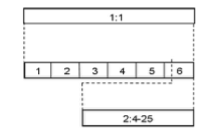
That is part of a narrowing pattern that runs all through Genesis and ends up coming down to Israel as God’s chosen nation. 1:1 is a statement of completed creation (Isaiah 45:18). Here the first “God said” is “Let there be light” (1:2), and the specifics of his command lead to “evening and morning” to conclude the first day. The two expressions “God said” and “evening and morning” serve as book ends for all the segments throughout the presentation. So, the complete process in 1:1 is segmented into seven parts that detail matters involved in going from nothing but God at the start, to the completed creation in the end.
This narrowing pattern continues in Genesis’ endeavor to place Israel in the world setting. Cain is set aside in favor of Seth (3:1-5:52), Noah is chosen from other members of Lamech’s lineage, Shem is preferred over Ham and Japheth, Abraham is taken instead of Nahor or Haran, Isaac is taken over Ishmael, and Jacob with the twelve patriarchs is chosen over Esau.
After human death and its accompanying losses, Genesis also traces continued restraints on evil in the case of Cain, the flood, the confusion of languages, and the shortening of life after the flood. Abraham died at 175 (35:7), Isaac at 180 (35:28), Joseph at 110 (50:26), and Moses at 120 (Deuteronomy 34:7). The Psalmist says that a person’s life is 70 to 80 years (Psalm 90:10). In addition, there come periodic divine interventions. On the positive side, the larger perspective introduces the later unfolding of salvation history in the choice of Israel and the prospect of a Messiah from that nation for the salvation of all nations.
Under a strict historical approach, (b) the interpreter might suppose a time break of some shift kind between 1:1 and 1:2 considered as being in sequence.
The first verse would be a statement of the completed creation—as in Genesis 2:1 and Isaiah 40:21; 45:18—that includes what follows. 1:2 would track back and detail matters from the beginning to the end. 2:4-25 reaches back again and picks up the account from Day (3 plus) 6 in chapter 1.
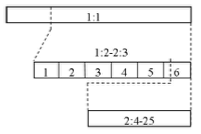
While this reconstruction is engaging, it seems unnecessary since Day 4 covers the heavens as a whole and by implication anything prior to earth’s “waste and void” condition in 1:2ff.
(c) Less acceptable is the approach that puts 1:1 a part of day one.
It is appropriate to observe that Exodus 20:11 and 31:17 say “in six days God created the heavens and the earth and all that is in them.” Those formulations could suggest that 1:1-2 was within the scope of Day 1. Since these statements in Genesis and Exodus come from the same author, they are not meant to convey conflicting scenarios. That leaves the option of reading the Exodus summaries as general statements that cover the bulk of material in Genesis 1 while glossing over anything prior to 1:2. However, no such glossing over is necessary under the previous analysis of 1:2 + 1:2ff: Day 4 covers that set of creative activities that would end up at earth’s “waste and void” condition. When plausible ways of handling different texts yield different conclusions, interpreters may choose one over the other or conclude that their inferences come from reading the material more strictly than the author intended. It is, after all, the actual account of what the later statements summarize.
The main objection to this reconstruction is that it creates an age of the universe that seems impossible to fit with what we learn elsewhere from nature itself. Additionally, the content of 1:1 precedes the first “and God said,” which marks the beginning of all the days one through six.
(d) Other interpreters have inserted a time break after 1:1 by postulating a ruin-reconstruction process (“the earth became waste and void”), but it seems like overkill to “ruin” things to the point of re-making the sun, moon, and stars, as Day 4 indicates. (e) The day-age theory for the six days of Genesis 1 likewise does not afford much chance for elongation since the grass of Day 3 would not exist long without the sun of Day 4. (f) The same objection applies to supposing six literal days with untold expanses of time between them. (g) Six revelation days does not seem to work because the days connected with God’s creative activities, not with his revelation activities.
Another way of handling Genesis 1:1-3 has been to supply different vowel points for the original Hebrew consonantal text. The translation would become, “In the beginning of God’s creating the heavens and the earth, [that] the earth was waste and void,” etc. That rendering could remove from 1:1 the idea of creation from nothing (as regards everything beyond the earth, at least) and have the text addressing only what happened from “the waste and void” stage onward. The age of the whole universe would fall out of consideration—along with creation from nothing. Day 4, however, talks about the creation of the heavenly host. That would surely fall within “heaven and earth” in 1:1, yet 1:1 speaks about the “beginning” of God’s creative work. We would not expect “the heavens” then to be mentioned later. Taking Genesis 1 as a finite verb makes a simpler grammatical construction that seems to fit better the style of writing in the rest of the chapter. That take is confirmed by the Septuagint, where pre-Christian Jewish translators so rendered the verse into Greek. It also parallels John 1:1-5 better. From a grammatical standpoint, the use of vav for “that” is a less likely value for the conjunction. Later, the Masoretes, Jewish scholars of the sixth century A.D. and following, pointed the consonantal Hebrew text to create a finite verb in 1:1.
In thinking through the various matters, we perceive that the author’s concern is not so much the length of time as the direction of it, not so much their sequence of origin as their manner of origin.
There is no interest here in capitulating to the evolutionary bias that permeates so much contemporary thought and research. The point is not to compromise but to avoid extremes. Truth tends to lie between extremes—the Golden Mean. (1) General evolution, especially biological evolution, is not capable of scientific demonstration. Hard science is limited to observable, recurrent, natural process. Science and history are related and overlapping disciplines, but history as one-time eventness cannot be subsumed under scientific research—or at least done so with the same degree of certainty associated with science properly so-called. Science also has no capacity for disallowing miracle, which is what creation from nothing is. Science describes what is natural; it cannot make pronouncements against what is outside of natural—against supernatural causation, especially when events are contrary to what natural explanation could account for (as in the next entry).
Furthermore, (2) reciprocating parts cannot originate in sequence in matters that determine viability. In this issue, there are highly complex sets of interdependent parts that themselves also reciprocate with other systems and reciprocate across different compenetrating levels. By the very nature of multiple systemic reciprocations, step-by-step changes, whether few or many, whether natural or by intelligent design, cannot occur without losing ongoing functionality. The impossibility of staged change lies in the nature of reciprocating systemic complexities regarding viability, not in proposed agencies of such change. The present objection to staged change relates to extreme complexity (the eye, the brain, etc.), irreducible minimums, and adequate cause for the truly new; but it goes beyond them by focusing on the inherent impossibility of required continuous operation during postulated periods of transition between sets of wholes operating by inherently necessary reciprocality.
Finally, (3) the cause-effect series apparently traces back to a personal act of the will—a personal “first cause.” No apparent reason exists that a certain sequence or configuration of proteins, genes, chromosomes, etc. should have anything to do with leading to one living form rather than another—an amoeba rather than a duck. The causal properties seem to have the character of code, that is, communication, “meaning” as a superadditum—something that “rides on” rather than inheres in. If so, origins do not rest on something inherent; they are designated causations—design; and that moves beyond materialistic explanation for the whole and for the source of it. It invokes the characteristics of personhood—will, intelligence, authority, supernatural-spiritual.
The concern here relates to supposing that God’s whole creative activity took place in a week and that no creating preceded Day 1 or followed Day 7. Observations that imply a shorter earth history have their place in calling into question dating systems that suggest billions of years. Before all that work gets settled, however, we do better not to require unnecessary biblical constraints on chronometry and thereby set up unnecessary resistance to Christian faith.
The age of the universe is not the point of the Judaeo-Christian faith; so the more important point is how the natural order got here (divine creation), not how long it took to get here. The origin of the universe is more basic than the age of it. The main points are that matter is not eternal (entropy), that self-creation is impossible (nihil ex nihilo), and holistic creationism is required for upward complexification over time, however long that time may be. Lengthened time does not detract from creationism or enable evolution. God’s supernatural causation can be clustered or sequenced. Since time is not a cause, having more of it does not increase the likelihood of a natural explanation for biological origins. The earth’s age brings up a substantial interpretative enterprise for the relevant texts of scripture; that enterprise should not be confused with the reliability of the text itself. Reliability applies to scripture, not the interpretation of scripture.
We do not have to defend even the idea that mankind has existed for just six thousand years, whatever may be said of the rest of the created natural realm, organic or inorganic. While that number seems nearer the order of magnitude than we would gather from the biblical literature, Christians are not pressed into unnecessary conflict with scientific, archaeological, and historical research, where it seems clear that people have been somewhat longer than six millennia. For now, on the science side radiometric dating techniques may continue to be evaluated, and certain discoveries may be challenged as examples of human remains. Admittedly, on the scripture side the antiquity of mankind cannot be pushed back farther than a few thousand years. For schematic purposes, some generations could have been omitted in the genealogical tables to have ten generations from creation to flood and flood to Abraham. By analogy, Matthew omits a few names in the genealogy of Jesus to create three sets of (approximately) fourteen generations from Abraham to Jesus (Genesis 5, 10; 11:1-32; 35:22-36:43; Matthew 1:12-17). That is about the only elongation of human history that looks plausible. (In the Masoretic text Methuselah died the year of the flood. The Septuagint and Samaritan Pentateuch do contain some difficulties in this regard because of their larger numbers for life spans.) At any rate, we would not expect hundreds of generations to be omitted from those genealogies as if the entries were representative or dynastic lists (king lines rather than kings). In places where they can be checked, these are names for individual patriarchs instead. A six-thousand-year antiquity of mankind is not apt to fit with information deduced from extra-biblical sources.
As with the age of the universe, so also with the antiquity of mankind, the concern is not to compromise what is supposedly clear from revelation in deference to the speculations of methodological naturalism and evolutionary developmentalism. Rather, some ideas found among interpreters of the Bible are simply not warranted by the Bible. There is enough incompatibility between naturalistic philosophy and clear biblical teaching without pushing differences to unnecessary extremes, especially regarding the age of the inorganic universe and the animal orders. There is also enough inescapable incompatibility between the two worldviews that Christianity is not going to get swallowed up by naturalism or made irrelevant as if naturalism can explain everything without recourse to exogenous causation (supernatural creation).
We do not have to explain how there could be four rivers flowing from Eden when before the Fall—or at least before plants and man—there was no rain, but a mist that arose from the ground (2:5). Since rain does not enter the biblical record until the time of the flood (Genesis 7:4, 12), do we infer that it did not rain for the first 1656 years? If so, how does that fit with Adam and Cain tilling the ground meantime and how does it square with the comment in 2:5 that it had not rained because there was no plant life or nobody to till the ground? That final feature sounds as if tilling the ground were in the offing aside from the curse as much as having plant life was. However, using the rainbow as a sign of promise against another world flood may seem more natural if a rainbow was something new at the time of Noah. In a different vein, is this simply a partial picture of an idyllic setting with no need for shelter from the elements, no need for clothes, or no need to labor to produce food—the big three (cp. Matthew 6:25-33)?
We do not have to find four rivers that either flow into or out of the same location. Furthermore, we may wonder how any such rivers would remain at Moses’ time if Noah’s subsequent flood was catastrophic enough to account for most of the fossil-bearing strata the world over. Pishon and Gihon are unknown altogether today despite being accompanied by geographical markers—which are also unclear. We would think that they would not be named at all unless they were recognizable to the writer’s contemporaries. Cush and Havilah are post-flood persons in the lineage of Ham, Noah’s son. Both have relatives Mizraim and Canaan, which are also place names (patronymics) respectively for Egypt and the area occupied later by Israel. The territories as a group look like the whole Middle East with the Tigris and Euphrates rivers combining with the Nile and the Jordan or some other pair of rivers—a rather large Garden.
Re-using old pre-flood names for new post-flood rivers (Tigris/Hiddekel, Euphrates) is conceivable (New York, New Amsterdam, New England) but irrelevant, since the names would apply to a place no longer in existence. Besides, Genesis 2:10-14 describes in present tense the geological features and gemology of Eden’s environs. The account even locates the Garden itself “eastward in Eden.”
On the one hand, we wonder why the author would give a detailed description of a hypothetical place, since detailed description is presumably to help the reader identify the location. On the other hand, virtually the same problem arises if it is a detailed description of a pre-flood place destroyed by a geographically universal catastrophy. In either case, the site would not be something anyone could locate at the time of writing. We might combine the possibilities and say that the flood was not geologically catastrophic (tranquil flood theory) and that the original “Garden” was the Middle East as we know it today but without its original qualities. A “flaming sword” might be a poetic representation for making the area (virtually) uninhabitable by making it into a hot desert or letting the flood destroy it. In that way, Adam and Eve count never return to the kind of place it was even if the place itself could be returned to.
Rather than get lost in that conundrum, it seems advisable to suppose that Moses is using an approximate post-flood location for an idyllic pre-flood event or else Noah’s flood was not as catastrophic as one that could account for most of the geological column. We do not expect, then, to locate the Garden of Eden in a postdeluvian world.
We are not left to wonder how to put together Adam and Eve’s role in the Garden and their mandate to fill the earth (1:26, 28). God planted the Garden for them to dress and keep; and when they sinned, he cast them out of it. Whereas in Genesis 1 the whole world sounds like their originally intended domain, in Genesis 2-3 the whole world outside the Garden looks like an accursed fallen domain because they entered it as part of the curse after their fall. Does 1:26, 28 look past the temporary circumstance in Eden, or is the world outside Eden not all that different from Eden—merely being away from the tree of life and requiring labor and pain? It seems better to suppose the two presentations are simply not intended to be taken together in this respect. They tell different stories to convey different messages—similar again to the parables about the pounds and the talents.
We do not have to explain how everything that happened on Day 6 could fit within one set of daylight hours. We do not doubt God could have created all the hosts of animals in one day—even instantaneously, but Adam’s naming all these animals sounds like a formidable task, much less one that could take place in fourteen or sixteen hours before Adam was put to sleep so God could create Eve from him and bring her to him. The naming could have been more representative than exhaustive, since the evident purpose of that episode was to emphasize the distinctness between mankind and animals: humankind is superior to animals (naming) and finds no appropriate partner among those kinds (different). There may have been fewer species from which today’s plethora of land and flight animals developed by speciation. Even so, an awful lot took place that day.
We do not have to defend the idea that animals did not die or feed on each other prior to Adam’s sin as fiat creationists frequently believe. Under any reading of scripture, those ideas are unwarranted anyway since they are based on inference from questionable New Testament texts instead of specified results of the Fall and aspects of the curse (2:7-24. (A more extended treatment of this matter appears in Addendum B.) Genesis 1:29-30 need not be read as a restrictive comment so much as a non-restrictive one.
We are not tempted to see whether men have one less rib than women.
We do not have to entertain the idea that a person could become wise and independent by eating a certain fruit or live forever by eating another. Besides, the text says that God expelled the first couple from the Garden in part so they would not be eating from the tree of life and live forever. We could take that to mean death was already operative within them but “counteracted” by the fruit of that tree. Even a historical reading of that episode should probably take the tree of knowledge as having an assigned value rather than a natural one. It was the occasion, not the cause.
The appointed value is in keeping with their eyes not being opened until both of them had eaten the fruit (3:6-7). A causal value might imply that Eve’s eyes would be opened immediately—before she gave the fruit to Adam. That difference may reflect the parable character of this material: if Eve’s eyes were opened at once, it would have confused the story. Would she have given it to him if her own eyes were already opened? Would he have taken it? The situation would not have lined up as well with reality with that complication—with just one having “opened eyes.” The consequence of disobedience (fear of God) and the consequences of the curse were given, not caused. Placing “the tree of knowledge” in Eden established an ethical/moral circumstance.
We do not have to defend the possibility of a talking snake or the related idea that prior to the Fall all the animals talked. That all animals could talk has been used to explain why Eve was not suspicious of hearing words coming from a snake. Another proposal has been that Satan possessed the serpent and spoke through it. But the text indicates that what the serpent did reflected what it was: “The serpent was more subtle than any beast of the field” (3:1). That quotation likewise eliminates the idea that Satan used a snake as a manifestation of himself. Instead, the snake in this story is a symbol of Satan. The situation is remininiscent of animal symbolism in apocalyptic literature—like Daniel’s dream of the four beasts (Daniel 7; cp. Revelation 12-13, etc.).
We are not inclined to ask herpetologists to interpret the skeletal structure of snakes as exhibiting vestiges of legs so as to indicate that this order of being originally used an entirely different system of locomotion and obtaining nourishment.
We need not suppose with some interpreters that, because of human sin, God re-did the whole food chain in terms of animal death, dentition, digestive systems (that could process meat and neutralize the toxins that subdue prey), methods of obtaining food, survival instincts and techniques, animal toxicity, and so on. Such an idea would require considerable recreation over a sizable portion of land animals and even more so with sea animals, which have an almost total percentage that feed on each other. Even new creation would be involved, including the many kinds of germs, bacteria, viruses, and toxins that cause diseases and death and that decompose dead animals. The wholesale modifications of animal life and the creation of additional things strain the statement that after Day 6 God rested from his completed creative work.
We are not inclined even to wonder why all of Adam’s descendants would be permanently cursed for “the sins of another.” Admittedly, the social circumstance causes a father’s sins to harm his sons sometimes for generations (Exodus 20:5; 34:14; Deuteronomy 5:9-10). In this case, however, scripture teaches that “death passed on all men because all have sinned” (Romans 5:12). These consequences have relevance to every person. We are all like Adam and are appropriately subjected to the same limitations and restraints as he was. Those limitations and restraints force us to acknowledge our dependent position and prompt us to reach out to the One that can provide the transcendent needs we unconsciously yearn for: security, worth, love, and innocence. That is the role of death and the other features identified in the curse, the flood, the confusion of languages, the shortening of life, and periodic divine interventions. Meantime, the redemption option offers to reverse the human condition, and resurrection brings into view an afterlife that requites any inequities of this life (Romans 8:18; for related matters, see Addendum B).
Among these strictures, we do not include the claim that the creation time in Genesis 1 and Genesis 2 differs between six days and one day (2:4). “In the day that Yahveh God made earth and heaven” apparently uses day to mean “when.” The two “day” references do not cover the same items: the second recounts some of the story in detail from the dry-land stage while the first recounts it in detail from the “waste and void” stage. In the second usage, there is no reference to light; the sun, moon, and stars; or the separation of water in the sky (cloud or a theorized vapor canopy?) from water on the earth.
We also do not concern ourselves with where Cain got his wife. Presumably she was a sister (Genesis 5:4); likewise for Seth. In the progress of time, that “limited” pool for spouses would enlarge.
We do not take God’s questions “Where are you?” and “Who told you that you we naked?” as suggesting that he did not know where they were or what they had done as if not omniscient. These might be anthropomorphic questions. More likely, we just say that asking does not necessarily imply ignorance; it may call for someone to “fess up” or speak up. It’s like a miracle worker asking a blind beggar what he wants when he cries out, “Son of David, have mercy on me” (Luke 18:41).
Of the advantages of our approach, the two most significant are that it gets rid of the problem of deep-time origins and the sequence of earthly origins—antiquity before humankind and the order of individual creative acts. The seven parts topically outline the main divine creative acts.
Besides (1) what we do not have to do negatively under the reverse hermeneutic and (2) what are not legitimate questions under either hermeneutic, (3) our approach affords us a way to account for certain phenomena in the text.
We note (a) the parallels between the first three and the last three days. Light on Day 1 correlates with the luminaries on Day 4. The water above and below the firmament on Day 2 parallel the birds of the sky and the fish of the sea on Day 5. The vegetation on Day 3 answers to the animals and mankind on Day 6, whose nourishment derives from plants (1:29-30). That last parallel calls attention to the fact that chapter 2 does not retrace a closing sequence from chapter 1 like Days 5 and 6. Instead, it combines Days 3 and 6.
(b) Since an author can imply more by a figure than a reader would necessarily infer from it, it is understandable why Moses inserts two interpretative notations from his own vantage point in time: one about the Sabbath (2:3) and one about marriage (2:24-25).
(c) Word plays are easier. The association between man and woman (2:23) works in Hebrew (ish from whom ishah was taken). The explanatory comment, however, does not imply that people originally spoke Hebrew and that God, Adam, Eve, and early mankind spoke Hebrew till the time of Babel. Some paronomasias on person and place names could be Hebrew translations, but these explanations work easier if they originated in Hebrew. That kind of thing translation often cannot preserve. In all the cases we cite, the receptor language would need sets of cognates of similar import to the related words in the original language.
For example, English has no word for dirt/ground/soil that would serve well as a proper name for a person (Adam; cp. adamah, “ground”; 2:7; 3:19; 5:2). Woman does have a complicated derivational connection to man, but no modern English speaker would know that (ishah, “woman”; ish, “man”; 2:23). Other cases are Eve (havvah, “to live”; “mother of all living”; 3:20), Cain (“acquisition,” from qanah, “to get”; 4:1), Abel (“transitoriness”; 4:2), Seth (“compensation”; 4:25), Eden (“delight”; 2:8-15; 3:24; 4:16), Nod (“a wandering”; 4:12, 16), Noah (“to comfort”; 5:28-29), Babel (“to confuse”; 11:9).
The same complication that shows up in English could show up with an original-language term translated into Hebrew. In some cases, the names were more likely attributed to the participants by the Hebrew writer, accompanied by an explanatory connection to the setting. Such practices can occur in straightforward history, but they are more in keeping with the genre proposed here.
The important lessons from these chapters are such as can be conveyed in a simplified manner. That observation provides no proof against reading the chapters more strictly; it only notes that under the reverse construct, the same factors come through about the universe and human life under a holy God who creates and relates to his creation, and calls individuals to responsibility and purpose.
Furthermore, the listing of advantages above is not calculated to disprove a literal historical reading of Genesis 1-3; disproving a previous idea does not need to precede proposing an alternative one anyway. Some hypotheses cannot be disproved. Any approach must bear its own burden of proof, and each viewpoint starts out with no advantage over the others. The one that accounts best for the features of the situation and results in the fewest difficulties is the one an interpreter prefers—at least for now. A reverse hermeneutic has more advantages and fewer difficulties, so it offers a better treatment of the Genesis chapters.
On the positive side, all spiritual content is retained that these chapters have a bearing on. Nothing of eternal import is at stake here. God is not portrayed in some unworthy fashion. Salvation history is left intact. Nothing is omitted that pertains to the nature of sin, its origins, or its consequences. The great distinctives of the Judaeo-Christian worldview remain, not only as to the nature of God, but as to the universe and mankind together with the distinctions and relations between parts of the whole. Such foundational elements of worldview stand in stark contrast to other ancient and modern conceptualizations of reality and so have an adequate reason for being presented in these materials. There are no resulting contradictions with the rest of special revelation as far as we can see. There is no denial that this material is true and reliable.
The things lost under this approach are the stumbling blocks we do not now have to circumvent. The things retained are the theological perspectives listed above. We observe that the “contradictions” readers observe are in the ambiance of the parables, not in the theological outlook they portray. Such features of the text do not call for disbelief but for re-interpretation.
This analysis of Genesis 1-3 supposes that features of life contemporary to the time of writing became vehicles for describing origins by analogy, and that certain historical stack poles anchor the materials parabolically woven around them to teach spiritual viewpoints. Approaching origins this way parallels approaching eschatology. When we read the other end of history in Revelation, we understand that certain historical future stack poles have theological perspectives figuratively woven around them. Whereas creation highlights the origin of evil in the universe of a holy God, eschatology stresses the triumph of good over evil in that holy God’s epic plan of restoration. As if in confirmation of that parallel, Revelation appeals to creation imagery to convey its own message (“serpent” in 12:1-17; “fruit” in 22:1-5). Genesis is to cosmogony what Revelation is to eschatology.
Treating the creation materials as history blended with parable does not degrade scripture into “myth” as popularly conceived—false and fabulous. It is not an imaginary story disconnected from reality. It is not “just” a myth any more than Jesus’ stories were “just” parables. God has long used parables (Jesus) and visions (Isaiah) and dreams (Joseph, Daniel) to communicate with people. The vision in Isaiah 6 was not pointless because it was not “real.” Seraphs (“fire beings”) do not have six wings, and God did not sit on a throne in a temple while wearing a train that filled the whole building (Isaiah 56:1-2; cp. Acts 7:48; 17:24). That vision served as a call to Isaiah by the real God with an important message for that prominent prophet to deliver to the chosen people. Pharaoh’s dream (Genesis 41) was not meaningless because it was not literal or historical. Cows don’t eat each other, and heads of grain do not consume one another, but by that dream God showed Pharaoh through Joseph what was going to happen, and the country was able to prepare for the alternating periods of famine and plenty. Parables, visions, and dreams are not meaningless; their meaning comes differently—indirectly and pictorially.
There is another point worth noting about shifting from straightforward history to a historical parable. In non-historical elements, the truth base moves from the fact that it happened to the authority of the speaker. In “The Rich Man and Lazarus” (Luke 16:19-31), the content is guaranteed by the authority of Jesus rather than by something that took place: the moralizing view of history is implicitly denied in that earthly wealth does not indicate divine approval and poverty is not proof of sin; there is more to life than this life; the inequities of this life are gathered up in the eschaton; comfort later in “the arms of Abraham” more than compensates for innocent suffering here; Hades is not “a wonderful place”; there is no change of state after death—people’s final condition here becomes their destiny hereafter; dead people do not return to warn Scrooges; scripture suffices for human life and divine judgment; disbelief and disobedience are rooted in more than insufficient evidence.
Recognizing the quasi-parabolic character of this piece avoids allegorizing the story to the meaning. It allows for “scenery” to appear alongside the intended message and to leave unresolved the extraneous tensions that would exist if the scenery were incorporated into the intent. By comparison, we do not have to decide whether Lazarus was an actual person or whether his name was symbolic (“without help”/“whom God helps”). We can hold as typical the dogs, the sores, the rich man faring sumptuously, and Lazarus being laid daily at his gate; they help set the tone. We are not obliged to believe that people in one intermediate state can see and talk to people in the other—or that spirits talk at all in the immaterial realm since verbal communication requires material tongues. We need not wonder how the spirits of unjust people—without flesh and bones (Luke 24:39)—can be tormented by fire or whether people with spiritual bodies in the afterlife (1 Corinthians 15:35-58; cp. Luke 24:39) have eyes and arms and tongues and fingers—or how a drop of water would do much to relieve someone’s physical torment. The rest of revelation helps sort the realities from the scenery and helps show that it is, in fact, a parable. Other passages picture hell as outer darkness (Matthew 8:12; 22:13; 25:30). That also means we do not have to figure out the nature of hell and the resurrected body or justify how the God we know from elsewhere could torture disobedient people, before we heed the obvious import of the parable. We hold in abeyance the tensions in revelation about the nature of intermediate-state embodiments and the nature of the resurrected body and consider them as belonging to God’s secret things (Deuteronomy 29:29), secret because we probably could not understand the explanations anyhow (cp. 1 Corinthians 2:9; 2 Corinthians 12:4). There is enough in what we do know to justify trusting God in what we can’t know. We can do what we know without getting distracted by side issues.
So, while the intended ideas remain the same in history and parable, the basis for them changes, and the number of specifics adjusts downward. We need not strain after explanations for what should not strike us as literal likelihoods anyway. We consign them to figurative expressions and extras in the movie. That way of handling “The Rich Man and Lazarus” and eschatological expression parallels the handling of the creation narrative in those places that do not fit well with each other, with what scripture teaches elsewhere, and with what we know from clear personal experience.
One ramification of this shift from reality to the writer’s perception is the later, especially New Testament, inferences from reality to Mosaic perception (albeit inspired). 1 Timothy 2, for example, could more easily become confirmatory illustration instead of primary proof for women not authoritatively teaching men in the church. That, in turn, might make more likely the idea that Paul’s directive stood inside an implicit cultural limitation—like our understanding about braided hair and jewelry in 1 Peter 3:3 and having long hair and covered heads in praying and prophesying in 1 Corinthians 11:2-16. That approach to New Testament directives allows for distinguishing the fact (order of responsibility in family, etc.) from the cultural manner of manifesting that fact.
Besides the difference between history and parable, history and dreams, or history and apocalyptic, there is the lesser distinction between history and poetry and between parable and poetry. “Poetic license” introduces imaginative expression for affective purposes. The difference that makes shows up in the differences between the historical account of Deborah and the “Song of Deborah” (Judges 5), where the events are somewhat “hyped.” A similar difference between history and poetry comes in events of 1 Samuel 17:1-18:5 and the song of the women, “Saul has slain his thousand, and David his ten thousands” (1 Samuel 18:6-7).
Hermeneutical Principles for the Creation Account
A. Reverse Hermeneutic
The idea behind the “reverse hermeneutic” comes from a distinction between logical and chronological order. It takes its cue from the biblical description of salvation, a related process put in place “before the foundation of the world” to transform evil into good (soteriology). God, foreseeing human sin, made plans by which to save humans from it. Likewise, God, foreseeing human sin, built into the original human condition features that would control it and predispose people to “feel after him and find him” (Acts 17:27). That two-part reconstruction combines the negative and positive aspects of salvation history. God, “in founding the world,” created a human condition in less than a conceivably ideal fashion to limit the expression of evil in the meantime (theodicy) before “the restoration of all things” (Acts 3:21; cp. Matthew 17:11; Romans 8:18-25). As noted before, Genesis also records later restraints on evil in the flood (6-10) and the confusion of languages (11:1-9). So to speak, for humans as they are, this world as it is amounts to about “the best of all possible worlds.”
In both the salvation motif and the limitation of evil, there is a reversal of logical and chronological sequences. The sin that would come chronologically afterwards was dealt with chronologically before even as the later originating of human evil was curtailed before it started happening. The chronologically later sin was logically before the preparation for salvation from it; the chronologically later sin was logically before the mechanisms to restrain it. Early Genesis presents that logical order as chronological format; it is a chronological telling of a logical sequence.
The text presents those notable features of human history as resulting from human sinfulness. That scenario is true, not particularly in a chronological historical sense (occurrences), but, more importantly, in a logical theological sense (meaning). Moses took notable features of our living circumstance and wove them into a narrative description of origins.
NOTE: As part of the larger problem of evil, we can say that ahead of the plan for salvation from evil and the built-in restraints on evil, there is the even more basic decision to allow the very possibility of it. Evil was allowed by creating free will and allowing (restrained) expression of it. Although evil does not have to exist to define good by actual contrast, it does serve to highlight good by contrast (as between the snake’s and first couple’s condition before and after the fall). Good is defined in theory by purpose as expressed in nature along with commandments and prohibitions. Actual evil only bears out evil in theory. On the positive side, allowing evil and establishing the less than ideal human condition provided opportunity for developing virtues and degrees of virtue that would not otherwise be needed or possible. The situation compares with domesticated animals, which tend not to be so hardy as those in the wild, because tame animals are sheltered, fed, and protected from opposition and competition. Besides, giving the ability to exercise free will has the value of providing occasion for a higher potential for experiencing existence—a more fulfilling life. Those values were in addition to the restraint principle through less than ideal circumstance. Triumphing over evil additionally glorifies God, who implements the curses unhindered by others.
“The problem of evil” lies at the heart of most arguments against the existence of God—at least the God of the Bible. A very high percentage of evil in the world comes from people—like those of us who are wont to use evil as proof that God does not exist. The objection sets up a theoretically impossible situation—the kind of thing even omnipotence and authority have nothing to do with solving: If God does nothing about it, he is blamed; if he does do something about it, he is blamed for being mean or not giving people a chance to straighten up. We can agree that although the holy God is not guilty of evil because he did not do it, the omniscient, omnipotent God is responsible for letting it happen, particularly to the degree it does. Death and shortened life together with pain and suffering are not reasons to accuse God of irresponsibility; they are, in fact, aspects of his taking responsibility for it by restraining it, stopping it, punishing it, and redeeming it. The later salvific element is not in early Genesis (although some have suggested that the stomped head and bruised heel might be a dim allusion to the work of Christ, born of woman, maybe even the bruising of his heel on the cross). Whatever else we may say, there must be good reason for allowing some evil because God himself in the person of the Son deliberately entered that situation to experience the full brunt of it—“slain before the foundation of the world” (Revelation 13:8?). If God is not above suffering, then we aren’t either; and we have lost the argument from evil.
B. Event for Process
This parable presents as one non-real event what repeatedly happens in real process—the fall of the first couple. In Genesis, that takes the form of weaving around the original real people the parabolic particulars that embody the principles operative in history with all people.
C. Fused Historical-Parabolic Character
This endeavor to understand Genesis calls for deciding at what level to place historicity between total parable and total history. Our inclination has been to see parabolic elements attached to historical realities in Genesis 2-3. Thus, we do not detach the narrative from its historical grounding; there is a limit to the parabolic nature of elements in the account. The genealogies in Genesis 5 and 10 tie Adam and Eve into subsequent historical persons and things. The fact that they are the ancestors of all humankind today (3:20) evidently lies behind statements like “he made of one [nature/father/God] every nation of people to dwell on all over the world” (Acts 17:26 < Malachi 2:10). Hebrews 11:4; 12:24 identifies their son Abel as an example of faith. In predicting the destruction of Jerusalem, Jesus speaks of all the blood that was shed from Abel to Zachariah (Matthew 23:35). Mankind is monophylogenous.
In the parabolic direction, we hesitate to stretch the picture of Adam and Eve far enough to allow for a situation in which God chose one couple out of a general population to start something special as he did with Noah, Abraham, Moses, or the Twelve. Such an idea would be comparable to postulating pre-Adamic races to harmonize Genesis with the presumed dating of ancient anthropological remains. This present idea might allow for a different possibility in which earlier races were not destroyed and then a new beginning made. Instead, Adam and Eve would become a separate beginning from among a larger mankind, and should live in a special place (Garden) temporarily till they were thrust out into the larger world. With the later anthropologically universal destruction by the flood, all those other people would have perished along with the sinful descendants of Adam and Eve. As a result, the whole of mankind today would still have originated from the same first couple through Noah’s family. The proposal, however, would have to be entertained cautiously because it has to speculate on so many additional facts and raises more questions than it answers.
In the historical direction, we could increase the proportion of fact to symbol that would leave Genesis 1 as a simplified list of divine creative acts outlined in the form of a seven-day week. Thereafter, we could strip out those features that seem parabolic/unreal and discontinuous with one another: a garden with a tree of life and a tree of knowledge, naming all the animals, the creating of Eve from Adam’s rib, and the snake materials. Remaining would be the creation of the first couple with responsibility and ethical expectations, succumbing to temptation that forfeited their moral excellence, and the initiation of human death, increased pain and suffering, and a less ideal living condition—along with the psychological effects of guilt. Depending on how the flood is understood, the location of Eden and its environs might be retained as well.
The seven-day week does present a calendrical anomaly since it corresponds with no celestial cycle as do years (with the sun), months (with the moon), days, and days-nights (with the earth’s rotation). It would make sense to explain that time segmenting as coming from Genesis 1 taken literally. Exodus 20:11 at least correlates the week with this creation narrative. The reverse hermeneutical paradigm, however, takes the seven-day week as an enjoined cultural structure that Moses accommodated to his own purposes for describing universal origins.
NOTE: The five-day week, encountered in a few cultures, is not a perfect year or month division either. In fact, no small grouping of days (for months or weeks) can form an even division of the year, because the year itself does not have an exact number of complete days divisible into equal small numbers of full days. In contemporary calendars every four years adds a day; the individual months vary between thirty and thirty-one days and have the odd twenty-eight- (or twenty-nine-) day month of February. Weeks are kept constant at seven days without attempting to synchronize them with the solar year or lunar month.
The best explanation for the origin of the seven-day week is that God incorporated it into the life of his new nation as part of making it distinct from the Egyptian ten-day week. That went along with establishing a new festival cycle, a new place of residence, a different kind of organization and government from what the Israelites had experienced during their bondage under Pharoah.
Under any approach, the Bible presents a greatly simplified version of origins. It could hardly have done otherwise, given the practical limitations of space and a design for popular use in an ancient culture. That reduction process takes the form of attaching parabolic elements to historical anchors, using notable features of life to carry forward the points of the account: people’s aversion to snakes, their unique sense of nakedness; humankind’s need to plant, cultivate, and harvest food; intense pain in childbirth, and the power of temptation through pleasure (food). Beyond the general ideas, the details of a parable may not “work” because they are not part of the point. Discontinuities, variances, and tensions between Genesis 1 and 2 become irrelevant if the presentation consists of a topical presentation of divine historical acts followed by more parabolic presentation in chapters 2-3. These important perspectives are historicized (presented as history) to some degree for clarification, simplification, and memorableness.
D. Authorial Intent
Finally, we address one popular concept advocated as a primary principle in biblical interpretation and invoked with special emphasis in Genesis 1-3: literal takes precedence over figurative. While that idea sounds good and does work out in many cases, the more accurate primary principle is authorial intent. What someone says could conceivably make sense literally even though the speaker means it figuratively.
Correcting that interpretative error removes from literalism an improper advantage in ambiguous cases. Human language does not work literal-over-figurative in general; so we should not promote it as the way language works in the Bible. Matthew 16:5-12 comes close to illustrating the priority of authorial intent over presumed literalism. When Jesus said to beware of the leaven of the Pharisees, the disciples took “leaven” literally to mean yeast, but Jesus meant “teaching.” Compare the following:
“Elijah” for “John the Baptist” in Matthew 17:9-13;
“the girl is not dead, she’s sleeping” (Matthew 9:18-19, 23-26; Mark 5:22-24, 35-43; Luke 8:41-42, 49-56);
“eat my flesh and drink my blood” in John 6:52-59;
“tear down this temple and in three days I will rebuild it” in John 2:18-22; Matthew 26:61 + 27:40; Mark 14:7 + 15:29).
“I have water to drink that you don’t know about”; Christ would give the woman “water” (John 4:11-15).
In John 9:34 the Pharisees misuse literally Psalm 51:5 to explain the blind man’s misfortune: “you were altogether born in sin.”
We need to emphasize the stricture on literalism in biblical origins especially because scripture comes from a culture that had a stronger propensity for using picturesque language (Semitic) than do modern western cultures more disposed to literal speech.
In each case, there must be a search for (a) clues that indicate genre. Presumed literalism agrees in part with this idea by taking something literally unless it cannot be taken that way. Not to be taken literally is, then, determined by clues in the text or the setting. The difference shows up, however, when a text might be taken either way. Our approach calls for making the lesser affirmation since details can be taken as scenery and particulars can be taken as conveying general ideas. Going beyond minimum affirmation loses divine authority.
In the creation narrative, our analysis has concluded that unexpected tensions within the account are, in fact, clues that we are not dealing with straightforward literalism: mist, dew, fog that makes rivers; significant creation and recreation after the Fall when creation was finished after Day 6, light and plant life before the sun, overabundance of activities on Day 6, and the like. Sanctified imagination might generate explanations for some of these anomalies, but more likely they are tensive parts of a presentation that the author did not worry about avoiding (cp. above pp. 15-18 and “A Rationale for the Structure of Genesis 1:1-2:3”).
Using clues combines with preferring an interpretation with (b) fewer difficulties in selecting the genre and its interpretation. We do not balk at re-interpreting things that do not match clear human experience—talking snakes, and the like. Such interpretation is not capitulating to naturalistic speculation; it is not compromising the truth or evading the obvious; it is not taking a low view of scripture. Fear of those mistakes should not deter us from using clear experience (“science”) to identify the intended meaning of an inspired text and choosing an approach that produces fewer difficulties. To do otherwise seems artificial and contrived. Close-mindedness can be dangerous if it shields us from correction. Disbelievers who refuse to acknowledge inconsistencies in their beliefs or make claims that defy clear experience, would never be open to the truth of the gospel if they operated that way. Christians need to submit their own understanding to the same tests—with the added point that clear matters justify leaving in abeyance secondary matters we may not figure out.
In sum, the creation account combines three devices: physical for spiritual, chronological for logical, and one-time event for recurrent process. Some anomalies are scenery in the story, some come from overlapping Genesis 1 and the more parabolic nature of 2-3, and some arise from reversing logical and chronological sequence.
We close by saying that if there is anything more than these necessary things, well and good. For now, we let matters stand at a more general level and conduct ourselves accordingly, following through on whatever research and study that commends itself and not creating divisions in Christ’s body over God-honoring interpretation of this material.
The Foundational Documents and Pre-History of Israel
The previous observations follow an inductive format, taking analysis of specifics to form a synthesis. The observations below work deductively, starting with the context of writing and putting the specifics of Genesis 1-3 in that literary and cultural setting.
The Pentateuch provides the foundational literature for the one nation God called into existence to carry forward the promise to Abraham to bless all the nations in his seed (Genesis 22:18). That promise culminated in the Messiah (Galatians 3:16), whose “kingdom” represents the fruition of salvation history. Meantime, over a 430-year period, spent largely in Egypt, Abraham’s descendants multiplied into a full-fledged nation and left that land under Moses to possess Canaan as a land of their own (Hosea 11:1).
Through the twelve great-grandsons of Abraham came the people of the nation. Canaan became the land of the nation. The Five Books of Moses supplied the foundational literature of the nation, and Yahveh was that nation’s God. These documents constituted a suzerainty covenant between Yahveh and that nation. They served as its constitution and contained a history of its origins from the time of Abraham forward to the conquest of Canaan and from Abraham backward to the creation of everything.
One purpose for the pre-history of Israel is to legitimize Yahveh as its God. In the future, the Yahveh of the burning bush (Exodus 3), who called this Moses to liberate Israel, would be referenced as “Yahveh their God who brought them out of Egypt with a strong arm” (Exodus 6:65, etc.). The deliverance from Egypt was to Israelites what Christ’s resurrection is to Christians. In the past, he was the One who called Abraham in Haran (Genesis 12). Beyond Abraham, all the way back in the beginning he was the God of creation. Yahveh explained to Moses that his name meant “I Am That I Am.” It revealed his nature as ultimate being, self-existence, aseity, that beyond which nothing exists as a frame of reference (Acts 17:24-25). Since Yahveh is the source of everything, nothing exists beyond him to thwart his intentions, and he can guarantee his promise to Abraham Israel’s primogenitor, he can fulfill his promise to deliver them from Egypt and its gods, he can grant them conquest over Canaan and its gods, and he can accomplish his eternal purposes because “Yahveh is his name forever” (Exodus 3:15). The God that called Moses at the burning bush created heaven and earth and everything in them—looking back—and guarantees eschatology—looking forward.
That pre-history also shows Israel’s place among the nations. The farther back it goes the faster its pace, the broader its scope, and the higher its proportion of symbolic representation to historical anchors. It flows in narrowing reference from God, who created earth and sky, through Adam, Seth (vs. Cain), Noah, Shem (vs. Ham and Japheth), Abraham (vs. Nahor and Haran), Isaac (vs. Ishmael), Jacob (vs. Esau), and finally to the Twelve Patriarchs that multiplied into the nation of Israel.
Israel and its pre-history belong to the even larger context of salvation history. That stream of history flows in an ethical-moral channel whether it connects with the Great Commission (Matthew 28:18-20), the Abrahamic/Mosaic Covenant, the Noachian Covenant (Genesis 9:1-17), or the Creation Mandate (Genesis 1:26-30). History has a purposive, moral character. The redemptive thrust as the flip side of evil emerges more clearly as time goes on.
Since no history recounts everything that happens, all history is interpreted history. From everything that has happened, a historian interprets it as following a theme that reveals its direction of time, and selects direction-setting events as towers on which to suspend the bridge. The creation narratives in the pre-history of Israel manifest that phenomenon in the events Genesis highlights.
Purpose determines form and content. Beyond the purpose of Genesis, for example, lies the origin of angels, who already existed (Job 38:7b + 1:6; 2:1; Genesis 3:24), but were not part of this creation and therefore not part of the Genesis presentation. Together with the rest of Moses’ writings, Genesis is also not a history of the world, but a pre-history of one nation in the world, finishing in Moses’ time. The front end of that pre-history has become the focus of this study. Because of its seemingly unreal elements and its internal tensions, discontinuities, and differences, we have offered an interpretative approach that retains historical grounding in a way that allows symbolic ornamentation. In conformity with the purposive and ethical character of history generally, these chapters maintain that theme in the selection of material and in the manner of presenting it.
Furthermore, purpose dictated a form that befit an oral society and the presumed pre-literate condition of the slave population that left Egypt and endured a generation of wilderness peregrinations before finally possessing Canaan under Joshua. Putting ethical principles into story form can be more efficient, nuanced, memorable, and convincing just as the parables, demonstrations, and visual imagery Jesus used to answer conceptual questions and teach abstract principles.
The disciples ask who is greatest in the kingdom of heaven; Jesus sets a child in their midst (Matthew 18:1-7ff). A lawyer asks who is a neighbor; Jesus tells the Parable of Good Samaritan (Luke 10:25-37). The multitudes think the kingdom of God is immediately at hand; Jesus tells The Parable of the Pounds (Luke 19:11-27). The chief priests and elders ask him what right he has to throw the animals and moneychangers out of the temple; Jesus tells them The Parable of the Two Sons (Matthew 21:23-32) and The Parable of the Wicked Husbandmen (Matthew 21:33-46). Instead of a straightforward description of his coming kingdom, Jesus sets forth several parables about the tares, the mustard seed, leaven, hidden treasure, a goodly pearl, the net, and so forth (Matthew 13:1-53).
The ethical tone of Genesis 1-3 distinguishes it significantly from the origins myths of other ancient cultures.
The pre-history leads forward into where things were at the time of writing. The creation portion gives factual parts knowable to the author by race remembrance, historical information available elsewhere, personal experience with Yahveh, revelation from God, and sanctified perception (cp. Peter in Acts 10:1-34-48). We can be as confident as we would be under a literalist approach that inspiration guided the process—the choice of material, its reliability, its form. Moses knew about his calling to deliver the people even before he fled Egypt the first time (Acts 7:23-28). Beyond what he may have learned at home as a small child, he learned all the wisdom of the Egyptians (Acts 7:22); and he had forty years to reflect in the wilderness of Midian, forty days atop Mt. Sinai with God, besides any unrecorded communications during the forty years of wandering after the exodus. From a combination of such sources, he could shape a presentation about origins that would incorporate the values of Yahwism. Besides, Yahveh himself could be the actual source of this way of expressing the truths he wanted his people to know.
It appears that Moses used features of his situation to fashion chapters 1-3. Non-moral matters include the use of the seven-day week for outline purposes, Hebrew word plays for naming people and places, a near-eastern/Mesopotamian “cradle of civilization” (location of Eden, the four rivers of which two are Tigris and Euphrates), the direction of expulsion from Eden, and Cain’s land of Nod; God’s natural attributes, the universe, people, and their relationships.
God’s moral attributes come into view with his covenant name Yahveh in the interpersonal directives and curses of chapters 2-3 (and beyond). As soon as sentient beings become participants, he assigns responsibility and inserts the forbidden tree of knowledge, which two acts establish the setting as a moral one. A serpent tempter appropriately characterizes God’s adversary and mankind’s nemesis. (Did having a rod became a snake suggest Moses’ choice of a serpent tempter in Yahveh’s Garden?)
The notable negatives of the human condition Moses included in the account as indications of sin and its results: human death and pain, pain in childbirth, labor for food, self-consciousness, aversion to snakes, temptability, propensity toward sin, endeavor to determine right and wrong for themselves.
Since we know from elsewhere that God planned salvation before creation, we know he foresaw human sin before he made the world. We surmise that he originally built people and their circumstance somewhat less than an imaginable ideal with negatives that restrain evil and prompt the quest for God. Genesis recounts that anticipation in reverse sequence as chronological order. The truths about God, man, and the world equal what a literal approach would find, but without the issues that the other reading encounters.
In this treatment, we have prioritized who and why over when, where, and how, and have split what between symbol and substance. We have retained two main things: the historical grounding of origins and the Mosaic connection with this foundational literature and pre-history of Israel. We have consigned the “contradictions” to the ambiance of the parables rather than to their intended message. Literal interpreters account for the differences by point-by-point explanations. The documentary hypothesis* accounts for them by separate origins. We account for them by different forms of presentation constructed by the same author—like Jesus’ similar parables. In the face of the questionableness of literalists’ explanations, we have not retreated to the disbelief that typically lies behind documentary reconstruction; we have advocated faith in these chapters at the level of their intended meaning.
*NOTE: As something of an aside, we point out that the popular documentary hypothesis identifies certain features of the text in the Pentateuch as distinguished by the name of deity as Yahveh (J) and Elohist (E) material. In addition, D stands for deuteronomic material (legal codifications) and P for priestly material. Those observations (and similar elaborations along with them) are not objectionable in themselves. Speculation begins when those blocks of material are explained as originating from separate documents pieced together sometime later by an unknown redactor to create the current text.
The process exemplifies the recurrent tendency in modernity to conceptualize everything under an evolutionary formulation—a single concept by which to create a unified field of knowledge and a filing system for organizing the fruits of research. To the eye of the beholder, it appears to reflect the unconscious assumptions of a paper-and-ink culture that cuts and pastes things together from loosely related places in an attempt to create a mosaic to replace the picture. It seems to project a modern literary mentality onto a more oral ancient culture. In that respect, it seems artificial.
There is no independent basis for believing such source documents ever existed, and so the theory is likely never to become susceptible to verification or falsification. The proposal arose from a context of disbelief in the earlier understanding about the Mosaic origin of this writing; it attempts to replace the essentially supernatural origin of Israel’s foundational literature with a naturalistic explanation, just as evolution has attempted a naturalistic explanation of the universe itself to replace the supernatural origin of it put forward in this literature.
For our part, such deconstruction disrupts the patterns observable in the composition as a whole. It leaves inadequately accounted for (1) the systematic narrowing of reference from universal to one nation over time, (2) the evident intent to contextualize Israel among the nations, (3) the legitimizing of Yahveh as Israel’s God by presenting him as the monotheistic creator of the universe and everything in it, (4) the advocacy of a teleological and moralizing view of history at the general level. Pattern bespeaks unity in structure and harmony in message. Together it looks away from a document pieced together from multiple authors from various circumstances and different times. For a control case, we need only to note what happened over the centuries in Israel prior to the Babylonian captivity all up and down the eschelons of society. The period of the judges, the time of the monarchy, and the centuries of the divided kingdom exhibit every imaginable departure from the worship of Yahveh to serving every god under heaven. Polytheism is the reason God allowed the northern and then the southern kingdom to devolve into captivity. In such circumstances, a harmonious lengthy writing like the Pentateuch would be much more difficult to achieve by a later redactor than by an originating author of the whole.
Addendum A: Summary of Consequences of the Fall and the Curse
1. Mankind has gone out from the presence of God in the Garden. God no longer speaks
directly to all people (at least) and then only through manifestation and representation (3:22-24).
2. People do not live forever; death is an unwanted but inescapable fact (2:16-17; 3:22). 3. Fear of God replaces walking with him “in the wind of the day” (3:9).
4. People are now plagued with self-consciousness, a sense of “nakedness,” the felt need to hide from God (3:7-11).
5. Women experience increased pain in childbirth (3:16).
6. Mankind’s sustenance comes from the “sweat of the brow” and hard labor (3:18) and the related feeling that the ground does not yield its produce the way it could (4:11).
7. Thorns and thistles come up in the field of human agrarian efforts.
8. The snake has to move on its belly and eat dirt (3:14).
9. Enmity exists between humans and snakes, which leads to people stomping the heads of snakes with their heels and bruising their heels in the process (3:15).
10. People have come to act like God/gods, determining good and evil for themselves (3:5, 22).
Addendum B: Additional Proposed Consequences of the Fall
Interpreters have proposed additional consequences of the curse that scripture does not indicate in these chapters or elsewhere.
(a) One such idea is that there was no animal death before the Fall. First, Romans 5:12 does say, “By mankind came death,” but the apostle Paul is not talking about animals; he is talking about people. Besides, are we to believe that animals resurrect? In a similar context, he says again that “by mankind came death” and then adds that “by mankind came also the resurrection from the dead” (1 Corinthians 5:21).
Romans 5:12 (“by mankind came death”) is talking about death in mankind, not death absolutely. Romans 8:18-25 speaks of the whole creation (ktisis) groaning till it is delivered from the bondage that comes from corruption. Again, the context is dealing with the human condition in a way that does not suggest including animals in the word creation here. Paul even adds that we who have the Spirit groan, awaiting our bodies’ redemption from corruption. Animals are not in his perview. In Colossians 1:23 he uses creation (ktisis) in reference to the then-known inhabited world, saying that already by the time he wrote Colossians the gospel had been “preached in all creation under the sky.” He surely does not mean it was preached to animals.
Second, if animal death—and its accompanying pain—is the fallen condition that “groans in travail” (Romans 8:22), what do we say of sea animals? They rely even more uniformly on the food-chain system—from plankton through krill through smaller fish up to sharks and orcas. We would have to imagine a completely revamped sustenance arrangement based on kelp and other such underwater plant life as the base for feeding all marine animals. Beyond simple modification, those changes would involve wholesale recreation and creation after the creating process was presumably over (Genesis 2:1-3). We may suppose that Genesis means only that God finished the creative work it has described without implying that nothing new and no further adjustments would be needed. Nevertheless, pushing the Romans text beyond its frame of reference loses scriptural authority for that additional claim; it goes beyond what is written.
We do not have to explain why God would bring death on animals because people sinned—the one coming from the other seems like a non sequitur. The explicit features of the curse address the sentient players in the rebellion. Granted, animal death would be suffering, not “punishment”; and it would not just be a matter of what is “fair”—animals are insentient life. It is a question of connection: why would human disobedience have anything to do with animal death and carnivorousness? What inherent causal connection could there be, or why would God appoint such a consequence? Human sin and animal death seem foreign to each other. The only thing that comes remotely to mind is the principle of appropriateness—that people should not be more short-lived than the animals they rule. It is unclear that many animals outlive humans; but plant life, also under human dominion, outlives people in some cases (California redwoods, bristle-cone pines, etc.). So, we take it that the way of the animal kingdom that we see now was the one originally put in place for another reason and pronounced good because the system works—with its food chains and death-deterioration-rebirth cycles. The reason for it is not that people sinned, but that it keeps nature in balance and prevents animals from overrunning the world.
The Genesis account itself may work against the inference that animals did not die before humans sinned. When God expels Adam and Eve from the Garden, he places cherubs and a flaming sword to keep them away from the tree of life (3:24). His action suggests that the death principle was already operative in our first parents before they sinned and that their not dying came from having access to the tree of life. At least many animals that die did not have access to the tree of life; cows do not climb trees, so to speak. Anyway, would one tree keep alive all the animals in the world—all the animals that Adam named? This whole set-up makes it look like the death principle was already operative in the zoological world
As a point of consistency, we wonder about the belief that God surely would not create a world and call it good where animals prey on each other and suffer pain and disease in the process. That does not appear to differ greatly from supposing that a loving God cursed them later with that condition because someone else sinned. That aversion to the original death principle seems to come more from personal sentiment than biblical requirement. It appeals to philosophy instead of revelation. Using idealistic philosophy to commend a special form of creationism would be comparable to using naturalistic philosophy in the form of simple-to-complex by degrees to commend an explanation of all things without God. Good is always figured relative to purpose more than preference.
We do not have to figure out how God’s ideal world could have operated very long if no animals or humans had died. We could imagine a scenario where God never intended the original world to be mankind’s permanent dwelling place. In fact, the translation of Enoch (cp. Elijah in 2 Kings 2) early on may hint that such was the case; so the world does not have to be as ideal for people as conceivable. God could have translated people into another realm like he did Enoch and Elijah, a realm where there would be no marriage or procreation (Matthew 23:30). That still leaves the animal part of the situation without account. Perhaps God knew an ideal world was not going to last long enough for that problem to arise. All these speculations are interesting, but they fade away if the idea behind them lacks scriptural support.
We are not left to ponder how Adam and Eve would even know what “death” meant if there were no examples of it anywhere. If death did not exist, why would they have had a word for it?
(b) The related idea is that people and animals were all herbivores before the Fall; so again, animals did not die for human consumption or from preying on one another. Genesis 1:29-30 says that God gave herbs and fruit to mankind, every animal in the field, bird in the sky, and creeping thing.
Genesis 1:29-30 no more requires that meat-eating did not precede the Fall than 9:13 implies that it did not precede the flood. It is not until 9:13 that the text has God expressing approval for eating meat and does so in connection with mentioning it in addition to plant life. Between the Fall and the flood, animal death for clothing would have followed God’s example of killing for animal-skin clothing (1:21); and Abel’s flocks—beyond providing milk and wool—surely provided for more than sacrifice (4:2-5). Elsewhere, tending flocks was for growing meat and supplying resources for clothing. Lastly, as a prelude to loading the ark, what would clean and unclean animals mean unless for dietary purposes as is the case elsewhere (Genesis 7:2-3, 8-9)?
This reference to eating plants may be part of the initial portrayal of the world origins aside from the “rest of the story,” including death, which the text has not spoken of yet. Offering them plant food would also not necessarily eliminate allowing animal food, especially if the verse is a loose comment about how the general biosystem works. Genesis 1:29-30 does not have to be taken as a restrictive statement, but as a positive one, a non-contrastive one that fits with the narrative as far as it has gone. Neither does it have to contrast with Genesis 9:3, “Every moving thing that is alive will be food for you as I gave the green plant. Only you are not to eat flesh with its blood.” Contrasting it with 9:3 would make eating meat part of a developmental pattern over time as regards diet, and would imply that nobody was eating meat from creation to the flood. Speaking of meat-eating in Genesis 9 may have been in the interest of forbidding eating blood with the meat, a prohibition that immediately follows it. 1:29-30 may be a generalization that animal life depends on plant life, which would make the text imply indirect dependence on plant life. Perhaps 1:29-30 assumes the situation in the Garden, one that did not obtain outside it, the later wild or agricultural setting (the serpent was a “beast of the field”; 3:1).
NOTE: For the most part, except when threatened, carnivorous animals kill for food (or during competition for scarce food); and do so, targeting the diseased, unfit, old, or overly plentiful (because those are easier prey?). Generally, carnivores are not wanton killers.
When secondary items are regarded as resting in a parabolic presentation, tensions and improbabilities become scenery or symbol in an idyllic portrayal, and unelaborated details are left hanging because they are there to set ambiance—an ideal world (parable) rather than a point-by-point record of facts (allegory or history). They are illustrative, and illustrations illustrate; they don’t demonstrate, and they do not fit in every respect.
Under the reverse interpretative approach, the comment in Genesis 1:29-30 may picture an arrangement that never came to exist. Rather than being an ideal world that actually was or temporarily was (fiat creationism), it was an ideal world that did not take place (creationism). It was a presentation like the poetic description of people in the Messianic age, where, so to speak, “the wolf lives with the lamb and the leopard lies down with the kid” (Isaiah 11:6-9). The “return to origins” motif pictures the culmination of a process poetically envisioned in the beginning but not actualized until the end. Given his originating purposes and human nature, the world is good as God made it, and he made it basically the way it is now—minus the changes scripture records later.
(c) An idea from antiquity is that consequent to Adam’s sin his spiritual nature was depraved in a biologically inheritable way. The Bible never talks about such a result from the curse. The belief was given classical expression by Augustine of Hippo (354-430) in his endeavor to argue that all evil, natural and moral, is not a substance (as gnostics and the Manichees had said), but a lack (privation) in the form of substance relative to its pristine condition. Adam, therefore, must have lost some spiritual capacity that he passed on to his descendants in a way that explains why everybody sins and why people cannot save themselves.
First, there are adequate reasons that “nobody’s perfect” without appealing to something with no scriptural support. After all, before the supposed fallen nature, Adam and Eve sinned under the social influence of an evil tempter, who appealed to their pervertible drives and their viewpoint of consciousness. That is essentially what happens to everybody. A text like Psalm 51:5 exaggerates for emphasis (cp. 58:3, e.g.). John 9:34 records how the Pharisees misused that same passage in another way to justify their moralizing view of history; they said to the man born blind: “you were altogether born in sin.” A conceivable meaning need not be the author’s meaning. “Thou shalt not kill” does not enjoin vegetarianism or prohibit war or capital punishment. All three proposals run counter to the rest of the Mosaic law. It means, “Do not commit murder.”
Secondly, the reason people cannot save themselves is not that they cannot respond to God, but that their response to God cannot save them. Perfection is the standard, and imperfection is impossible to overcome (note Deuteronomy 27:26 LXX; Galatians 3:10-12; James 2:10).
Besides, reconciliation is always accomplished by the offended party in accepting the offending party. Repentance does not overcome alienation—as Esau discovered in a similar situation (Hebrews 12:17).
Augustine’s philosophy of evil illustrates how a person’s circumstances and agenda can misshape his thinking and interpretation. Therein lies the value of historical theology and its implicit warning that we, too, are susceptible to current misinformation in formulating our own reconstructions.
In place of this “natural depravity,” we put “psychological depravity,” something we all have observed and experienced. It is not so much a downward change in ability as a downward change in behavior. Depravity is not a change in what is genetically inheritable (ontic), as in the disorienting effects of rebellion against God in all aspects of human nature. Not wanting to have him in one’s thinking (Romans 1:21-32) and the sin that accompanies that refusal do lead to total depravity, not in complete degree but in all aspects: confused thinking, disoriented emotions, weakened will, insensitive conscience, perverted drives, poorer health, social divisions and ills. The stones Louis Leakey found in Olduvai Gorge are primitive tools (design), while the human eye and brain result from chance! Advocating a woman’s “right” to kill her unborn baby is put under the umbrella of women’s health when pregnancy rarely has anything to do with a mother’s life. It shows up in urging the acceptance of homosexual behavior on the analogy of racial non-discrimination (genetic) when research has found no more genetic evidence for that psychological bent than for an inclination to commit adultery or be a pedophile (behavioral). Race is not a behavior, and so does not argue for accepting sinful behavior as normal.
(d) Another idea is that because Adam sinned, the whole race is guilty to hell, an idea present from Augustine forward but given special prominence in the theology of John Calvin (1509-1564). Augustine’s idea has been called “original sin,” a natural condition; this current idea is called “original guilt,” a relationship-to-God issue.
Central to this and the previous doctrine is Paul’s short comment in Romans 5:12. Augustine’s notion of “federal man” came in part from Jerome’s mistranslation of the Greek eph hoi (“because of whom” all sinned) into the Latin in quo (“in whom” all sinned). Universal inherited depravity fit in with that wording, and the notion of corporate guilt did too. Adam and Eve were the race; so in their sinning, the whole race sinned. Therefore, the whole race is guilty and lost.
From that point on, the reasoning took different paths. One route was that all people are lost except for those God sent his Son to save by his penal substitutionary death (Calvin). Others have distinguished corporate and personal guilt and made Christ the savior from both: “What we lost in Adam through no fault of our own we gain in Christ through no virtue of our own”; hence, the actual savior of all from corporate guilt and the potential savior of all who believe in the case of personal guilt.
For our part, saying that “because of Adam all sinned” does not mean legal inclusion or natural participation, but interpersonal identification via his influence. There is no corporate guilt or federal man. We get into Adam, not by physical birth or legal assignment, but by identifying with him by doing as he did and thereby receiving the same destiny he did; alternatively, we get into Christ not by physical birth or legal assignment, but by personal identification. “Because of Adam all sinned” does not mean “all” because Adam was all the race or represented all the race, but influenced all the race. Adam is Paul’s label for all those who enter his class by doing as he did. Lostness is alienation through guilt, and guilt is not transferable because it arises from acts, which are not transferrable. That line of reasoning is confirmed in Ezekiel’s famous dictum: “the soul that sins is the one that dies” (18:4, 20). In the human part of the Genesis drama, only suffering and death passed to Adam’s descendants; guilt belonged to him and his wife.
(e) A final idea is that the husband’s headship is a fallen condition subsequently reversed in Christ. The rest of this part of the curse, however, has not been reversed (pain in childbirth). Besides, New Testament teaching about final responsibility in the home is reiterated in Ephesians 5:21-27 and other places. It is not even clear that Genesis 3:16 is talking about a changed or fallen condition at this point. Another rendering of the text says that despite intensified pain in childbirth, her desire will still be toward her husband. (The multi-purpose vav conjunction in Hebrew would be covering for the value of “yet”: “In pain you will bring forth children; yet your desire will be toward your husband, and he will have ‘rule’ over you.” There is no reason to take the Hebrew imperfect here as a plain predictive future, rather than a prescriptive future. The evident meaning is not, “This is what will happen” (not necessarily my idea), but “This is what I am stipulating will happen” (my call in the matter). The original order still obtained; aside from the sequence in the Fall, her being created from Adam sets that arrangement prior to the curse (2:20-25). We take it that the largely overlapping characteristics of man and woman still leave them each distinctively endowed for primarily different complementary roles in the basic unit of society (cp. 1 Timothy 3:11-14).
“Ruling” does not mean despotic control, bossiness, insensitive command, being “in charge.” Having authority is not a perk but a responsibility; it’s a burden, not a big deal; it is not a matter of personal worth, but an arrangement for orderly operation. Submission is not obsequiousness; it is deference toward the one God is holding ultimately accountable. Authority is never needed except to facilitate responsibility. The perverted notion of egocentric leadership ought not dictate how leadership and authority should function in a Christian understanding of marriage, parenting, the church, and society. Specifying the place of final responsibility is a practical measure that avoids using competition to settle the matter. Included in this comment may also be an implied directive not to allow undue feminine influence in the future to mislead him as it had done in the temptation.
christir.org