
Overview of Creation and Evolution
OVERVIEW OF CREATION AND EVOLUTION
Virgil Warren, PhD
I. Preliminary Definitions and Concepts
A. God: label for ultimate reality
B. God’s relationship to the universe
1. Natural imminence: God is not distinct in kind from the universe.
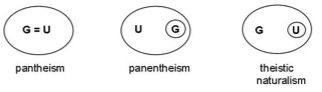
*2. Natural transcendence: God is distinct from the universe. Overlapping in immanence has to do with availability; overlapping in kind has to do with personal creation.

C. Change
1. Modification: change without increasing the number of factors.
*2. Complexification: change with increasing the number of actors.
D. Causation
1. Natural cause: an effect produced by a cause inside nature.
*2. Miracle: an effect produced by a cause outside of nature, above nature, supernatural; not just a different way, but different kind of way.
E. Creationism: complexification via factor(s) external to the natural realm.
F. Evolution: complexification via factor(s) internal to the natural realm.
1. Micro-evolution: demonstrable change in matters of degree
*2. Macro-evolution: extrapolated change into matters of kind.
II. Models of Creation
Creation involves transcendent deity that, among other acts, brings mass/energy into existence from nothing (Hebrew 11:3) and complexifies by miracle irrespective of time rate. The natural order has a finite beginning and possesses order because of the common Mind that lies behind the origin of “parts” whether created directly from nothing (fiat) or using previously existing created mass/energy (progressive).
A. Short-term creationism
1. Type A: creation from nothing to final form in a week’s span; earth's age is in the order of 10,000 to 30,000 years.
2. Type B: same as Type A except that the creative process occurred in unspecified length of time; the earth’s age is longer in varying degrees according to the theorist’s construction. The antiquity of humankind extends back to some degree, but the antiquity of non-human origins is indefinite.
B. Long-term creationism
3. Ruin-reconstruction: the present form of the earth is one of several destructions followed by new beginnings of divine creativity.
4. Progressive Creationism Type A: polyphyletic
5. Progressive Creationism Type B: monophyletic
III. Models of Evolution
Evolution is endogenous complexification over time by laws operating without beginning or end.
A. Relative to God
1. Theistic evolution: transcendent deity is only involved in the creation from nothing and by building into the natural order the potentials for nature’s complexifying itself.
2. Atheistic evolution: mass/energy is eternal and self-complexifying. (If the view of God is not that of transcendent deity, then atheistic is the same as theistic (pantheism), but no external causation is involved; hence, it is not called “creation” even if something new comes about naturally.
B. As to pattern: assorted terms
1. Emergent evolution
2. Punctuated equilibrium
3. Vitalism
The creation-evolution controversy is important to Christians because evolution is an alternative, non-theistic explanation of cosmogony and cosmology, which if successful eliminates any need for a supernatural explanation of life. Furthermore, it reduces life to a materialistic base with implicit meaninglessness because of lacking purpose. Evolution is yet one more example of humans’ needless departure from a knowledge of the truth about God, nature, and humankind (Romans 1).
christir.org