
Proposed Relationship Between Genesis 1:1 and 1:2-2:3
PROPOSED RELATIONSHIP BETWEEN GENESIS 1:1 AND 1:2-2:3
Virgil Warren, PhD
I. Genesis 1:1, Caption for the Creation Account (Hebrew construct form)

In this view, Genesis 1:1 does not necessarily provide a statement of absolute origin in the “book of beginnings.” (Day 4 may cover the origin of the heavens.) This view leaves open the possibility of eternal matter and, when in combination with a parabolic understanding of Genesis 1-11, poses no difficulties for a theistic evolutionary system. Observations against this view, however, include the following:
A. The rest of scripture teaches creation from nothing. We would expect it to be included here as part of the Genesis account of origins, and to be the basis for New Testament writers’ understanding.
B. Bara’ (בָּרָא) means to create a new kind of thing. Referring to the universe, the word implies creation from nothing.
C. Taking “in the beginning” (בְּרֵשִּׁית) as a Hebrew construct form creates a more complex syntax in Hebrew grammar that does not match as easily the simple style in the rest of Genesis 1-2. (cp. Deuteronomy 24:1-4, however)
D. The Masoretic Hebrew text does not add vowel points on the original consonantal text so as to have it read, “In the beginning of God’s creating the heaven.” Instead it says, “In the beginning God created the heavens and the earth.”
E. All the ancient translations understand the Hebrew as an absolute reference. That includes the Septuagint (LXX), translated by Hebrew scholars a couple centuries before the coming of Christ.
These objections disappear, however, if day 4 refers to the rest of the universe beyond the earth. That strong possibility makes preferable this relationship between 1:1 and the rest of the chapter—preferable even to the next major entry.
II. Genesis 1:1 recedes 1:2ff. yet includes them.
Under this schematic, Genesis has a series of narrowing fields. Genesis 1:1 states (a) the completed creation act for the whole universe and then (b) laps back to the point at which the earth was waste and void, and elaborates the account with a seven-point outline on the analogy of a week; (c) 2:4-25 becomes another such lapping back to elaborate the last part of what was previously under day six, as centered around man.
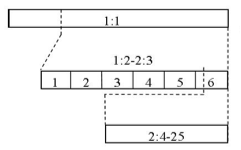
A. Isaiah 45:18 uses “the heavens and the earth” to indicate the completed creation; hence, there is precedent for understanding the phraseology that way in Genesis 1:1
B. Genesis 2:4-25 largely elaborates the last part of day six.
Consequently, the literary pattern of these two chapters allows for an indefinite period of time prior to the “waste and void” condition of Genesis 1:2. Those stages of cosmological development that precede the situation envisioned at this point could be of any order of time. That period could accommodate chemical evolution (if that is possible) as well as solve the difficulty created by light traveling for millions of years and other chronometric issues that have arisen in scientific research.
The pattern of narrowing reference continues on through Genesis by (d) distinguishing the Cainite and Sethite lines down to the time of the Flood and then (e) distinguishing the Shemite lines from the lines of Ham and Japheth thereafter. Finally, (f) Abraham is distinguished from Haran and Nahor; (g) Isaac is distinguished from Ishmael and (h) Jacob from Esau. Genesis functions to place the Israel in its surroundings by tracing it back through its beginnings to the origin of all things.
Clearly there is some “looseness” of expression in statements about God’s creating the heavens and the earth. In Genesis 1:1 the phrase would mean bringing mass-energy into being since creating from nothing the sun, moon, and stars on day four would otherwise not be possible as a separate act. “Heaven” sounds more like the stellar expanse a person could see. Sheer mass-energy does not sound like anything formed really. Isaiah 45:18, however, uses the phrase for completed creation.
III. Gap Between Genesis 1:1 and 1:2 (gap theory; ruin-reconstruction; pre-Adamic cataclysmic
theory, reiterations)

After a previous form of existence, the earth “became waste and void”; God started over. The format removes any concern about geological remains, because it assigns virtually all this stratigraphy to a pre-Adamic situation. Gap theory rests on points like the following:
A. The expression “the heavens and the earth” appears elsewhere as a reference to the completed creation: Isaiah 45:18.
B. Hayah (הָיָה) can mean “became.”
IV. Genesis 1:1 is a part of the first day.
Exodus 20:11 and 31:17 speak of God’s creating heaven and earth in six days. this statement would be unlikely if 1:1 preceded Day 1,
While Exodus 20:11; 31:17 could make Genesis 1:1-2 part of day 1, the recurring clause “and God said” elsewhere in the chapter marks the beginning of each creative activity; the placement of that expression in 1:3 implies that 1:1-2 precedes it. When information fits alternate reconstructions, we cannot reach a conclusion. We may also suppose that the author did not mean to address the conclusion we seek; otherwise, he would have written more clearly to that end. Such unclear information may also indicate that we are dealing with figurative material. Conflicting data may come from reading material too strictly or from reading it in the wrong genre.
V. Genesis 1:1, a label for the rest of the chapter. (Hebrew finite verb construction)
Genesis 1:2ff. is a topical treatment of the major items in creation. See the document elsewhere on this site entitled “A Rationale for the Structure of Genesis 1:1-2:3.”
christir.org