
Providence
PROVIDENCE
Virgil Warren, PhD
God controls his universe and directs its functioning by the operations diagramed below. (1) Reality combines freedom and determinism with freedom occurring inside the determinism.
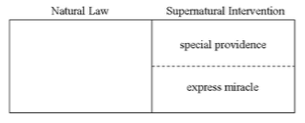
If we add advancing time, providence takes on the form of a “broad arrow,” which can represent the idea that (2) history is going somewhere rather than moving in a circle, that is, just moving back and forth among the old options. History is going somewhere intentionally rather than merely eventuating.
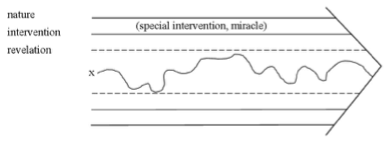
(3) The outermost lines represent in-built limitation that determines the range of variation. (4) Within natural law appears divine intervention, which can take two forms—special providence and express miracle. Miracle differs from special providence by its evidential value. Miracle involves visible intervention; special providence may include invisible intervention. They are equally supernatural, but they differ on how obvious that supernaturalness is. Generally, answered prayer corresponds with special providence because the point of prayer is benefit; the added point in miracle is evidence.
Miracle and special providence differ from natural law as to cause, not necessarily as to result. Miracle is not just a different cause; it is a different kind of cause. It is not just a “technology gap” within the natural order. Miracle brings in a supernatural (or non-natural) cause. “Miraculous” does not just mean “awesome.”
In general, (5) God operates positively on impersonal, non-personal matters. He determines them through natural law. God operates more restrictively with persons. He gives freedom through the ability to choose, so persons originate what they do while he restrains excesses beyond which he does not want them to go.
(6) Special revelation complements nature and intervention to complete his set of natural, supernatural, and verbal means of directing affairs in the impersonal and personal realms of creation. As long as people (“x”) are operating within the boundaries of God’s revelation, they are within his will for them unless God intervenes more specifically in special circumstances. A refinement within revelation is commandment vs. advice, law vs. wisdom, which means that some things may not necessarily be wrong as per God’s intentions, but they are not likely to be good (wise) or as good in most cases for most people or the most people. What is wise is more restrictive than what is moral, or “lawful.” Wisdom works from all down while commandment works from zero up.
(7) The general diagram could be enhanced to show progressive revelation by allowing the dashed line to narrow or broaden over time and across circumstances. Likewise, (8) the intervention line can narrow or broaden over time and (9) may even move inside the revelation line depending on the situation and the will of God at a given time and place.
(10) People can move outside the lines of revelation—commandment as well as advice—and can even rebel against the implications of special intervention if they so choose, but that rebellion will not continue endlessly. (See the document “The Problem of Evil.”)
Providence corresponds with predestination. Predestination covers two aspects, which correspond with the ways in which God deals with personal and impersonal creation. He deals (1) restrictively/permissively with his rational/personal creation and (2) prescriptively/positively with his impersonal creation.
christir.org