
Old Testament Backgrounds and The
OLD TESTAMENT BACKGROUNDS AND THE
MESSIANIC COVENANT
Virgil Warren, PhD
Introduction
God is the Great Teacher. Readiness is an educational principle he observed in working to achieve his purpose of a new united mankind (Ephesians 2:15). Over the centuries he has increased people’s readiness for spiritual growth by (1) giving progressive revelation, (2) instituting present forms for later realities, and even (3) adopting human forms to serve as shadows of later substances. Establishing covenants illustrates this third use of readiness.
I. Description of Covenants
Covenants were common throughout the Middle East in biblical times. A covenant was a formalized agreement between parties. The term covered a broad range of agreements between individuals, between groups, and between individuals and groups. Covenants could regulate a relationship about a single issue or the whole of life, and they could take place between equals or unequals. In this last respect, covenants are categorized as “parity covenants” or “suzerainty covenants.” The Mosaic covenant is an example of the latter. (See below: “Addendum: Covenants Mentioned in the Old Testament.”)
The more formal covenants of the ancient Near East had a common set of elements, several of which appear in Exodus 19-24 taken as a covenant form: (a) a preamble identifying the covenant parties, (b) a historical prologue outlining events that led up to making the covenant (19:4), (c) stipulations (19:5-6, 20-23), (d) a list of divine witnesses, (e) a statement of blessings and curses for obedience and disobedience (20:1-17), the taking of oaths (19:8; 24:3), the performing of ceremonies of ratification (24:4-8), and the creating of a covenant document (24:7).
Covenants were ratified by a ritual act performed by the covenant parties. Covenant signs included the slaughter of an animal that was cut into parts (Genesis 15:9-11, 17), circumcision (Genesis 17), putting the hand under the other’s thigh (Genesis 24:2; 47:29), or setting up a visible symbol of remembrance like a pillar or even a pile of stones (Genesis 31:44-54; cp. Joshua 4:5-7). For details, see New International Standard Bible Encyclopedia, Vol. 1, pp. 790-93.
This background sets the context for the Abrahamic, Mosaic, and Messianic covenants recorded in Holy Writ. We see an added appropriateness to the manner of making these covenants. In giving the Law through Moses, God adapted this cultural practice, first, to bring the Israelite nation closer to his will and, second, to foreshadow further progress through the predicted Messianic covenant.
II. Change of Covenants from Mosaic to Messianic
A. Models for Mosaic-Messianic covenant relationship
When the Christian gospel came on the scene of redemptive history, the status and use of the Mosaic Law came into question. Not only was this question relevant to Jews, but it was even more crucial for Gentile converts, whose background did not lie in the Judaism. Was Messianism an extension of the Mosaic covenant or a replacement for it? The problem manifested itself particularly in the controversy over circumcising Gentile Christians. Christendom has responded in five different ways to this question about Mosaic-Christian covenant relationships.
1. Adding the gospel to the Law. The Law and the gospel are compatible stages of the same thing. Many Jews took this view during the early years of the Gentile mission. Judaizing missionaries first clashed with Paul and Barnabas in Antioch and then later at the conference on circumcision in Jerusalem (Acts 15). In Galatians, 2 Corinthians 3, and Romans, Paul vigorously opposed this view primarily from a salvation perspective; but other matters pertained as well.
2. Discarding the Law as false and retaining the gospel only. The Law and the gospel are antithetical. Marcion, son of the bishop of Sinope, Pontus, in the second century took this view and has as his heirs the modernist movement of the nineteenth and twentieth centuries. Early in his ministry, Jesus himself attempted to head off any such inference from his teaching: “Do not think that I have come to destroy the law” (Matthew 5:17).
3. Spiritualizing the law in terms of the gospel. The Law and the gospel are formally alike, so hermeneutically the content of the gospel can be derived from the language of the Old Testament by using analogy and allegory. Already in the second century, the quality of interpretation in some quarters had fallen quite low because of such fanciful exegesis. Shepherd of Hermas and The Epistle of Barnabas are examples.
4. Amending the Law with the gospel. The Law and the gospel are modifications of the same expression of God’s constitution for his people. This formulation shows up in the reformed, or covenantal, view of divine economy. But, there is a difference in degree between amending the Law in this way and adding the gospel to the Law (#1 above). Adding the gospel to the Law leaves unchanged everything in the body of the constitution (with the exception of sacrifices for sin) whereas amending the law removes and alters provisions within the body as well as brings in new elements. This approach was what the Judaizers of apostolic days were evidently supposing should happen.
5. Repealing the Law in favor of the gospel replacement. Instead of the previous four options, we adopt this model for understanding the Law-gospel connection. The Law and the gospel are different covenants. The Messianic covenant is not to the Mosaic covenant what the Moab covenant (Deuteronomy 29-30) was to the Sinai covenant (Exodus 19-24; cp. Deuteronomy 5). It is not a re-affirmation or extension of the Mosaic Law. The Law is not simply changed (cp. Hebrews 7:12); it is exchanged for the gospel covenant. Jeremiah 31:31-34 calls it a “new” covenant. On the background of this prophecy, Paul comments that the previous ministration “is done away” (2 Corinthians 3:11, cp. 3:7), and the Hebrews writer says that the old covenant is “vanishing away,” historically speaking (8:13). The repeal-replace model involves one people of God and one constitution over them—the Messianic covenant. It does not bring in a second people of God under a different covenant that leaves the first covenant in force over the former group (“one fold,” John 10:16; cp. Ephesians 4:5-6). The former passes away.
B. Features of the repeal-replace model
1. The behavior category
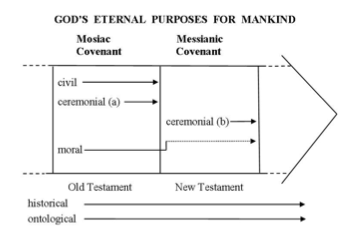
Behavior is all that covenants—hence, change of covenants—address; history and nature are aside from the issue. The Old Testament is retained (a) as an inspired record of human deeds, of divine acts, of God’s will for the Jews’ behavior, and of predictive prophecy (history). It is retained (b) as a statement about the nature of God and the creation (ontology). It continues to be useful even (c) as a witness to moral principles as guided by New Testament parameters (1 Timothy 1:8; behavior). Exchanging the Law for the gospel is not a question about truth but about relevance—not about accuracy and inspiration but about application.
Civil, ceremonial, and moral matters are the only issues because they are things that people do. History, geography, doctrine, nature, and predictive prophecy are not “terms” of behavioral relationship between covenant parties. A covenant deals with promises and expectations, which correspond with the two parties of the covenant.
2. Adjustments in the behavior category
The Law and the gospel are different covenants (code), though they include many of the same promises and expectancies (content). Christians are not under the Law, but much of what it required is required also in their own covenant. Similarity exists between the covenants because God’s overall purpose for humankind has been the same since creation and because the nature of God and people is unchanged, which means that the appropriate manner of their relating vertically and horizontally is the same.
Dissimilarity exists because of (1) God’s increased expectancy for his people (moral), because (2) God has removed the national component (civil) in favor of a purely interpersonal system—and the corresponding promises that belonged to the nation and race. Dissimilarity exists because (3) Mosaic ceremonial observances have been superseded by the Messianic realities they foreshadowed, and because some new ordinances have been enacted. Finally, dissimilarity exists because (4) new responsibilities have been added for people in the covenant, especially toward people outside the covenant. These additional aspects were already implicit in the First and Second Great Commandments verbalized within the Old Covenant itself.
3. The common purpose and content
While the Mosaic covenant and the Messianic covenant are indeed different covenants, they have a common purpose and share the common content already noted. They represent two stages in the larger context of the same redemptive history. As to code there is distinction, but as to content there is significant continuity as adjusted by progressive stages within God’s ongoing efforts to bring about human righteousness and divine-human relationship.
The law is superseded—more than antithesized—by a more refined expression of God’s will for people and by a real means of reconciliation with God. “Superseded” means that the former is related to the latter and related to it in a preparatory way. Paul says that the gospel “establishes the Law” (Romans 3:31; cp. 8:4). Jesus came to “fulfill” the Law (Matthew 5:17). The gospel supersedes the Law with higher expectancies and better promises. The two covenants are in series, not in parallel. The resulting situation is also not two parallel systems, but one people of God.
4. The different kinds of covenants
Finally, in addition to being different covenants with a sequential common purpose, the Mosaic and Messianic Covenants are different kinds of covenants. Jeremiah 31:31-34 says that the New Covenant is not like the one God made with the Israelites when he brought them out of Egypt: the New Covenant is written on the heart (cp. 2 Corinthians 3:6-11), everyone in it knows God, and people’s sins are no longer remembered. The results of the covenants differ in that God no longer reckons sins under the New Covenant, but more importantly the character of the New Covenant differs: now only those personally related to God (“know”) and only those who have internalized the values of the covenant are in any sense part of the covenant. No one can be born into it or inducted into it on some other artificial, ceremonial, legal basis. If a person does not adopt the values of the covenant, there is nothing left (national citizenship, physical descent, e.g.) to identify that person as being under the covenant. In short, the Messianic Covenant is an interpersonal covenant whereas the Mosaic Covenant was also legal and political/national. The Messianic Covenant is on the analogy of the Mosaic Covenant; it is not another example of that kind of covenant.
The diagram below pictures the relationship between successive covenants of different kinds in the same redemptive history. The diagram illustrates what is repealed, new, refined, and re-enacted—in that order.
C. Advantages of the repeal-replace model
In Christendom today the most common ways of relating the Mosaic and Christian Covenants are the amendment approach and the repeal-replace approach. The following observations show the advantages of the latter properly formulated. 1. The repeal-replace model vs. the amendment approach clarifies how Christians are not under the Law (code) without denying the truth and divine source of the Law (content). What is true cannot be abrogated; but since a covenant expresses one person’s will for another person’s behavior, it may be modified or changed appropriately under changed circumstances and refined purposes. We can discriminate between what we are under and what we are not under without calling the latter false.
2. The repeal-replace model vs. the amendment approach provides a mechanism for distinguishing what in the Law applies likewise to Christians and what does not. The New Covenant establishes the guidelines for Christian living. Insofar as they correlate with Old Covenant principles and commandments, the Law is useful for ethical decisions even today. We need not, however, find a statement of repeal for each item in the Law that Christians no longer observe. In amendment theory any matter not repealed is still in force. To be sure, we could eliminate several items on a one-by-one basis: dietary laws (Mark 7:19), circumcision (Acts 15), sin offerings (Hebrews 10:1-10), temple ritual (Hebrews 9), the priesthood system and its duties (Hebrews 7-8), civil marriage regulations (Matthew 19:3-9; 5:31-32). How can we eliminate, though, the law of jealousy in Numbers 5? Can we avoid keeping some aspects of the ceremonial law, especially those not antitypical of the Messianic sacrifice?
There was evidently a rationale that stemmed from the difference in the purposes of the covenants that led particularly to Paul’s inferences about what Gentile converts were obliged to do and not to begin doing. It does not seem likely that his stricture against observing the Jewish festival cycle (Galatians 4:10) was based on sheer authority, even if it were God’s sheer authority. In general, the expressed changes in New Covenant are based in something real as to God’s overall intent in salvation history rather than in sheer, arbitrary change of expectancy. Alternatives must derive from principles like (a) when the perfect comes, the preliminary ceases in deference to it (cp. 1 Corinthians 13:10) and (b) when the temporary becomes irrelevant to overall purpose, it disappears. The rationale then can be extended to unexpressed possible changes as based on the proper understanding of the nature and purpose of the New Covenant—as interpersonal.
3. The repeal-replace model vs. the amendment approach eliminates having to distinguish successfully between moral law and positive commandment. The New Testament speaks of the Law as being abrogated, blotted out, annulled, taken out of the way, and so on (Colossians 2:14-15; Hebrews 7:18); it does not speak just about annulling individual items. It speaks of sacrificial ceremonies being annulled as a class (Hebrews 10:1ff). The problem is not with moral, civil, and ceremonial as concepts, but with categorizing cases that combine moral and ceremonial.
Composite matters like the law of jealousy alluded to above are difficult because the moral matter of adultery is involved, but there is also a prescribed method of establishing guilt regarding adultery. One could conceivably claim that Jesus’ sacrifice did not eliminate sacrificial offerings; they could continue as memorials rather than as anticipations of the Christ reality (cp. some pre-millennialists who anticipate the re-institution of animal sacrifice during the millennium). Somewhat similar is the Roman Catholic mass, which in theory re-enacts Christ’s redemptive work. Under the repeal-replace approach, such questions can be settled because the New Testament contents alone are adequate for Christian life and worship.
Morally and religiously speaking, nothing beyond the contents of the New Testament is normative for Christians. The repeal-replace model establishes a positive burden of proof for deciding about Christian obligations. What the New Testament does not include or necessarily imply is not required. The amendment model implies a negative burden of proof. It assumes that an item of duty is still binding unless we can show that it is not. The negative burden of proof is more difficult to bear, and therefore frequently inadequate.
4. The repeal-replace model vs. the amendment approach allows the Messianic covenant to be a different kind of covenant. The New Testament is a different covenant as to identity, but it is also a different covenant as to kind (Jeremiah 31:31-34). It does not have a national component like the Mosaic covenant, and it is not a legal system as Mosaism was. An amendment approach leaves the covenants as being of the same kind, but the second covenant is essentially interpersonal only. Not only is the content different, but the character of the common content is transformed as well. In some ways this consideration is the most crucial of all because it changes the quality of moral behavior from law-keeping to love-keeping. It is now an interpersonal framework in which good is defined as good relationship. The motivations of the heart are necessarily included in our overtly doing good. We are not limited to the specifications in the Law, but operate also in terms of wisdom, expediency, and love. Good and bad are not just quantifiable do’s and don’t’s; they are characteristic ways of behaving that stem from attitude and purpose. Grace-faith does not take place within a larger legal context, but in the alternative context of interpersonal relationships. In fact, grace-faith vs. law-works are Pauline code words respectively for interpersonal vs. legal operations. Legal operation was intended to be added onto interpersonal process in a way that did not vitiate the interpersonal. That point relates to “using the law’ lawfully’” (1 Timothy 1:8).
III. Issues Affected by a Confusion of Covenants
In the first century, confusion of covenants manifested itself in (1) the circumcision controversy and in (2) the doctrine of works relative to continued salvation especially. In post-apostolic times, distinction of covenants has affected issues like (3) tithing, (4) Sabbath-keeping and/or observing Sunday like the Jewish Sabbath, (5) infant baptism, (6) infant communion, (7) assumptions about church-state relationship (note attempts at theocracies), (8) atonement theory (the manner in which persons come to be viewed as righteous through Christ to receive reconciliation with God), (9) assumptions about Israel-church relationship, (10) the clergy concept, which addresses the nature and role of ministry in contrast to priesthood (sacerdotalism—the official administration of ordinances, the use of the confessional, leadership style, and the like), (11) the nature and operation of the church, and (12) the theology of the church—whether grace flows from God through the church to the individual (legally) or from God directly to the individual (interpersonally).
Confusion of covenants can have a subtle, and significant, effect on hermeneutical method, which shows itself, for example, in manifestations of the silence-is-prohibition principle: (13) worship (instrumental music, church buildings, choirs, etc.) and (14) church organization (no Sunday schools, parachurch agencies, etc., because the organization of the church is complete). Legal system statements have a much greater tendency to be meant in a restrictive vs. non-restrictive sense. Possibilities parallel to the ones specified have no positive basis for being brought into the picture. That is the reason people who interpret the New Testament with a legal hermeneutic are prone to ask how some non-biblical practice is “justified” when other people see no reason for needing to justify it—Sunday schools, singing in parts, singing songs of human composure, and the like. In some important ways, the interpretation of law differs from the interpretation of interpersonal communication. It makes a corresponding difference whether we regard the New Testament as having the same character as the Law of Moses.
Summary and Conclusion
Covenants were a common feature of ancient New Eastern culture. The covenant concept covered a wide range of formal agreements between parties. In the Old Testament literature, we see God using covenant repeatedly to provide terminology, structure, and forms for his approximating efforts at moving people away from sin toward righteousness for purposes of personal relationship to him and his eternal agenda.
The range of covenant types and circumstances is broad enough to incorporate both a national covenant like that between Yahveh and Israel and an interpersonal covenant like the one between Messiah and his people. These two covenants are (a) different covenants, (b) different kinds of covenants, and covenants that share (c) significant common content because they have (d) common purpose. They are covenants that represent (e) successive stages within (f) the same redemptive history with (g) the first covenant preparing for the second. Since the two covenants are analogous rather than identical, there is (h) a different character to even the common material.
Distinction of covenants applies only to commanded material. Inside commanded material, civil and ceremonial obligations drop out while moral expectancies continue with adjustments because moral behavior is a major component in relationship to God and others and therefore relevancy to the eternal purposes of God for humankind.
By seeing, on the one hand, that the Mosaic and Messianic Covenants form successive stages in the same redemptive history, we can appreciate the unity and continuity that exists between them and the progression that occurs in moving from the former to the latter. By seeing, on the other hand, the discontinuity that exists between them, we will be less tempted to return to the shadows and types of the former economy. Hopefully that means we will make the appropriate interpretation adjustments involved in moving from the legal genre to the interpersonal communication of the New Covenant.
Few matters affect Christian practice as much as relationship of covenants does. The number of controversies that have arisen over this one issue make it paramount that we grasp as clearly as possible the association that exists between Old and New Covenants. The unity of those in the Messianic Covenant is at stake.
ADDENDUM: COVENANTS MENTIONED IN THE OLD TESTAMENT
God and Noah (Genesis 9:9-17)
Abraham and his “confederates” (Genesis 14:13)
God and Abraham (Genesis 15:8-18; 17:1-14)
Abraham and Abimelech (Genesis 21:22-32)
Isaac and Abimelech (Genesis 26:26-31)
Jacob and Laban (Genesis 31:44-54)
God and Israel (Exodus 19-24)
God and Israel (Deuteronomy 29:30)
Rahab and the Israelite spies (Joshua 2)
God and Israel (Joshua 23-24)
Gibeonites and Israel (Joshua 9:6, 11, 15-16)
Israelites and Nahash the Ammonite (1 Samuel 11:1-2)
David and Jonathan (1 Samuel 18:3; 20:8; 22:8; 23:18)
David and Abner (2 Samuel 3:12-13)
David and Israel (2 Samuel 5:1; 1 Chronicles 11:3)
God and David (2 Samuel 7:12-17; 23:5; Psalms 89:3-4, 26-27, 34; 132:11-12; Isaiah 55:3-4)
David and his vassals (2 Samuel 8)
Solomon and Shimei (1 Kings 2:42-46)
Solomon and his vassals (1 Kings 4:21)
Solomon and Hiram (1 Kings 5:12)
Israel-Judah and Ben-hadad (1 Kings 15:19)
Ahab and Ben-hadad (1 Kings 20:34)
Joash and Judah (2 Kings 11:17)
God and Judah (2 Kings 11:17-20)
God and Judah (2 Kings 23:3; Jeremiah 34:8; Ezra 10:3; Nehemiah 9:38; 10:29)
God and Israel (2 Chronicles 29:10)
Metaphorical covenants with things (Job 5:23; 31:1; 41:4; Isaiah 28:15, 18; Jeremiah 33:20,
25; Hosea 2:18; Zechariah 11:10)
New Covenant of the Messianic Age (Isaiah 42:6; 49:6-8; 55:3; 59:21; 61:8; Jeremiah 31:31-
34*; 32:40; 50:5; Ezekiel 16:60, 62; 34:25; 37:26; Hosea 2:18)
Zedekiah and Judah (Jeremiah 34:8)
Nebuchadrezzar and Judah (Ezekiel 17:13)
Assyria and Israel (Hosea 12:1)
Marriage (Malachi 2:14; Proverbs 2:17)
christir.org