
The Relationship of the Law and the Gospel
THE RELATIONSHIP OF THE LAW AND THE GOSPEL
Virgil Warren, PhD
When the Christian gospel came on the scene of redemptive history, the status and nature of the Mosaic Law came under question. Not only was that question relevant to the Jews, but the Gentiles also had to cope with it because Christianity came out of a heritage different from their own. Christendom has demonstrated five ways of dealing with the issue.
1. Keeping the Law constitutionally (code and content) and adding the gospel to it. The Law and the gospel are regarded as two stages of the same thing; they are compatible. Among the Jews the approach received significant impetus during the early years of the Gentile mission. Judaizing missionaries received strong opposition from Paul and Barnabas in Antioch and eventually in Jerusalem at the Conference on Circumcision recorded in Acts 15. In Galatians, 2 Corinthians 3, and Romans, Paul vigorously opposed the concept primarily from a soteriological point of view; but other matters were also implicated.
2. Throwing away the Law (code and content) as evil/false and retaining the gospel only. The Law and the gospel are considered antithetical. Marcion, son of the bishop of Sinope, Pontus, in the second century took that stance and has as his heirs the modernist movement in the late nineteenth and early twentieth centuries. Not far into the ministry of Jesus, we find the Lord attempting to head off any such inference from his teaching: “Do not think that I have come to destroy the Law” (Matthew 5:17).
3. Spiritualizing the Law in terms of the gospel revelation. The Law and the gospel are perceived to be formally alike, so Christians may seek the content of the second by the allegorical, analogical, or moral interpretations of the Law. Already in the second century the quality of Old Testament exegesis had fallen quite low under the influence of such fanciful methods as appear in The Shepherd of Hermas and The Epistle of Barnabas.
4. Keeping the Law as amended by the gospel. This approach considers the Law and the gospel as modifications on the same basic expression of God’s will for his people—his constitution. The formulation seems to be an appropriate way of expressing the reformed, or covenantal, view of divine economy.
5. Abrogating the Law constitutionally and replacing it with the gospel as to code. The Law and the gospel are formally different while materially related. That construction distinguished between code and content so that two levels of change are possible.
codewise there is discontinuity;
contentwise there is (general) continuity.
The Law and gospel are formally different but materially related. As to code, Christians are not under the Law, but as to content much of it is applicable as ascertained from what is enjoined from the time of Pentecost onward.
a. The Law is retained
(1) with respect to historical matters. (history)
(a) as an inspired record of God’s will for the Jews.
(b) as an accurate record of God’s deeds among them.
(2) with respect to the nature of things. (ontology)
(3) with respect to moral content used illustratively as guided by New
Testament parameters (1 Timothy 1:8). (behavior)
b. The Law is superseded, not antithesized
(1) by a more refined, not parallel, expression of God’s will for us.
(2) by a better means of our having relationship with God.
Under the code-content distinction the relationship of the covenants in God’s continuing purpose among people follows the accompanying diagram.
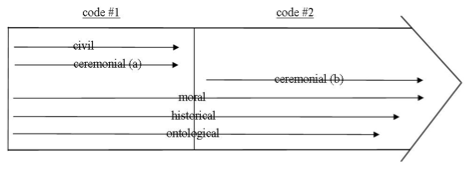
The diagram pictures the first as preparing for the second, and what in the second is abrogated, new, refined, and continued—in that order.
(a) Making the code-content distinction rather than taking the amendment approach enables us to explain how Christians are not under the Law (code) without denying the truth or divine source of it (content). What is true cannot be abrogated; but since it is the expression of a will, the Person may modify or change it under appropriate circumstances. A person can then discriminate between what a Christian is under or not under without pronouncing the earlier code false.
(b) Making the code-content distinction rather than taking the amendment approach provides a mechanism for distinguishing what in the Law applies to Christians and what does not. The New Testament revelation lays out the guidelines for Christian living. Inasfar as these correlate with Old Testament principles and commandments, the Law may be used as a basis for moral and ethical behavior. That construction does not require finding a statement of repeal for each item in the Law that Christians no longer need to keep. In the amendment approach each matter not repealed is in principle still binding on Christians. An interpreter can eliminate the dietary laws through Mark 7:19 or circumcision via Acts 15:13-29, but can he find a way of eliminating the law of jealousy in Numbers 5:11-31? On what basis can a Christian avoid keeping some aspects of the ceremonial law? Failure to make the code-content distinction has created problems about Sabbath keeping by Christians (or at least observing Sunday after the manner of Sabbath observance). Similarly, the Jewish requirement of tithing has illegitimately been brought in as a Christian expectancy.
(c) Making the code-content distinction rather than taking the amendment approach eliminates having to be able to distinguish between moral law and positive commandment. The New Testament speaks of the Law as being abrogated, blotted out, annulled, taken out of the way, nailed to the cross, and so on (Colossians 2:14-15; Hebrews 7:18). It sometimes speaks of civil or ceremonial commandments being annulled as a class. The problem is not with the concepts of moral, civil, and ceremonial law, but in categorizing specific cases with composite elements and in establishing the argument that ceremonial law as such has been abrogated.
Composite matters like the law of jealousy are difficult because a moral matter (adultery) is involved, but the method of establishing guilt as prescribed is not. Is it civil? Perhaps, but we wonder if Jesus’ efficacious sacrifice would necessarily per se eliminate animal sacrifices; they could continue being offered in memorial rather than in anticipation of what they were proleptic or reflective shadows (cp. premillennialists who look for the re-institution of animal sacrifice during the millennium). Under the code-content approach, such decisions fall out because the New Testament contents alone establish the normative for Christian living. The concomitant point is that, morally and religiously, nothing beyond the contents of the New Testament is normative and binding for Christians. There is one people of God and one constitution over them at the present age.
christir.org