
Primary Factors in Ethical Theory
PRIMARY FACTORS IN ETHICAL THEORY
Virgil Warren, PhD
Preliminary Factors
Conclusions about specific moral matters depend on what framework we use when we think about them. Several fundamental constructs set limits on how Christians should act. The factors involved help us interpret scripture correctly when it does address moral issues we face. Those factors are particularly vital when we have to generalize biblical standards to questions that special revelation does not address.
The first primary framework focuses on start-up factors that impact human behavior:
Out of the (1) nature of God comes the (2) purpose of God.
Out of the purpose of God comes the (3) creation by God.
Out of the nature of creation by God comes the (4) human behavior
(including human nature).
Several features of this layout call for comment. First, out of the (1) nature of God comes the (2) purpose of God. The nature of God establishes and limits the possibilities for everything else because in the Christian worldview everything else comes logically after God. Christianity understands that God is (1) personal; so the subsequent possibilities include (2) purpose, which arises out of personal capacity. God purposes, and purpose establishes boundaries for proper behavior.
This step in the analysis includes a significant fact: as goes the character of the god, so goes the character of the whole religion. The God of the Bible is ethical deity, not just powerful deity; he is ultimate being (Exodus 3:14), and people are created in his image with interpersonal capacity (Genesis 1:26-27). Consequently, people should be holy because God is holy (Leviticus 19:2; 1 Peter 1:16). If God were not in the picture, the first two elements would be gone as determining factors for ethics. Human nature itself would become the ultimate basis for behavior, but that restrains human behavior to little more than animal “ethics.” It leaves “might makes right,” “end justifies means,” “majority preference” as bases for ethical theory.
Second, out of the (2) purpose of God comes the (3) creation by God. Placing God’s purposing ahead of his creating establishes the possibility of non-determinism. Divine purpose for human behavior can be more narrow than human ability, which avoids determinism. Personhood involves choice between alternatives, not simply the capacity to respond to environmental stimuli. Moved by love (interpersonal nature) and guided by values (purpose), people may decide to restrict behavior from what they can do to what they should do. There can be freedom within determinism, an arrangement that allows for responsibility and ethical behavior relative to purpose.
In theory, behavior rests more basically on the creator’s purpose than on created nature, even though from a practical standpoint, doing what God commands does increase happiness in most cases. “Greater happiness for more people for longer time” implies closer conformity to individual and social nature. But ethical and moral behavior can rest on more than created nature, that is, on more than the interpersonal nature of the individual person, the nature of the interpersonal situation, and the nature of interpersonal interaction. It can rest directly on divine purpose for people generally or for a particular person because God can require what has no necessitating correlate in the human constitution.
Functional Factors
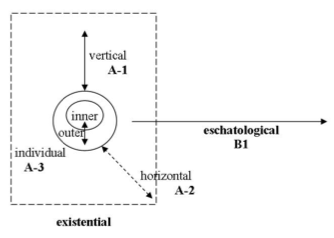
The second primary framework is that ethics and morality have to do with person-to-person associations. Person-to-thing and thing-to-thing relationships do not involve right and wrong in a moral sense. The diagram below pictures a second primary framework, which deals with the operation of what God purposefully created. It organizes the basic dimensions of life in terms of personal factors. Life has two primary aspects often called the “existential” and the “eschatological.” “Existential” refers to the present experience of “existence,” including relationships vertically with God (A-1), horizontally with other people (A-2), and internally between the inner and outer aspects of a person—spirit and flesh (A-3). “Eschatological” refers to the forward movement of life from purposes toward goals; it represents not just movement, but directional movement.1 Primary ethical principles correlate with aspects of these two main facets of living.
I. The First Great Commandment (A-1)
“Loving God with all our being” is the most primary ethical principle (Matthew 22:34-38; Mark 12:28-30; Luke 10:25-28a). If love is defined as principled behavior for the joy of others, it is more than a feeling; it is a pattern of behavior characterized by self-giving for the glory of God (John 3:16). If we love him, we do what he says (John 14:23, 15) without feeling “put upon” (1 John 5:3). Love is reciprocal between God and man.
II. The Golden Rule/The Second Great Commandment (A-2)
The Golden Rule governs relationships between people (Matthew 7:12). “Treating other people the way we want to be treated” restates the Second Great Commandment—that we should love our neighbor as we love ourselves (Matthew 22:39-40; Mark 10:31; Luke 10:29b-37; Romans 13:8-10; Galatians 5:13-14). It gives a “rule-of-thumb” basis for deciding how one person ought to act toward another, and it does so in a positive as well as negative sense. Love is reciprocal between people.
Ideal behavior is more than (a) not doing what we would not want done to us; it is also a matter of (b) doing what is to someone else’s benefit. Furthermore, it means (c) doing what we would prefer to have done to us even though not doing it would not be sinful, even though doing it would not be necessary, or even though doing it would not make life intolerable. (Note seemly in 1 Corinthians 13:5.)
Furthermore, the Golden Rule (d) takes into account the way they want to be treated, which means taking into account the differences between people. So it calls for more than treating other people the way we want to be treated; it means treating them the way we would want to be treated if we were in their shoes. That broad principle in the Golden Rule/Second Great Commandment is limited by prior divine purpose, by the First Great Commandment, by our own integrity as persons, and by their own need to love God and respect us. Love is mutual respect.
Love is an important behavioral principle, because it covers the full range of human interaction. It moves us to obey God’s moral laws and positive commandments2 (law; John 14:21, 23), to take his advice3 (expediency, wisdom), and to respect others’ preferences (Romans 14:15; 1 Corinthians 13:5). We are not acting in love when we grieve someone else by our actions (cp. Romans 14:15). Love takes care of matters of omission (positive) and commission (negative), faith and opinion. Love is an all-purpose tool for behavioral decision making.
III. The Priority of Spirit over Flesh (A-3)
“The priority of spirit over flesh” governs activity within the individual person. In 1 Corinthians 6:12 Paul says he will not be brought under the power of anything. The principle he enunciates takes care of why it is wrong to do private practices that cause addictions and psychological compulsions (“hang-ups”). He goes beyond the notion of “victimless crimes,” acts that supposedly impact no one but the doer. Something is wrong if it puts physical drives in ultimate position. Morality applies not only to behaviors that can be measured quantitatively as to physical consequences, but also to what has psychological effects.
As a principle for our individual use of the body, asserting the supremacy of spirit over flesh differs from arguing that we should do what is physically most healthful because our body is the Spirit’s temple (1 Corinthians 6:19). Sometimes what is harmful to the body may take second place to interpersonal considerations implicit in A-1, A-2, and B-1. For example, certain foods are less healthful for the body than others; yet Jesus did cleanse all meats (Mark 7:19), which means at least that dietary laws no longer belong to religious concern; that is, they are not Christian ethical considerations. “Cleansing all meats” does not change the scientific fact that some foods are less healthful particularly for some people. We infer that the body as the temple of the Spirit does not form an ultimate basis for arguing the moral need to eat what research shows is the most healthful and to avoid eating what may cause heart conditions, cancer, high cholesterol, etc. Paul’s positive approach to ethics within the individual centers around addictiveness, which breaches the principle of prioritizing spirit over flesh. Since he pictures the body as the residence of the Holy Spirit, we must not use the body in a way that subordinates the spirit to the body.
Paul also invokes what could be called “the nature principle” in ethics. He does so with adultery and homosexuality (Romans 1:26-27) and possibly with the female deference principle expressed in the first century by veil-wearing (1 Corinthians 11:7, 13-14).4 Nature in this case does not mean simply what a person has the ability to do. Obviously, people are quite capable of doing sinful acts. Natural behavior is behavior that is most appropriate to intended use. It is not physically and psychologically detrimental, it prioritizes the higher self, and it enhances harmonious intrapersonal and interpersonal operations.
The one-to-many splice. Ethics not only needs to address individual behavior and social behavior in themselves; it needs to describe the boundary between individual freedom and social responsibility. Individual freedom ends where other individuals’ freedom begins. Most “victimless crimes” do not affect just the persons who do them, because people’s lives are so intertwined that the behavior of one ends up eventually impacting others. Similarly, private acts between “consenting adults” are matters of morality because the repercussions of private acts can end up costing society money, effort, and time. They may also depersonalize the other consenting adult and may prioritize flesh over spirit.
Our individual actions must leave us able to be responsible for ourselves. What we do is immoral if it makes us unable to function appropriately in relationships and responsibilities (relate to B-1).
IV. Right and Wrong Relative to Purpose (B-1)
Right and wrong, good and bad are measured relative to purpose. In behavior the ultimate issue is not whether something is legal under a temporal or divine standard, but whether it is effective. Abiding principles applicable in all cases are relative to the standing purposes of God and man. Obviously since people are dependent beings, they cannot define their own ultimate purpose(s). The purpose measurement for ethics is first God’s purpose, within which man’s self-chosen purposes may be worked out. In that framework God allows considerable freedom.
Right and wrong focus on motives and attitude more than on sheer acts taken by themselves. Attitude applies particularly to interpersonal relationships; motive applies particularly to purpose. The same act can be good or bad depending on why we do it and on our attitude toward other people in doing it. A normally good act becomes evil if done out of selfish motives or with a depersonalizing attitude. In interpersonal activity intentionality counts for something important.
Morality includes not only what is or is not wrong, but what is wise. Wisdom brings in practical considerations. Some things may not break any of God’s abiding principles of behavior, but it is normally not wise to put ourselves in certain situations. What is possible is not necessarily smart, because we may not be as strong as we think we are; standing outside the force field of certain situations, we may suppose that we can handle more than we can. Not only does wisdom deal with us (which applies also in the “one-many splice” under A-3); it deals with practical effects on other people. It addresses what other people prefer, what other people may misread about our motives, and what other people may slip into doing on the basis of their misreading. Not only is there commandment; there is advice. And where there is neither commandment nor advice, love and expediency reign.
The existential-eschatological splice. As there is a point of contact in the existential aspect between the individual and the group, so also there is a point of contact between the existential and the eschatological. Right and wrong are measured relative to purpose as qualified by love. Latitude and longitude (the existential and the eschatological) combine in ethical choices. Ethics prioritizes purpose over pleasure—spiritual over material—because purposes are chosen relative to values, not necessarily rooted in material considerations, but in interpersonal ones (love). Spiritual and interpersonal are closely related if not identical.
Definition Factors
It is time to make explicit what has been left implicit so far. Appropriate behavior includes not only what is or is not wrong, but what is wise. Wisdom brings in practical considerations. Some things may not break any of God’s abiding principles of behavior strictly speaking, but it is normally not wise for people to put themselves in certain situations. What is possible is not necessarily smart for people themselves because they may not be as strong as they think they are; standing outside the force field of certain situations, they may suppose that they can handle more than they can. Not only does wisdom deal with the doers themselves (which applies also in the “one-many splice” under A-3); it deals with practical effects on other people. It addresses what other people prefer, what other people may easily misread about the doer’s motives, and what other people may be led into doing on the basis of their misreading. Consequently, not only is there commandment; there is advice. And where there is neither commandment nor advice, love and expediency rule.
This third primary framework distinguishes three kinds of interpersonal behavior. There is more to choosing how to act with other people than what is moral or ethical in the strict sense. (a) Morality is based on originating nature and purpose; uniformity of action is the understood intent. It is communicated by divine command. Telling the truth is an example.
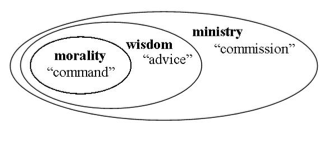 The accompanying diagram shows two other
kinds of interpersonal action and their relationship to ethics. People live
best when they live above mere duty, legal minimums, simple
The accompanying diagram shows two other
kinds of interpersonal action and their relationship to ethics. People live
best when they live above mere duty, legal minimums, simple
right vs. wrong. There is the looser category (b) “wisdom,” which chooses actions that work better—that are expedient, that reduce temptation, and so forth. Wisdom is based on practical considerations about what is most likely to work even though other choices may not necessarily be wrong. Varying degrees of uniformity are possible. Wisdom is communicated by “advice.” Advice refers to what is wise, over and above what is moral. If people do not obey a command, they sin; if they do not take advice, they risk. That is so because advice deals with good vs. better whereas morality deals with good vs. bad.
Beyond both of these is (c) “ministry,” which involves encouragement, evangelism, forgoing rights, helping others mature, helping them solve their problems, and providing for their needs. Ministry acts for the welfare of other people, whose needs the minister did not create. Whereas bearing our own burdens is morality (Galatians 6:5), bearing someone else’s burden is ministry (Galatians 6:2). Specific ministry directives may not apply uniformly to everyone all the time.
It is important to note in this arrangement that each larger circle includes the smaller ones. Living morally is also the wise thing to do, and living wisely ministers to other people and earns the right to help them with their needs. There can be gradations of uniformity in wisdom and ministry, and there may be gradations out of the one into the next.
Biblical revelation contains all three categories, not just the moral one. From a Christian standpoint it is a crucial issue in interpretation to decide whether an issue like women in ministry is meant in a moral or wisdom sense from the scripture’s standpoint. The reader has to decide what the intended use of the imperative mood is in biblical texts. Commandment forms do not necessarily enjoin behaviors in a moral sense.
The same issue may even connect with all three levels. Drinking is a case in point. Whereas drunkenness is a moral matter (1 Corinthians 6:9-11, e.g.), leaving wine alone altogether is good advice (Proverbs 23:31, “Do not look on the wine when it is red.”). Paul would not touch it if it hindered ministry (Romans 14:21, “It is good not to eat meat or to drink wine, or to do anything in which your brother stumbles.”).
Earlier, in calling love an ethical principle, we were anticipating this third set of distinctions. Love governs interpersonal behavior beyond what people normally regard as ethics in the strict sense. Many of our earlier comments about love went beyond ethics. Love is, of course, an ethical principle because it works no ill to a neighbor, and therefore fulfills the law (Romans 13:10). But, love is more than an ethical principle, because it serves also as a wisdom and ministry principle. Ministry surpasses moral duty and wise circumspection and goes on to grace. Besides the observations made under “II” above, love helps people with needs that lie beyond our responsibility, gives people another chance, saves them from immorality, forgives them as enemies, avoids shedding negative influences on them as weaker brothers, and strengthens them for service. Love can factor readiness into the social equation and honors progress without relinquishing perfection (John 16:12-13; 1 Corinthians 1:1-3). It gets us through the gray areas as well and can cope with various kinds of relativity in social behavior (cp. Romans 14:23? 12:6?). Because love can handle so many questions about behavior, it becomes the universal guideline for human interaction. Love is therefore indispensable as an ethical principle because it manages more than ethical questions.
From a practical standpoint, an important feature of love as a moral principle is that it does not require us to be sure whether something is in fact a moral matter, because that is not the only question in interpersonal relationships. Love can also handle wisdom and ministry matters, along with positive commandments and matters of opinion. Some issues are not clearly moral ones, moral ones in every case, moral ones for everybody, or practically applicable to a person at this present level of Christian growth. Sometimes situations present moral dilemmas, where any choice seems to involve evil; such instances may drive us to hard decisions in a lesser-of-evils approach. Some modern issues do not seem to have close parallels to express commandments, apostolic precedents, or necessary inferences in Holy Writ. Love from an honest heart is about all we can fall back on in hard cases. Love motivates us to keep God’s commands and guides us on matters where he has not given commands.
Consistency provides a summarizing principle for morality whether it is consistency between behavior and the nature of the situation, between behavior and purpose, or between behavior and promise that comes from purpose. With God consistency is between his nature and purposes and between his purposes/promises and behavior. With mankind, consistency is between our behavior and God’s values and purposes for us. Appropriateness and consistency involve restricted freedom rather than positive determinism.5 We are free within a framework; we have personal liberty to generate specific acts that fit the circumstances. Consistency does not generate the specific acts, but limits what specific acts our free will should choose.
In the context of consistency, love and expediency provide the positive principles for specific acts in vertical and horizontal relationships. Love is holistic because it combines feelings and principles and unites self and others. There needs to be a consistency in love—principled caring.
Ethics normally refers to what is right rather than wrong. In terms of the present set of categories, ethics does not pertain especially to wisdom, grace, and ministry. Given the biblical emphasis on love, however, one of the most important things we can say about ethics is that ethics is not the most important thing. Holy love is what it takes to live out fully God’s ideals for us.
Summary
Ethics is an interpersonal consideration. It deals with what is directly interpersonal, what is intrapersonal, and what grows out of interpersonal (purpose). Ethics involves internal attitude (motives) as well as external behavior (actions) both horizontally (love for people) and vertically (love for God). It relates to purpose because people purpose by making choices relative to values and goals more than drives. Ethics is interpersonal, not just legal; it involves more than a conceptual standard. It is relational, not just natural; it operates by a higher principle than simply what is physically and economically best. Ethics is consistent with the existence of other persons and the future; it is not just an emotional feeling, a physical drive, or an intuitive impulse.
Beyond ethics, Christian ideals call for doing what we can to improve the quality of relationship (positive), not just to keep it from getting worse or leaving it at the level where other people’s sins have taken it (neutral and negative). In the broadest sense, Christian living is principled love.
_____________
1The diagram here depicts a linear rather than a cyclical view of history. In the linear view there is the possibility of the truly new—something that has never happened before. The created order then is not limited to the same old options that have been here since time immemorial (cp. Ecclesiastes 1). Furthermore, history is going somewhere predetermined; it is directional and purposeful, not just operational.
2A moral law derives necessarily from “the nature of the case,” or nature plus purpose. A positive command does not; it represents authoritative directive to do something in a particular way that could be done other ways. Baptism and observing the Lord’s Supper are examples.
3See below for the distinction between commandment and advice, which correlate with law/morality and wisdom.
4We should note that in these texts “nature” translates different words and evidently carries somewhat different ideas.
5In our construct, there are both determinism and freedom, which combine to form a broad arrow with determinism on the outside and freedom inside it. In this respect, determinism is restrictive in that it limits freedom. Within boundaries set by nature, intervention/environment, and revelation/values/purposes, people are free to choose between alternatives. People cannot set aside nature and intervention, but they can cross over the values boundary. Of course, with some things there is positive determinism, determinism from zero up versus infinity down, a line arrow vs. a broad arrow. Reflex actions and involuntary actions exemplify positive determinism, but they fall outside ethics/morality for the very reason that no choice can be made about them.
christir.org