
Resurrection
RESURRECTION
Virgil Warren, PhD
I. Biblical References to Resurrection
A. Old Testament
1. Exodus 3:6 (Matthew 22:29-32)
2. Job 19:25-27
3. Isaiah 26:19
4. Daniel 12:2
5. Ezekiel 37:1-14
6. “Deliverance from Sheol”: Psalm 49:15; 73:24-25; Proverbs 23:14
7. Note Hebrews 11:10, 13-16, 19
B. New Testament
1. John 5:25-29
2. John 6:39-40, 44, 54
3. John 11:24-25
4. John 14:3
5. John 17:24
6. 1 Corinthians 15
7. 2 Corinthians 5:1-10
8. 1 Thessalonians 4:13-16
9. Revelation 20:4-6?
10. Revelation 20:13
C. Resurrection of the wicked
1. Daniel 12:2
2. John 5:28-29
3. Acts 24:14-15, 24
4. Revelation 20:11-15
5. Hebrews 11:35?: “a better resurrection”
D. Biblical examples of resurrection
1. Elijah raised the widow of Zarephath’s son (1 Kings 17:17-24).
2. Elisha raised the Shunammite woman’s son (2 Kings 4:32-37).
3. Jesus raised the widow of Nain’s son (Luke 7:11-17)
4. Jesus raised Jairus’ daughter (Matthew 9:18-25; Mark 5:21-24, 35-43; Luke 8:40-42, 49-56).
5. Jesus raised Lazarus (John 11:1-44).
6. Jesus resurrected (Matthew 28:1ff, etc.).
7. Unidentified Old Testament saints arose after Christ’s resurrection (Matthew
27:51-53).
8. Peter raised Dorcas (Acts 9:36-43).
9. Paul raised Eutychus (? Acts 20:9-12).
II. Nature of the Resurrection Body
A. Nature of resurrection
1. Resurrection is more than being remembered in the thoughts of others (Ecclesiastes 9:5).
2. Resurrection is more than having a lasting influence on others after a person dies.
3. Resurrection is more than having descendants.
4. Resurrection is more than continued existence (see below).
5. Resurrection is not replaced with reincarnation (see below).
B. Descriptors for the resurrection body
1. Eternal
2. Spiritual (πνευματικόν, pneumatikon; 1 Corinthians 15:44)
3. Incorruptible (ἄφθαρτον, aphthαrton; 1 Corinthians 15:42)
4. Immortal (ἀθάνατον, athanaton; 1 Corinthians 15:53-54)
5. Celestial (ἐπουράνιον, epouranion; 1 Corinthians 15:40, 48, 49)
6. Heavenly (ἐξ οὐρανοῦ, ex ouranou; 2 Corinthians 5:2)
7. Asexual (Matthew 22:29-30; at least there is no marriage in the resurrected state)
C. Sets of conditions
1. Christ 2. Humans
a. Pre-incarnate condition g. Condition of Samuel when called up
b. Incarnate condition by the witch of Endor
c. Transfiguration condition h. Condition of Elijah and Moses on the
d. Condition in earliest resur- Mount of Transfiguration
rection appearances i. The immortality of the soul
e. Ascended condition j. Condition during intermediate state
f. Condition in appearance to k. Resurrected condition
Paul l. Transformed condition of those living
at the parousia
D. Comparing cases
1. Comparing biblical resurrections and our resurrection is not necessarily helpful, because all biblical resurrections happened soon after death. The longest time difference was four days with Lazarus. Matthew 27:52 makes brief reference to many bodies of the saints that had fallen asleep were raised, entered the holy city, and appeared to many. Presumably they were recognizable in their appearance or there would have been no purpose in appearing or any knowledge that they were dead saints. Those resurrections do not help us answer how resurrection can occur after thousands of years when bodily materials have completely disintegrated, been shifted around, and been re-assimilated elsewhere. Besides, except for Jesus Christ, resurrected people arose only to die again or re-enter their previous intermediate condition as far as we can tell.
Those resurrected and those translated at the return of Christ end up in the same condition (1 Corinthians 15:51-52); hence, we can say that k = l.
The transfigured condition of Elijah and Moses is not necessarily the same as their (and our) normal intermediate state; hence, h ≠ j.
Samuel’s called-up condition may equal that of Moses and Elijah (g + h), but that is indeterminate. At least he was recognizable.
Our intermediate condition evidently does not equal the resurrected condition; otherwise, resurrection would not bring anything additional; yet the intermediate condition has a heavenly body (2 Corinthians 5:2) just like the resurrected body has (1 Corinthians 15:40, 48-49). They are both incorruptible and eternal (2 Corinthians 5:1-2, 4; 1 Corinthians 15:42, 50-54). So, j ≠ k = l.
The intermediate state must be more than immortality of the soul. Assuming that 2 Corinthians 5 speaks of the intermediate state, we learn that in that condition we are not “unclothed” or “naked” (5:3-4). That probably means we are not (exactly) disembodied spirits. We are “absent from the body” and “at home with the Lord” (5:6, 8-9) with a “heavenly habitation” (5:2). So, i ≠ j.
Most clearly, resurrection is not to be confused with the Greek notion of the immortality of the soul. Greeks objected to resurrection even though they believed in immortality (Acts 17:31; 1 Corinthians 1:23). Their objection could not have been simply to Christ’s resurrection as if his and ours were enough different to make our resurrection—though not Christ’s—comparable to immortality. In 1 Corinthians 15 Paul equates Christ’s resurrection with ours as to kind (at least in the final analysis), using Christ’s as a reason to believe in ours. So, i ≠ k/l.
So, g ? h ≠ i ≠ j ≠ k/l.
2. It is not decisive to compare Christ’s resurrection and our resurrection. Although people sometimes say that Christ’s resurrection is “proof and prefigure” of our resurrection, we do well not to press the “prefigure” to too detailed a level. He had not been dead more than thirty-eight hours when he arose. Furthermore, his resurrection had to have apologetic force, which does not transfer to our resurrection. He needed to be visible, audible, touchable, able to eat physical food so the disciples could recognize him and be thoroughly convinced he was the same one they knew before death.
His risen condition was not the same during the whole time prior to his ascension to the Father. At times he could pass through material buildings while immediately afterward he could be touched, could handle material things, and yet later ascend to heaven; so we might say there was d and d1. Nevertheless, at some level his and our resurrections are comparable—at a level higher than mere continuity of identity—because Paul combines Christ’s resurrection with ours in 1 Corinthians 15:12-13. Christ’s appearances to the Twelve may not have been exactly the same as the one to Paul later near Damascus, but they must have been enough alike for Paul to call it a resurrection appearance (before in the Sanhedrin in Acts 23:6-10; cp. 24:20-21) and to list it with the other appearances (1 Corinthians 15:5-8) in a way that authenticated him as a primary apostle (1 Corinthians 9:1-2).
Christ’s pre-incarnate and incarnate states were not alike (a ≠ b), and his regular incarnate and transfigured states were different (b ≠ c).
How the transfigured appearance and ascended conditions compare is indeterminate (c ? d/d1). Evidently there was a difference between some appearance conditions and the ascended condition (d1 e). Therefore, a ≠ b ≠ c ? d/d1 ? f ? e. In other words, we have more questions about these conditions than we have answers. When we try to relate his resurrection to ours, even more questions arise.
In comparing our and Christ’s final condition, we must take care since we will not be deity in the resurrection. Whether there is an ontological difference between spiritual deity and supernatural personal, spiritual beings we cannot say since we cannot know the nature of various identities in the spiritual realm. (Could the difference be only a matter of authority, ontic being becoming an irrelevant category?) Nevertheless, John can say that we will be like him and see him as he is (1 John 3:2).
In summary, the subsequent diagram attempts to capture the more important facets of resurrection both in regard to variant human conditions and in regard to Christ’s and our
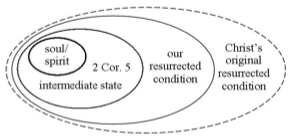
conditions. While being less than Christ’s original resurrection condition, our resurrection adds something to our intermediate state, which in turn is itself more than mere immortality. These all amount to formal statements because we cannot answer materially what any of these four states are like.
Furthermore, the differences discussed above presuppose hypostatic considerations. The variation between God, angels, and humans in our final, intermediate, and resurrected states might be more a difference in “power” or authority than form and substance of being, and our final resurrection may be more a matter of reidentification with our earthly origins than with any hypostatic component. The resurrected condition might approach that of Jesus in his “translated” form as comparable to, but not identical with, the appearance form of Moses and Elijah. The form Samuel had when called by the spirit medium of Endor affords another possibility of state along with the condition of Enoch and Elijah after their translation.
III. Conclusions Regarding Resurrection
A. Resurrection maintains continuity of identity between us in our physical and
resurrected states (1 Corinthians 15:42-54).
B. Resurrection is at least re-identification with our earthly origin.
C. Since the physical human body of this life corrupts by returning to the dust from which it came, the resurrected body is conceivably recreated-plus-translated from the memory of God.