
The Seventy-Week Prophecy of Daniel 9
THE SEVENTY-WEEK PROPHECY OF DANIEL 9
Virgil Warren, PhD
I. The beginning time for the seventy “weeks/hebdomads” is best placed at the first year
of Darius, the son of Ahasuerus (538 B.C.).
A. The word/commandment that goes forth in 9:25 seems to be the same as the word/
commandment that went forth in 9:23a.
The terminology is the same: “the going forth of the commandment” (מֹצָא דָבָר) in 9:25 is parallel to “the commandment went forth” (יָצָא דָבָר) in 9:23. (In appropriate circumstances דָּבָר may be translated “commandment”: Exodus 34:28; Joshua 1:13; 1 Chronicles 26:32; Esther 1:19, etc.) In 9:23 there may be another reference to the same thing in the expression “consider the commandment” (בִּין בַּדָּבָר), although usually the word דָּבָר is translated “matter” or some other indefinite way here. Gabriel may be telling Daniel to understand the outworking of this word of God that has been decreed (9:24) on Israel and Jerusalem. The vision (מַרְאָה) of 9:23b is then in reference to the whole of 9:24-27.
While it may be possible to understand the word/commandment of 9:25 without any reference elsewhere, it seems necessary to connect it with 9:23 in order to obtain a satisfactory meaning for the latter, unless we say that the word/command of 9:23 is God’s “word” to Gabriel telling him to go to inform Daniel of these things. Even so, it would still include the command in 9:25.
B. Beginning “the commandment” with “about the first year of Darius” maintains a chronological connection and continuity with the seventy years of captivity prophesied by Jeremiah (Jeremiah 25:11-12; 29:10; 2 Chronicles 36:21; Ezra 1:1; cp. Zechariah 7:5).
A close association must be kept between 9:24-27, 20-23, 3-19, and 1-2. The prophecy in 24-27 falls back on the preceding section since 24-27 is the communication that Gabriel came to give in 9:21-23; 9:20 unites with 9:3-19 since 9:20 summarizes the prayer recorded in those earlier verses. That summary is twofold, mentioning “the sin of my people Israel” and “the holy mountain of my God.” There is an association also with 9:24: the decree “on your people” and “on your holy city.”
It was because of Jeremiah’s prophecy about the seventy years of captivity that Daniel prayed the subsequent prayer (9:1-2). Daniel being carried away in the 605 B.C. captivity, the seventy-year period had almost ended when he offered that prayer (538 B.C.). If the seventy weeks/hebdomads begin immediately at the end of the seventy years of captivity, God is taking up the future of Daniel’s people where the end of Jeremiah’s seventy-year prediction had left them.
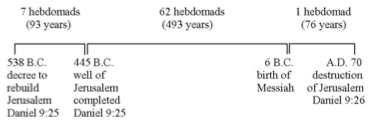
II. The end of the first seven “weeks” is the rebuilding of the walls of Jerusalem (445 B.C.).
A. The total of seventy hebdomads is comprised of 7 + 62 + 1. Daniel 9:26 says that after the sixty-two hebdomads Messiah will be cut off. Since 9:25 says that the time to Messiah Prince is seven plus sixty-two, the end of the seven hebdomads must be the completion of the building of Jerusalem, its streets, and “moat/ditch” mentioned in 9:25b. חָרוּץ (from חָרַץ, to cut) originally signified the protective ditch or trench around a fortified city. Here it may refer to the “wall” of Jerusalem since the Septuagint translates it τεῖχος. Such an understanding fits with the fact that the building of the walls was in “troublesome times” (Nehemiah 4:13, 16-21).
B. That the first seven hebdomads refer to the period of restoring Jerusalem comes also from the fact that the word/commandment at the beginning had to do with the reconstruction of Jerusalem. The going forth of the command to restore the city (9:25a) is to be connected, then, with the building of the wall (9:25c) as the beginning and end of one well-defined period of time, a period significant enough to the subsequent history of Israel to make that period an integral part of a prophecy about Israel’s future.
III. The middle of the final “week” is the death of Messiah (A.D. 30).
After the sixty-nine hebdomads (7 + 62), the Anointed One would be cut off and have nothing, perhaps in comparison with the material emphasis of the first section of the seventy weeks. At least the death of Messiah would be a failure in the eyes of an Israelite nationalist who looked for a political Messiah.
Although 9:26 merely says after the sixty-nine hebdomands, it is understood here to be in the middle of the seventieth week on the basis of 9:27a. Even as 9:25a parallels 9:25c with 9:25b intervening, so 9:26a parallels 9:27a with 9:26b intervening in parallel to 9:27b. The he who makes the firm covenant is identified especially by dispensationalists with the prince whose people will come and destroy the city in 9:26b that was rebuilt in 9:25c. Since that prince is grammatically subordinate in 9:26b, it is best to take he in reference to the Anointed One of 9:26a. As a result, the ceasing of the sacrifices and oblations of 9:26a is with respect to the divine requirement of them as the obedience on which God’s forgiveness of sins was conditioned. Therefore, their ceasing here is with respect to the basis of their ceasing even as the everlasting righteousness in 9:24 refers to the basis, not the fact, of everlasting righteousness. The middle of the hebdomad is the crucifixion; the beginning is Messiah’s birth (or conceivably the beginning of his ministry); the end is the destruction of Jerusalem.
IV. The end of the seventy weeks is the destruction of Jerusalem (A.D. 70).
A. Presumably whatever is mentioned under the caption of the seventy hebdomads takes place during the time of the seventy hebdomads. The culminating event mentioned in 9:24-27 is the “desolation” (9:26b) and “full end” (9:27b) of the city rebuilt in 9:25a + c. The destruction of Jerusalem and the temple in A.D. 70 by the people (Romans) of the prince (Titus) is a fully satisfactory fulfillment of this prediction.
As an aside, it is interesting to note that it is the people of the prince who destroy the sanctuary. Titus himself gave order that the sanctuary was not to be burned, but it was burned nevertheless by the soldiers (Josephus, Wars 6:4:5). Josephus’ comment is also interesting:
“But, as for that house, God had for certain long ago doomed it to the fire; and now that fatal day was come, according to the revolution of the ages: it was the tenth day of the month Lous [Ab], upon which it was formerly burned by the king of Babylon.”
This culminating destruction occurred at the end of the same hebdomad in the midst of which Messiah was cut off. “Full end” (כָּלָה) is most appropriately applied to the “final end” of Israel as a nation, which occurred in A.D. 70. At that time there ceased historically (Hebrews 8:13) the sacrifices that ceased theoretically at Messiah’s death (Colossians 2:13-15). The “full end” mentioned in Isaiah 10:23 may also refer to the Roman destruction, because the preceding text is speaking of a remnant returned from captivity (although E. J. Young in loco identifies “full end” with the final judgment, while others associate it with the fall of Judah in 586 B.C.). “Full end” in both passages is combined with its being “determined” (כָּלָה וְנֶחֱרָצָה). Since there is an end mentioned in 9:24-27, it is presumably that end of which the building of Jerusalem is the beginning.
B. An atmosphere of completeness pervades the whole of the passage: the making of an end of sin, the sealing up of prophecy, and perhaps even the use of hebdomads to emphasize a seventyfold completeness.
Lamech said, “If Cain will be avenged sevenfold, truly Lamech seventy and sevenfold” (Genesis 4:24). Evidently this latter passage is the basis for Jesus’ statement to Peter in Matthew 18:22, “I do not say to you ‘until seven times,’ but ‘until seventy-seven times,’” reversing vengeance by forgiveness. The kinship between Genesis 4:24 and Matthew 18:22 is clear since the numbers in the Septuagint of Genesis are the same as Matthew but not like Daniel (ἐβδομηκοντάκις ἑπτά contrasted to ἑβδομήκοντα ἑβδομάδες respectively. The former is best taken in the Greek as seventy-seven times and the latter as seventy times seven, though the distinction is often blurred in English versions). God’s vengeance on Israel came when he had forgiven them “seventy times seven,” because they did not repent (Matthew 18:22 + Luke 17:3-4).
Certain significant objections may be raised to the above construction of Daniel’s seventy hebdomads.
I. The most basic matter is the necessity of understanding seventy hebdomads figuratively, or symbolically, in a passage that is ostensibly rather literal otherwise. שָּׁבֻעִים is commonly interpreted to mean seventy weeks of “days,” which stand for “years.” As a result, a period of 490 years would be meant, an insufficient number to cover the 607 years from 538 B.C. to A.D. 70. If we begin with 458 B.C. with Cyrus’ decree, an interesting arrangement can be made in which the end of the sixty-ninth week is A.D. 26, the time of the Anointed One’s anointing with the Holy Spirit (cp. Acts 10:38) so that his being cut off is in the midst of the seventieth week (A.D. 30).
While this arrangement with literal years can obtain significant results at two points (anointing and cutting off), it seems deficient at the other two points. (1) the end of the seven hebdomands (49 years after 458 B.C.) would be 409 B.C., a year that does not seem historically, and therefore prophetically, significant. (2) The end of the seventy hebdomads comes at A.D. 33, the time of Stephen’s martyrdom and the conversion of the Gentile missionary Paul. (The conversion of Cornelius, the first Gentile, may be a better choice than Stephen’s martyrdom if indeed he was converted that same year.) While the goal of the seventy hebdomads as stated in Daniel 9:24 is admittedly spiritual, the events of about A.D. 33 seem to be no more spiritually significant than, say, the beginning of Paul’s first missionary journey to the Gentiles. The completion of the wall of Jerusalem in 445 B.C. is a better alternative for the former of these two weaknesses, and the destruction of Jerusalem is better in the later instance, both events marking significant political and spiritual terminations of well-defined periods of time.
With respect to the A.D. 26 date, it may be worth noting that the end of the sixty-ninth hebdomad is said to be, not the anointing of the Anointed, but the Anointed himself. The reference could as easily be to his birth as to his presentation to Israel.
Since the whole of Daniel 9 grows out of Jeremiah’s prophecy regarding seventy years of captivity, seventy hebdomads may be based on the Jeremiah number proportionately expanded by שָׁבוּעַ, that is, the completion of Daniel’s nation and city was to be seven times as long as the duration of their captivity. There were waves of captivity and waves of return so that a definite period of time is difficult to attach to the captivity; hence, seventy itself is a round number standing for the captivity that lasted in its extremes from 605 to 444 B. C., or 139 years (twice 70). Seventy years is as close to the number of years of captivity as seven times seventy is for the subsequent history of the nation (607 years).
As for the traditional view, on the other hand, it seems unlikely that a decree on Jerusalem and Israel should include all but the last thirty-seven years of the nation, especially when that end is mentioned under the caption of the seventy hebdomads.
2. Perhaps a more important objection lies in breaking down the seventy into parts: 7 +
62 + 1.
Seven as a number of completeness “is not based on the sum of any of its factors or any other arithmetical feature of the number, but is usus loquendi” (John J. Davis, Biblical Numerology, p. 119). One response to this objection is that the total number is in fact “broken down” in the prophecy itself. Furthermore, a significant period of rebuilding the city and the sanctuary comes at the beginning while another period of consummation and destruction comes at the end. When the seven hebdomads representing the former are taken from the beginning and the one hebdomad representing the latter is taken from the end, there remains a central portion proportionately much larger than either of them, which is designated by the remainder—sixty-two. Therefore, the last week is comparatively large, because it has several important elements.
It is to be observed that according to the text Messiah comes at the end of sixty-two, not sixty-nine. Daniel does not add sixty-two to seven as if to say that the seven is part of the sixty-nine and therefore of the same category as the whole. He keeps them separate and makes them grammatically definite (שָׁבֻעִים שִׁבְעָה וְשָׁבִים שִׁשִּׁים וּשְּׁנַיִם) as if to signal their independence from the former seven (9:25a; 9:26a). Furthermore, the seven weeks are not only mentioned separately, but put first as if to imply that they precede the sixty-two. With reference to this non-symbolic number sixty-two, we may also note that 62 x 7 = 434 years, which is only about five years off from Messiah’s birth calculated from 445 B.C. Consequently, sixty-two is proportionately appropriate to the long segment that intervenes between the first seven weeks and the last one week.
Perhaps the reason seven hebdomads represent the first period of return and reconstruction (538-445 B.C. = 72 years) while one represents the last period of consummation and destruction (4/6? B.C. to A.D. 70 = 75 years) is that the former was viewed as a less unified period than the period of the Messiah’s preparation and presentation, and the church’s establishment and initial spread. It was also closer at hand, which would make it appear larger to the forward-looking eye than the remote period of time that would close out the history of Israel.
The basic question underlying these two objections is whether the intended meaning of the numbers is figurative or literal. Is there any clear example of biblical apocalyptic where days or numbers stand for the exact number of years between future events? Isaiah 7:8 and 23:15-17 come close, but the number is not a number of days that represent years. Is not this very idea open to question?
Although the preceding analysis of the prophecy is somewhat open to question, other arrangements are probably more so. The strength of the above presentation lies in the importance of each terminal point in the series as ending some definite, well-defined period of history quite appropriate to the information given in the text. Its possible weakness lies in the relationship of these periods to the numbers the text assigns to them.
Summary Diagram
christir.org