
Attributes of God
ATTRIBUTES OF GOD
Virgil Warren, PhD
Introduction
Suggested breakdowns
1. Communicable and incommunicable: attributes that can or cannot be
communicated to his creatures
2. Absolute and relative: those which belong to God independently and those that he
shares with his creatures in varying degrees
3. Immanent and transcendent: those which belong to God’s inner being and those
which pass over to his creatures
4. Individual and relational
5. Two ways by which we speak of God’s nature even though by experience we do not know what spirit is like: (a) by negating the characteristics of the material/physical world; (b) by taking shared characteristics via imago dei and pushing them to absolutes.
Some characteristics of deity are difficult to discuss because we are not sure they correlate closely with our form of existence. That difficulty applies especially to omnipresence, omnipotence, eternality, spirituality, imperceptibility. For that reason (1) we talk about God in negative terms: he is not limited by time and space, not perceivable, not material. The negative approach applies particularly to his natural attributes vs. moral attributes. A second way we conceptualize God’s traits is that (2) we push shared characteristics to the absolute: omniscience, omnipotence, love, holiness, and the like.
I. Natural attributes
A. Eternality
God is superior to, not bound by, time (Psalm 41:13; 90:2; 106:48). Sequence can be kept with God, but there is no beginning or ending with him.
B. Self-existence (aseity)
He depends on no one or no thing for his existence. All creatures apart from him owe their existence to him because none of them have that quality. The name “Yahveh” itself has to do with being (Exodus 3:13-15). God is ultimate being—independent being. Self-existence implies sovereignty. In God’s self-existence, the objective and subjective come together in the ultimate and original One.
C. Unicity
Solidarity in kind; singularity, uniqueness. There is no genus, species, or class in which to list God (1 Corinthians 8:4). He is in a class by himself; he is the class in contrast to polytheism (Deuteronomy. 6:4). There are no other gods; Yahveh is the only one that has deity. He is unique even in comparison to imaginary gods.
D. Spirituality
John 4:24: “God is [a] spirit.” The concept is not exactly in the Old Testament (see 1 Kings 8:27; Isaiah 31:3). God is spirit in contrast to (1) matter, (2) abstract force, (3) weakness, (4) idea, (5) limitation by time and space. Spirituality is revolutionary among the ancient religions.
E. Perfection
God alone is not subject to external standards of rectitude (Isaiah 40:28; James 1:13, 17; Matthew 5:48 (Exodus 3:14-15). Perfection is the only goal God can give (Matthew 5:48; 25:28). We should not be surprised at the expectation for perfection; even we do not tell a person not to steal too much or disrespect us most of the time. God is the only one that has his characteristics in the absolute: eternality, power, knowledge, love.
F. Immutability
Passages include Hebrews 6:13-18; 13:8; James 1:17; Malachi 3:6.
Immutability means moral self-consistency, unchangeableness, unchangingness. It means that he is fair. People cannot accuse him of arbitrariness, favoritism, capriciousness, fickleness, and the like.
Immutability is unchangeable in his nature and purpose.
Self-consistency does not contradict sovereignty. He chooses to act in self-consistent ways without a need to get approval from any higher authority.
Immutability does not mean God cannot make free decisions. He can adapt to any situation; he changes in response to changes in people. When people sin, they receive wrath from God. When those same people become believers, he pours out his blessings without a change in himself. God’s immutability shows when he changes his actions toward changed people. His unchangeableness is seen in his changing (in changing circumstances of nature). God can change his will for us according to our need in accordance with his own ultimate purposes for us. God is changeable in the methods he may employ to bring about his
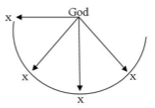
God's relation changes as the object changes position.
unchangeable ends. Immutability does not mean God is limited to doing what he did before, doing them as he did them before, or doing everything he did before. A miracle, then, is not a contradiction of natural law, and Christ does not have to work miracles in every age just because Hebrews 13:8 says that he is the same yesterday, today, and forever; the different “days” are in different circumstances.
Immutability also does not mean that God cannot answer prayer. In answering prayer, he may decide to bring about a result that would not otherwise have occurred. In so doing, he does not abandon his principles (general will of God); he chooses another alternative he would not have enacted if someone had not prayed.
Immutability does not mean that God cannot be sorrowful. In Genesis 6:6 God did not experiment and learn that he had made a mistake (See also 1 Samuel 15:11, 35; Numbers 23:19; cp. 2 Samuel 24:16; contrast Exodus 32:14; Psalm 110:4 < Hebrews 7:21.) He was sad that people had gone against their creator. He knew from the beginning that people would sin (Ephesians 1:4ff); yet he grieved at the actual sinning. We know our parents will die; yet we grieve when they do. When God “repents” it is not a moral change as in mankind. “God is a free person dealing with free human beings” (E. Y. Mullins).
The first question with Genesis 6:6 is whether the statement represents (a) an anthropomorphism, which assigns human characteristics to God, or (b) literal statement. The second issue is that if it represents a literal use of “repent,” whether it means (a) to be “sad” or (b) to be “sorry.” The second alternative implies error on God's part, and so for systematic reasons we do not choose it as the meaning here. We may add that (1) in reference to self it means “grieve” but (2) in reference to others it means “pity.”
This passage is “anthropopathic.” It attributes to God the feelings of a human. Anthropopathic is a special kind of anthropomorphism, which itself is a figure of speech that makes a comparison. It involves a model, or similarity—in this case God’s feeling of sadness, but it is not meant to include other aspects that are not part of God. The implied ignorance that leads to mistakes and sorrow from them is not transferred to God. This approach is not the one taken by liberal theologians, who see Yahwism as a developing religion in which omniscience was not originally a divine characteristic.
Immutability does not mean absolute immutability, that is, immutability in every conceivable sense or circumstance. It means moral and personal self-consistency within the framework of his personal values and purposes.
In summation, immutability does not mean that God cannot (1) act, (2) do something new, (3) do something in a new way, (4) stop doing something old, or (5) answer prayer.
G. Omnipresence
Psalm 139: God is transcendent; that is, he is not limited by time or space. The psalm closely associates divine omniscience and omnipresence, which suggests that it would be satisfactory say that God's omnipresence is by virtue of his omniscience. Transcendence has to do with kind of being, not distance.
Hebrews 4:13: he is immanent in that he indwells time and space. Immanence deals with availability more than nearness.
Omnipresence is not a matter of location or immensity even though God is said to “fill” heaven and earth (Isaiah 66:1; Jeremiah 23:23-24; 1 Kings 3:27). He is omnipresent in that no point of time or space lacks connection with him. We do not know enough about divine spirit even to know whether it is subject to location. If we choose to speak of “immensity,” we should not mean it as alternative to specific location. Spatial dimensions may not apply to God, or even to spirit, at all.
Omnipresence is a way of getting behind models that end up in tension with one another. The idea of his being “near,” for example, is probably our human way of thinking about him so we can feel that he is available to help us (power), that he is aware of what is happening to us and what we are doing and feeling (knowledge), that he cares about us, and so on. Picturing him as distant, or “high and lifted up,” on the other hand, helps us respect him. Omniscience for omnipresence can account for both of those matters without tension or contradiction.
God’s omnipresence is assumed in the biblical doctrine of prayer (Psalm 34:15).
We are not to conclude from omnipresence that we can worship God in fishing, and so on, on Sundays, for example, because in failing to meet with other Christians, we are not complying with the commandments for corporate worship (Hebrews 10:25). We do not want to go to the extreme that because God is not in one place only, we are not to meet together with other Christians for worship.
There is no contradiction between God’s omnipresence and (a) a manifestation at a certain place; it is not lost during an occasion of manifestation, especially if we see omnipresence as a function of omniscience. Furthermore, omnipresence as a function of omniscience means (b) there is nothing that the Son had to give up to become incarnate. (See “The Christ.”) Immensity would imply giving something up.
H. Omniscience
“Omniscience” means knowing everything.
Think how much God has to know (Psalm 139:1-6; 147:5; Job 38:4-5; Isaiah 40:12-14; doxology in Romans 11:33-36; Jeremiah 17:9-10).
Things God knows:
1. Himself: 1 Corinthians 2:11
2. Creation: Isaiah 40:26; Psalm 50:10-12
3. People: Hebrews 4:13; Proverbs 21:2; 16:2; Psalm 44:21; John 2:24-25
4. the past
5. the universal present
6. Future: Isaiah 46:9b-10a (Psalm 139:16 may be an anthropomorphism.)
That God knows everything could be inferred from his omnipresence if omnipresence means immensity. In reverse, omnipresence could be inferred from—or even be another way of saying—his omnipresence.
We assume that God’s knowledge is immediate (no discursive thinking, no reasoning to a conclusion), distinct, complete, inclusive.
Judging from the kinds of things scripture says that God does know, we have no reason to eliminate any fact or any kind of fact, including a future free-will act. If there is certainty on something, it can be known. The future is certain because all other possibilities for every point in time and space are eliminated by the only one that really occurs. If the future is certain, it can be known—even if we in our limitedness cannot understand how that is the case
Omniscience and other matters
a. Foreknowledge and free will (See the author’s What the Bible Says About Salvation, pp. 157-70.): John 10:17-18 + Acts 4:28
(1) Knowledge vs. reality (our sense of freedom)
(2) Certainty vs. the reason for certainty
(3) Bases for certainty, including the future
(a) Divine decree (positive predestination)
(b) Basis in the characteristics of material nature
(c) Nature of space-time reality itself
We do not attempt to imagine how God knows the future; we simply affirm that he does know it in detail, as demonstrated by detailed predictive prophecy. By dropping a piece of chalk on a desk, we can illustrate how occurrence in space-time reality itself reduces an infinite number of possibilities to one reality in the occurrence itself. Adding free will to the picture, or knowledge by another, or future time—rather than present or past time—does not change the nature of “eventness,” the nature of occurrence in space-time reality.
Two views of omniscience relative to the future:
(a) Complete knowledge of all actualities—future as well as
present and past
(b) Complete knowledge of all potentialities. Omnipotence would compensate for any lack of omniscience in maintaining sovereignty and directing history. God could know the general pattern of the future in the sense of what he plans to do, which his omnipotence guarantees by intervention if natural and social process starts moving history in a direction unacceptable to him..
b. Foreknowledge and effective prayer: Matthew 6:8
c. Foreknowledge and divine repentance. God deals with people in the present as they are in the present, not as they will be in the future or were in the past
d. Foreknowledge and evil
e. Foreknowledge and testing people. Genesis 22:12 is not a test of God’s faith in Abraham. It is a test of Abraham’s faith in God. God knew Abraham’s faith, but he wanted to establish it by actual experience. From God’s perspective, Abraham’s actual obedience did not bring a greater certainty.
f. Omniscience and a person’s self-consciousness
Psychological self-destruction is avoided because omniscience combines with grace and love, other aspects of God’s total character, and other good benefits that override this one seeming disadvantage to total omniscience.
(1) God’s omniscience serves to stimulate our doing good because it enhances humility and helps deter evil thoughts.
(2) God’s omniscience comforts us because God will not misunderstand our motives. He notes sincerity and does not falsely accuse by appearance. Since he knows everything, he knows the power of the temptations we face. There is peace of mind in knowing that he is not as hard on us as we and other people may be on ourselves. (Note Paul’s plaintive cry at the end of Romans 7:9-24 followed by 7:25-8:4.)
In regard to Jesus, note that he knew people’s thoughts (Matthew 9:4; 12:25; Luke 6:8; John 6:61; 11:17) and other significant matters (John 1:42, 46-50; 2:24-25; 4:29; 6:64; 13:11; 16:30; 18:4; 21:17); yet something he did not know was the time of his future return (Matthew 24:36). Perhaps that was because the Father had not yet decided that matter yet; hence, it was not yet knowable. If God’s knowledge is limited to what he has decided on, then the ramifications of what he has decided on would also be unknowable. Perhaps there may be a difference between what God knows and what all three members of the godhead know. The point is that “saying” someone knows everything does not prove actual absolute omniscience because statements can use absolute terms for less than absolute things; they can mean “for all practical purposes.”
I. Omnipotence (“almighty,” all-powerful)
God can do everything that is consistent with his nature and purpose (Psalm 115:3; 62:11-12; 147:3-5 [Mark 14:36] Job 42:1-2).
God’s limitations are self-imposed.
God cannot do what is inconsistent with his moral and natural perfection (Matthew 19:26; Hebrews 6:18). God cannot lie (Hebrews 6:18; Titus 1:2) or deny himself (2 Timothy 2:13) in the sense of self-consistency.
(There may be some ambiguity in saying God cannot lie. It may not mean that he does not have the ability to lie but that he cannot lie and be who he has committed himself to being: “I cannot tell a lie.”. In that construction of deity, God would be who he is because he freely chooses to be that way, and he carries through with his chosen way of behaving. He is then righteous by choice just like we—who are created in his image—are to have righteousness by carrying through on the same set of values and purposes God has chosen to operate by.)
God could not deliver Jesus from death (Mark 14:36?). To say that means that he could not deliver him from death given the previous decision to establish a basis for atonement that involved Christ’s dying, given his prophecies to that effect. In the case of substitutionary atonement, from the standpoint of theory God had to let Jesus die to save people as he promised he would (necessity and self-consistency). In the case of identification theory, God had Jesus go to the cross to qualify himself as the most appropriate source of salvation for people whom God would also ask to carry their obedience to him to the point of violent death if need be (appropriateness and self-consistency rather than inherent necessity). Jesus “had to carry through” because of the prior promise to do what the Father called previously for.
(See separate document on “The Problem of Evil.”)
J. Sovereignty
Sovereignty means God has no higher frame of reference to conform to.
Sovereignty implies that God is self-sufficient, not depending on anything greater
for his existence and welfare. He is “Yahveh,” ultimate being, who possesses self-existence, aseity.
Sovereignty does not mean capriciousness, where God would act any way he pleased without consideration for those who depend on him. His is a principled sovereignty, consistent with his nature, purposes, and promises. We conceive of that principled sovereignty as self-chosen since nothing higher dictates his choices to act.
Sovereignty combines both natural and relational characteristics.
K. Invisibility/Imperceptibility
1. Unseen
“No one has seen God at any time”: John 1:18; cp. 6:46; Colossians 1:15;
1 Timothy 1:17; 6:16; 1 Peter 1:8; 1 John 4:12, 20 (1:1-2)
Hebrews 11:27: “[Moses] endured as seeing him who is invisible.”
2. Invisible
1 Timothy 6:16: “Whom no human can see”
Exodus 24:9-11: Moses, Aaron, Nadab, and Abihu with seventy elders of
Israel “went up and saw God.”
Exodus 33:17-20-23: “No one can see me and live”
(a) “No one can see me while they are alive” (?).
(b) “No one can see me without being killed by seeing me” (?).
This second option has some parallels in other cases where there was fear at having seen God:
Isaiah 6:5: “Woe is me! . . . for my eyes have seen the king, Yahveh of hosts.”
Exodus 32:30: Jacob marveled that he had seen God and did not die. (cp. Luke
5:8: Peter told Jesus to leave him because he was a sinful person.)
A similar fear is expressed in seeing “the angel of the Lord” (Exodus 3:2, 4 [God] is quoted in Acts 7:30 [angel]).
Judges 6:22-23: Gideon expressed fear at seeing the angel of the Lord, that he
also designates as “Yahveh.”
Judges 13:22: Manoah expressed fear even though the text says “angel of the
Lord” (13:21-22; but his wife observed that if he was going to kill them,
he would not have accepted their sacrifices or shown them what he did).
The “angel of the Lord” is spoken of as God himself: Exodus 3:1-4:17; Judges 13:21-23. As God’s diplomat what he says and does is functionally the same as what God himself says and does. “What one does through another he does himself.”
The law was given by angels even though it was given by God: Acts 7:38, 53;
Galatians 3:19; Hebrews 2:2; Deuteronomy 33:2 (Septuagint/LXX).
God appeared to Moses and spoke to him “face to face”: Exodus 24:9-11;
Numbers 12:6-8; Deuteronomy 34:10 (“knew” God face to face). Does
that mean he spoke directly to Moses rather than through a messenger,
through visions, dreams, signs, or some other indirect form?
The invisibility of God refers to his not being perceivable in his own nature. When scripture says people saw God, it means seeing him in manifestation.
3. Imperceivable
That God is imperceptible by any of our senses is implied by Samson’s not knowing that the Spirit (of God) had left him (Judges 16:20); “Whom no human can see” (1 Timothy 6:16).
II. Moral Attributes
Moral attributes have to do with relation to other persons.
A. Holiness means “cut off,” “separate,” hence, “to exalt.” He is exalted above people morally as well as naturally.
A more common designation of God in Old Testament than in the New
Note Isaiah 6:1-3 as a modification of Tersanctus, or Trisagion, as well as Revelation 4:8 and the other passages where “holy, holy, holy” occurs.
Holiness embraces all other moral attributes.
Holiness relates to love. God is not (a) love alone or (b) holiness alone, nor do his love and holiness relate (c) in parallel (as in holiness to some and love to others). Love and holiness are (d) in sequence. Love offers salvation to all, and then when it is refused, holiness brings judgment on those who refuse. The two steps correspond to the different main purposes of Messiah’s two comings.
Holiness is not just a matter of following rules regardless of the consequences on other persons or their circumstances. Holiness is not a legalistic notion, but an interpersonal one. It is interpersonal holiness and self-consistency with God’s own values, purposes, and promises.
Holiness is in the larger category of interpersonalism; it is of a sort that operates in personal relationships. Because God’s holiness is accompanied by love, progress toward perfection (holiness) can be counted for achievement of perfection (love), repentance from sin can be counted as not having sinned, and option to redeem can preclude condemnation of evil; creation with a will in the creature can occur so quality of existence can be experienced (love again).
B. Righteousness
God is self-consistent; he is always true to his nature in relation to his creations.
God cannot do wrong: Genesis 18:25; Numbers 23:19; Deuteronomy 32:4; Job 34:10, 12; 2 Timothy 2:13; Titus 1:2; Hebrews 6:18 (See What the Bible Says About Salvation, pp. 13-17).
God is free from any defect or taint of character.
Note the problem of theodicy: Jeremiah 12:1.
God is not self-centered: Ephesians 1:6 (12, 13).
C. Justice
Correspondence to a moral norm is the essence of justice.
Justice means accomplishing all the requirements of the moral order.
Types of justice
1. Mandatory: God’s moral requirements include both prohibitions and
commandments
2. Punitive: punishment of the guilty
3. Redemptive: moral self-consistency in the redeeming work of Christ as
reconciliation (Romans 3:26ff)
D. Wrath
Wrath is an activity of God’s holy love. It is an overly strong word in modern English because it implies almost an out-of-control fury at other created persons’ sins. Displeasure might be a better term. It involves God’s holy displeasure at sin, the reaction of his nature against disobedience.
Wrath is the energy with which his love repudiates its opposite.
There needs to be a proper understanding of the relationship of God’s love and wrath. Calvinism misrepresents God’s wrath. God’s eternal purpose is redemptive, not condemnatory. The fatherhood of God and the brotherhood of man misrepresents God’s love. “The most disappointed people in the world are those who get what they deserve.”
E. Grace
Relationship of grace and mercy: mercy withholds just punishment and spares the object. Grace goes farther and bestows all possible good and claims the object for its own.
God is essentially gracious because he is a person, but he manifests his grace in accordance with the demands of his nature, values, and purposes. Herein lies the apologetic for hell and a proper understanding of what it must be like.
F. Mercy
Wrath Mercy
Justice Christ Grace
Judgment combines Redemption
Doom Promise
Mercy and grace are conditional, being conditioned on a sinner’s repentance and commitment to the One who is what they aspire to be as the Father’s sons and daughters.
christir.org