
Difficulties in Evaluation (Hs Book Pt 11)
C. Difficulties in evaluation
1. Distinguishing divine miracle from other phenomena (epistemology)
We may not be able to know which alternative we are investigating, but all cases must measure up to the marks of divine miracle. Divine miracle succeeds over all alternatives in confrontation (power encounter), and they (usually) have positive value rather than neutral or negative value.
a. Distinguishing between divine and demonic miracle (they are at least distinguishable: Acts 13:4-12)
(1) Divine miracle triumphs over demonic in confrontation.
(a) Egyptian magicians (Exodus 7:11, 22; 8:7)
(b) Elymas the sorcerer (Acts 13:6-20)
(c) Ephesian occult (Acts 19:18-20)
(d) All examples of exorcism (Matthew 12:28-29)
(e) Seven Sons of Sceva (Acts 19:13-16)
(f) Daniel in Babylon
The observation applies only to legitimate attempts to use supernatural divine power for overcoming evil, sickness, and other negative matters. Evidently God chooses (special) individuals for this manifestation instead of enabling all who might want to do it (contrast answered prayer). The reasons for choosing special persons include (a) the desire to avoid confirming false teaching or incorrect practices by sincere people (miracles have evidential value) and (b) not removing the restrictions that God has placed in the human circumstance (or allowed to come into it) for reasons like those in Genesis 3.
(2) Demonic does not have positive effects as divine miracle does.
Demonic miracle is negative or at least neutral. This generality may not eliminate demonic miracle from having a small, temporary good in exchange for something proportionately worse.
There are cases of divine miracle with negative effect, but always in cases of judgment in confrontation situations: Aaron and Miriam’s leprosy (Numbers 12:1-15), the destruction at the rebellion of Korah (Numbers 16), the destruction of Sennacherib’s army, Paul’s striking Elymas blind, the death of Ananias and Sapphira, and maybe the death of Herod (Acts 12:20-23).
There may be a few cases of seemingly neutral divine miracle like Elisha’s floating ax head (2 Kings 6:1-7). Jesus’ (and Peter’s) walking on the water was to get to the disciples and save them from destruction by the storm on the Sea of Galilee. (Matthew 14:22-23; Mark 6:45-51; John 6:15-21). The cursing of the fig tree had a didactic purpose (Matthew 21:18-22 = Mark 11:12-14, 20-24).
(3) Demonic is not allowed to act in Christ’s name: Mark 9:39 (= Luke 9:49-50).
(4) Demonic cannot agree to distinctive Christian doctrines in order to commend itself for its own purpose (1 John 4:1-4; Acts 19:13-16).
(5) Satan does not cast out Satan, a principle applicable particularly to exorcism: Matthew 12:25-26 (Mark 3:23-26; Luke 11:17-18; Acts 19:13-16).
(6) In divine miracle the person is always in control of himself:
1 Corinthians 14:32.
Demonic power cannot overcome believers contrary to their will (Matthew 8:28; John 10:28-29). In demonic possession the person is subject to the spirit (Luke 9:37-43, e.g.); in divine enablement the Spirit is subject to the person.
The demonic can look like the divine; otherwise, Satan could not disguise himself as an angel of light so as to deceive the very elect (Mark 13:22; 2 Corinthians 11:14).
We could raise the question here whether Satan might use a miraculous greater evil to overcome a lesser evil. That possibility probably could not apply to exorcism, because it would not fit with Jesus’ words that Satan does not cast out Satan. It sounds as if Jesus means a more powerful demon does not cast out a less powerful one. Perhaps if he did, we would have another case of a person ending up worse than before, and so Jesus discounts such a case.
b. Distinction between divine miracle and paranormal phenomena or magic
(1) Divine miracle always succeeds.
(a) The seven sons of Sceva (Acts 19:13-16)
(b) Deuteronomy 18:20-22
(2) Divine cannot soon be speaking of Christ lightly (Mark 9:39;
Luke 9:49-50).
(3) Divine miracle has positive value, not just negative or neutral (see
above).
(4) In divine miracle the person is in control of himself (1 Corinthians
14:32-33).
(5) Divine miracle may require faith of the requester, but success does
not depend on it if the miracle worker makes the attempt.
(a) The case of Malchus: John 18:10-11
(b) Jesus’ requirement of faith: Matthew 8:13 (= Mark 5:36); Matthew 9:2 (= Mark 2:5); Matthew 9:22 (= Mark 5:34; 10:52; Luke 7:50; 8:48; 17:19; 18:42; “your faith has made you whole”); Matthew 9:28-29; 12:58 (= Mark 6:5); Mark 9:23-24; 11:23-24 (cp. Matthew 17:20; 21:21; 1 Corinthians 13:2); Luke 8:50; cp. Acts 14:9.
(c) The lame man at Gate Beautiful: Acts 3:1-10
(d) All negative judgments: Ananias and Sapphira, Elymas, all cases of exorcism
(6) Divine does not allow communication with the dead and similar commonplace practices in non-Christian circles.
c. Confrontation with false religions
The contest between Elijah and the Baal prophets on Mount Carmel serves as a model for cases where supernatural may not have been demonstrated by the opponent (1 Kings 18).
2. Testing miracle by doctrine + proving doctrine by miracle (apologetics)
a. Components of the solution
(1) Unmistakable initial authentication
The doctrinal truth is established in the first place by stupendous or otherwise unmistakable display of miraculous phenomena in competition with alternatives: the gods of Egypt.
(2) Consistency
(a) The message is not only internally consistent, but correlates
with previous revelation.
(b) John 16:13-15 + Jude 3
(c) Galatians 1:8-9
(d) Deuteronomy 13:1-5
(e) 1 Peter 3:18; Hebrews 9:26-28 (“once and for all time”)
(3) Triumph of divine in confrontation
(a) Moses (Exodus 7-12)
(b) Joseph (Genesis 40-41)
(c) Daniel 5
(d) Philip (Acts 8)
(e) Paul (Acts 13, 19)
(f) 1 John 4:14
b. Combined interaction of components
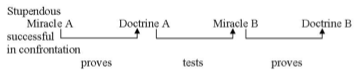
To get the process started, “Miracle A” is stupendous in degree and in confrontational situations.
(1) The original establishment: Moses
(a) Stupendous miracles: Egyptian plagues, crossing the Red Sea, manna, quail, pillar of smoke and fire, manifestations at Sinai, snakes, earthquake, consumed by fire, clothes not wearing out
(b) Triumph over the Egyptian bull-god Apis and the Egyptian
Magicians
(c) Pronouncement as false on all other alternatives (gods)
(d) Other prophets were to come, but their further revelations had to harmonize with the normative prophet Moses (Deuteronomy 18:15-22; 2 Kings 18:20-40)
(2) The coming of other prophets who reaffirmed the Mosaic economy and predicted its abrogation (Jeremiah 31:31-34; cp. Hebrews 8-10; Matthew 5:17-20)
(3) The subsequent establishment: Christ
(a) Stupendous miracles: exorcism, resurrection of Lazarus, etc.
(b) Resurrection of Jesus himself
(c) Pronouncing abrogation on previous economy (in keeping with prophecy in Jeremiah 31) and the pronouncement as false on all other lords (1 Corinthians 8:5)
(d) Affirming the finality of the new economy
There are two major starting points apologetically and theologically in the Judaeo-Christian religion that correspond to the beginning of the two successive economies. Both give stupendous display to dispel doubt and authenticate claims. At the same time there was triumph in confrontation with alternatives—demonic and otherwise. The circularity between doctrine and miracle is avoided because it is not the same doctrine that tests miracle that was established by miracle. The original doctrine was accompanied by stupendous display and triumph over demonic confrontation. That doctrine became a restrictive test on all subsequent doctrinal claims. Even if subsequent claims were (seemingly) miraculously accompanied, they were still rejected because they did not harmonize with previous doctrine. New future doctrine was authenticated by miracle that bore the marks that could distinguish it from demonic miracle, deception, or paranormal phenomena. In addition, doctrinal revelation in the Christian dispensation is final.
3. Practice
How can I tell the genuine?
christir.org