
Duration of Charismata a (Hs Book Pt 14)
II. Duration of the Supernatural Charismata
Introduction
Four approaches have arisen regarding the duration of supernatural charismata.
1. Miraculous manifestation was scaffolding for the original building of the church. After the church was adequately established, the apologetic base shifted to the record of miraculous manifestation. Miracle correlates with new revelation; since the new covenant closes revelation, it does not include progressive revelation, and miraculous authentication is not ongoing.
2. The sign gifts are permanent throughout the church age, because they are part of the continuing apologetic for the Christian message. Record of authentication does not replace ongoing authentication. Advocates differ as to whether every Christian has a supernatural gift.
3. A mediating position supposes that in pioneering a new field, supernatural may occur until the church has been firmly established there—in much the same way miracle validated the original apostolic preaching.
4. The idea of “the latter rain” is that supernatural manifestation will show up again in the church as history nears the end times. Typically advocates picture the current situation as the “latter days.” (See below under “The Testimony of History.”)
Four distinctions apply to the duration of miracles in the church age.
1. The question is not what God can do, but what he has decided to do; not what he can do but what he does.
2. The question is not whether God supernaturally intervenes today, but whether he miraculously supernaturally intervenes today. Answered prayer can involve supernatural intervention as surely as miracle does, but it is not usually an overt, visible intervention.
3. The question is not what we believe is happening today, but whether scripture indicates anything about the duration of miraculous phenomena. The question is about scripture more than experience.
4. The question is not whether the Spirit exists or does anything today; it is whether he manifests himself supernaturally in his doing.
A. 1 Corinthians and the Duration of Miraculous Phenomena
The following treatment analyzes 1 Corinthians 13 to discover Paul’s purpose, especially in the context of 1 Corinthians 12-14.
1. Basic data
a. ἐκ μέρους (13:9-10) vs. τὸ τέλειον (viewed in the sense of direction
“of part,” “partial,” “the complete” or end; τέλειος adds to ὁλόκληρος
“in part” the idea of direction, consumma-
tion, or completeness: maturity.)
b. ἄρτι (13:12) vs. τότε
“now “ “ then”
c. Being a child (13:11) vs. being an adult becoming an adult is obviously
supposed to be put on the same side with “the perfect,” not only
from the general flow of thought,
but also the same word (“put
away”) is used of child behavior
and the “of-part” things of
prophecy and knowledge.
d. Seeing through a glass darkly vs. seeing face to face
δι’ ἐσόπτρου (13:12) πρόσωπον πρὸς πρόσωπον
e. γινώσκω (13:12) vs. ἐπιγνώσομαι
I know = being known I know = being known both before and at that time
(not particularly to know fully, but to know directly or certainly. The τέλειον above is that kind of end time fullness/completeness that comes with direct knowledge vs. communicated knowledge; not a matter of omniscience, but a relatively clear, or complete, knowledge of the thing in view.)
f. Paul equals Paul
we we Paul is in both the ἐκ μέρους and the τὸ τέλειον:
(1) Paul will know in the τὸ τέλειον as he is known in the ἐκ μέρους (13:12).
(2) Paul was both the child and the adult (13:11).
(3) Paul now sees through the glass darkly and then face to face (13:12).
(4) Paul “knows in part” and “prophesies in part” (13:9).
Paul could refer to a “we” of which he was not a part (1 Thessalonians 4:16-17; 1 Corinthians 15:51-52). Here, however, he puts himself in the “we” since “we-now” and “we-then” parallels “child” and “adult,” which refers to childhood and adulthood generally as well as to Paul himself. Τhe continuity of personnel between the ἄρτι/νυνί and the τότε is most natural if not necessary.
g. Abiding of faith, hope, love vs. love’s lone continuance (13:7-8; 13:13) (13:13)
Love’s not falling (οὐ πίπτει) contrasts with things
said to be ceasing; hence, “not fall” means “not
cease,” that is, “continue.”
1 Corinthians 13:13 implies that faith and hope no longer abide in the τὸ τέλειον as respects the things they govern in the ἐκ μέρους. But love continues, indeed increases by virtue of the directness that fosters greater appreciation. Trust will exist in the face-to-face relationship, hope will be possible, and knowledge will continue; but faith and hope will be with respect to other matters than they now are, and knowledge will be ἐπίγνωσις, no longer γνῶσις, experienced (direct) rather than communicated (indirect).
Parallels between 1 Corinthians 13, Romans 8, and 2 Corinthians 5:
1 Corinthians 13 Romans 8 2 Corinthians 5
(1) face-to-face the seen (24) sight (7)
then
(2) redeemed body (23) at home with the Lord=absent
from physical body (8)
(1) groaning in ourselves (24) present in the body (6)
now
(2) through a mirror
darkly (12) hope (24-25) faith (7)
Paul says in Romans 8:38, “Life . . . does not separate us from God’s love.” In Corinthians, love is present in this life and will continue in the next. “For me to live is Christ, to die is gain” (Philippians 1:21).
2. Interpretative conclusion: “The perfect” is the face-to-face relationship that
begins at death.
Paul, speaking of the ἐκ μέρους vs. τὸ τέλειον, is talking about the knowledge of Christ in this life vs. the knowledge of Christ in the next. That distinction is background for saying, “Do not get caught up in the medium (tongues, etc.) instead of the message” (the reality of the God-man relationship most synoptically characterized by love).
a. Christianity brings personal relationship with God through Christ.
Understanding is not the point (1 Corinthians 8:1; 13:2). If people seem to know anything, they do not yet know what they need to know (1 Corinthians 8:3). Abilities are not the point (1 Corinthians 13:2), because they are not ultimately germane to the Christian system understood as a loving-relationship with God.
b. The next life begins immediately after death: 2 Corinthians 5:1-10; Revelation 6:9-11; Luke 23:43; Philippians 1:21-24. That fact is implied also by Christ’s appearance to Stephen at Stephen’s execution (Acts 7:55-60).
c. 1 Corinthians 13:1-14:40 deals only with information and communication gifts: 14:6 (tongues, prophecy, knowledge, revelation, teaching, and faith) is in response to these. Information and communication gifts pertain to indirect knowledge.
d. Paul deals with both natural and supernatural gifts in 1 Corinthians 12-14, and even in 1 Corinthians 13.
Knowledge is not particularly supernatural in 13:8. Knowledge (γνῶσις vs. ἐπίγνωσις) will be done away. Knowledge is listed last before “now we know in part” (γινώσκω vs. ἐπιγνώσομαι). If we know in part and our γνῶσις will pass away (12b), it follows that γνῶσις is not necessarily by supernatural means—though it could be. Prophesying is not necessarily supernatural.
e. Paul’s emphasis in 1 Corinthians 13 is appropriate because love is the all-inclusive term that regulates and defines interpersonal behavior for now and eternity.
Love partakes now of a reality yet more fully to come, whereas spiritual gifts are only means to awareness of the reality. Communications (13:1), abilities (13:2), and activities (13:3) that do not partake of this reality are not meaningful (13:1-3). Communication, abilities, deeds become meaningful only in the context of love, which governs relationship with God.
Love is then the central emphasis of 1 Corinthians 13 in the context of not confusing the medium of communication with the message communicated. What is communicated is relationship to Christ. Love is the characteristic feature of our relationship to him and all others related to him. Love must pervade everything we do, or ur doing has abandoned the orienting characteristic of the faith. Without love all prophesying is devoid of meaning because it is devoid of relevance to personal relationship.
f. The data best fit this construction of Paul’s thought.
(1) The approach makes the identification between τὸ τέλειον and
πρόσωπον πρὸς πρόσωπον that the parallelism requires.
Face to face and its equivalents suggest that direct-immediate vs. indirect-mediate is more the point than degree of completeness (a figurative usage that could arise from the literal situation out of which the expression arose: face to face; hence, direct; hence, complete). Relevant passages are Genesis 32:20, 30; Exodus 33:11; Numbers 12:6-8; 14:14; Deuteronomy 5:4; cp. 25:16; Galatians 2:1; 2 John 12. 1 John 3:2 seems to carry a like idea. 2 Corinthians 3:18 says we behold with unveiled face the glory of the Lord as in a mirror. It has been taken to mean something comparable to the knowledge of God in the Old Testament, a comparison suggested by the veil Moses put over his face because the people of Israel were afraid to look at him after he had faced the glory of God. The expression “unveiled” is comparable to face-to-face, and its combination with mirror is striking in connection with 1 Corinthians 13. But that it warrants calling the knowledge people have in the New Testament a face-to-face knowledge is not necessary. (See canon view below.)
(a) Comparing the two contexts puts “mirror” in a different position. 1 Corinthians puts mirror over against “face-to-face” and separates them by time (“now” and “then”). 2 Corinthians puts them on the same side in the “now.”
(b) Furthermore, the canon view (see below) says the perfect is the completed revelation by the end of the century, but 2 Corinthians is speaking in the 50s about this unveiled situation.
(c) In 2 Corinthians the unveiled is in regard to glory; in 1 Corinthians the face-to-face is in regard to knowledge.
(d) The comparison in 2 Corinthians is between what “we” have now with what they had in the Old Testament; the comparison in 1 Corinthians is between what “we” have now and what “we” will have later. The use of 2 Corinthians 3:18 to show that face-to-face means complete knowledge makes a word comparison rather than a meaning comparison.
(2) Paul—and any Christian—can be on both sides of the situation.
g. The approach correlates earthly and heavenly with the present life and the next life. This schematic captures the idea.
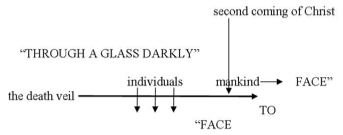
The perfect is aside from the duration of miraculous gifts because time is not the point. Paul does not contrast one time in history with a later time in history, but this life with the next life—a life already begun by saints who have passed beyond the veil. It is not a contrast of this age with a later time, but of this stage with the next stage. How long miraculous gifts continue in this age is not the point; the point is that they are in this stage only. If they are in this life only, they are temporary. The permanent must govern the temporary.
3. Against the canon view
“The perfect” refers to the completion of new revelation in written form, hence, the completion of the canon.
a. Under that view the “we” of the ἐκ μέρους cannot be (among) the “we” of the τὸ τέλειον.
(1) It is not likely that Paul knew less than what came to comprise the full content of the New Testament canon.
(2) It is not possible to consider Paul as being in the perfect as well as the imperfect if perfect means the complete canon; he died too soon.
There may be an outside chance that “we” in the two contrasting statements is comprised of different personnel as in the idea that we Christians know in part now, but we Christians will know in toto then, even if the individuals who make up the “we” change because of time. But it does not seem likely to put that construction on it since this contrast involving we’s is compared with the same individual’s growth from childhood to maturity. Besides, the growth is with respect to persons, not revelation.
b. “Face-to-face” cannot be taken literally—its more natural import.
c. “I will know the revelation in the future as the revelation knows me in the present” is not so natural to say as, “I will know Christ as [directly] as he knows me now.” (Hebrews 4:12, however, is unclear as to whether word means scripture or Word meaning Christ; the text seems to melt the two usages together.)
It may be possible to say that “I will know the truth [as a result of the completed revelation] as Christ knows me now.” The objection is still that such an approach acts as if first-century disciples did not know as completely as modern Christians who have the written word; that seems to confuse completeness of knowledge with completeness of inscripturation.
d. The contrast is usually (1) bit-by-bit information via individual revelations to those who had the gifts of prophecy and knowledge as distinguished from (2) a complete information set available to Christians in the completed Bible.
That view makes ἐκ μέρους mean “in parts” rather than “in part.” But the point of the text does not contrast modes of receiving, but directness, degree, or completeness. The contrast is partial vs. complete, or preliminary vs. consummate, rather than in parts vs. in one set. It is the kind of knowledge that comes from someone’s telling about it vs. experiencing it. The point is not progressive vs. complete (manner), but partial vs. full (content). We have no basis for saying that first-century Christians knew only “in part” relative to later content in the canon.
e. The canon approach has no provision for non-miraculous gifts (assuming that faith and knowledge in 13:2, 8 are not miraculous possessions) and yet advocates use it as an argument for the cessation of miraculous gifts. If non-miraculous is included here, the argument would require the cessation of non-miraculous gifts as well. Here the argument proves too much.
f. The canon approach has no provision for explaining why Paul talks only about communicative and informational gifts in the immediate context of the part vs. the perfect; yet advocates use it to argue for the cessation of miraculous manifestation generally. That argument might close the canon, but it would not exclude miracles of healing. Here the argument proves too little.
g. The canon approach does not explain the change from γνῶσις to ἐπίγνωσις in 13:12—communicated vs. direct experience, faith vs. sight, knowing by being told vs. knowing by experiencing.
h. The canon approach does not explain how faith and hope can be in the proposed ἐκ μέρος but not in the τὸ τέλειον.
i. First-century Christians may have known some things about the future that are not in the canon now (2 Thessalonians 2:5, e.g.). The canon approach assumes not only that early Christians did not know as much as is in the canon now, but also that the apostle Paul did not.
As a matter of fact, genuine miracle may have ceased at about the time the New Testament was finished. The latter could be the cause of the former without that correlation being the point in 1 Corinthians 13. It is not so much that it was complete, but that it was written, that miracles could now cease. This context deals with completeness, not written completeness.
4. Against the permanence view
“The perfect” refers to the situation at the coming of Christ with the implication that miraculous gifts will continue till the end.
a. This view does not take the nearest adequate fulfillment, a general principle for interpreting prophecy. There is no contextual reason to make “the perfect” wait till Christ’s return when a nearer fulfillment exists.
b. Even if we think of the face-to-face relationship as not beginning until the parousia, since more than the miraculous is in the in-part situation, 1 Corinthians 13 does not become an argument for the duration of miracles. For reasons not addressed here, the miraculous aspect of the in-part might stop while the in-part as such continues in its non-miraculous aspects.
Of the views set aside the permanence-of-miracle view is the closest to correct.
5. Against the view that “the perfect” is the unity of the Jewish-Gentile church
a. This view is aside from this context.
b. There is no time when this degree matter could be said occur.
c. The childhood of the church fits the infancy figure, but not the face-to-face.
6. Against “the perfect” as love
a. This view is usually taken by those opposed to miraculous duration, but it would be as well suited to the opposite side since love has never been fully experienced.
b. There is no time when this degree matter could be said to be reached; yet the idea of degree preceding a culmination is not eliminated from this context because of Paul’s analogy of being an adult vs. being a child.
This view supposes that all the contrasts in 1 Corinthians 13 address the same contrast. Paul evidently has one line of reasoning in mind.
christir.org