
Evaluating Manifestation (Hs Book Pt 9)
EVALUATING CURRENT MANIFESTATION
Virgil Warren, PhD
Introduction: reasons for testing manifestations of the Spirit (1 John 4:1-4)
A. Other explanations besides divine agency may exist:
lying wonders/deception/magic/illusion/sleight of hand,
demonic miracle,
psychological/parapsychological phenomena, altered states of consciousness,
psychosomatic/“mind over matter,” mental illness.
The person who has these experiences is in no better position to identify them and their causes than another else is.
B. Miracles authenticate the claim of the miracle worker: the doctrinal issue (Mark
2:1-12).
If “miracle” is self-deception, demonic, or misidentification of biblical gifts, an observer may mistake it as a basis for believing that idea is new revelation, proper interpretation, special divine guidance. The miracle worker may not be open to correction.
C. Emphasizing miraculous display can detract from the purpose of the kingdom.
D. Misimpressions from pseudo-miracles can adversely affect the church’s witness to unbelievers and mislead fellow Christians.
E. Divisive effects can come from false prophets that do “lying wonders.”
I. Testing manifestation
A. Tests to be applied
1. The definitional test
a. “Tongues” as actual human languages
b. Revelation as something distinguishable from our own thoughts
c. Miracle as something distinguishable from answered prayer
miracle answered prayer
(1) apologetic purpose beneficent purpose
(2) always succeed (see below) other answers: no, not now,
if, another, instead
(3) immediate possibly a process over time
(4) visible intervention invisible intervention
(no agent used: medicine, e.g.) (medicine may accompany)
(5) with certain persons available to all Christians
(6) involves a second person no second persons necessarily
involved (direct access, not
sacerdotal)
(7) does not benefit the person may benefit the person who
agent prays
The purpose sets the pattern.
We think that most claims of current miracles involve misidentification of some sort, examples of answered prayer rather than miracle, coincidence, or deception. Some answers to prayer may have some evidential value, but miracle is clearly divine intervention.
2. The doctrinal test
a. Deuteronomy 13:1-5 (“Let us serve other gods.”)
b. Deuteronomy 18:20-22 (“in the name of other gods”)
Deuteronomy 18:22 shows that the doctrinal test applies even on matters not found in previous revelation. If a prophet’s sign fails on any matter, God’s people are not to respect/honor/fear him. The assumption is that a true prophet does not err. So, God’s people should disregard the specific false claim itself but anything else that prophet says. The ovals represent three possibilities.
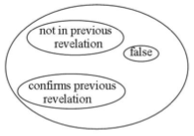
c. Mark 2:5-10 (“that you may know . . .”)
d. Mark 9:39; 1 Corinthians 12:3 (1 Corinthians 12 equals the practical test)
e. John 9:16, 31 (“how can a sinner do signs?”) “Praise God; this man is a sinner” (9:24).
f. Acts 15:12: Paul and Barnabas used God’s signs and wonders among the Gentiles to confirm their doctrinal claim that Gentiles did not have to be circumcised.
g. Galatians 1:8-9
h. 1 John 4:1-4: that Jesus had come in the flesh was a test against Gnostic
dualism
One caution in implementing the doctrinal test is that we may be mistaken about the doctrine we uses as a test; so humility, honesty, and caution should prevail.
3. The practical tests
a. Pattern
(1) Is one person claiming to have all the gifts?
(a) The New Testament suggests that gifts were generally one or a few per person: 1 Corinthians 12:7-10 (29-30; Ephesians 4:7-11; Romans 12:4-8; 1 Timothy 4:14; 2 Timothy 1:6).
(b) The apostles had a plurality of gifts:
Peter: Acts 2 (languages); 3:1ff (healing); 5:15-16 (exorcism—though never called a “gift” in the Bible); 9:36-43 (resurrection); 8:14-18 + 6:6? (dispensing gifts)
Paul: 1 Corinthians 14:18 (languages); Acts 28:1-6 (snakebite); 20:7-12 (resurrection); 16:16-18 + 19:11 (exorcism); 14:8-10 + 19:12 (healing); 19:1-7 + Romans 1:11 + 2 Timothy 1:6 (dispensing gifts)
The Mission of the Twelve: Matthew 10:1-15; Mark 6:7-13;
Luke 9:1-6, 10
(c) Examples of plurality beyond the apostles
Members of the Mission of the Seventy: Luke 10:1-20
An interpreter who spoke in languages: 1 Corinthians 14:5
(2) Is a range of manifestations occurring or just certain ones that can more easily be counterfeited or misidentified?
The point is illustrated in drinking poison (Mark 16:18), surviving snakebite (Mark 16:18; Acts 28:3-6), taking up scorpions (Luke 10:19), or examples that would harm the miracle worker if they failed.
(3) Is the person in control of himself? (1 Corinthians 14:32)
(4) Does enthusiasm produce the message or does the message produce the enthusiastic proclamation of the message? (cp. 1 Kings 18:25)
(5) Are there direct but also indirect miracles through symbols: Acts 5:15-16 (Peter); 19:11-12 (Paul)?
(6) Is there miracle from afar: Matthew 8:5-13; John 4:46-54 (Jesus)? See also Matthew 15:21-28 (= Mark 7:24-30).
b. Purpose
(1) Sheer desire to escape the limitations of the physical world
What of seeking a miracle to have my legs the same length when brethren are dying for their faith elsewhere? “My grace is sufficient for you” (2 Corinthians 12:9) seems to imply that miracles (and prayer) do not yield desired results on issues less important than the current situation requires. Perhaps lesser problems would be resolved miraculously if the evidential purpose was the overriding concern. It is questionable whether evidential purpose explains most minor claims in current manifestation.
(2) Trial of God? (cp. Matthew 4:5-7 = Luke 4:9-12)
(3) Does it proceed from an attitude of love? (1 Corinthians 13 equals
the test of love.)
c. Results
(1) Do they always succeed?
(a) Deuteronomy 13:1-5; 18:20-22
(b) Acts 19:13-17
(c) The apostles’ failure in Matthew 17:14-20 (= Mark 9:14-
29).
[1] Because of the apostles’ lack of faith (Matthew 17:19-
20)
[2] Does the dictum apply “this kind comes not out but by
prayers” (and fasting; Mark 9:28-29)?
[3] Not from a lack of faith in the one requesting help (Mark
9:24)?
(d) Peter’s partial “failure” to walk on the water: Matthew 14:28-
31
(e) The two-stage miracle of the blind man: Mark 8:22-26
(f) Do the results fade and need to be renewed? No such pattern
occurs in the New Testament.
(g) He does not give his Spirit by measure (just part of the time, or
in measured degree?): John 3:34.
(2) Do they glorify God or benefit the miracle worker?
(a) Biblical examples of glorifying God: Matthew 5:16; 9:8 (=
Mark 2:12; Luke 5:25-26); 15:31; Luke 7:16; 13:13; 17:15;
Acts 4:21; 21:17-20
(b) Biblical miracles were not used to benefit the miracle worker.
[1] Paul’s thorn in the flesh (2 Corinthians 12:7-9 =
Galatians 4:13?)
[2] Jesus and the stones to bread (Matthew 4:3-4 = Luke
4:3-5)
[3] Jesus’ not coming down from the cross
There are no biblical miracles worked by the miracle worker on/for himself. At the feeding of the five thousand did Jesus eat some of the bread and fish? There were also promises against personal injury (Luke 10:19; Mark 16:18; Acts 28:3-7). Very few cases of miracles worked even on fellow Christians (Acts 9:36-41); 20:7-12; contrast 1 Timothy 5:23; 2 Timothy 4:20).
(c) Does it appear to be a money-making scheme?
[1] Acts 16:16-18
[2] No example of a divine representative taking money for
his service (note Acts 3:6) of healing (Acts 8:18-24)
(3) Do the miracle workers benefit others (edify) or draw attention to themselves? (1 Corinthians 14 equals the test of edification.) Miracles do not look like attention-getting behavior (cp. Matthew 4:5-7 = Luke 4:9-12).
(a) Application to the nature of the gift
(b) Application to proper use of the gift: 1 Corinthians 14:3-19,
28
(c) The refusal to give Simon the sorcerer the gift he wanted
(Acts 8)
(d) Miracles were refused in the New Testament
[1] To show off (Matthew 4:5-7 = Luke 4:9-12)
[2] To benefit the self (Matthew 4:1-4 = Luke 4:1-4)
[3] To make money (Acts 8:18-34)
[4] To satisfy curiosity (Luke 23:8-12)
[5] To answer a challenge (Matthew 12:38-45 = Mark 8:11-
13; Luke 11:14-26)
[6] To come down from the cross
4. The moral test
a. John 9:31, 33
b. Mark 9:39
c. What of Matthew 7:22-23?
(1) Lying at the judgment. Jesus may have planted the claims about miracle working as an extreme example of what does not suffice as a replacement for virtuous living—an exaggeration for emphasis like Galatians 1:8-9; 1 Corinthians 13:1-3; Psalms 22:10-11; 51:5; 58:3. Nevertheless, it could be a real possibility as with Judas Iscariot, who was part of the Mission of the Twelve (Matthew 10:1-15; Mark 6:7-13; ); the Mission of the Seventy may have included the Twelve with Judas (Luke 10:1-20),
(2) Formerly faithful with gifts plus subsequent apostasy (never knew?). “Never” might have the value of saying “as good as never” since a person’s final condition becomes that person’s eternal state. Balaam was a prophet that God later rejected.
(3) God’s speaking through an office held by an evil person (cp. one view of John 11:47-53). But God does not specially endow someone that opposes him (Acts 19:13-16; note the question re Jonah; Philippians 1:15; Galatians 1:6-7)?
(4) Living within the general will of God, but not within the special will
of God for that person
(5) Lacking love (cp. 1 Corinthians 13:1-3)
*(6) People who thought they were doing miracles but weren’t
d. The moral test does not mean moral perfection.
(1) Paul: “chief of sinners” (1 Timothy 1:15)
(2) Peter: “stood condemned” (Galatians 2:11)
(3) Samson: (Judges 13-16)
(4) David, though significantly sinful, is called a man after God’s own
heart (in his life? in regard to steadfast commitment to Yahveh alone?).
(5) Some Corinthians were misusing gifts.
(6) Note the “one” among the Galatians (3:5) who was supplying them
the Spirit and working miracles.
(7) The case of Balaam raises some unclear points.
We may wonder how far God allows people to drift into sin before he removes their special endowments. The case of Samson shows that God may take gifts away. The answer may relate to the person’s or involve some relativity factor. Relative to surrounding circumstances, people like Samson, David, and Solomon were better than most. The fact remains that Jesus told his disciples no one could work a miracle in his name and soon speak evil of him (Mark 9:38-39).
The moral test shows that God does miracles through a person, not an office/position. Caiaphas in John 11:47-53 probably said more than he knew (cp. Matthew 26:6-13; Mark 14:3-9; John 12:1-7 + 11:2). Miracles are through a person, not a formula/incantation/word. There is no “power” in the name of Jesus as such, a point the seven sons of Sceva learned the hard way (Acts 19:13-17). In the same vein, miracles do not come through a ritual formula. That is one reason James 5 does not call for a set pattern to obtain results. (See essay in the Addenda entitled “James 5 and Anointing with Oil.”) New Testament miracles always succeeded.
Applying the moral test calls for making sure that God has proscribed the behavior; the moral test converges with the doctrinal test. The Pharisees were trying to apply the moral test when they told the lame man to praise God because Jesus was a sinner. The claim that he was a sinner referred to his making mud and smearing it on the blind man’s eyelids when healing him on the Sabbath. Their flawed understanding of Mosaic Sabbath law prompted them to dismiss Jesus’ work as “not from God.” In this case, they also entertained the idea that God would work a miracle through someone that was a “sinner.” That combination of mistakes led them to misjudge what was happening before their very eyes.
Summary of Observations
Divine miracles are not done through an office rather than through the person. Apostates, immoral people, false prophets and teachers cannot do them by virtue of ecclesiastical appointments.
Divine miracles cannot be done by those who do not first have salvation status.
Divine miracles (vs. answered prayer) have uniform success. There is no pattern of occasional success or even usual success.
Divine miracles are done to enhance faith. They are not sheer displays of the supernatural for entertainment purposes, satisfying curiosity, personal gain of the miracle worker, pointless results, mere release from the natural order and its limitations, or showmanship.
Divine miracles are not ends in themselves or the focal point of Christian activity; miracles are adjuncts to kingdom purposes.
Divine miracles do not soon lose their effectiveness, as when an adrenaline rush from excitement wears off later and the malady returns.
Divine miracles must be distinguished from other sources of the supernatural (demonic) or other kinds of events that are not supernatural (parapsychological, fakery).
christir.org