
Gidance by the Spirit (Book Pt 5)
B. Guidance: what to do (in Christian living and ministry)
1. Biblical evidence for the Holy Spirit’s guidance
a. Examples of divine calling and special direction
(1) Noah: Genesis 6:13ff
(2) Abraham: Genesis 12:1ff.; 13:14ff
(3) Moses: Exodus 3:1ff
(4) Gideon: Judges 6:11-25ff
(5) Manoah: Judges 13:2ff
(6) Samuel: 1 Samuel 3:1ff
(7) Amos: Amos 7:14ff
(8) Jonah: Jonah 1:1-2; 3:1-2; 4:9-11
(9) Isaiah: Isaiah 6
(10) Jeremiah: Jeremiah 1:1-2:1
(11) Ezekiel: Ezekiel 2:1-7; 3:16-21, 22-27; 6:1ff., and so on
(12) Haggai: Haggai 2:10ff, 20
(13) Zechariah: Zechariah 1:1-2ff
(14) Zachariah and John the Baptist: Luke 1:5-25, 39-80; 3:1-20
(= Matthew 3; Mark 1:1-11); John 1:6-36
(15) Joseph: Matthew 1:19-25
(16) Mary: Luke 1:26-38
(17) The twelve collectively: Matthew 10:1-4ff (= Mark 3:13-19; Luke 6:12-16); Acts 1:1-11
(18) The four: Matthew 4:18-22 (= Mark 1:16-22; Luke 5:2-11; John 1:40-42)
(19) Philip the Apostle: John 1:43
(20) Matthew: Matthew 9:9 (= Mark 2:14; Luke 5:27-28)
(21) Philip the evangelist: Acts 8:26-40
(22) Saul and Ananias: Acts 9:1-19; 2:3-21; 26:2-23 (cp. 9:26-30)
(23) General statement by Paul: Galatians 1:11-2:10
(24) Paul’s second missionary tour: Acts 16:9-10; 18:9-10
(25) Paul’s last trip to Jerusalem: Acts 22:17-21
(26) Peter and Cornelius: Acts 10:1-11:18
b. Evidence for the Spirit’s guidance of all Christ’s servants
(1) Romans 8:14 (S or s?)
(2) Galatians 5:16 (S or s?)
(3) Galatians 5:18 (S or s?)
(4) Galatians 5:25 (S or s?)
c. The Spirit’s responsibility over special revelation
(1) Where the Old Testament human author is mentioned: Matthew
22:43, 44 (Mark 12:36); Acts 1:16-20; 4:25-26; 28:25-27; 1 Peter
1:10-12; 2 Peter 1:16-21
(2) Where the Old Testament human author is not mentioned: Hebrews
3:7-11; 9:8; 10:15-17
(3) Promise to oversee the apostles’ message: John 14:26; 16:13
2. Important variables regarding divine guidance
a. The distinction between general will of God for all people and the special will of God for one person

b. What God himself determines (prescriptive will) and what God allows (permissive will). In his providence, he oversees history by
(1) The nature of creation
He decided the amount of power his creatures have.
He decided whether to set up opportunity for salvation, and so on.
He set up life in such a way that evil tends to self-destruct and
righteousness tends to prosper.
He determines the length of time for availing ourselves of
opportunity.
He determines what destinies there are.
(2) The special revelation of his will
He directs us through what he tells us.
He does not reveal himself to us in all respects.
(3) Special intervention
c. The difference between direct and indirect
d. The difference in degrees of specificness
A person may be called to be a missionary, a missionary to Germany, a missionary to Berlin, Germany; a specific area in Berlin, a particular person in Berlin.
3. Questions that occur in light of the biblical examples of calling and leading
a. In what ways did God call to specific tasks and direct his special
messengers?
They were clear, observable ways that they could not confuse with chance, natural phenomena, or subjective experiences. So, if we cannot tell the difference between natural phenomena and subjective experience, we should not suppose that what we are experiencing is divine revelation or special guidance. If it is good as per scripture, it is all right to do. Since the Spirit is personal, he is not like a force field, and knowing his will is not like having ESP.
b. From the biblical examples, we have no reason to think God had for every Christian a specific job to do or that he directed each step each day. There were thousands of God’s people whom we have no indication that he specially led—like those dispersed at the stoning of Stephen.
(1) God is a Father. A father answers his children when they ask a question. But allegorizing the comparison can happen here. God always answers, but it is not necessarily an audible one like “Samuel, Samuel” in the night. Furthermore, he does not always answer “yes.”
(2) “If the Lord will” sounds permissive: Acts 18:21; 1 Corinthians 4:19; 16:7; James 4:13-15 (Hebrews 6:3; Romans 1:10; 15:32; 1 Peter 3:17; 1 Corinthians 12; Romans 12:6-8)
(3) All things being equal, why would God rather have “X” do a job than “Y”?
(4) Interpreters might suppose that the body figure implies that each of us has a specific job God wants us to do instead of someone else or some other job (Ephesians 4:1-16; 1 Corinthians 12). But it is one thing to say that there is something for each of us to do; it is another thing to say that God chooses which job he wants each one of us to do.
(5) In interpreting passages related to divine guidance, we need to remember the Semitic tendency to omit intermediate causes as well as causal distinctions in general.
c. Is there reason for supposing that the biblical examples of special calling and special direction are proportionately the same throughout history as in biblical times?
There could be less special attention needed after God’s program has been set in operation. For four hundred years between the testaments, there was no exact succession of prophets. Since the Bible is a collection of God’s special acts in history, the amount of special leading in scripture does not necessarily hold true all the time. Likewise, the proportion of people specially led in the early church does not necessarily compare with that of today.
Rather than wonder whether God calls and guides as directly today, we can put ourselves in the first-century setting and apply the principles Christians needed to use to distinguish God’s calling from other influences.
d. Aside from special direction, what considerations determine what we should do with our life? We can say that he operates by principle.
(1) The teaching of scripture
(2) Needs there are
(3) Opportunities that come
(4) Interests we have
(5) Abilities we have
(6) Suggestions we receive
(7) Maximum influence possible
(8) Doing it with our strength: Ecclesiastes 9:10
(9) Prayer
(10) Sense of the Spirit’s presence
Items 2-5 are subject to modification. People can read, research, study,
pray, discuss, develop skills.
e. Do we necessarily need to know the Spirit is specifically leading us? There could be something special going on “behind the scenes” at God’s behest that will shape our choices. That divine guidance does not have to be overt to be real.
*(1) What about “throwing out the fleece” (Judges 6:11-40)?
Judges 6:17 is important because it shows that Gideon’s concern was not to determine what the Lord wanted him to do, but to make sure that it was Yahveh that was wanting him to do it. Paul did the same thing on the way to Damascus when he asked, “Who are you, sir?” (In a similar vein, note Xenophon’s Anabasis 3:1:4-7.) We are not being led by the Spirit if we are setting the options and telling God to choose between them, or if we set the option and ask God’s direction in helping us fulfill it.
(2) Affirm the Spirit’s potential special guidance by promise yet be careful about affirming the Spirit’s special guidance in a given case.
How do we tell the difference between God not opening the door and Satan holding it shut? If something apparently good does not “succeed,” do we conclude that it was not God’s will although it was good, the doors seemed to open, and we felt good about it when we started?
(3) To the extent that God’s will is specific his guidance must be explicit.
God holds us responsible for what we can know: Romans 3:25; 1 Timothy 1:13; Acts 17:30; 14:16 (?). If we cannot distinguish his special guiding from the normal course of events, it seems best not to suppose that he is specially leading. We can go ahead and do what is right under his general will. Within any set of circumstances there are opportunities to do many good things for God’s glory.
(4) What does it mean to be sensitive to the will of God?
Being sensitive to God’s will does not require a special capacity beyond our Christian capacities. It means having our heart in the right place so Christian concerns are in mind as we go about our routine, make choices, and formulate plans. Instead of trying to see what is invisible, we adopt an attitude of submission to God’s will.
(5) What about answered prayer?
Prayer is primarily for benefiting. Answered prayer may confirm faith, but it is not often an apologetic basis for ours or other people’s faith or guidance.
(6) God is the more glorified by the less he has to do for us. God lets us do as much as we can do without doing it for us.
(7) Difficulties may come from supposing direct, specific, knowable guidance in all instances (same as those under “The Gift[s] of the Spirit”).
(a) Encourages the behavior of waiting
*(b) Encourages reading events as signs to be followed rather than as data to be considered
(c) Encourages self-justification; so we may not be sufficiently receptive to advice from other Christians
We may reason that because we have the Holy Spirit, an idea that comes to mind the Spirit planted there. Especially is that true if it comes to mind in connection with a spiritual exercise like Bible reading or prayer. The rule should be that if we cannot tell the difference between an idea that comes to our mind and revelation from God, we ought not regard it as revelation even for our own thinking, much less for directing the activities of other people.
(d) Tends toward tempting God
(e) Requires secondary explanations when things do not work out as planned, guilt often being attached to the lack of success
(f) The specific “will of God” is not always kept within the general will of God as it should be.
(g) We tend to think that ideas that come to mind unexplainedly
are revelation.
(h) Confuses result with cause
Looking back over a series of events shows the pattern they followed. That is different from supposing that special guidance caused the pattern. The very occurrence of a choice eliminates all the other options at each point, and a set pattern emerges. When we look back over the past, those other options are no longer “there” to see; and it can look like God had it planned all along.
(i) Creates false expectancies; when they are not fulfilled, despondence and disappointment can come, even abandoning the faith because it does not deliver on what it supposedly promises. It can make us question our relationship with God. Finally, it makes us susceptible to false teachers who claim to have special experiences we have wanted to have.
The scattering of Christians after the stoning of Stephen (Acts 11:19ff.) may illustrate non-specific will for Christians. At any rate, the fact that Christians may with good intent do something that in time proves not to be good or not good indicates that guidance is not exact, special, and direct.
4. Model for guidance and other post-conversion work of the Spirit
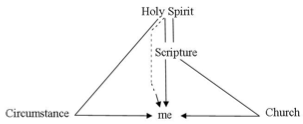
a. Dangers in the model
We can push concepts to extremes, to “absolutize” them. In the case of divine guidance, the extremes are (a) no direct involvement in history and our lives (deism) and (b) direct involvement in every act and choice we make. As there are dangers in overdoing God’s prescriptive will for us, so also there are dangers in “under-doing” it.
(1) The supposition that God is not involved at all and that Christians are on their own and alone in the world. It could create a sense of abandonment.
(2) Not properly crediting God with the accomplishments of ministry and personal growth could create pride. We could misconstrue success.
(3) Not properly crediting him could create an illegitimate sense of guilt, because we see the result as too dependent on our own actions. We could misconstrue failure.
b. Ways to guard against the dangers of the model
(1) In attitude we are willing to let God have prescriptive control down to the smallest detail of life, while in responsibility we are willing to make the choices on our own all the way up to the largest ones. That is what has happened in our choosing salvation.
(2) To be invisible does not mean non-existent.
(3) Not to know God is specifically leading does not mean he is not specifically leading.
(4) Again, God can be the more glorified the less he does for us in
guidance and otherwise.
c. Implications of the model
(1) What is capable of an alternate explanation is not capable of certainty. We cannot be sure about something if it has an alternate explanation. If we cannot distinguish the idea from our own idea, we should not claim the Spirit told us.
(2) God holds us responsible only for what we can know.
(3) To the extent that God’s will is specific his guidance is explicit.
(4) God lets us do as much as we can without doing it for us.
(5) We can go ahead with our own judgment if there is no special
indication of his will.
(6) Let the simpler explanation explain as much as possible: the law of parsimony means that the simpler explanation is more likely correct; at least it is safer. Do not appeal to supernatural explanation if “natural” explanation suffices.
d. Effects of the model
(1) Glorification of God (doing as much as we can without direction or help); a sense of responsibility
(2) Assurance; a sense of being pleasing to God
(3) Freedom; a sense of self-determination that fits with the fact that we have a will, a sense of security, and his word. We do not need to read into events the feeling that God is specially trying to tell us something—if only we could figure it out.
5. Summary: two models for guidance
a. God has a specific will for each person at each point in life. He wants to direct all our choices directly and exactly. We need to search for what that will is. The inferences are:
(1) If I am not getting that kind of direction, there is something wrong with my faith. GUILT
(2) If I am not seeking that kind of guidance, I am not being sensitive to God’s direction. GUILT
(3) The things that are happening to me are signs I should follow rather than data I should evaluate. FORCED INTERPRETATION OF EXPERIENCE
b. God may or may not have a specific will for each of us at each point in life. God does not necessarily want to direct everything we do—any more than a parent wants to program everything the children do. We are to be willing to let him make all our choices, but are willing to make the choices ourselves.
GOD IS THE MORE GREATLY GLORIFIED BY THE LESS HE DOES FOR US (as long as we are willing to let him do with us according to his will).
The Spirit is always guiding his people, but that does not mean that he is always guiding them directly, miraculously, or perceivably. His guidance may involve supernatural intervention in varying amounts, but he has not promised miraculous, direct guidance to each of us. So, we do not require that kind of guidance as an indication that we or others are genuine Christians. Furthermore, guiding people miraculously and directly is not always, or perhaps often, necessary. We live by faith more than by sight (2 Corinthians 5:7); likewise, Jesus told Thomas in the resurrection scene that those are blessed who have not seen—directly experienced—and yet believe. God wants people to trust him farther than see him. He wants them to trust his promises, more than see his signs.
christir.org