
Indwelling of Hs as Non-Locational
THE “INDWELLING OF THE HOLY SPIRIT”:
A NON-LOCATIONAL UNDERSTANDING
Virgil Warren, PhD
Introduction
1. The Father is said to be “in” us: 1 John 4:12, 15 (John 14:23).
2. Christ is said to be “in” us: Romans 8:10; Galatians 2:20; 4:19; Ephesians 3:17; Colossians 1:27.
3. The Holy Spirit is said to be “in” us: John 14:17 (“with you” and “in you”), 23; Romans 8:9, 11; 1 Corinthians 3:16; 6:19; 2 Corinthians 6:16; 2 Timothy 1:14; compare 2 Peter 1:10-11; Ezekiel 36:26-27 (Psalm 51:11); compare also the “filling” passages: Luke 1:15 (44) 41; Acts 2:4; 4:18, 31; 9:17; 13:9, 52.
4. The word is said to be “in” us: John 15:7; Romans 10:8 (Deuteronomy 30:14); Colossians 3:16.
5. Truth is “in” us: Psalm 15:2; 2 Corinthians 11:10; 1 John 1:8; (2 John 2).
6. Love is said to be “in” us: John 5:42; Romans 5:5; 1 John 3:17.
7. The Holy Spirit is said to be “in” the church: 1 Corinthians 3:16-17; 2 Corinthians 6:16; Ephesians 2:21-22.
8. Satan is said to be “in” a person: Luke 22:3; John 13:27; cp. Acts 5:2.
9. Demons are said to be “in” a person: Luke 4:33; 8:30; and so on.
10. A person’s body is said to be the temple of God: 1 Corinthians 6:19.
11. God is said to be “in” Christ: 2 Corinthians 5:19 (?).
12. People are said to be “in” Christ or baptized “into” Christ: Romans 6:3; Galatians 3:27; and so on; Romans 16:7; 1 Corinthians 3:1; 15:18, 22; 2 Corinthians 3:14; 5:17; 12:2; Colossians 1:2; 2 Thessalonians 4:16; 1 Peter 5:14 (note other “in Christ” expressions: Romans 3:24; 9:1; 12:5; 16:3, 9, 10; 1 Corinthians 4:10, 15, 17; 15:19; 2 Corinthians 2:14, 17; 11:3; 12:19; Ephesians 1:3; 2:6; 1:10; Philippians 1:13; 1 Timothy 2:7; 2 Timothy 3:12; Philemon 8; note also “in the Lord” passages).
13. Churches are said to be “in” Christ: Galatians 1:22; 1 Thessalonians 2:4.
I. Observations Tending Away from Locational Indwelling
A. The lack of positive evidence for locational indwelling
1. “In” statements not meaning “in” locationally
a. “The Father in me does the works” (John 14:10b).
+
“I am going to my Father” (John 14:12).
b. Christ is said to be in us. (See Introduction 2 above.)
+
Christ is a priest in heaven rather than on earth: John 6:17; 2 Corinthians
5:6, 8; Hebrews 8:4.
c. The Father is said to be in us: 1 John 4:12, 15.
+
The Father is in heaven: Matthew 6:9 and so on.
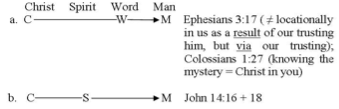
2. The “in” via concept (“in” by way of)
3. The interchanging of “Spirit” and “spirit” as if they are correlative
a. Romans 8:1-30
b. 2 Corinthians 3:3 + 6
c. Galatians 5:16-6:10
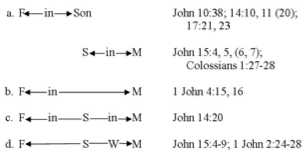
4. The a-in-b-in-a phenomenon in Johannine literature: a formula for unity
(John 17:20-22)
5. Compare “members of one another”: Ephesians 4:25
6. “In” terminology used also of Satan
B. Difficulty of the concept
1. How can one personal spirit continuously indwell many Christians?
2. Combined with the notion of locational omnipresence, locational indwelling
would suggest that “holes” in the Spirit occur wherever there is a sinner.
C. Consequences to which locational indwelling can lead
1. Depersonalizing the Spirit into a power or sheer being
2. Reading ideas and feelings as implanted by the Holy Spirit
Conclusion: There are sufficient examples of “in” passages that do not mean locational “in-ness” to raise the question whether those speaking of deity being “in” us mean something besides location.
II. Positive Construction
A. Three possibilities
1. “In” of location: “in” means the Spirit is located inside the person
2. “In” of unity: “in” (a-in-b-in-a) mean close association (compenetration)
3. “In” via: “in” means the Spirit’s effects/characteristics are internalized by believing
B. Choices among options
1. A-in-b-in-a is a productive unity based on love, common purpose, intimacy, interdependence: John 15:4-11; 17:21; 1 John 4:16 + 20 (compenetration). It is a tangible picture of an intangible truth.
2. “In via” means that the effects of the Spirit are put for the Spirit. The characteristics of the Spirit shared by Christians are credited to their source. The characteristics, values, and truths he teaches are never to be abstracted from him. “With you and in you” (John 14:17) has been taken to imply that “in you” means more than “with you” and therefore more than personal relationship. That can be true, however, without showing that “in you” means “locationally inside you.” It may be one of the several possibilities under “in by way of” or may be two spatial word pictures for the same thing.
C. Reasons for the terminology
1. The “in” terminology originates from the viewpoint of an observer who can see the effects of the Spirit’s invisible influence. By appearance, it looks like the cause is inside rather than invisible. “What’s gotten into him?” or “You can just see his daddy in him.” These are cases of phenomenological language.
2. The “in” terminology suggests that a person is not self-centered. A new center has replaced “I”; so the primary sin, self-centeredness, is overcome by other-centeredness. “In” represents phenomenological language again.
3. The “in” terminology is prompted by contrast to demon possession. So to speak, the Spirit is in us rather than demons being in us. God’s Spirit with us replaces demonic possession.
Concluding comment: The gift of the Spirit provides a personal, omniscient presence. That fact identifies where to begin our understanding of the reality as well as the meaning of terminology that describes it. We let that reality explain as much as it can about the Spirit and his work—without denying more or claiming more.
christir.org