
Nature of the Spirit (Book) Pt 1
PART I: THE NATURE OF THE HOLY SPIRIT
Virgil Warren, PhD
Introduction
Holy Spirit studies pick up where Christ’s work ended: preparing the individual for conversion in response to the message about Christ, the sanctification process for the individual in Christ (growth), and evangelism of other people to bring them to Christ (outreach).
Viewing the Spirit as impersonal is a problem created by the following:
1. “It” statements in some passages of English translations: Acts 8:16 (ASV),
Romans 5:5 (ASV); 8:26 (KJV).
2. The Holy Spirit does not have a personal name.
3. The Greek word is grammatically neuter (πνεῦμα, pneuma).
4. The Holy Spirit is rarely, if ever, addressed in the second person.
Scripture uses Spirit (πνεῦμα; רוּחַ) several ways. In general, the term refers to an invisible reality. More specifically it has these values:
1. Wind: John 3:8*
2. Angels: Hebrews 1:14, including
3. Demons, or fallen angels: Matthew 10:1, and so on
4. The spirit as a component of the human person, in contrast to the body: 1 Peter
8:19
5. The Holy Spirit in parallel to Father and Son.
6. Mentality, or attitude: Luke 9:55 margin (“You do not know what spirit you are
of.” Note manuscript variance.)
7. Mental presence vs. physical location, as when we say that we are with someone
“in spirit”: 1 Corinthians 5:3 (Paul was in Ephesus at the time.); Colossians 2:5
8. Agreement in thought or purpose: 1 Corinthians 5:4?
9. In contrast to “letter,” hence, intent or purpose of something: Romans 2:27-29;
7:6; 2 Corinthians 3:6*.
10. In contrast to “flesh,” hence, transcendent, psychological interpersonal, intangible: John 3:5-6; 6:63-64; Romans 8:1-30; 9:8; Galatians 4:21-31; 5:16-6:10; Colossians 2:5; 1 Peter 3:18-19 (cp. 1 Corinthians 5:5); Ephesians 6:12 (“spiritual”). There is a “mind-flesh” contrast in Romans 7:25. In most cases where spirit contrasts with flesh, it should not be capitalized. Philippians 3:3 may be an exception since the terminology is expanded to “worship by the S/spirit of God (and have no confidence in the flesh).” Flesh and spirit occur together also in 1 Corinthians 7:1 in a way that suggests the human spirit in distinction from the material part of us. There is a spirit-flesh/spirit-letter crossover in Romans 2:28-29 and 7:7-8*.
11. A surge of concern, boldness, and the like, especially in the expression “he was
filled with the S/spirit and said” (Acts 4:8; 13:9; 2:4?; Luke 4:16?).
I. Personal
A. He does things persons do (one side of the interpersonal relationship).
1. He loves (?): Romans 15:30; note Galatians 5:22; Colossians 1:8. (affective)
2. He decides: Acts 15:28. (cognitive)
3. He knows: 1 Corinthians 2:10, 11.
4. He thinks: Romans 8:27.
5. He speaks: 1 Timothy 4:1. (communicative)
6. He intercedes: Romans 8:26.
7. He testifies: John 15:26.
8. He teaches: John 14:26.
B. He is treated like a person (the other side of the interpersonal relationship). He
can be
1. Lied to: Acts 5:3.
2. Tempted: Acts 5:9.
3. Resisted: Acts 7:51.
4. Grieved: Ephesians 4:30.
5. Blasphemed: Matthew 12:31.
6. Insulted: Hebrews 10:29.
C. The personal verbal παράκλητος (paraklētos) is used of him: John 14:16, 26; 16:7. These are not cases that involve a masculine pronoun for a neuter antecedent—pneuma. The antecedent in these cases is always paraklētos (comforter, advocate) rather than pneuma; note John 14:26, 15:26; 16:(7, 8,) 13.
The real point about παράκλητος is that the activity of a paraclete is personal. John uses the word both for the Spirit and for Christ (1 John 2:1). The word already existed in connection with a lawyer who presented someone’s case in court.
D. Alternatives denied
1. The Spirit is not a power, but a person who has power.
Some consider the Holy Spirit as God’s energy, something like a force or a
force field.
2. The Spirit is not a feeling, but a person we feel close to.
3. The Spirit is not an attitude, but a person who influences our attitudes.
Compare “He has a good ‘spirit’ about him.”
4. The Spirit is not a principle, but a person who communicates principles.
5. The Spirit is not an atmosphere.
Compare “There’s a sweet, sweet Spirit in this place and I know that it’s
the Spirit of the Lord”; “There is a good ‘spirit’ among the workers.”
We must distinguish he effects of the Spirit from the Spirit himself: feelings that come over people, the irrational/non-rational/affective, spontaneity and uninhibitedness, the creativity (the origin of ideas that come unexplainably to mind, the “tacit dimension”), insanity, enthusiasm and boldness, altered states of consciousness, the subjective dimension, apparently miraculous occurrences—in short, anything unusual or unexplained.
The five alternatives denied above are no more to be associated with the Spirit than with the Son.
Christians tend to supernaturalize their experiences when they do not know the cause of them. They do so to glorify God, to be sure; but the implications can be misleading and unhealthy when natural explanations come clear later.
E. Effects of the personal emphasis
1. Qualifies the idea of “getting the Spirit”
Getting the Spirit is conceived of as getting enthused. Enthusiasm is one of the usages of the English word “spirit” (“school spirit”). Enthusiasm may result from the person-Spirit relationship; but since it may come from elsewhere, enthusiasm and the Holy Spirit do not correlate one-to-one.
2. Reduces the tendency to suppose that one can “perceive,” or “feel,” the Spirit: Samson did not know the Spirit had left him (note Judges 16:20). Experiencing the Holy Spirit is not like having an electric “thrill.”
3. Looks away from the necessity of supernatural manifestation of the Spirit’s presence. Having the Spirit is first an interpersonal presence rather than a supernatural empowerment.
Natural vs. supernatural is thought of in connection with natural laws inside creation. What God and we have in common is not supernatural. We are created in the image of God. That wherein we are like God is natural, and what transpires between us within that area is natural process. We are related to a supernatural person, but the relationship itself is not supernatural.
So, relationship to God does not require miracle as part of the experience. Miracle is not interpersonal process, because in miracle God is the only one acting to produce the result directly. Interpersonal process is often indirect operation, and there is response by the other that combines with God’s act to produce the result.
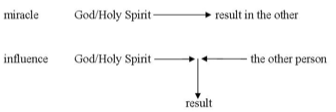
In miracle, conditionality is the only role that we have. We may ask for the effect, but the effect itself comes from God alone. In influence there is more than request, because the person’s response joins with influence to produce the result.
4. Avoids mechanical conceptualizations like the idea that the Spirit is “transmitted” in succession or healing by the imposition of hands or insufflation (John 20:22). These are symbolic acts not real causes.
5. Avoids the tendency to think that having the Spirit is like having an idea.
F. “Problem” text: In Ephesians 6:17, does “sword of the spirit which is the word of God” mean the spirit is the word or the sword is the word? It is probably best to take which as a reference to sword:
1. Modifiers often refer to the phrase head rather than to the nearest preceding
term: Ephesians 3:2, 7; 6:16.
2. This is probably a case of gender attraction in the Greek. (See notes in “Greek
Helps”: Ephesians 6:17.)
II. Divine
A. He appears in expressions parallel with the Father and the Son: Matthew 28:19; 1 Corinthians 12:4-6; 2 Corinthians 1:21-22; 13:14; Ephesians 4:4-6; 1 Peter 1:2; Romans 15:30 (?); Hebrews 9:14 (?)
B. Scripture describes him as having distinctively divine characteristics.
1. Omniscience: 1 Corinthians 2:10-11
2. Omnipresence: Psalm 139:7-10
3. Omnipotence: Psalm 104:30 (?) creating; Zechariah 4:6 (?)
4. Eternality: Hebrews 9:14 (?)
C. He is possibly called God.
1. Acts 5:1-9 (3 +4/9)
2. Acts 11:17 (“If God gave them the Holy Spirit, I would be withstanding
God.”)
(a) That is, God who gave them the distinguishing gift (?)
(b) That is, the Holy Spirit who was given (?)
christir.org