
Nature of the Spirit (Book) Pt 2 Trinity #1
III. A Person in the Divine Trinity
For the most part, the trinity is a New Testament issue. The nature and relationship of the Spirit to the Father and the Son we must learn from these texts.
A. Methodology
1. Investigate the activities of the Father, Son, and Holy Spirit (as well as statements about them) in passages where they are mentioned together, thus observing interaction in real circumstances.
2. Examples of relational activities are often clearer than abstract statements of relationship. That procedure minimizes problems created by figurative language, the various meanings that can be attached to words like “one,” and the possibility of accommodation to our mode of thinking and being.
B. Clusters of New Testament passages
1. Father, Son, and Holy Spirit: Matthew 3:16-17 (= Mark 1:10-11; Luke 3:21-22); John 14:16-17, 25-26; 15:26-27; 16:7-15; Matthew 28:19; Acts 2:29-36; 7:55; 20:28?
(“. . . the flock in which the Holy Spirit has made you overseers to feed the church of God/Lord [manuscript variation] that he purchased with his own blood.”); Romans 15:30?; 1 Corinthians 12:4-6; 2 Corinthians 1:21-22; 13:14; Ephesians 4:4-6; 1 Peter 1:2; 1 John 5:4-8. Note also Revelation 1:4-5: “Grace . . . from [a] the one who is and was and is to come, from [b] the seven spirits that are before his throne, and from [c] Jesus Christ . . .”; perhaps the “seven spirits” means the Holy Spirit, who is called “seven spirits” to stress completeness (i.e., the full presence of the Spirit).
Plural pronouns are sometimes used for deity in the Old Testament: Genesis 1:26; 3:22*; 11:7; Isaiah 6:8. In Genesis 18:1 “the Lord” appeared to Abraham at Mamre. When the patriarch looked up from the door of his tent, he saw “three men” (18:2). In 18:9 they say to him while in 18:10 the narrative continues with “I will surely return to you.” Could this be a manifestation of the trinity?
2. Father and Son: Matthew 10:40; Luke 23:46; John 3:16, 35; 8:17-18; 14:6, 28;
16:28; 17:1, 3, 5, 18; (2 Thessalonians 3:5); 1 Timothy 2:5
3. Son and Holy Spirit: Luke 1:35; John 1:33-34; 16:7, 13-14
C. Passages emphasizing distinction within the trinity
1. Concepts of Son and Holy Spirit
a. The Holy Spirit conceived the Son (?): Luke 1:35.
b. The Holy Spirit descended on the Son: John 1:33-34.
c. The Son will send the Holy Spirit: John 16:7.
d. The Holy Spirit will not speak of himself, but of the Son: John 16:13-
14.
e. The Holy Spirit will glorify the Son: John 16:15.
2. Father and Holy Spirit
a. The Father sends the Spirit: John 14:26.
b. The Spirit proceeds from the Father: John 15:26.
c. The Holy Spirit intercedes for people to God: Romans 8:26.
3. Father and Son
a. Father loves the Son and gives everything into his hand: John 3:35.
b. The Son does the Father’s will: Luke 22:42 (= Matthew 26:39; Mark
14:36); John 6:38.
c. The Son knows the Father and vice versa: Matthew 11:27-30.
d. The Father glorifies the Son: John 12:28; 17:1.
e. The Son prays to the Father (John 12:28) and is answered (Matthew
17:5).
f. The Son is with the Father: John 1:2; 17:5.
g. The Son goes to the Father: John 14:28.
h. The Son intercedes between people and God: John 14:6; 1 Timothy 2:5. The ministry of intercession here is in the post-incarnate state.
i. The Father bears witness of the Son: John 8:16-18. The Father and the Son
make two witnesses.
j. The Father sent/gave the Son: Matthew 10:40 (cp. John 20:21); 3:16; 8:16-
18; 17:3, 18.
k. The Father said, “Hear him”: Matthew 17:5.
l. 2 Peter 1:2 suggests that when not otherwise qualified, “God” means the Father or the godhead undistinguished: “Grace to you and manifold peace in the knowledge of God and of Jesus our Lord.”
D. Passages and concepts emphasizing identity within the trinity
1. The Great Commission: Matthew 28:18-20
2. Father-in-Son and vice versa: John 10:38; 14:10, 11, 20; 17:21, 23
3. Seeing the Son is seeing the Father: John 14:7-10; 15:(23-)24.
4. The oneness of the Father and the Son: John 10:30, (33).
5. 1 John 5:4-8
E. Key contexts
1. The baptismal account: Matthew 3:16; Mark 1:9-11; Luke 3:21-22; John
1:33-34
2. The procession of the Spirit: John 14:16, 26
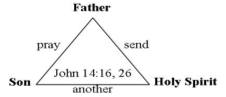
3. Intercession (Galatians 3:20)
F. Suggested models (objective trinity)
*1. Ideal marriage: Genesis 1:26-27 + 2:24
a. Proposal: the twoness-in-oneness of marriage in mankind reflects the threeness-in-oneness of the trinity in deity—the image of God in its broad sense.
b. Observations on parallelism in Genesis 1:26-27
c. Effects of the proposal
(1) Captures both the distinctness and the oneness within the Godhead
(2) Maintains the personal element in deity
(3) Maintains the same nature
(4) Complementary roles
(5) Different order/rank/levels of “hierarchy”
(6) Compenetration
(7) Full range of life
(8) Common values and purposes
d. Caution: the parallel between God as spirit and the physical nature of humankind because God as spirit has no consort as in pagan religions.
2. Ideal church: John 17:11, 20-23 (note 15:10; Ephesians 5:22-33) and the body imagery for the church (Romans 12:4-5; 1 Corinthians 10:16-17; 12:12-30; Ephesians 3:6; 4:4, 16-17)
3. Compare 1 John 5:8
4. The trinity should be understood in terms of interpersonalism.
a. Interpersonalism captures both distinctness and oneness in one picture.
b. Interpersonal trinity shows how both difference and oneness relate to each; it shows the sense in which they are three and one. The distinctness and relationship between the Father, Son, and Spirit is an interpersonal one: the Son prays to the Father and the Spirit is another comforter.
The trinity is not just any kind of threeness-in-oneness; it is interpersonal threeness-in-oneness and contemporary threeness-in-oneness. The point is important because it can take into account the somewhat overlapping character of even personal identity. Who we “are”—in a psychological sense at least—is the sum total of all our aspects of being, action, and relationship. Interpersonal threeness-in-oneness can also take into account the plural, reciprocal, transactional, complementary, and compenetrating features of personal relationship.
Other three-in-one situations are significantly inadequate, because they lack this interpersonal element even though they do have contemporary threeness-in-oneness. That is the problem with emanationism, tritheism, manifestative/economic trinity. They do not involve the kind or degree of distinction, on the one hand, or oneness, on the other, that characterizes interpersonal oneness.
Speaking of interpersonal threeness-in-oneness avoids the verbal entanglements with saying “the Father, Son, and Spirit are separate,” “they are together,” “they are one,” and so on. Such statements have at least one term that can carry more than one meaning; so we can spend a lot of time sorting through those options to clarify which they mean. The result is a cacophony of confusion filled with subtle distinctions that leave us cold. “Trinity” ends up dying a death of a thousand qualifications. Non-interpersonal models do not get at interpersonal gestalt, and they do not naturally incorporate complementariness.
Texts like those above in B and C show that during history Father, Son, and Spirit have interpersonal threeness-in-oneness. Before and after history they have interpersonal threeness-in-oneness. Strictly speaking, we cannot show that they have eternal threeness-in-oneness even though that makes the best sense given what we know about personal and interpersonal identity. Of course, it cannot be shown either that somehow they become one person at some time in the future or were one at some time in the infinite past.
G. General approaches
1. Three permanently distinct beings (trinity and tritheism)
2. Three temporarily distinct beings. The idea that part of God was drawn aside and incarnated and will ultimately return to the one: 1 Corinthians 15:28 is sometimes appealed to (note the all-in-all expression and the a-in-b-in-a idea).
3. Three emanations
4. Three beings with first creating the second as functional deity and creating the third as divine energy
5. Three manifestations of the same individual
H. Alternatives set aside
1. Monarchianism (God as a single individual): Isaiah 43:11; Deuteronomy 6:4
a. Modalistic (dynamic; economic trinity)
b. Adoptionistic: Jesus is God’s adopted son.
2. Emanationism: Origen’s doctrine of the eternal generation of the Son (like a
ray of light continuously shining forth from the sun)
3. Tritheism (polytheism) vs. trinity contrasts in the way a man and a woman
contrasts with a husband-and-wife relationship and operation.
4. Manifestative trinity: but see John 1:2; 17:5
The idea that part of God drew aside and incarnated and will ultimately return to the one: 1 Corinthians 15:28 (Note again the “all-in-all” expression and the a-in-b-in-a formula.)
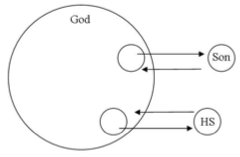
5. Other models
a. Three cookies from the same dough
b. Three points of one iceberg
c. Three corners of one triangle
d. Three states of one chemical: gas, solid, liquid
e. Three members of one committee
f. Three functions of one mind: memory, reason, will
g. Three relationships by one person: one person who is a son, a father, and a
brother
h. The white, yolk, and shell of one egg (cp. cherry pie: crust, cherries, and
thickening)
6. The supposition that deity does not conform to the categories of finite intelligence (e.g., the idea that deity is such that “opposites” may both be true)
The trinity is not just any kind of threeness-in-oneness; it is contemporary, interpersonal threeness-in-oneness. The point is important because it accounts for the somewhat overlapping character of even personal identity. Who we “are”—in a psychological sense at least—is the sum total of all our aspects of being, action, and relationship. Interpersonal threeness-in-oneness also accounts for the plural, reciprocal, transactional, complementary, and compenetrating features of personal relationships.
Other three-in-one situations are significantly inadequate because they lack this interpersonal element even though they have contemporary threeness-in-oneness. That is the fundamental problem with emanationism, tritheism, and manifestative/economic trinity. They do not involve the kind or degree of distinction, on the one hand, or oneness, on the other, that characterizes interpersonal oneness.
Speaking of interpersonal threeness-in-oneness avoids the verbal entanglements associated with saying things like “the Father, Son, and Spirit are separate,” “they are together,” “they are one.” Such statements have at least one term that can carry more than one meaning; so people spend a lot of time sorting through those options to clarify which they mean. The result is a cacophony of confusion filled with subtle distinctions that leave the hearer cold. “Trinity” ends up dying a death of a thousand qualifications. Non-interpersonal models do not get at interpersonal gestalt, and they do not naturally incorporate complementariness.
Texts like those above in II and III show that during history Father, Son, and Spirit have interpersonal threeness-in-oneness. Before and after history they also have interpersonal threeness-in-oneness. Strictly speaking, we cannot show that they have eternal threeness-in-oneness even though that makes the best sense given what we know about personal and interpersonal identity. On the other hand, it cannot be shown either that somehow they become one person sometime in the future.
I. Passages raised as difficulties for the above view
The Gospel of John has the most Christological material of any gospel. Revelation, Hebrews, and Philippians also have “high Christology.”
The texts in John are often taken as disallowing distinctness between Father and Son; yet 14:16 is perhaps the clearest text in the whole Bible on the distinctness between Father, Son, and Spirit.
1. John 10:30: “The Father and I are one”
The statement means “same” in kind and purpose; we are “at one” (note: 10:31-39). The Son equals the Father in that he does the Father’s works, is in the Father and vice versa, and the Father sanctified and sent him (cp. 1 John 5:8). The following verse brings up the Son of God, which involves distinction from the Father.
2. John 14:7-10; 15:24: “Seeing me is seeing the father.”
The preceding and succeeding contexts mention all three (14:7, 9). “The one that has seen me has seen the One who sent me.” There must be distinction between sender and sent, yet he says seeing the sent is seeing the sender. So, that expression is a way of saying, “. . . is as good as.” Sending the Son was for revealing the Father (cp. John 1:18). In seeing what the Son is like, we can see what the Father is like—insofar as deity can be demonstrated in the material realm. We best read the passage with an emphasis on me rather than on seen: “Have I been so long time with you, and you have not seen me? If you have seen me you have seen [what the Father is like].” In 15:23 Jesus says, “Hating me is hating the Father also,” implying distinction between them. (Is there any connection between “seeing God” in this context and Jesus’ comment in Matthew 5:8 that the pure in heart will see God?)
3. John 14:12 + 18; 14:28; “I go away . . . and I come to you,” taken to mean the
coming of the Spirit is the next form (spiritual) of the Son (physical)
Compare 14:3 with 14:18:
a. = the Son’s second coming, not the Spirit’s coming.
or
b. = the Spirit’s representative coming for the Son
or
*c. = the Spirit’s representative coming is the proleptic presence (earnest) till the Son’s second coming. He comes representatively through the Spirit (on the day of Pentecost) until he comes personally in the end (parousia).
The Father will send the Spirit in Christ’s name (14:26).
4. John 14:10, 11, 20: “The Father is in the Son, and the Son is in the Father.”
Note 10:28; 14:20; 17:21-24.
A-in-b-in-a means close identification (via love?), not “identicalness.” There is mutuality and reciprocity. In a rougher analogy, interpersonal influence and love are like interpenetrating gases blown into the same container.
These texts in John are often taken as disallowing distinctness between Father and Son; yet 14:126 is probably the clearest text in the Bible of the distinctness between Father, Son, and Spirit.
5. Deuteronomy 6:4: “The Lord our God is one Lord.”
a. It must mean “solicity” (uniqueness), not singleness. Singleness does not afford a reason to love him; a person may love God whether God is single or triune. “God is not a unit but a union.”
b. “One”: see Ezekiel 7:5; Job 23:13; compare יָחִיד בֶּן (“only son”; Genesis
22:16)
6. Isaiah 43:11: “I, even I, am Yahveh; and there is no savior besides me.”
It is easier to understand passages about oneness in light of passages about prayer, sending, intercession, and so on, than it is to understand these activities really as instances of singularity.
J. General Observations
1. The trinity is not a mathematical absurdity; they is not three in the same sense
as they are one. The threeness and the oneness are not at the same level; the threeness is within the oneness.
a. Three as to individual personalities
b. One
(1) Uniqueness: from all others proposed as gods (kind in contrast
within a category)
(2) Commonality: of the same nature and purpose (kind in comparison within a category). In Galatians 3:28 Paul says there is no male or female, bond or free; but all are one in Christ. One here does not mean “united” or “the same one,” but everyone is viewed as the same (kind) in Christ.
(3) “Loneness”: only Yahveh is in the category of deity: he is the “only
One”
(4) “Corporateness”: a whole is bigger than the sum of its parts (unity within the category). John 17 records Jesus’ prayer that his disciples would be one as he and the Father are one. In such a context “one” means “united.” They are “at one.”
(5) Unicity: complementariness; John 17 records Jesus’ prayer that his disciples be one as he and the Father were one.
2. Most models neglect the unity at the expense of the distinctness or vice versa.
3. Understanding of the trinity is through divinely chosen models.
The reason for sticking with divinely chosen models is that to do otherwise might construct something that does not match the reality at crucial points. The idea of a son who is later a father who is later a grandfather is a model that gets three and one, but it fails to have them at the same time. That is the mark of Father-Son-Spirit in John 14:16 and other places.
4. Knowledge of the trinity is partial.
With the trinity there is distinction during time, before time, and after time. The oneness of a bucket of water (before time) from which a cup of water is later taken (during time) does not explain John 10:30, where Jesus says that he and the Father are one and says it during the incarnation, when supposedly a monarchianist must admit there was separateness. That same thing describes their relationship before time. So, the question becomes one of where we get the idea that their relationship was different before time from what it was in time. We also have to ask why there is some problem with their being distinct before as they were in time.
K. Reasons for interest in the trinity discussion
1. Desire to understand what God has actually revealed about himself
2. Missions to pagans, Jews, Muslims, and unitarians: We must understand the issue sufficiently to articulate it to non-Christians and remove unnecessary stumbling blocks to their accepting the Christian message.
3. Christian unity: some groups within Christendom as well as individuals in more “mainline” movements object to the traditional formulation of trinitarianism. We have to decide whether the alternatives they adopt are sufficiently objectionable to warrant separation, division, and withdrawal of fellowship.
Concluding Summaries
The trinity involves an interpersonal threeness-in-oneness. The distinctness between the Father, Son, and Holy Spirit takes place within that larger oneness. That threeness-in-oneness is simultaneous.
1. They have the same nature: deity; that is, they are not of different kinds or different degrees of a kind—homoousia (of the same kind, ὁμοούσια) rather than homoiousia (of a similar kind, ὁμοιούσια).
2. They serve complementary roles: they are not three clones, doing the same thing,
working in parallel, or working against one another.
3. They have different rank: they have order within the whole rather than being of
equal authority.
4. They are objectively distinguishable.
There is (1) plurality, (2) contemporaneousness, (3) complementariness, and (4) compenetration.
a. John 14:16 shows the distinction between Father, Son, and Spirit at least
during time.
b. John 1:1-2 and other passages show the distinction between Father and Son
before the incarnation.
c. Revelation shows the distinction between Father and Son after the ascension.
It is difficult to prove the eternal pre-existent and eschatological distinction between them. It is also difficult to disprove the createdness of the Son, but createdness is not positively said about him.
christir.org