
Power From the Spirit (Book Pt 6)
C. Power: means of doing it
The work of Christ (theory) provides the basis for salvation. The work of the Spirit picks up the process at that point and contributes to the functional aspects: conversion, guidance, and Christian growth (sanctification).
Propositions about the operation of the Holy Spirit in the interpersonal model
a. Faith and fruit are natural responses to the Spirit, not supernatural deposits by him. We are speaking here of the “ordinary” operation of the Spirit. The miraculous is always “potential” because he is a supernatural person we \relate to. Supernatural—vs. miraculous—occurs in providence/guidance/answered prayer, but that work is not directly on our being—as when interpreters assume natural depravity. (Miraculous is visible supernatural.)
b. A sense of assistance plus a sense of responsibility
c. No credit for succeeding plus no blaming the Spirit for failure
1. Passages applicable to empowerment
a. Fellowships with us
(1) Advocate: John 14:18 (not “orphans”); 14:16; 16:7
(2) Gift: Acts 2:38 (the “indwelling” presence)
(3) Earnest: 2 Corinthians 5:5; Ephesians 1:13-14; 4:30
(4) Note presence in Psalm 51:1
b. Sanctifies: 1 Corinthians 6:11; 1 Thessalonians 4:7-8; 2 Thessalonians 2:13; 1 Peter 1:2
c. Frees: 2 Corinthians 3:17
d. Supplies: Philippians 1:19
e. Strengthens: Ephesians 3:16 (cp. Philippians 4:11, 16?)
f. Fructifies: Galatians 5:22, 25 (?)
g. Comforts: Acts 9:31
2. Areas of application
a. As regards us
(1) Strength to endure conflict
(2) Strength to overcome temptation (The second verse of “I Need Thee
Every Hour” says, “temptations lose their power when thou art nigh.”)
(3) Boldness to evangelize others
(4) Power to improve self
b. As regards the Spirit: glorification
3. Primary components of the model for empowerment
a. Temptation appeals to our viewpoint of consciousness (self-centeredness), operates through social influence, and draws on bodily desires.
b. The pull of sin has the nature of habit (vs. disordered being)
c. Overcoming sin is like breaking habit (vs. a miracle from outside), that is,
through heightened motivation and substituted behavior.
d. Heightened motivation comes through the influence of love (together with making it more real through the body of Christ): interpersonal activity of service, learning, fellowship, and witnessing.
4. Further notations on the model for empowerment
a. How this model works among people
(1) Results that would not have come without the influence
(2) Results that we would not have been concerned to produce without it
(3) Examples
b. How we know his presence: by promise rather than by perception or product
The effect is just as strong whether we know his presence by perception or
promise if we believe the promise.
c. What this model stands as over against
(1) Make believe
(2) Mere presence (communion)
(3) Mere relationship (as with a relative)
(4) An energy poured into us
(5) A capacity added to us
(6) Power of positive thinking
(7) Mind over matter
d. How he causes the empowerment
(1) Not by direct operation or deposit
(2) Not by indirect operation (We know about it indirectly.)
(3) By motivational appeal. It occurs, not aside from will or contrary to will, but the will is moved by personal love. It contrasts with possession, where the spirit controls irresistibly.
5. The behavioral and practical importance of the motivational, interpersonal response model (i.e., the importance of seeing fruits as a natural response rather than as a miraculous empowerment deposited in a person)
a. Human responsibility plus humility
The behavior of deposit is waiting, which leads to not doing until or
unless.
The Holy Spirit is the “occasional cause” of his products.
We say both that fruit is our responsibility and his work but in different
senses
b. Non-essentialness of miracle
The behavior of miracle expectancy in non-communicative “gifts” is experience/orientation, leading either to despondency (for lack of the experiences) or to forced misidentification of self-exhilaration (from autosuggestion, etc.) with the “gift” desired.
That failure draws attention away from the purpose of miracles to self-satisfaction by miracles, a formula Jesus repudiated in the stones-to-bread temptation.
Holy Spirit Me vs. Holy Spirit Others
c. Means of availing
The behavior of deposit is asking only, instead of asking while doing/trying (note Luke 17:5).
The result [empowerment] really does not come from a deposit by one person in another; it arises out of the two functioning conjointly in a way that one gets the credit and the other does the succeeding.
The idea is not “Get out of the way and let the Spirit work” nor “Let go, and let God.” In these fruits, we do in response to his influence. We need motivational help, not substitute doing.
This process involves active harmony, not passive coexistence. To avail ourselves of the power of the Spirit, we must do all those things that bring to our conscious minds the fact that he is real, here, personal, looking, loving, concerned. Motivation comes in our doing with a loving person; that is, motivation comes in active interpersonal relationships.
To the extent of our conscious awareness of his real presence, we will have power provided directly by him through that awareness. Unleashing the power of the Spirit is by conforming through heightened awareness, not by becoming passive. The spiritual exercises have the value of making us more aware of the real presence of the invisible Spirit. These exercises include prayer, Bible reading, meditation, fellowship, communion. From greater awareness comes greater power.
6. Place and nature of feeling
a. Place: confirmatory, arising out of the relationship
b. Nature: interpersonal (as in the feeling of acceptance or rejection) rather than a feeling of exhilaration or perception (sense of feeling)
7. Pattern of receiving and having
a. Not all at once (as in a deposit) but developed by degrees as we achieve. Putting to death the members is a process rather than a point.
b. The behavior of deposit is doubt, because we are constantly aware of the fact that we have faults, weaknesses, sins, and so on.
c. Not all Christians have power to the same degree.
8. The confirmatory-apologetic place of fruit-bearing
The behavior of righteousness in non-Christians (biblically defined) does not force us to deny the goodness of their motives, or force us to affirm the salvation of people who think they have the Holy Spirit when they have no biblical reason for thinking so. It is not necessary for us to deny their having the Spirit either. Thinking they have the Spirit is as powerful an influence (effectively speaking) as if they did (cp. believing testimony that is false).
Without the Spirit actually, they may not be as consistent in fruit-bearing, but they can do the kinds of things they should. The reason that is true may lie (1) in a difference in the Spirit’s circumstantial and ecclesiastical operation and (2) in people’s going about empowerment in the wrong way.
The importance of this construct manifests itself in doctrinal considerations. For example, Mr. X has good life quality; he must have the Holy Spirit; he has not been willing to identified with Christ in Christian baptism; so baptism has nothing to do with having the Spirit or the salvation it rests on. Because he has good fruit does not mean he is in the position to teach doctrinal matters or to explain how fruits are produced.
In this thought sequence, ambiguous experience gives rise to doctrine rather than letting clear revelation do it. (We also do not have to deny Mr. X’s salvation status or his having the Spirit either; God may dispense his gifts on different conditions from those to which he has committed himself. We cannot presume on such grace, however, nor offer conditions of our own choosing.)
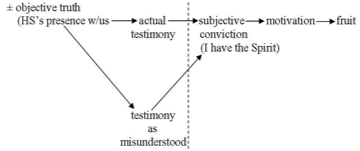
The presence of the Spirit is not necessarily different from thinking we have his imperceivable presence. It is motivational power that produces fruit. Our motivational level rises in response to the personal influence of the Spirit, whom we cannot perceive. That concept is a minimum affirmation that allows for additional, unnecessary and non-uniform benefits whether (a) supernatural on the person’s ability level itself (potential, but not essential), (b) providential operation through the environment (calamity, specially planted experiences like opportunity), (c) the Spirit’s oversight of the church’s influence in addition to (d) the written word.
Important elements
1. We know we have the Spirit by testimony, not feeling (Judges 16:20).
2. We have the ability to produce fruit (2 Peter 3:9; Ezekiel 18:23).
3. The lack is motivational.
In the above diagram, unfounded knowledge creates the same motivational power as the truth itself because it is “the truth to him.” Each person has the capacity to produce fruit, and motivation is a subjective thing.
We believe this construct also explains how saved people can end up having a lower life quality than someone that is not a Christian. Having the presence of God’s Spirit does not help unless Christians avail themselves of the empowerment that presence can bring. Not being a Christian—being a “good moral person”—but being motivated by the presumed presence of God may yield a higher life quality than some people in the church.
It does not follow, however, that the Holy Spirit is of no use, or that he does not have to exist to help me. It does not follow from the fact that the subjective conviction produces the result that the objective truth is unnecessary.
It is only because of previous true testimony properly believed that people respond the way they do in this instance. It is true that the Spirit is of the sort someone might believe him is and that he helps our weaknesses in the way we have described. The error is in thinking that the person has that promise. I may be just as happy and moved to work just as hard to fix up a piece of property I think I have bought as I would if I had signed a legitimate deed that actually made the property mine. It does not follow, however, that owning the property is unnecessary for the happiness and motivation to fix it up.
Christianity (1) motivation (2) fruit

Alternative religious
construct
In step (2) Matthew 7:15-20; 12:23 pertains to consistency between outward behavior and inward motivation. It does not speak to (1) the truthfulness of the system out of which such motivation rises.
In John 15:1-8, fruit does not prove the truth of a system, and that does not hurt anything. Fruit is a negative test—confirmatory evidence. In other words, if fruit is not occurring, the relationship does not exist. Fruit is not the most fundamental point of Christianity. Fruit is a byproduct of personal relationship with God. It is not goodness, but perfection that is necessary for that relationship. The same answer regarding good moral people (who say they are better than the people in your church, so why come?) applies to why non-Christian systems may produce fruit without proving the total systems are true.
Since fruit is confirmatory (fits with, but does not establish), we are not compelled to accept the truthfulness of quasi-Christian and non-Christian belief systems where good character may appear. Luke admitted that Sergius Paulus was a “prudent” man (Acts 13:7). Paul admitted that some noble people respond the gospel (1 Corinthians 1:26). The degree of goodness is not the essential problem Christianity addresses, but the need for perfection that only grace-faith can give because grace is something God treats us as having (trust), not something we have (works).
All things being equal, however, the Christian system should engender a better motivation for fruit because it involves the greatest love display of any religion, and love is the best “mechanism” for motivation. The capacity for motivation is hard to read because other factors enter in, factors like (1) the person’s sin level and (2) the quality of exposure to the belief system.
Before leaving the question about empowerment through the Spirit actually vs. supposed, we need to remember the Spirit’s imperceivable operation through circumstance. If we really do not have the Spirit, that aspect of his work may be missing or at least weaker.
D. Intercession
Romans 8:16, 26-27
Ephesians 2:18?
Advocate: John 14:16, 26 (cp. 1 John 2:1 re Jesus)
E. Unification
1 Corinthians 12:13
Ephesians 4:3-4
Conclusion
Empowerment through sheer personal relationship is part of how the Spirit empowers (I-You vs. I-He). We do not forget the other three avenues in the process in emphasizing this one: the Word, Other Christians, and Natural Circumstances operate alongside sheer presence. Special intervention is another, unknowable variable that God can use secretly to kick up experiences that improve those who respond to them appropriately.
Each of the four avenues of operation have different spiritual exercises that activate them. Reading/study activates “Bible.” Fellowship activates “Other Christians.” Prayer activates “Circumstance.” Meditation/contemplation/communion and the other three activate “Relationship.” Scripture provides the content; the other three make it real.
christir.org