
Supernatural Products of Hs (Book Pt 7) Tongues #1
II. Supernatural Products of the Relationship Between the Spirit and a Person
Several issues come into the discussion of supernatural products from the Spirit. That aspect of the study needs to address the following points:
1. The relationship between miraculous and non-miraculous
2. The purpose of supernatural manifestation: evidence, evangelism,
edification
3. How people receive supernatural gifts: imposition of hands, prayer, direct outpouring
4. The duration of miraculous manifestation: apostolic, permanent, at the opening of a new field, the “latter rain”
5. The nature of specific supernatural manifestations
6. The alternative explanations for the divine origin of these phenomena: demonic, misidentified natural experiences, parapsychological, psychological, deception/illusion
The General Relationship Between Non-Miraculous and Miraculous
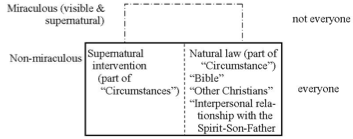
The diagram pictures miraculous built on non-miraculous. Everything that has been said about the Spirit’s non-miraculous operation in conversion, guidance, power, intercession, and unification underlies any miraculous operation. Certain implications are come from this arrangement of the Spirit’s ways of working.
(a) The non-miraculous and indirect supernatural work of the Spirit applies to everyone who is in Christ. Miraculous manifestation (as distinguished from answered prayer) does not apply to everyone.
(b) Genuine miracle presupposes that the miracle worker is in Christ. Miraculous manifestation does not occur through those who are not his, because miracles have evidential purpose; they confirm the claims of the miracle worker. That means miraculous signs are not done through an office, but through the person. God does not work through the office aside from the person in the office; the institutional church is an interpersonal system, not a legal one like priesthood or kingship. There is no such thing as having the second layer without the first to build it on. As status must correlate with walk, walk must correlate with miraculous endowment.
(c) New revelation must harmonize with previous revelation. No legitimate empowerment can do what is contradictory to or foreign to the purposes of the faith. No special revelation can deny previous revelation: reconciling people to God (salvation) and enabling them to grow in that relationship (evangelism and edification).
A. Speaking in languages in the New Testament
One question about New Testament language speaking is whether there was more than one type. Evangelicals agree that speaking in languages was a first-century phenomenon involving actual human languages. Not everyone agrees that there was a “second type.”
1. Method of research
a. Terminology
There is a lack of finality in the vocabulary approach regarding γλῶσσα (tongue, language) as well as λαλέω (speak) and διερμηνεύω (interpret, translate). What a word means in other cases does not necessarily determine its usage in a given instance. The statistically most likely meaning may be set aside by the peculiarities of a special setting. Inasmuch as the meaning of an expression is ultimately determined by its context anyway, it is better to examine the characteristics of the situation than to rely on word usage elsewhere. Any uniformity that can be found, however, for γλῶσσα as a reference to actual human language does tend to shift the burden of proof onto someone who claims a non-language character for speaking in languages. The positive evidence for glossolalia based on word usage becomes a difficulty for those who call for a special usage not evidenced elsewhere. One offsetting consideration might be that if there were no other examples of what was happening among the Christians, referring to it by the closest word available could explain a special meaning.
Words get their meanings from the settings they address. A word’s meaning we learn from the circumstances where it occurs. We must not confuse the reality (perception), the idea about the reality (conception), and the word that represents the idea about the reality (language).
b. Examples
(1) Starting with Cornelius and moving to Pentecost is illustrated by William L. Hendricks, “Glossolalia in the New Testament,” in Speaking in Tongues: Let’s Talk About It (ed. by Watson Mills, Word Books, 1973), pp. 51-52.
(2) Starting with 1 Corinthians 12-14 as defining a double possibility and then moving to Acts is another approach.
(3) Starting with Acts 2 and supposing that other cases are the same seems to be the most natural method. Only those marks in Acts 10-11, Acts 19, Mark 16:17, 1 Corinthians 12-14 that would not harmonize with the picture in Acts 2 could justify supposing that speaking in languages was of more than one type. This procedure seems best because Acts 2 is the first example of language speaking in the New Testament. It is also a clear account of what they were. The importance of starting with Acts 2 is that beginning elsewhere allows for unfalsifiable claims based on ambiguous descriptions (like that of 1 Corinthians 14) and thereby creates a negative burden of proof, which is almost always an invalid thinking pattern.
c. Experience
A common approach begins with a personal or observed verbal experience. The elements of the procedure are as follows:
(1) The observation is made that there is Christian fruit in the person’s
life.
(2) The event occurred in connection with acts done to honor Jesus.
(3) It cannot be “their own act” because people cannot do such a thing on their own. It cannot be by Satan’s power, so it must be the Spirit’s work.
(4) The observer consults scripture to see if the experience fits with what scripture teaches. But the method does not demonstrate sola scriptura well because experience provides the precise information about what occurred. Scripture may not be precise enough to eliminate that possibility; so the fact that it can fit with scripture does not establish it as true. In the case of glossolalic tongues, it does not mean that an experience can be identified, say, with tongues in a “second sense,” because that second sense (second kind of tongues) cannot be positively established. Since everything mentioned in 1 Corinthians 14 (and elsewhere) fits with actual human languages, the precise nature of the “second type” comes from experience rather than scripture.
“Baptism in the Spirit as evidenced by speaking in tongues” people may consider a self-authenticating experience. It is so clearly real that people who experience it accept it as real even though they cannot explain it or answer objections people may raise. The problem is that “self-authenticating” may mean nothing more than vivid subjectivity devoid of objective evaluation. Furthermore, it confuses the vivid reality of the experience and the explanation of the cause and meaning of the experience. The fact of the experience is a different thing from what it is and means. No one denies that those who have had an experience have had it, sometimes in a life-changing way. The objection is to identifying it with New Testament language speaking and concluding that God dispensed his Spirit in that experience. The person experiencing it is in no better position than anyone else to explain its source, significance, and identity with the New Testament phenomenon.
B. Speaking in languages in Acts 2
a. Observations that they were actual languages (xenoglossia)
(1) “They began to speak in other tongues [ἑτέραις γλώσσαις] as the Spirit enabled them to speak” (2:4b).
(2) “They were hearing them speak each one in our own language [διαλέκτῷ] in which we were born” (2:6 + 8; note 2:11, γλώσσαις). The amazement in the audience came from seeing these Palestinian commoners preaching in distant Gentile “dialects/vernaculars.”
(3) No interpreter was needed for the Parthians, Medes, and the rest, to know that these Jews were talking about the “mighty works of God” (2:11).
b. Observations posed against their being actual languages
(1) The idea that the miracle was in the hearing rather than in the
speaking
(a) “We hear them speaking.”
[1] The text is explicit, however, that the apostles spoke in other languages. If they spoke in other languages, the audience would hear them speaking in other languages. If the miracle were in the hearing, the apostles would not be speaking in other languages as the text says.
[2] The visible manifestation was fiery tongues over the
speakers.
[3] The Holy Spirit came on the speakers, not the hearers.
[4] Acts 2:4 sets the stage so that 2:6, 11 explains the preceding, not vice versa.
[5] In the other cases of language speaking, the miracle clearly occurs with the speakers, especially in Corinth because “no one understood.”
[6] We wonder where the charge of drunkenness would come from if they were all hearing their own language only. Why would everyone not have been endowed with the power of interpretation instead? (The charge could have been made because of the message rather than the sound of foreign languages.) Evidently some of them could hear languages they did not recognize—perhaps from another apostle speaking nearby.
Speaking in a language does not require a preposition. In Acts 26:14 “speaking to me in the Hebrew language” is worded τῇ Ἑβραΐστῇ διαλέκτῷ. In 1 Corinthians 14:21 “I will speak to this people in/with other languages and with other lips” is worded ἐν ἑτερογλώσσοις καὶ ἐν χείλεσιν ἑτέροις [ἑτέρων] λαλήσω τῷ λαῷ τούτῳ.
(b) The number of nations was too large to be addressed by twelve
languages.
[1] The number of language groups could probably have been covered by twelve men speaking simultaneously in various areas in the temple court, a twenty-seven-acre area on Mt. Moriah.
[2] The deliveries could have been made in series so that more than twelve languages would have been used.
[3] Quite a few foreign Jews would have known Aramaic, but the comment had to do with the languages where they were born. Greek would have served for the vast majority and would perhaps qualify as a language “wherein they were born.” Since many Israelites would have known Greek, however, we wonder whether speaking Greek would have elicited the comment or would have had much sign value.
(c) Each heard them speaking in their own language while we know they heard in their own language.
Each hearing them speaking may be regarded as a distributive singular (cp. “Put spoons, knives, and forks by the plates when you set the table.” See also Ephesians 4:2a, 18, 23; 5:19; 6:14, 22; and Philemon 25?).
(2) The charge that the speakers were drunk (2:13)
(a) Hearing an unknown language could elicit that remark as surely as hearing an ecstatic utterance could, particularly if the mockers were near an apostle who spoke a language they did not understand or if they were not sympathetic to what they were hearing.
(b) Perhaps some Palestinian Jews, being somewhat unsympathetic toward Hellenists, resented the presence of foreign elements in the temple precincts.
(c) If the mockers understood the message, perhaps they were mocking it—the resurrection, Jesus as the Messiah, a suffering Messiah. At any rate, a person does not have to be drunk to be accused of it. Paul was accused of being crazy (Acts 26:24); Jesus was accused of having a demon (John 8:48).
(3) Other (kinds of) languages (ἑτέραις 2:4): ἑτέραις as distinguished from ἄλλαις supposedly means another as to kind rather than another as to number. John 14:16 and 1 Corinthians 14:17 come up as examples. In 1 Corinthians 12:10, 28 the text says “kinds of languages” (γένη γλωσσῶν).
(a) The words do not have to differ in this manner—a distinction more characteristic of classical Greek than the Hellenistic Greek of the New Testament. If distinguished, ἕτερος regards the “other” in distinction, disjunction, contrast to the former—a matter of identity more than kind. Ἄλλος regards it as separate. With ἄλλος, so to speak, they face one another, but with ἕτερος do not. The pattern seems evident from the following passages: 1 Corinthians 12:9-10 uses them interchangeably in regard to the same list; Luke 5:7; 7:41; 8:6, 7, 8; 11:16, 26 (= Matthew 12:45); John 19:37; Acts 13:35; 20:15 (= 27:3); Romans 7:3; Galatians 1:19; Hebrews 5:6; 7:11; 11:36.
(b) A difference even in kind might address the cause of the languages rather than the kind of languages themselves.
(c) The difference in kind might arise from a Semitic vs. non-Semitic distinction. 1 Corinthians 14:21 (ἐν ἑτερογλώσσοις) is instructive and could fit either (a) or (c) because actual human languages are in view in this Old Testament reference to the Book of Isaiah (28:11-12). The Septuagint for Isaiah 28:11 is διὰ γλώσσης ἑτέρας. Other kinds of languages do not have to mean unearthly as well as earthly, angelic as well as human, natural as well as supernatural. The quotation from Isaiah is about human languages.
(4) Same as the ecstatic utterances in Caesarea (11:15, 17)
But the case of Cornelius’ household does not involve ecstatic utterance. That they had no control over their beginning to speak either in Acts 2 or Acts 10 is not a necessary inference from the text. Even if they did not, the ecstatic nature of these speakings does not follow.
3. Speaking in languages in Acts 10-11
a. Observations that they were actual human languages
(1) They are said to be the same as what happened on Pentecost (11:15-17). If Acts 2 represents human languages, then Acts 10-11 does also.
(2) “They heard them . . . magnify God” (10:46). There was discernible content to their speech. The text does not indicate that this was an involuntary outbreak, as in a seizure or case of demon possession. The text does not specify how the Jewish believers could tell that these Gentiles were magnifying God. Peter could understand because he had also the gift of interpretation. Perhaps it was Aramaic or even classical Hebrew that Cornelius’ household was enabled to use, Greek or Latin being their native language. Most Jews would know Greek, but one wonders whether Roman officials would know Aramaic, and it is not clear that a Roman centurion would learn Hebrew. At any rate, the believers among the circumcision, who knew these dialects, could tell that these Gentiles were glorifying God.
As far as grammar goes, “Heard them speaking in languages and magnifying God” (10:46) could be taken two ways: magnifying God was done by the language speaking or they were speaking in languages and also magnifying God as two separate actions. Hebrew idiom could use two verbs to cover one composite act (hendiadys): cp. Acts 19:6; 1 Timothy 2:12; Revelation 2:20).
b. Opposing observation
There was an immediate outburst rather than a calm conversational response to Peter’s message. But their enthusiasm for what they were hearing could sufficiently explain their behavior without resorting to uncontrollable utterance. Besides, the text does not say that the languages heard were an immediate “outburst.” Paul teaches in 1 Corinthians 14 that the Spirit of the prophet is subject to the prophet.
4. Speaking in languages in Acts 19
a. They did speak in languages and prophesy, so they were real languages that carried a message. If they did not know what they were saying, they would not be saying it, especially in the case of glorifying God.
b. Acts 19:6 is evidently speaking of a composite act when it says that they spoke in languages and prophesied. In both Acts 10:46 and 19:6, we note that on Pentecost Peter identifies the language speaking of Acts 2—and therefore 10-11—with Joel 2, which talks about pouring out the Spirit and people prophesying. Joel says nothing about speaking in languages; hence, the prophesying was through the tongue speaking.
c. Luke does not elaborate; so presumably he knew nothing peculiar about
this instance.
5. Speaking in languages in 1 Corinthians 14
a. Introductory considerations
(1) Some elements of the description in 1 Corinthians 14 either differ from those of Acts 2 or involve matters not specified elsewhere. J. Oswald Sanders lists several differences between Acts 2 and 1 Corinthians 14. Most are readily answerable; others have more cogency to them.
Pentecost Corinth
(a) all spoke in tongues (2:4) not all spoke in tongues
(12:30)
(b) everyone understood (2:6) no one understood (14:2)
(c) tongues spoken to men (2:6) spoken to God (14:2)
(d) no interpreter needed (2:6) interpreter needed (14:23, 28)
(e) sign to believers (11:15) sign to unbelievers (14:22)
(f) strangers awed (2:7-8) think they are mad (14:23)
(g) perfect harmony (2:1) confusion (14:32)
(2) Three explanations could account for these differences.
(a) A difference in the circumstance: the hearers in Acts could understand the languages without supernatural aid, but the hearers in Corinth were having to listen to people misuse the gift by using it in languages none—or almost none—of them knew.
(b) A difference in the nature of the tongues themselves
[1] Some commentators view the Corinthian tongues as illegitimate because they were uncontrolled ecstatic utterance rather than human languages. Paul was content to deal with the problem pastorally by putting enough regulations on using them that they could no longer be done unless they were genuine.
[2] Other writers consider them as structured languages of angels (1 Corinthians 13:1). Most Pentecostals do not believe that the “second kind of tongues” is ecstatic gibberish or babble. They suppose they are actually verbalizing in something that may be called a language. So, there are three understandings of speaking in languages in the New Testament: actual human languages, angelic languages, and ecstatic utterance. The last two are only theoretically different from each other.
(c) A difference in the use of the word γλῶσσα (glōssa): in Acts γλῶσσα means language, but in 1 Corinthians Paul nuances γλῶσσα to mean a language a hearer does not understand. Combined with γλῶσσα, λαλέω lends itself to this distinction because it focuses on the speaking in contrast to λέγω, which focuses more on the form that can carry meaning. So, speaking in a language contrasts with prophesying as non-communicative speech contrasts with communicative speech.
It is important to use the English word “language(s)” in the expression “speaking in languages/a language.” Part of what opens the door to supposing non-language utterance is that modern English seldom uses tongue to mean “language”; current usage reserves it for the mouth organ whereas Greek uses γλῶσσα for the tongue and for language. Tongues is a relatively meaningless word, and can get filled with foreign meaning. So, in the discussion of 1 Corinthians 14, we use languages instead of tongues to illustrate the difference it makes when the normal word languages replaces the ambiguous term tongues throughout, thereby reproducing the continuity of usage in the Greek text of 1 Corinthians and elsewhere.
(3) The method required: understanding the ambiguous in light of the clear and thereby shouldering the positive burden of proof
If the descriptive elements in 1 Corinthians were indecisive as to the nature of that language speaking, proper procedure would still call for understanding those languages as actual languages, because Acts 2 sets the framework for determining their nature. As long as other descriptions fit with actual languages, there is no reason to bring in a second type. The situation is ot so imprecise, however, because actual languages are evidently in Paul’s mind for the following reasons.
b. Arguments for their being actual human languages, not “angelic” ones
(1) The phenomenon was capable of serving as a sign to unbelievers (14:22; cp. 16:17).
(a) If εἰς σημεῖον (eis sēmeion) means “is of significance/is meaningful” as far as an unbeliever knows, the languages must be actual languages outsiders could understand. They could recognize in the message something that addressed the secret yearnings of their heart (14:25). “Secrets of the heart” could be the matter of a prophet’s knowing things about the person without being told (cp. John 4:19). More likely the message addressed the yearnings of the human heart and fostered intuitive acceptance. “That God is surely among you” could compare with “you are the Son of God” (John 2:47-51; note Mark 15:39).
The importance of “sign to unbelievers” lies in their not needing the gift of interpretation. Unbelievers could not understand if speaking in languages was speaking in languages of angels or in ecstatic non-language.
(b) If the sign value is evidential in the sense that a hearer could recognize something miraculous was happening (people speaking a language they would not know), the phenomenon would have to be recognizable as supernatural. This means again that languages would have to be recognizable languages. These “languages” could have no proof value unless they were something God would need to enable a person to do (cp. John 3:2). What is not capable of being verified or falsified is not capable of bearing proof. The nature of languages here had to be different from what was going on down the road in the mouth of the priestess of the Delphic oracle or no one could distinguish pagan practice and divine manifestation. Unbelievers had to be able to appreciate what was occurring. What occurs in pagan religions and non-religious experimentation cannot mark Christianity.
The foregoing argument assumes that the sign could mark Christianity in contrast to demonic and parapsychological phenomena. Perhaps Christianity could be marked by some trait without being distinctively so marked. Supernatural, for example, is available through satanic as well as divine sources. Consequently, we could remember that combinationalism takes evidence as a cluster to create cumulative effect. We could also remember that scripture often does not distinguish primary proof and confirmatory evidence.
Paul would still not have in mind “languages of angels” here because no one has heard “languages of angels” so as to identify something as an example of them. When the angels appeared to people in biblical times, they spoke the languages of the people they visited.
How can we explain the combination of ideas that languages are for a sign to unbelievers and yet unbelievers will think people are crazy if they come in and everybody is speaking in languages (14:23)? The answer is either that they will think the people are crazy because everybody is talking at once (chaos), that the speakers are “out of control,” or that the languages are not being translated. The likelihood is that these unbelievers will not understand the languages either.
If Jewish hearers mocked actual languages in Acts 2, pagans would surely have done the same—or more—with non-languages. What a person mocks is not convincing to him.
(2) Paul is talking about “sounds in the world” (14:7-11), hence, not
that of “angels.”
(3) Not knowing the meaning of the languages would cause a person to be viewed as a “foreigner” (14:11), not an angel.
(4) Paul considered Isaiah 28:11-12 applicable to the Corinthian languages (cp. Deuteronomy 28:49-50; Isaiah 66:18; Jeremiah 5:15). The passage deals with foreigners (Assyrians) speaking to Israel (14:21). So, he is talking about languages of people, not angels.
(5) The prophet is in control of himself (14:32). Consequently, these languages are not glossolalic expression arising from uncontrollable ecstasy that would cause a visitor to think the people were crazy.
(6) Languages here are capable of being made plural: note 14:5, 18, 21, 22, 23, 39 as opposed to singulars in 14:2, 4, 13, 14, 19, 26?, 27. What can be made plural must have boundaries; that is, a language must be a system parallel to other systems or it cannot be made plural. There is no way to make “gibberish” plural—“gibberishes.” Even if we were to understand “languages of angels” as other than a hyperbole, the “languages” would have to be systematic articulations. If language speaking is random sounds, it cannot be made plural.
(7) Languages could be interpreted, or translated (12:30; 14:5, 13, 26, 27), to convey meaning. The terms ἑρμηνεύω (Luke 24:27; John 1:42; 9:7; Hebrews 7:2) and διερμηνεύω (Luke 24:27; Acts 9:36; 1 Corinthians 12:30; 14:5, 13, 27) mean “to translate,” or with the latter term “to expound” (Luke 24:27). What can be translated must have meaning to be translated. To have meaning, languages must have structure (even if they are “languages of angels”); because it is by structure that meaning is codified and conveyed. No structure, no meaning, no translation. Any phenomenon that does not have analyzable structure cannot be included under Paul’s usage of “languages” in this chapter. Languages were able to become prophecy. Languages-unto-prophecy means sounds with agreed-upon significance (14:7-11). As a result, these languages in Corinth were not non-linguistic glossolalia.
(8) In praying in languages, you are truly giving thanks all right (14:17). Something is being communicated by the person speaking. (You is a separate pronoun in the Greek text, hence, emphatic.)
(9) Even if other persons were ἰδιώται (idiōtai), they would know what you are saying and could say “Amen” to it. An “idiotes” is a layman, a non-specialist, perhaps a person without a gift—like that of interpretation. The language speakers are saying something. They are using a sound-symbol system; otherwise, nothing would be “said.” This concept stands over against something meant by God back to himself without the human instruments having any idea of what is passing through their voices. That alternate view pictures language speaking as something where the speakers do not mean anything because they do not understand what they are saying.
c. Arguments posed against their being actual human languages
(1) They were “languages of angels.”
Several considerations make clear that “languages of angels” in 1 Corinthians 13:1 is hyperbole for emphasis, not sober literalism.
(a) The context of 1 Corinthians 13:1 is hyperbolic: remove mountains (13:2; cp. Matthew 17:20; 21:21 = Mark 11:23; Luke 17:6), give my body to be burned (13:3; note textual question “that I might be proud”), know all mysteries and all knowledge (13:2), give all my goods to feed the poor (13:3). A similar heightened expression occurs in Galatians 1:8-9: “Though an angel from heaven should preach any other gospel . . . let him be accursed.”
(b) Angels are spirits, who do not have flesh and bones (Luke 24:3; Hebrews l:4, 14); consequently, in their own natural form of being, they have no physical tongues to make sounds with; hence, angels do not communicate by physical means. “The word spoken by angels” (Hebrews 2:2) happened in times of manifestation to human beings, when the angel entered the material sphere. In such cases the angels were speaking in the languages of people.
The idea that angels communicate, though true, is not enough. For angelic languages to explain human glossolalia, angels would have to communicate in their own realm in a way that could be duplicated by flesh-and-bones people. That is what we have no basis for saying they do because they are not physical beings.
(c) Such a view commits a person to the idea that there is atmosphere in heaven for physical languages to make sounds with.
(d) Paul identifies languages with the temporary and temporal matters of this life in contrast to love, which never falls; languages will not be part of “the perfect” (13:8). Languages of angels cannot be literal; otherwise, they would be in this life (the “in-part” situation) and in the hereafter (the perfect). But the “in-part” will be done away when “the perfect” comes. In the face-to-face relationship, we will be with angels and like them—spiritual; so we cannot now be receiving something angels do not have.
(e) Languages of angels could not have evidential force. But Paul teaches in 14:23 that languages are a sign, or “sign-ificant,” to unbelievers. How would people ever know that what they witnessed or personally experienced were languages of angels unless they had previously known what such a thing was like? And if angels’ realm differs from ours, how would a human person ever find out what their languages are like?
(f) Languages of angels would have to have structure to convey meaning. Language is a sound-symbol system that relies on form to represent meaning. Linguistic analysis can determine whether an utterance has linguisticality.
(g) Those who followed the apostles were not linguists or psychoanalists who could verify scientifically that they were dealing with an actual specimen of language. They had to recognize it as language in some down-to-earth way. They could do that if they knew the language they were hearing and could tell that these people were not native speakers of it. For that reason, in today’s situation languages cannot be ancient human languages now dead or a human language from some obscure tribal people no one here knows. The typical “person on the street” could not render a verdict in such cases; so they could have no evidential force for him.
(h) There is no reason to believe that there was a confusion of languages among the angels as was the case among men. If not for some punitive reason angelic languages were confused, we wonder why they would differ from one another?
(2) Languages are addressed to God (14:2, 28) and to oneself (14:28; cp. 14:4). Some have maintained that 1 Corinthians 14 refers to prayer language because of 14:2, 14-19, 28.
(a) More strictly, the text says, “Those who speak in languages speak to God.” “Address” implies intentionally directed speech, something not evident in the verse. Languages were not directed to God intentionally as shown by the following points. The marks of human language have been noted. “Speak to oneself” might be hyperbole, though doubtful. That “speaking to oneself” (14:28b) can occur while people are keeping silent (14:28a). They are verbalizing to themselves and, as we say, praying silently. Meditation and communion would both fit with silently speaking to oneself. Neither are closely tied to specific wording.
(b) The reason the language speaker speaks to God is “because human beings understand.” Speaking to God is by default, not intent. God is the only one left who understands. The absolute “no one” would not have to include those with the gift of interpretation or those with the language as their native language. Since it cannot be really absolute, it may be wise even to suppose that a few speakers of a language were present on occasion. Perhaps this simultaneous language speaking got started in Corinth as a way to communicate to small pockets of foreign-language speakers that showed up at the services. Paul would then have been telling language speakers to translate so everyone could profit. For all practical purposes, no one was understanding.
(c) What sense does it make for God to talk to himself? If speakers in languages have no idea what they are saying and if the Spirit of God is giving them a message appropriate for listeners, what intentional purpose could it serve for God? “You are giving thanks all right” and “blessing” (14:17); if so, God is not the originator of the message. If speakers have no idea what they are saying, they are not saying it. Having God talking to himself removes it from being an interpersonal experience, and it breaks the principle that miraculous gifts are intended for other than the ones who have them.
If spiritual gifts are not for the benefit of the person who has them, languages are not for the speaker’s benefit. As a counter comment, the statements in 14:4, 28 are raised. “They who speak in a language edify themselves” (14:4) is true when the communication loop is completed (as when interpretation takes place, the hearer knows the language, the language speaker has also the gift of interpretation or understands the flow of thought—just not the word-by-word level). The intention of languages is not to edify oneself, but to edify others; however, when communication to others does not take place, the result is that only the speaker is edified, and the speaker ends up speaking only to God (14:2). The purpose in such cases differs from the result.
(d) In regard to speaking to oneself, 14:4, 28 are sometimes taken as indicating a second kind of languages (“languages of angels”) to be used in a different setting. These languages are for private use in address to God as in prayer.
Paul does not say in 14:28 that the ones who speak to themselves do so in a language. They may be running the truths through their mind so that they edify themselves or praise God, as the case may be. In 14:4 the speaking to God and the edifying of self comes while using languages out loud. In 14:28 it comes in people speaking to themselves. Whether aloud or silently, and whether in a language or not, the effects are the same. (See comments below under “the speakers do not understand what they are saying.”)
Since language speaking is a communication gift, it does not necessarily involve revelation as well. The message of the ones who “speaks to themselves and to God” are most likely message originating with themselves, not God
In the earlier part of the chapter, Paul may have in mind people that have the gift of interpretation as well as languages, and so they edify themselves (14:4) because they are doing for themselves what Paul urges them to do with the listener in 14:6—interpret what they say. Later Paul recommends praying for the gift of interpretation if the speaker in a language does not have it. More likely, however, is the proposal that language speakers would be edified by the ideas they had in mind, ideas that speaking in languages enabled them to communicate to others in a language they as speakers did not know.
As to private usage, Paul deals with a situation occurring “in church.” In so doing, he does not say to the Corinthians that they are using this gift in the wrong place and should do it at home or alone. Instead, he regulates it as something that can take place in the gathered community. On other occasions involving public vs. private, he comes right out and tells them to eat at home (1 Corinthians 11:20-22) or raise questions at home (1 Corinthians 14:35) instead of abusing each other and creating disturbance during fellowship and worship.
In church (14:18-19) does not have to contrast with in private. It can contrast with in evangelism. The point would be that languages work well in proclaiming the gospel in cross-cultural settings as a reversal of the tower of Babel. In a cosmopolitan city like Corinth, occasions for using that gift might arise often. They could be adapted to worship settings with a mixed audience, but normally that would not be necessary; gathered worshipers tend to be local and understand the same language. It is not possible to maintain the proposition that languages were intended purely for evangelistic purposes since Acts demonstrates their occurrence in cases where brand new converts spoke in languages aside from any evangelistic effort. But then again, it is not possible to maintain that languages were for private use either. The use of languages in places that did not call for them and in ways that were counter-productive was prompted by desires inappropriate to Christian service. People’s not interpreting when they could shows the motivation behind this language speaking. In Corinth, language speaking seems to have degenerated into attention-getting behavior in place of benefit to others or glory to God.
At any rate, even if “in church” contrasted with “in private,” we do not have to have a second type of language. Speaking in a real language in private would likewise be possible.
(e) Languages is used alternative to prophecy because there is no communication going on if the hearer cannot understand them. If the audience comprehends as at Pentecost or when interpretation is given (14:5), then languages become prophecy. The
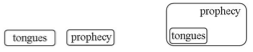
relationship between the terms changes from separate circles to one within another. Speaking in languages is a speaking gift, not a content gift. It does not necessarily convey a message—prophecy—if the hearers do not understand it.
(3) Someone unlearned or unbelieving will think you are crazy (14:23).
This observation does not show they were not real languages. A similar reaction came from skeptical people in Acts 2, where actual languages were spoken. Skeptics accused them of being drunk, which is comparable to being crazy. In another incident, Festus told Paul he was crazy even when Festus knew the language (Acts 26:24). The Pharisees accused Jesus of being a demonic Samaritan when they could not understand what he was telling them in their own language (John 8:48).
(4) Speakers do not understand what they are saying (14:14). In 14:2 the apostle says that no one understands. In 14:14 he adds, “If I am praying in a language, my spirit is praying, but my understanding is not fruitful.” Paul would pray with his understanding also (14:15, 19). These verses need not be taken to mean that speakers have no idea what they are saying, with the inference that what they are saying comes from God. The following considerations provide an alternative reconstruction of this matter.
By “understand” Paul means the element-by-element, word-for-word level, not the conceptual flow of thought. Understanding always occurs at the conceptual level in language speaking, but not necessarily at the word level. It is language, not concept, that occurs in speaking in languages and interpretating languages. We take it that Paul refers to the conceptual level when he uses the word “spirit.” It is “spirit” relative to “words” much as Paul speaks of the “spirit” of the Law relative to the letter of the Law, that is, its intended purpose (Romans 2:29). In like manner, he refers to the word level when he says that the understanding, or mind, is unfruitful (14:14-19). Revelation is concept; languages and interpretation are matters of language, the verbiage by which we convey concepts.
The text does not say that Paul does not understand when he speaks in a language. Since speaking in languages is a language gift rather than a revelation or content gift, he surely means that he did not understand the language, not that he did not understand the line of thought.
Paul goes on say that the hearers cannot say “Amen” to a prayer spoken in a language because “they do not know what you are saying.” Indeed, how can “you” say “Amen” to your own prayer or even be said to be praying? It is no good to say, “I agree with the spirit/feel/attitude of the prayer”; the one occupying the place of the “idiotes” could say that. If language speaking should not be done when the “other” has no understanding, speaking in languages in prayer to God should not be done when the speaker does not understand, which would amount to prohibiting speaking in languages; but Paul does not do that.
(a) You are giving thanks, all right, but the other is not edified. It is doubtful how proper it would be to speak of giving thanks if language speakers did not understand that that they were giving thanks—if they did not understand at all what they were “saying.” What point would there be in prayer if the speaker was not offering the content? Perhaps it is imaginable how people proclaiming to other people would be doing something real and beneficial even though they themselves had no idea what God was saying through them. It would at least be communication. But in the case of prayer, the speaker and the hearer would be the same person: God. First, what sense would it make for God to talk to himself? At least what sense would it make to call it “communication”? Second, what would the text mean by saying that the speaker is giving thanks (cp. “magnifying God,” Acts 10:46)? The point here is reinforced by the express use of the pronoun with the verb “thank”: “You are giving thanks all right, but the other is not edified.” If the pronoun “you” (σύ) contrasts with “other” (ἕτερος), it stresses the fact that you does understand the speaking
(b) Edification does occur despite not “understanding.” Edification is not simply affective exhilaration, but cognitive “eye-opening.” So, edification must be understanding at a different level.
If “edifies themselves” in 14:4 meant affective uplift, the persons nearby would also be edified by knowing that the supernatural hand of God was penetrating the world right beside them; yet 14:17 says that the hearers are not edified. In 14:26 edification comes from psalms, teaching, revelation, languages, interpretation. Although singing might involve the emotional side, the emphasis is on cognitive forms of communication. Edifying others happens when languages, by translation, become prophecy (14:5). Other people in 14:17 are not edified, because they do not know what you are saying. The intended use of spiritual gifts is edification (14:12).
(c) Paul contrasts speaking in languages with speaking five words with his understanding. He thereby seems to contrast the language-speaking type of understanding with the word level communication.
(d) Singing with the spirit (14:15) is the word ψάλλω (psallō), “to sing a psalm,” not ἄδω (adō), “to praise” (Ephesians 5:19a), or αἰνέω (aineō), “to sing” (Luke 2:13). It is even used in Ephesians 5:19b in apparent contrast to ἄδω (“to sing”). Ψάλλω most likely means “singing psalms.” If so, a set and known content is involved. Secondly, τῷ πνεύματι (tōi pneumati, “with the spirit”) is comparable to τῇ καρδίᾳ (tēi kardiāi, “with the heart”) in Ephesians 5:19. Finally, “singing in the spirit” may not be singing in languages.
(e) Except they interpret/translate (14:5) may mean, not that they have also the gift of interpretation (contrast above), but that they are explaining the message, which they know at the general level. The gift of interpretation would be for interpreting someone else’s language. Praying to interpret their own language speaking (14:13) would presumably be so they could express cogently in their own language the word-for-word presentation they just spoke in a language. Another possibility is that in the case where content is known, “interpret” would be the ability to explain the meaning rather than translate the language. “Interpret” (ἑρμηνεύω, hermēneuō) can mean either to translate from one language to another or to explain something differently in the same language.
(f) Nowhere in Corinthians or elsewhere does scripture indicate that speaking in languages necessarily involves a revelation of what is said in languages. In fact, 14:26 distinguishes the two gifts. Of course, were a person to have both gifts, they could be combined on an occasion such as Pentecost (note also 14:30).
(g). “Speaking mysteries” (14:2) does not have to mean “hidden things” to the speaker or the whole world. They were mysteries to listeners who did not understand the words spoken.
(h) In witnessing or in teaching believers, how could a language speakers field questions about their message if they had no idea what they had just said? On Pentecost Peter was speaking in languages when he preached what Luke recorded. How would he understand the audience’s question when they responded to his presentation? Even worse, he would not know what answer the Holy Spirit was giving them. It would apparently be a surprise to him when they come to him, wanting him to baptize them. Similarly in Corinth, how would speakers answer questions about what they had just said (14:35)?
(i) In prayer especially, if speakers have no idea what they are saying, we say again that God would simply be talking to himself.
Even if this alternate reconstruction does not commend itself as the point, it is satisfactory enough to indicate another way to read the text. If so, the “not understand” factor falls out as a distinctive mark for a second type of language speaking found at Corinth.
In summary, we offer a listing of approaches to the statement that in prayer the language speakers’ spirit is praying while their understanding is not: (a) idea level vs. verbal level, as advocated above; (b) emotional level vs. rational level; (c) enthusiasm vs. content; and (d) intention vs. result.
(5) The languages are “unknown” (14:2).
The word “unknown” in the Authorized Version does not appear in the original text. Even if it did, it would not mean the language was unknown to mankind and so be angelic utterance. It could be unknown to the speaker even as “new languages” (Mark 16:17) can be new to the speaker rather than to mankind. Similarly, the “other languages” (Acts 2:4; 1 Corinthians 14:21) are other than what the speaker used normally.
Our summary comments on proposals for a second type of languages are these: scriptural statements are being accommodated to the experience of people who have done what they suppose is speaking in a language, “speaking in tongues,” as they term it. Since they did not understand what they were saying, they suppose 14:14 means that. Since the sounds they made were not understandable to anybody around them, they suppose that unknown languages in 14:2 (KJV) means unknown to mankind, and so on. The experience is providing the precise information for understanding the wording of the text. The assumption is that their experience is what this text is talking about. Since that is not necessarily the case, the interpretation is not really an interpretation of the text.
d. Summary of main points of interpretation in 1 Corinthians 14
(1) Languages speak to God because no human being understands; they speak to God by default.
(2) The speaker does not understand at the element-by-element level, but knows at the conceptual level.
(3) The language speakers are accused of being crazy because the hearers cannot understand the human language they are speaking—or the speakers are all talking at once.
(4) The language speakers edify themselves by conceptual edification.
(5) They speak mysteries as far as the audience is concerned.
(6) “Languages of angels” is exaggeration for emphasis.
6. Ephesians 5:18
The idea sometimes taken from this text is that being filled with the Spirit unto speaking in languages is comparable to being filled with wine. The charge of drunkenness in Acts 2 supposedly reinforces the point along with the mention of madness in 1 Corinthians 14:23.
Paul does not mention languages in this context. Even so, it is not at all necessary to follow the above line of reasoning any more than it is to make thanksgiving comparable to levity, silly talk, and filthiness because they appear next to each other in Ephesians 5:4. Understanding contrasts to, not compares with, foolishness in Ephesians 5:17. Likewise, drunkenness replaces or contrasts to, not compares with, being filled with the Spirit in the next verse. Instead of drunkenness there is sobriety. People with the Spirit who are speaking in languages are in control of the Spirit’s operation through them 1 Corinthians 14:23.
7. Romans 8:26-27 says that the Spirit makes intercession for us with groanings
that cannot be uttered.
Again, speaking in languages is not part of the context. Paul speaks of groanings that cannot be uttered, but according to this proposal they would be “uttered” by using angelic language. The passage deals with intercession by the Spirit, not endowment by the Spirit. The point of the verse is that we do not have to rely on the adequacy of wording our feelings and intentions, because the Spirit sees that our real intents “get through.” Admittedly, human language is somewhat inadequate to express some things, particularly inner feelings and abstract ideas, but non-language or angelic language would be worse, not better, because such a thing would not express anything at all from the person. Besides, Paul would rather speak five words with understanding than five thousand without understanding, presumably because speaking those five words would be better. Private use of languages in a “prayer language” would not be better because the understanding would not be involved in the manner Paul means in 1 Corinthians 14:19.
Even if people were to agree that on occasion language simply fails us—as with the utterance of pain, they hardly thereby agree that language-speaking as non-language is then the case or that non-language is better than language. People do not have to have a supernatural gift to express “groanings.”
Summary of Characteristics of “Languages”
1. Languages are actual human languages (xenoglossia).
2. Speakers control when they use the gift.
3. Speakers are in control of themselves while they use the gift.
4. They understand conceptually what they are saying while they are using the
gift.
5. The gift of languages is a supernatural gift. It is not “primed” into existence. A person does not just decide to do it; it is a gift. Being emotionally “driven” does not enhance the coming of the gift.
6. Speaker evidently can match the language of the ones they address.
7. Speaking in languages is a language-speaking ability; it does not necessarily involve a revealed content as well.
8. Language speaking is such that it can serve as a sign to unbelievers.
christir.org