
Analysis of Augustines Doctrine of Evil
ANALYSIS OF AUGUSTINE’S DOCTRINE OF EVIL
Virgil Warren, PhD
The view of mankind common in evangelicalism descends from Augustine of Hippo. His early efforts in philosophy centered on the problem of evil. Although he spent his earliest years under the influence of Catholic Christianity, he left that background to become an Auditor for nine years in a Gnostic-like sect that followed the teachings of Mani. At first, Manichaeism seemed to him to explain the problem by teaching that evil and good are two kinds of substances. They have become intermingled in mankind so that “salvation” consists of separating good from its mixture with evil. Because of internal inconsistencies that Augustine came to see in this dualistic philosophy, he eventually left it and returned to Christianity. The problem of evil stood at the beginning of his development as a philosopher-theologian; its solution stood near the center of the theological system he formulated.
Augustine’s understanding of evil and sin originated in response to two important factors in his circumstance. The first was Manichaeism in his earlier writings; the second was Pelagianism in his later ones. In the case of Manichaeism, he argued against a natural dualism where good and evil were two ultimate substances, or natures. In the case of Pelagianism, he argued against a view of the consequences of sin that appeared to make divine grace unnecessary in salvation. His positive proposal was suggested by Neo-Platonism and was put in connection with the Genesis statement, “God saw that everything he had made was very good” (1:31).
In contrast to Manichaeism, Augustine was undertaking to demonstrate by reason what he first understood by faith. Scripture had provided him with the insight that the material universe, the world, and mankind are good. He used reason to discover the assumptions necessary for making that scriptural concept true. To determine the origin of evil, he sought to analyze its nature, criterion, and cause. What evil is, how it is measured, and what causes it led to an explanation of where it came from. What something is must be understood before its source can be sought.1
Nature of evil
Manichaeism taught that some substance is good, some is evil, and that both kinds of substances are equally eternal. In contrast, Augustine said that all substance is good. Some is incorruptible, but some substance is corruptible. God is incorruptible good but what is not God is corruptible good. The incorruptible created the corruptible, so not all substance is equally eternal. Corruptible substance is not eternal. Evil pertains to the corruptible substance, so evil had a beginning in corruptible good.
Augustine could say that all nature is good because scripture as well as the Manichees said that God is good. He could say that all non-God is good because before the Fall God called his creation good (Genesis 1:31) and because scripture elsewhere says, “Every creation by God is good” (1 Timothy 4:4). The incorruptible, good, eternal God created all that is non-God, so all things are good because only good can come from what is incorruptibly good.2
Augustine could distinguish two kinds of good because scripture differentiates between corruptible and incorruptible, “. . . you will change them, and they will be changed, but you are the same” (Psalm 102:26-27). Elsewhere the Bible states, “Now to the King eternal, incorruptible, invisible, the only God be honor and glory forever and ever” (1 Timothy 1:17). “Every good and perfect gift is from above and comes down from the Father of lights, with whom there is no variableness or shadow of turning” (James 1:17). “You will not let your Holy One see corruption” (Psalm 16:6, cp. Acts 2:27; 13:35).3 God is good, and his creation is always called good; consequently, incorruptible good created corruptible good.4
These considerations locate evil outside of God and in the created realm, but they do not yet define evil precisely. Augustine did not simply adjust Manichaeism from two kinds of natures to one good nature. He meant that good is in nature (substance) as a characteristic. Good is not a substance, but a quality of substance. Good is in corruptible nature; hence, it is a characteristic that a nature can come to have.
Manichaeism had pictured evil as a kind of substance rather than a quality of substance. Augustine detected inconsistency here because Hyle, the dark lord of evil substance, possessed good health, nourishment, fecundity, and other consequences of good nature. In so picturing him, Manichaeism demonstrated the impossibility of conceptualizing an absolutely evil substance. If the present situation involves a mixture of good and evil substances, then ultimately salvation leads to unmixing them. Unmixed good and evil means that eventually there will be pure, absolute evil. But something absolutely evil cannot experience consequences of good substance.5 Substance as such is good, so evil must be an unnecessary quality within good substance.
Substance has both form and content. For substance to exist, it must have form. Since form is a necessary characteristic of substance, form itself must be good.6 Anything that has form must therefore be good at least insofar as it has form. What contains good is not opposite to good, but evil is opposite to good. Opposite attributes cannot be applied to the same thing.7 The Manichaean doctrine of evil substance is rejected because all substance contains form, and form is good because form is what brings good consequences. There is not good form and bad form, but form itself is good. The form of substance is precisely what good is, because substance must have form to have existence. All substance is good8 so evil is not a substance.
Determining that evil is not a substance does not specify what it is. Since substance is good and is necessarily comprised of form and content, evil is not a form or a content of substance. Evil corresponds with non-existence because shape, or form, as well as “stuff” makes up every existing thing. “Evil is that which is contrary to the nature of kind.”9 Precisely, then, evil must be a “lack” in the form of substance. The word “privation” has traditionally referred to the essence of evil according to Augustine.
The “lack” is not a lack of nature, but a lack in nature. More specifically, evil is a lack in the order of nature. The privation is a qualitative lack seen in deterioration, corruption, disorder, defect. Form inheres in content so that if form were removed, content would disappear, “A corporeal object has some concord between its parts; otherwise, it could not exist at all.”10 Substance vs. non-substance is an either-or matter, but order vs. disorder is a matter of degree. To the extent that something has order it is good; but to the extent that it lacks order, form, organization it is evil. All substance is good to some degree because it has form. All incorruptible nature is absolutely good because it has all its form. All corruptible nature is absolutely good as long as it has all its form. All corrupted nature is good to the extent that it has its form, and evil to the extent that it lacks it. Evil is relative, not categorical.
An example may help crystallize an understanding of Augustine’s proposal that evil is a lack in the form of substance. Some commentators have suggested that previous to the Genesis flood a vapor canopy surrounded the earth. Before the flood there is no mention of rain, and Genesis 2:6 says that a mist came up from the earth to water the ground. Water for the flood was partially supplied by the collapse of that canopy.
Precipitating such a canopy would create a lack in the order of nature with many natural evils resulting. Water vapor filters out harmful cosmic rays that form mutations. One theory of aging proposes that as the proportionate number of mutational cells increases in the body, their accumulated effect contributes to the dysfunction and ultimate death of an organism. A vapor canopy would have a greenhouse effect that would provide a uniform climate worldwide. An environment without precipitation would greatly relieve shelter and clothing needs, and would eliminate climatic catastrophes like storms, tornadoes, and floods.
The post-diluvian world would have the same amount of matter, but the disorganization in matter represents a lack of order as measured relative to the pre-collapsed condition. Collapsing the vapor canopy causes untold pain and suffering for life forms better suited to the previous circumstance. On this kind of model, Augustine conceived of all evil, suffering, and sin.11
Augustine stressed nature, or substance, in defining evil, but he included action as well. “[Pelagius] quotes also John of Constantinople, as saying ‘that sin is not a substance, but a wicked act.’ Who denies this?”12 “[Gold, food, female beauty] are not to be blamed, but the men who make a bad use of them.”13 Nevertheless, he maintained that the problem involved more than action; it involved a problem in substance that produces actions.
Besides nature and action Augustine posited a third class. A soul is a thing; theft is an act; avarice is a defect. A person is avaricious even when he is not stealing.14 To nature and action he added property,15 by which “he apparently means a non-essential attribute, without which man would remain man, but yet not what is called a ‘separable accident.’”16 Since the Fall man has had desires like avarice and concupiscence. These properties need not exist in human nature; yet no person can free himself from the fallen nature that uniformly includes them.
In summary, evil represents a privation, or lack, in the form of being, nature, substance. Sinful action comes from evil nature, which introduces the issue of the cause of evil.
Cause of evil
By epitomizing evil under the word “lack,” Augustine included the cause of evil in its very definition. Defective nature produces defective action, an idea seemingly compatible with Matthew 7:18 and other texts which teach that good fruit comes from good trees, etc. Nature demonstrates its character in performance.17
In speaking about evil and sin as caused by a lack, Augustine did not mean the lack itself but the lacking condition. The difference between the undeteriorated and deteriorated conditions accounts for the difference between good and evil in nature generally and between righteousness and sin in persons particularly. A lose tube in an amplifier causes popping and cracking when the guitar music vibrates through it. That is bad relative to the effects produced by an amplifier that “works.” In the personal realm, Augustine’s formulation fits well with the ancient idea that sickness in general is caused by imbalance of the humors. Sickness and sin were closely related in his mind. Hormone imbalance does greatly affect human behaviors that issue from the basic drives that hormones can affect. The “disorder” does not make a person completely dysfunctional, but it produces behavior that is not good. Persons do not cease being persons, and they are still responsible for their actions, but they do not “work right.” In moral matters the condition would make them not “righteous.” The remaining “stuff” with its lesser order produces the lesser of different action and behavior.
Augustine’s concept of evil assumed a necessary correspondence between nature and action, a being-action composite. The deformed being produces deformed act. Conversely, the deformed act can produce deformed being, “Vice in the soul arises from its own doing, and the moral difficulty that ensues from vice is the penalty which it suffers . . . . Careless looking at the sun and the disturbance that is its consequence is evil.”18 The one-for-one correlation between being and behavior is a kind of determinism with a long history that continues today in Skinnerian behaviorism and related views. In this respect Augustine is quite contemporary in his approach to the cause of evil action and sinful, or “abnormal,” behavior.
Criterion of evil
The nature of evil as defective nature and the cause of evil as defective nature means the measure of evil is “un-defective” nature. The nature, cause, and criterion of evil lie in substance. The undeteriorated form of a thing serves as its standard of rectitude. Augustine’s use of original nature for evaluative purposes goes with his practice of contemplating human nature as unfallen human nature rather than presently observed human nature.19 The flesh-spirit discord described in Galatians 5:17 and elsewhere he called a defect, not a nature.20
Pristine nature provides the standard for good because it demonstrates the eternal truth God directly expressed in nature at creation, “It is not evil because it is forbidden by law; it is forbidden by law because it is evil.”21 “Sin, then, is any transgression in deed or word, or desire of the eternal law.” By “eternal law” he meant natural law, not revelational law, “And the eternal law is the divine order or will of God, which requires the preservation of natural order, and forbids the breach of it.”22 Since the natural order reflects the will of God, sin means living contrary to nature. Augustine’s philosophy of nature afforded him the concept of innate, more than revealed, ethic.
Action comes from nature so that the action of defective nature is sinful in contrast to what undeteriorated nature would have produced. Sinful behavior arises from
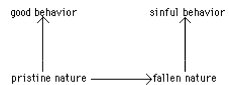
fallen nature as righteous behavior arises from pristine nature. Original nature provides the standard for deteriorated nature, and defective and perfect action derive from their respective natures. Original nature becomes the frame of reference for deteriorated nature and its defective action. Augustine formulated natural and moral evil alike.
Origin of evil
The nature, cause, and criterion of evil pose the question of how present evil could originate from good nature. In contrast to the Manichaean notion that evil is co-eternal with good, Augustine’s model attempts to provide an origin for evil by associating evil with a created nature. Inasmuch as evil is a “non-thing,” strictly speaking Augustine had to say that he did not know where evil came from, “That which is nothing cannot be known.”23 Nevertheless, he had some positive things to say. Since sin and evil had a beginning, he sought to devise an answer that did not fall into an infinite regress.24 Evil cannot be traced even back to God because everything God created is called good.25 Augustine located the source of sin in the free will of God’s creatures although free will itself is good.26
On the basis of Genesis 3, Augustine said that evil originated through the Fall of Adam as far as mankind and his environment are concerned. The question here is whether the defective condition of mankind after the Fall was an (a) inherent result or a (b) non-inherent result of Adam’s sin (either-or). Since it is difficult to conceive of how some aspects of the situation after the Fall could have been inherent results of Adam’s exercise of free will, (c) a combination of internal and external factors could be posited. Some consequences may have resulted inherently while others resulted non-inherently (in parallel). Perhaps a combination of internal and external causation both played a part in a single consequence (conjoined). In reference to human nature itself, Augustine may have pictured God as external cause of mankind’s evil by creating man in a way that when he sinned depravity automatically resulted from within. These two modes of causation would be in series.27
This last model seems most in keeping with the sum of Augustine’s expression on the origin of evil and sin in man. On the one hand, he speaks of mankind as existing in a penal state.28 “Penalty” sounds like external cause. On the other hand, he sounds as if he believed human depravity resulted from the disobedience itself, “It was by the evil use of his free-will that man destroyed both it and himself.”29 The statements combine consistently if God created human nature in such a way that when mankind sinned, he corrupted himself. Augustine could conceive of “penalty” through inherent, internal cause, “Vice in the soul arises from its own doing; and the moral difficulty that ensues from vice is the penalty it suffers.”30 Mankind’s fallen nature came from divine disablement through internal causation when Adam first used his free will contrary to his nature. In other words, sin tends to self-destruct.
Application to man
The nature and criterion of evil together with its originating and continuing causes apply to mankind as represented by the diagram below. Adam’s sinful act produced a penal state involving desire for temporal things, desire for things able to be taken away without loss contrary to man’s defective nature, which in turn produced concupiscence. For Augustine concupiscence epitomized the effect of depraved nature. In his thinking, concupiscence included bodily drives as well as desire for temporal things, desire for things able to be taken away without loss contrary to man’s will, and desire for unnecessary things.31 His own early failure at self-control in sexual matters so impressed
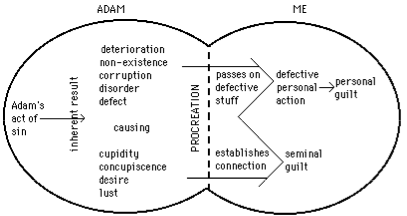
him that he universalized this experience as the nature and essence of all sin. In the fallen condition, procreation takes place through the concupiscence that arose from original sin. Augustine thought that reproduction would have occurred without desire if Adam had not sinned. Concupiscent procreation fittingly correlates with the fallen nature it perpetuates. Defective nature passes on through the lust that results from defective nature.32
Sin and guilt were of two kinds for Augustine. Original guilt attached to the human race as such because of Adam’s original act of sin. Personal guilt attaches to the individual person who sins because of the depraved nature he inherited biologically from Adam.33 If guilt comes from sinful action, the question arises of how a person today can be guilty of Adam’s sinful action. An action cannot be inherited, so its guilt cannot be inherited or transferred. The answer to this question lies in Augustine’s concept of “federal man.” “Federal” refers to being part of a whole in which autonomy does not exist for the parts. In political theory, for example, a distinction is made between federation and confederation. A confederation maintains the autonomy of the component state; a federation does not. Similarly, in Augustine’s view mankind forms a federation of men who share the guilt of the “federal crime” as all states share the responsibility for a “federal atrocity” even though they take no part in it.
Biological procreation, strictly speaking, does not pass on guilt, but establishes connection with him who was guilty. Much of this thinking in Augustine stemmed from the Latin mistranslation of Romans 5:12. It reads in quo where the Greek has ἐφ’ ᾧ. In quo means “in whom” or “by means of whom,” which represents a more restricted concept than the Greek “because of whom.” “Because of whom all sin” leaves open the mode of connection between present sinning and Adam’s sin. The association could be through his example and influence passed on socially, through his nature passed on biologically, or through natal connection with him whom God counted a sinner.35 Even if the “in whom” idea were accepted as the translation, Paul’s comments do not include how men come to be in Adam. He simply describes the difference between those in First Adam and those in Second Adam.
Procreation, then, serves two distinct, though related, functions in Augustine’s thought. Biological reproduction (1) passes on the defective form of nature that produces concupiscence, which in turn leads inevitably to personal sin and guilt. Biological reproduction also (2) establishes connection with original man so that each person automatically participates in his original guilt. All subsequent men become extensions of the original man so that they are extensions of him rather than parallel to him.36 Men differ from angels in this respect. God did not cast out the obedient angels when he expelled the rebellious ones because they had not descended from a common source.37 Procreation in man relates to evil as a mechanism for transferring depravity and as a means of connecting sinful Adam with present-day, “enlarged” Adam.
Augustine viewed man as a corporate person as well as a group of persons and spoke of mankind as the “mass of humanity” and the “mass of perdition.”38 Under this conception individuals partake of the identity, and therefore the guilt, of the whole. Adam plus Eve were the human race as well as the head of it. Mankind then was guilty of sin; increasing the number of those in mankind does not cause the race to become more than mankind; so new individuals are parts of the same old identity. Like reproduction by fission in single-celled organisms, the new is just the old divided up and enlarged.
Augustine developed his view of mankind’s fallen condition from his understanding of Paul’s personal experience described in Romans 7:18, “ . . . to will is with me, but to do what is good is not.” He distinguished between will and ability,39 indicating that will precedes action.40 All people have the ability to will, but they face an insurmountable difficulty when they attempt to carry out what they have decided in their minds they ought to do. Concupiscence causes this inability in the “members,” which work against the mind. The perverted sense of desire that arises from the defective, “death-filled body” overrides the free will.
For this reason, Augustine said that every man stands guilty for his own sins despite the fact that they come from a deformed nature he does not voluntarily receive, “Whatever be the cause of willing, if it cannot be resisted no sin results from yielding to it.”41 Since all men sin personally, they must all have free will. A rock is not guilty of hurting someone, because it cannot will to stop its own falling.42 On this point Augustine used Aristotle’s distinction between internal necessity and external compulsion. In many cases necessity and compulsion cannot be differentiated because the original internalization of the necessity was not voluntary. But Augustine, having limited the definition of guilt to willful acts irrespective of the ability to perform, found a way of calling a man guilty for what he could not help doing.43
Augustine distinguished between what amounts to practical vs. theoretical possibility and between possibility and actuality.44 He seems to have thought that escaping personal sin poses a practical impossibility because mankind’s perverse sense of desire produces an inability to fulfill the choice of the will. Escaping personal sin represents a theoretical possibility insofar as mankind has what it takes to do good if desire would “get out of the way.” Although it is a possibility, righteousness will never occur as an actuality in this life, even with grace.
The exact nature of this conflict between will and desire is reflected in what is required to overcome it. The inspiration of love helps the will to fulfill itself in action.45 In this respect Augustine appears to have espoused an interpersonal-motivational model more than a nature-change model, which is not what a person would expect, given the rest of the theory that precedes this point in his thought. The defect and its consequent desire are not removed in this life, but God’s grace dispensed in the form of love can sufficiently empower a person to overcome the practice of sin generally, though not perfectly.46
Summary
As to nature, the definition of evil centers on the form inseparably present in all nature. Evil is a lack in this form. As to action, evil is the product of defective being. The cause of evil is defective being. The criterion of evil is the form and product of the undefective state of nature. As far as it may be known, the origin of evil lay in a defective movement of free will in God’s creatures. Form and content comprise a necessary composite, which in turn necessarily correlates with evil or good depending on whether the form of being involves a lack. Moral and natural evil inter-relate in that moral evil was punished with natural evil; natural evil in turn perpetuates moral evil. Therefore, all evil—moral as well as natural—stems from degenerate nature.
End Notes
1De natura boni Manichaeos 3.
2De libero arbitrio 2:18:47ff.; De natura boni 3:13:36; De natura et gratia 54:63.
3De natura boni 24:20.
4De libero arbitrio 13:35.
5Being able to conceive of an absolutely evil substance was for Augustine the logical requirement of hypostatic, substantive, natural evil: Contra Faustum Manichaeum 21:14. See Gerald Bonner’s treatment in St. Augustine of Hippo: His Life and Controversies (Westminster Press, l963), pp. 196-201.
6In De ordine 6:15 Augustine objects to Licentius’ statement, “To me order seems to be neither a good thing nor a bad.”
7See Enchiridion 14.
8“For all existence as such is good” (De vera religione 11:22).
9De moribus Manichaeorum 2:2; cf. 3:5 (what is “hurtful”); 5:7 (“corruption”); 8:11 (“disagreement to substance”); see also Contra epistolam quam vocant Fundamenti 40:46. In various places Augustine even correlates “true and false” with “good and evil” and “existence and non-existence”: Confessiones 7:11; Soliloquia 2:6:9ff. In De immortalitate animae 1:1; 4:1 he explains that an eternal content exists only in an eternal container.
10De vera religione 11:21; hence, he could say that if something is corruptible it is doubtless good (De natural boni 3:13:36).
11A rather full treatment of the vapor-canopy theory is available in Joseph C. Dillow’s book The Waters Above: Earth’s Pre-Flood Vapor Canopy (Chicago: Moody Press, l981). The concept appears frequently in the writings of evangelical flood geologists. For a seminal work in the twentieth-century resurgence of fiat creationism, see John C. Whitcomb and Henry M. Morris, The Genesis Flood: The Biblical Record and Its Scientific Implications (Grand Rapids, MI: Baker Book House, l966), pp. 239-58 especially.
12De natura et gratia 64:76.
13De libero arbitrio 1:15:33; cp. 2:18:48; De natura boni 37.
14De perfectione iusticiae hominis 3:4-5.
15In this passage Augustine evidently commits the linguistic error called “reification.” He confuses nominal reference with substantive being. Avarice describes a characteristic attitude or way of feeling and behaving. The noun avarice does not point to a thing in this case, but to a pattern of behavior. In his analysis Augustine also apparently limits action to “movement,” or overt action, instead of including non-movement, internal “functioning” like disposition and attitude.
16Editorial comment in A Select Library of the Nicene and Post-Nicene Fathers of the Christian Church (First Series), ed. by Philip Schaff, Vol. V, p. 160, fnt. 5.
17Contra Pelagium et Coelestium, de gratia Christia et peccato originali 1:17:19-20:21.
18De vera religione 20:39.
19De libero arbitrio 3:18:51-52.
20De natura et gratia 54:63.
21De libero arbitrio 1:3:6.
22Contra Faustum Manichaeum 22:27.
23De libero arbitrio 2:20:54.
24De libero arbitrio 1:2:4; 2:18:48.
25De libero arbitrio 2:20:54.
26De libero arbitrio 1:1:1; De natura boni 7.
27In De musica 6:14 Augustine appears to state that sin practice in general disorganizes human nature. He seems to conceive of habit as disordering, rather than re-ordering, human nature.
28De libero arbitrio 3:18:51-52.
29Enchiridion 30; cp. De vera religione 19:37; 22:24.
30De vera religione 20:39.
31De libero arbitrio 2:18:50; 3:10:31; Soliloquia 1:10:17; De duabis animabus contra Manichaeos 11:15.
32The reason for the virgin birth was to avoid birth by concupiscence in order that Christ might be born in the “likeness [not the actuality] of sinful flesh” (Romans 8:3): Epistola 187:32, Ad Dardanum.
33See the opening chapters of De peccatorum et remissione, et de baptismo parvulorum, Ad Marcellinum.
34See, for example, Confessiones 10:20.
35Paul elsewhere uses ἐφ’ ᾧ (eph’ hoi) in Philippians 3:12 when he says, “I press on if so be that I may lay hold on that because of which I was also laid hold on by Christ Jesus.” The “in which” idea would not fit in this context.
36J. Oliver Buswell, Jr. (A Systematic Theology of the Christian Religion, Vol. I, p. 304) and B. B. Warfield (Studies in Tertullian and Augustine, pp. 289-412) are of the opinion that Augustine did not decide between immediate imputation of Adam’s sin and mediate, or substantive, view of imputation. The relationship was simply such that his descendants were guilty.
37Enchiridion 28.
38De natura et gratia 5:5; De correptione et gratia 7:15ff.; Enchiridion 92, 93.
39De spiritu et litera 53:30-55:32.
40De natura et gratia 51:59.
41De libero arbitrio 3:18:50. Augustine seems to have lacked precision as to whether an unregenerate man will wish for, or ask for, deliverance from his condition. In two passages where he speaks of the matter, he may not be talking about a present unbeliever: De perfectione iusticiae hominis 10:10; Enchiridion 103. A different slant appears in De praedestinatione sanctorum 5:10:
For the capacity to have faith is of nature, is it also of nature to have it? ‘For all men have not faith [2 Thessalonians 3:2],’ although all men have the capacity to have faith. . . . Accordingly, the capacity to have faith, as the capacity to have love, belongs to man’s nature; but to have faith, even as to have love, belongs to the grace of believers.
He says elsewhere that belief is willed. John Calvin later objected to Augustine for failing to emphasize sufficiently the effect of sin on the mind and will themselves as seen in their not even wanting to do good: Institutes of the Christian Religion 2:2:4.
42De libero arbitrio 3:1:1-2. In De duabis animabus 10:12, 14 he says that sin is nowhere except in the will and that sin takes place only by exercising the will.
43Besides (1) responsibility through a federal head, another instance of responsibility for what someone cannot help doing is (2) responsibility through prior choice. A person bears responsibility for what he does while he is drunk even though he may not be “able” to keep from doing it at the time. He is responsible because he could help getting himself into a state where he could not then help doing wrong. The difference between these possibilities hinges on the concept of federal man in the former. As an opposite to guilt through a federal head is (3) responsibility by assignment. The law may hold the parent responsible for his young child’s action he was not even present to control. Of course, the reasons for so doing are practical rather than theoretical. The child does not have the resources for payment of damages, for example, and the parent bears responsibility for disciplining the child so that such actions do not recur.
Gerald Bonner, in St. Augustine of Hippo, pp. 211-14, may be correct in suggesting that Augustine did not abandon the intent of his earlier views on free will. (a) The total construct can combine an emphasis on volition with an inability to act. (b) In his early book against the Manichees, Augustine says that he is contemplating man as unfallen: De libero arbitrio 3:18:51-52 (cp. 3:5:15). His early problem with the Manichees had to do with the origin of sin; thus, he was viewing man in his pristine condition. His later arguments with the Pelagians dealt with the restoration of man; thus he was concerned with man in his fallen condition. (c) In his Retractationes 1:8 [9]:3 he at least claims not to have changed his view on the matter.
44See the opening paragraphs of De spiritu et litera.
45Contra Pelagium et Coelestium 1:7:7. Love by another person, however, cannot change the sinner’s substance. The reversal of defect would seem to require supernatural miracle on the very stance of a person.
46Again Augustine’s thought seems imprecise. Perhaps the motivational-interpersonal model was what he was trying to express in De spiritu et litera 33:57-58 because for him belief was an act of the will. But the will to believe must be given by God because he cites Paul as asking, “What do you have that you did not receive?” (1 Corinthians 4:7). Belief must be mankind’s act too, or God would be doing the believing. The will itself is neutral, and all men have it (capacity); but to will good (content) must be given by God.
christir.org