
Criteria for a Biblical View of Human Ability
CRITERIA FOR A BIBLICAL VIEW OF HUMAN ABILITY
Virgil Warren, PhD
Prevenient grace and natural depravity
In place of the natural depravity of traditional theology, we prefer to speak of psychological depravity. In doing so, we acknowledge the power of sin without considering ourselves subject to a determinism that results in lostness. In the construct of depravity plus prevenient grace, psychological depravity functions on the analogy of habit. Prevenient grace consequently omits natural regeneration from God’s acts of grace that precede salvation. A view of human ability is developed below under five criteria listed according to the sequence in which they apply to the process of restoration to fellowship with God.
Impossibility of original righteousness
The first criterion for a biblical anthropology is that our view of mankind cannot provide for the practical possibility of original sinlessness. The practical possibility of sinlessness, allowed by Pelagius, scandalized Augustine and prompted him to overreact in propounding a view of mankind that eliminated even the theoretical possibility of sinlessness.1 Since Augustine’s time, one theological function of natural depravity has been to guarantee the sinfulness of every person as declared by the Psalmist, “There is none righteous, no, not one” (14:3 = 53:3; cp. 5:9; 140:3; 10:7).2 The following paragraphs propose to show that universal sin does not require natural depravity.
In our critique of Augustine’s doctrine of evil, we enumerate originating causes of sin in each person’s life and the continuing causes of sin in society generally. Different kinds of ignorance, social experience, and physical components combine and interact to create universal sin as a practical result. We are born into this life as babies innocently impacted by varying degrees of evil influence from parents, siblings, neighbors, playmates, schoolmates, and others. Consequently, we are faced with negative moral input before we even have a standard by which to evaluate that input. These immoral influences address the physical and psychological desires at a time when the child has not developmentally reached a stage where he can operate interpersonally with much facility and consistency. Not having arrived at the socialization stage means that he has a hard time projecting his consciousness over behind the eyes of someone else and thus being able to fulfill the Golden Rule. He operates in a moral situation at the very time he is not fully trained for relational existence or fully capable of moving relationally.
Pervasive effect of sin
A second criterion of a biblical anthropology is that our view of mankind must provide for the pervasive effect of sin on every aspect of the self and its relations.3 First, sin (1) produces personal guilt in all those to whom God “imputes” guilt, that is, holds sin against them. The imputation of that sin against a person’s “record” includes all of us either because of disobedience to revelation or disobedience to the correct leading of conscience.4
Beyond personal guilt are those effects of personal sin that accrue to each of us ourselves, not just to our status. Sin (2) perverts bodily appetites. There is pleasure in sin, but it lasts only for a while (Hebrews 11:15) because sating the senses soon deadens them and because pleasure ends at death. Exploiting physical appetites subjects them to the law of diminishing returns. When over-exercised and pursued for their own sake, they do not yield the fulfillment sought in pursuing them. The physiological and psychological make-up are alike in this respect as the Preacher says incisively, “He that loves silver is not satisfied with silver” (Ecclesiastes 5:10-12; cp. Galatians 6:8). Only when desires are fulfilled within the boundaries of restraint do we experience the satisfaction intended in them.
Sin also (3) weakens will power. The strength of a habit is known to everyone who has tried to break one. At an early age, people learn patterns of thought, behavior, and emotional reaction at the conscious level. By repetition these consciously learned patterns incorporate themselves into the personality at the subconscious level and take on the strength of a habit that the mind does not notice and the will finds hard to override.
Sin (4) confuses the mind. When God and his purposes do not shape our thinking, something else becomes the center of our worldview, either ourselves or some other substitute for the one true God. With a false internal or external center, we rotate or revolve in a false pattern of living. Without God in our thinking, knowledge is incomplete. Because this incompleteness has to do with ultimate concerns, it necessarily errs. Sin lives the lie that the true God is absent, does not care, or does not exist. As a result, the actions of the body produce a “living logic” that accepts this error as true. People become “corrupt in mind” (1 Timothy 6:5; 2 Timothy 3:8).
Sin (5) disorients the emotions. The lack of “natural affection” overtakes us when we give up God and are given up by him (Romans 1:24-32). Our heart will be where our treasure is (Matthew 6:21) because feelings attach themselves to the objects of attention. The deceitfulness of sin produces despair by forming compulsions that cannot be fulfilled.
Recurring sin (6) defiles the conscience because the moral sense originally learned is subsequently conditioned by action. When the promptings of conscience go unheeded, they weaken with time. Conscience is not lost with the practice of a sin, but it ceases to condemn that sin. It is seared with a hot iron and defiled (1 Timothy 4:2; Titus 1:15).
In all our parts we are dynamic units. Being interdependent, the members influence each other reciprocally. The body tempts the mind (James 3:2-3), and the mind commands the body (1 Corinthians 9:27). It is not possible to sin in only one part of the self or to confine the consequences of sin to any one arena of conflict.
In all our relations we are also a dynamic unity, but the presence of sin (7) fragments society by alienating bond and free, male and female, Jew and Gentile, rich and poor, learned and unlearned. Sin always tends toward death, or separation, vertically from God (1), horizontally from other people (7), and internally from our own selves (2-6). The effects of sin may be inferred backwards from the mission of Christ and his church to save us (1 Timothy 1:15), to unite us (Ephesians 2:15), and to heal us (Ephesians 5:21-24). As acting contrary to the nature of marriage dissolves marriage, acting contrary to the nature of society destroys society.
Sating the flesh turns us in on ourselves and destroys our harmonious relations with other people. Sin begets a selfishness that seeks independence from other people or manipulates other people to selfish ends. When there is no common center for society, society is impossible.
A final consequence of sin is that it (8) forfeits dominion over nature. As ecological concerns show, people cannot even fulfill the first commission to the human race because sin has entered into the picture. Accordingly, the Hebrew writer declares that one reason for the incarnation was to qualify Jesus as representative mankind to stand over the works of God’s hands (2:5-9).
In the first criterion of anthropology, the givens of human existence account for universal sin. In the second criterion, interdependence and reciprocity account for pervasive sin. Within each of us, false action in one aspect feeds off into other aspects. Between us, false actions in one of us beget false actions in others. Since within persons and between persons the “parts” interact reciprocally, sin does not remain isolated in any one aspect of us or our relations.
Natural ability for response to God
The third criterion of a biblical anthropology is that our view of mankind must provide for our ability to respond to God. For us to be able to respond to God, the process of coming to faith interrelates the factors shown in the accompanying sketch.
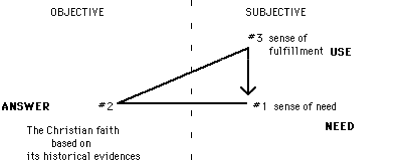
Subjective point of contact. The point of contact in us as fallen lies in our (a) sense of dependence, (b) drive for meaningfulness, (c) need for innocence, and (d) desire to be loved.
On the negative side, providentially God has built natural evil into our existence—disease, natural catastrophe, suffering, and death. Genesis 3:16-24 shows that because of our sin God placed limitations in our experience. Removal from the tree of life followed the exercise of independent autonomy by dependent beings. Living forever while experientially knowing good and evil would mean that no practical difference would exist between good and evil. By limiting freedom to less than what seems ideal for us, the creator placed perceptually in our experience—not just conceptually in our understanding—our secondary place in reality. General revelation creates at least a subconscious awareness of finitude and dependence. It is intuitively obvious that dependent beings need more than they can supply and that they lack ultimate sovereignty over their destiny.
On the positive side, we seek a reason to live so that a sense of insignificance fosters suicide. As individuals we are driven to purpose and to become, and as social creatures we aspire to community and love. The need for security and innocence and the desire for love and worth in community form two sets of givens in human nature that derive from creation and providence. We naturally can recognize dependence, guilt, alienation, and worthlessness, and can reason that only a sovereign can determine his own significance and be central in society. The ability to be loved provides the point of contact for redemption from guilt, worthlessness, and insecurity.
Objective revelation. A sense of dependence and meaninglessness on the subjective side does not necessarily prove the existence of something to depend on or give meaning on the objective side. It does, however, prime us for accepting that possibility. The sense of finitude requires that external evidence for the Infinite not be treated academically or indifferently. The sense of guilt and alienation makes the offer of reconciliation relevant. The sense of meaninglessness legitimizes listening to proclamation about a basis for worth.
The point here differs from the aim of what is called natural theology. Natural theology attempts to use reason and experience to ascertain the existence of an omnipotent, transcendent, personal, holy God. On the basis of that knowledge from general revelation in nature, we can subsequently learn from special revelation in the Bible the particulars about God, mankind, sin, and salvation. Philosophy leads to theology at the content level in such an arrangement. In our proposal, however, philosophy leads to theology only at the formal level. In the face of general revelation, human experience justifies us in listening to what special revelation says. Reason and experience do not generate the content of truth, but they do create an awareness of the need for it. Special revelation then presents the answer to that problem of need.
For the positive object of ultimate concern, we must involve the scripture principle. Proclamation confronts us with the explicit answer to our implicit problem. In the preceding diagram Step #1 prepares the needy for recognizing in the Christian faith the object of their need. Step #2 is revelatory, coming to us from the outside. Revelation does not replace intuition or vice versa. Revelation is recognized intuitively. Intuition is contentless in itself. From a practical, functional standpoint, the first aspect of Step #2 is (a) the body of Christ that demonstrates an attitude and radiates a love. The crucial role of the church in the atonement appears in Paul’s statement to the Colossians, “I rejoice in my sufferings for you and fill up in my flesh what is lacking in the afflictions of Christ for the sake of his body the church” (1:24). The second aspect is (b) the message of Christ itself, proclaimed by the church in word and deed, and given life, perceivableness, and power in the world. Inherent within the message is a power independent of the witness of the church. That power proceeds from its correlation with our needs so that, on the principle of correlation, we can recognize in it the quality of answer.
Beyond correlation with perceived needs is (c) the Christ event, including the historical evidence independent of the question-answer composite. The Christian kerygma uniquely proceeds from historical events without which the faith would not exist. Its eventness makes Christianity subject to historical inquiry, and so Christian evidences combine with the inherent power of the gospel and the living demonstration of the church to comprise one dynamic whole to which people can respond.
We need to point out here that this order in Step #2—church, gospel, history—is the practical order in proclamation. It represents the chronological sequence in which the unredeemed come into contact with the objective basis for the faith. The theological order of what is proclaimed begins at the opposite end with the events in which the message inheres, the message that describes the intended meaning of those events, and the church that proclaims that message. The body of Christ does not originate the message, but conveys it, and the hearer turns to face the One to whom it points.
I-You encounter. The objective message directed toward people in subjective need leads to Step #3, where the hearer begins to live in terms of what was proclaimed, demonstrated, and sensed. Step #3 becomes the place of subjective confirmation through personal experience, producing added practical evidence. Here is the place of encounter in I-You relationship. For the negative side, the need for security is answered in the omnipotent Father of Jesus Christ who can even resurrect the dead. For the positive side, the need for significance is found first in the love of the Father and then in the love of Christians. Paul extolled love in 1 Corinthians for giving a sense of meaning to words (13:1), abilities (13:2), and acts (13:3). Love gives a sense of existential meaning (punctiliar). From love arises the trust that creates hope for the future. The suicide of purposelessness is replaced by a sense of eschatological meaning (linear). Existential love and eschatological hope produce an ongoing sense of worth in the security of community.
Christian living (Step #3) refines perceived needs (Step #2) in terms of the gospel and the new experience the gospel brings. This factor is important because correlation by itself assumes that the right questions are being asked, and the needs are correctly perceived. The gospel message and the Christian experience sharpen the awareness of actual needs. Step #3 also reciprocates backward on the message itself; experiencing the message clarifies the meaning of the message.
We can respond to God because negatively we can perceive our dependence and guilt, and because positively we can yearn for love and purpose. We can respond to God because we can recognize the correlation between problem and solution. We can see in the faith the potential answer for our yearnings because therein “the secrets of his heart are manifest” (1 Corinthians 14:25). We can respond to God because we can love in response to love, and we can hope because of the faith love generates.
Impossibility of self-justification
The fourth criterion of a biblical anthropology is that our view of mankind cannot provide for the possibility of self-justification. Paul reasons that if we could save ourselves Christ died for nothing (Galatians 2:21; 3:21). The doctrine of natural depravity has safeguarded against self-salvation. J. Oliver Buswell, Jr., in a representative statement, spoke in this vein regarding Calvinistic theology, “The doctrine of unconditional election follows necessarily from the doctrine of total inability.”5 Since in Calvin’s view we are depraved, we have no ability to meet any conditions in terms of which our election could be figured. Theoretically, other reasons might conceivably eliminate self-salvation; but if inability is the case, self-salvation is all the more impossible.
Using natural depravity to explain the impossibility of self-salvation illustrates overkill. Other sufficient reasons exist besides this natural reason. The most basic reason lies in (a) the interpersonal character of salvation. A relationship must be established from both sides. When one person breaks the relationship by sinning, the other must do the forgiving before it can be re-established. Furthermore, forgiveness by the other is not subject to coercion. From a (b) functional standpoint, people cannot save themselves because they need the influence of other people to help them rise above the practice of sin that dissolves relationships. In a (c) corporate sense, we cannot save himself because he cannot rise above the status of the group of which he has chosen to become a part.6 When a person sins, in effect he identifies with the “Adam” group by acting essentially as Adam acted; consequently, he shares the effects of being part of that group, particularly separation from God and more generally those consequences that flow from that separation.
We cannot save ourselves because of the nature of imperfection. All interpersonal relationships use a perfection standard. That is particularly so in fellowship with a perfect God. Once perfection is lost it cannot be regained. The nature of imperfection means imperfection cannot be overcome. Earlier we argued that, though someone could theoretically remain sinless, practically speaking he will never do so. Here we observe that even theoretically sinners cannot become sinless after they sin. The two points taken together mean that all have sinned practically speaking, and none can save themselves even theoretically.
People fall, not from ability, but from perfection. It is not our nature, but the nature of our circumstance that precludes self-salvation. The nature of imperfection means that imperfection cannot be overcome. We cannot save ourselves, not because we cannot respond to God, but because our response to God cannot save us. We cannot “make up for” our own past sin by working harder from now on, by going back and doing the act over, or by hoping guilt will dissipate with time. There are no “leftovers” from other saint’s perfect lives that can be transferred to imperfect people. The attitude and fact of the matter is that when we have done everything commanded, we should say, “We are unprofitable servants; we have done what it was our duty to do” (Luke 17:10). Under that circumstance no treasury of unnecessary good works can build up for other people’s salvation. Besides, more is involved in personal relationships than either person’s doing good things: there is always the added component from the other person in the relationship, who sovereignly decides to accept us and love us because of his goodness in wanting to do so. Relationships are not caused from just one side, and they are not earned simply by the goodness of either side. Love is what holds relationships together, and love on one side is not caused by the goodness of the other, and love does not depend on that goodness or at least a perfect degree of it.
Perfection is the ideal held up in all relationships human or divine. Relationships exist, however, only because repentance and forgiveness make up the difference between performance and perfection. Moral perfection has always been God’s ideal. One sin cast our first parents out of the Garden. The Mosaic Law required continually doing everything commanded (Deuteronomy 27:26; cp. Galatians 3:10). Jesus teaches in the Sermon on the Mount, “So be perfect like your heavenly Father” (Matthew 5:48; cp. James 2:10). Once lost, perfection cannot be regained; consequently, sinners cannot save themselves for interpersonal, corporate, functional, and legal reasons. Natural depravity is not necessary for protecting against autosoterism.
Impossibility of subsequent sinlessness
A fifth criterion of biblical anthropology is that our view of mankind cannot provide for the possibility of a full conquest of sin. Justification is wholly God’s active attitude toward our condition; sanctification is wholly our active response to God’s influence.
Evidence on subsequent sinlessness. Whereas Roman Catholicism places entire sanctification after death in purgatory and Reformed theology puts it at death in confirmation in holiness, John Wesley (1703-1791) located it before death.7 George Turner described the concept this way:
The New Testament presents, not a doctrine, but a conviction, that God can make His children like Himself, as they believe on His Son and respond to His Spirit, until every motive is unselfish and every action consistent with the end of holiness. This is not an absolute perfectionism, but a relative one–man can become well-pleasing to God, as a man. A life is possible in which, by the grace of God, sin is no longer operative, and every action is in harmony with the law of God.8
Denying absolute perfection allows for mistakes of judgment because of ignorance and even for evil thoughts that occur to the mind without being welcomed there. Sin is an act and a state. It is not an infirmity of body or mind, but a defect of love corrected by the Holy Spirit in a second definite work of grace.
Wesley felt that scripture implied entire sanctification in passages that (1) describe Christians as being restored to the image of God (Romans 8:29; 1 Corinthians 15:49; 2 Corinthians 3:18; Colossians 1:15-22; 3:10; Ephesians 4:23; cp. 2 Peter 1:2-4). (2) Other passages exhort the saints to have the mind of Christ (Luke 6:40; Romans 12:1-2; 1 Corinthians 2:16; 2 Corinthians 8:9; Philippians 2:5-11; 2 Timothy 2:21; Hebrews 12:2; 1 Peter. 2:21). Furthermore, (3) believers are to be filled with the Spirit (Ephesians 5:18). (4) The word perfect occurs in commandments and promises: “Be perfect as your heavenly Father is perfect” (Matthew 5:48).9 (5) 1 John 3:6-9 and 5:18 say that a Christian does not and cannot sin.
Further observations in scripture, however, adjust this understanding of holy living. (a) Speaking to “sinless” Christians in 1:8-10, 1 John exhibits a pattern found elsewhere in calling it a lie for Christians to claim sinlessness. (b) Evidently “to have sin” (1:8) and “to sin” (1 John 3:6, 8, 9; 5:18) respectively mean occasional sin vs. characteristic sin, because in the latter connection John says that Satan “sins from the beginning,” hence, characteristically (3:8).10 More directly (c) in 5:16-17 a distinction occurs between “sin unto death” and “sin not unto death,” the latter being something a “brother” might do. The “sin not unto death” clearly coincides with “not sinning” because 5:18 immediately reaffirms as in 3:6, 9 that the one begotten by God11 does not sin and because the only two Johannine definitions of sin occur in these two contexts. The writer must have the same set of contrasts in mind in both places. There is a Christian sinfulness not unto death that contrasts with characteristic sinfulness unto death.
As 2 Peter 1:10 promises, with the continuing development of godly qualities a Christian will never stumble. Jude 24 teaches that God can keep a person from stumbling. However, James 3:2 admits, “In many things we all stumble.” Not to stumble and to stumble must mean, respectively, falling away vs. falling short as in stumbling to fall (Romans 11:11) contrasted with stumbling only. There is a Christian sinfulness that contrasts with apostasy.
The paradox appears in Pauline literature as well when the apostle expressly denies having attained perfection (Philippians 3:12-14) only to affirm it afterwards: “Let us as many as are perfect, be thus minded” (3:15). Not perfect yet perfect indicates behavior vs. state (i.e., as regarded by the other) or actual vs. “for all practical purposes.” There is a Christian sinfulness that contrasts with justification.
In the Philippians statement, Paul considers perfection (1) a goal rather than a achievement, “I press on toward the goal unto the prize of the high calling of God in Christ Jesus” (3:14; cp. Hebrews 12:2). The Hebrew writer ascribes perfection to Christians as (2) a state, “For by one offering he has perfected forever those who are sanctified” (10:14). He included with it a perfection in (3) conscience, “ . . . gifts and sacrifices that cannot as regards the conscience make the worshiper perfect” (9:9; cp. 10:1-3, 10). Being offered repeatedly, such gifts and sacrifices are replaced by “the body of Jesus Christ” offered once and for all. The saved experience the loss of any guilt complex. The status of being viewed as perfect makes appropriate behavior tending toward perfection and produces a consciousness of being considered perfect.
Although sin is still sin regardless of knowledge, it is doubtful whether “occasional sin,” “stumbling,” and “not perfect” in the above examples can be accounted for simply by ignorance as allowed in the doctrine of entire sanctification. (1) Paul presses on toward this perfection as a goal. (2) 1 John 5:16-18 contrasts the sense in which a Christian sins and the “sin unto death” for which a brother does not ask forgiveness in another, which seems to imply its unforgivableness. Wesleyanism, however, has not taught the unforgivableness of someone who lacks entire sanctification.
Entire sanctification has three exegetical weaknesses. (1) It reads statements about the state of justification as statements about the behavior of sanctification. “Sanctification” as a punctiliar action in scripture does not mean that sanctification, theologically defined, is instantaneous, but that the categorical change of state is set forth under the idea of “making holy” as well as under the idea of “making just.” (2) It reads statements about characteristic holiness as statements about absolute holiness. (3) It reads statements about attempted holiness as statements about achieved holiness.
Entire sanctification has three systematic weaknesses. First there is (1) the question of how sanctification could be by grace without involving natural depravity. A stimulus-response or miraculous model could not escape determinism if it were an operating grace rather than a cooperating grace. A second weakness in Wesleyanism and in Pelagianism is (2) the supposition that the theoretical possibility of perfection will lead to its actuality, though the two differ as to whether this perfection is an original sinlessness or a subsequent sinlessness only and as to whether this perfection is by ability or by grace.
Finally, entire sanctification leads to an experiential weakness. It militates against assurance of salvation. Calvinistic sanctification undercuts assurance by making the present status inseparable from the final end inasmuch as perseverance marks genuine conversion. Wesleyan sanctification undercuts assurance by creating an experiential expectancy. Saved, but unsanctified, citizens may not by experience be able to distinguish themselves from alien good moral people or from apostates. The possibility of apostasy is not objectionable as such, but there is a loss of assurance that can go with it because of this formulation of sanctification. The self-authenticating of Christian experience is subordinate to the kerygma. Salvation is known primarily by promise (objective) and secondarily by experience (subjective). The sense of assurance arises from this knowledge as we experience Christian growth. The sense of assurance may not continuously be commensurate with the objective basis for it; but when the expectancy is that it should come to be commensurate, a temporary lull tends either toward fear and despair, or toward insensitivity. A sense of assurance should not become a reason for assurance lest a lack of that sense become a reason against it.
Reasons against subsequent sinlessness. Even if a Christian can become perfect, actually no one will. (1) All factors that led to sin in the first place continue to operate later. What caused unfallen people to fall from perfection will continue to make them fall short of it; and if they are not careful to persevere, they may fall away altogether.
(2) Ingrained habit is harder to break than to make, especially in subtle psychological patterns like a sense of despondency, avoidance, frustration, failure, and guilt complex. Niebuhr’s idea that people would not feel tempted had they never sinned overstated the point,12 but it drew attention to the drag of past failure on present resolve. One interpretation of Hebrews 4:15 suggests that Jesus was tempted like other people in all points “apart from [χωρίς, choris] sin,” i.e., except by past sin. All others have sinned less or more and are then hindered less or more in the triumphant Christian life. It is easier to explain continued sin than “original” sin.
(3) If sin affects all aspects of a person and if all aspects affect reciprocally, then each of us is a complex of interwoven sin habits. The likelihood is nil for dealing with these on all fronts in the face of constant originating and perpetuating factors.
End Notes
1Augustine’s anti-Pelagian writings are De peccatorum meritis et remissione, et de baptismo parvulorum, Ad Marcellinum; De spiritu et litera; De gratia Novi Testamenti, Epistola 140; De natura et gratia, Ad Dardanum; Contra Pelagium et Coelestium; De gratia Christi et de peccato originali; De nuptiis et concupiscentiis; De anima et eius origine; Contra duas epistolas Pelagianorum; Contra Julianum; De gratia et libero arbitrio; De correptione et gratia; De praedestinatione sanctorum; De dono perseverantiae.
2In Romans 3:10-18 Paul assembles these texts along with Isaiah 59:78. What the apostle initiates implicitly in Romans 1:16—that the gospel is the power of salvation to both Jew and Gentile—he concludes explicitly 3:23, “All have sinned and fall short of the glory of God.” See likewise Romans 3:9; 11:12; Galatians 3:22, etc. Johannine literature speaks similarly even of Christians: 1 John 1:8; cp. Job 15:14; Proverbs 20:9.
3The eight effects of sin given here appear in somewhat more elaborate form in What the Bible Says About Salvation, pp. 38-41.
4See What the Bible Says About Salvation, pp. 20-21, 104-12.
5Systematic Theology, Vol. II, p. 139.
6Michael Landmann describes this idea in his Philosophical Anthropology, pp. 79-86.
7George A. Turner lists four other unique features in Wesley’s view of sanctification: (2) it is distinct from, and consequent to, regeneration; (3) it comes entirely by faith rather than by co-operating grace; (4) though normally gradual, sanctification is often consummated in a moment; and (5) a person may have the “witness of the Spirit” that this work has been done in him (“The Scriptural Basis for Wesley’s Doctrine of Christian Perfection,” The Asbury Seminarian, Vol. I (1946), p. 44.
8Ibid., p. 43.
9For various derivatives of the Greek root τελ- (tel-) applied to human behavior, see other examples in Matthew 5:48; 19:21; 1 Corinthians 2:6; 14:10; 2 Corinthians 7:1; 12:9; Ephesians 4:13; Philippians 3:15; Colossians 1:28; Hebrews 5:10; 9:9; 10:14; James 1:4; 3:2; 1 Peter 1:13; 1 John 4:12, 17-18. In the range of meanings for this root, however, we do not have just perfection, but maturity, completeness, completion, fulfillment. The word picture in tel- is that of “end”; consequently, it tends to have a directional thrust in circumstances that describe process. This feature of the term makes it especially appropriate for referring to spiritual development.
In some ways interpersonalism makes perfection even harder. Jesus’ statement in Matthew is more than an ideal perfection. It is a particular kind of perfection, a perfection of love more than law. A person might do everything in a list of do’s and don’t’s without being interpersonally perfect. Exceeding the righteousness of the scribes and Pharisees does not mean being more fastidious at it than they were; it means having a higher type of righteousness—one of love, as in the First and Second Great Commandments. This righteousness is higher because it assumes responsibility for helping other people become more than they are, which is more than personal justness. It is concerned with the heart as well as external behaviors directly, which means it is more than humanly observable behavior. It is a matter of doing good in return for evil, which is more than justice. It addresses internal motives and attitudes, which means it goes beyond quantifiable considerations. It means doing from within rather than under compulsion from outside (Jeremiah 31:31-34). Not going beyond the call of duty is in practice what law tends to elicit, but being sons of the Father means being like him as in being a peacemaker and sending rain on evil as well as good
10“From the beginning” could mean that Satan “began” the sin phenomenon (3:8; cp. John 8:44). It could mean since the “beginning of the world,” which amounts to about the same thing as sins characteristically. “From the beginning” said of Satan may be comparable to “born in sin” said of people.
11Some commentators have suggested that “the one begotten by God” is a reference to Jesus and not a reference to Christian people at all.
12Both the Fall of Adam (Genesis 3) and the Temptation of Jesus (Matthew 4:1-11; Luke 4:1-13) amount to paradigms of exactly the opposite view because in both cases those who were tempted genuinely felt the pull of their temptations. The sinlessness of Jesus is indispensable to atonement theory as well as directly taught in scripture (John 8:48; 1 John 3:5; Hebrews 7:26; 9:28; 1 Peter 2:22; 2 Corinthians 5:21). Nevertheless, the reality of his temptation is evident from the events in Gethsemane (Matthew 26:36-46; Mark 14:32-42; Luke 22:39-46; Hebrews 5:7-8) and the cry of dereliction on the cross (Matthew 27:46; Mark 15:34; note Hebrews 12:3).
christir.org