
Psychological Depravity
PSYCHOLOGICAL DEPRAVITY
Virgil Warren, PhD
Explaining Non-Determinism
Natural determinism
In many cases, opposing natural depravity amounts to opposing natural determinism,1 that is, a determinism based in mankind’s substantive nature itself. On a strict Augustinian model, natural depravity creates a determinism from within due to disordered nature. Its remedy must come by miraculously reordering the corrupt nature so that the person who could not respond before must respond now. The objection has been that this construct cannot resolve the Great Dilemma because it puts within God the variable between “the all” God desires to save and “the some” he decides to save.
Systematically speaking, Augustine did not have to make regenerating grace such that the recipient must respond. He did not have to consider it effectual; he could have considered it effective. “Effectual,” or efficacious, guarantees the result while “effective” tends toward it. The remedy needs only to reorder to the point of potential response. By unnecessarily carrying it to necessary response, Augustine demonstrated his supposition that obedience before justification would be merit. A false presupposition about the nature of salvation created—or at least correlated with—an error in his understanding of the nature of man. Merit is not doing the action ourselves, but achieving the result ourselves. The latter is what is not possible. God gives the result, not the action, the ability to do the action, or the necessity of doing the action. The essential error of Augustine’s earlier answer to Mani regarding the source of sin becomes clear in his later answer to Pelagius regarding the solution to sin. “Depravitizing” human nature unnecessarily adds to the causes of sin because “undepravitizing” human nature becomes unnecessary for avoiding merit. Sin and evil are disconformity, not privation, because sin must involve a relational element.
Functional determinism
To explain the first Great Awakening from a Calvinistic perspective, Jonathan Edwards (1703-1758) moved toward what can be called “functional determinism.” The Edwardsian model created a double source of determinism—a determinism from within due to weak nature (more than disordered nature) and a determinism from without due to strengthened stimulus (more than miraculous reorganization of the nature itself).
Under either model, however, no choice appears between good and evil, but only the result of being able to respond to the one good alternative to which God draws the individual. Both Augustine’s and Edwards’ constructs give freedom to choose for good works, but not a prior choice of freedom to choose between good and evil works.2 Advocating choice between good and evil does not suggest that doing the one is necessarily as easy as doing the other. The causes for universal sinfulness apply equally to the origin and continuation of each person’s sin. The contention is, however, that these causes do not essentially differ between the unsaved and the saved. Having no concept of choice between good and evil, necessarily corresponds with the doctrine of particularism; otherwise, those for whom redemption was accomplished would not necessarily equal those to whom it is applied. Edwards’ stimulus-response construct does not meet the criterion of the Great Dilemma any more than Augustine’s model did. In both cases, the variable that would solve the Dilemma ends up in God, which makes him inconsistent.
Saying that the variable lies within us means that stimulus does not necessarily equal response. More stupendous evidence does not necessarily create more desirable results. This idea is implicit in the Parable of the Rich Man and Lazarus (Luke 16:19-31). The request to have someone go back to five living brothers is answered, “They have Moses and the prophets to hear.” The rich man argues that his brothers would repent if someone went to them from the dead, but Abraham observes that unwillingness to hear the former predicts refusal to hear the latter. More stupendous display of evidence does not necessarily correspond with greater likelihood of repentance. Avoiding sufficient evidence exhibits the same mentality as evading stupendous evidence.
Notes to this same effect occur also in Matthew 11:20-24; Mark 6:1-6; Luke 10:12-16; and John 12:37. The Jewish leaders had ideological reasons for not accepting Jesus’ claims, teachings, and deeds. The Pharisees were attempting to apply the doctrinal test of Deuteronomy 13:1-5 without questioning whether they understood the doctrines (John 7:40-41). Their refusal to reconsider their beliefs illustrates the pride that lies at the heart of sin.
More stupendous love tends to create more desirable results. When Jesus was anointed by the sinful woman, he enunciated the principle that the one forgiven the most loves the most (Luke 7:43, 47). An inverse proportion may exist between the degree of entrenchment in sin and the degree of response to sanctification. On the one hand, the greater the forgiveness the greater the responding love. On the other hand, the extent of entrenchment in sin does not correspond with the extent of overcoming it.
Laying out an overall framework eliminates parallel possibilities, but it does not positively arrange the internal structure. Eliminating natural depravity avoids the Great Dilemma because a man can at least respond to external influence. The task changes here from biblical to speculative theology, specifically to formulating a hypothesis about the mechanisms for discontinuity between stimulus and response.
(1) On the response side, we may posit a lack of correspondence due to the power of imagination and related concepts like self-transcendence, the tacit dimension, penetration of a situation in thought, and creative ability. What issues in behavior does not equal exactly what enters as stimulus and influence. The mind transforms perception into conception because the rational power of imagination formally manipulates experience by recombination, negation, subtraction, misperception, and the like.
Behavior comes, then, not from reality itself but from perceived reality. Even more exactly, behavior comes not from sheer perception, but from processed perception. Speaking this way assumes (a) that the internal structures of the mind and external structures of the world sufficiently harmonize and correlate for practical purposes. It assumes (b) that the structures of the one do not come from the other, but derive from a common origin in the creator of both. Finally, it assumes that (c) persons come equipped with the forms of rationality to which experience gives content.3 Limited experience necessitates imagination. For example, in conceptualizing the total flow of reality from limited perception, a person might imagine that a seemingly straight line is in fact part of a very large circle. On the other hand, he might imagine that the observed revolutions of life are actually spiraling upward or moving toward a goal like a wheel rolling down the road. Concepts like these may in turn impact behavior. Experience is active rather than passive action; it involves creativity as well as reception. The rational power of imagination adds to what it receives to produce the completed conception. Behavior issues not so much from perception of reality as from conception of reality.
(2) On the stimulus side, the inherent power of the Christian message does not depend on the quality and intensity of the presentation. Response may have greater or lesser intensity than the presentation had. Much of the inherent power of Christianity lies in its correspondence with the actual needs of man—a correspondence intuitively recognizable on the rational principle of correlation. Amid alternative influences, persons tend to choose what best correlates with their perceived needs. The faith of the Christian is that the Christian faith is best suited to mankind’s real needs.
Mankind has culture in place of instinct. His acts come more from teaching than from heredity.4 The influence of an idea taught by a person does not evoke so necessary a response as a physical stimulus does. The Christian faith calls people to live by values instead of impulses, drives, and stimuli. “The unreasoned life is not worth living.” Authentic existence means living by transcendent values. Though spiritual values and physical stimuli may both come under the term stimulus, the rational power of conception must be distinguished from the sensory power of perception. Conception enables persons to live by transcendent values even in the face of contrary imminent stimuli. As a result, persons do not have to live in an Edwardsian stimulus-response determinism.
Practical determinism
There is also a practical determinism in the case of those who have had no real opportunity to hear the gospel unto salvation. One encompassing principle applies to this matter of opportunity: inequities during the time of proclamation are gathered up at the time of judgment. They are not determined during the process, but adjusted for after it. Under the natural depravity concept, for there to be any salvation at all, a preliminary operation of God must take place during the time of proclamation. At that time the issues are essentially decided by virtue of whom God enables. But if supernatural enablement does not have to occur, God maintains his self-consistency; and in his wisdom he can evaluate inequities in (a) the degree of sin pressure and in (b) the quality of gospel exposure. Subsequent judgment takes into consideration qualifying features during proclamation.
In Romans 2:12-16 Paul offers a positive framework for those outside special revelation. Paul included the Gentiles in his argument from history, experience, and scripture that all men are lost. The inference seems clear that in principle those evaluated by conscience are under the perfection construct as surely as those under law. They are both under an absolute standard of expectancy. The process of judgment stays the same, but the basis changes. God renders judgment on the basis of conscience (2:14-15) and law—or gospel (2:16), even though sins of ignorance he can overlook or not impute (3:25; cp. 1 Timothy 1:13; Acts 17:30; 14:16?). Since Romans 2:14-16 connects conscience and law, the passage evidently teaches that judgment applies to that area in which conscience properly leads. Since no one consistently lives up to his conscience, he becomes as surely imperfect relative to conscience as Jews became imperfect relative to special revelation. The possibility of a Gentile’s being saved through Christ without hearing of him seems as realistic as a Jew’s being saved through Christ before he came.
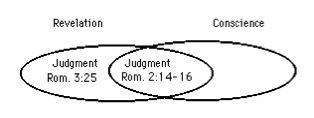
Evaluative determinism
Sliding-scale judgment does not exhibit an evaluative determinism where everyone comes out the same. Paul’s comments about the Gentiles represents God as conducting his judgment in this manner. Sliding-scale judgment is also evident in comments about degrees of punishment and reward: “more tolerable for Sodom and Gomorrah” (Matthew 10:15; 11:22; Luke 10:24); “the first will be last and the last first” (Matthew 19:30; 20:16; Mark 10:31; Luke 13:30); “twofold more the child of hell than yourselves” (Matthew 23:15); “better not to have known” (2 Peter 2:20-22); “many and few stripes” (Luke 12:47-48a); “receive the greater condemnation” (Mark 12:40; Luke 20:47); “she did what she could” (Mark 14:8); “to whom much is given much will be required” (Luke 12:48b); “he has the greater sin” (John 19:11); “the right hand and left hand in the kingdom” (Matthew 19:28; 20:21-23; Mark 10:36-40). The rewards of divine fellowship come in the form of varying responsibilities.
Any form of absolute determinism contradicts the implication of the Great Dilemma. The rational power of imagination, the inherent power of the message, and sliding-scale judgment bring modifying factors into the salvation process that help avoid determinism. There is an environmental and hereditary component to all behavior, but factors that we cannot control fall out of the judgment process. The ones we can affect form the basis for evaluation. On the one hand, influence is necessary and effective, because we will not change without it. On the other hand, we can change when the influence comes, and the change is not necessarily commensurate with the influence.
Preserving influence
Avoiding determinism must preserve influence so ability to resist must allow tendency to respond. Interpersonal love seems to meet these specifications. In the conquest of sin, if we succeed, God gets the credit; if we fail, we take the blame. The situation is comparable to a husband that overcomes alcoholism through the influence of his wife. He might say, “She made a new man out of me,” even though he did the “making.”
Avoiding determinism must also preserve a difference between the pre-Christian and Christian states since becoming a Christian means receiving the Spirit who gives strength. At the corporate level, the Spirit give (a) unity to Christian people (1 Corinthians 12; Ephesians 4:3). At the individual level, he not only gives (b) guidance as to what we are to do (Galatians 5:25; cp. 5:18, 17; Romans 8:14) and (c) strengthens us to do it (Ephesians 3:16), but also (d) intercedes for us when we fail to do it (Romans 8:16, 26-27; Ephesians 2:18; John 14:16, 26; 15:26; 16:17). Before salvation the previous dispensations of God’s love draw us to him. After salvation the sense of present acceptance moves us to greater triumphs in holy living than would be possible standing alone and lonely.
Components of conversion and sanctification. Four elements combine to form the process of conversion and sanctification in the case of psychological depravity and co-operating grace: (a) scripture, (b) church, (c) providence, and (d) awareness. The accompanying diagram shows the relationship of these elements. Solid lines represent indirect operation, and the dashed line represents direct operation.
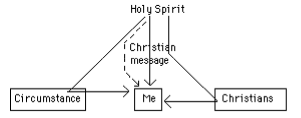
Faith comes and continues through (a) hearing the message about Christ (Romans 10:17). Hearing may not always produce or enhance faith, but faith always comes from hearing, as experience shows. The content of God’s purpose and pattern for human life are found principally in the message that comes from the outside.
The motivation to conform to God’s purpose and pattern for human life is found in the other three elements of the process. Whereas the cognitive predominates in the Christian message, the affective predominates in the rest, particularly in (b) experiencing relationship with fellow Christians. We feel God’s love through the love of God’s people so that God has assigned a most significant role to the church as a community that builds itself up in love (Ephesians 4:6). In New Testament literature, edification always appears in connection with the body of Christ and the atmosphere of love (Romans 12; 14; 1 Corinthians 8; 12-14; 1 Thessalonians 5:12-22; the Johannine literature throughout).
(c) Participating in providence creates and sustains in us a sense of finiteness and dependence in a circumstance we cannot cope with, alter, or manage alone.5 Under the confidence that God will not let come on us more than we can handle (1 Corinthians 10:13), several benefits accrue to us when we successfully confront hardship and temptation. We learn obedience (Psalm 119:67), respect (Hebrews 12:9), proper ranking of priorities (Romans 8:18); psychological, or spiritual, strength (2 Corinthians 12:10; 1 Peter 5:10), humility (2 Corinthians 12:7-9), ability to empathize with other people (2 Corinthians 1:4-5; 11:23-29; Hebrews 2:18; 10:34), patience (2 Corinthians 1:6; James 5:10-11; 1 Peter 2:20; Revelation 13:10; 14:12), and boldness (1 Thessalonians 2:2; Philippians 1:12).
Finally, (d) for a Christian, guidance, power, and intercession come from sharing an I-You association with the Spirit. On the human side, is a psychological depravity with the power of sin as the power of habit and faith as a natural response rather than supernatural deposit. On the Holy Spirit side, is a person rather than a power, principle, feeling, or attitude. He does what persons do in that he thinks (Acts 15:28), loves (Romans 15:30), and communicates (John 14:26; 15:26; Romans 8:26; 1 Timothy 4:1). He is treated like a person in that he may be blasphemed (Matthew 12:31), lied to (Acts 5:3), tempted (Acts 5:9), resisted (Acts 7:51), grieved (Ephesians 4:30), and insulted (Hebrews 10:29). The we-Spirit relationship is an interpersonal relationship between us who have ability and the Holy Spirit who sheds influence.
Combined interaction of components. Three aspects comprise the sanctification process: (a) vertical relationship to God, (b) horizontal relationship to other people, and (c) personal development in the context of these two dimensions. It is an interpersonal relationship centered in love and characterized by reciprocation. The first aspect is the God-to-us love spiral. Love always involves an act of self-giving that expresses it. The first step in the whole program is this, “God so loved . . . that he gave . . . .”6 God’s love provokes our love in self-giving obedience, “If you love me, you will keep my commandments.”7 The cycle is completed when it says, “If you keep my commandments, you will abide in my love.”8 Starting at different places, other passages cover varying portions of the full circle: “We love because he first loved us.”9
The second aspect of sanctification is horizontal. God-to-man love initiates man-to-man love, “If God so loved us, we also ought to love one another.”10 In initiating it, the God-to-man movement demonstrates also the key to reversing the downward spiral of deteriorating relationships—by an act of unprovoked love.11 The same act that builds neutral or positive associations also corrects worsening ones, but in the latter case it necessarily adds the feature of not returning in kind.12 Since people tend to do as done to, a mechanism usually used for evil13 can by love be transformed into good, “Give, and it will be given to you; good measure, pressed down, shaken together, running over they will give into your bosom” (Luke 6:3;8). Reciprocal love becomes the means for sanctification at the corporate level.
At the individual level the process of sanctification reciprocates between the inner and outer aspects of each person.14 As sin in one aspect of human nature spreads by interdependency throughout the whole person, so also good spreads in a person. Therein lies the value of a spiritual exercise like fasting. Controlling the body about food may enhance controlling other more subtle aspects of the personality. A human person is a psychosomatic whole, which accounts for pervasive sin and the possibility of pervasive sanctification.
Internal motivation produces outward behavior, “Out of the abundance of the heart the mouth speaks.”15 Outward behavior affects the inward man, “Where your treasure is your heart will be also.”16 The complete inner-outer-inner cycle appears in Colossians 1:9b-10, where knowledge, spiritual wisdom, and understanding lead to outwardly walking and bearing fruit, which in turn increase the original knowledge of God. Similarly, 2 Peter 1:5-9 adds to faith virtue, the knowledge, self-control, patience, godliness, brotherly kindness, and love—which things make us active and fruitful to the knowledge of Jesus Christ. Saying that love is not easily provoked (1 Corinthians 13:5) amounts to calling it the means to self-control and Christian growth. Since that process is triggered externally by the love of God and others, the Hebrew writer urges frequent assembly for promoting mutual sanctification (Hebrews 10:19-25). Agape love contains both rational and emotional aspects. Those elements appear to be arranged in parallel rather than in series, as in humanism. Rationality and emotion reciprocally affect each other and conjointly or separately can move the will to action. The synoptic character of love especially qualifies it for the salvation and sanctification processes.
Integrating Non-Determinism
Love has figured in several objections to concepts rejected in alternative formulations. (1) Love answers the Calvinistic will of complacency. No legal complaint could be raised against passing over some in the saving of others because, on the basis federal man, preterition is legally just and logically self-consistent, but it is not consistent with the nature of love. God loved the world when he gave his Son. If God loved the world in such a way as to give his son to save it, he does not balance his justice and his love by directing love to some and justice to others in Augustianian fashion. Love and justice are balanced, not by being directed to different people simultaneously, but by being directed to the same people sequentially.
(2) Love answers the problem of the point of contact. Love creates trust, which answers a person’s sense of meaning existentially in community and eschatologically in purposeful hope. So the point of contact in a man is his ability to be loved.
(3) Love provides the mechanisms for conversion. First, love takes the initiative so that reversing the downward spiral of deteriorating relationships comes by an act of unprovoked love. Secondly, love is synoptic, functional, interpersonal, and reciprocal. It addresses interpersonal relationships and touches on everything that comprises people in community. Love is both rational and emotional so that it combines cognitive and affective content with the social dimension through reciprocal behavior. By making love central in the real world of history, Christianity offers higher potential than competing faiths for meeting the needs of the whole self in its relations. Thirdly, love is resistible so that it avoids determinism. Love replaces natural miracle and stimulus-response.
(4) Love provides the mechanism for sanctification. Love motivates, brings self-control, and has degrees so that it gives the strength to overcome sin by generating motivational power to conquer habit. With salvation comes the sense of acceptance into fellowship with the Spirit of God and the increased potential for development over pre-Christian possibilities.
Love integrates the Christian faith because Christianity deals with the art of living relationally. The only promise faith gives is a better quality of interpersonal relations. Logic describes the bonds between ideas; force describes the bonds between natural elements; love describes the bond between persons. Natural depravity is impersonal, which shows up in misformulated emphasis on holiness. In its place, a construct is needed that is resistible so as to avoid determinism and yet be effective over non-Christian systems. It must have degrees to be better than the pre-Christian condition and yet not produce sinless perfection. That construct is love.
Contrasting with Different Understandings of Depravity
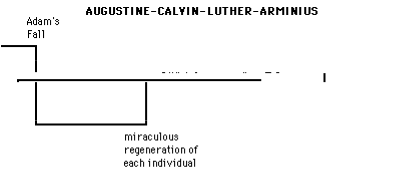
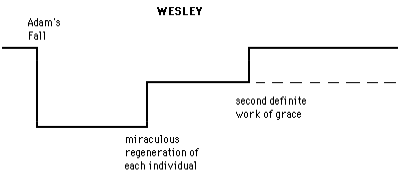
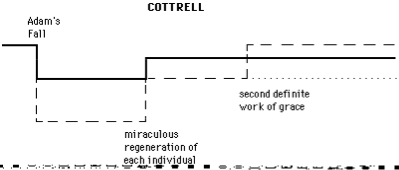
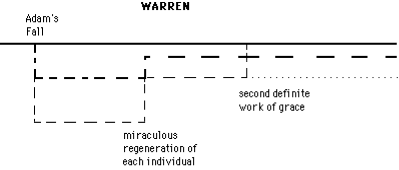
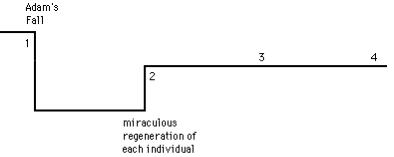
The first four diagrams above incorporate several important variables in God’s operation relative to depravity in connection with the Fall, individual regeneration, and personal sanctification. Some of these cannot be captured by diagrams designed to picture depravitizing-undepravitizing process per se. In the fifth diagram, we have supplied numbers at crucial points in the total process in order to locate other variables that apply. At station #1 the variables include (a) hypostatic vs. psychological depravity, which refers to affirming or denying natural depravity. All the layouts except ours suppose hypostatic depravity. Another variable here is (b) total vs. partial depravity within the natural depravity category. By “total” in this connection we mean that the depravity inheritable from the fall is so severe that a person cannot initiate response without supernatural, miraculous operation of the divine Spirit on our very nature itself (usually, “total” depravity means that depravity affects all aspects of the human person). A final variant here is (c) racial depravity vs. self-depravitization, which corresponds respectively with whether the depravity is or is not inheritable.
At station #2 a variable not covered in the first diagrams is (d) necessity vs. possibility of response subsequent to regeneration. Calvinistic-Augustinian regeneration was deterministic; regenerated persons never fail to respond to the gospel. Arminian regeneration was potential; regeneration restored people’s spiritual capacities to the point where they could choose whether they would accept the gospel. In general, the baptistic community has taken this alternate approach. By “baptistic” we mean a broader spectrum of evangelical denominations than just those that include the word Baptist in their name. Furthermore, there is a difference between (e) restoration by miracle vs. influence. A variable in station #2 plus #3 is (f) partial vs. total restoration. Those who speak of natural, or hypostatic, depravity make the restoration partial—in this life at least—except for the Wesleyan tradition. In the latter there is a second definite work of miraculous grace either simultaneous or subsequent to the regenerating grace unto conversion.
That last distinction in turn parallels (g) miraculous or non-miraculous sanctification, that is, enablement to grow by miracle or influence. In the first option miraculous regeneration is by operating grace; sanctification is by co-operating grace. Regeneration is made possible by miracle while sanctification is made possible by influence. Correlating with that distinction is (h) terraced vs. degreed sanctification, that is, whether sanctification is instantaneous or processual. Wesleyan sanctification is instantaneous insofar as there is a full restoration of pre-Fall spiritual capacity; the person in fact may then grow under personal influence into the ideal human person.
A final variable not addressed by the diagrams is (i) apostasy vs. non-apostasy. In Augustine and Calvin free will is not involved either in becoming saved or staying saved. In the baptistic heritage there is free will in becoming saved but not in staying saved—either because genuine conversion always lasts (perseverance) or because God never withdraws salvation as a state no matter what the person does (eternal security) or because God takes a person before he degenerates to the point of reprobation. Perseverance is more characteristic of the Calvinistic tradition while eternal security is more characteristic of the baptistic heritage. In the Cottrell, Wesleyan, and Warren formulations, free will is involved both in becoming saved and staying saved. Apostasy is possible behaviorally, relationally, and statively; people can turn away from practical Christian living, lose their interpersonal relationship with God, and no longer be saved.17
Our own position in this whole cluster of issues is that no demonstrable difference exists between pre-Fall Adam and post-Fall Adam as far as spiritual capacity based in inheritable nature is concerned. Since depravitization is not hypostatic, neither regeneration nor sanctification is miraculous; they occur because of influence rather than miracle. No one grows to the point of behavioral perfection, but the change that does take place is degreed change through influence instead of categorical change through miracle. Therefore, it is reversible rather than one-directional. The power of sin is habit not privation; it is psychological, not ontic. The pull of the past has the character of habit, not the loss, weakening, or disordering of being. Interpersonalism is the fundamental reality behind all these conclusions, whether they deal with our nature, our behavior, or our relationship with God and other people.
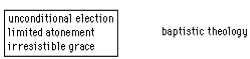
Depravity affects significantly how we conceptualize the process of (a) coming to salvation and (b) continuing in salvation. Consequently, it affects the role of the Holy Spirit, the value of apologetics for unbelievers, the process of interpretation, the definition and manner of regeneration/conversion/salvation, the nature of Christian growth, the reversibleness of salvation. T-U-L-I-P has long served as a handy acronym for the salient points of traditional Calvinistic theology:
Total depravity
Unconditional election
Limited atonement Calvinistic theology
Irresistible grace
Perseverance of the saints
Historically in reaction to this kind of system, “baptistic theology” has adjusted away from the format by dropping out the three middle steps:
Total depravity
Perseverance of the saints
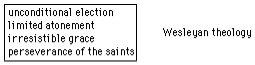
With the coming of Wesleyan theology, another shift away from reformed theology occurred. This time the fifth step was omitted along with steps 2-4:
Total depravity
Finally, we propose that this whole system of thought is wrong. Psychological “depravity” needs to replace natural depravity with all the adjustments that entails:
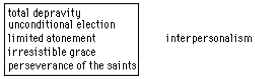
Into the theological picture the T-U-L-I-P system injects ontic and legal factors that do not belong to interpersonal relationships because both ontic and legal are impersonal factors. Ontic elements introduce an inheritable defective nature that irresistible miracle must correct. Unconditionality, limited atonement, and eternal security are legal concepts. We need to “do theology” with interpersonalism as the primary category. Ontic and legal considerations do not have a decisive bearing on the matter at all. Their place, if anywhere, is practical and secondary. At best, legal matters reinforce interpersonal ones; if the interpersonal element is not there, legal operation can do nothing. Ontic matters drop out of the evaluation process (judgment) unless, of course, they somehow resulted from a person’s own self-destruction for which he was responsible in the first place—self-depravitization in a natural sense. In other words, by way of summary, instead of picking off various petals from the tulip, we need to get an entirely different flower.
We picture that shift by replacing the tulip with a daisy. A daisy diagram captures something of the nature of the situation. Interpersonalism is the basic reality in the Christian worldview. We let that reality account for as much of revelation experience as we can. Abstract thought, ontic being, and legal process do not come into the picture except where scripture brings them in, and it brings them into the picture within the larger interpersonal framework. The aspects of Christianity we understand in an interpersonal sense. We can add petals to represent aspects of that interpersonal process.
Correlating Psychological and Natural Depravity
Natural depravity and the oft-accompanying legal process illustrate theological overkill in all the areas where nature and law individually or conjointly can affect anthropology itself as well as salvation, regeneration, conversion, hermeneutics, illumination, pneumatology, sanctification, apologetics, which grow out of it. Traditional theology has rather consistently legalized and ontologized the aspects of Christianity that law and substance could conceivably affect. The result has been perversion, inconsistency, and controversy. We do not want to overreact to overkill, however, and fall into errors that are equally harmful or worse; so we summarize comparisons with traditional theology:
universality of sin,
all-pervasiveness of sin,
inability of self-salvation,
power of sin that works against conversion and growth,
the (in)ability to understand the message,
Instead of using inheritable depravity to account for the origin and perpetuation of universal and all-pervasive sin in individuals and society, we have used ignorance, social existence, and pervertible psycho-physical nature as sufficient explanations. Ignorance means lack of awareness, our subjective viewpoint, God’s present invisibility, and our intellectual confusion. Social existence covers evil example, misunderstood good example, and social reinforcement of sins. Pervertible psycho-physical nature includes pervertible drives, disoriented affections, weakened will power, insensitive conscience. In all aspects of each individual and throughout society, sin is personally originated and socially influenced.
Instead of using inheritable depravity and federal man (a legal concept) to account for the impossibility of self-salvation, we have appealed to the nature of personal relationship, the nature of imperfection, the nature of personal group identification, and the power of sin as habit (cp. What the Bible Says About Salvation, 46-53).
Instead of using inheritable depravity to account for the power of sin before regeneration and during sanctification, we have appealed to ingrained habit reinforced by pervertible physical drives and negative social factors, a combination of physical and psycho-social factors. In extreme forms we see addiction and compulsive behaviors.
Instead of using heredity to account for depraved behavior, we have used a person’s own previous sins to account for it. We have appealed to corruptibility rather than corruption, self-perversion rather than race perversion. Here belong addiction and compulsive behaviors, which combine psychological and chemical dependencies. We admit the possibility of body chemistry affecting more than we might suppose, but we do not absolutize that mechanism.
So, sin has a psychological more than ontic basis. Instead of appealing to ontic miracle and medical treatment to account for behavioral change, we have looked primarily to interpersonal influence for both conversion and growth. We do not need to deny a physical component in behavior nor the affecting of such components by previous behavior, but that is self-depravitization. We do not expect to find a chemical cure for behavioral problems although medical treatment can affect some behaviors. Examples of perhaps surprising behavioral difficulties that can be chemically affected are certain kinds of emotional and compulsive behaviors. Emotionally driven behaviors include depression and its consequences, aggression, and the like. The reversal of these tendencies can involve getting rid of things like sugar and caffeine intake and using certain chemical, electrical, or surgical treatments.
Many chemical-based behaviors do not deal with morality although they may make life more difficult for people and for the ones they depend on.
Note the concept of self-depravitization: Paul says in Romans 1 that when we sin we receive in ourselves the recompense for our disobedience. Effects of previous sins include being hardened by the deceitfulness of sin (Hebrews 3); sin deceives. Not only is sin a habit, but sin is a hardener (sin hardens/sin weakens, a weight—Hebrews 13:2: will, etc.) That is why we call them sin; the designer has told us how to live with ourselves and other people.
Instead of appealing to supernatural miracle to eradicate some, most, or all the supposed inheritable depravity, we have invoked personal influence, influence mediated through love, evidence, example, experience and other facets of the Bible-church-circumstance complex. Note the love, meaning, security, and innocence factors as givens in human nature that influence addresses and that prime the pump for profitable hearing of the good news. Natural givens in us plus influence through the message, other people, and the direct relationship with the Spirit himself as well as accompanied by the preparation of the heart through circumstance.
Instead of appealing to direct supernatural illumination parallel to the word, we have appealed to indirect natural illumination through the message.
As far as mechanisms go, we replace corruption with corruptibility, heredity with society, ignorance, and flesh; miracle with influence, nature with psychology.
Arguing Against Natural Depravity
Lack of Primary Evidence
The Great Dilemma
Internal inconsistency
Unwholesome Consequences
missions
hermeneutics
apologetics, unverifiability, unfalsifiability
unwholesome self-image impoverishes people in order to glorify God.
unwholesome picture of God (He depravitizes people and then punishes them for being the way they are. Depravitizing people only exacerbates the problem of sin in the world.)
lack of accordance with experience
End Notes
1We say “in many cases” because theologians who believe in natural depravity do not necessarily also believe in “irresistible grace,” as it is called. The Spirit’s miraculous regeneration of sinners brings them to the point where they can accept or reject the gospel. This latter approach usually includes the idea that each of us during our life experiences this miraculous regeneration as a kind of “common grace.” Consequently, the “limited atonement” in Augustine-Calvin shifts to “whosoever will” (see comments on “TULIP” later in this chapter as well as the materials in What the Bible Says About Salvation, pp. 466-68; cp. 132-33, 150, 222-23, 529, and 560).
2See Augustine, De correptione et gratia 8; John Calvin, Institutes of the Christian Religion 2:3:1-14; Jonathan Edwards, A Careful and Strict Inquiry into the Modern Prevailing Notions of That Freedom of the Will Which Is Supposed to Be Essential to Moral Agency, Virtue and Vice, Reward and Punishment, Praise and Blame; and Martin Luther, On the Bondage of the Will. Understanding the nature of will lies central to understanding how the Christian system works. In regard to Luther, for example, Harry J. McSorley maintained that the real controversy between him and the Roman Catholic church was the freedom of the will: “Luther’s Central Concern: Neither Papacy, Purgatory or Indulgences,” One in Christ, Vol. III (1967), pp., 429-31. James Arminius in The Writings of James Arminius (Vol. I, p. 345) defined freedom as the ability to refrain from acting when all requisites for acting are present.
3For a fuller description of the rational empirical construct, see Stuart Hackett, The Resurrection of Theism: Prolegomena to Christian Apology, particularly pp. 37ff and 221ff as well as other literature noted there.
4Note Michael Landmann, Philosophical Anthropology, pp. 203-31.
5Genesis 3:22; Ecclesiastes 7:14; Romans 8:31-34; 1 Corinthians 1:9-10; 11:28-30; 12:7-10; 2 Timothy 3:11.
6John 3:16; see also Romans 5:8; 8:31-39; Galatians 2:20; Ephesians 2:4-5; 5:2, 25; 2 Thessalonians 2:16; 1 John 4:9-10; Revelation 1:5-6.
7John 14:15; see also 14:21a, 23-24, 31; 1 John 3:17; 5:3; 2 John 5; cp. Exodus 20:6; Deuteronomy 5:10; 7:9.
8John 15:10; see also 14:21b, 23b.
91 John 4:15-21; see also Proverbs 3:11-12; Luke 7:47; John 16:27; 2 Corinthians 5:14; Hebrews 12:5-13; Revelation 3:19.
101 John 4:11; see Luke 6:35; John 15:12-13; 2 Corinthians 8:8-9; 1 John 3:16; 4:7-10, 21; 5:2. According to Matthew 22:37-40 the Second Commandment is “like” the First.
11Proverbs 10:12; 17:9; 12 Corinthians 13:4-7; 1 Peter 4:8.
12Deuteronomy 32:35; Psalm 94:1; Proverbs 20:22; 15:1; 25:15, 21-22; 24:29; Luke 6:27-38; Romans 12:17-21; 1 Thessalonians 5:15; Hebrews 10:30; 1 Peter 2:18-25; 3:9-18. “Turning the other cheek” contrasts with revenge in social situations.
13Matthew 26:52; 2 Timothy 3:13; 2 Peter 2:13.
14The outer minus the inner is not satisfactory (1 Corinthians 13:1-3; Matthew 6:1-5; 7:15; 23:5-7, 25-36; Luke 11:37-44; John 7:24; Hebrews 4:12-13; 2 Peter 2:17; Jude 12; 1 Samuel 16:7, 20, 24, 26). Both must be present (James 2:14-26).
15Matthew 12:34; see also 5:8; 15:17-20; 23:26; Mark 7:19-21; Romans 6:17; 2 Corinthians 9:7; Proverbs 4:23; 15:13; 16:23; 28:25.
16Matthew 6:19-21; all passages involving imitation imply that idea also.
17There is no distinction between relational and stative. We have included both expressions here because some who believe in eternal security seem to think that a person can lose friendship with God but not status with God. Salvation seems to be a legal state of non-hell comparable to continued sonship with an estranged father. By way of contrast, interpersonalism in salvation means that if the friendship is gone there is nothing left. “Salvation state” means precisely personal relationship with him.
christir.org