
States of Man and Implications for Depravity
STATES OF MAN AND IMPLICATIONS FOR DEPRAVITY
IN ROMANS 7 AND 8
Virgil Warren, PhD
Romans 7:5-8:15 is one of several sections in Romans that have raised considerable controversy. In this study we attempt to work out Paul’s meaning in terms of legal imperfection in contrast to interpreting it in terms of humasn nature. Philosophically, the function and relationship categories replace the nature category. Theologically, ethics and salvation replace anthropology as the central concerns. We propose to show that natural depravity is a concept irrelevant to this text, if not false in itself.
Framework of Thought
Two Means to Perfection
Earlier in Romans Paul labors to help his readers understand a distinction between what he calls “faith” and “works,” code words for two formal means to a result in two different “systems.” By works he means inherent result; by faith he means non-inherent result.1 The result Paul is concerned with is human righteousness, or to be more exact, being viewed by another Person as having human righteous so that relationship between them can exist. Inherent result applies to law while non-inherent applies to grace. Theoretically under law (Mosaism), personal righteousness can come only from the person’s own actions. The other Person views him as righteous because he is righteous and gives him fellowship on that personal basis. Under grace (interpersonalism), righteousness is not fully there, but the sinner trusts (faith) the other Person to view him as righteous on the basis of his identity with the One who is righteous (Messiah/Christ) and to give him fellowship on that interpersonal basis. The sinner also trusts that Messiah’s righteousness is the proper, adequate basis for the other Person can view him as righteous likek the Messiah. Works as the direct cause of personal righteousness clarifies what it means to be “in bondage to sin” (7:14-24) and explains how a person falls into that situation (7:7-13). Faith is useful for understanding the state of the believer under grace (8:17).
Two Problems with Imputed Perfection
After Paul declares that everyone is lost (1:16-3:23) and shows the need for the “faith system” in overcoming alienation from God (3:19-4:25), he lays the foundation for that new system (4:25-5:19) and describes its applications and benefits (Romns 5:20-8:17). In this last section, two questions come to Paul’s mind as soon as he declares that works under law are not effective and that mankind needs to put faith in God’s grace. Antinomianism is a problem on one side of the issue and anti-Mosaism is a problem on the other. Antinomianism means that moral behavior has no decisive connection with salvation. Anti-Mosaism is opposition to Mosaic legislation as divine revelation about moral behavior. Jews falsely supposed that early Christians were opposing the Law when they said God’s revelation through Moses was not a permanent code for God’s people.2 Paul makes his positive presentation in a way that keeps his readers from slipping off into either false inference. Both points have a bearing on what he means in Romans 7-8.
Antinomianism. How can Paul dispense with the Law without implying that it does not matter how a we act? If actions have no meaning for salvation, does it not matter what we do: “Shouldl we continue in sin that grace may abound” (6:1; cp. 6:15)? Paul answers that the intent behind providing a way of salvation is to get away from the sin that leads to lostness. Bringing up antinomianism misses the point of both law and grace because both deal with the sin problem. Furthermore, observing that actions cannot themselves save us does not mean they bear no relation at all to salvation. They may serve as conditions God lays down for saving us through a system of non-inherent result (interpersonal process). The antinomian issue relates to 7:5-8:17 because 6:16-23 follows a rhetorical question to that effect, and what Paul answers there equals 7:6; 8:1-17.
Anti-Mosaism. How can Paul dispense with the Law without saying there is something wrong with it? Can he help casting aspersions on the Law by abandoning it in favor of another system? “Do we make the Law of none effect through faith?” (3:31; cp. 3:1). No, because faith has the same purpose as law had—establishing human righteousness and a person’s consewqurent relationship with God.3 “Is the law sin?” (7:7). No, the problem is with us, not the Law that governs us. God’s Law is good (7:12-13, 16).
Paul shows in 7:1-4 how not being under law does not belittle law or move outside the spirit of the Law into lawlessness. The question about the Law relates to Romans 7:5-8:17 because 7:1-4 on the Law immediately connects with 7:5-6, which state respectively the alternatives of being under, and out from under, the Law’s requirements. Verse 5 is elaborated in 7:7-24, and verse 6 is expanded in 7:25-8:17.
Without question legalism (7:5) vs. antinomianism (7:6) is a framework of thought for Romans 7-8. Paul’s solution is that we are released from law as to the irreversible consequences of disobeying it, but we are under law as a description of right and wrong.
Three Constructs Within Romans 7:5-8:17
Three constructs lie in the background of Romans 7:5-8:17 and form a matrix in Paul’s thought. (1) This section must be interpreted in terms of the difference between being under law and being under grace: Paul under Moses and Christ. What faith and works mean has been treated above, but we note again that the distinction between them is relevant here. Not only (a) has that distinction been a major theme in our essays; (b) the immediate context here opens with dying to law as a way of looking at the change from Jew to Christian. The comparison to a wife’s remarriage after a husband’s death is especially significant because (c) it stands within the block of material that urges Christians toward the implications of salvation for Christian living—a section that includes at least 5:20-8:17. The section given special attention here is not, then, the beginning of the topic in Paul’s treatment. (d) Immediately after the analogy to marriage under law, Paul applies that analogy to us under law (7:5) vs. not under law (7:6). Romans 7:5-6 summarizes 5:20-7:4 and serves as a précis for 7:7-8:17.
(2) This section must be interpreted in terms of a parallel between Genesis 3 and Romans 7: Adam and Paul. Several items are common to both chapters. “Knowing sin” sounds like “knowing evil” (Genesis 3:22). “Death” is the consequence of sin (Genesis 2:17; 3:3-4, 19). There was a time when “I” had not sinned, a time called being “alive.” “Beguiled” recalls Satan’s deception of Eve (Genesis 3:13; 2 Corinthians 11:3; 1 Timothy 2:14). “Desiring” psarallels wanting the forbidden fruit. Lastly, the fallen situation is irreversible.
(3) This section must be interpreted in terms of a parallel between the history of the human race and the life of Paul: Mankind and Paul. (a) Being “alive apart from the Law once” (7:9) does not derive from the context of the Garden particularly because there was never a time when the first couple were apart from law as God’s commandment. The commandment did not “come” to them after a time of ignorance. The revelation to Israel through Moses, however, does correspond to this part of Paul’s thinking. (b) Paul has referred to the coming of the Law through Moses in Romans 5:12-14 and in 5:20. The last verse begins everything up to 8:17 and ties back in the other direction to 5:12-14. A consistent progression of thought becomes evident with that observation. Moreover, the coming of the Law through Moses appears in the statement with Adam’s original act of sin (5:12-14). In his mind Paul associated the Adamic Fall and the Mosaic Revelation.
So there are three related comparisons behind Romans 7:5-8:17: a comparison between the history of mankind and the history of an individual man, a comparison between the Fall of mankind and the fall of an individual man, and the contrast between a man under law and under grace. Each person’s life partially recapitulates the history of the human race (innocence to accountability), re-enacts the Fall of the human race (accountability to sinfulness), and requires the change from law to grace (sinfulness to righteousness).
The Coming of Imperfection
Knowing Sin
In 7:7-13 Paul explains how “I” got into the death predicament. He says first that his knowledge of sin came through the Law. What “knowing sin” means partially depends on how closely Romans 7 parallels Genesis 3. If Paul deliberately connects them, “knowing sin” means experientially knowing sin, being actively involved in sin, as distinguished from knowing what sin is definitionally. Before they sinned, Adam and Eve knew definitionally what was right (caring for the Garden, populating the earth) and wrong (eating from the tree of knowledge). So, “mankind has become like one of us knowing good and evil” does not mean knowing definitionally what good and evil are, but participating in evil as well as in good—knowing experientially.4
In Romans 7, then, Paul does not intend (a) a statement on revealed ethic vs. innate (or scientific) ethic.5 It is not (b) that right and wrong do not exist where there is no standard (4:15), nor that (c) God does not hold wrong action against us until he reveals to us that it is wrong action (3:25; 5:13).6 (d) Neither does he mean, “It hit me what the Law really meant.” Rather, (e) he would not have sinned had it not been for the Law (cp. 3:20). All these other ideas may be true, but the point here is not so much an objective one, as in the first three; nor a subjective one, as in the fourth; it is an experiential one.
Sin and Law
The question raised here is how the Law relates to “my” sin. The coming of sin to “me” parallels the coming of sin to the human race in the beginning. The coming of the commandment to “me” parallels the coming of the commandment to the human race through Moses. Many commentators suppose that (a) the commandments and prohibitions of the Law in themselves aroused perverse desires dormant in Paul. Most comments to that effect arise from the natural-depravity presupposition generally brought to the passage. Aside from depravity, there is some truth to the idea that forbidding something draws more attention to it than not mentioning it at all. Continually reprimanding a child for some habit tends to crystallize that habit in him. Nevertheless, that kind of adverse effect seems not to be Paul’s point here.
The suggested interpretation is that (b) the Law was the occasion temptation used to lead Paul into sinning. (1) In the Fall, Genesis does not picture Adam and Eve as lusting after the forbidden fruit after God forbade eating it. The prohibition itself was not counterproductive. Their natural “desire” for food was misdirected by Satan, who took “the law” as an occasion to tempt them into fulfilling their desires “unlawfullly.” Likewise, in Romans the commandment was the occasion by which sin slew Paul in the day that he partook thereof. God’s Law is then the occasion temptation uses to lead people into sinning against God. Temptation does so by taking a desire that is in itself wholesome and urging us to satisfy it in an unwholesome—in a way that is contrary to God’s revealed Law. So the problem is not the desire nor the Law, but temptation by other persons to get “me” to satisfy that desire the wrong way. Law—and the desire itself, for that matter—are the occasion that temptation uses to bring about sin. Once sin is brought about, the sinner is “trapped” in legal imperfection (state), psychological compulsion (behavior), and interpersonal alienation if nothing but law and behavior bear on relationship to the Lawgiver.
(2) In the history of our race, there was no formal law before Moses on the basis of which God imputed sin (5:13). There were interpersonal covenant values (Genesis 9:1-7). In one sense an act is sinful whether a sinner knows it or not, but God has adopted the practice of not holding sin against us if he has not revealed to us that he considers it sinful. Under that construct sin definitionally speaking was already in the world before sin revelationally speaking came into being. So, sinful practices preceded the Law on the basis of which God held people guilty for those sins. The comparison is that Paul’s sinful practice preceded the Law on the basis of which God held him guilty. So, the coming of the commandment merely provided the basis for God’s beginning to impute to him what he had already been doing before the commandment came. The conclusion is that the Law relates to the sin of a man like Paul, not as cause to effect, but as occasion to effect. The commandment itself is holy, righteous, and good.
That understanding of Paul’s thought is reinforced by the Jewish practice of celebrating bar-mitzvah. Previous to about twelve years of age, the Jewish boy was taught what God expected of him as a member of the Jewish nation. In bar-mitzvah he formally came under the Law by becoming a “son of the covenant.” It meant the personal, active acceptance of the Law under which he had automatically and passively been placed by birth. Its functional equivalent is first communion and confirmation in magisterial churches and roughly corresponds in time with the age of accountability in the free-church traditions (baptism). Those acts formalize into a point what in many respects is a process. Paul treats as a point in time what must have had elements of process over time since he could hardly specify an exact moment when the commandment “came” to him. In effect, bar-mitzvah was not a coming into life, but into death: “When the commandment came, sin sprang to life, and I died.” Bar-mitzvah was the occasion of “the evil impulse.” The coming of the commandment was the occasion of the effect.7
(3) The placement of “through the commandment” in 7:8 and 11 may support the second way of viewing the relationship between law and sin. Is it, “But sin, taking occasion through the commandment, worked in me all lust,” or is it, “But sin, taking occasion, through the commandment worked in me all lust”? Does “through the Law” modify “taking occasion” or “worked in me”? The latter leaves the reader hanging as to what “occasion” means, so the other seems preferable. In 7:5 Paul does not mention “occasion,” but states in shorthand fashion that “sinful passions . . . [were] through the Law.” Regardless of the grammar, the sense is that sinful passions are through the influence of temptation in connection with the prohibitions of the Law. The “passions” per se, we add, are not themselves sinful.
Law and God
Since the Law was only the occasion for sin, Paul does not blame the Law (7:12) or question God’s motives in giving it. “Did good become death to me? Certainly not. But sin, that it might be shown to be sin, [became death to me] by working death to me through good” (7:13; cp. 5:20; Galatians 3:19). The evil of sin used the good of the Law to bring about the evil of death. God did not do evil that good might come (3:8) as if he gave the Law to get people “messed up” so they would have to look to him for salvation. God intended the Law to be a source of life, not a stumbling block for death (7:10; 10:5; cp. Galatians 3:12; Luke 10:28; see Leviticus 18:5).
God’s first motive in giving the Law was to define what people should do to have life (7:10). Since people had already developed habitual patterns of life, the second motive for giving the Law was to sensitize them to the fact that what they were doing was sinful. That intent was not to make them stumble, but to show them that what they were doing was stumbling. God made sin “abound” by putting those actions into the sin category (5:20; cp. Galatians 3:19). The third motive for giving the Law was to make sin “exceedingly sinful” (7:13). Sensitivity to sin is not simply an increased awareness of right and wrong, but our realization that we stand under a condemnation that leads to despair, which in turn leads us to Christ (7:14-25). By attaching the death penalty to the im perfection, God showed how flagrant infractions of his commands really are. Since the punishment is commensurate with the crime, heavy penalty indicates serious offense.
Meaning of Death
God intended his Law to give us “life” (7:10) by regulating our behavior, bringing us within God’s purposes, and so giving us “meaningful existence” through relationship with God and his purposes. But in practical effect, temptation relative to that Law resulted in “death.” Although Paul uses dead and death with more than one meaning in this context, he does not mean (1) physical death when he says, “I died,” but something that resembles it; because in 7:1-4 he compares physical death to the topic at hand. That comparison shows that physical death is not his subject and that certain of its features do fit his subject. The spiritual death he means might be death as (2) separation—separation from God (death separates husband and wife) and therefore meaninglessness (for a woman a dead man can no longer mean “husband”). Separation from the Law means not being affected by the Law, as when someone says, “He is dead to the world.” Death could be (3) internal conflict (separation between intent and physical desire). Death could also be (4) irreversible situation or (5) impotence either to affect or effect something. Perhaps all these elements of death apply to the various usages of dead in the chapter. Life means the opposite of each meaning of death.
That Christians are dead to law (7:4, 6) evidently means separated from law so that it no longer rules us. “Discharged” in 7:6 equals “having died” in 7:4. Sin is dead apart from law (7:8) because it is impotent to affect or effect anything. When Paul says, “I died,” he evidently means a cluster of ideas: (a) he entered an irretrievable, or irreversible, situation8 of (b) separation from God, from which (c) he was impotent to deliver himself. That separation is irreversible, and sinners cannot deliver themselves from it because imperfection by its very nature cannot be overcome.
State of Rejection
Christian Grace Perspective
At 7:14 many interpreters see a shift from pre-Christian to Christian experience, especially in the reformed tradition, which follows the explanation of the later Augustine.9 (1) A shift from past to present tense occurs here, which implies a change to Paul’s current experience. (2) On the presupposition of natural depravity, a non-Christian would not want to do good, would not hate sin, not delight in God’s Law, or serve him with the mind. (3) The struggle between intent and accomplishment is so characteristic of the Christian life (“the spirit is willing, but the flesh is weak”; Matthew 26:41 = Mark 14:38). For an unregenerate person there is no struggle. For a regenerate person the struggle supposedly reflects the partial restoration from depravity that the Spirit’s supernatural regeneration gives toward an unfallen condition. Regeneration is not something that enables us to the point that we no longer struggle with temptation.
In response to the third point, we overdo the sinfulness of sinners by asserting that for them there is no struggle for moral attainment. Non-Christians are not perfect, of course, but that does not justify making them all out to be worse than they are (or, for that matter, that they all are worse than any Christian). They need Christ because they are not perfect, not because they are perfectly evil. Paul’s point is not how sinful sinners are, but that they are sinful. Being sinful at all means they need Christ. Being sinful at all means that they need more than a definition of right and wrong. At a more general level, being sinful at all means they need interpersonal factors applied to their circumstance—grace for faith. During his days as a Pharisee Paul claims to have achieved a rather enviable level of legal morality (Philippians 3:6-11). Though he was “blameless” (in a loose sense, of course), he was not perfect (3:12-16). For that reason he told the Philippians that he needed to keep growing. “Having Christ” released Paul from the necessity of total success in his struggle, which freed him up to keep trying to bring about in his behavior (actual righteousness) that for which Christ had “laid hold of him” (reckoned righteousness). From a practical—and especially a theoretical—standpoint, perfectionism stifles and unnerves. We do not do as well as we would if we were not “trying so hard.” “Trying too hard” is like absolutely having to hit both foul shots or lose the game. Some “good moral men” appear to strive as hard to do good as many of us regenerate Christians do. Paul was a previous Jew who had attained a notable level of moral quality; yet he needed Christ. In Romans 2:14-15, Paul speaks even of Gentiles as doing by nature and conscience what Mosaic revelation contained. Advocates of the depravity position tend to overdo how sinful sinners are, which is not surprising if depravity were true; but bringing in such an indictment here more reflects the depravity position than argues for it.
One seeming justification for the tendency to exaggerate the sinfulness of non-Christians appears in some of the Old Testament scriptures Paul cites earlier in Romans 3:10-18 (Psalm 14:1-3 = 53:1-3; Psalm 5:9; 140:3; 10:7; Isaiah 59:7-8; 36:1). But these descriptions do not have to be taken in the extreme for everyone. For a significant number of people, the passages amount to exaggerations for emphasis. They are affective statements that reflect the way we often feel about other people—Christians included—and about ourselves when we fail miserably or sin significantly as David did in the incident with Bathsheba (Psalm 51; 2 Samuel 11-12). Admittedly there are many people of whom such statements are not exaggerations in the least. But that is different from claiming that non-Christians as a class do not struggle to do good. Romans 3:10-18 must be understood in harmony with 2:14-15.
Furthermore, the Christian struggle is not the kind of struggle Romans 7:14-24 presents. That these verses hardly describe a Christian becomes more evident when materials in chapter 6 and 7:5 combine with 7:14ff. (a) A Christian is not properly, or at least fully, described as someone in bondage to sin. In 7:14 Paul says, “I am carnal, sold under sin” (cp. 7:13). In 7:24 he cries out to Christ for deliverance from his captivity. Similar language expresses the pre-Christian experience in 6:16-23, where Paul refers to his readers as previously “servants of sin” (6:17, 19, 20). He does so in the past tense, which contrasts with the present “servants of God,” etc. (6:22). They were not Christians when they served sin; they are Christians now that they serve God. “We have died to that wherein we were held” (7:6). The Christian struggle is not a struggle in a context of bondage.
(b) A Christian is not properly described as someone who “brings forth fruit unto death” (7:5): “What fruit then did you have at that time with respect to the things you are ashamed of now, because the end of those things is death?” (6:21). A Christian’s fruit is “unto sanctification and in the end eternal life” (6:22). The “I” in chapter 7, however, amounts to one who brings forth fruit unto death in that a law works in his members in a way that puts him where he needs to be delivered from death (7:24). The Christian struggle is not one that leads to death.
(c) A Christian is not properly described as someone that lives in despair, crying, “Wretched man that I am! Who will deliver me out of the body of this death?” (7:24). We have not received a spirit of bondage again unto fear, but a spirit of adoption (8:15). We do not cry out, “Wretched man that I am,” but “Abba, Father.” That deliverance is a present possession received by those who have identified with the resurrected Lord through the resurrection of the new man in baptism (6:1ff.). The Christian struggle is not a struggle that produces despair. No one denies that Christian living involves struggle; Paul buffeted his body daily to bring it into subjection (1 Corinthians 9:27). But the struggle is not one of bondage to sin, fruit unto death, and a sense of despair.
One argument may suffice to neutralize the force of the second point. The line of reasoning went,
“People cannot delight in God’s Law unless they are regenerate;
they cannot be regenerate unless they are in Christ;
therefore, Romans 7:14ff. is describing a Christian.”
The minor premise is not true. A regenerate Jew could have delighted in the Law. Saved people are coextensive with regenerate people. Some people under the Law were saved, hence, regenerate—people like Moses, Elijah, David. The pertinent variable then is the law-gospel variable already in the context, not the unregenerate-regenerate variable introduced from outside. Paul is talking about salvation (soteriology), not necessarily the nature of mankind (anthropology).
With reference to the first point, the change of tense at 7:14 does not require a shift to Christian perspective because a Christian is writing in first person. Paul might be using a literary device as he does elsewhere (1 Corinthians 6:12, 15; Galatians 2:18-20, etc.), though that alternative is not likely here. More to the point is the fact that Paul’s topic is salvation, which applies to everyone including Paul.10 Furthermore, the “I” appears not only in the present, but also in the past (7:7-13). The preferred explanation follows the explanation outlined below.
Jewish Law State
From the perspective under grace Paul contemplates his present experience aside from the benefits of grace. He views the Jewish state from the Christian perspective. That accounts for the present tense and avoids the artificialness of saying that Paul is talking about something purely hypothetical. Since 7:14-24 applies to Christians, it describes a present, real experience from Paul’s standpoint. Insofar as it does not fully or properly describe Christians, it might be called hypothetical. Romans 8:1 describes the other aspect of the total Christian experience. As a splice verse 7:25 combines spiritual aspiration and “fleshly” drag on it. Christ makes up the difference; or, to put it more abstractly, interpersonal processes make up the difference between personal performance and legal perfection, actual living and ideal expectancy.
The first reasons for this interpretation are the same as (1) the exegetical observations given above against the reformed interpretation. There are features in 7:14-24 that do not fit Christian experience. (2) Furthermore, 7:14-24 is totally silent about Christ and the Holy Spirit, elements supplied in 7:25-8:3 and 8:4-17 respectively. (3) Nothing beyond a Jewish person under law is necessary for understanding chapter 7.
The reason 7:14-24 applies to grace, but does not describe grace, is that law and gospel are not parallel categories except as bases for relationship to God (soteriologically). Moses and Christ are not discontinuous divine economies (3:31, etc.). They have a common purpose and a common “holy history,” the former preparing for the latter (7:14-24) and the latter fulfilling the anticipations of the former. Formally they relate as follows:
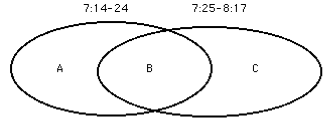
Instead of two separate circles, they are two overlapping ones. Both law and grace have distinctive features (A, C) as well as common ground (B). Law (7:14-24) and grace (7:25-17) are the same as to perfection standard and the struggle to attain it; so 7:14-24 does not describe Christians even though some aspects of the description apply to Christians.
Christians are, so to speak, under “law” (B) definitionally and “demandingly.” God defines right and wrong for them and requires perfection just as surely as before. The means to perfection is the main thing that has changed. Under law, perfect righteousness is by works (A); under grace it is by faith (C). As a consequence, there are opposite implications (A, C) for the struggle (B) common to those living under either system. God’s Law always (B) requires death for sin (alienation for disobedience). Since all people sin, the struggle under law (A) leads to death, bondage, and despair. Serving the Law in effect meant serving sin (7:25). Since all people in Christ stand uncondemned (8:1), their struggle (C) leads to life (8:11), freedom (8:21), and hope (8:24-25). Christians are subject (8:7) to God’s “Law” (B), not captive to it (A). Being under Christ and being under Moses are the same (B) ethically11 and anthropologically, but they are not the same (A, C) soteriologically and therefore psychologically.
In summary, (a) the experience described in 7:14-24 does not have to be a Christian’s struggle because it can be that of a regenerate Jew; so regenerate-unregenerate does not belong to the discussion. (b) Christianity vs. Mosaism is not distinguished by moral struggle; so chapter 7 is relevant to Christians as to the fact of the struggle, but it does not describe Christians in that struggle.
Paul views the situation under law from his Christian perspective, not as something he looks back on, but as something he looks out from in his present position minus the benefits of Christ. He describes the legal circumstance (commandments and works) minus interpersonal factors (grace, faith, and identity with the Righteous One). This understanding is preferred over the one that looks back for four reasons. (1) As a Jew, Paul would have spoken confidently, not despairingly, of his place before God: “. . . as touching the righteousness that is in the Law, found blameless” (Philippians 3:6; cp. Galatians 1:13-14; 2 Corinthians 11:21-22). (2) As a Jew he did not see the ineffectiveness of animal sacrifice provided by the Law. Imperfections in his works were made up for by offering a sacrifice that balanced the books, a sacrifice being something he could give in addition to himself to make up for what he lacked in himself.
(3) Jews seem not to have perceived that Mosaic righteousness required perfection, but conceived of righteousness as a preponderance of good deeds over evil ones. (4) Contemporary Judaism concerned itself more particularly with matters that could be quantified than with qualitative motivation. Jesus continually denounced the Pharisees for getting “hung up” on such things and leaving undone the really important things like mercy, justice, love. Paul also wanted his Roman readers to turn aside from the traditional misemphasis on the measurable letter of the Law and serve God in the qualitative spirit, or purpose, of the Law. Perhaps for this reason he centers his discussion around the abbreviated form of the tenth commandment: “Do not covet.” Coveting is a general covert attitude in contrast to several other items in the Decalog that deal with specific overt actions.
In conclusion, Romans 7:14-24 does not properly describe a Christian, but it describes a Christian contemplating his situation without the benefits of Christ, which amounts to describing a Jew. But it is a description that only a Christian would give. Jews did not really realize the predicament they were putting themselves in by taking a purely legal approach to relationship with God. However, when a person (a) sees that the Law requires moral perfection, (b) realizes that death is the consequence of not actually living up to that impractical standard, and (c) understands the ineffectiveness of animal sacrifice to make up for failures under such a standard, the only possible reaction is psychological bondage and emotional despair. Jews did not realize their predicament mainly because they did not have the Christian experience for contrast.
State of Acceptance
Recapitulation
Temptation operating through the flesh uses the Law as an occasion to produce sin, which in turn produces death (cp. James 1:14-15).

The Holy Spirit operating through the human spirit uses the Law as the occasion to produce righteousness, which in turn becomes life.

In the actual Christian experience these two processes are going on simultaneously to create the struggle Paul confesses. However, the sin that occurs is canceled because of Christ.
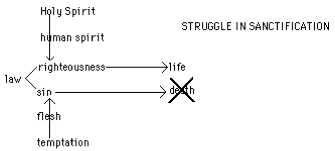
We hasten to add that these statements represent the purely logical movement within law and grace. They do not include modal and qualitative distinctions in those movements. In the first process, the mode of production is inherent result: sin produces death because a sinful act itself breaks perfection. In the second process the mode of production is non-inherent result: the aspiration for righteousness (implied by identification with the righteous Messiah) only meets the interpersonal condition on which God grants life. The third situation goes beyond the scope of Romans 8 because Paul does not specifically address the struggle. It must be remembered from Romans 7 (or brought in from Galatians 5:17-18; 1 Corinthians 9:27; cp. 1 John 1:8-10). The second and third processes presuppose the state of acceptance made possible by Christ. In all three, “flesh” is equivalent to “body” (6:6; 7:24; 8:13), “passions” (7:5), and even “members” sometimes (6:13, 19; 7:5, 23). The “human spirit” (8:16) is equivalent to “mind” when used alone (7:23) and to “inward man” (7:22). Finally, “death” covers two related matters: the irreversible bondage inherent to legal imperfection and the practical bondage that may be called habit (psychological). Before discussing this last point, we must say some things about Paul’s use of the word flesh.
Flesh
What Paul means by “flesh” correlates with the reason he chose the term. In 7:5 he speaks of sinful passions; in 7:7-8 he refers to the tenth commandment: “Do not covet.” In the last half of chapter 7 we understood “knowledge” on the background of the Fall to mean experiential knowledge. The inference is that Paul uses “sinful flesh” (8:3) and “sin” personified (7:8-9, 11, 14, etc.) to mean flesh functionally, not flesh naturally. Therefore, he does not mean that the stuff “flesh” is materially evil as in Gnostic/Manichean dualism, or that it is formally evil by disorder relative to a pristine state as in Augustinianism. Rather, he means that “flesh” is experientially sinful in accordance with meaning “knowledge of sin” experientially. Sin is an action, not a nature; so flesh is actively sinful, not naturally sinful. “Flesh” is used experientially.
Since it is used actively, “flesh” stands by metonymy for its desires. Flesh is the noun equivalent for the verb in the prohibition, “Do not covet.” Coveting is self-centered behavior that correlates formally with the desiring of the flesh. Thirst is quenched by taking something into the flesh from the outside. The same is true of the other bodily drives. The flesh finds satisfaction only when something is directed in toward it, as distinguished from finding fulfillment by directing itself outward toward something else. Satisfying the flesh has an outside-to-inside pattern, the same pattern that coveting has.
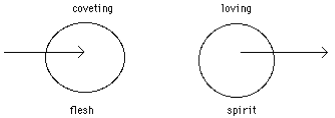
The tenth commandment is an “anti-egocentric” prohibition. It is formally opposite to the First and Second Great Commandments, which deal with love in serving God and man. Paul’s term flesh captures the idea behind the tenth commandment. “Flesh” is used psychologically.
Fleshly desires are self-centered desires. Although they are self-centered, they are not in themselves sinful. They merely have the pattern pictured in the first diagram above. Since fleshly desirings are self-centered, in themselves they are also unprincipled desires because external principles do not govern them.
Revelation and conscience govern the way we fulfill bodily desires. God’s Law and culture’s mores restrict the gratification of those desires within the person in terms of the requirements of relationships between persons. Inherently amoral drives take on moral qualities.
When once we fail to direct with the mind/spirit/will the fulfillment of physical desires in conformity with the moral norm, we have broken the perfection that law requires. The decisive factor here are the physical drives that are not restrained by the mind and directed into a suitable manner of satisfaction. That decisive factor gives name to a state defined relative to law as imperfection; Paul calls it “being in the flesh” (7:5). By nature, imperfection is irreversible. Death is Paul’s term for irreversibility, or “bondage.” Bondage is bondage to the penalty of law contrary to which we assuage physical desires. Theoretically, one sinful act is all that is necessary for that legal consequence, as even the Fall account witnesses (cp. also James 2:10. That bondage called “being in the flesh” is equivalent terminology for irreversibility. Furthermore, the appropriateness of flesh terminology for what is also set forth in death terminology is because flesh dies. Flesh is used legally.
Having traced the line of reasoning that explains the appropriateness of Paul’s flesh terminology for legal bondage, we can understand practical bondage in flesh terminology also. Practical bondage we have called “habit.” A habit is a learned pattern of behavior that becomes increasingly automatic as a function of time and degree of indulgence. A habit is learned behavior, not inherited defect. It is changed the same way it is brought about—by interpersonal influence to alter action, not by miraculous force to change being. Death as legal bondage is being “in the flesh”; death as practical bondage is walking “after the flesh” (8:4; 6:2). Legally, Christians are not “in the flesh” (8:9); so practically, they ought not walk “after the flesh” (8:4). Instead, they are legally in Christ (8:1) and walk practically “after the spirit” (8:4). Flesh is used practically.
Spirit
Besides the law-flesh-death cluster of terms, there is a cluster of spirit expressions: spirit of the law, human “spirit,” Holy Spirit. That set of phrases raises two questions: (a) does spirit means human spirit or Holy Spirit and (b) what is meant by spirit of the Law vs. “letter of the Law”? To the first question we may say that our spirit and God’s Spirit correlate in contrast to flesh and Satan (sin, tempter). In unclear cases, we need not decide which is meant. It seems most natural, though, to take spirit in the lower case when it contrasts to flesh, and in the higher case when it contrasts with mankind. Flesh is one aspect of us; so we expect what it contrasts with another aspect of us—our spirit rather than the Holy Spirit.12 The hermeneutical “law of contrast” implies that contrasted items are at the same level within a common larger category. Since “flesh” is within the category “individual man,” we expect “spirit” to be within the same larger category “individual man.”
As to the spirit vs. the letter of the Law (cp. 2 Corinthians 3:4-6), we set aside several alternatives in favor of one that correlates with the rest of the spirit cluster. The rejected ones are figurative vs. literal (Origen), personal vs. written (Sanday), gracious vs. legalistic (Luther), internal vs. external (Calvin). We chose the contrast between purpose and nature. The spirit of something is some invisible aspect of it. The spirit of the Law is its purpose, or intent: human righteousness. The letter of the Law means the precise way by which law achieves that human righteousness: inherently producing it through continuous obedience to its every command (Galatians 3:9-14). Some of the interpretations above are akin to this one, but they do not emphasize the purpose vs. nature of the Law.
Sanctification
At last we can attempt to state the mode of the Holy Spirit’s interoperation with the human spirit in putting to death the deeds of the flesh (8:13; 6:6). That is Paul’s central concern in this section: the process of sanctification. We must combine two points to elucidate the nature of the Christian struggle: (1) the nature of a Christian’s state of acceptance; and (2) the nature of practical sin as habit.
Our state of acceptance in the Beloved means that God no longer looks on us with a “frown,” but comes to us with “open arms” in the person of the Holy Spirit, who is present and loves us. We are always more productive and successful when other people are present and interested than when we are alone. We are always more productive and successful in an atmosphere of love, acceptance, and encouragement than in a climate of rejection. We more often win in our struggles when we have the “home court advantage.” We know about the presence and love of the Spirit, not by direct perception (Judges 16:20), nor necessarily by supernatural products, but by promise and indirect “perception” through God’s people. The degree of help that comes from the Holy Spirit is therefore in direct proportion to the level of our conscious awareness of his Invisible presence. The level of awareness is affected by activities and relationships that help us focus on the Unseen—fellowship with those of like awareness who demonstrate the same love the Spirit has. The experience of God is mediated through people who possess the divine attributes of presence and love. Bible reading, prayer, worship, meditation, the Lord’s supper are other activities that raise our level of God-consciousness and consequently increase the “power” to conquer sin as habit. That is how a Christian’s state of acceptance benefits him.
Secondly comes the nature of practical sin as habit. If sin is habit, then what we need to curb and subdue sin are those things by which we break habits. Sin is not the loss of some aspect in our being as in natural depravity, so its solution is not through miraculous power. Sin is an action we do; hence, its solution is through interpersonal power from motivational strength supplied by interpersonal influence. That kind of positive power exists between one person and other people and the Holy Spirit. Both Satan and the Holy Spirit have their counterparts in people who embody their characteristics, values, and behaviors. Interpersonal power implies motivational power; the strongest motivational power is love; the greatest lover is God; from his love no other person or thing can separate us (8:35-39; cp. John 10:28-29).
Implications for Depravity
Traditional exegesis has aligned Romans 7-8 with the regenerate-unregenerate variable. In this chapter we have attempted to work out Paul’s meaning in terms of the law-gospel variable. If the exposition is satisfactory without appealing to natural depravity, we may infer that it is unnecessary for properly understanding Romans 7-8.
Commenting on Romans 7:9, 13, John Calvin appealed to 2 Corinthians 3:12-18 to illustrate the kind of thing responsible for Paul’s statements in the Roman letter. In that appeal, Calvin undermined his own system by correlating regenerate-unregenerate with law and grace.13 First is a summary of his reasoning followed by an alternative solution and the anti-depravity implication.
In 2 Corinthians 3:12-28 Paul compares the veil Moses put over his face with the veil that lies over the hearts of Jews when they read the Law. For Calvin this veil, being associated with the hardened mind (3:14), meant that the Jewish heart was insensible to the import of the Law—rather than insensitive to it. Only when a person turns to the Lord is the veil removed and the heart becomes sensible to the Law. In this way Calvin brought to Romans 7 the regenerate-unregenerate distinction. “I died” came to mean “became insensible to.”
The apostle’s intent, however, relates to the Jews’ lack of awareness that the Law demanded perfection. They apparently reasoned that God could not have meant sinless perfection when he required holiness because such would not be possible. The Law described an ideal, not a required achievement. They took the actual requirement to mean what was possible for a person to do from a practical standpoint, rather than what he ought to do from an ideal one. They substituted practically perfect for actually perfect.
God’s holiness is his perfection, which is also his glory, a glory that the Law demanded of a person: absolute perfection. In that all have sinned, none are perfect. They all “fall short” of God’s glory (Romans 3:23) by being “less than” holy.
In light of that thought, Paul’s analogy in 2 Corinthians takes on a different significance. As the veil over Moses’ face reduced the glory of his countenance to a level tolerable to their sight, the veil over their heart reduced the glory of the Law to a level tolerable to their insight. Jews reduced that glory by substituting practical perfection for absolute perfection and by supposing that animal sacrifice was actually effective. These sacrifices were for individual sins, however, not for sin, that is, not for removing a person from his sin status (Hebrews 10:1-4). Their practical presupposition prevented them (“hardened their minds”; 3:14) from beholding barefaced the glory of the Lord into whose image they were to be transformed (3:18). When a person turns to see the Lord, who is gloriously perfect, and realizes that he is to be as holy as the Lord is holy, the veil that dims the glory of the Law’s demands is removed (3:16). His mind allows the Law to say to him what it really means because his mind also sees that the impossible demand it makes is taken care of in the person of Christ. The perfection standard is made tolerable by interpersonal considerations.
The Jews drew that pragmatic veil between themselves and the Law because it had not been revealed to them that Messiah would remove it (3:14) in such a way that they could look on the full glory of the Law in its demands (3:7-11) and yet not cry out, “O wretched man that I am! Who will deliver me from this irreversible state of imperfection?” The answer is, “Messiah.” There is no condemnation to them that are in him (Romans 7:25; 8:1). So then, the Law had a glory by virtue of the perfection it required of people to make them like their glorious God, but Messiah has greater glory than his Law by making it possible for imperfect people to look barefaced at that demand without being driven to real and psychological destruction—death (2 Corinthians 3:7-11). Not only does Messiah demand perfection, but he goes beyond law in making perfection possible for imperfect people when they identify with and commit themselves to him, his lordship, purposes, and values. It is a “reckoned” based on the intent of the heart.
What Calvin mistook for an anthropological indictment is really an exegetical indictment. The point then is not that the mind is hardened because the heart is insensible, but that the mind is hardened because the heart is insensitive. The heart is insensitive, not because it is insensible. Insensitivity can be caused by other than an inability to sense. Insensitivity to the Law’s demand for perfection was caused by the supposition that God could not mean absolute perfection because that was not possible even before there was sin.
Either Calvin is inconsistent in applying regenerate-unregenerate to Romans 7 or natural depravity is not true. In Calvinism the regenerate-unregenerate distinction necessarily correlates with the saved-lost distinction. By appealing in Romans 7 and to 2 Corinthians 3, Calvin effectively correlates the gospel-law distinction with the regenerate-unregenerate distinction. The inference is that either there were no saved people under (not by) the Law system, or depravity is not true. Since there were saved people during the law system, we conclude that Calvinistic depravity is not true.
Summary and Conclusion
In the introductory framework of thought, we differentiated two means to perfection: works, which produce inherent results in the legal setting; and faith, which meets conditions in an interpersonal setting for receiving non-inherent results. The faith system means neither antinomianism nor anti-Mosaism. To avoid these extremes, Paul combines in Romans 5:20-8:17 a recapitulation of human history (innocence to accountability) and the Fall of the human race (accountability to sinfulness) to elucidate the change from law to gospel (sinfulness to righteousness).
In 7:7-13 the Law was the occasion temptation used through the flesh to produce death as irreversible separation from God. Paul then describes in 7:14-24 from his Christian perspective the actual dilemma of a sinful person under Jewish Law. In 8:1-17 he depicts the Christian life, where the letter of the Law has been met through Christ and the spirit of the Law is met through the interpersonal power that comes from the love and presence of the Spirit. Instead of crying out in a state of rejection, “Who will deliver me?” a Christian cries out in a state of acceptance, “Abba, Father.” As legal imperfection produces a sense of rejection and separation from the Person who wrote the Law, so gracious perfection creates a sense of acceptance and fellowship with the Person who gave the gift of belonging.
This whole context is understandable in terms of the law-gospel variable. The regenerate-unregenerate variable is both unnecessary and untrue. To understand Paul’s thought, we must substitute Paul’s stative considerations for Calvin’s anthropological postulations. In so doing, we set aside a seventeen-hundred-year-old approach to Romans 7:14-24 in favor of one that is more in keeping with apostle’s intent.
End Notes
1See our discussion in What the Bible Says About Salvation, pp. 194-215.
2Christ himself had to deal with that fear of disrespect for the Law and the temple (Mathew 5:17-20; Luke 16:17; Matthew 11:12-13; 26:59-61 [= Mark 14:58]; 27:40 [= Mark 15:29]; John 2:19-21). The same charges came up at the trial of Stephen (Acts 6:11-14; Moses and the customs Moses delivered). It lies behind the conference on circumcision in Acts 15 and all the encounters Paul had with Judaizing teachers who followed him into the Gentile territories trying to get Gentiles to become Jews in the process of becoming Christians. That problem not only precipitated the Jerusalem Conference and the circulation of letters later from church leaders in Jerusalem (Acts 16:4); it called forth the epistles to the Galatians and Romans and several passages in 1 Corinthians 1-4, 2 Corinthians 3 and other letters. Later, the Jerusalem temple riot, which led to Paul’s four-year incarceration in Caesarea and Rome, resulted from the same things, “This is the man that teaches everybody everywhere against the people, the Law, and this place . . . ” (Acts 21:28ff.; cp. 24:6 + 12; 25:8).
3Paul’s interpreters must keep in mind that he is not dealing with the impersonal problem that someone’s behavior does not measure up to an abstract standard for behavior. The behavior/sin/action problem is in route to a personal relationship problem. He is concerned about the problem of personal behavior in connection with interpersonal relationship. The lack of relationship to God is what lostness is (alienation). Changing the behavior that affects relationship is conversion. Overcoming that lack of relationship is reconciliation. Having that relationship is fellowship with God. Drawing near is the Hebrew writer’s expression for that stative and recurring result (4:16; 7:19, 25; 10:1, 22; cp. James 4:8; Old Testament antecedents include Deuteronomy 4:7; Psalm 34:18; 119:151; 145:18; Lamentations 3:57). Having access to God is likewise the idea behind having a “mediator,” or priest (Hebrews 7:25, etc.).
4Genesis 3:22 is somewhat ambiguous even though its main thrust is clear enough for present purposes. We have already said that “knowing/to-know good and evil” does not mean (1) intellectually or definitionally knowing about good and evil because Adam and Eve had already known about evil through previous commands and prohibitions; so 3:22 must mean experiential knowing. However, it cannot be (2) an experiential knowing of good and evil that describes their being like God. A holy God does not do evil; so experientially “knowing good and evil” is not causally connected with “becoming like one of us.” (3) “Knowing good and evil” can be temporally or circumstantially associated with “becoming like one of us.” “Becoming like God” exercises autonomy to the exclusion of higher authority as shown by disobedience. It is evil to become like God by becoming independent, because it denies our subordinate position, our limited nature, and our responsibility role under the true Authority. It is evil for what is not God to become totally like God. Knowing good and evil means acting out our own decision about what is good or evil. It means becoming “wise” like God (3:5-6), or supposing that we are wise in doing so. After evil entered the picture, God removed the tree of life to keep evil subordinate through death. What “caused” Adam and Eve to become like God was autonomous behavior. They tried to become more like him than they were supposed to be. They exercised choice in a sovereign way. They used their personal capacity (image) in an “anti-interpersonal” fashion. That was evil because it was contrary to the Autonomous One’s will and contrary to the fact that they were not independent beings. In that light, “becoming like one of us” may have a partitive sense—one acting without reference to the others in the situation. Understanding 3:22 depends on the meanings of “becoming like God” (= becoming “wise” and acting autonomously), “knowing good and evil” (= deciding for themselves what was good and evil, which was an evil thing to do), and “one of us” (acting self-ishly).
5An inborn/innate ethic would be one genetically based. If ethics is based solely in human nature, then we can discover it by experience. Ethics based on nature and experience, when systematically treated, becomes scientific method applied to issues of right and wrong. In light of mankind’s high degree of variability, a scientific approach in all likelihood will not yield the specific results called for in revelation. Man can live at a much less ideal level than revelation calls for or human nature requires.
6See also Luke 23:34 and Acts 7:60 as well as 1 Timothy 1:13 (?). For a discussion of ignorance relative to reckoning sin, see What the Bible Says About Salvation, p.106-12; for seeing how that issue relates to the patriarchs, pre-Christian Jews and Gentiles, and the unevanglized during the Christian era, see 22-21, 77-78, 104-12, 115, 521, 553, 555 in the same volume.
7Note W. D. Davies, Paul and Rabbinic Judaism: Some Rabbinic Elements in Pauline Theology, pp. 17-35.
8Several terms in the context stress irretrievableness: reign (6:12), dominion (6:14), held (7:6), sold (7:14), captivity (7:23), deliver (7:24), and bondage (8:15).
9The interpretation goes back before Augustine, however; see his Retractationes 1:23 as cited by Wm. S. Plummer, Commenatry on Romans, p. 338.
10“I” in chapter 7 equals “we” in 7:5 and “you” in chapter 6.
11In general, we say the ethical standards in the Mosaic Law and in Christ are the same. One well-known exception within the Law per se (vs. the non-legislative sections of the pentateuch) is the divorce law of Deuteronomy 24:1-4, which allowed divorce for any cause (Matthew 19:3-12; cp. 5:31-21, etc.). Even here Deuteronomy is dealing only with the civil legislation on divorce, not God’s full moral (interpersonal) expectancy as implied by the commentary on marriage found in the creation account that Moses also wrote (Genesis 2:24; Matthew 19:7-8). Several other regulations in the Law are hybrids of moral and civil or ceremonial matters. In such cases, the transition to new covenant involves dropping certain specific ways (civil) of handling moral matters. In such cases, only the principle comes across into second covenant.
12For a listing of the usages of spirit, see the “Glossary of Terms” under spirit. Spirit terminology is quite diverse in scripture. The constant seems to be “invisible reality.” (1) The S/spirit-flesh contrast appears in John 3:3-15; Romans 8:1-17; Galatians 4:21-31 + 5:16-25 + 6:8-10. (2) The spirit-letter contrast appears in Romans 2:27-29; 7:6; 2 Corinthians 3:1-8. (3) The Spirit-Father/Son contrast appears in a number of places like John 14:16. (4) A spirit-real contrast shows up in 1 Corinthians 5:3, where Paul says he is with the Corinthians in “spirit” even though he is absent in body. (5) spirit-soul contrast comes up in 1 Thessalonians 5:23 and Hebrews 4:12. (6) A spirit-man contrast exists in cases that mention evil spirits or angelic spirits (Luke 24:39). (7) The word translated “spirit” (pneuma) refers to the “wind” in John 3:8 (cp. related words πνοή in Acts 2:2, “wind,” 17:25, “breath”; and πνέω, “to blow” in Matthew 7:25; Acts 27:40, etc.).
13See Institutes of the Christian Religion 4:14:23.
christir.org