
Ethical Observations on the Image As
ETHICAL OBSERVATIONS ON THE IMAGE AS
THE INTERPERSONAL CAPACITY
Virgil Warren, PhD
Ethical Use of Imago dei
(1) The image as interpersonal capacity connects the natural and the ethical usages of the expression image of God. One pervasive concern of biblical content is wholeness, the big picture, the synthetic emphasis in contrast to a dichotomistic, analytical, reductionist approach. That concern carries over into the terminology. The penchant for integration accounts for the rather facile shifting back and forth between natural, behavioral, and relational usages of terms like image, life, sin, flesh, create, knowledge, and wisdom associated with the creation narrative. Integration accounts for places where such expressions may combine these rather different, though related, concepts when dealing with subjects in broad scope.
Image in the sense of nature appears in Genesis 1:26; 5:1; 9:6; 1 Corinthians 11:7; and James 3:9. Paul uses image in an ethical sense in Romans 8:29;1 2 Corinthians 3:18; Colossians 3:10.2, 3 Not only were we created in the image of God as to nature; we are commanded to be like him as to behavior.4 Ethics and morality apply only to interpersonal circumstances. The natural image is interpersonal capacity; the ethical image is proper interpersonal behavior made possible by that interpersonal capacity. The extended use of image for ethical character confirms our understanding that its natural use means interpersonal capacity, because that capacity makes ethics possible.
Substantive terminology for behavioral realities represents typical linguistic usage. It occurs in all languages including modern English and biblical languages. Image as a term for ethical likeness to God parallels the use of “divine nature” in 2 Peter 1:4. In a context about virtue, Peter declares that obtaining the divine nature reverses the corruption that lust has brought into the world. The kind of result matches the kind of cause. Corruption from lust is then a behavioral corruption rather than an ontic one. Escaping behavioral corruption means a coming to partake of the ethical divine nature. Therefore, “nature” refers not to substance/hypostasis/being, but to character/behavior. The passage has nothing to do with becoming deity by, say, moving up the “chain of being” through evolution, reincarnation, or Gnostic progression.5 Likewise, Peter is not talking about miraculously “reconditioning” a creatable nature given in the beginning but lost to some degree during the Fall of Adam. It is a renewed “nature,” not in substance but in kind of person. Peter speaks about behavior (1:5-8) and relationship (1:10-11), issues pertinent to salvation as reconciliation.
1 John 3:2-4 says that when Christ is manifested, we will be like him. John does not mean we will become deity, but that we will be able to see him as he is. Becoming spiritual beings and obtaining the glorified body satisfies that hope.6 Seeing him as he is at his return may not even require translation into spiritual beings because every eye will see him (Matthew 24:30; Revelation 1:7). Being like him may represent ethical usage as in 2 Peter; but if John had more in mind, his words do not have to mean becoming like Christ as to deity. We are already in his likeness without being divine. Being like him at his coming need not indicate more than an increased similarity with God.
Christological Image and Likeness
(2) The image as interpersonal capacity makes a natural connection with Christ as the ethical image and likeness of God for us. Whereas the natural image is retained when people fall, the ideal ethical image is lost by sin and able to be restored through grace in Christ, who is the image of God (2 Corinthians 4:4; cp. Colossians 1:15).7 Paul sprinkles creation terminology throughout his comments on salvation and sanctification: creation, image, likeness, knowledge, wisdom. Because none of us behaves completely like God in expressing the interpersonal capacity, Christ came to redeem us from being sinners to “put on the new man that is being renewed to knowledge after the image” of the creator (Colossians 3:10). We are “created in Christ Jesus for good works” (Ephesians 2:10). From Jews and Gentiles, Christ “created in himself” a new united mankind (2:15). We “put on the new man that has been created according to God [= likeness?] in righteousness and holiness of the truth” (4:24; cp. Colossians 2:10). Image as interpersonal capacity makes it natural for Paul to adapt image for the ethical character that comes from such a capacity and to label Christ as God’s ideal Man with whom we can identify for being considered righteous like him.
Image and Ethics
(3) The image as interpersonal capacity sets the framework for ethics. Morality and ethics address person-on-person activities, not person to thing and thing to thing. The diagram below organizes the dimensions of its two main aspects: existential and eschatological. Existential refers to the present experience, including relationships vertically with God (A-1), horizontally with other people (A-2), and internally between the inner and outer self—spirit and flesh (A-3). Eschatology refers to the forward movement of existential life from purposes to goals. Primary ethical principles address these two dimensions of life.
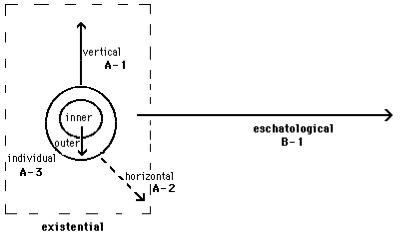
The First Great Commandment [A-1]
Loving God with all our being is the most primary ethical principle (Matthew 22:34-38; Mark 12:28-30; Luke 10:25-28a). Love is principled behavior for the lasting joy of others; so it is more than a feeling; it is (a) an act of the will in carrying out (b) a pattern of behavior characterized by self-giving for the glory of God. If we love him, we will do what he says (John 14:23, 15) and not feel “put upon” (1 John 5:3).
The Golden Rule/The Second Great Commandment/Royal Law [A-2]
The Golden Rule governs relationships between people: treating other people the way we want to be treated (Matthew 7:12). That restates the Second Great Commandment to love our neighbor as we love ourselves (Matthew 22:39-40; Mark 10:31; Luke 10:29b-37; Romans 13:8-10; Galatians 5:13-14). It gives at least a “rule-of-thumb” for deciding how one person ought to act toward another one, and it does so in a positive as well as negative sense.
(a) Morality is more than not doing what we would not want done to us. (b) It is doing what is to someone else’s benefit. Furthermore, (c) it is doing what we would prefer to have done to us even though not required, and even though not doing it would not be a sin or make life intolerable (note “seemly” in 1 Corinthians 13:5).
Furthermore, (d) the Golden Rule takes into account the way they want to be treated. It takes into account the differences between people. So, it is not just a matter of treating other people the way we want to be treated; it is a matter of treating them the way we would want to be treated if we were in their shoes. That ends up meaning we treat them the way they want to be treated. That broad principle in the Golden Rule/Second Great Commandment is limited, of course, by the First Great Commandment and by our own integrity as individuals. Treating other people the way they want to be treated is limited by their own need to love God and respect us. Love means mutual respect.
The Superiority of Spirit Over Flesh [A-3]
The priority of spirit over flesh governs activity within each person. The predominance of the inner over the outer is another way of saying the predominance of spirit over flesh. In 1 Corinthians 6:12 Paul says he will not be brought under the power of anything. The principle he enunciates gives one reason why it is wrong to do privately what causes physical addictions and psychological compulsions (“hangups”). Consequently, he goes beyond the notion of “victimless crimes,” which supposedly impact no one but the doer. Something is wrong if it puts physical drives and psychological compulsion in ultimate position on moral matters. Immorality does not apply just to those behaviors that can be measured quantitatively relative to physical and social consequences; it applies also to what brings psychological bondage.
Asserting the supremacy of spirit over flesh does not argue for doing what is most healthful because the body is the Spirit’s temple (1 Corinthians 6:19). What harms the body can take second place to the interpersonal considerations implicit in A-1, A-2, and B-1. Some foods are less healthful than others; yet Jesus cleansed all meats (Mark 7:19), so dietary laws no longer belong to religious concern as in ethical considerations. “Cleansing all meats” does not change the scientific facts about healthful foods at least for some people. The body as the Spirit’s temple does argue for the moral need to avoid eating what may cause heart conditions, cancer, high cholesterol, etc. Paul’s positive approach to ethics centers on addictiveness, which eliminates prioritizing spirit over flesh.
The body as the residence of the spirit (not Holy Spirit) requires using the body in a way that puts spirit over flesh.8 Having the interpersonal capacity means living by values more than drives. Unlike animals we do not have only behaviors based largely in genetics but based voluntarily in ideals. Our actions are not determined just by heredity conditioned by environment; they are determined by decision and learned through influence. Ethics is a human possibility because it is more than an elaborate determinism subject to science.
Ethics involves more than conforming behavior to an external standard. It calls for a righteousness that “exceeds the righteousness of the scribes and Pharisees” (Matthew 5:20). It addresses heart and motive as well as action that other people can evaluate. It means positive decisions based in the internal impulses (Jeremiah 31:31-34). The personal-interpersonal capacity supplies the primary principles for ethical theory.
The principle of spirit over flesh connects ethics with nature. Nature sets potential behaviors rather than specific acts as moral. The high variability in humankind means ethical behavior ties rather loosely to nature. Yet certain actions are not optimum for the interpersonal capacity—our distinctive characteristic in “this creation.” Living by the “lower nature” alone does not bring satisfaction; it does not bring “life.” We do not live by bread alone, but by values that address the higher nature, which enables us to relate to God and other persons (Deuteronomy 8:3; Matthew 4:4; Luke 4:4) and to fulfill purpose in those relationships. Failure to live by the higher nature leaves us with psychological emptiness even if it does no physical damage. Psychological emptiness and stress can lead to physical problems because we each one are a psychosomatic whole. Since living by the lower nature amounts to individualism, it has social repercussions like those Paul lists in Galatians 5:19-21. Inasmuch as these do not make for love, joy, peace, and other spiritual fruits, they dimmish the quality of life and in the extreme can even destroy it. In an indirect way, then, scientific research can address ethics if it is sensitive to more than physical consequences.
Because nature includes more than our physical nature, being “contrary to nature” applies not only to what causes physical maladies, but to what causes psychological ones. For this reason especially, there are a few cases where scripture, using a negative ethical principle based on nature, labels certain behaviors as evil because they are against nature. Paul does this with homosexual behavior in Romans 1:26-27. He does a similar thing in 1 Corinthians 6:18 when he says that fornication is a unique sin against a person’s own body. He apparently means that fornication destroys a person’s sense of identity, or wholeness, with his wife, and therefore his own self-definition. In regard to hair length, Paul asks the Corinthians, “Does not even nature teach you that if a man has long hair it is a dishonor to him?” (1 Corinthians 11:14).9 But being different from nature is a negative principle, not a universal one, because Paul observes that uncircumcision is according to nature (Romans 2:27).
The one-to-many splice. Ethics not only needs to address individual behavior and social behavior; it needs to describe the boundary between individual freedom and social responsibility. Individual freedom ends where other individuals’ freedom begins. Most of the supposedly “victimless crimes” do not in reality affect just the person who does them, because people’s lives are so intertwined that the behavior of one ends up impacting others. Similarly, private acts between “consenting adults” are matters of morality because the repercussions of private acts end up costing society money, effort, time, and grief. They also depersonalize the other consenting adult and prioritize flesh over spirit. Our individual actions must leave us able to be responsible for ourselves. What we do is immoral if it makes us unable to function appropriately in relationships and purposes (note B-1).
In the horizontal dimension, the best ethical principle is for each person to act consciously as a model for others. That is what happens in good teaching and particularly in effective parenting. People grow best when they are helping other people grow. Going at ethics this way gets away from individualism, pleasure orientation, and unconscious living. It takes care of weaker-brother situation as well.10 Edifying others combines with glorifying God to produce sanctifying of the self.
Right and Wrong as Measured by Purpose [B-1]
Right and wrong, good and bad are also measured relative to purpose. In behavior, the ultimate issue is not whether something is legal under a temporal or divine standard, but whether it is effective. Abiding principles applicable in all cases are relative to the standing purposes of God and man. Obviously, since we are dependent beings, we cannot define our own ultimate purpose. The purpose measurement for ethics is first God’s purpose, after which we work out our self-chosen purposes. In that framework, God allows us considerable freedom.
Right and wrong focus on motives and attitudes more than on acts taken by themselves. The same act can be good or bad depending on why we do it and on our attitude toward other people when we do it. A normally good act becomes evil if done out of selfish motives or with a depersonalizing attitude. In interpersonal activity, intentionality counts for something important.
Morality includes not only what is or is not wrong, but what relates to what is wise. Wisdom brings in practical considerations. Some things may not break any of God’s abiding principles of behavior, but it is normally not wise to put ourselves in certain situations. What is possible is not necessarily what is smart because we may not, for instance, be as strong as we think we are. Standing outside the force field of the situation, we may suppose we can handle more than we can. Not only does wisdom deal with the doer himself (which applies also in the “one-many splice” under A-3); it deals with practical effects on other people, as in the weaker-brother situation. Wisdom addresses what other people prefer, what other people may easily misread about our motives, and what other people may be led into doing on the basis of their misreading us. Not only is there commandment (principle), there is advice (wisdom) And where there is neither commandment nor advice, love and expediency reign.
The existential-eschatological splice. As there is a connection in the existential aspect between the individual and the group, so also there is a connection between existential and eschatological. Right and wrong are measured relative to purpose as qualified by love. Latitude and longitude (the existential and the eschatological) combine in ethical choices. Ethics prioritizes purpose over pleasure—spiritual over material—because purposes are chosen relative to values not wholly rooted in material considerations, but also in interpersonal ones (love). Spiritual and interpersonal are closely related if not identified.
Consistency provides a summarizing principle for morality whether it is consistency between behavior and the nature of the situation, between behavior and purpose, or between behavior and promise. Consistency for God is between his nature and purposes and between his promises and behavior. Consistency for us is between our behavior and God’s values and purposes for us. Appropriateness and consistency involve restricted freedom rather than positive determinism. There is freedom within a framework; people have personal liberty to do that fits the circumstances. Consistency does not generate the specific acts, but limits what specific acts free will should generate. In the context of consistency, love and expediency provide the positive principles that generate acts in the vertical and horizontal relationships between persons. Love is holistic because it combines feelings and principles and unites self and others. There needs to be a consistency in love—principled caring.
Summary
We have differentiated between the natural and ethical usages of the image terms in scripture—ethical image appearing only in Paul’s writings. Within the natural usage, we have identified the image of God with the interpersonal capacity and distinguished the image itself from its manifestations, modes, and aspects. The capacity for interpersonal operation leads to the manifestations, uses, consequences, and extensions of it in fellowship with God, in responsibilities like dominion and mission, in marriage and the home especially, and in society generally. Male and female are modes of the image. Reason, will, affection, conscience, spirit, and the like are aspects of the image—individual capacities that combine to produce the complex interpersonal capacity with its modes and manifestations.
The natural image consists of the creatable, shared likeness between us and God. The image is not just what is common between us and God or distinctive between us and animal. It does not directly include all characteristics of us or God, nor does it include them in the same degree. It is not just what is common to all of us or what is unaltered throughout eternity for each of us. The image does not have to be grounded in the same thing that it is for God or angels; hence, it can indirectly include even the physical body, human sexuality, and marriage by involving them as the ground of the image, the medium for expressing it, or the means of transferring it from one generation to the next. The image is not an irreducible something; it exists at the level of the individual in a way that includes all aspects below that level and functions in parallel and hierarchical relationship with all other persons of every order of being. Interpersonal capacity fosters holism, avoids reductionism, and legitimizes diversity and its potentials.
The image of God involves in us and God items of the same kind but different degree as well as items of different kind that are nevertheless compatible with the shared characteristics. In the first category, belong the image itself as interpersonal capacity and the components that make interpersonal behavior possible. We have rationality, volition, affection, conscience, and the like; but we are not as intelligent, etc., as God himself. In the second category, belong non-essential variants not shared with God but operative within the confines of interpersonal capacity: physicality, sexuality, marriage. Interpersonalism establishes a theology of physicality and sexuality, and affirms the completeness of single persons of either sex without projecting sexuality onto deity.
The image as interpersonal capacity is confirmed by its integrative and explanatory power for a wide range of other phenomena. The first seven of these are natural observations. The image as interpersonal capacity
(1) provides for a holistic understanding of mankind in keeping with the fact that the text of Genesis says mankind is in the image of God, not that the image of God is in mankind. Consequently, it avoids the reductionistic, simplistic, and static picture of man that comes from identifying the image with something at the “sub-individual” level. Interpersonal holism in the earthly state
(2) establishes a positive attitude toward physicality, which in turn connects with incarnation, indwelling, theophanies, anthropomorphisms, etc. Interpersonal wholeness likewise
(3) provides the theological foundation for interpreting sexuality, and
(4) sets the fundamental nature of marriage without implying that unmarried people lack the image. The interpersonal image
(5) clarifies the man-animal distinction by providing a balanced view of their differences and likenesses. Discovering shared capacities does not undermine human uniqueness as long as the degree to which animals possess them is not of the degree or kind to produce interpersonal relationship. Interpersonal capacity
(6) makes incarnation formally a more understandable fact, even though we still cannot specify exact mechanics and the like. We do not have to resort to some kind of dualism in order to account for it as in the doctrine of the “two natures.” Finally, it (7) clarifies the deification-glorification distinction.
Interpersonal image also relates to three ethical matters. The first is terminological. Interpersonal capacity
(8) shows the propriety of the New Testament ethical usages of the image expression, because ethical character is an interpersonal consideration. Furthermore,
(9) the New Testament presents Christ as the image of God and calls on men to identify with that personal Likeness as a basis for being viewed themselves as having the ideal ethical image. The consequent possibility is relationship with a holy God. Interpersonal image
(10) sets the framework for ethical theory as something applicable only to the interpersonal domain.
Identifying the image of God with the interpersonal capacity has several advantages because the concept is so basic and yet so comprehensive and complex. Because of the complexity of persons in relationship, interpersonal capacity can incorporate anything scripturally relevant to the imago dei and everything that has been associated with it historically. Interpersonal capacity can account for an extensive and diverse range of items without making us too much like God or vice versa, which confirms the correctness of identifying the image with the interpersonal capacity.
Image relates to all three primary categories of reality: being, action, and relationship. (a) As to being, we have interpersonal capacity. (b) As to action, interpersonal capacity captures what we can do and should do. (c) As to relationship, interpersonal capacity is expressed in the male-female variant, the marriage circumstance, and society as a whole. Image addresses everything about us in both our existential and eschatological frames of reference.
Righteousness is a personal-interpersonal consideration. Although it deals with nature, it deals especially with relationships and purpose. It addresses what is directly interpersonal, what accompanies the intrapersonal, and what grows out of the interpersonal (purpose). Righteousness involves internal attitude (motives) as well as external behavior (actions). Righteousness is both horizontal (love for people) and vertical (love for God). It means doing what we can to improve the quality of relationships (positive), not just to keep them from getting worse (neutral and negative). Being good is not just a matter of avoiding what is wrong, or unethical, but of choosing to do what helps relationships and furthers purposes; it involves more than a legal standard. Righteousness relates to purpose because persons purpose; they do so by making choices relative to values and goals more than drives. Righteousness is interpersonal, not just legal; it involves more than a conceptual standard. Righteousness is relational, not just natural; it involves more than what is best for the body—a natural standard. Righteousness is consistent with the existence of other persons and the future; it is not just an emotional feeling, a physical drive, or an intuitive impulse. Righteousness is behavior consistent with the interpersonal situation made possible by the interpersonal capacity; righteousness is principled love.
Endnotes
1Romans 8:29 may represent what is sometimes called an eschatological usage of “image.” If so, there are three usages of the term: natural, ethical, and eschatological
2Interestingly, likeness has a nature sense in passages like Genesis 1:26; 5:1; Acts 14:11; 17:29; Romans 8:3; Philippians 2:10; 1 John 3:2; but seems not to be used in an ethical sense in comparisons between us and God.
3We understand Paul’s use of “image” as an extended usage here. He is using creation terminology for reconciliation process. In Ephesians 2:10 he does the same thing when he says that we are “created in Christ Jesus” for good works (cp. 2:15; 4:24; Colossians 3:10). Resurrection terminology serves a similar purpose in 2:5 and Colossians 2:13: we are “made alive in Christ Jesus.” These are examples of ontological terminology for relational or behavioral realities, a frequent phenomenon in language usage.
Many interpreters do not recognize that Paul is using an old term for a new subject to gain a fresh word picture for it. Instead, they suppose that image includes an ethical dimension even in Old Testament usage, and suppose that there is a connection between the nature and ethics usages because nature enables a person to have ethical capacity. In the Fall a certain degree of that capacity was supposedly lost, which means that it has to be somewhat restored by Christ through the Spirit before a person can respond to the gospel and be saved in Christ Jesus. The primary weakness of this reconstruction is that ethical likeness cannot be created. It must result from behavior in conformity to a standard. While it is true that there is a capacity that makes ethical behavior possible, scripture does not say that Adam lost some of that capacity when he sinned. There is no indication in the creation account or elsewhere that Adam’s ethical ability after he sinned was any less than what it was before in an inheritable sense.
4The nature sense of image David Cairns calls the “Old Testament” image, and the ethical sense he calls “New Testament” image, even though the nature usage appears in the New Testament too (The Image of God in Man, p. 60).
5The more elaborate forms of gnosticism postulated a series of levels [the pleroma, πλήρωμα; “fullness”] between our present realm [eon, αἰών; “age”] and the realm of pure spirit. These advancing levels decreased the proportion of evil matter to good spirit. “Salvation” meant escaping material existence by moving up though these levels, each of which had a ruler [archōn, ἄρχων]. Knowledge [gnōsis, γνῶσις] was the “password” a person used to advance through the system. This doctrine is probably what Paul is combating in Colossians 1:15ff. when he teaches that Christ is the true fullness by which true salvation is gained into the true realm of spirit.
6Angels are not deity; yet they behold the face of the Father (cp. Matthew 18:10).
7The Greek word εἰκών appears in these two texts. The term χαρατήρ occurs in the Hebrews statement about the Son as “the image of [God’s] substance” (Hebrews 1:3).
8The term spirit has a wide range of uses. The distinction between human spirit and Holy Spirit is not always clear in biblical usage. The principle of contrast in interpretation suggests that when “spirit” stands in contrast to “flesh,” it means spiritual. If this approach is correct, the word should appear in lower case in texts like John 3:3-15; 6:63; Galatians 4:21-31; 5:16-24; 6:8; 1 Corinthians 15:50. 1 Corinthians 6:16-17 features a similar contrast between spirit and body. We do not have to decide in many cases whether to capitalize “spirit,” because human spirit and spiritual correlate with Holy Spirit in contrast to material considerations (Jude 18-21).
9Paul may mean “nature” in the sense of culture: “Doesn’t it seem unnatural to you for a man to have long hair?” Under this reading, what would seem natural would come to be seem that way by cultural conditioning rather than by birth. It is an interesting observation, however, that in almost all cultures men’s hair is worn relatively shorter than women’s. The tight curly hair of the African Negro, however, makes the matter of relative length a moot question for them.
10The texts that deal with weaker brother situations include Romans 14:1-15:9; 1 Corinthians 8:1-11:1; Galatians 6:1-2; Ephesians 4:13-16; 1 Thessalonians 5:14.
christir.org