
Natural Observations on the Image
NATURAL OBSERVATIONS ON THE IMAGE
AS THE INTERPERSONAL CAPACITY
Virgil Warren, PhD
Introduction
In the previous chapter we offered restrictive guidelines for identifying the image of God—boundaries within which the understanding of image must fall. The image must be a creatable likeness that applies to the whole individual even after the Fall. Then we offered two sets of positive evidence for the image as interpersonal capacity to build the view “from zero.” There were two deductive arguments: (1) the interpersonal purposes of mankind predict interpersonal nature of man as the image; (2) being in the image of an interpersonal God implies that mankind is interpersonal. Finally, we made inductive observations: human peculiarities observed in connection with image terminology end up being aspects of interpersonal capacity.
Those considerations offered primary evidence, evidence that requires a certain view. The next three chapters provide confirmatory evidence, evidence that reinforces a conclusion reached on other grounds though perhaps not required by this second kind of evidence itself. Together these latter observations form one argument: the image as interpersonal capacity connects nicely with a range of biblical teachings about the nature of man and Christ.
The Image and “Levels” of Man
The image as interpersonal capacity appropriately connects with all levels of man. Interpersonal capacity does not require putting the image at any “level”—whether individual, “sub-individual,” or corporate. Putting the image simply at the individual level would not so easily account for the “us” of the image. Identifying the image with a specific “sub-individual” aspect of the person would work against a holistic understanding of a human person, a point elaborated in the next observation. Putting the image at some corporate level brings in several difficulties. If marriage were the level at which the image exists, single persons would not have the image, including Jesus himself. Adam would not have been in the image of God before the Lord created Eve. Feral children, lone mountaineers, hermits, and the unborn would not have the image.
If mankind were the level of the image, it would not exist now because sin has divided mankind racially, nationally, religiously, etc. Taking away unity removes an essential characteristic of deity. But alienation does not destroy the image per se because, as we have observed before, scripture applies image-likeness terminology to mankind even after sin and its divisive effects had entered the human race (Genesis [5:1-3] 9:6; 1 Corinthians 11:7; James 3:9; cp. Acts 17:28-29). The image resides in the individual, but it involves all aspects of man in his relationship to other persons. By speaking of the image as interpersonal capacity, we avoid some difficulties present in other proposals.
It is appropriate that our view of the image not be limited to any level. The individual-corporate distinction in humanity is not absolute. The individual man Adam was the one from whom God made Eve; so the man-marriage distinction is diminished by the fact that the first wife was taken from the first husband. Besides, each individual person is marriageable. The man-mankind distinction is also not absolute because all mankind has descended from that same first pair. Paul combines these observations to highlight male-female interdependency: woman was created from the man, and man is given birth by the woman (1 Corinthians 11:8, 12).1 These factors establish in mankind an intimacy potential for reflecting the imago dei that angels do not have since they were presumably created individually and directly. They are united by common values, common purposes, and hierarchical arrangement, but not by their manner of origin or any possibility of propagation. Interpersonal capacity is not equated with any particular aspect or manifestation of that capacity. Capacity draws attention to what is potential in man more than what is actual in him. Manner of origin (history) and manner of propagation reflect the image (nature) even as nature reflects purpose and values reflect both.
The Image and Wholeness
(2) The image as interpersonal capacity provides for a holistic understanding of man. On the positive side, the previous chapter noted that mankind was created in the image of God. Genesis does not say that the image of God is in man. On the negative side, there are several disadvantages to identifying the image with a sub-individual level. First, (a) identifying the image with rationality or volition is not exegetical. Such identifications lack direct bases in the imago dei texts themselves. The interpreter is not drawing the meaning for image out of the text first and then correlating it with experience or other scriptures. He starts with correlation between the biblical expression and human experience—the experience of human rationality, for example, in contrast to the observed lack of it in other physical creations. Whenever possible, exegesis from a text should precede correlation with other texts or with experience. If nothing in the “near context” explains a point of interest, we do have to look at the “distant context” in the rest of special revelation and at “the nature of the case” inferred from experience to see what "fits with” the issue at hand. Such cases involve a “correspondence” approach to interpretation, which says “this is that” (cp. Acts 2:16; Ephesians 4:9-10; Matthew 11:14; John 1:45-46), rather than an inductive approach. But the correspondence approach increases the likelihood of error and irrelevance.
Ideally, interpretation should follow a pattern of induction, deduction, integration. In our own method, we have tried to begin exegetically, then make inferences, and then generalize and integrate with other particulars to arrive at an understanding of the imago dei that harmonizes with the rest of the Christian worldview. So, we have taken the image to be man’s interpersonal capacity in a worldview that centers on interpersonalism.
An exegetical approach here produces a holistic and functional understanding of the image more than an analytical and static one. Traditional proposals about the image of God offer some significant insights into man’s nature, but Genesis 1:26-27 suggests the larger and more basic truth we have identified with interpersonalism. Reason, will, conscience, affection, and spirit do belong to the subject, not because individually any one of them is the image, but because they combine to make the image possible. They make interpersonalism possible. They are capacities necessary for behaving interpersonally; consequently, we may call them “aspects of the image,” not the image itself.
Besides lacking contextual foundation in Genesis, another disadvantage to identifying the image with, say, rationality or volition is that the approach is (b) reductionistic, which does not fit the nature of the case. People are actually more than mind, will, conscience, emotion, or spirit. They are a combination of these and more. The imago dei of Genesis 1:26-27 evidently includes at least all the creatable characteristics common to God and man. The limitation “creatable” obviously applies because holiness derives from behavior not being. Substance can be created, but action cannot. Perhaps by a figure of speech in deterministic settings we could speak of creating an action. We could say that someone created an action by creating something that had to act a certain way. Precisely because mankind has rationality and volition, however, there cannot be a one-for-one relationship between his being and behavior; so behavioral qualities in people cannot be created indirectly by creating a substance that would necessitate holiness. Necessitated holiness would in fact be a contradiction of terms, an oxymoron.
Our wholeness extends to characteristics we do not share with God (physicality, sexuality, corruptibility, and the like),10 but there is no reason to exclude any shared likenesses at least and no harm in including them as sub-parts. As with most things, people are not one irreducible something from which everything else “unpacks.” Philosophically that would be “foundationalism” in contrast to “combinationalism.” In the latter case the thinker starts with a item and frame of reference that is comprised of more primary elements.2 Reason, affection, and the like are individual capacities that form a gestalt, that is, a whole that is more than the sum of such parts.
A third disadvantage to identifying the image with rationality, etc., is that it is (c) simplistic. It fosters a faculty psychology comparable to “bean-bag genetics.”3 It proceeds as if a person were a series of parts that individually produced identifiable phenomena like conscience, will, affection, thought, and so forth (reification). The complexity level is too low for what we need to describe.
A fourth disadvantage is that it is (d) analytical and static rather than synthetic and dynamic. Conceiving of the image as rationality plus volition plus conscience plus affection . . . fragments the person. It loses the gestalt that a human person is. The whole of mankind is more than the sum of its parts even if all the parts are taken into account. In a real whole, there are factors beyond sheer number. There are qualitative features like unity, interaction, hierarchy, compenetration, and beauty. So to speak, several individual genes contribute to one capacity, and one gene connects with several capacities (next ¶). Identifying the image with interpersonal capacity avoids reducing persons to one essence or fragmenting them into a series of parts conceived of in static terms. It fosters functional wholeness.
Holism can exist without having to keep forever in the image everything mankind now is. Such is the case because the same effect can arise from more than one “basis.” God and angels can be interpersonal as spirit beings (John 4:24; Hebrews 1:14; Luke 24:39) and humans can be interpersonal on physical bases. Brain may be able to produce mind epiphenomenally, but mind may not have to come from brain or “reside on” brain. Theologically the concern is practical effect more than ontic cause and analysis. Because we have in our thinking an omnipotent God with ultimate authority, we can believe that God is free to will that mind exist on some other basis besides brain or on no basis at all. He can transform the physical into what is not physical and “re-connect” mind, for example, with a “new body,” as in resurrection, translation, transubstantiation, re-creation, or some other form of “miracle,” that is, by something that does not derive from the natural order. What he has done or will do in these connections cannot be known, and yet it is ours to know that we are in his image; consequently, the image of God in man is something we can know in a functional sense even though our understanding does not include unknowable factors.
We are concerned about holism because scripture presents mankind holistically. It speaks of the redemption of the whole person. Although a part of us dies, resurrection (or translation) remedies even that loss. We do not become less than persons when we die. Individual statements of scripture make the flesh part of us, as Paul implies in Romans 7:18: “I know that nothing good resides in me, that is, in my flesh.” In the context Paul bemoans the warring that goes on in his members. He is both part of them (7:18) and above them (7:20); so the mind/spirit/transcendent nature should predominate, but it includes that over which it predominates instead of being parallel to it. The biblical picture of mankind does not suggest “dualism” because the higher and lower natures are not set in contrast or put in parallel but arranged in hierarchy.
Holism could put too much in the image while honoring God’s image could work against holism. The image as interpersonal capacity avoids these extremes by establishing a context that can incorporate everything in people and their relationships at least indirectly. That interpersonal context qualifies every aspect of our being, behavior, and relationship which manifest that capacity. Flesh becomes interpersonal flesh; sexuality becomes interpersonal sexuality; marriage becomes interpersonal intimacy. Although such factors may not be inherently necessary to the image, they are included in its operation for now.
The Image and the Body
(3) The image as interpersonal capacity establishes our attitude toward the physical body. God created mankind in his own image in the physical state (Genesis 1:26-27), blessed them (1:28), and pronounced them very good in that state (1:31); the physical body is part of that state. In the biblical view, the material realm relates to the spiritual realm as positive to positive (1:10, 12, 18, 21, 25; cp. 1:22, 28; 9:1; cp. Psalm 104:28; 119: 68), not as negative to positive. The human body then relates to the human spirit positively. The lower nature does not relate to the higher as negative to positive. Since the material realm came by creation from the spiritual realm that preceded it, matter is not parallel to spirit and not opposed to it, but positively secondary to it and functionally incorporated under it. The material manifests the spiritual (Psalm 19:1) and serves as an instrument for accomplishing the purposes of the spiritual. Likewise, the human body is not parallel to the human spirit or opposed to it, but positively secondary to it.4 The body manifests the spirit and serves to accomplish its purposes. As a result, the image as interpersonal capacity sets people’s attitude toward themselves in the physical state as persons in fellowship, not as animals in herds or chemicals in clusters.
Characteristics of the relationship between spiritual and material realms in general establish guidelines for understanding the spiritual and material aspects of mankind particularly. There have been three general approaches to the body relative to the spirit. (a) The body is evil, and the spirit is good (Stoicism, Epicureanism, gnosticism, Manichaeism) or a poor imitation of the “idea-l” (Platonism). The body is “the prison house of the soul.” These are negative-to-positive views. (b) The body is amoral, and the spirit does not exist (materialism). The physical realm is all there is. (c) The spirit is dominant and body subordinate (Christian). Scripture implies this last viewpoint since a good God created matter including the human body and made it an aspect of the same mankind he commissioned to take care of other matter God created. The doctrine of creation and the fact of commission establish the positive character of the material universe, all the parts that comprise it, and what can be done with it. In our physical humanness we can have fellowship with a holy God and can participate in the responsibilities such a God gives us. A positive attitude toward the physical body fits with the positive attitude toward physicality in general. The biblical religion does not teach that matter is evil; consequently, the material body is not evil.
Positive attitude toward the body corresponds with an ethic that uses the physical body for spiritual ends. The behavioral implication is that we not satiate the body as in hedonism (cp. Philippians 3:19), depreciate it as in asceticism (cp. Colossians 3:23), glorify it as in humanism, but transcend it. We keep the body in secondary position (1 Corinthians 9:27; Romans 8:13; 12:1-2), using it as an instrument of activity for good guided by transcendent values of spirit and mind, and directed especially toward interpersonal purposes and relationships. The body can be viewed as a temple of the Spirit (1 Corinthians 6:13-19; cp. Mark 14:58), as a vessel for spiritual treasures (1 Thessalonians 4:4; cp. Acts 9:15; 2 Corinthians 4:7; 2 Timothy 2:20; 1 Peter 3:7), as a temple and tabernacle of the soul/spirit (2 Corinthians 5:1, 4; 2 Peter 1:13-14), as an instrument of righteous for glorifying God (Romans 6:7; 1 Corinthians 6:13; Colossians 2:17).
Positive attitude toward the physical body relates to several other biblical doctrines that presuppose it. Incarnation, divine indwelling, theophanies, anthropomorphisms, and creation in the image of God do not degrade deity; they dignify humanity. The very doctrine of creation itself correlates with the idea that the creation is in some sense good—or at least not evil (Genesis 1:31, etc.). There is no contradiction between the prohibition against idolatry and the notion of relating the image to the body if the lower nature and the higher nature are not parallel parts and if body is subsumed under spirit as its director.
Physical humanness in the image allows for incarnation without incarceration or dualism. For first-century Jewish religious leaders, the offense in Jesus’ claim to deity probably lay not only in their fear of polytheism, but in their abhorrence for making God too imminent. They stressed God’s transcendence and the ineffableness of the divine name to the point that they did not even pronounce his personal name Yahveh. Even today when they read the Hebrew scriptures orally, Jewish people say Adonai (“my Lord”) or occasionally Elohim (“God”) in the place of the tetragrammeton (Yahveh). The New Testament writers did not challenge this hypersensitivity as is shown by their regular use of kyrios (“Lord”) in their references to deity. For Jews, incarnation made God too imminent. But if interpersonal capacity capsulizes the shared nature of God and man, then Jesus Christ was not an artificial mixture of deity and humanity, and his deity was not imprisoned in a body.
Later Judaism had difficulty with anthropomorphisms, expressions that assign human characteristics to what is not human. Old Testament scripture, however, is replete with phraseology about God’s hands, right hand, fingers, eyes, ears. It freely speaks of him as “getting up early,” even “being grieved.”5 Semitic idiom used body parts symbolically for psychological, abstract, and intangible realities; and in scripture it did so even with God.
Physical humanness in the image allows for the concept of indwelling. Indwelling pictures the body as a temple for the Spirit rather than a prison. Indwelling means at least that the transforming influence of God fully permeates to the inner character of the human self, from which springs the issues of life. Whether the indwelling is strictly locational or simply pictured as locational,6 the implication remains that God’s being with us and in us (John 14:17) does not grate on spiritual sensitivities.
Physical humanness in the image allows for physical death without losing the higher nature and physical life without tainting it. Scripture never says we lose the image when we die, and obviously we have it while we live. The image does not require any circumstance of its manifestation. The body manifests the human person in much the same way as the incarnation manifested the second person of the trinity.
Positive attitude toward the body allows for resurrection of the body (both Christ’s and ours), not just immortality of the soul. Resurrection was foolishness to Gentiles (17:31-32, 18; cp. 1 Corinthians 1:23)7 because they typically believed in a dualism that depreciated matter or made it evil. Resurrection of the body as distinguished from immortality of the soul affirms the dignity of physical humanness and the fundamental meaningfulness of life in this present condition. Even though we do not know exactly what resurrection is, it must be more than immortality of the soul. In resurrection, there is at least re-identification with the material realm and the kind of physical body we have now. Obviously, resurrection is more than the resuscitation of a dead corpse because metamorphosis, transformation, transfiguration occurs even for those alive at Christ’s coming (1 Corinthians 15:50-54). That transformation evidently involves the change to asexual being since there is no marriage in the resurrection (Matthew 22:30). But resurrection and transformation both involve continuity between the earthly, physical body and the spiritual, heavenly one (1 Corinthians 15:42-54).
The Image and Sexuality
(4) The image as interpersonal capacity provides the theological foundation for interpreting sexuality. It implies a positive view of sexuality, affirms the equal worth of both sexes (Galatians 3:28), and defines the proper relationship between them (1 Corinthians 6:13-20). Sexuality represents a variable within the image since both sexes have interpersonal capacity and equally so. This variance is subsumed under the larger truth of the divine image common to both and expressed in the union of the two (Genesis 2:24). Sexuality along with the physicality of which it is a part, is a non-essential part of human wholeness. What is variable is not essential, and we have concluded that the essence of image is interpersonal capacity. That is a little different from defining what is the essence of humanness since interpersonal capacity applies to a range of created and uncreated kinds. Since in the resurrection marriage does not take place (Matthew 22:29-30), we infer that sexuality does not continue; yet in the resurrection humans evidently do not cease to be human nor in God’s image. Therefore, on this side of death-resurrection, sexuality does not constitute a basis for valuing one mode of the image over the other.
1 Corinthians 11:7 bears some comment if male and female are non-essential variants within the image. Speaking about the propriety of women/wives not wearing a veil while praying or prophesying in public, Paul says, “A man [husband?] should not uncover his head, being the image and glory of God; but the woman [wife?] is the glory of the man [husband?].” He gives as reasons for his verdict the fact that in the beginning woman was made from man and for man (11:8-9; Genesis 2:21-23 + 20, “helpmeet”) and “because of the angels,” an ambiguous reference he does not explain. The veil is an “authority” on her head (7:10). Scripture associates two other issues with the image of God. Man should not be murdered (Genesis 9:6) or cursed (James 3:9-10) because he is in the image of God, and a man should not wear a veil (1 Corinthians 11:7) for the same reason. The parallel, however, between the first two and the last is only apparent because the meaning of man shifts from “mankind” to “male.” Something must explain this meaning shift because Paul bases his comments on the same Old Testament image terminology as is present in the prohibitions against murder and cursing.
The issue for the present is what it means to say that the man is the image and glory of God in a context that contrasts man and woman. Does Paul mean that women are not in the image of God, less in the image of God, or indirectly in the image of God. That woman is (a) not in the image cannot be the point since other scriptures use image (in the natural vs. ethical sense) indiscriminately of mankind. Genesis 9:6 does not mean that if someone killed a woman capital punishment would not apply. James 3:9 does not mean to imply that it is okay to curse a woman but not a man. The original creation proposal itself presents male-female as a variant within mankind, the image of God. Elsewhere Paul himself teaches that at some level in Christ the male-female distinction is no more relevant than the bond-free or Jew-Gentile distinction (Galatians 3:28). That level would seemingly have to be high enough to include interpersonal capacity.
The second option—that woman is (b) less in the image of God than man is—does not sound likely unless Paul makes an unmarked shift in what “image” includes. We have understood image-likeness as terminology about human nature, which then has several consequences and manifestations. In this format, interpersonal capacity (the image itself) leads to dominion, etc. (consequences of the image); nature leads to responsibility. Paul, however, may be thinking of the image as covering the broader spectrum. If so, he combines nature and responsibility (dominion). This latter arrangement fits with the idea that the man’s responsibility is more ultimate than the woman’s without exalting males or debasing females. Especially if Paul is using “image and glory of God” as a reference to responsibility as well as nature and if he is thinking of the sequence of man and woman’s creation, then he may be identifying the image more directly with the man because he considers man’s responsibility more ultimate than woman’s as reflected in the creation sequence. Paul could then relate that to the contemporary practical issue of veil-wearing as a woman’s cultural symbol for acknowledging before God and other people the authority that reinforces a man’s more ultimate responsibility. “Because of the angels” might then refer to God’s rejection of angels who did not keep their proper principality (Jude 6; 2 Peter 2:4). Paul would be bringing them in as a reminder of what happens when people try to take over things not appointed to them or to act in ways that are not appropriate to the manner of carrying forward the privileges and responsibilities that God has given them. Since woman was created from man, she is (c) more indirectly in the image from a history and responsibility standpoint.
Physicality, sexuality, procreation are evidently at least related to, analogous to, governed by, or exhibitive of, the imago dei since scripture makes the same connection termwise between Adam and Seth as between God and Adam. “In the day that God created man, he made him in the likeness of God; he created them male and female. . . . Adam lived a hundred and thirty years and begot a son in his own likeness, after his image” (Genesis 5:1-3; cp. 1:26-27); Luke’s genealogy of Jesus concludes with “. . . Enos, (the son) of Seth, (the son) of Adam, (the son) of God” (3:38). Paul is even willing to call mankind “[God’s] offspring [γένος, genos]” (Acts 17:28-29).
Procreation takes place in all organisms, which reproduce after their kind; so we might be inclined to separate procreation from image considerations entirely. But the image consists of more than the peculiarities of man versus animal. More importantly, the interpersonal image transforms the character of everything in its context, including reproduction. God intended human sexuality to be interpersonal rather than purely biological as reflected in the fact that man is unique in being able to reproduce face to face and in the fact that sex has more than a reproductive purpose.8 It involves commitment to common identity, values, and purposes. Hebrew idiom for sexual intercourse is “knowing,” which represents personal terminology. Besides, mankind’s uniqueness in face-to-face reproduction reinforces the interpersonal nature of human sexuality. Relating sexuality to deity through the image in man does not mean God has sexuality but that man’s sexuality operates as an expression of interpersonal capacity. It reaffirms interpersonal identity and has to do with commitment to values and purposes more than drives. The image logically precedes sexuality; so human and animal reproduction differ in character.
The Image and Marriage
(5) The image as interpersonal capacity establishes the fundamental nature of marriage. One flesh defines marriage, which leads to multiplying offspring by that union. The one flesh of marriage manifests a plurality-in-oneness in humanity that reflects the plurality-in-oneness in deity. Sexual unity between male-female is an intended physical analogy to the person-to-person relationship between man and God and more especially between the “us” in deity. Arguing against temple prostitution, Paul says that being sexually joined to a harlot makes the two one “body,” which he considers alternative to being joined to the Lord as one “spirit” (1 Corinthians 6:16-17). Sexual union is intimate physical and psychological identification even as spiritual union is interpersonal identification. Husband-wife sexual relationship is ultimate intimacy in the physical realm even as Father-Son-Spirit spiritual relationship is ultimate intimacy in the interpersonal realm (note John 17:20-22).
God intended male-female physical unity to be kept within the interpersonal context rather than being something separate. When sexual activity is made something by itself, it is reduced to temporary physical pleasure and works against ongoing psychological identification. Intimacy is missing, and the possibility of achieving it can be destroyed. Sexual relations were intended to be a union in the larger context of commitment to values and purposes (ethics) and to each other (identity). Intercourse is not for the one or for the other partner, and so Paul teaches that neither the husband nor the wife has final authority over his or her own body (1 Corinthians 7:2-5). Interpersonal identity leads to physical intimacy, which establishes and reinforces interpersonal identity.
For this reason, the New Testament teaches that fornication, adultery, and divorce are sins: they destroy identity and the sense of identity, and they are unique in the degree of their doing so (1 Corinthians 6:18). Sexual expression has the guidelines it does because God intended to establish the marriage mode of intimacy as a reflection of the divine image. That interpersonal purpose of God to have man in his own image is then reflected in the historical manner of his bringing man and woman into existence (making one from the other and making one for one other) and in the manner of having them reach their full number (procreation). It is reflected in their complementariness (one flesh) and interdependency (man from the woman plus man by the woman). All New Testament teaching on men-women relationships stems from the nature of man and woman as implied by their manner of origin. That is the reason New Testament teaching refers to Genesis 1-3 on every issue associated with sexuality and men-women relationship in the home, the church, and society. Those issues include fornication, adultery, divorce, and complementary roles in the home and in the church (Matthew 19:3-12; Mark 10:2-12; 1 Corinthians 6:12-20; 11:2-16; Ephesians 5:22-33; 1 Timothy 2:11-15).
Of special importance regarding marriage is the fact that its interpersonal character precedes its physical distinctiveness. Not until there is compenetration of personhood can there naturally be compenetration of physical natures; otherwise, there is loss of self-image. There is loss of self-esteem both by the “user” and the “used” (the woman ends up being the one most often “used” in fornication and adultery). Obviously, the “used” loses self-esteem because he senses in the other’s behavior a lack of “esteem,” which is another way of saying impersonal behavior. The “used” is not treated as an equal but as something lower. The way others treat us is a prime basis for the way we view ourselves. No wonder “love ’em and leave ’em” makes people feel like they are living a “dog’s life.” Even the “user” is not fulfilled because he does not receive interpersonal response from the other. “Emptiness” results. Paul probably had such thoughts in mind when he said that fornication is unique as a sin against the “body.” More than any other sin fornication strikes at the very sense of who we are, our identity, our “body” (1 Corinthians 6:18). Marriage and therefore sexuality is mutual commitment and common identity before it is pleasure and procreation.
Consequently, we place the relevance of image to male-female, not directly in the physical domain, but contextually in the interpersonal framework where the physical body and human sexuality function. Physical relationship occurs in interpersonal relationship, and physical relationship bonds interpersonal identity uniquely between husband and wife. As a result, analogy to the trinity teaches us about the divine intent in marriage as an interpersonal experience, and the interpersonal intimacy of the marriage experience helps us comprehend something about the divine trinity in whose image men and women are created. In other words, the image of God in each individual person manifests itself in ideal marriage as well as in ideal society. The socio-physical unit we call marriage bears further analogy to the social-spiritual unit we call trinity (cp. 1 Corinthians 6:17). As such, marriage participates in the less specialized interpersonalism that all persons have capacity for: they can be one as Father and Son are one (John 17:22), and they can be one with the Father and the Son in the same way the Father and Son are one with each other (17:21).
The dignity of marriage nevertheless harmonizes with the validity and wholeness of persons not married, because the interpersonal capacity accentuated in marriage finds expression in all other interpersonal relations as well. The interpersonal oneness of marriage simply adds the dimension of physical intimacy (Genesis 2:24; Ephesians 5:23-33). The total, permanent, exclusive identity of husband-wife is reminiscent of the Father-Son-Spirit. In his own image God created them male and female.
The Image and the Man-Animal Distinction
(6) The image as interpersonal capacity clarifies the man-animal distinction. The principle of harmony defines the image of God in connection with the God-man parallels. The principle of contrast defines the image in connection with the man-animal distinctives since no animal is said to be created in God’s image. The man-animal distinction is further reinforced by other observations. No mate for man was found in the animal kingdom (Genesis 2:18-20). Animals could be killed but not man (Genesis 9:6). Cohabitation between man and animal was punishable by death under Mosaic legislation (Exodus 22:19; Leviticus 18:23; 20:15-16; Deuteronomy 27:21). Man was given dominion over the animal kingdom (Genesis 1:26, 28; 2:18-20).9 Revelation does not classify mankind among animals even though mankind and animals share many characteristics.
If the image is the interpersonal capacity, in order to be distinguished from animal, man does not have to be different in every respect nor absolutely unique in any one respect. Rather, the degree to which he possesses these abilities is sufficiently greater that in combination they can constitute man’s uniqueness as a total being–interpersonal capacity. Most specifically, then, man’s uniqueness from animals would not be jeopardized by discovering, for example, rudimentary intelligence seen in crude tool making (vs. tool using) or perhaps in elementary language learning and usage—which has not satisfactorily been demonstrated despite claims to that effect.10 The image, then, is not just the distinctives of man vs. animals any more than it is only the commonalities between God and man. Rather, specific human peculiarities usually reflect the image because they are appropriate to, vs. necessary for, the purpose of man summed up in interpersonal existence. The image as interpersonal capacity establishes the man-animal distinction at the most general level–the level of the whole, not at the level of some particular trait.
Interpersonal capacity can resist the constant temptation toward reductionism and therefore fragmentation. So much thinking about the imago dei–and many other subjects as well–focuses attention on specific distinctives rather than on the integrated whole. Evolutionary thinking offers one relevant example. Evolution arranges “kinds” in a sequence based on relative complexity amidst similarity and then correlates that “logical sequence” with chronological sequence. The next item up the evolutionary “tree” is contemplated in comparison to the one preceding it. It is a matter of adding new features and subtracting or altering old ones. It is a process of complexification through time. When theistic evolutionists plug mankind into this scheme and integrate their format with biblical considerations, the image ends up being something added onto animal nature (donum superadditum). The “add-on” can be thought of as the image, which roughly correlates with “higher nature” vs. “lower (animal) nature.” This reductionist scenario works against wholeness.
Not only is the resulting view reductionistic and fragmenting, it is also simplistic. Even the distinctions between animals are more complex than that; much more the distinctions between man and any one of them. The lack of adequate complexity comes from confusing homologous11 with same and from not appreciating the complexity that comes from interdependent parts within a functioning whole. You cannot seriate the origin or interdependent, reciprocating parts; that is, you cannot put in a time sequence the beginning of parts that depend back and forth on each other. The whole must be there from the beginning. Nascent and vestigial organs12 would be dysfunctional within the previous whole and would tend away from the viability of the organism rather than enhance its survival as evolution theory requires. The only way to get a whole from the beginning is through creation of the whole at the beginning by external means. The result cannot come about by stages from within.
This critique of materialistic evolution applies likewise to reincarnation and chain of being. The complexity coefficient in these formats is too low to fit the actuality or provide for the whole that humanity particularly is. In discussing the imago dei, we want to avoid that same fault of making mankind too much like animal or overdoing the differences between them. Interpersonal capacity seems to meet these requirements by keeping physicality and sexuality within the image, on the one hand, while allowing for animals to have characteristics that are not individually of sufficient degree to comprise in the aggregate what we are calling interpersonal capacity.
The Image and Incarnation
(7) The image of God as interpersonal capacity provides for a natural understanding of incarnation. As we said above it accounts for incarnation without incarceration. Though the Logos was in a more limited condition during the incarnation, he was not in an evil condition inasmuch as he exercised self-limitation in humble obedience to the Father to accomplish a positive purpose. He expressed humility to the point of death, violent death, yes, violent death of the most extreme sort (Philippians 2:1-8). Whatever evil there was lay in the behavior of those who rejected him and did with him as they would. Incarnation does not require the discarding of deity or imply the prostitution of humanness because man and God share interpersonal capacity.
Image of God as interpersonal capacity accounts for incarnation without dualism. The traditional doctrine of the “two natures” is terminology that must be qualified carefully and may be ill-advised. The “two natures” are not an artificial combination of the divine and the human in Jesus. It does not represent a kind of “consubstantiation” or “impanation” that mixes divine and human substances or amalgamates them into a third substance that is neither truly human or verily divine. The “two natures” are not so much two different kinds as two different levels of the same kind: being interpersonal being. At least the interpersonal capacity forms the distinctive
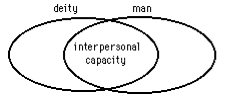
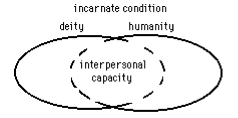
cluster of shared capacities between man and God as over against lower orders of being. Incarnation has to remain something of a mystery, of course, since we do not know much about the nature of spirit much less deity, and do not know whether deity has any distinctive hypostasis/substance.13
But we can say that (a) deity does not become something else in becoming humanity, because the interpersonal image of God that man has covers their creatable shared characteristics. (b) Incarnation then adds compatible, human distinctives interpersonalized by their image dei context. That addition does not bring in foreign characteristics; it defines a more limited arena in which the common capacity operates. Deity temporarily suspends distinctives by choice.
Finally, (c) incarnation need not lessen the degree of shared characteristics or eradicate the unshared ones. It only requires voluntarily limiting the active expression of interpersonal capacities or temporarily not using the unshared ones to the fullest. But self-limitation is not loss or less being. Consequently, we can understand “emptying” (kenosis) in Philippians 2:7 as voluntarily giving up the free exercise of the prerogatives of deity rather than the giving up of deity per se. It was a matter of humbling himself and being obedient (2:8), not a matter of being less.14
The Image and “Deification”
(8) The image as interpersonal capacity distinguishes glorification from deification. John says that Christians will become like Christ and see him as he is, in contrast to seeing him as he was in manifested form (1 John 3:2; cp. 1 Corinthians 13:9-12). Being able to see him in his own nature does not require being deity. The angels always behold the face of God (Matthew 18:10, etc.), but they are not deity. Becoming like him can occur by entering the resurrected state—by receiving the spiritual body (1 Corinthians 15:40-55; 2 Corinthians 5:1-10).
Being in the image of God differs from having a “spark of divinity” in us. Such language implies that a piece of the One is imbedded in us. Earlier we spoke of being in the image of God rather than having the image of God in us. We are not partly divine; we share a common capacity with God. More importantly, the expression “spark of divinity” in new-age thinking means that a piece of God is in us. That is also different from having a shared characteristic. “Spark of divinity” speaks quantitatively rather than qualitatively. Divinity is somehow diffused throughout the universe, and each person has some of “it” (panentheism). The image, however, represents common capacity, not overlapping identity. One man is as distinct from God as he is from other men (John 17:21). Interpersonal capacity involves distinction between the persons, hence distinction between mankind and God. The goal is to relate to another Identity (interpersonalism), not to access Power for personal gain (individualism).
Similarly, becoming partakers of the divine nature (2 Peter 1:4) means becoming righteous, as the succeeding context in 2 Peter 1 shows. The apostle does not mean that in the resurrection Christians become gods. Becoming like Christ no more makes a man into a deity than being a spirit (Hebrews 1:14) makes angels deities because God is a spirit (John 4:24). Likewise having a common capacity does not make man God now or in the resurrection. The issue is glorification, not deification.
Endnotes
1Recognizing the unborn as “another within” is the crucial point in the pro-life stand against abortion. The issue is whether a mother has any right based on the real nature of things to call this “her own” body. In connection with marriage, Paul even teaches that one spouse should not regard “his own body” as his body (1 Corinthians 7:4). Individualism is unreal to the nature of man created in the image of God, whether the issue is the unborn or the married.
2“Basic unit” corresponds with the level of wholeness. Individual sub-capacities interanimate and compenetrate. These interdependent parts combine to produce the resultant whole and its consequences. The boundary of interanimating aspects defines the unit level. An individual aspect does not by itself “reach out” beyond the basic unit and directly produce some consequence. In the case of mankind, rationality or affection or will does not operate independently to produce some effect outside the individual person. Rather, these interoperating aspects of man combine to accomplish things beyond the individual. So, the image as interpersonal capacity combines all sub-capacities within the individual in producing consequences that impact other persons.
3“Bean-bag genetics” refers to the idea that a one-for-one relationship exists between a given gene and a particular trait. In reality, each gene affects several traits, and each trait is affected by several genes.
4Our comments may seem at odds with human experience—even Christian human experience—as well as Paul’s personal testimony in Romans 7:7-25. In the interests of other questions also, scholars have argued whether the apostle is describing (1) pre-Christian experience or (2) Christian experience. Since the passage relates significantly to the depravity issue, we have reserved our treatment of it for later. We consider Paul’s statements as (3) human experience under a legal perfection requirement contemplated aside from the benefits of Christ. Analysis and evaluation of arguments from different perspectives appear later. Suffice it to say here, Paul’s inner conflict does not reflect a created disharmony between different aspects of the whole self or even a biologically inheritable genetic defect that resulted from the Fall. Instead, that inner conflict results from attempting to live up to a high moral standard in the face of present temptation to sin and ingrained habit resulting from previous sin. Paul argues that his “higher self,” the real “me,” is at odds with the tug of war that goes on within his members, that is, within himself. The united “I” is both in the members (7:18) and above them (7:20). Therefore, he means that his transcendent self includes the lower self rather than existing in parallel with it.
5This last item represents anthropopathism, assigning human emotions to what is not human. God’s being “grieved” in Genesis 6:6; 1 Samuel 15:11, 35; Numbers 23:19 (cp. 2 Samuel 24:16; Exodus 32:14) are probably all anthropopathic statements rather than exceptions to divine immutability. Another approach says that the word translated “repent” here means “to be sad” rather than “to be sorry.”
6Although there is no necessary impropriety in the idea, we prefer to understand “indwelling” of the Spirit in a non-locational sense. Other statements about one person’s being in another are not locational (John 14:10b + 12; Romans 8:10 + John 6:17; 1 John 4:12 + Matthew 6:9). Close unity is what the “a-in-b-in-a” formula means in Johannine literature (John 10:38; 14:20; 15:4-9; 1 John 4:15). Locational indwelling is a difficult concept especially if we combine it with the idea of locational omnipresence. The Spirit’s character is the same “spirit” that (a) totally characterizes believers all the way down to the inner motives that become visible in outer action. His “indwelling” (b) pictures the Christian alternative to self-centeredness and (c) contrasts with demon-possession. That invisible personal influence is made more concrete by speaking of it as located inside the person where observers cannot see it. In like manner the Father (1 John 4:12, 15), Christ (Romans 8:10; Galatians 2:20; 4:19; Ephesians 3:17; Colossians 1:27), the word (John 15:7; Romans 10:8; Colossians 3:16), and truth (2 Corinthians 11:10; 1 John 1:8) are said to be “in” us. Conversely, persons (Galatians 3:27; 2 Corinthians 5:17; etc.) and churches (Galatians 1:22; 1 Thessalonians 2:4) are said to be “in” Christ.
7Sadducees did not believe in resurrection either, although scripture never says why (Matthew 22:23; Acts 4:2; 5:17; 23:6-10).
8The Roman church has taught for centuries that sexual relations are for procreation only or, more exactly, that procreation must always be potential in each sexual experience. This teaching represents an over-reaction to the sexual promiscuousness of the pagan world. It also stands as a remnant of Greek thought, which depreciated material existence or considered it outright evil. In modified form Augustine integrated that notion into Christian theology when he defined evil as privation in the form/structure of substance and concluded that sexual desire per se was “concupiscence,” a manifestation of the fallen nature that supposedly came on the human race when Adam sinned. Had the Fall not occurred, sexual relations would have been purely an act of the will. Although sex-for-procreation-only may be difficult to disprove, it has no positive foundation in revelation for it. 1 Corinthians 7:5 implies a frequency of sexual relations that safeguards against incontinence: “Do not deprive one another except by concept for a time . . . so Satan does not tempt you because of your incontinence.” Paul ties conjugal relations to sex drive rather than procreation. Making procreation a constant in all sexual experience also makes abstinence the only effective avenue open to those who cannot support or care for more children. It also runs counter to the principle Paul states in this same context that “it is better to marry than to burn [with passion],” which is exactly what is often—if not normally—going to happen with total abstinence. Marriage is precisely the answer Paul gives to this problem.
9Man’s responsibility for the animal kingdom is directly stated and then implied by his naming the animals. Naming the animals not only highlighted the fact that no creature among them corresponded to him, but implied higher responsibility than they, even as naming a child or pet does today. (Adam also named Eve, although New Testament writers never allude to that point in commenting on the structure of the home; Genesis 3:20). Further development of this idea led to the notion that naming something—or even knowing its name—gives control over it (cp. the fairy tale about Rumplestiltskin). Perhaps in keeping with this idea is the promise in Revelation 2:17 that Christ will give the overcomer a name no one knows but the one that receives it. No one else will be able to control him (likewise 19:12; cp. 14:3). There is a loose correlation between these notions and the psycho-linguistic observation that having a term for something clarifies it in a person’s mind. It gives the thinker a certain “control” over the idea by taking away the mystery. This last point relates to the psychological benefits of prayer and even “talk therapy” in counseling, which is built on the observation that talking about something reduces fear of it. Finally, there is a loose correlation between knowing a person’s name and being able to influence him effectively.
10This kind of research has been carried on mostly in the interests of evolution. Evolutionists infer that if such rudimentary capacities appear among animals, it is only a matter of time till the degree of that capacity can evolve to human levels. Our observation about rudimentary intelligence, etc., is not calculated to disprove evolution. It simply removes the discovery as a argument for it.
11Homologous means structurally alike but functionally different; analogous means structurally different but functionally the same. The limb bones of a bat, a whale, and a man are modifications of the same pattern and therefore exemplify homology. The wings of birds and insects serve the same purpose but have different structures and so illustrate analogy. One criticism of the common-heritage inference in cases of homology is that it does not give enough attention to the different instincts that must accompany the different uses of structures as diverse as bat wings, whale flippers, and human arms. Both analogy and homology make better sense in the context of external creative “mind” than they do in the context of mindless origin within the same physical plane.
12In evolutionary theory, “nascent organs” are those that are developing into the organism as it now exists; “vestigial organs” are those that cease to serve any role and are fading away.
13Hebrews 1:3 does use the expression “the very image of his substance [χαρακτὴρ τῆς ὑποστάσεως αὐτοῦ],” but it does so without comment; so the reader does not know whether to take it onticly or as an ontic figure for a functional reality. In other words, is it the same as “divine nature [θείας . . . φύσεως]” in 2 Peter 1:4, a reference to behavioral character stated in ontic, or substantive/hypostatic, terms? It is also the hermeneutical issue when we look later at depravity and understand “by-nature children of-wrath [τέκνα φύσει ὀργῆς],” etc., to mean behavioral nature rather than substantive nature.
14Because the interpersonal capacity is common to deity and humanity, the Logos did not have to give up any distinctive trait in becoming a human being. Omnipotence, omniscience, etc., would not have had to change. The only difference would be his free choice not to exercise his omnipotence, for example, in self-defense or nourishment (cp. Matthew 4:3-4; Luke 4:3-4). Saying that Christ did not need to give up any deific trait assumes that omnipresence is not immensity. God’s omnipresence is not a matter of being so big he is everywhere. Psalm 139 is the classic passage on omnipresence; it discusses God’s omnipresence (139:7-10) in connection with a presentation on his omniscience (139:1-6, 11ff). It seems likely then that God’s omnipresence is by virtue of his omniscience; he is omnipresent in the sense that he is omniscient. Since we do not know the nature of deific spirit, we cannot know whether location even applies to God.
christir.org