
The Image and Ethics
THE IMAGE AND ETHICS
Virgil Warren, PhD
Introduction
The theory of meaning, the basis for self-image, and the theory of ethics all three reference the same factors: being, action, and relationship. The previous chapter discussed meaning and self-image as the objective and subjective sides of the same thing. This chapter notes that ethics belongs to action in the interpersonal sphere. Since we have identified the image of God with the interpersonal capacity, it remains for us to explicate the principles for ethical theory that grow out of the construct established by God’s creating us in his (a) interpersonal image for (b) fellowship and (c) purpose. Action connects the first item with each of the last two. Image defines human nature/being, which behavior ties to relationship and purpose. Relationship and purpose are relational since action relates persons to others in fellowship and relates them to the results of their deeds. Action connects being to relations (ethics) even as action connected objective and subjective in the previous chapter (meaning).
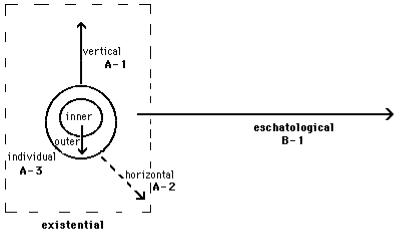
Ethics and morality pertain to persons in association. Person-thing and thing-thing relationships do not involve moral right or wrong. The diagram below organizes the dimensions of life in terms of personal factors. Life has two aspects that we have labeled the “existential” and the “eschatological.” The existential refers to the experience of “existence” including vertical relationships vertically with God (A-1), horizontally with other people (A-2), and internally between the inner and outer man–spirit and flesh (A-3). Eschatological refers to the forward movement of life from purposes to goals. The primary ethical principles correspond with the aspects of these two main dimensions of life.
I. A-1: The First Great Commandment
Loving God with all our being is the most primary ethical principle (Matthew 22:34-38; Mark 12:28-30; Luke 10:25-28a). Since love is principled behavior for the joy of others, it is more than a feeling; it is a pattern of behavior characterized by self-giving for the glory of God. If we love him, we do what he says (John 14:23, 15) and will not feel “put upon” (1 John 5:3). Love is an act because it can be commanded; it is a pattern of action that is outwardly directed for the joy of others.
II. A-2: The Golden Rule/The Second Great Commandment
The Golden Rule governs relationships between people (Matthew 7:12): treating other people the way we want to be treated. Treating other people the way we want to be treated restates the Second Great Commandment that we should love our neighbor as we love ourselves (Matthew 22:39-40; Mark 10:31; Luke 10:29b-37; Romans 13:8-10; Galatians 5:13-14). It gives a “rule-of-thumb” basis for deciding how one person ought to act toward another one, and it does so in a positive as well as negative sense. Again, love is an action because it commanded; besides, it is a pattern of action that is outwardly directed for the joy of others.
(a) Morality is more than not doing what we would not want done to us; (b) it is also doing what is to someone else’s benefit. Furthermore, (c) it is a matter of doing what we would prefer to have done to us even though not doing it would not be sin, even though it would not be necessary, or even though it would not otherwise make life intolerable (note “seemly” in 1 Corinthians 13:5).
Furthermore, (d) the Golden Rule takes into account the way they want to be treated. It takes into account the differences between people. So it is not just a matter of treating other people the way we want to be treated; it is a matter of treating them the way we would want to be treated if we were in their shoes. That ends up meaning we treat them the way they want to be treated. That broad principle in the Golden Rule/Second Great Commandment is limited, of course, by the First Great Commandment, by our own integrity as persons, and by their responsibilities as persons. Treating other people the way they want to be treated is limited by their own need to love God and respect us. Love is mutual respect.
III. A-3: The superiority of spirit over flesh
Asserting the priority of spirit over flesh governs activity within the individual person. In 1 Corinthians 6:12 Paul says he will not be brought under the power of anything. The principle he enunciates takes care of why it is wrong to do private practices that cause addictions and psychological compulsions (“hangups”). Consequently, he goes beyond the notion of “victimless crimes,” acts that supposedly do not impact anyone but the doer himself. Something is wrong if it puts physical drives in ultimate position. Immorality does not apply just to those behaviors that can be measured quantitatively relative to physical consequences; it applies also to what brings psychological difficulties.
As a principle for use of our bodies, asserting the supremacy of spirit over flesh differs from arguing that we should do what is physically most healthful because our body is the Spirit’s temple (1 Corinthians 6:19). Sometimes what harms the body may take second place to interpersonal considerations implicit in A-1, A-2, and B-1. For example, certain foods are less healthful for the body than others; yet Jesus did cleanse all meats (Mark 7:19), which means at least that dietary laws no longer belong to religious concern; that is, they are not Christian ethical considerations. “Cleansing all meats” does not change the scientific fact that some foods are less healthful particularly for some people. We infer that the body as the temple of the Spirit does not form the ultimate basis for arguing the moral need to eat what research shows is most healthful and to avoid eating what can cause heart conditions, cancer, high cholesterol, etc. Paul’s positive approach to ethics within the individual centers around addictiveness, which breaches the principle of prioritizing spirit over flesh. Perhaps his real point is that the body is the residence of the spirit (not Holy Spirit); so we must not use the body in a way that puts the spirit under the body.
The one-to-many splice. Ethics not only addresses individual and social behavior; it describes the boundary between individual freedom and social responsibility. Individual freedom ends where other individuals’ freedom begins. Most “victimless crimes” do not affect just the ones who do them, because people’s lives are intertwined in such a way that the behavior of one eventually impacting others. Similarly, private acts between “consenting adults” are matters of morality because the repercussions of private acts can end up costing society money, effort, and time. They can also depersonalize the other consenting adult and may prioritize flesh over spirit.
Our individual actions must leave us able to be responsible for ourselves. What we do is immoral if it makes us unable to function appropriately in relationships and purposes (relate to B-1).
IV. B-1: Right and wrong are measured relative to purpose.
Right and wrong, good and bad are measured relative to purpose. In behavior the ultimate issue is not whether something is legal under a temporal or divine standard, but whether it is effective. Abiding principles applicable in all cases are relative to the standing purposes of God and mankind. Obviously, since we are dependent beings, we cannot define our own ultimate purpose. The purpose measurement for ethics is first God’s purpose, within which our self-chosen, secondary purposes are to be worked out; in that framework God allows us considerable freedom.
Right and wrong focus on motives and attitude more than on sheer acts alone. The same act can be good or bad depending on why we do it and depending on our attitude toward other people when we do it. A normally good act becomes evil if done out of selfish motives or with a depersonalizing attitude. In interpersonal activity, intentionality counts for something important.
Morality includes not only what is or is not wrong, but what is wise. Wisdom brings in practical considerations. Some things may not break any of God’s abiding principles of behavior strictly speaking, but it is normally not wise for people to put themselves in certain situations. What is possible is not necessarily smart for the persons themselves because he may not be as strong as he thinks he is. Standing outside the force field of certain situations, he may suppose that he can handle more than he can. Not only does wisdom deal with the doer himself (which applies also in the “one-many splice” under A-3); it deals with practical effects on other people. It addresses what other people prefer, what other people may easily misread about our motives, what other people may be led into doing on the basis of their misreading. So, not only is there commandment; there is advice. And where there is neither commandment nor advice, love and expediency must reign.
The existential-eschatological splice. As there is a point of contact in the existential aspect between individuals and their group, so also there is a point of contact between the existential and the eschatological. Right and wrong are measured relative to purpose as qualified by love. Latitude and longitude (the existential and the eschatological) combine in ethical choices. Ethics prioritizes purpose over pleasure–spiritual over material–because purposes are chosen relative to values not rooted in material considerations, but in interpersonal ones (love). Spiritual and interpersonal are closely related if not identified.
Consistency provides a summarizing moral principle for consistency between behavior and the nature of the situation, between behavior and purpose, and between behavior and promise. Consistency for God is between his nature and purposes and between his promises and behavior. Consistency for us is between our behavior and God’s values and purposes for us. Appropriateness and consistency involve restricted freedom rather than positive determinism. There is freedom within a framework; we are free to act in ways that fit the circumstances. Consistency does not generate the specific acts, but limits what acts we may choose. In the context of consistency, love and expediency provide the positive factors that generate specific acts in vertical and horizontal relationships between persons. Love is holistic because it combines feelings and principles and unites self and others. There needs to be a consistency in love as principled caring.
Summary
Righteousness deals with personal-interpersonal considerations. It addresses what is directly interpersonal, what is intrapersonal, and what grows out of interpersonal (purpose). Righteousness involves internal attitude (motives) as well as external behavior (actions). Righteousness is both horizontal (love for people) and vertical (love for God). It means doing what we can to improve the quality of relationship (positive), not just to keep it from getting worse (neutral and negative). Righteousness relates to purpose because persons purpose; they do so by making choices relative to values and goals more than drives. Righteousness is interpersonal, not just legal; it involves more than a conceptual standard. Righteousness is relational, not just natural; it involves more than what is best for the body—our bodies may get crucified because of our choices. Righteousness is consistent with the existence of other persons and the future; it is not just an emotional feeling, a physical drive, or an intuitive impulse.
Righteousness is behavior consistent with the interpersonal situation; it is principled love. It is made possible by the interpersonal capacity created into us when God made us in his image.
christir.org