
The Image and the Body
THE IMAGE AND THE BODY
Virgil Warren, PhD
Including the Body in the Image
In this chapter we address more deliberately the issue noted before. A long-standing debate about the image concerns whether to include the body in it. There are three ways to relate the image and the body. The body might be (a) part of the image, (b) involved with the image, or (c) analogous to the image. Several considerations go into deciding whether the body is in, with, or like the image.
The main reason for including the body is (a) for wholeness. Earlier we objected to identifying the image with the rational capacity because it is reductionist by placing the image lower than the individual person. Identifying the image with the non-physical part of us would also be reductionist and would create a dualism between image and non-image factors in man. Historically, dualism has tended, not just to distinguish, but to divide body from spirit and to depreciate this corruptible aspect of us that does not correspond with God the spirit (John 4:24; cp. 2 Corinthians 3:17, etc.). Greek dualism either considered material things less desirable than the ideal things of which they are but poor imitations (Platonic dualism), or made matter evil and spirit good (Gnostic dualism). So, if we opt for dualism in us relative to the imago dei, we need to do so in a way that avoided such weaknesses.
A second reason for including the body in the image is that (b) the Genesis text does not say God’s image is in us but that we are in his image. Saying that his image is in us could imply that it constitutes less than the whole of what we now are. The wording seems to indicate that in our earthly condition—in our creatureliness, physicality, individuality, corporateness, and even sexuality—we are in the image of God, yet without making God himself a physical or sexual being.
Thirdly, (c) the image-likeness terminology applied to God and Adam is likewise applied to Adam and Seth (Genesis 5:1-3; cp. 1:26-27),1 so physicality can be included in these words if context warrants. The words are used then in connection with both divine creativity and human procreativity. The degree of likeness between Adam and Seth was greater than that between God and Adam since God does not have a physical component. The issue is not the expression used but the referent intended. What “image and likeness” means depends on the subject.2
Reasons Against Including the Body in the Image
Against including the body in the image is (a) the fact that God does not have a physical body. Much of the biblical objection to idolatry stems from its making God into the likeness of corruptible things (Romans 1:23). Idols do more harm than good in worship. While they might help focus the mind, what they focus the mind on is not what God is like. God is not immobile, inactive, insensible, speechless, destructible wood, stone, etc.
Another factor looks away from including the body in the image. We take it that (b) we do not lose part of the image when we die. We do not cease to be mankind when we lose the physical body. Consequently, the corruptible aspect of man relates to the image differently than does the spirit that returns to the God who gave it (Ecclesiastes 12:7).
Resolving the Dilemma
The question about body and image poses a dilemma between affirming our wholeness, on the one hand, and reducing God to a flesh-and-blood being, on the other. To avoid making God in our image, we feel forced to affirm dualism in us and deny that the body is part of the image. Only part of us corresponds with (part of) God. Our physical component lies outside the set of shared characteristics, and God surely has other characteristics than the ones he shares with us. The “overlap” is the image.
But we ask whether we are forced into this dilemma. In controversial matters, it is best to see what the essential aspects of the issue are, to handle these correctly, and then to see whether we can solve the larger question. The essential issues here are retaining a positive attitude toward physicality, affirming the wholeness of humankind, and avoiding a flesh-and-blood God with sexuality and the like.
First, we can distinguish dualism and division. Two different kinds of things can nevertheless relate harmoniously. Different does not have to mean separate or divided. “Dualism” is not bad as long as the two aspects relate positively; so the real concern is not dualism but holism. The body’s being or not being part of the image presents no difficulty if the body is not depreciated by leaving it out of the image or God degraded by putting it in.
Second, we must distinguish ontic and operational dualism, two “beings” and two behaviors, two kinds of parts and their working in parallel or in competition. We could say that for now, man in his wholeness is comprised of at least two different types of “stuff”–corruptible and incorruptible, what dies and what does not.3 In that respect, duality would exist, which is okay since the two aspects combine functions harmoniously. Two “substances” can work together.
It seems to us, however, that if the imago dei is interpersonal capacity, we do not have to eliminate or include the body as part of the image. Instead, we see a kind of capacity that the body expresses, and a kind of behavior that could be expressed otherwise but for now is expressed through a physical medium. If the physical body relates to the image in other than negative or neutral fashion, we can affirm our wholeness as well as our being in the image of a spiritual God. For one thing, even though each person is a whole, we may say that (1) some components are more essential than others. As the heart is more essential than the feet, so the incorruptible is more essential than the body: we can lose the body without ceasing to be human, and we can be given a new one without becoming another “species.” Physicality is a non-essential variant within a larger whole. Under this picture the body would be involved with the image but not included in it.
“Not essential” yet “involved in” avoids dualism by affirming degrees of essentialness within the whole. Interpersonal capacity can operate in different mediums. We say then that the image as interpersonal capacity resolves the issue about whether the body is part of the image. It does so because interpersonal capacity can operate within or without physicality. Indeed, it can function within any ontic medium and, as far as we know, without any medium at all. As long as any particular medium is part of the whole that a person is, it is functionally part of the image in us since it is part of our identity.
Whether we feel a need to include in the image depends on what the image is and what dualism indicates. We have identified the image with the cluster of characteristics—however rooted or caused—that constitute interpersonal capacity. That capacity is the constant that pervades all examples of persons human, divine, angelic, or otherwise. Distinctives between and within orders of persons become non-essential variants that produce “modes” of personhood—like sexuality does. Such non-essentials are nevertheless integral, harmoniously interanimating parts of the whole that each person is. The image is the capacity for personhood as distinguished from the operation of that capacity. It is nature rather than ethics. If the body is not part of the image, it is still part of the whole that each of us is functionally and psychologically.
Besides distinguishing degrees of essentialness in the parts of the whole, we can observe that (2) non-essential variants are subsumed under the image in harmonious interaction. They are not functionally or psychologically parallel to the image or negatively contrary to it. As even the non-essential members of the body are under the control of the “head,” so also the physical body is under the direction of interpersonal capacity. That capacity is now grounded somehow in the physical nature. The interpersonal God who created us will create a new body for the image to operate in—something Paul calls a “spiritual body” (1 Corinthians 15:44ff.).4 This understanding of human personhood means that we do not have to “hang onto” the body for fear of losing identity, because the inner self is “the true me”; nor do we have to depreciate the body as if it were a hindrance to “the true me.” However, we do have to transcend the body with “the true me.” The image as interpersonal capacity means we do not have to include or eliminate the body as part of who “I” sense myself to be. If we include it, we regard it as a functional variant; if we eliminate it, we regard it as functionally expressive of the image.
Although we may not have to include the body in the image, frankly it seems more natural to do so. We already observed that (a) including the body more easily guarantees our wholeness and that (b) the Genesis text says we are in the image of God, not that the image of God is in us. Moreover, 1 Corinthians 15 and other texts speak of (c) the destiny of the whole person by including resurrection of the body along with “rest” of us. Although we have cautioned against making Christ’s experience an exact prefigure of our own, we do see at least an analogy there. His death-resurrection-ascension includes the body at all points. Second, Adam was a spiritual, heavenly, life-giving spirit; but while he was these things, the transformed body was part of him. He was what presumably we all are, are to be, and will be. We do not mean to include the body in the image in a way that implies that the Son now has a fleshly nature. We mean only that the body can be included in the image because it can be included under interpersonal character.
A fourth observation is terminological and operational: (d) when we say something is “like” something else, we have the whole entity in view including unshared characteristics. “Likeness” indicates that there are shared and unshared characteristics; otherwise, the two things would be “same,” not similar. In this fashion if we are in the image and likeness of God, we and God have shared and unshared characteristics. So our likeness to him indicates first that the unshared characteristics are also in view and they are designed to operate under the framework of the shared characteristic, the higher nature, the interpersonal capacity. The shared characteristic is the larger category that contains the unshared characteristic. Unshared does not mean irrelevant; the body is integral to us and therefore integral to what comes under “the lordship of the interpersonal capacity.” Unshared characteristics are not just ideally, but in fact, under the interpersonal capacity since we cannot function “un-interpersonally.” There are degrees to which we do not conform our bodily behavior to ideal interpersonal living, but even in sinning we use the interpersonal capacity to some degree. Our body is part of our personhood, our interpersonal operating. Interpersonal capacity is not just in us; we have interpersonal capacity. Genesis does not say that we are like God in some named respect as would be implied by the statement, “He is smart just like his dad.” Instead, mankind is said to be in God’s likeness and image.
The likeness between man and God differs from the likeness between, say, the kingdom of heaven and a mustard seed. This second kind of “likeness” involves items from different categories that have some formal characteristics which enable the one to picture the other in some respects. We are not dealing with previously existing items that have undesigned similarities. God created us for the express purpose of having what was like him: the summarizing statement about us is that he created us in his image.
Whatever the substantive “bases,” or “causes,” of the capacity for divine likeness, the cluster of abilities that comprise our imago dei are expressed in and through the physical body or they would not have real existence at all. Functionally there does not have to be—and “should” not be—a dichotomy in us (cp. 1 Corinthians 12:24-25). No part ought to be thought of aside from the whole. Theologically, we are a whole and as a whole stand in God’s image by creation (capacity) and function in his image by (inter)personal behavior.5 The use of the body is bounded by the features of social interaction, even though bodily behavior may “transgress” those boundaries. Christianity is not so much concerned with substance questions themselves (ontic category) as with active and relational ones. Substance issues are relevant but only insofar as our theories about them do or do not fit with the expected behaviors. When scripture speaks of our being created in the image, its ultimate concern is theological/functional/relational more than ontic/hypostatic/ substantive. The image has to include the ontic since it is creatable; but the image as “capacity” is capacity for operation, and the operating makes potential into real. So the created body serves now as part of the interpersonal capacity—part of the image.
As the secular comes under the sacred and the material comes under the spiritual, so also the body comes under the image. In our earthly state, we can function and relate socially. Some things are not necessarily sacred in and of themselves; but when they are brought under the qualifying influence of the sacred, they cease to be purely secular, and the sacred-secular dichotomy disappears. Some things are not necessarily material in and of themselves; but when they are brought under the qualifying influence of the spiritual, they cease to be purely material, and the spiritual-material dichotomy disappears. Likewise, the physical body is not necessarily interpersonal in and of itself; but since it is brought under the qualifying influence of the interpersonal, it ceases to be purely a physical body, and the physical-interpersonal dichotomy disappears. The body “becomes” an interpersonal medium and instrument. For all we know, there may be two kinds of “substances” in us, but they are not parallel categories; the one fits within the other. Therefore, our body is part of the image of God.
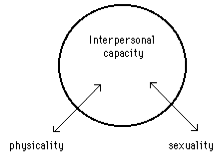
The accompanying diagram shows how non-essential variants relate to the image. Items like physical body and sexual difference can move into and out of the image without altering what interpersonal capacity is and without changing what physicality or sexuality is. The model shows how the image relates to death, resurrection, the new “spiritual” body, incarnation. It is not so much a matter of adding them to the image, but of adding them into the image. They become additional factors in and through which interpersonal capacity expresses itself as long as they are under the control of that capacity.
We can mention here a matter of consistency. If the body is in the image, is sexuality part of the image? Apparently, we should include it, but we hasten to add that doing so no more implies that God has sexuality than including the body implies that he has physicality. The decisive point lies in the kind of thing the image is. Other identifications of image may not be able to include the body, and that fact in itself confirms our understanding of the image. If interpersonalism is the definitive constant between us and God, then everything we or God is stands as part of each one’s interpersonalness even though they do not have all the same aspects or even the shared ones in the same degree. The character of something is determined by the character of the category in which it operates. As everything done in the category of faith has the character of faith, so also everything standing inside the image has the character of the image. When physicality, sexuality, and marriage are kept in the interpersonal category, they have an interpersonal character and belong under the image.
Up to this point we have been discussing whether the body is part of the image vs. included with the image. A third option might be to consider the body analogous to the image as a functional equivalent. The possibilities for analogy depend on the ontic nature of God, which is something we do not know or can know. Not even revelation about God’s substantive nature could help very much because language can communicate only what humans experience. Such is the case because experience supplies the basis for the meaning of words.6 But we cannot experience God in his own nature;7 that is the reason he has “manifested” himself to us. For resurrected people Paul speaks of a “spiritual body,” but we have no way of knowing what he means by “spiritual body,” whether a spiritual body is what angels have, or whether they even have such a “body.” Even more is this a moot issue in the case of God, who alone is independent, immortal being (1 Timothy 6:16; cp. Exodus 3:14, etc.). Hebrews 1:3 does say that the Son is the very image of God’s “substance” (hypostasis; cp. 2 Corinthians 4:4; Philippians 2:6; Colossians 1:15), but that description stands in a list with “having made purification for sin”; so we wonder whether “image of [God’s] substance” is describing the Son during the incarnate state since that is where he accomplished his atonement for us. So nothing can be concluded from Hebrews 1 about the kind of “hypostatic” nature deity has aside from an incarnate state.8 Linguistically speaking, “substance” may here be an ontic term for behavioral character.
We discuss the nature of deity here because the human body may conceivably have formal likenesses to divine substance if deity has substance. Upright gait, bipedal motion, opposable thumb, longer life, rational capacity, self-transcendent potential, etc., illustrate our relative dignity and freedom above the rest of the organic creation. The interdependency and diversity of bodily organs might reflect the complexity of personal interdependency and the diversity within the godhead. Woman’s being created from man and children’s coming from parents might correlate with the Father’s sending the Son who sends the Spirit; creation and procreation would resemble commission and procession.9 Obviously, these are loose comparisons, and we question their value since plants and animals also have these characteristics in some degree. The parallels with divine nature could not be very specific because bodily components are mainly features of physical necessity.
In summation, functionally and theologically the body does not parallel the image if the body is contextualized by the image, analogous to the image, indirectly included in the image, or if the body is considered a functional equivalent of the image, a non-essential basis for the image, a medium of being the image, or an instrument of expressing the image. Other definitions of the image may not so naturally be able to include the body; but if we define the image as interpersonal capacity, we see no difficulty in considering the body as taking part in the image and therefore prefer so to regard the body. Its ability to include the physical body and even sexuality again confirms the view that interpersonal capacity is the primary meaning of the image of God.
Endnotes
1Reminiscent of the “image” and “likeness” terminology of Genesis 1:26-27 + 5:1-3 is the “son of” terminology in Luke’s genealogy of Jesus. The physical descent is marked by the formula x, son of x all the way back to Adam, who in turn is said to be “(son) of God” (3:38). Obviously, language can exhibit some shift in meaning as required by the nature of the subject even if examples of terminology fall in the same context. With some degree of approval, Paul could say with Epimenides and Aratus that people are the “offspring of” God (Acts 17:28; Phainomena, line 5; cp. Cleanthes’ Hymn to Zeus, line 4 ).
2In our understanding of terms, we have been assuming that image and likeness in Genesis 1:26; 5:2-3 are practical synonyms rather than technical distinctions.
3For further discussion of the bipartite-tripartite nature of man, see elsewhere on this website.
41 Corinthians 15:44ff. In the subsequent context, Paul talks about the transformation of those living at Christ’s coming (15:51-54) and says that “flesh and blood cannot inherit the kingdom of God” (15:50). “Kingdom of God” here must refer to a future reality beyond the church age since the apostle is speaking of things yet to come (see also 6:9; Galatians 5:21; Ephesians 5:5; cp. Acts 20:32). “Flesh and blood” can be an expression simply for mankind in contrast to God (Matthew 15:17; Galatians 1:16), but it probably has a more literal significance in 15:50 (cp. John 1:13; 6:54-56; 1 Corinthians 11:27; Ephesians 6:12; Hebrews 2;14 as well as Luke 24:39).
5We are speaking here of personal and interpersonal behavior as such in contrast to non-interpersonal operations like chemical reactions, electromagnetic processes, or plant and animal actions. That is different from saying that we always behave personally and interpersonally as we ought. Among other things, sinning is living contrary to interpersonal nature; but even in our failures at living interpersonally, we are usually misusing that capacity rather than not using it. We use an interpersonal capacity in a dysfunctionally interpersonal way. For example, when one person curses another, he negatively uses the interpersonal capacity of communication. Sin itself is not even a possibility except in terms of the interpersonal capacity. When by behavior we misuse the image, we have forgiveness (an interpersonal act) by identification with the Christ who fully bore out the potential for that image (ideal realization of interpersonal capacity).
6In dealing with what is beyond human experience and understanding, communicators have to resort to analogy, negation, and pragmatics. Analogy makes a comparison to what the hearer does know, and negation tells him what something is not or is not like. Pragmatics by-passes the mysterious and indicates what must be done in order to achieve the practical results needed.
7No one has ever seen God (Exodus 33:20; John 1:18; 6:46; Colossians 1:15; 1 Timothy 1:17; 6:16; Hebrews 11:27; 1 Peter 1:8; John 4:12, 20; cp. 3:2). Even angels, who are spirits, manifest themselves to human beings. Samson did not realize the Lord had left him (Judges 16:20), which implies that God is imperceptible, or presumably Samson could have told the difference.
8We may even wonder how strictly to take the Hebrews statement so as to infer that God even has hypostatic existence. Language can use ontic/hypostatic/substantive terms for functional and relational realities (cp. 2 Peter 1:4, “you might become partakers of the divine nature”). Though we do not argue for it particularly, it is conceivable that “image of his substance” indicates the deific power and rank, or more exactly “authority,” of the Son vs. angels. The Christological controversies of the fourth century assumed that existence has to be hypostatic or has to have a hypostatic/substantive base; in other words, existence has to act and relate on the basis of, and through, “stuff”; otherwise, Athanasius, Arius, Eusebius, etc., would not have been arguing whether the Son was homoousia (“same” kind of being) or homoiousia (“similar” kind of being). We cannot deal with such issues satisfactorily because our understanding is limited to possibilities in our incomplete human awareness, which we too easily consider complete.
9For that matter, procreation might resemble emanation, which was used in the ancient church as one conceptualization for trinity—particularly by Origen. The Father relates to the Son as the sun relates to a ray of its light, and the Son relates to the Spirit in the same way.
christir.org